What Is an Apprenticeship Intermediary?
The critical role that intermediary organizations play in building and expanding apprenticeship programs has emerged as federal and state policymakers seek to expand apprenticeship beyond the traditional trades in which it has long operated. Intermediaries in the building trades, often referred to as Joint Apprenticeship Training Councils (JATC), have been instrumental to their success, but they do not exist in other parts of our postsecondary education system.1 Indeed, the term intermediary was borrowed from the public workforce system, where “workforce intermediaries” have a long history of facilitating connections between public and private services and workers. Unlike Registered Apprenticeship, which is well defined and regulated by the U.S. Department of Labor (DOL), there is no definition of an “apprenticeship intermediary” in federal statute.
Intermediary in the apprenticeship context can be used to refer to a variety of distinct entities. The term is sometimes used to refer to sector-focused national or multi-state groups such as the DOL’s Industry Intermediaries, which first received federal funding in 2016, or to organizations working at the state and regional level, often across multiple industry sectors. In addition to community colleges and college systems, other organizations, including industry associations, community-based organizations, workforce boards, and labor management partnerships, can be referred to as and serve as state or regional apprenticeship intermediaries.
To create a more clear definition of what it means to be an apprenticeship intermediary, New America convened an advisory committee of policy and practitioner experts with knowledge of both apprenticeship and community colleges. The advisory committee’s work was grounded in members’ experiences and research into the field of apprenticeship intermediaries.
According to the federal government, “An apprenticeship intermediary helps to build, launch, and run apprenticeship programs in collaboration with other apprenticeship partners. Just as many organizations may participate in apprenticeship partnerships—including employers, and often also labor organizations, secondary and postsecondary institutions, community-based organizations (CBOs), and industry organizations or associations—an equally wide array of organizations may perform intermediary functions.”2
To further understand the role of an apprenticeship intermediary, it is useful to define the types of functions and duties that apprenticeship intermediaries perform. These include some functions that an employer would take on if it were to sponsor and run a program on its own. As is broken down in the table below (Figure 1), intermediaries commonly serve in the areas of program development and delivery; stakeholder engagement; monitoring, evaluation, and support services; and strategy and field building.
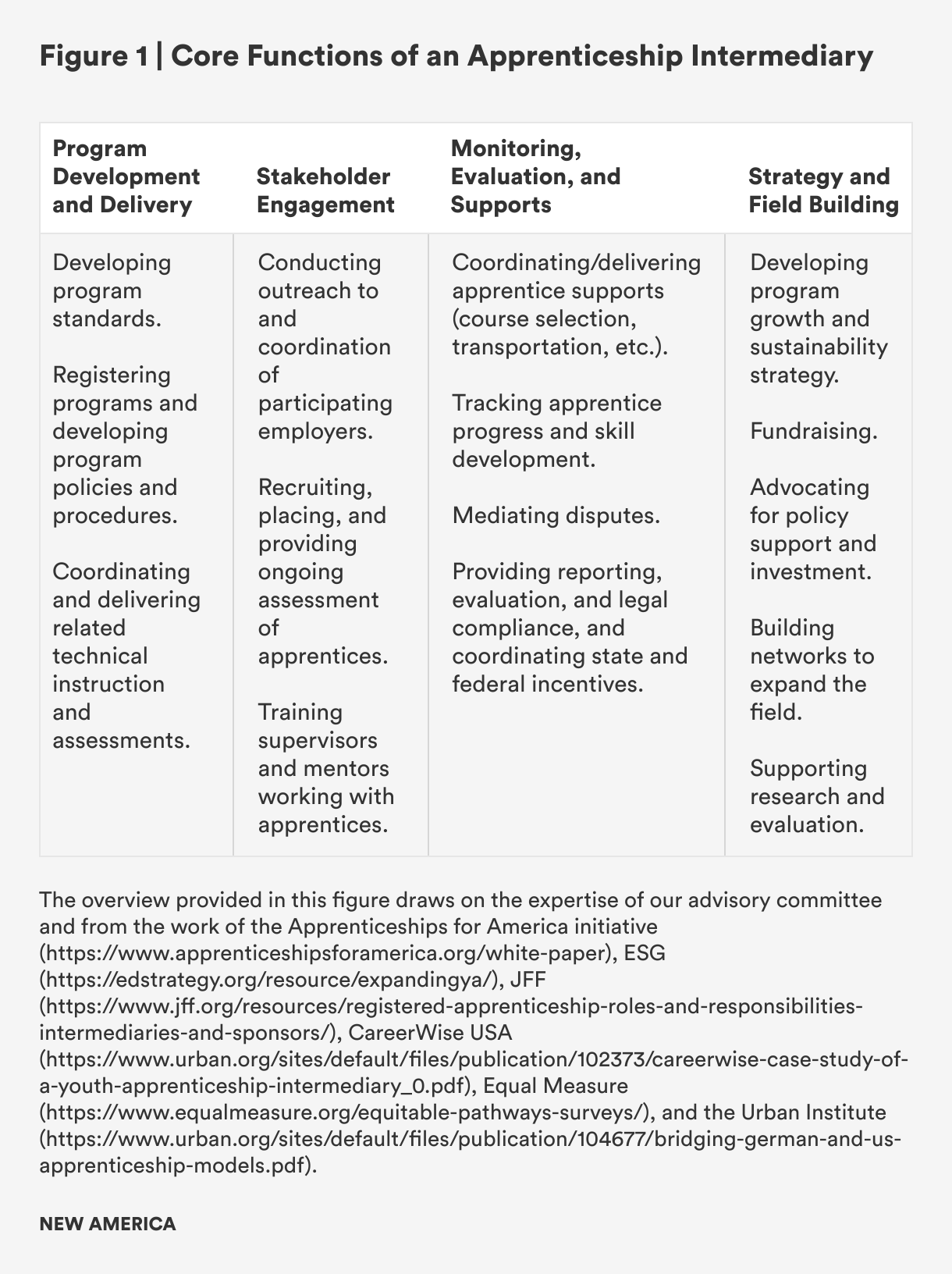
The number of functions intermediaries take on to support their apprentices and employer partners can vary significantly. The list above represents some common “core” functions that colleges often provide, but it is by no means an exhaustive list of all of the roles an institution can play as an intermediary. The colleges highlighted in this report all have different approaches to the intermediary role, but by building and leveraging strong relationships with external stakeholders and maintaining flexibility, each one has established successful apprenticeship programs that serve the needs of their students and the workforce.

Citations
- For more information on the Joint Apprenticeship Training Councils see North America’s Building Trades’ Unions Training Capacity Talking Points, https://nabtu.org/wp-content/uploads/2017/03/Building-Trades-Training-Capacity-Talking-Points-11-23-16.pdf.
- See ApprenticeshipUSA (website), U.S. Department of Labor, "Join an Existing Program," https://www.apprenticeship.gov/employers/registered-apprenticeship-program/build/join.