
Community Colleges and Apprenticeship_The Promise the Challenge
Abstract
To better understand the challenges and opportunities facing community colleges that want to expand apprenticeship opportunities to their students, New America conducted a year-long study. We created an advisory committee to guide this work and spoke to apprenticeship, workforce development, and community college leaders about the community colleges role in expanding apprenticeship.
Based on these conversations, we chose case studies and conducted in-depth interviews with leaders from the Community College System of New Hampshire’s ApprenticeshipNH, Arapahoe in Colorado, San Jacinto in Texas, and Howard Community College in Maryland’s programs in IT and cybersecurity, and Coastal Alabama Community College’s nursing apprenticeship. Each of these colleges found a different way to fill the role of intermediary, taking on funding from different sources, using a mix of strategies for sponsorship, and finding place-based approaches to strengthening workforce partnerships. In a variety of sectors, these five colleges found ways to fill the intermediary role that worked for their context, and in doing so provided excellent programming that filled their community’s needs. This mosaic of case studies demonstrates that there are some common challenges and successful strategies that colleges looking to serve as apprenticeship intermediaries can learn from.
Acknowledgments
We would like to thank Ascendium Education Group and especially Maryann Rainey and Carolynn Lee for graciously supporting this project. Our gratitude also goes to Taylor White, Sarah Oldmixon, and Mary Alice McCarthy for guidance and feedback on this brief and project. We thank Katie Portnoy, Mandy Dean, and Sabrina Detlef for editing and communications support.
Finally, this work would have not been possible without invaluable input from and collaboration with our advisory committee: Amy Mackenroth, Senior Managing Director for Workforce Development, Dallas College; Patrick J. Enright, Senior Vice President for Academic Affairs and Workforce Development, County College of Morris; Tiffany Miller Dean of Apprenticeships, West Los Angeles College; Daniel Bustillo, 1199 SEIU; Shanell Brumfield, Project Manager, ECEPTS; Amy Firestone Vice President, Apprenticeship Carolina, South Carolina Technical College System; Daniel Kuehn, Principal Research Associate, Urban Institute; and Ryan Craig, Managing Director, Achieve Partners.
Downloads
Introduction
Matthew Dempsey knew it was time for a change. Originally from the border of Alabama and Mississippi, he had been pursuing his passion for helping others through the ministry, completing a bachelor’s degree in theology and enrolling in a master's degree program in seminary divinity in Knoxville, Tennessee. But he was struggling to make ends meet and support his growing family. When he and his wife decided to move back home, he used the move to also seek out a new vocation. Nursing was an obvious choice. He had always been interested in the medical field, there was high demand and good pay for nurses, plus he would be caring for people.
But becoming a nurse meant returning to college, which takes time and money, both of which were in short supply for Dempsey. Indeed, for many adult students, the need to make a living while in school is the greatest barrier to completing their degree. The more time students spend working, the less time they have to devote to their studies.
Coastal Alabama Community College (CACC), where Dempsey enrolled in a nursing program, has developed an innovative solution to this common challenge facing its students: an apprenticeship program. In contrast to a traditional nursing program, CACC’s student-apprentices are able to combine work and learning seamlessly, earning both wages and credit for structured on-the-job training (OJT) in a health care setting that is relevant to their future career.
“It's almost too good to be true, except that it's not,” he said, describing the program.
Dempsey became an apprentice at North Baldwin Infirmary at the beginning of his second semester, and he works 24 hours a week. His job includes the clinical rotations that are necessary for him to complete his nursing degree, as well as valuable OJT. “Before I got this apprenticeship,” he said, “I didn't know how I was gonna pay for school.” With the apprenticeship, not only is he paid while completing his clinicals, but his tuition and books are covered too. In exchange, Dempsey agreed to work at North Baldwin for two years after he graduates, which he felt was fair.
And it’s not just the financial support that Dempsey finds so valuable. The apprenticeship also gives him access to a mentor in the hospital who helps him master skills he has learned in the classroom. “Just the wealth of experience it has given me,” he explained, “it's really difficult to put into words how incredibly valuable and how helpful that experience has been.” With typical rotations, he would have to wait until later in his education and take turns practicing skills with up to five other nursing students—and would not have been paid while completing them.
The apprenticeship program has had a huge impact on Dempsey and his family. “I'm incredibly grateful to North Baldwin Infirmary for giving me the opportunity, because it really did change my life,” he said. Dempsey’s experience encapsulates the promise of apprenticeship. It is a proven education and employment strategy that can address many of the financial and social challenges that prevent students from completing postsecondary education and transitioning into a good job. The result? The fabled win-win of apprenticeship programs: employers get well-trained employees and students get wages and on-the-job practice in their chosen field.
But these programs can be challenging to start and run effectively. To expand, apprenticeship needs intermediary organizations, which assess employers’ training needs and develop occupationally specific training packages to meet them. These intermediaries build and launch apprenticeship programs and coordinate activities across employers, education providers, and other apprenticeship partners. Many intermediaries also take the lead in apprentice recruitment, support, and post-program job placement.
Community colleges have long played a role in student career preparation and in providing work-based learning opportunities. Now they are increasingly stepping into this intermediary role, working more directly with employers and other regional partners to build and coordinate programs, while also providing coursework for apprentices. Community colleges can be well positioned to serve both employer partners and students. They are particularly well positioned to expand apprenticeship beyond the construction trades where they are most common, creating affordable and equitable pathways into careers in health care, information technology, business services, and other high-quality, high-demand jobs.
But developing and delivering apprenticeship programs requires robust relationships with employers, recruitment and support of apprentices, assessments for on-the-job learning, and mentorship training, roles that can be challenging for colleges. What it means to be an apprenticeship intermediary varies widely from one college to another, and while community colleges are well positioned to take on the role, they can hit barriers while trying to grow and sustain this capacity. Developing a cost model and determining who will bear which parts of the cost between employers, the college, and students; deciding if the program will be hosted on the credit or non-credit side of the institution; and finding alignment between employer needs and student interests are just a few issues that schools face when becoming apprenticeship intermediaries.
To better understand the challenges and opportunities facing community colleges that want to expand apprenticeship opportunities to their students, New America conducted a year-long study. We created an advisory committee to guide this work and spoke to apprenticeship, workforce development, and community college leaders about the community colleges role in expanding apprenticeship.
Based on these conversations, we chose case studies and conducted in-depth interviews with leaders from the Community College System of New Hampshire’s ApprenticeshipNH, Arapahoe in Colorado, San Jacinto in Texas, and Howard Community College in Maryland’s programs in IT and cybersecurity, and Coastal Alabama Community College’s nursing apprenticeship. Each of these colleges found a different way to fill the role of intermediary, taking on funding from different sources, using a mix of strategies for sponsorship, and finding place-based approaches to strengthening workforce partnerships. In a variety of sectors, these five colleges found ways to fill the intermediary role that worked for their context, and in doing so provided excellent programming that filled their community’s needs. This mosaic of case studies demonstrates that there are some common challenges and successful strategies that colleges looking to serve as apprenticeship intermediaries can learn from.
What Is an Apprenticeship Intermediary?
The critical role that intermediary organizations play in building and expanding apprenticeship programs has emerged as federal and state policymakers seek to expand apprenticeship beyond the traditional trades in which it has long operated. Intermediaries in the building trades, often referred to as Joint Apprenticeship Training Councils (JATC), have been instrumental to their success, but they do not exist in other parts of our postsecondary education system.1 Indeed, the term intermediary was borrowed from the public workforce system, where “workforce intermediaries” have a long history of facilitating connections between public and private services and workers. Unlike Registered Apprenticeship, which is well defined and regulated by the U.S. Department of Labor (DOL), there is no definition of an “apprenticeship intermediary” in federal statute.
Intermediary in the apprenticeship context can be used to refer to a variety of distinct entities. The term is sometimes used to refer to sector-focused national or multi-state groups such as the DOL’s Industry Intermediaries, which first received federal funding in 2016, or to organizations working at the state and regional level, often across multiple industry sectors. In addition to community colleges and college systems, other organizations, including industry associations, community-based organizations, workforce boards, and labor management partnerships, can be referred to as and serve as state or regional apprenticeship intermediaries.
To create a more clear definition of what it means to be an apprenticeship intermediary, New America convened an advisory committee of policy and practitioner experts with knowledge of both apprenticeship and community colleges. The advisory committee’s work was grounded in members’ experiences and research into the field of apprenticeship intermediaries.
According to the federal government, “An apprenticeship intermediary helps to build, launch, and run apprenticeship programs in collaboration with other apprenticeship partners. Just as many organizations may participate in apprenticeship partnerships—including employers, and often also labor organizations, secondary and postsecondary institutions, community-based organizations (CBOs), and industry organizations or associations—an equally wide array of organizations may perform intermediary functions.”2
To further understand the role of an apprenticeship intermediary, it is useful to define the types of functions and duties that apprenticeship intermediaries perform. These include some functions that an employer would take on if it were to sponsor and run a program on its own. As is broken down in the table below (Figure 1), intermediaries commonly serve in the areas of program development and delivery; stakeholder engagement; monitoring, evaluation, and support services; and strategy and field building.
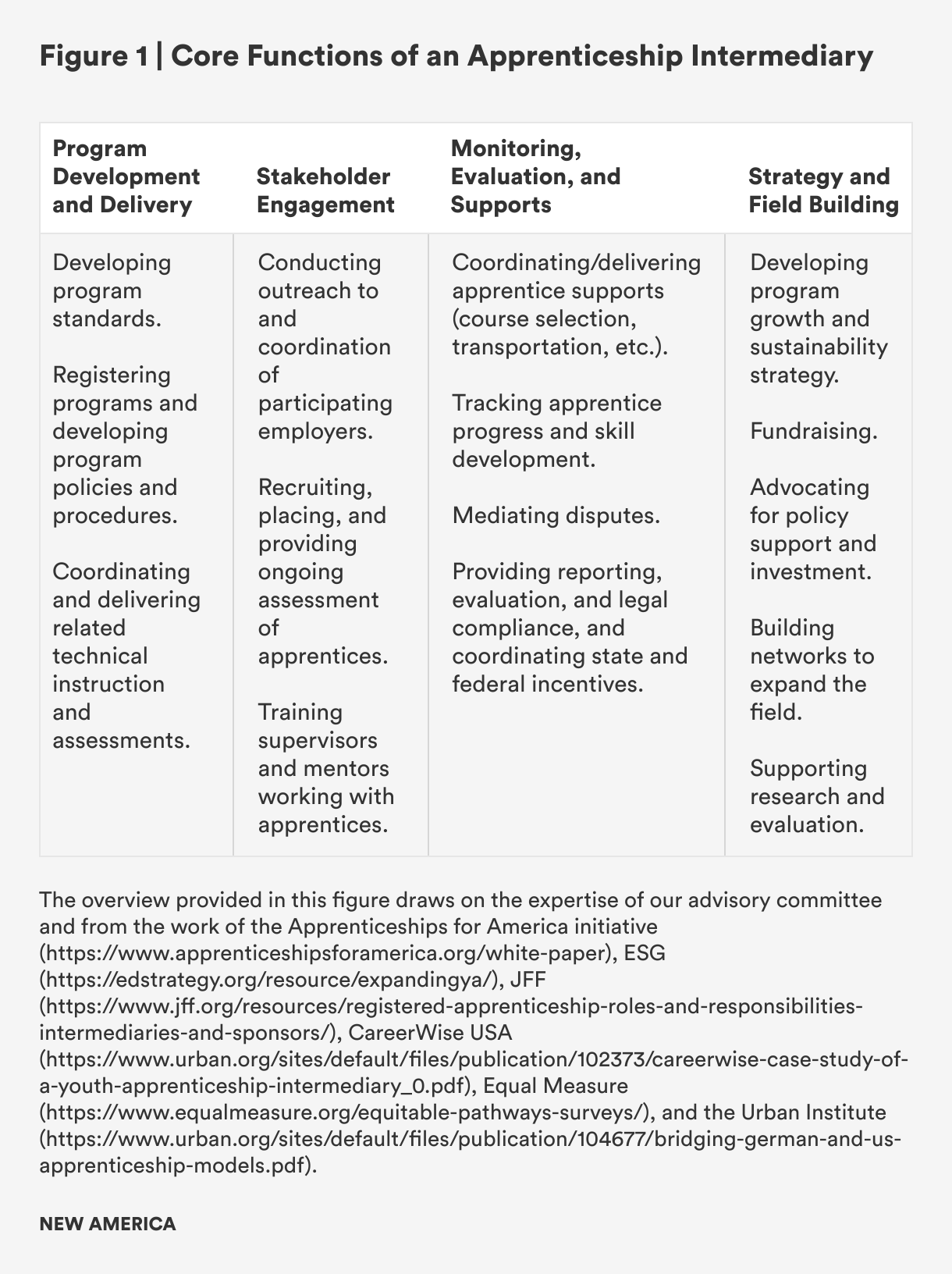
The number of functions intermediaries take on to support their apprentices and employer partners can vary significantly. The list above represents some common “core” functions that colleges often provide, but it is by no means an exhaustive list of all of the roles an institution can play as an intermediary. The colleges highlighted in this report all have different approaches to the intermediary role, but by building and leveraging strong relationships with external stakeholders and maintaining flexibility, each one has established successful apprenticeship programs that serve the needs of their students and the workforce.
Citations
- For more information on the Joint Apprenticeship Training Councils see North America’s Building Trades’ Unions Training Capacity Talking Points, https://nabtu.org/wp-content/uploads/2017/03/Building-Trades-Training-Capacity-Talking-Points-11-23-16.pdf.
- See ApprenticeshipUSA (website), U.S. Department of Labor, "Join an Existing Program," https://www.apprenticeship.gov/employers/registered-apprenticeship-program/build/join.
Apprenticeship Intermediary Initiative in New Hampshire
With an energetic team of about a dozen full-time staff, ApprenticeshipNH builds apprenticeship and pre-apprenticeship offerings in five broad industry sectors, including programs in health care, business, and hospitality as well as the more traditional skilled trades occupations of construction and automotive technology. ApprenticeshipNH staff members develop program standards, register the standards with the federal Office of Apprenticeship, and deliver related technical instruction (RTI), the classroom component of apprenticeships. They conduct outreach to prospective apprentices and apprentice employers. ApprenticeshipNH works with a wide spectrum of apprenticeship employers, from those who already have apprenticeship offerings to those that are completely new to the model. Staff also manage compliance and performance goals for the numerous federal grants that have provided ApprenticeshipNH with the majority of its financial support since its founding.
Program-focused intermediary functions such as standards development, program registration, and RTI provision are probably the easiest for colleges to adopt, as they build on colleges’ usual work of curriculum design and education. Standards development happens in partnership with local employers, using established industry advisory boards and templates developed by DOL’s Industry Intermediaries, where available. Though CCSNH colleges do not serve as the sponsor for most of the apprenticeship programs they support (leaving that role to employers, unions, or industry associations), all of their programs are registered with DOL or, in the case of their pre-apprenticeship offerings, are developed to articulate into Registered Apprenticeships.
With only a handful of exceptions—such as an apprenticeship for insurance associates, where classroom training is provided by an industry association—New Hampshire community colleges deliver apprentices’ RTI. This coursework is split between the college system’s credit-bearing classes and non-credit customized training, according to Anne Banks, CCSNH’s apprenticeship programs manager. “With the community college system,” she says, “we have great flexibility to build both types of coursework, or a combination of both.” It all comes down to the employer’s preference, as well as students’ interest in setting themselves up to earn degrees down the line.
A second big part of ApprenticeshipNH’s work as an intermediary involves engaging with prospective apprentices and employer partners. In addition to helping develop program standards, the team’s work on employer engagement has an even more crucial objective: securing paid work placements for prospective apprentices. To build its roster of employers, ApprenticeshipNH has adopted a model pioneered by Apprenticeship Carolina, an early statewide apprenticeship intermediary launched in 2007 that is also housed in the state community college system.3 Under this model, regional outreach coordinators assigned to different parts of the state reach out to local businesses with hiring needs aligned with available apprenticeship programs.
ApprenticeshipNH also advertises apprenticeship openings to local students and job seekers. Indeed, CCSNH’s students are a key value-add for New Hampshire employers as well as the central motivation for the system’s apprenticeship initiative. Faced with an aging population and a very low unemployment rate, New Hampshire businesses are keen to attract CCSNH’s students; the college system, for its part, is happy to connect its students to jobs where they can put their education to use. This is the fabled win-win-win of apprenticeship, for employers and apprentices, with another win added for the college. “It helps to improve the community college system, because we’re learning, and we’re engaging with employers,” says Banks. “We have advisory boards, but this is an active, mutually beneficial program where colleges and industry can sit down at the table together.”
Some colleges, including examples discussed later in this report, take a larger role in the apprentice placement process, assessing and pre-screening prospective apprentices. But although CCSNH offers mentorship training for participating businesses, apprentice screening is mostly left to employers. “We put the ownership on the program sponsor,” says Banks, “because they’re the ones hiring this person.”
New Federal Grants Bring Growth—and Growing Pains
The first federal apprenticeship grant that CCSNH received, $2.05 million from the State Apprenticeship Expansion (SAE) awards, launched ApprenticeshipNH in 2016.4 This award let ApprenticeshipNH establish its most fundamental functions of program design, employer engagement, and outreach to prospective apprentices.
In 2019, CCSNH received a $1.3 million top-up of Apprenticeship State Expansion (ASE) funding, plus $400,000 from the Expanding Community College Apprenticeships initiative administered for the Department of Labor by the American Association for Community Colleges, which allowed expansion into the biomedical and automotive industries.5 Another $3.4 million SAE grant in 2020 brought expansion into business services as well as a new focus on youth programs.6 The ApprenticeshipNH, which starts with a pre-apprenticeship, allows high schoolers to start a Registered Apprenticeship as early as 12th grade in hospitality, business, and health care, as well as skilled trades such as construction and automotive technology, which have sometimes lagged behind in youth work-based learning.7
The 2020 SAE grant also triggered a shift away from the project-focused mindset that prevailed before. “We had three separate teams, all trying to work in the same space,” says Banks. “When we got [the 2020 SAE grant] we had to make sure we were all working as one program for employers and stakeholders, and that we weren’t seen as separate entities.” This concern will resonate with anyone who’s had to administer multiple concurrent grants. In a small state like New Hampshire, with just under 1.4 million residents, the risk of fragmentation is even more acute.
Even through the COVID-19 pandemic, which dented demand from employers as well as apprentices, successive rounds of federal grants have allowed ApprenticeshipNH to expand while growing in sophistication. New employer partnerships and apprenticeship occupations are constantly in the works—including, most recently, a paraeducator pathway—helping CCSNH continue to grow its apprentice enrollments and registered employers to 1,167 and 63, respectively.
But as ApprenticeshipNH has added occupations and new overlapping grants, it has also accrued new monitoring and evaluation responsibilities. “The amount of information we have to report on is impossible to manage without a good system in place,” says Tracey Jackson, who leads work on the ASE grant. For an undertaking of ApprenticeshipNH’s size, she continues, “it can’t just be Excel spreadsheets and Word documents.” Banks and Jackson say that ApprentiScope, a new case management software implemented with ApprenticeshipNH’s most recent federal grant, will help with the administrative burden of tracking apprentices’ skill development and program hours.8
Additional monitoring and evaluation responsibilities are not even the biggest challenge to emerge from ApprenticeshipNH’s success, however. Each new federal grant brings a new enrollment target and CCSNH’s staff, as for other community colleges who have gotten into apprenticeship intermediary work, must ensure that program quality is not sacrificed for a larger head count. “Our numbers don’t reflect the amount of work we put into these systems,” says Banks. “The numbers keep me up at night, not the compliance.”
Emerging Intermediary Strategies
Jackson and Banks were clear-eyed about two of the most important priorities for supporting ApprenticeshipNH’s success: regular funding and deeper connections with other state workforce development stakeholders.
Apart from small charitable grants that help connect some apprentices to social services, ApprenticeshipNH is entirely funded by federal dollars. As in other communities where federal grants have helped stand up innovative apprenticeship intermediaries, the looming question is who will step in to fund these critical intermediary functions in the longer term. States play a critical role in funding successful apprenticeship systems, and some intermediaries support their operations with fees-for-service charged to participating employers.9 As it stands, ApprenticeshipNH faces an uncertain outlook in terms of new, more sustainable funding streams. But even though its staff members are not in a position to advocate for legislative updates, they have continued working to shore up ApprenticeshipNH’s intermediary processes and deepen its statewide connections to show the value of their work.
ApprenticeshipNH plans to use its most recent federal grant—$5.8 million awarded in June under the Apprenticeships Building America (ABA) grant program—to establish a stronger statewide infrastructure that can deliver consistent support for apprenticeships, pre-apprenticeships, and high school apprenticeship model.10 That means new shared branding as well as more centralized processes for grant administration. Further relationship building will be another key part of the ABA strategy. Although CCSNH’s intermediary role provides key competencies in program design, student recruitment, and strategic oversight, workforce boards have the ear of employers in a way that individual CCSNH colleges may not. And tighter connections with the state education and labor departments can help to harmonize apprenticeship offerings across the state, Banks and Jackson hope, while avoiding conflicting messaging.
Despite its early success, ApprenticeshipNH is still a work in progress. This is perhaps the most important lesson from ApprenticeshipNH’s experience: that community colleges and systems can excel as apprenticeship intermediaries, but that it will take time, investment, and lots of behind-the-scenes work. Banks and Jackson encourage aspiring community college intermediaries to conduct an inventory of existing work-based learning programs in their state or region. Teams working as intermediaries should connect prospective apprentice employers with relevant faculty as soon as possible: “That way the employer knows those classes, and they’ll be there whether ApprenticeshipNH is here or not,” says Banks.
Above all, the team should avoid biting off more than it can chew. “We can’t be everything to everybody, even though we want to,” Banks says. Navigating this role and knowing when to stop “biting” is sometimes easier said than done, particularly in fields that aren’t considered traditional in the apprenticeship sector, such as IT and cybersecurity.
Citations
- See Daniel Kuehn, Diversity and Inclusion in Apprenticeship Expansion: Lessons from South Carolina (Washington, DC: Urban Institute, October 2017), https://www.urban.org/sites/default/files/publication/93831/diversity-and-inclusion-in-apprenticeship-expansion.pdf.
- See ApprenticeshipUSA (website), U.S. Department of Labor, "State Apprenticeship Expansion," https://www.apprenticeship.gov/investments-tax-credits-and-tuition-support/state-apprenticeship-expansion.
- For more information about these grants see ApprenticeshipUSA (website), U.S. Department of Labor, “Apprenticeship State Expansion," https://www.apprenticeship.gov/investments-tax-credits-and-tuition-support/apprenticeship-state-expansion; and American Association of Community Colleges (website), “Expanding Community College Apprenticeships," https://www.aacc.nche.edu/programs/workforce-economic-development/expanding-community-college-apprenticeships/.
- For more information about the grant, see ApprenticeshipUSA (website), U.S. Department of Labor, "Building State Capacity to Expand Apprenticeship," https://www.apprenticeship.gov/investments-tax-credits-and-tuition-support/building-state-capacity-expand-apprenticeship-through#awardee_list.
- For more information see ApprenticeshipNH (website), "High School Apprenticeships," https://apprenticeshipnh.com/highschool/; and Michael Prebil and Taylor White, Youth Apprenticeship and Work-Based Learning in the Skilled Trades: Findings from Discussions with Employers, Educators, and Intermediaries (Washington, DC: New America, April 14, 2022), https://www.newamerica.org/education-policy/briefs/youth-apprenticeship-and-work-based-learning-in-the-skilled-trades/.
- For more information on ApprentiScope, see its website at https://www.apprentiscope.com/.
- For more information on state support for apprenticeship, see Michael Prebil, Solid Foundations: Four State Policy Approaches for Supporting College-Connected Apprenticeships (Washington, DC: New America, September 2019), https://www.newamerica.org/education-policy/reports/solid-foundations-four-state-policy-approaches-supporting-college-connected-apprenticeships/.
- For more on the grant, see "Community College System of N.H. Awarded $5.8M to Extend ApprenticeshipNH," news release, New Hampshire Center for Public Interest Journalism, August 29, 2022, https://indepthnh.org/2022/08/29/community-college-system-of-n-h-awarded-5-8m-to-extend-apprenticeshipnh/; and U.S. Department of Labor, "US Department of Labor Announces Availability of More Than $154 Million for YouthBuild Programs," news release, July 7, 2022, https://www.dol.gov/newsroom/releases/eta/eta20220707-0.
Community College Intermediaries in Cybersecurity and Technology
Some colleges have taken innovative approaches to find external partners to fill these gaps.
IT and cybersecurity are among the most exciting and the most complicated sectors for apprenticeship development. The required skills are highly technical; qualified mentors are expensive and rare; and jobs in the field can be very well-paid, attracting abundant interest from prospective apprentices. The allure of cybersecurity apprenticeships has prompted federal legislation as well as a dedicated initiative from the Department of Labor.11 But there are risks as well. In a program managed by the University of Colorado at Colorado Springs, whose collapse was covered by journalist Greta Anderson last year, excitement among prospective apprentices gave way to deep disappointment when placements failed to materialize.12
Despite the exciting potential for transforming career preparation and higher education through apprenticeships in IT and cybersecurity, higher education institutions must be careful not to underestimate the challenge of starting and maintaining these programs. Especially in nontraditional apprenticeship occupations typically accessed through college pathways, it is easy for colleges to misjudge the effort required of effective intermediaries. Burgeoning student interest in paid, career-focused pathways like apprenticeship can make miscalculation by would-be community college intermediaries even riskier.
But well-designed IT and cybersecurity apprenticeships can live up to the hype, and colleges and universities can have an important role in growing them. A look at three community colleges with cybersecurity programs in Texas, Colorado, and Maryland provides lessons for schools interested in working as intermediaries to support programs in these and other well-paid nontraditional apprenticeship sectors. Each program approaches the intermediary role and the development of their programming differently, but each has built successful apprenticeships for students in part as a result of their ability to tailor their programming with labor market needs and engage in a timely manner and in meaningful ways with employers. In some cases, they engage via third-party partners, and in others, they conduct widespread and varied outreach in order to work with both large multinational and small local employers.
IT Apprenticeship Consortium in Texas
Claims of “skills gaps“ or “workforce shortages“ have sometimes been used to shift responsibility for workforce training off employers and onto education systems and job seekers themselves.13 In cybersecurity, however, there can be little doubt: there are many more open jobs than qualified applicants to fill them. CyberSeek, a labor market intelligence partnership, estimates that there are over 570,000 open cybersecurity jobs.14 According to ISC2, a certification body, there are at least 400,000 more open jobs than there are candidates to fill them.15
In response to the shortfall of cybersecurity talent, many new apprenticeship partnerships have included it among their target occupations. IT occupations including cybersecurity are the third most popular targets of states receiving federal apprenticeship grants and USDOL funds seven national organizations to support IT apprenticeships, including one that focuses specifically on cybersecurity and another focused on cybersecurity youth apprenticeships.16
San Jacinto College, a 30,000-student community college southeast of Houston, is among the recent entrants into the work of cybersecurity and IT apprenticeship intermediaries. The college received $12 million in 2019 to launch Texas Is IT! (TXIT), a four-college consortium aimed at training 5,000 new IT professionals through apprenticeship by summer 2023. San Jacinto’s experience highlights some of the challenges facing colleges working to quickly scale up apprenticeship offerings in cybersecurity, IT, and other nontraditional industries.
The key challenge in developing nontraditional programs returns to the basics of apprenticeship at the individual level: programs must be designed to fit well with a specific job needed by a specific employer. Cybersecurity and IT jobs have in common that they all focus on computers and other networked information systems, but a huge array of subfields exist, each with their own essential tools, technologies, and competencies. Software development requires programming languages that a network administrator will never use, while roles in cybersecurity risk management more closely resemble the jobs of lawyers and accountants than those of cryptographers.
TXIT is about two-thirds of the way to its training target, with its placements spread across 11 IT roles. Tellingly, it has placed only two apprentices as information security analysts, a relatively advanced cybersecurity role focused on monitoring networks for suspicious activity and keeping security systems up to date. Other prospective cybersecurity employers have found it difficult to work mentorship time into their staff members’ schedules, or to provide appropriate training tasks for apprentices. The work of a cybersecurity analyst is both sensitive and highly technical, according to Pilar Martinez, who formerly managed TXIT for San Jacinto. One of the two cyber apprentices had to take extra classes just to meet their job’s initial requirements. And the challenges aren’t just confined to San Jacinto: two of the initial colleges in TXIT dropped out, owing to the costs and challenges of coordinating high-quality apprenticeships in IT fields.
San Jacinto College has excelled in the work of employer engagement, however. Smaller companies are more easily convinced than larger ones to hire apprentices, Martinez finds, unless a larger company already has apprenticeships in place, as IBM and Lockheed did. One small company, Sunbelt Supply Co., agreed to work with San Jacinto to set up an IT apprenticeship at the request of a student who was an incumbent employee. The college has distinguished itself by recruiting a mix of large and small companies to employ apprentices. Big names like Lockheed Martin and IBM—the latter of which has used remote work arrangements to take on over 400 apprentices and 1,300 pre-apprentices—stand alongside small local employers hiring two or three apprentices at a time.
IT Apprenticeship Partners in Colorado
Serving as an intermediary can be a challenging role for community colleges, but there is nothing to say that colleges must go it alone. In some cases, it may make sense for colleges to seek support for their intermediary operations. As ApprenticeshipNH has grown, for example, the team has implemented a new software-as-a-service platform for data and accountability. At Arapahoe Community College (ACC) in the Denver suburb of Littleton, Colorado, the apprenticeship team has gone even further, contracting with an additional intermediary organization to help grow its cybersecurity apprenticeship offerings.
Arapahoe offers apprenticeships in a variety of fields, including health care, automotive technology, utilities, and even a new program (still in development) in property management. But cybersecurity is not like other fields. “You can’t just do it like you do in other fields, where you talk to HR. You need to talk to their [chief technology officer],” says Eric Dunker, formerly Arapahoe’s vice president for workforce development. Despite their existing offerings in IT occupations, Dunker and his team did not feel they had the right experience with cybersecurity roles to start advertising cybersecurity pathways as an option. So with a 2020 subgrant from the Colorado Community College System, they began working with CyberUp, a nonprofit intermediary based in St. Louis, MO, with a history of work in cybersecurity and IT apprenticeships.17 Arapahoe’s partnership with CyberUP is a good example of working with other organizations to meet all of the intermediary role requirements.
“The audience we talk to is heavily pestered,” says Tony Bryan, CyberUp’s executive director, of cybersecurity and tech company leaders beset by consultants and vendors, adding, “there’s a lot of white noise.” To cut through the chatter, Arapahoe and CyberUp make their pitches to employers precise and actionable, bringing occupational templates that can be adjusted to fit employers’ specific needs. Dunker’s team also works with Courtney Loehfelm, executive director of the college’s foundation, to secure start-up funding for initiatives like the cybersecurity apprenticeship. Start-up funding allows ACC to cover the cost RTI for apprentices, sweetening the deal for their employers; once programs are established, the apprenticeship team pursues grants from the state, federal government, and other sources to keep them running.
Transparency is just as important in ACC’s communications with prospective apprentices as it is with employers. “We’re very up-front with our students that their first job may not be in cybersecurity,” says Dunker. “No matter how many degrees you have,” he continues, “you need some experience in tech to move into cyber.”
Before prospective apprentices apply to programs, career navigators at ACC’s Sturm Collaboration Campus “play matchmaker,” helping them to find internships, pre-apprenticeships, co-ops, and job shadowing experiences to build career awareness and workplace experience. Then, once they’ve completed the prerequisite coursework, they can apply for an apprenticeship program that matches their career goals. Lockheed Martin, which has taken seven apprentices, hires accepted students into three-year software development apprenticeships while they concurrently pursue bachelor’s degrees. If prospective apprentices need more time to develop foundational IT skills, they could be hired into an IT help desk role, earning while they learn, on the way to more advanced cybersecurity roles.
Arapahoe does not claim to have cracked the code for apprenticeship in cybersecurity. Even businesses that are desperate for talent avoid uncertainty when hiring for sensitive roles, and cybersecurity apprenticeships, though expanding, remain uncommon.18 And many tech roles, including those in cybersecurity, require employers to sponsor apprentices for security clearances—a costly process that can take 18 months or more.
Even so, ACC’s partnership with CyberUp has helped it establish credibility as a cybersecurity intermediary, doing right by its students as well as its employer partners. Bryan credits Colorado’s governor, Jared Polis, as well as the state’s Department of Labor and Employment for their leadership and encouragement of nontraditional apprenticeship expansion, including through partnership with higher education institutions. ACC’s leadership, for its part, has decided to commit to apprenticeship expansion as a core institutional strategy as well. In light of his team’s success as a multi-sector apprenticeship intermediary, Dunker says, “our college has seen the [return on investment] and is investing general funds in our positions.”
IT Apprenticeship Fundamentals in Maryland
ACC’s early successes with cybersecurity apprenticeship show the importance of credible, sector-specific expertise in launching programs in nontraditional sectors. A cyber apprenticeship pilot at Howard Community College (HCC) in Columbia, Maryland also bears the hallmarks of development through industry expertise. One part of a broader apprenticeship strategy, HCC’s cybersecurity program benefits from shared processes that support apprenticeships in traditional as well as nontraditional sectors. The sponsor for HCC’s apprenticeships varies by program. In nontraditional occupations where no established sponsors exist, like IT and surgical technology, HCC serves as the sponsor; for traditional trades apprenticeships, unions and industry associations already do the job well.19
HCC launched its IT apprenticeship with AT&T in 2019, with funding under the ECCA initiative managed by the American Association of Community Colleges.20 Apprenticeships are available in four IT fields: IT field support, network support, Linux system administration, and information systems security, also known as cybersecurity. Since AT&T employs apprentices on government contracts, applicants are pre-screened for security clearance eligibility. For every 50 applicants, program staff say, only about eight make it through the screening and the subsequent interview with AT&T; these apprentices then work part-time on non-sensitive tasks while the clearance process is conducted. A separate subcontractor employs some IT apprentices on projects that do not require a clearance.
Having an employer champion for apprenticeships in a field like cybersecurity is critical, says Minah Woo, HCC’s vice president of workforce, innovation, and strategic partnerships. Convincing employers to train their own IT workforce instead of hiring based on academic degree is challenging, but not impossible. “In their minds, if they hire people with degrees, they don’t have to do as much training,” Woo says, “but if you talk to them, you realize they’re already doing a lot of training, plus all the resources they’re putting into turnover and headhunters.” Although AT&T is a standout partner, says Jeffrey Richmond, HCC’s director of apprenticeship and workforce innovation, champions don’t have to be big companies. He echoes the sentiment of Pilar Martinez at San Jacinto College: “The big ones are great, but the smaller ones are great, too, even if they’re only bringing in one or two apprentices.”
Once employer partners, whether large or small, are in place, community college intermediaries like HCC can start to refine their program design to deliver more benefits to student apprentices. HCC’s IT apprentices take advantage of the reduced workload of their pre-clearance phase to focus on obtaining key industry certifications that help build job readiness. Apprentices in the AT&T programs also earn college credit, and many continue to take college courses using AT&T’s tuition reimbursement benefit after they complete their programs. While Woo and Richmond are always glad to see that happen, they maintain that the movement towards skills-based hiring informs their apprenticeship strategy. “We want to disassociate degrees from competencies,” Woo says. “The sooner they complete their apprenticeship, the sooner they get their full salary. We don’t want their Psychology 101 class to be the reason they don’t get their full salary.” By front-loading job-essential courses, Woo says, students can complete their programs and get to full pay sooner.
These three colleges demonstrate the different ways that employer relationships can be built, and how important these relationships, and employer champions, can be to the success of a program. They also demonstrate the challenges of cybersecurity and IT apprenticeships, because they serve an occupation that is highly customized by the employer and role. It can be difficult to find roles for trainees on the job, particularly for the sensitive roles requiring security clearances. The workforce shortage creates a lack of staff to provide mentoring support. It is also very challenging work that only some people are cut out for, narrowing the field of possible apprentices.
Citations
- For more information on the federal legislation, see Jacky Rosen, U.S. Senator for Nevada (website), "Rosen, Blackburn, Lee, and Fitzpatrick Introduce Bipartisan Bicameral Bill to Support and Expand Cybersecurity Apprenticeships," press release, February 3, 2022, https://www.rosen.senate.gov/2022/02/03/rosen-blackburn-lee-fitzpatrick-introduce-bipartisan-bicameral-bill-to-support-expand-cybersecurity-apprenticeships/. For more information on the U.S. Department of Labor initiative, see The White House (website), "FACT SHEET: Biden-Harris Administration Accomplishes Cybersecurity Apprenticeship Sprint," November 15, 2022, https://www.whitehouse.gov/briefing-room/statements-releases/2022/11/15/fact-sheet-biden-%E2%81%A0harris-administration-accomplishes-cybersecurity-apprenticeship-sprint/.
- Greta Anderson, "UCCS Cyber Apprenticeship Program Falls Flat," Colorado Springs Business Journal, May 20, 2022, updated January 16, 2023, https://www.csbj.com/premier/uccs-cyber-apprenticeship-program-falls-flat/article_1c697826-d7ed-11ec-9e0b-a754f19d626f.html.
- For more, see Peter Cappelli, "The Skills Gap Is a Myth," HR Magazine, November 28, 2017, https://www.shrm.org/hr-today/news/hr-magazine/1217/pages/the-skills-gap-is-a-myth.aspx.
- For more, see Cyber Seek (website), "Cybersecurity Supply/Demand Heat Map," https://www.cyberseek.org/heatmap.html.
- See the (ISC2) Cybersecurity Workforce Study: 2022 at https://www.isc2.org/research.
- For occupational targets of states, see page xii of Samina Sattar, Jacqueline Kauff, Daniel Kuehn, Veronica Sotelo Munoz, Amanda Reiter, and Kristin Wolff, State Experiences Expanding Registered Apprenticeship: Findings from a Federal Grant Program (Princeton, NJ: Mathematica, September 8, 2020), https://www.mathematica.org/publications/state-experiences-expanding-registered-apprenticeship-findings-from-a-federal-grant-program. For more on the USDOL funds, see ApprenticeshipUSA (website), "Registered Apprenticeship Industry Intermediaries," https://www.apprenticeship.gov/investments-tax-credits-and-tuition-support/registered-apprenticeship-industry-intermediaries For more on cybersecurity youth apprenticeship, see the CYAI website at https://cyai2024.org/.
- For more on the subgrant, see Colorado Community College System (website), "Colorado Community College System Announces Lead Colleges for CO-TECH Apprenticeship Grant," press release, September 27, 2021, https://cccs.edu/press-releases/colorado-community-college-system-announces-lead-colleges-for-co-tech-apprenticeship-grant/.
- Find more cybersecurity apprenticeships at NIST (website), "NICE Cybersecurity Apprenticeship Program Finder," https://www.nist.gov/nice/apprenticeship-finder.
- Howard Community College (website), "HCC Launches Surgical Technician Apprenticeship," news release, July 7, 2022, https://www.howardcc.edu/about-us/news--events/news/hcc-launches-surgical-technician-apprenticeship/.
- For more information, see Howard Community College (website), "IT Apprenticeship," https://www.howardcc.edu/programs-courses/academics/apprenticeships/it-apprenticeship/.
Nursing Apprenticeship in Alabama
Coastal Alabama is another great example of the ways that an employer champion is necessary to propel apprenticeship programs forward. Alabama, like many places, acutely feels the critical need for more nurses. Nursing is one of the most in-demand positions in the state, with more than 4,500 openings every year.21 According to data from the Bureau of Labor Statistics, Alabama has fewer than 10 nurses per 1,000 people, and one of the worst general labor shortages in the nation.22 High rates of turnover that plagued the health care field for years reached a crisis point during the COVID-19 pandemic, motivating great interest in accelerated nursing programs. And a study released by the Alabama Board of Nursing in October of 2023 surveying 84,779 experienced nurses in Alabama found that over 45 percent of them (nearly 39,000 nurses) intend to leave the profession within the next five years, making the need to build the pipeline of new nurses even more urgent.23 This makes health care a challenging, but attractive, option for colleges in the state considering apprenticeship programs.
As a sector, health care is heavily regulated, for necessary and obvious reasons, and these regulations make it difficult for students to get practical experience before they are licensed.
For years, the leadership at Coastal Alabama Community College, employers like the Alabama Nursing Home Association, and the governor’s office had been advocating for new legislation that would allow students to apply to the Board of Nursing for a permit to participate in clinicals rounds and on-the-job training alongside a journeyworker ahead of their official licensure. The Board of Nursing, a critical stakeholder in the process, was eager to cooperate. In early 2020, the new legislation was at the top of the docket in the Alabama state legislature.
Then COVID-19 hit. The legislative and administrative processes required to make the change didn’t pick back up until March 2021, and it took another year after that before the new rules were implemented. When the new rules took effect in March 2022, Coastal Alabama Community College wasted no time in assembling its first cohort of nursing apprentices in the summer of that same year. It now runs a Practical Nursing Apprenticeship, which is three semesters, and the Associate Degree Nursing Apprenticeship, which is five semesters. Tiffany Scarborough, the dean of Nursing and Allied Health at Coastal Alabama Community College, noted her gratitude for the support of the governor and of Coastal Alabama’s leadership in advocating for the changes.
Meredith Smith, assistant director of the Alabama Office of Apprenticeship, noted that while she was also grateful for that support, “the loudest voice in the room was really the employer's voice. The Alabama Nursing Home Association was really struggling with recruitment and retention; [they said] what we’re doing isn’t working, we’re interested in trying something different, and we’re interested in apprenticeship.”
Based on this interest, the college was brought into the conversation, and the nursing apprenticeship program was born shortly thereafter. In the first semester of the program, Coastal Alabama worked with just one employer, but the program quickly grew. Now in its second program year, Coastal Alabama has signed over 30 employer acceptance agreements. Smith said that finding partners wasn’t a challenge. “We know that 90 percent of apprentices stay with the same employer two years after they finish an apprenticeship nationally,” she said, “so we communicate that to our employers. Health care retention is substantially lower than that, so if we can move the needle that is great.” Coastal Alabama hopes to help minimize the nursing shortage in its state not just by creating more nurses, but by creating more nurses who will stay in the profession long term.
But before taking on retention in the health care field, it had to tackle retention within the nursing program itself. When the program started, Coastal Alabama saw a lot of students leave after the first semester. Scarborough attributed this to a variety of causes, and said that many students are shocked by the difference in instruction between general education courses and nursing classes. They also have misconceptions about the time commitment. Scarborough noted that between classes, studying outside of class, and 12-hour clinical shifts, the program is really like a “mini med school.”
In order to make things less overwhelming for students, and to prevent relationship damage with employer partners, the college decided to onboard students into the apprenticeship program during the first semester of nursing school and allow students to begin working as apprentices during their second semester. This means students don’t have to juggle new classes and being oriented with their employer during the first semester. It also works better logistically, as onboarding is a lengthy process. Scarborough said that she has found that students who persist to the second semester are more likely to persist through the entire program. Stronger relationships with employer partners are built this way, since they are paired with students who are more likely to complete.
Scarborough said she recognized that academic challenges are not the only thing keeping students from completing their programs. Even before its apprenticeship program, Coastal Alabama was aware of many students dropping out due to financial difficulties. In fact, part of the reason that Coastal Alabama was interested in starting the program was to support a population that it saw had interest in the program—students like Matthew Dempesy who were entering their second or third careers, many of whom had families and were facing economic strain.
To alleviate this obstacle to program completion, the state of Alabama ensures that the program is no cost for nursing apprentices. The state has a last-dollar scholarship policy, so any costs remaining after Pell grants and other aid is charged to the employer, not the student. This is a resource that a college can leverage as a sponsor or intermediary eligible for state and federal financial aid. The state of Alabama is leveraging a public resource, in cooperation with the private sector, to build talent. The college has seen that employers are happy to participate, as they find the cost is often minimal, and they see value in the recruitment potential.
Legislative changes and employer champions got the program started, and Scarborough attributes its success to continued support from employers as well as a few other factors. Employers continue to be strong partners by offering flexibility for students, building their clinical hours in a way that allows them to also complete their RTI. This flexibility has helped students, and the program, to be successful.
Coastal Alabama also hired a nursing apprenticeship and clinical coordinator to act as a liaison between the institution and the employer, to oversee onboarding, and to ensure journeyworkers are trained appropriately. Having one sole point of contact at the college helps employers more easily navigate processes and keeps the program streamlined. The flexibility, thought, and care demonstrated by both Coastal Alabama and its employer partners were recognized at the end of 2022, with the award of the Governor’s Seal of Excellence for Work-Based Learning. Additionally, Alabama Works! recently announced the program as winner of an Innovator Award.
Citations
- Alabama Community College System (website), "Alabama Community Colleges Launch Nurse Apprenticeship Program to Help Meet High Demand for Nurses Statewide," news release, March 17, 2022, https://www.accs.edu/blog/2022/03/17/alabama-community-colleges-launch-nurse-apprenticeship-program-to-help-meet-high-demand-for-nurses-statewide/.
- See "The U.S. Nursing Shortage: A State-by-State Breakdown," NurseJournal, updated August 28, 2023, https://nursejournal.org/articles/the-us-nursing-shortage-state-by-state-breakdown/. The state is tied with Nebraska for the sixth worst labor shortage in the nation, according to analysis based on data from the U.S. Chamber of Commerce.
- Alexander Willis, "Nearly 39,000 Alabama Nurses Likely to Leave Profession in Next Five Years," Alabama Daily News, October 2, 2023, https://aldailynews.com/nearly-39000-alabama-nurses-likely-to-leave-profession-in-next-five-years/.
Lessons from Community College Apprenticeship Intermediaries
All of these intermediaries attributed their success in part to their willingness to be flexible and adaptable, recognizing that designing a robust program takes patience and requires cycles of continuous change and improvement. People we spoke to said colleges needed to be ready to adapt and rethink programming based on both student and workforce needs, and to find alignment between the two, using flexibility in curriculum design, delivery methods, and program structure.
People at these colleges also noted the importance of effective collaboration and communication with industry partners, governmental bodies, and other stakeholder organizations. Colleges found champions within these groups, and leveraged these relationships to advocate for, design, fund, and execute effective apprenticeship programs.
These relationships were also key in helping to ensure sustainable funding for programs, another critical component. Creating robust cost models for apprenticeship programs at community colleges can be tricky. Relying on grant funding is risky, so many colleges rely on employers to sponsor programs to avoid placing financial burden on students. Pricing these programs to cover the administrative costs of the intermediary role is something that many colleges miscalculate, and so planning and developing thoughtful cost models can help ensure programs are sustainable in the long run.
Employer and Community Partnerships: Employers at the Top
Apprenticeship intermediaries play a key role in balancing the needs of employers and apprentices. Community colleges are uniquely suited to do this because of their overlapping missions in training, workforce, and economic development as well as their experience serving diverse students. However, employers are the critical partners. If their needs are not being met, there will be no demand to hire and programs will fall apart. We saw this in the cybersecurity case study where the program managed by the University of Colorado at Colorado Springs fell apart in the absence of employer demand. San Jacinto College, which has robust IT apprenticeships, has only placed two in cybersecurity.
Employers can also be critical at helping to advocate for legislative changes in industries with licensing or other barriers. For instance, in Alabama, employer voices drove the legislative change that allowed nursing apprentices to get paid for their on-the-job training before they were fully licensed.
Other community partners can also strengthen that connection with employers. In the ApprenticeshipNH case study, the community college system does not serve as the sponsor, even though it supports and provides many of the traditional sponsorship roles. Instead, it leaves that official role to employers, unions, or industry associations. In Colorado, Arapahoe Community College partnered with a nonprofit intermediary with a history of work in cybersecurity and IT apprenticeships for insight into the complicated world of cybersecurity apprenticeship. This helped the school make its pitches to employers precise and actionable, yielding occupational templates that can be adjusted to fit employers’ needs.
Program Design and Nontraditional Occupations: Mentors, Specialized Skills, and Recruitment
Nontraditional apprenticeships—like nursing and cybersecurity—can warrant a more active community college intermediary role because the occupations require academic credentials to get and keep a job. Creating apprenticeships that work in these occupations can be a challenge. In health care programs like nursing, licensure restrictions as well as programmatic accreditation requirements, and a shortage of mentors can cause hurdles. In cybersecurity, the challenges are compounded by the need for security clearances, a lack of tasks that can be used for training, and extremely stringent requirements for people wanting to be apprentices.
Funding: Financial Aid and Sustainability
Community colleges acting as intermediaries can reduce financial burden on students who want to train by tapping into a range of public funding options. For instance, the apprenticeship programs in Alabama can use federal and state financial aid, with employers picking up the tab after that subsidy. At Howard Community College in Maryland, apprentices can use AT&T’s employer tuition assistance program, which is available because of a special tax break for up to $5,000 a year in tuition support for employees. Community college intermediaries can also reduce training and recruitment costs for employers, making it more attractive for them to invest and engage.
But to be an intermediary, community colleges also need some dedicated funding, which is hard to come by. Many of the case studies in this paper were started and are currently run by grants from the Department of Labor. In New Hampshire, ApprenticeshipNH has received five DOL grants totaling almost $13 million, and the state has no plan to fund the infrastructure if and when federal money runs out. At the institutional level, some colleges are self-funding to sustain the apprenticeship capacity. Arapahoe Community College in Colorado, for example, has seen a return on investment and is investing general funds in staff support for apprenticeship programs.
State Policy: Supporting Nontraditional Apprenticeships and Expansion
State and system policy plays a key role in supporting community colleges as apprenticeship intermediaries. In New Hampshire, the community college system took on a statewide coordinating role that remains instrumental in expanding apprenticeship statewide. In Colorado, the governor and the state’s Department of Labor and Employment have provided leadership and encouragement for nontraditional apprenticeship expansion, including through partnership with higher education institutions. This helped the Colorado Community College System secure its grant for IT apprenticeships from the U.S. Department of Labor and led to the sub-grant that Arapahoe Community College received. Alabama’s last-dollar scholarship policy helps support for-credit apprenticeship by having employers cover tuition after financial aid is applied. And the state’s willingness to take on requirements for scope of practice in pre-licensure training allowed its community colleges a clear way to create thriving nursing apprenticeships.
Recommendations
For Policymakers
Create a last-dollar scholarship or tuition waiver policy.
Alabama has taken advantage of its state and the federal financial aid programs to cover most apprentice tuition costs. Having employers make up the shortfall is a clever way to support apprentices and ensure employer buy in, while limiting the school’s bill. Another way to address this problem is to waive apprentices’ tuition, with the state paying instead of the student. North Carolina does this, but only for youth apprentices.
Integrate apprenticeship models into funding formula.
Outcomes-based funding models tend to be focused on traditional, academic credentials. However, there is no reason that states focused on meeting their workforce needs can’t create bonuses for community colleges which enroll and graduate apprentices.
Change licensure requirements.
States control licensure. Particularly in health care, the prohibition on paying students for their work before they are licensed can be a big barrier for apprenticeship programs. Many colleges get around this prohibition by ensuring that their apprentices are already certified nursing assistants. This can be cumbersome, making students get a credential they do not necessarily need. The solution found in Alabama could serve as a model for other allied health occupations and in other states.
For Community Colleges
Understand the challenges.
Sometimes community colleges assume that creating apprenticeship programs will be simple, given their ability to connect to employers, provide training, and support students. This is not the case. Navigating this role and knowing when to stop building is sometimes easier said than done, particularly in fields that aren’t considered traditional in the apprenticeship sector, such as IT and cybersecurity. Having a realistic understanding of the challenges and a plan to address them will go a long way toward success.
Create a sustainable funding model.
Apprenticeship is labor-intensive and thus expensive. Ideally, apprentices do not pay any tuition, but this means colleges must figure out how to cover the cost of the program including staff salaries and tuition. Maybe this means creating the apprenticeship on the credit side to ensure that the college receives the state enrollment subsidy and the apprentice receives financial aid. Maybe it means using institutional funds to cover staffing. Maybe it means asking employer partners to help support staff and tuition costs. Whatever the model, colleges should strive to understand how their apprenticeships will be sustainable after any grant money expires.
Create flexible and sustainable systems for administration and data collection.
In many cases, community colleges serving as apprenticeship intermediaries must report data on apprentice skill development and program hours to the agency where they register. These data and other information can help colleges improve their programs and strengthen their return on investment proposition for employers.
Conclusion
These case studies show why community colleges have the potential to be effective apprenticeship intermediaries. Community colleges are well positioned to co-design, with employers, the curricula for apprentices’ related technical instruction. But they are also in the position to make sure apprenticeships benefit students. For example, they can make apprenticeships credit-bearing or ensure they lead to credentials rather than just immediate employment in jobs that might disappear. While the colleges in each of our case studies were realistic about the challenges of the intermediary role, each also found ways to play to their strengths in creating place-based opportunities for students to advance their careers.
ApprenticeshipNH’s experience shows what community colleges can achieve by approaching the intermediary role with the right mix of caution and ambition. By focusing on the fundamental components of an apprenticeship—committed employers and support for apprentices—ApprenticeshipNH has steadily grown, enabling true systems change and closer linkages between apprenticeship and higher education. The ApprenticeshipNH program is built on a solid foundation of collaboration with employers and support via multiple streams of grant funding, which has allowed it to create programs that serve employers and students well.
Both Coastal Alabama and TXIT launched with ambitious goals and, despite immediate disruption by the coronavirus pandemic, have made impressive progress. Although not everything has gone to plan, supportive and engaged employer partners have helped them prove that apprenticeship can work, even for nontraditional fields like cybersecurity, IT, and nursing. Howard and Coastal Alabama also shared incredible champions in the field, without whom their programs would not exist, and Arapahoe demonstrated the importance of looking for champions and partners in unexpected places through its relationship with CyberUp.
Each institution featured in this study is distinct, and each approached its intermediary role differently, but we saw the themes of collaboration, flexibility, and the need for sustainable funding models in them all, along with the recognition that quality programming takes time, planning, and patience. The fact that this group could all achieve success demonstrates that intermediary functions are portable, and there are many different occupational pathways and workforce offerings available to community colleges interested in becoming apprenticeship intermediaries.
More About the Authors

Iris Palmer
Director, Community Colleges

Michael Prebil

Rachel Rush-Marlowe
Founder and Executive Director, ResearchEd
Issues
Programs/Projects/Initiatives
Topics
Related