Introduction
Work-based learning (WBL) can provide valuable opportunities for young adults to explore future career paths, to apply classroom learning to real problems, and to develop professional skills and networks that can help them jump-start their careers. Work-based learning experiences can range from exploratory activities like day-long job shadowing to multi-year apprenticeship programs designed to prepare young people for specific occupations. Evidence shows that participating in sustained cooperative education, internship, and apprenticeship programs in high school can lead to improved job quality later in life.1
But intensive WBL programs require close cooperation and coordination between high schools, employers, and sometimes colleges or universities, workforce agencies, and other community or industry partners. As interest in and demand for work-based learning has grown over the past several years, the importance of intermediary organizations that coordinate these actors has become increasingly clear.
WBL intermediaries come in all shapes and sizes. Often, intermediaries are nonprofit organizations, but they can also be situated within community colleges, chambers of commerce, K–12 school districts, or workforce development boards.2 The reach of intermediaries can also vary widely. While some serve a small local area, others work at the regional, state, or national level, supporting programs and initiatives in multiple communities.
Regardless of their location or scope, WBL intermediaries play an important coordination and translation role among program partners (Figure 1). They work to establish a shared vision, to facilitate communication between stakeholders, and to coordinate implementation in a way that yields benefits for all stakeholders. WBL intermediaries commonly serve functions in the areas of program development and delivery; stakeholder engagement; monitoring, evaluation, and support services, and field building.
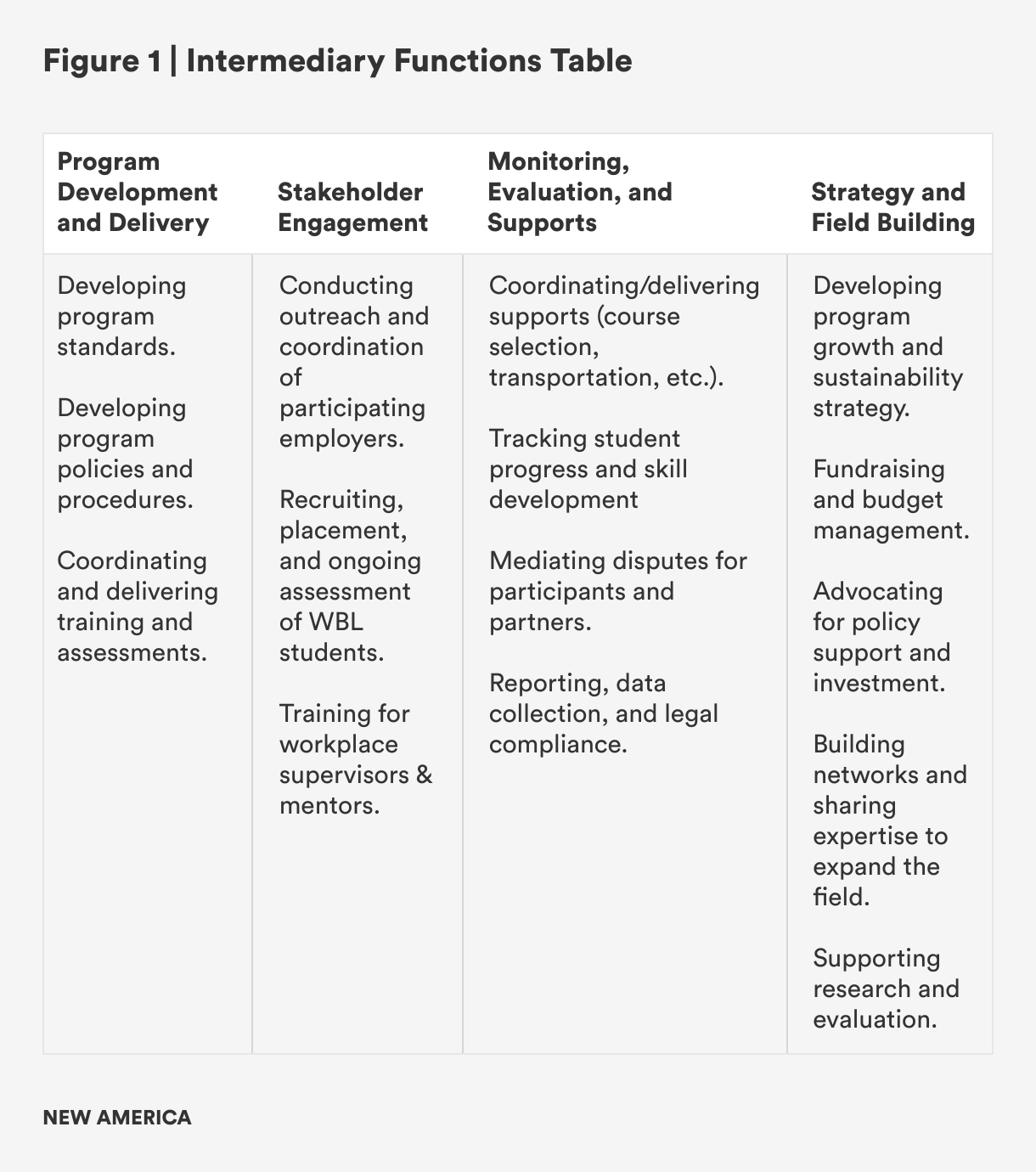
An organization need not perform all of these functions to be considered an intermediary, although some do. In many cases, however, intermediaries distribute some of the responsibility for performing these functions across partners and then, through careful management and coordination, hold partners accountable for their respective roles. A nonprofit intermediary might look to its high school partners to provide career advising and support student recruitment, for example, while a local chamber of commerce might recruit business partners to host or hire students through WBL programs. Ultimately, however, the intermediary is responsible for coordinating these efforts and ensuring they lead to the success of the program.
Intermediaries play a complex and critical role in the growing work-based learning ecosystem, but little is known about the funding models that support them or how their funding approaches might vary depending on the programs they lead, where they sit within an ecosystem, or the nature of their relationships with other partners.
To begin building this evidence base, New America, in partnership with Kinetic West, a social impact consulting firm, conducted an in-depth analysis of budgets at seven WBL intermediaries operating in seven states. Following this analysis, New America staff conducted extensive follow up interviews with three of these intermediaries. We sought to understand:
- How intermediary organizations leverage various funding streams to support WBL programs, and what major benefits or challenges they face in doing so;
- How program formats, intermediary types, and partnership structures influence access to various resource streams; and
- What changes in practice or policy could enable more effective and efficient combinations of resources from across K–12, postsecondary, and workforce funding streams in support of high-quality WBL models for youth.
This report seeks to examine the challenges intermediaries encounter in accessing and combining different sources of funding and to uncover common practices and challenges intermediaries face in their pursuit of sustainability. Finally, we offer recommendations to program leaders, policymakers, and philanthropic leaders interested in supporting the long-term financial success and sustainability of WBL intermediaries.
Our Approach
To understand how WBL intermediaries fund their operations and programs, New America and Kinetic West surveyed seven intermediaries offering structured work-based learning programs such as internships, pre-apprenticeships, and apprenticeships in different regions of the U.S.3 The intermediaries were selected to include a range of organizational longevity, place, type (e.g., nonprofit or public sector), size, and mission.
Of the seven organizations that participated in this analysis, four are large organizations and/or systems that are not exclusively focused on work-based learning programs but have well-defined units that provide intermediary capacity for and deliver WBL programming. For these organizations, our analysis focuses on the division or business unit focused on WBL, which we refer to as the ‘’intermediary’’ throughout this report. The other two organizations in our analysis are focused primarily on delivering training and work-based learning, so we consider their full organizational budget for the purposes of analysis, except where stated otherwise.
In our sample, five intermediaries focus their WBL programming exclusively on youth (ages 16 to 24); two serve a mix of youth and adults (25 and older) across multiple WBL formats. Three of the seven intermediaries identified themselves as program implementers—organizations primarily focused on delivering programs and coordinating partners to make programs successful. Two identified themselves as field-builders—intermediaries whose primary function is to help build and support programs led by other organizations, such as by delivering technical assistance or providing funding or other backbone services. The remaining two intermediaries were hybrid organizations, playing both a program implementation function and supporting other intermediaries in various ways.
To preserve the anonymity of the intermediaries that participated in this research, we have assigned them each a letter that is used to identify them in tables and graphics throughout this report (Figure 2).
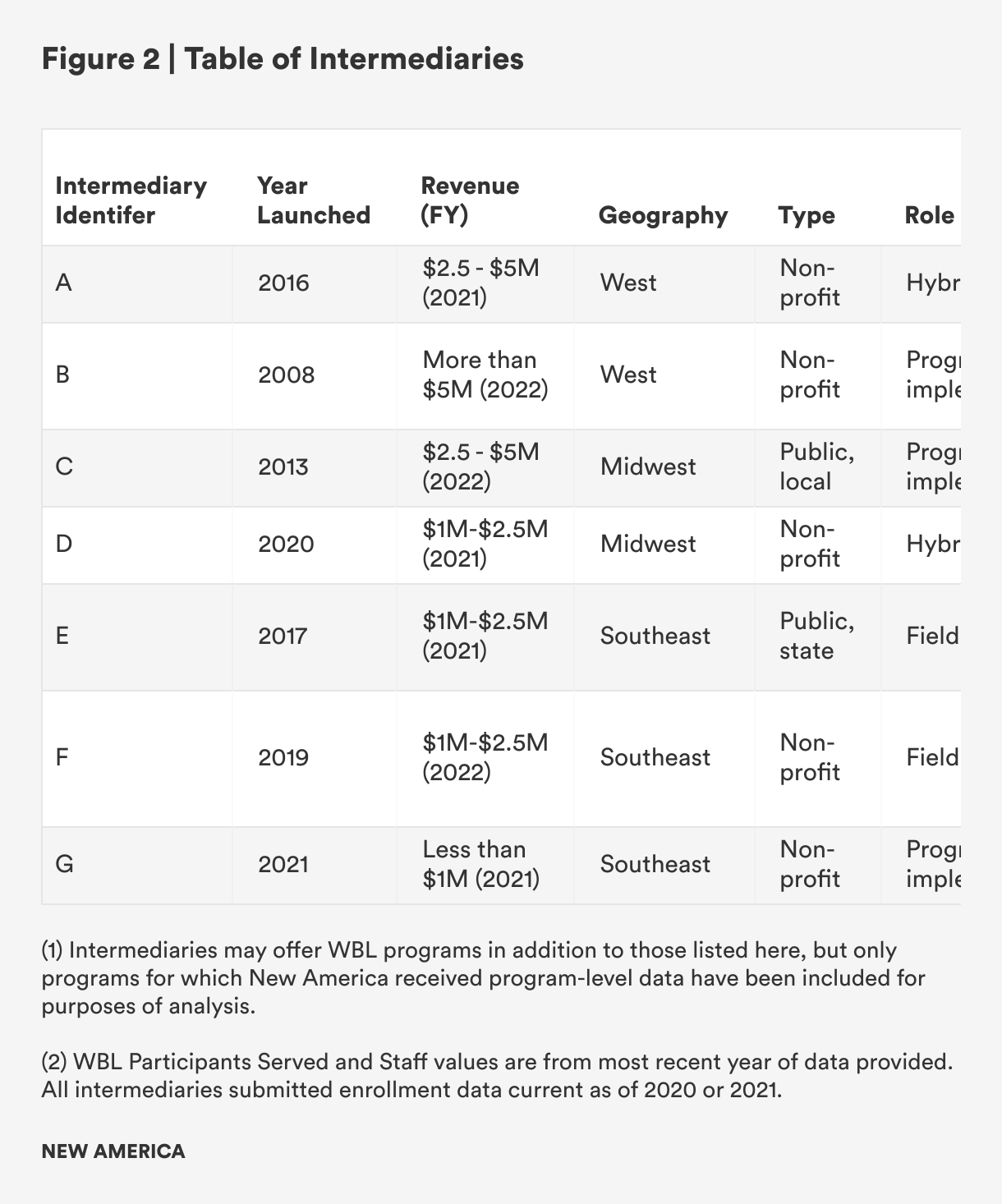
The intermediaries completed the survey over the course of several weeks in 2022. The survey was designed to collect detailed information about revenue sources and expenses specific to the intermediaries and their WBL program(s) over a recent two-year period.4 The survey also invited participants to respond to open-ended questions about budgeting practices, fundraising, and sustainability.
Differences in budget approaches posed a challenge in our analysis, especially in collecting and comparing program-level expense data. At the most basic level, WBL intermediaries have two types of expenses: program expenses and operational expenses. Program expenses include the direct costs associated with operating a WBL program, including things like program supplies and equipment, tuition or training costs, transportation, credentialing fees, etc. Operational expenses, on the other hand, include expenditures associated with serving as an intermediary. These might include traditional indirect costs like rent and utilities, salaries for administrative or development personnel, etc. But they might also include salaries for staff that support the success of programs without playing a part in their delivery—for example, staff members who provide technical assistance to other programs or engage with state leaders and policymakers to advocate for conditions and policies that can support program growth.
Unfortunately, the distinctions between program and operational expenses are not always clear cut. In some cases, intermediaries treated personnel costs as operational costs; in other cases, intermediaries understood and reported the bulk of their staffing expenses as a part of their program expenses. While this did not prevent us from analyzing their budgets, it did limit our ability to draw comparisons across intermediaries’ program-level expenditures. Additionally, though intermediaries had confidence in their intermediary-level revenue data, most had less confidence in the accuracy of the program-level expenditures. Because of these limitations, this analysis focuses primarily on intermediary- and program-level revenue.

Citations
- For example, see Martha Ross, Kristin Anderson Moore, Kelly Murphy, Nicole Bateman, Alex DeMand, and Vanessa Sacks, Pathways to High-Quality Jobs for Young Adults (Washington, DC: Brookings and Child Trends, October 2018), https://www.brookings.edu/wp-content/uploads/2018/10/Brookings_Child-Trends_Pathways-for-High-Quality-Jobs-FINAL.pdf; and Marisa Shenk, Erin Welch, and Sarah Dolfin, "Evidence Snapshot: Work experience and work-based learning," OPRE Report #2023-056 (Washington, DC: Office of Planning, Research, and Evaluation, Administration for Children and Families, U.S. Department of Health and Human Services, 2023).
- The Critical Role of Intermediary Organizations in Expanding Youth Apprenticeship (Washington, DC: Education Strategy Group, November 2019), https://edstrategy.org/wp-content/uploads/2019/11/ESG-Youth-apprenticeship-12092019-update.pdf; and Kimberly Braxton and Robert Roach, “Mending the Path: A Toolkit for Planning and Implementing Trauma-Informed Approaches,” Equal Measure, June 13, 2023, https://www.equalmeasure.org/mending-the-path/.
- The authors initially invited eight intermediaries to complete the survey, but one submitted incomplete information and chose to withdraw from the project. We have omitted this intermediary’s information from the analysis below.
- Intermediaries in this analysis operate on different fiscal calendars. The earliest fiscal year reported to us began January 2019; the most recent ended June 2022.