Unraveling the Finance Models of Work-Based Learning Intermediaries
Abstract
Intermediaries play a complex and critical role in the growing work-based learning ecosystem, but little is known about the funding models that support them or how their funding approaches might vary depending on the programs they lead, where they sit within an ecosystem, or the nature of their relationships with other partners.
To begin building this evidence base, New America, in partnership with Kinetic West, a social impact consulting firm, conducted an in-depth analysis of budgets at seven WBL intermediaries operating in seven states. Following this analysis, New America staff conducted extensive follow-up interviews with three of these intermediaries. We sought to understand:
- How intermediary organizations leverage various funding streams to support WBL programs, and what major benefits or challenges they face in doing so;
- How program formats, intermediary types, and partnership structures influence access to various resource streams; and
- What changes in practice or policy could enable more effective and efficient combinations of resources from across K–12, postsecondary, and workforce funding streams in support of high-quality WBL models for youth.
This report seeks to examine the challenges intermediaries encounter in accessing and combining different sources of funding and to uncover common practices and challenges intermediaries face in their pursuit of sustainability. Finally, we offer recommendations to program leaders, policymakers, and philanthropic leaders interested in supporting the long-term financial success and sustainability of WBL intermediaries.
Acknowledgments
We would like to thank the Bill & Melinda Gates Foundation for its generous support of this research. The findings and conclusions contained within are those of the authors and do not necessarily reflect positions or policies of the foundation. We are also grateful to Kinetic West for its partnership on the development and administration of the survey referenced throughout this report.
Thanks are also due to the staff from the seven intermediaries that completed the survey, especially to Lynn Strickland, Briana Durham, and Chris Pierson from AJAC; Kathryn Beach, Hollis Salway, and Ryan Gensler from CareerWise; and Marcella Zipp from High School District 214; they hosted us generously for visits and interviews, answered our questions patiently, and shared candid reflections for our case studies about what makes their work as intermediaries rewarding, challenging, and important. We are grateful to our CELNA colleagues Iris Palmer, Sarah Oldmixon, and Kelly Vedi, who provided helpful feedback and suggestions throughout this project. Former New Americans Lul Tesfai and Fabio Murgia also deserve recognition for their substantial contributions of subject matter and design expertise in this project’s early phases. Finally, we would also like to acknowledge the invaluable work of many colleagues on New America's communications and production staff, in particular Sabrina Detlef, Naomi Morduch Toubman, Molly Martin, Katherine Portnoy, and Natalya Brill.
Downloads
Introduction
Work-based learning (WBL) can provide valuable opportunities for young adults to explore future career paths, to apply classroom learning to real problems, and to develop professional skills and networks that can help them jump-start their careers. Work-based learning experiences can range from exploratory activities like day-long job shadowing to multi-year apprenticeship programs designed to prepare young people for specific occupations. Evidence shows that participating in sustained cooperative education, internship, and apprenticeship programs in high school can lead to improved job quality later in life.1
But intensive WBL programs require close cooperation and coordination between high schools, employers, and sometimes colleges or universities, workforce agencies, and other community or industry partners. As interest in and demand for work-based learning has grown over the past several years, the importance of intermediary organizations that coordinate these actors has become increasingly clear.
WBL intermediaries come in all shapes and sizes. Often, intermediaries are nonprofit organizations, but they can also be situated within community colleges, chambers of commerce, K–12 school districts, or workforce development boards.2 The reach of intermediaries can also vary widely. While some serve a small local area, others work at the regional, state, or national level, supporting programs and initiatives in multiple communities.
Regardless of their location or scope, WBL intermediaries play an important coordination and translation role among program partners (Figure 1). They work to establish a shared vision, to facilitate communication between stakeholders, and to coordinate implementation in a way that yields benefits for all stakeholders. WBL intermediaries commonly serve functions in the areas of program development and delivery; stakeholder engagement; monitoring, evaluation, and support services, and field building.
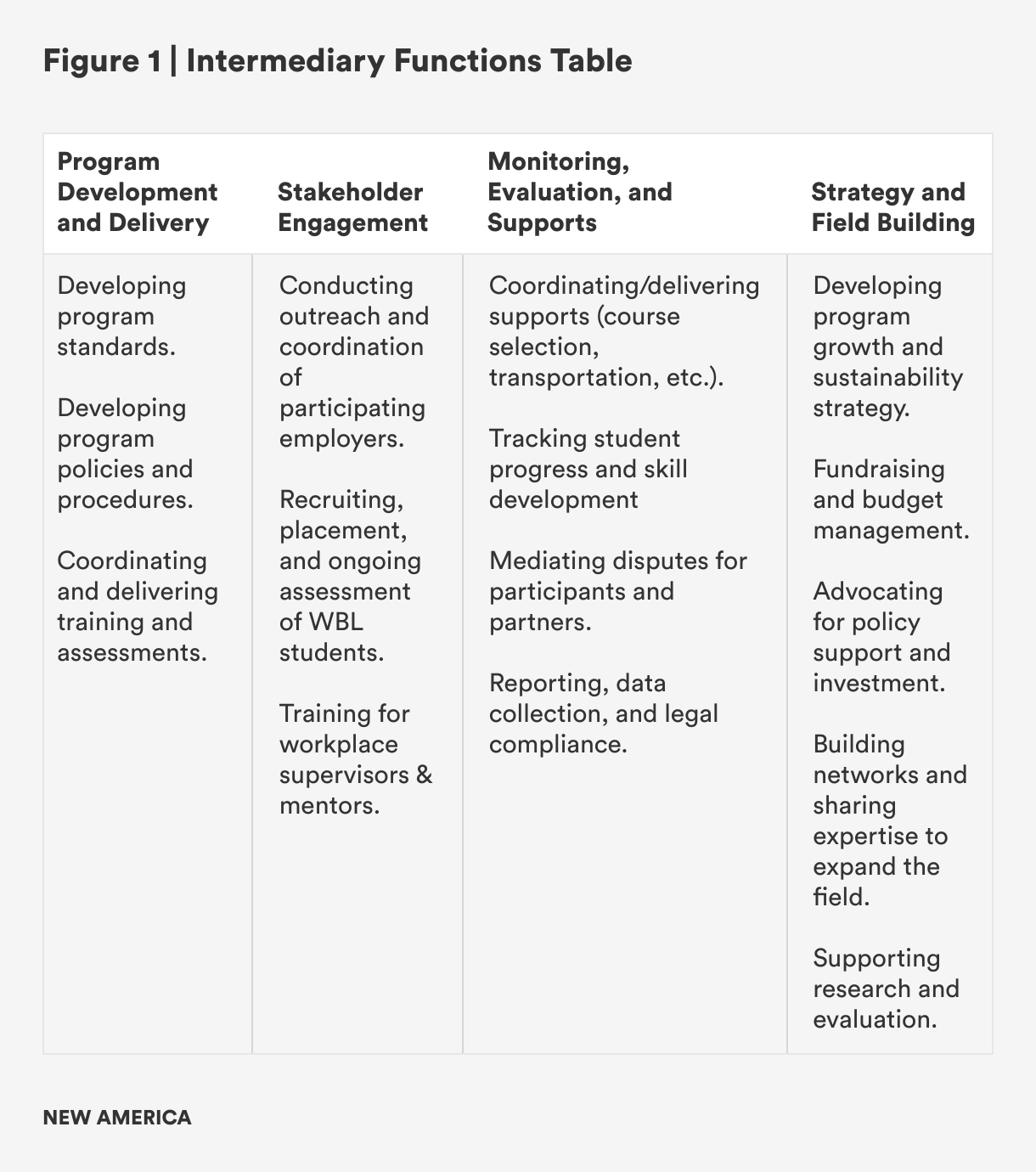
An organization need not perform all of these functions to be considered an intermediary, although some do. In many cases, however, intermediaries distribute some of the responsibility for performing these functions across partners and then, through careful management and coordination, hold partners accountable for their respective roles. A nonprofit intermediary might look to its high school partners to provide career advising and support student recruitment, for example, while a local chamber of commerce might recruit business partners to host or hire students through WBL programs. Ultimately, however, the intermediary is responsible for coordinating these efforts and ensuring they lead to the success of the program.
Intermediaries play a complex and critical role in the growing work-based learning ecosystem, but little is known about the funding models that support them or how their funding approaches might vary depending on the programs they lead, where they sit within an ecosystem, or the nature of their relationships with other partners.
To begin building this evidence base, New America, in partnership with Kinetic West, a social impact consulting firm, conducted an in-depth analysis of budgets at seven WBL intermediaries operating in seven states. Following this analysis, New America staff conducted extensive follow up interviews with three of these intermediaries. We sought to understand:
- How intermediary organizations leverage various funding streams to support WBL programs, and what major benefits or challenges they face in doing so;
- How program formats, intermediary types, and partnership structures influence access to various resource streams; and
- What changes in practice or policy could enable more effective and efficient combinations of resources from across K–12, postsecondary, and workforce funding streams in support of high-quality WBL models for youth.
This report seeks to examine the challenges intermediaries encounter in accessing and combining different sources of funding and to uncover common practices and challenges intermediaries face in their pursuit of sustainability. Finally, we offer recommendations to program leaders, policymakers, and philanthropic leaders interested in supporting the long-term financial success and sustainability of WBL intermediaries.
Our Approach
To understand how WBL intermediaries fund their operations and programs, New America and Kinetic West surveyed seven intermediaries offering structured work-based learning programs such as internships, pre-apprenticeships, and apprenticeships in different regions of the U.S.3 The intermediaries were selected to include a range of organizational longevity, place, type (e.g., nonprofit or public sector), size, and mission.
Of the seven organizations that participated in this analysis, four are large organizations and/or systems that are not exclusively focused on work-based learning programs but have well-defined units that provide intermediary capacity for and deliver WBL programming. For these organizations, our analysis focuses on the division or business unit focused on WBL, which we refer to as the ‘’intermediary’’ throughout this report. The other two organizations in our analysis are focused primarily on delivering training and work-based learning, so we consider their full organizational budget for the purposes of analysis, except where stated otherwise.
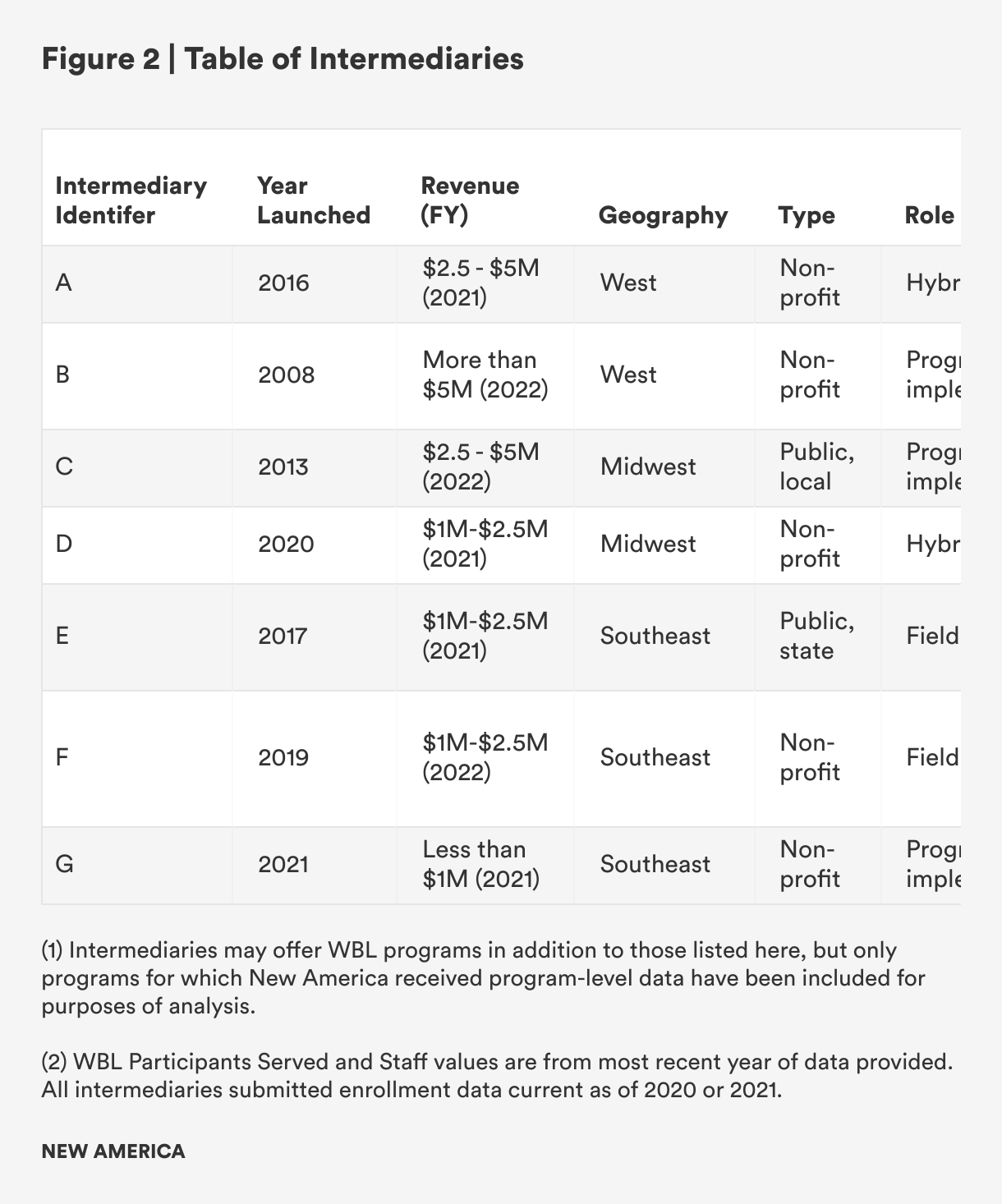
In our sample, five intermediaries focus their WBL programming exclusively on youth (ages 16 to 24); two serve a mix of youth and adults (25 and older) across multiple WBL formats. Three of the seven intermediaries identified themselves as program implementers—organizations primarily focused on delivering programs and coordinating partners to make programs successful. Two identified themselves as field-builders—intermediaries whose primary function is to help build and support programs led by other organizations, such as by delivering technical assistance or providing funding or other backbone services. The remaining two intermediaries were hybrid organizations, playing both a program implementation function and supporting other intermediaries in various ways.
To preserve the anonymity of the intermediaries that participated in this research, we have assigned them each a letter that is used to identify them in tables and graphics throughout this report (Figure 2).
The intermediaries completed the survey over the course of several weeks in 2022. The survey was designed to collect detailed information about revenue sources and expenses specific to the intermediaries and their WBL program(s) over a recent two-year period.4 The survey also invited participants to respond to open-ended questions about budgeting practices, fundraising, and sustainability.
Differences in budget approaches posed a challenge in our analysis, especially in collecting and comparing program-level expense data. At the most basic level, WBL intermediaries have two types of expenses: program expenses and operational expenses. Program expenses include the direct costs associated with operating a WBL program, including things like program supplies and equipment, tuition or training costs, transportation, credentialing fees, etc. Operational expenses, on the other hand, include expenditures associated with serving as an intermediary. These might include traditional indirect costs like rent and utilities, salaries for administrative or development personnel, etc. But they might also include salaries for staff that support the success of programs without playing a part in their delivery—for example, staff members who provide technical assistance to other programs or engage with state leaders and policymakers to advocate for conditions and policies that can support program growth.
Unfortunately, the distinctions between program and operational expenses are not always clear cut. In some cases, intermediaries treated personnel costs as operational costs; in other cases, intermediaries understood and reported the bulk of their staffing expenses as a part of their program expenses. While this did not prevent us from analyzing their budgets, it did limit our ability to draw comparisons across intermediaries’ program-level expenditures. Additionally, though intermediaries had confidence in their intermediary-level revenue data, most had less confidence in the accuracy of the program-level expenditures. Because of these limitations, this analysis focuses primarily on intermediary- and program-level revenue.
Citations
- For example, see Martha Ross, Kristin Anderson Moore, Kelly Murphy, Nicole Bateman, Alex DeMand, and Vanessa Sacks, Pathways to High-Quality Jobs for Young Adults (Washington, DC: Brookings and Child Trends, October 2018), https://www.brookings.edu/wp-content/uploads/2018/10/Brookings_Child-Trends_Pathways-for-High-Quality-Jobs-FINAL.pdf; and Marisa Shenk, Erin Welch, and Sarah Dolfin, "Evidence Snapshot: Work experience and work-based learning," OPRE Report #2023-056 (Washington, DC: Office of Planning, Research, and Evaluation, Administration for Children and Families, U.S. Department of Health and Human Services, 2023).
- The Critical Role of Intermediary Organizations in Expanding Youth Apprenticeship (Washington, DC: Education Strategy Group, November 2019), https://edstrategy.org/wp-content/uploads/2019/11/ESG-Youth-apprenticeship-12092019-update.pdf; and Kimberly Braxton and Robert Roach, “Mending the Path: A Toolkit for Planning and Implementing Trauma-Informed Approaches,” Equal Measure, June 13, 2023, https://www.equalmeasure.org/mending-the-path/.
- The authors initially invited eight intermediaries to complete the survey, but one submitted incomplete information and chose to withdraw from the project. We have omitted this intermediary’s information from the analysis below.
- Intermediaries in this analysis operate on different fiscal calendars. The earliest fiscal year reported to us began January 2019; the most recent ended June 2022.
Understanding Intermediary Funding
Though intermediaries are critical to the success of WBL initiatives, funding them is a complicated endeavor. Intermediaries typically rely on a mix of public and private funding sources, and usually combine several of each type. WBL intermediaries often sit at the intersection of K–12 education, higher education, and the public workforce system, each of which receives public funding that comes with different restrictions, allowable uses, and reporting requirements. Intermediaries may be able to access or leverage public funding, and many do, especially those that are themselves based within public systems. Intermediaries also frequently raise private philanthropic support from local, regional, or national funders. Some also receive in-kind donations from partners or generate revenue from their program offerings.
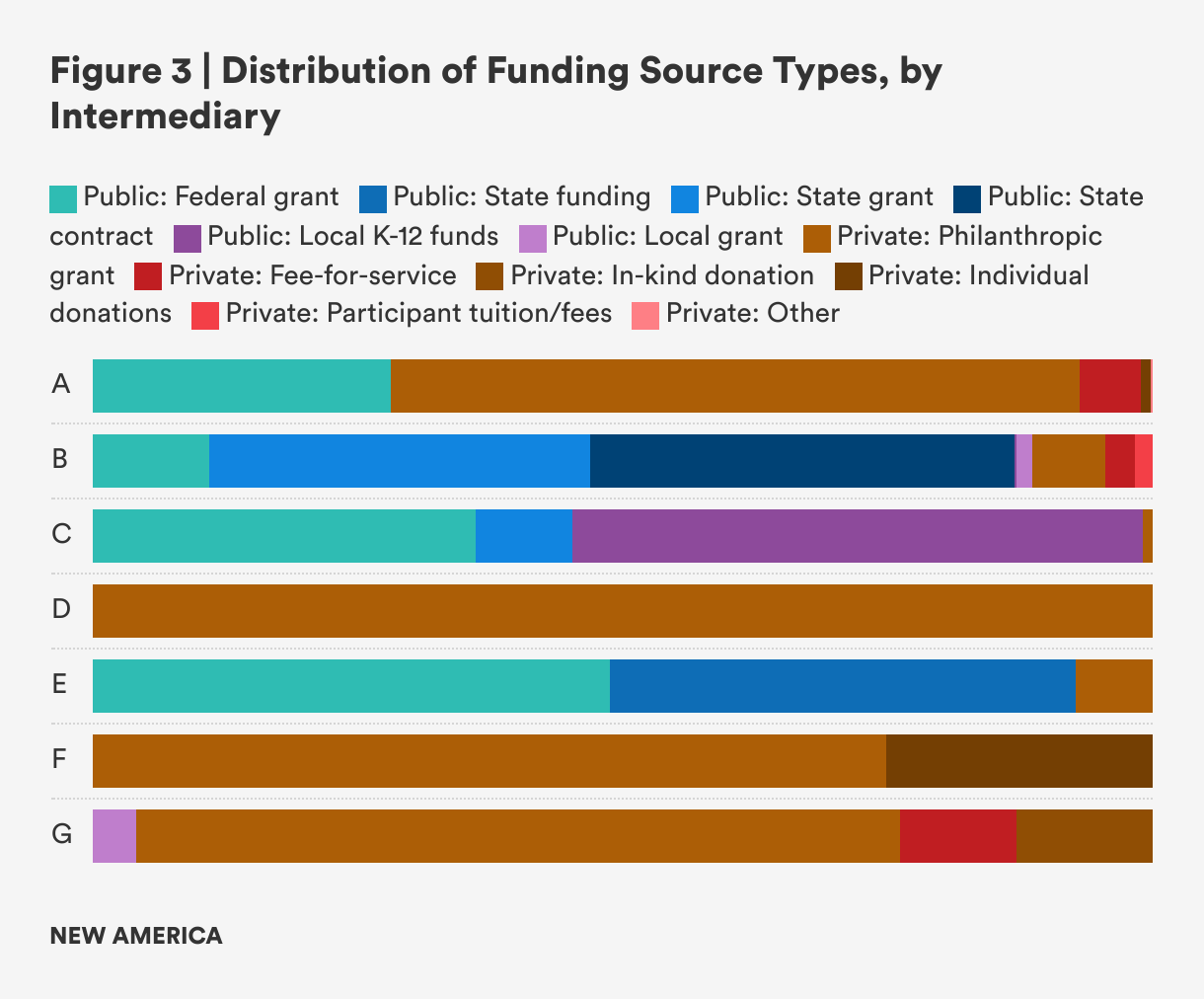
WBL intermediaries play different roles within their ecosystems; they operate distinct programs and vary in size. These and other factors mean the size of their budgets—and the source of funds within them—can vary considerably. The intermediaries in our analysis reported annual revenue ranging from less than $500,000 to more than $5 million. Four of the seven rely primarily on philanthropic dollars to support their work (defined as 50 percent or more of total revenue in the year reported); more than half of revenue for the remaining three comes from public funding sources.
Intermediary budgets are complex (Figure 3). The financial information submitted by the seven intermediaries we examined included state and federal grants, contracts, and formula dollars; local education funding; philanthropic grants, and some in-kind and fee-for-service revenue.5 One organization reported 21 unique funding sources. Grants were the dominant source of funding overall. Public grants or contracts ranged from $220,000 to $1.9 million per annum, with performance periods from one to five years. Of the 31 philanthropic grants reported by the intermediaries, only one grant accounted for more than $1 million in annual revenue; 18 provided less than $100,000.More than half had performance periods of a year or less, despite the fact that many of the WBL programs in the analysis last for a year or longer; only one philanthropic grant reported had a performance period of five years. More than 60 percent of the philanthropic grants were restricted and required reporting on an annual, biannual, or quarterly basis.6
The sources of funds available to intermediaries can vary based on a number of key variables, including:
- The intermediary’s role and mission. Intermediaries that implement WBL programs may have access to funding sources that intermediaries focused exclusively on field-building activities (e.g., policy and advocacy) do not. The reverse may also be true, in cases where a philanthropic partner may be interested only in funding policy reform, for example.
- The intermediary’s organizational status: An intermediary situated within a K–12 school district, for instance, can support WBL with federal, state, and local education funding that an independent nonprofit would not be eligible to receive. On the other hand, a nonprofit organization with a strong development arm might be better positioned than a K–12 school district to secure philanthropic grants. Regardless of where in the ecosystem an intermediary is located, however, it may leverage partners’ funding eligibility to cover some program costs.
- The population of learners it enrolls: The students that an intermediary serves can also affect its access to funding. A WBL program that serves disabled students, for example, might be able to access federal funding via Individuals with Disabilities Education Act (IDEA) grants to support their participation. Likewise, the Workforce Innovation & Opportunity Act (WIOA) Youth Program, which funds many different types of WBL opportunities, can provide resources to support young people who face barriers to education, training, and employment.
- The program type(s) it offers: Different WBL program types come with different costs and, in some cases, dedicated funding. Internships, for example, rarely require interns to complete specific classes, whereas apprenticeships require a specific sequence of courses (called related technical or related supplementary instruction). Many states provide funding to reduce the cost of related technical instruction for apprentices.
- State policy: Public funding for WBL varies considerably from state to state. Some states provide dedicated funding to support particular types of WBL programs or intermediaries. Some also provide geographically targeted funding that supports the development of WBL in areas with specific education or labor market needs or barriers.
We saw evidence of several of these factors at play in our analysis. For example, nearly all of the funding at the two intermediaries embedded within public institutions came from public sources, including some that would not be accessible to nonprofit intermediaries (e.g., local education funding, state appropriations). Multiple intermediaries reported accessing federal IDEA and WIOA dollars to support the participation of WBL students who qualify for those resources, though no intermediary was heavily reliant on either funding type. And several intermediaries were also able to access apprenticeship-specific funding from state and federal sources.
Citations
- Some intermediaries in this study provided program-level funding information for all of the WBL programs they led, while others provided program-level information for only their most intensive WBL offerings (see Figure 2) and excluded budget details for other programming (e.g., career exposure activities embedded in HS courses). It’s possible an intermediary may have additional funding sources not collected or reported in this analysis.
- We suspect that the number of restricted grants requiring reporting is higher than 60 percent. However, due to an inconsistency in the way one respondent interpreted the survey questions about these issues, we have chosen to report a conservative estimate here rather than an exact figure.
Combining Multiple Funding Sources
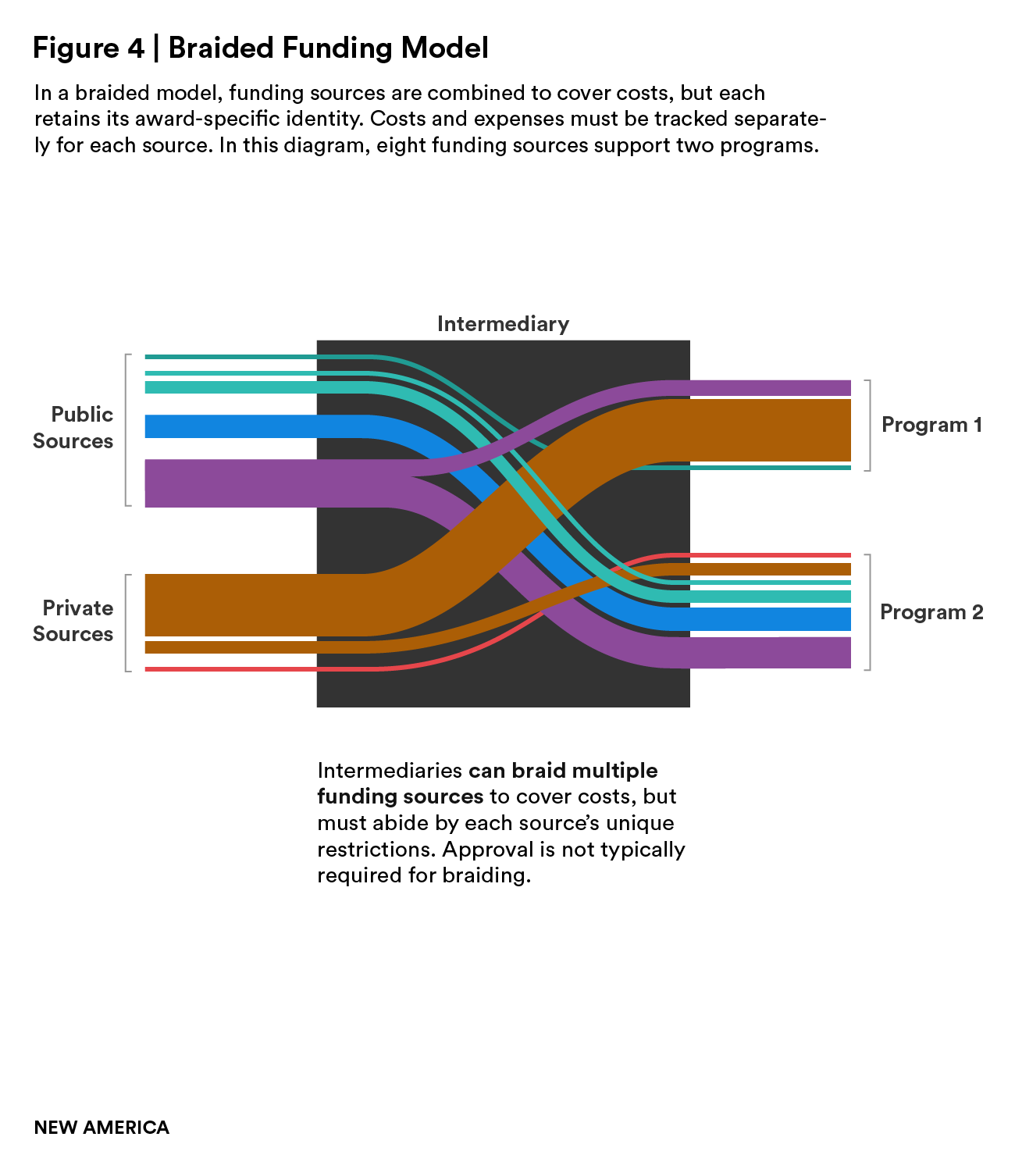
Though intermediaries’ funding models vary considerably, they share a reliance on strategic (and often creative) techniques to combine and administer multiple funding types (Figures 4 and 5). These techniques are commonly referred to as braiding and blending funding strategies, which are often framed as ways for nonprofit organizations to achieve sustainability, especially as they grow. The thinking is simple: an organization that combines multiple funding sources can protect itself from the risk posed by the disappearance of any one individual funding source. Having several funding sources can indicate a successful, diversified organization or initiative, which can in turn make it easier to attract or compete for additional funds.
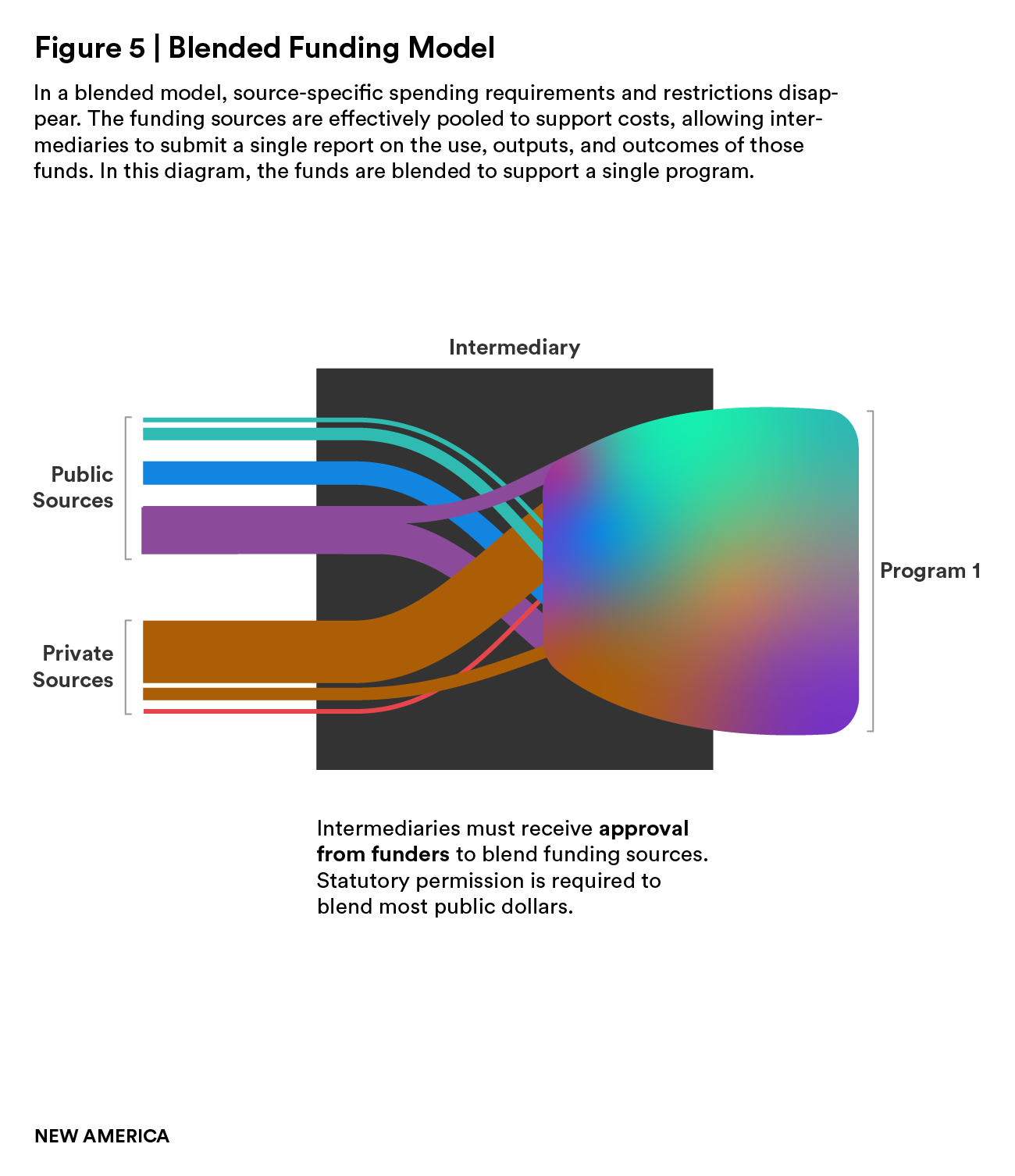
When an intermediary blends funds, the different funding streams lose their award-specific requirements when merged. Any restrictions or accountability measures associated with the money are no longer in effect. While blending offers more flexibility than braiding, it is a less common approach. Statutory permission must be granted to use most public funding sources in this way. Even in cases where a philanthropic funder provides flexible general operating funds, the nonprofit recipient typically tracks the use of those funds as it would for any other type of grant, whether or not it is required to do so. This was the case for at least one intermediary in this analysis that reported general operating support. We found no clear evidence that true blending was taking place for the intermediaries in this analysis.
Braiding was, however, ubiquitous. When intermediaries braid funds to support a program, they use multiple sources of funding to cover program costs, but each stream retains its award-specific identity. This means that the intermediary must adhere to the particular restrictions or reporting requirements for each funding source. In practice, this means that finance and development staff must diligently track the use of funds individually; collect different data and information according to each funders’ requirements; and submit regular reports—sometimes as often as four times a year—on activities and expenditures.
Two of the seven intermediaries that submitted intermediary-level revenue information through our survey braid philanthropic grants only. Both of these were nonprofit intermediaries and were among the youngest in the cohort, launching in 2020 and 2021. One of the seven combines fee-for-service revenue with philanthropic funding but does not receive any public dollars. (Notably, however, many of these programs leverage public funds that do not appear in their budgets. See below for additional discussion.) The other four braid different mixes of philanthropic and public funds. Of these, two—both embedded within public education systems—rely almost entirely on public funds, with small philanthropic grants (ranging from $20,000 to $154,000/year) supporting special projects or initiatives.
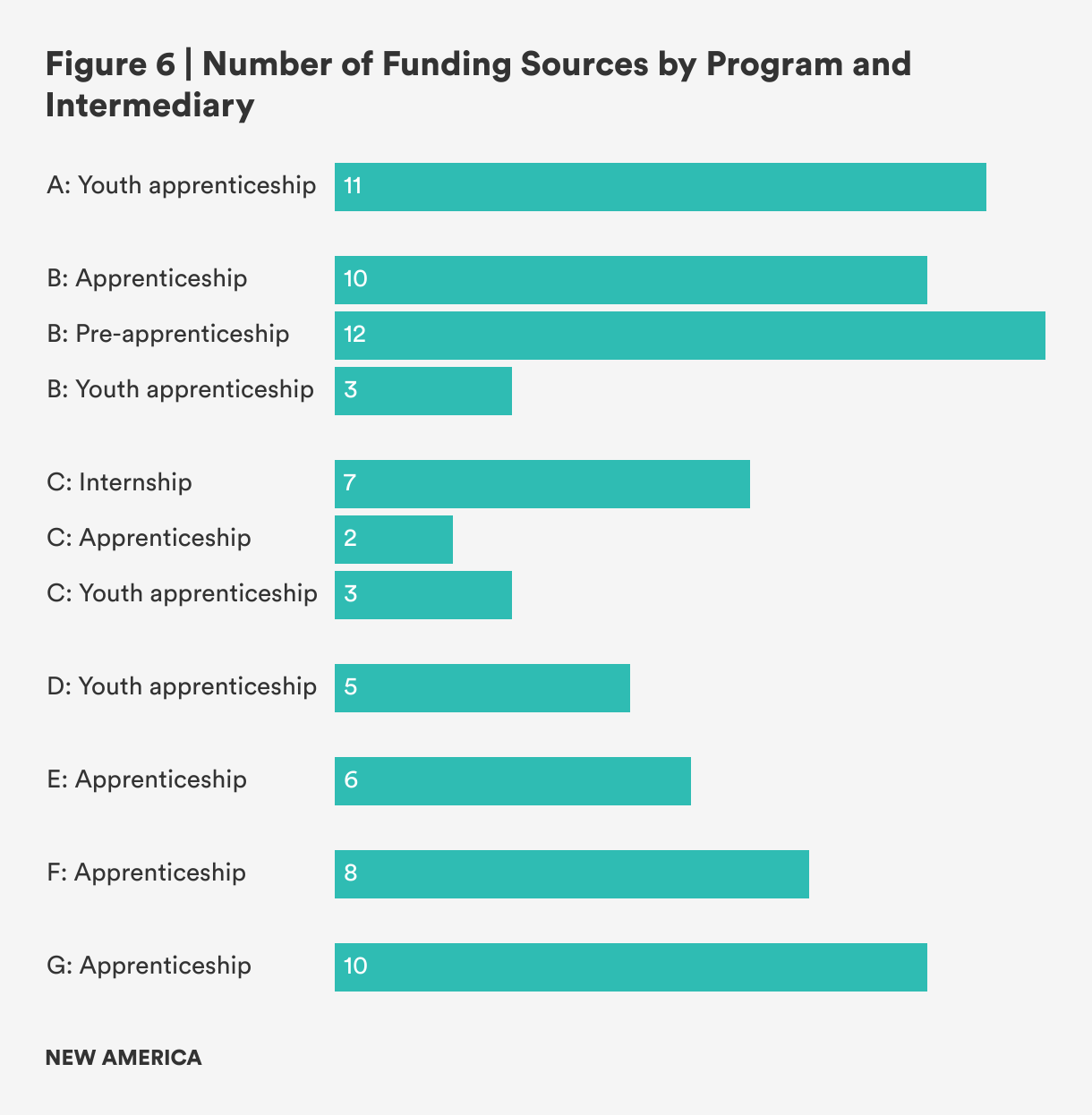
Braiding is especially complex at the program level (Figure 6). On average, intermediaries in this analysis braid seven sources to fund individual WBL programs. Some drew on as many as 12 distinct sources; others relied on just two. Even within the same intermediary, programs draw on different combinations of funds, adding complexity to these budgets.
Research suggests that braiding and blending can offer benefits beyond financial sustainability, by enhancing equity, program impact, efficiency, and flexibility. 7 It also can provide a return on an initial investment in the form of additional support, exposure, and appeal to funders.
It is unclear from our analysis the extent to which intermediaries’ efforts to braid funds have yielded these auxiliary benefits. (As we saw no evidence of blending, we can draw no conclusions about this practice.) But it is clear that the intermediaries in this analysis braid funding streams out of necessity. While they recognize that having diversified revenue sources is critical to achieving sustainability as they grow and mature as organizations, they braid funds to survive, first and foremost.
Citations
- See for example, “Blended and Braided Funding: A Guide for Policy Makers and Practitioners,” AGA, December 2014, https://www.agacgfm.org/AGA/Intergovernmental/documents/BlendedandBraidedFunding.pdf; and U.S. Department of Labor, “Funding Inclusive Apprenticeships: Strategies for Braiding, Blending, and Aligning Resources,” U.S. Department of Labor, https://www.dol.gov/sites/dolgov/files/ODEP/pdf/FundingInclusiveApprenticeshipsStrategiesforBraiding%2CBlending%2CandAligningResources.pdf.
Case Studies: Approaches and Strategies for Braiding Funds
What processes and tools do the intermediaries use to make this possible? And what major benefits or challenges do they encounter in doing so? Our initial survey collected limited qualitative data to answer these questions.
To better understand intermediaries’ approaches and strategies for braiding funds, we conducted extensive interviews with three of the participating WBL intermediaries over the course of several months in 2023. For these interviews, we selected AJAC (King County, WA), CareerWise Colorado (Denver, CO), and High School District 214 (Schaumburg, IL), the three intermediaries that, based on their surveys, had especially complex braided finance models and multiple years of experience managing them. In addition, their different locations, different origins, and different institutional types offered opportunities for us to explore the impact of different factors on their finance models.
In the case studies that follow, we examine how these three intermediaries make it all work: the funding sources they rely on, the braiding strategies they employ to support their programs, and the challenges they have encountered as they work towards financial sustainability.
Case Study 1: AJAC: Advanced Manufacturing Apprenticeships
AJAC: Advanced Manufacturing Apprenticeships
Intermediary Name: AJAC: Advanced Manufacturing Apprenticeships
Location: Washington State
Founded: 2008
Annual Budget (FY 2022): $5.23M
Staff: 26
Programs Offered: Apprenticeship, youth apprenticeship, pre-apprenticeship
Program Enrollment (2021–22): 525
Four times a year, John Manning sits down with a spreadsheet that lists incoming participants in AJAC Manufacturing Academy™ pre-apprenticeship programs. Manning is the Pre-Apprenticeship program manager at AJAC, a nonprofit apprenticeship intermediary that serves employers and workers in Washington State’s aerospace and advanced manufacturing industry, and his quarterly date with this spreadsheet means he has a painstaking task ahead of him: he must determine, one name at a time, which pre-apprentices are eligible for which funding streams that will support their participation in the academy.
As part of its mission to expand access to training for some of the state’s most lucrative middle- and high-skill occupations, AJAC is committed to making its pre-apprenticeship training free, or almost free, to anyone who wants it. But available funding doesn’t cover all of the costs all of the time, so leadership must find a way to bridge the gap. “We dial for dollars a lot,” Bri Durham, AJAC’s director of Business Engagement & Programs, explained, since “we don’t want to turn anyone away.” Fortunately, it’s not often AJAC needs to, thanks in part to the large network of community-based partners and employers it has developed since its launch 15 years ago.
Washington State is home to more than 1,500 aerospace companies, which employ more than 250,000 people. To meet the industry’s demand for a highly skilled workforce, the state legislature in 2008 set aside money for “skill[ing]-up the aerospace and advanced manufacturing workforce through Registered Apprenticeship.” This initial investment led to the creation of AJAC which has, since its founding, developed pre-apprenticeship, Registered Apprenticeship, and youth apprenticeship training programs to provide Washington’s aerospace and advanced manufacturing industries with a robust talent pipeline and to establish strong career pathways for workers.
Unlike many apprenticeship intermediaries that are established with small grants and must figure out how to increase their funding as enrollment expands, AJAC began with a single-source public investment and not one single apprentice. “Our charge was to get big [quickly] to justify the fact that we were getting this money with zero track record,” says Chris Pierson, AJAC’s director of Operations and Funding.
At first, AJAC served adults because its state investment targeted Registered Apprenticeship pathways for adult workers. But, facing acute talent shortages, employers soon expressed an interest in reaching new, untapped pools of talent. In response, AJAC launched the state’s first recognized manufacturing pre-apprenticeship program in 2011 to provide training to a wide range of workers, including many underrepresented in the industry, such as women, youth, and incarcerated individuals. In 2017, AJAC’s Registered Apprenticeship program for high school students launched, in partnership with local school districts.
Over time, pre-apprenticeship and youth apprenticeship enrollment have ticked slowly upwards. In 2020–21, pre-apprentices and youth apprentices comprised 32 percent of AJAC’s participants, or 168 individuals in total. But the growth of these programs has been slower than that of AJAC’s Registered Apprenticeships (Figure 7), which are its largest and easiest-to-fund programs, thanks in part to the state’s continued investment and financial contributions of employers, who typically cover the cost of their apprentices’ tuition, fees, and books (in addition to paying their wages and facilitating their on-the-job learning).

Nearly 90 percent of AJAC’s budget comes from public sources. In 2020–21, AJAC drew on 24 unique funding streams to support its operations and programs. Of these, 19 were from federal, state, or local sources and ranged in size from $10,000 grants from municipal partners to million-dollar grants from state and federal agencies. The remaining five sources (12 percent of all funding) came from private sources, including philanthropic grants, fees paid by employers, or student-funded tuition costs.
AJAC has become adept at braiding these resources to make its funding work. Through interviews with AJAC’s leadership, we identified four strategies that have led to its continued success.
1. Maximize Benefits of Dedicated Operational Resources
Nearly half of AJAC’s annual revenue comes from just one source: a competitive grant from the Washington State Board for Community and Technical Colleges (SBCTC). This grant has provided flexible, multi-year funding for AJAC to operate as a statewide apprenticeship intermediary since its launch in 2008. Unlike many other state and federal grants available to intermediaries, the SBCTC contract is intended specifically to fund operational costs associated with AJAC’s role leading a complex cross-sector partnership. It supports critical functions like business recruitment and engagement, apprentice registration and compliance with the Washington State Apprenticeship Training Council (WSATC), data management, equipment quality control, and the coordination of services and supportive services for apprentices. The contract is intended to support AJAC’s role as an intermediary for its Registered Apprenticeship programs; however, youth and pre-apprenticeship programs can leverage certain operational assets, such as business recruitment, equipment quality control, and data management. Without them, those programs would likely not exist.
A secondary benefit of this multi-year contract is that it has made AJAC more competitive for other public and private funding. “Part of our success in going after [other] grants is being able to point at this large public investment that the grant will be leveraging. Not having that would make us a less competitive applicant,” Pierson explained, noting AJAC’s success in securing both federal apprenticeship funding and philanthropic investment, independently and as part of various consortia.
AJAC’s operational funding from the SBCTC is secured through June 30, 2027. From 2008 until 2022, AJAC was a sole-source recipient of the funding, as the state’s only aerospace apprenticeship intermediary. But in 2022, in response to new competition, Washington shifted to a competitive bid process. AJAC won, but it will encounter the same competitive process again in 2027.
2. Leverage Assets Available to Key Partners
As a companion to the 2008 investment that led to AJAC’s creation, the Washington legislature established a related funding stream, also administered by the SBCTC, to support costs associated with delivering related supplemental instruction to apprentices. This stream, the Aerospace Apprenticeship Full-Time Equivalent (FTE) funding, supports community and technical colleges that partner with Registered Apprenticeship programs supported by the recipient of the SBCTC grant. Colleges can use the FTE funds to cover the administrative and instructional costs (if provided by the college) of delivering related supplemental instruction (RSI) as part of apprenticeship programs.
This funding incentivizes and supports AJAC’s relationships with seven community and technical colleges across the state and makes it possible for them to provide credit-bearing coursework as part of apprentices’ related supplemental instruction. AJAC, a sector intermediary, recruits and hires instructors directly from industry to deliver RSI and it works with colleges to ensure that instructors meet state and campus credentialing requirements. To fund this arrangement, colleges keep 30 percent of each FTE to support administrative costs and AJAC receives the remaining 70 percent, the bulk of which goes to compensating instructors.
The number of funded FTE slots is 130 each year. There have been various values assigned to these FTEs over the years; as of July 2022, the value is $8,000 per FTE. The slots have been permanently allocated to seven different colleges.
In the past, as AJAC staff members planned the upcoming annual budget, they prioritized recruiting employers and apprentices to capitalize on their FTE allotment and to remain competitive for when the SBCTC contract goes out for bid again in 2027. Maximizing the opportunity presented by the FTE allotment is “essentially our North Star,” says Pierson. But while the funding stream has been a reliable source of revenue, it’s not been without challenges. For one thing, it requires a complex invoicing process to achieve the 30 (college)/70 percent (SBCTC grantee) split of resources. Second, funding does not always stretch as far as it needs to. Because apprentices take part-time course loads, AJAC must enroll three apprentices to meet one funded FTE slot.
Additionally, AJAC cannot usually claim the aerospace apprenticeship FTE for their youth apprentices or, more accurately, it chooses not to. In theory, it could, if it required youth apprentices’ RSI courses to be taught after school by AJAC’s own instructors. But currently, youth apprentices’ RSI starts with dual enrollment courses delivered during the school day through career and technical education (CTE) programs offered at apprentices’ high schools or regional skill centers. Students earn both high school and college credit for these courses, and the costs are usually covered through arrangements between local school districts and colleges. This means RSI courses are convenient and inexpensive for the youth apprentices; for school districts, it means they can maintain robust CTE enrollment and the mix of local, state, and federal funding associated with it.
3. Partner with System Sustainability in Mind
AJAC’s staff recognizes that while this may not be the most advantageous arrangement for the organization, it still allows them to leverage public dollars to support RSI. And, more importantly, it works better for their apprentices and for their school district partners. Durham, director of Business Engagement & Programs, explained that “we’re trying to be good partners. We want our district partners to get their needs met. We need to get our needs met. And it needs to work well for the kids, too. It’s just better for most [youth] apprentices to have instruction during in-school hours.”
To date, AJAC has leveraged public resources to support youth apprentices’ RSI and leaned on one- or two-year grants to cover other costs associated with the program. It has received four rounds of Program Builder funding from Career Connect Washington (CCW), a statewide initiative that supports a wide range of career exploration and work-based learning opportunities for students and workers up to 30. These resources—and CCW’s efforts to coordinate state actors for large federal grants like Apprenticeship Building America—have been an important asset for AJAC in keeping its youth apprenticeship program afloat. But, to meaningfully grow the program, Pierson said, AJAC would need longer-term operational funding. For now, the program operates with what Durham described as a “skeleton crew.”
But that’s not to say that funding for capacity to implement youth work-based learning does not exist in Washington State. It’s just that AJAC, as an intermediary outside of the public school system, cannot tap into those resources, at least not directly. For example, through Career Connect Washington, school districts can receive Enrollment Growth Funding (EGF), additional per-pupil funding for students enrolled in state-endorsed WBL programs like Registered Apprenticeship. EGF is meant to recognize that districts need additional staff capacity to coordinate and support students’ participation in the most intensive WBL experiences. But that funding stays in the district, even in cases where a substantial portion of program coordination and management is led by an external partner like AJAC.
AJAC staff members believe these resources are necessary for their district partners, but they would not object to an opportunity to receive similar capacity support themselves. For now, though, they are content to work together with their education partners to “find the most cost-effective way to run youth apprenticeship that is going to be the most sustainable—even if it’s a little bit to the detriment for us—to make sure we aren't just a flash in the pan program that dies off a few years later,” as Pierson said.
4. Mind the Gaps
This diversified mix of funding provides a solid financial foundation for AJAC and allows it to provide low- to no-cost programs for its participants, a key part of its strategy to expand access to training and opportunity in the aerospace and advanced manufacturing industries. But, especially for its pre-apprenticeship program, which enrolls AJAC’s most economically vulnerable students, there are always gaps in funding that require creative solutions, like the quarterly calls AJAC staff make to community partners to secure additional funding. Often, AJAC covers gaps for its apprentice and pre-apprentices by pulling in resources from local partners that can access public workforce dollars (e.g., WIOA funding) or from one of AJAC’s four philanthropic supporters, whose funding is typically the most flexible.
Putting the funding puzzle together each year is no easy feat, even with a strong foundation of public investment, but AJAC understands it to be a core part of its purpose as an intermediary. As Pierson explained, “We take on the administrative complexity to figure out how to tap into funding streams on behalf of our employers, participants, schools, and other partners. Apprenticeship isn’t necessarily a funding priority for the other entities, but apprenticeships are an avenue for nontraditional workers and students. For us, that’s the ‘why’ of it.”
No Guarantees
Fifteen years since its founding, AJAC has cultivated a diverse set of largely stable public funding sources and fine-tuned its budgeting and grant management process to keep its programs running smoothly every year. It has built strong relationships with educational partners, community-based organizations, state and federal agencies, and employers, thanks in part to the organization’s willingness to be a team player, even when it means a sacrifice to its own bottom line. Those partnerships, in turn, have helped AJAC leverage and compete for other funding sources, ensuring the continuation of its youth and pre-apprenticeship programs.
But even with well-developed strategies, diversified funding, and robust partnerships, AJAC is not immune to threats to its long-term sustainability and growth. Its reimbursement-based grants, for example, create cash-flow headaches and their intensive grant reporting requirements gobble up staff resources. With the elimination of sole-source funding and the lack of major state investment in youth and pre-apprenticeship programming, AJAC, like many other WBL intermediaries, knows that true financial sustainability will likely require large and consistent investment at both the state and federal levels for Registered Apprenticeship. While Pierson and Durham could identify changes in funding structures, reporting requirements, and revenue streams that would make programs easier to finance, those alone wouldn’t guarantee financial sustainability. “What we'd really like to see,” Pierson explained, “is more long-term public investments in the capacity it takes to lead and manage these programs—resources that recognize intermediaries play a critical role in making apprenticeship work for businesses and workers.”
Case Study 2: CareerWise Colorado
One afternoon in October 2023, over 250 people representing youth apprenticeship partnerships around the country packed into a midtown Manhattan event space for a panel billed as the highlight of the three-day conference they were attending. On stage, three teenagers and their parents sat in a row, sharing their experiences of participating in, or having a child participate in, youth apprenticeship with some of New York City’s most prominent employers. It was the final panel of a lively, busy day that had already seen presentations from employers large and small, higher education leaders, policy experts, and a renowned education reform scholar. But the crowd hung on the words of the apprentices and their parents, with many breaking into intermittent laughter and applause and others furiously jotting down notes.
Six years ago, this panel, and the conference it was a part of, would have been hard to imagine for the event’s host, CareerWise, a Colorado-based nonprofit youth apprenticeship intermediary that launched its first apprenticeship cohort in 2017. The organization was founded by entrepreneur Noel Ginsburg in 2016 after a visit to Switzerland, where more than two-thirds of high-school aged students enter apprenticeships after finishing compulsory schooling.10
Ginsburg’s vision was to introduce a new way of learning and working in the U.S. The goal was not just a new program, but a rethink and redesign of American education and employment systems. In the U.S., apprenticeship as a training model had been largely confined to adult workers in the skilled trade professions. Ginsburg hoped to bring the apprenticeship model into school systems, combining existing career and technical courses at high schools and postsecondary institutions with on-the-job training for well-paying careers beyond just the skilled trades. “What we are doing is fundamentally combining [classroom education and workplace training] in different ways and…building new systems,” says Hollis Salway, CareerWise’s vice president of development and research.
In 2017, the bold vision for systems change took its first steps towards reality when CareerWise Colorado (CWC) debuted pilot programs in three communities—Denver metro area, Fort Collins, and Mesa County—with 116 apprentices and 40 employers. CareerWise sought to build a youth apprenticeship system that could work for any school district and any employer. It would target modern industries such as financial services, technology, and business operations, industries relatively new to the apprenticeship model. Today, CareerWise Colorado operates in 10 counties across the state and offers youth apprenticeships in 35 occupations in 10 industries. Local employers hire apprentices from their region and CareerWise provides centralized data systems, program tools, and apprentice and employer case management as a statewide intermediary, operating from its headquarters in Denver.
But CareerWise’s field-building work has not been limited to Colorado. Over the past six years, interest in CareerWise Colorado’s program, and its tools, resources, and expertise, has risen, and the organization has built a national profile. Today, CareerWise programs operate in Colorado, Indiana, New York, and Washington, DC. CareerWise has provided technical assistance to leaders in more than 35 states.
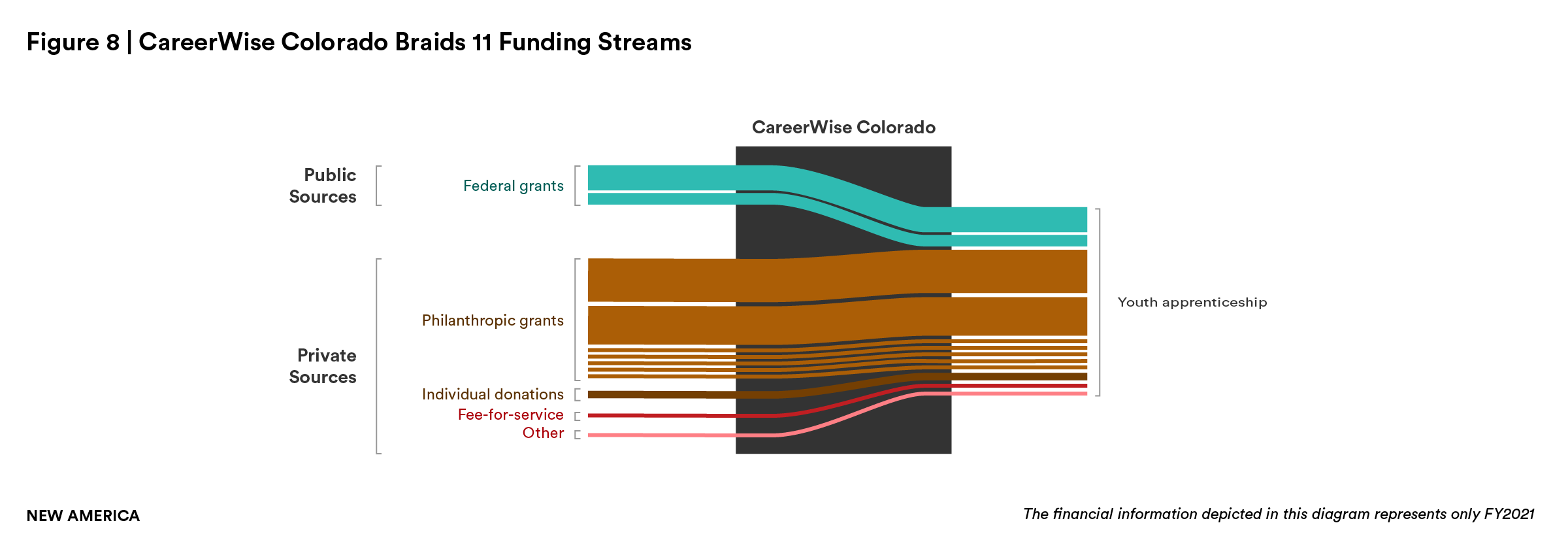
Funding CareerWise’s work has grown increasingly complex as the organization has evolved from a single program to a field-building intermediary supporting youth apprenticeship efforts nationwide (Figure 8). In 2020, CareerWise reorganized to create CareerWise USA to better reflect the national scope of its operations. The organization’s Colorado-based work is now housed under CareerWise Colorado, a business unit within the CareerWise organization. Below, we unpack four key strategies CareerWise uses to braid the dozen-plus income streams that support its work. Note that our analysis focused on the revenue and expenditures for CareerWise Colorado, and we have noted below instances that apply more broadly to CareerWise USA.
1. Secure Large Investments for Stable Start Up
In 2016, newly formed CareerWise Colorado received its first large, multi-year philanthropic grant, after a year where volunteers worked with Denver Public Schools on a vision and after many months courting potential funders This “angel investment” made the 2017 launch a reality, and helped attract two other large, multi-year philanthropic investments. CareerWise’s Hollis Salway and Kathryn Beach, vice president of Accounting and Finance, attribute securing these major grants to the ambitious vision of systems change they pitched to philanthropic funders, as well as the buy-in they received from several CEOs, school superintendents, and even Governor John Hickenlooper.
These initial grants provided some early breathing room, allowing CareerWise to establish itself as a statewide youth apprenticeship intermediary, even as it worked to define exactly what that might entail. CareerWise knew it needed to start smaller, with local pilots to test the model and build momentum toward its statewide vision. Initially, CareerWise provided resources and expertise to public-private partnerships in three communities to help them launch local programs. But even the promise of resources did not speed up pilot timelines, and partnerships took longer than planned to coalesce. This made spending down grants in the established timeframes tricky, and required CareerWise to seek modifications on early grant budgets to accommodate strategic shifts. But even with these challenges, the large, multi-year grants provided security as it figured out how to begin turning its ambitious vision into reality.
Early on, CareerWise also received public funding through Colorado’s Industry Infrastructure Grant Program, which was established in FY 2016. CareerWise was involved in advocacy efforts to shape the legislation which created the program, and it was well positioned to win funding when the grant launched. While the Industry Infrastructure Grant was a relatively small line in CareerWise’s overall budget, it helped the organization begin diversifying funding streams early and, more importantly, established CareerWise as a strong steward of public dollars.
2. Leverage National Footprint to Unlock Public Dollars
In 2018, CareerWise began fielding inquiries from community leaders from places as disparate as New York City and rural Elkhart County, Indiana, who, like its early investors, were drawn to CareerWise’s ambitious vision for systems change. Quickly, CareerWise Colorado leadership saw an opportunity to support the adoption of youth apprenticeship further afield. “We were kind of feeling stable in Colorado, and then—boom! New York [City] came in,” says Salway, referring to CareerWise NY, the first affiliate program to launch outside of Colorado. “We had the national demand sooner than we anticipated.”
CareerWise soon began providing technical assistance to other nonprofit organizations looking to develop and launch youth apprenticeship programs similar to their Colorado model. This growing national profile made it a more competitive applicant for federal apprenticeship funding. In 2018, for example, when JFF received a contract from the U.S. Department of Labor to serve as a national intermediary for youth apprenticeship, it selected CareerWise to serve as a subcontractor to provide technical assistance to communities developing youth apprenticeship programs.
Then, in 2020, CareerWise won a $5 million USDOL Youth Apprenticeship Readiness grant (YARG), the largest awarded in what was the federal government’s first-ever direct investment in youth apprenticeship programs. This funding not only supported CareerWise’s Colorado program, but also its emerging affiliate programs in New York, Indiana, and Washington, DC, illustrating how a national network can create “efficiency in fundraising across multiple sites,” as Salway put it. The YARG funds went towards critical intermediary functions, including student and business engagement, supportive infrastructure development, and marketing for the CareerWise sites.
This move towards federal funding has allowed CareerWise to increase the share of public dollars supporting its work, a goal it had set early on. In fiscal year 2021, for instance, public money—in the form of federal grants and subcontracts—made up nearly a quarter of CareerWise Colorado’s annual funding, about $1.4 million.
3. Develop Earned Revenue Streams
After receiving the YARG funding in 2020, CareerWise Colorado officially reorganized to create CareerWise USA, a national intermediary supporting the expansion of youth apprenticeship.11 This has allowed the organization to expand its national footprint and bring in more revenue from consulting, which is the organization’s largest earned income stream. CareerWise USA provides technical assistance and coaching to youth apprenticeship programs across the country. Some are CareerWise affiliate sites, who access CareerWise’s proprietary technology and program resources and pay for technical assistance. Others are not formally affiliated with CareerWise, but want to learn from its approach and get coaching as they build their own youth apprenticeship capacity. CareerWise’s leadership views these services as key to the organization’s future sustainability.
Employers’ buy-in is equally critical. Since its inception, CareerWise Colorado has charged a flat, per-apprentice fee that employers pay annually. Revenue generated from these fees supports intermediary capacity to operate the youth apprenticeship program, including recruitment and ongoing support for apprentices and business. To date, the income generated from this stream is not a sizable portion of CareerWise’s budget. In 2021, for example, it brought in around $156,000, out of $2.7 million in overall Colorado program funding. (CareerWise affiliates outside of Colorado keep income generated from their own employer fees.)
Still, the employer fee model is a conceptually significant feature of the CareerWise vision for youth apprenticeship in the U.S. CareerWise wants employers to see youth apprenticeship as a critical talent strategy worthy of their investment. The fee recognizes this value, as well as the value of the efficiencies and services that CareerWise provides as the intermediary.
When employers contribute financially, they also have a stake in the success of the program, which can be good for quality and long-term growth. According to Salway, when the enthusiasm—and financial support—for youth apprenticeship stems only from public sector and philanthropic partners but not employers, programs will struggle to gain momentum.
4. Establish a Vision for Sustainability
While philanthropic grants still make up the majority of CareerWise Colorado’s funding, the organization has worked to diversify its revenue streams to ensure a more sustainable funding structure. Over time, it has increased the share of revenue coming from public and earned revenue sources like consulting and employer fees.
Salway says that its medium-term sustainability goal would be a roughly three-way split between philanthropic grants, public dollars, and earned income. While it will take time for CareerWise to work up to this “more comfortable place,” as Salway describes it, having a clear objective helps drive strategy and shape priorities as different funding opportunities emerge.
For example, CareerWise has invested more capacity in state and federal policy discussions that could help unlock more reliable, renewable, noncompetitive public funding streams to support youth apprenticeship intermediary work in Colorado and nationally. “That stability and consistency would be huge,” Salway says.
So far, figuring out how to leverage state dollars hasn’t been easy. For one thing, Colorado’s constitution places strict limits on the amount of revenue the state can retain and spend, making new funding streams hard to come by.12 That’s not to say that the CareerWise advocacy efforts have not paid off, however. Some of its start-up funding resulted from advocacy from its leadership. And in October, CareerWise secured a new advocacy win: Colorado Governor Jared Polis announced the launch of the Colorado RISE Youth Apprenticeship Fund, a $2.5 million grant program to accelerate the expansion of youth apprenticeship in the state. In addition, the governor’s 2024 budget request aims to further solidify Registered Apprenticeship as a mainstream education pathway by investing $6 million in programs development and intermediary capacity and creating a $30 million tax credit for employers hiring apprentices.13
Like many organizations, however, CareerWise must weigh its goals for achieving a sustainable funding mix against the realities of the staffing needs necessary to pursue and manage it. Expanding policy engagement and advocacy work requires capacity and expertise that cannot be easily funded with grants intended to support programmatic work. Likewise, increasing earned revenue by expanding CareerWise’s consulting footprint could potentially be lucrative, but also potentially resource-intensive, given the expertise and time required to support program launch. And the nature of philanthropic support is always evolving. CareerWise Colorado has seen a gradual shift towards large, unrestricted grants from some of its funders, giving it more flexibility to invest in system change strategies while maintaining its programmatic goals.
CareerWise’s finance team is lean. With a dozen different funding sources braided to support CareerWise Colorado alone (in FY 21), it already has its work cut out for it. As it continues to diversify its funding mix in pursuit of that rough three-way split, CareerWise leadership knows they will need to maintains both financial health and appropriate staffing levels, and finds efficiencies along the way.
For all of its careful planning, skilled grant management, and entrepreneurial diversification strategies, true, long-term sustainability remains, in Salway’s view, decades away. To achieve it would require youth apprenticeship to become a mainstream postsecondary option, connected to and embedded within high schools, colleges, and employers’ talent strategies. And that, Salway observes, will require a dramatic reorientation of the country’s education and employment systems, and the funding infrastructure that currently supports them.
It’s a tall order, but that was, after all, the ambitious vision that landed CareerWise its first major philanthropic investment in 2016, and continues to motivate their work in Colorado and beyond. And it’s what drew that rapt audience of 200 to a dark ballroom in New York City on a gray day in October, thinking big about what’s possible for the future.
Case Study 3: Illinois High School District 214
Center for Career Discovery
Intermediary Name: Center for Career Discovery
Location: Schaumburg, Illinois
Founded: 2013
Annual Budget (FY 2022): $3.5M
Staff: 10
Programs Offered: Youth apprenticeship
Program Enrollment (2021–22): 679
When Dr. Lazaro Lopez began his tenure as Illinois High School District 214’s (D214) new associate superintendent of Teaching and Learning in the summer of 2013, he had an ambitious plan to transform how the suburban Chicago district prepared students for life after high school. Lopez’s vision was for D214, the state’s largest high school district, to provide every student, regardless of family income, disability, immigration status, etc., with high-quality college and career readiness experiences that would smooth their transition to post-high school opportunities.
Slowly but steadily, the district reoriented itself towards Lopez’s goal. The changes were incremental, but always ongoing. Programs that did not fit with Lopez’s college and career readiness vision were reconfigured until they did or were removed entirely. According to Dr. Marcella Zipp, D214’s director of Grants and Special Programs, “leadership has [had] such a focus on and commitment [to] scaling work-based learning in the district that if there were not funds available to do it, there are other programs that we would sunset because they are not necessarily contributing or aligned to college and career pathways.”
The three guiding principles for the district’s college and career pathways work is a sequence of courses beyond high school, a WBL experience, and a capstone of early college credits and industry credentials. As part of this new orientation, the district developed and launched work-based learning initiatives that, with time, became bedrocks of the D214 student experience.
Chief among these programs is the Center for Career Discovery. As D214’s flagship career-connected learning initiative, the Center for Career Discovery provides career exploration and training opportunities, from worksite visits to Registered Apprenticeships. In the range of experiences the center offers, Lopez’s vision to create WBL options for every student has come to life. On any given day in D214, students can be found solving work-related problems embedded within academic coursework, managing student-run businesses at some of the district’s seven campuses, or filling prescriptions at Walgreens as part of paid on-the-job training for their apprenticeship. Each year, the Center supports over 2,500 work-based learning experiences in partnership with over 1,000 employer partners. These experiences can be embedded in coursework, part of co-curricular activities, or standalone experiences, and together enroll 85% of the senior cohort. In the three major programs they operate – registered apprenticeships, youth apprenticeships, and internships – almost 1,050 students participate annually.
Enrollment in Center for Career Discovery programming was not always this robust. When it launched, only three students participated in Registered Apprenticeships and 20 in internships, out of 12,000 students district-wide. The small early numbers didn’t faze district leaders like Lopez. They had decided that, rather than pushing for higher enrollment as quickly as possible, they would aim for slower, more gradual growth, setting small, manageable goals for expansion in the early years. As student demand for the center’s programming increased, district leadership redirected financial resources to the center and later supported staff in pursuing competitive state and federal grants.
Zipp says the slow-but-steady approach has been key to the center’s success, both in terms of financial viability and community buy-in. “To have a sustainable program embedded into the entire culture of the district, there has to be a long-term plan to get it going,” she said.
That community support is meaningful, because the Center for Career Discovery relies almost entirely on public money, including tax dollars in the form of school district funds from the local community itself. Much of that tax revenue goes towards the salaries of center staff, including student success coaches and job placement specialists, who help students prepare for and navigate their WBL journeys.
Our analysis focused on the center’s three most intensive WBL programs: Registered Apprenticeship, youth apprenticeship14, and internship. Local district funds are the primary source of funding for each program, covering half the total cost of the internship program and nearly 80 percent of the cost for operating the youth apprenticeship and Registered Apprenticeship programs. The remaining funding for these programs comes from state and federal grants, both formula-based and competitive. Philanthropic grants comprise only a small share of program revenue (Figure 9). Program costs vary slightly among the three programs, depending on student needs and program requirements, but include expenses like transportation, dual enrollment tuition, instructor pay, supplies and equipment, student advising and job coaching support.
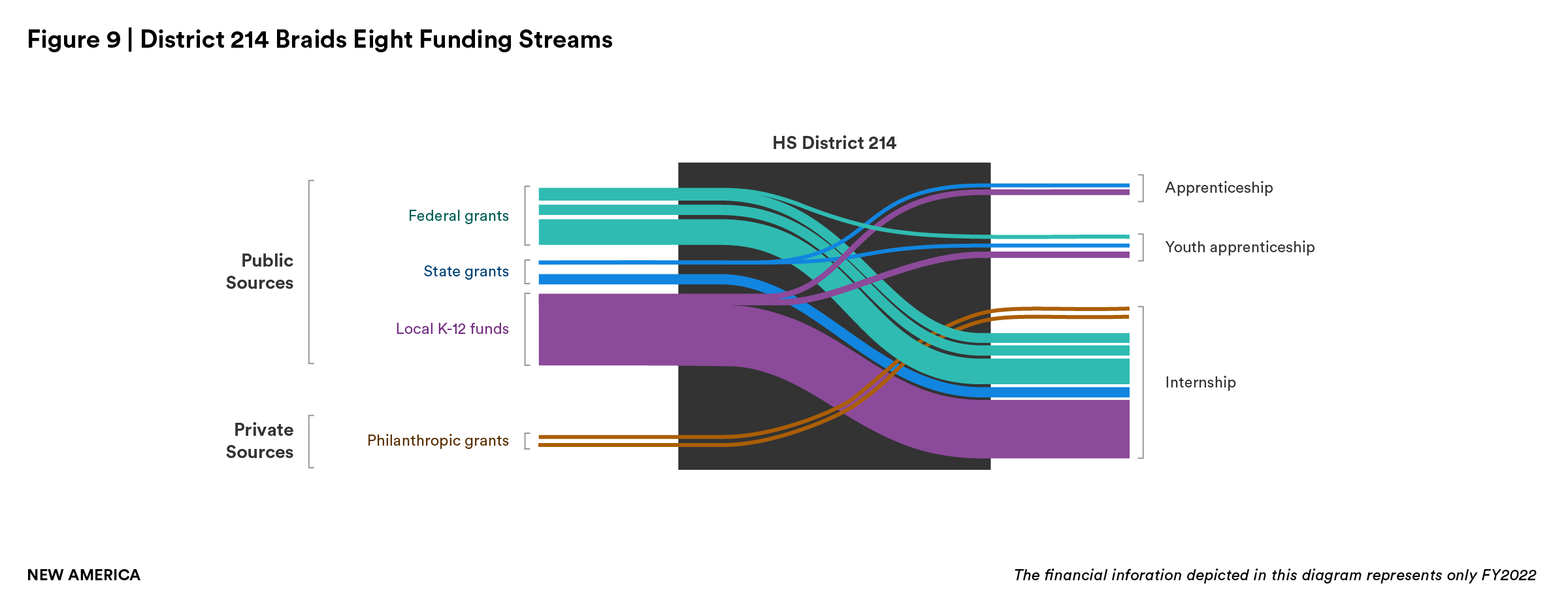
To braid these sources and streams of funding, Zipp and her colleagues rely on a set of strategies honed over the center’s first 10 years. These four approaches are characterized by nimble thinking with a core goal in mind: to ensure that the center’s needs dictate how its financial resources are spent—and not the other way around—in order to maximize its flexibility and support its own long-term sustainability.
1. Use Stable Funding for Most Critical Costs
Funding itself almost entirely with public dollars provides the center with a stable funding base. Its state and federal grants, including the competitive grants it receives, are usually part of reliable annual formula grant programs, rather than one-off funding opportunities. The center has the added bonus of access to local school district funds drawn from a robust tax base across eight towns in Cook County, a resource that has proven to be among the center’s most valuable assets. Compared to state and federal grants, local district funds are more flexible and require less intensive reporting. Moreover, D214 leadership’s willingness to spend this cash on hand has helped ensure program continuity in tough situations.
For example, during Illinois’s 793-day budget crisis—when the state could not distribute federal grant awards to school districts, from 2016 to part of 2018—D214 leadership approved the use of district funds in place of the missing federal dollars, even though there was no clear timeline on when they would be reimbursed. This decision embodies leadership’s vision for WBL: at D214, college and career pathways are considered a part of regular instruction, not a supplemental activity on top of academics, so funding this work is not seen as optional.
Given this orientation, it’s not surprising that Zipp draws on the center’s most stable funding streams to support its most critical resource: its staff, which includes six student success coaches and 17 job placement specialists as well as special education and administrative teams across the district’s seven high schools. Zipp prioritizes their salaries—the center’s largest expense—by funding them through school district funds and formula grants so that if the center were to lose its competitive grants, the programs would continue operating. “The staff is critical to our students’ success in the workforce,” said Kathy Wicks, partnership manager and apprenticeship and program supervisor at D214. “We couldn't [provide] that [support] without this budget.”
Ensuring consistent, equitable access to the district’s college and career readiness opportunities has required creativity. For example, D214 has twice petitioned the Illinois State Board of Education for permission to use Every Student Succeeds Act (ESSA) Title I funds more flexibly, which has removed financial barriers for low-income students to participate in college and career readiness activities, including dual credit coursework.15
2. Braid Funding Strategically to Promote Access and Pursue Sustainability
Though the public grants that fund the center can vary in terms of structure, award sizes, lengths, and reliability, they do have one thing in common: none of these grants includes legal permission to blend dollars with other funding streams.
Instead, Zipp employs braiding strategies to cover intermediary-wide and programmatic costs. When developing program budgets, staff generally apply the grant dollars first, beginning with the least flexible funding streams (i.e., those with the most specific and rigid eligibility requirements) and moving towards the more flexible options. For example, students with disabilities can receive IDEA (Individuals with Disabilities Education Act), STEP (Secondary Transitional Experience Program), or youth WIOA (Workforce Innovation and Opportunity Act) grant dollars, which ‘’follow’’ them and can be used to support their participation in different programs, including WBL. This setup allows local district funds, which have fewer restrictions and reporting requirements than these grants, to be applied last, covering whatever the grant dollars don’t or can’t. For example, students enrolled in WIOA who need transportation to and from their assigned worksites would have those costs covered first by WIOA grant funds. If there are remaining transportation expenses when that funding is exhausted, district funds can be used to cover remaining costs. This practice ensures that the WIOA grant is completely spent down on an annual basis, minimizing the use of district funds.
The strategy of spending down grant dollars first is emblematic of D214’s pragmatic, nimble approach. Zipp says other schools avoid spending down grants because they are hesitant about running out of funds. Instead of letting these norms dictate how they use their financial resources, D214 and Center for Career Discovery staff determine program priorities and needs and use this information to drive allocations.
3. Use Short-Term Grant Funding to Innovate
Of D214’s public grants, most are long-term. However, on occasion, short-term public grant dollars become available. The district braids these to support existing programs where possible, but also uses them to fund one-time or short-term expenses to expand or improve the district’s work-based learning offerings.
Recently, for example, the district used Elementary and Secondary School Emergency Relief (ESSER) funds—made available to schools during the COVID-19 pandemic—to purchase equipment and supplies for a new classroom with workstations that simulate real-world workplaces. Dubbed the Vocational Lab, the classroom is designed to help students with intellectual and developmental disabilities explore their interests and develop job skills so they can find meaningful employment after they leave D214. A typical day sees Vocational Lab students delivering mail, setting up retail displays, tending to plants, serving lattes, and operating cash registers at a student-run coffee shop. “The Vocational Lab and associated businesses like Forest Brew coffee shop and the D214 Store give students exposure to and the ability to practice job skills in more authentic settings than a typical classroom, helping them feel more prepared and setting them up for success in paid employment once they leave D214,” said Barb Kain, director of career discovery.
Similarly, the Center for Career Discovery has not relied on philanthropic grants to support long-term costs because those dollars are generally seen as more fickle than district funds or multi-year public grants. If a public grant award is going to be reduced or eliminated, the center usually knows two years in advance, giving ample time to secure new funding streams. Private foundations, on the other hand, can choose not to renew grants with little advance warning. “The uncertainty makes staff nervous,” Zipp said of relying too heavily on philanthropy.
While Zipp sees philanthropic money as less reliable than public funding streams, it does have some enticing advantages for the center—namely, much less intensive grant management. The center has used philanthropic grants to pursue new, untested pilot programs, channeling those private dollars directly into research and development efforts. This strategy not only allows the center to launch and then evaluate pilot programs, but also to determine whether they should become permanent and, if so, how to fund them sustainably using other, more permanent resources. And because it relies on private grants for this process, the center is able to develop and test unproven programming—to innovate—without jeopardizing funding for the rest of its work.
4. Leverage District Assets to Support the Center’s Operations
One of Zipp’s major challenges is the intensive grant management that comes with the center’s state and federal grants. The lack of alignment between the grants, their applications, and their reporting requirements creates a workload made manageable only by the center’s access to financial and data teams that serve the whole district. Similarly, because of its location within the district, the center is also able to leverage its student data systems, transportation infrastructure, and support resources (e.g., health services, counseling services, etc.) to monitor and support student success. While an external intermediary might need to fund these operational and support functions independently, the center is able to coordinate and provide WBL opportunities as part of a broader, district-provided ecosystem of shared resources.
Now at Cruising Altitude
The Center for Career Discovery has been around for a decade, and in that time, it has reached, as Zipp said, “a cruising altitude.” Budgets don’t need to be built from scratch anymore. Program staff know eligibility requirements of different grants inside and out. Data and financial teams have set up dashboards to ease reporting challenges. The center has survived and thrived during a two-year state budget crisis and a global pandemic, among other things.
Over the past 10 years, the center’s programming has become an expected part of high school education at D214. That fact, combined with leadership’s steadfast support and a healthy local tax base to fund WBL programming, allows Zipp to be confident that the Center for Career Discovery is here to stay. She knows staff members have the experience and the commitment to make programming work, even if they were to lose a significant share of their revenue. “If all the [grant] funding dried up, [the programs] probably would look different,” she acknowledged. “Maybe the transportation piece would be a little bit different, or maybe we would have to have employers contribute something for student dual credit tuition. But if the [grant] funding went away, this program would not.”
Citations
- CareerWise Colorado is a division of CareerWise. This figure represents annual revenue for CareerWise Colorado only. Total CareerWise revenue in FY 2021 was $6.2 million.
- This number represents total enrollment in CareerWise Colorado youth apprenticeships in 2021–22. Point in time enrollment fluctuates throughout the calendar year due to program timelines. Total enrollment across all of CareerWise’s affiliate sites is more than 1,900 since 2017.
- Swiss Confederation (website), “Vocational Education and Training & Apprenticeships,” updated September 13, 2023, https://www.eda.admin.ch/countries/usa/en/home/representations/embassy-washington/embassy-tasks/scienceoffice/vocational-education-and-training_apprenticeships.html.
- CareerWise Colorado and CareerWise USA sit abusiness units within CareerWise. CareerWise’s other affiliates—CareerWise DC, CareerWise Elkhart County (Indiana), CareerWise Greater Buffalo, and CareerWise NYC—are operated by or as independent 501(c)(3)s.
- Colorado’s Taxpayer’s Bill of Rights (TABOR) Amendment, which was approved by voters in 1992, allows the state to retain and spend an amount based on the prior fiscal year's actual revenue or limit (whichever is lower), grown by inflation and population growth and adjusted for any “voter-approved revenue changes.” For more information on this amendment, visit “TABOR” on the Colorado General Assembly website, https://leg.colorado.gov/agencies/legislative-council-staff/tabor.
- FY 2024–25 Budget Request (Denver, CO: Office of the Governor, November 1, 2023), https://drive.google.com/file/d/107s5Poa_QScaKEnYxbdKtZzIJw6CkBVw/view.
- In Illinois, a youth apprenticeship is distinct from a Registered Apprenticeship. Youth apprenticeship programs are shorter in length, requiring a minimum of 450-hours of OJT and at least two semesters of credit-bearing classroom-based instruction, among other components. For more information, see Brian Richard and Jennifer Foil, “Apprenticeship and Work-Based Learning in Illinois,” (DeKalb, IL: Northern Illinois University Center for Governmental Studies), https://www.ilga.gov/reports/ReportsSubmitted/1023RSGAEmail2276RSGAAttachApprenticeship%20and%20Work-Based%20Learning%20in%20IL%20Study%20Report.pdf.
- In Illinois, per state policy, the cost of dual credit coursework is negotiated and set in local partnership agreements between community colleges and high schools. Often, tuition and fees are reduced, but costs are borne by high schools, students and families. In FY2024 the state budget included $3.15 million for the Illinois Community College Board for Dual Credit grants and administration, the state’s first-ever appropriation to support dual enrollment.
Trends and Challenges
The seven intermediaries in this project vary in terms of their staff size, the number of youth they serve, their organizational strategies, and their geographic locations. Still, they face many of the same challenges when it comes to financing their work. Based on the quantitative and qualitative information provided to us through the intermediaries’ survey responses and our in-depth interviews with three of the seven respondents, we have identified six of the most common, pressing challenges WBL intermediaries face in developing funding models.
Program expenses are easier to fund than personnel costs.
Intermediaries in this analysis shared that some aspects of their work are easier to fund than others. For most, funding costs associated with classroom training and certification16 is relatively easy. The majority report using public funds to cover at least part of the costs of classroom training. Based on our case study interviews, we know that some leverage public education dollars that are not included in their budgets but are critical to their programs (see Intermediaries struggle to communicate the true costs and value of their programs below). Several intermediaries indicated that funds for supportive services (e.g., student advising) and direct student supports (e.g., stipends, transportation, books and supplies) are also easy to secure relative to other costs, but many also said they are insufficient to cover students’ needs (especially transportation costs). Program expenses with clear benefits for young people were the easiest for intermediaries to secure funding for—in part, as one intermediary explained, because these costs can be tied directly to enrollments and outcomes.
On the other hand, all of the intermediaries reported that adequately funding staff capacity is a challenge. The survey asked intermediaries, “If your organization were to receive 50 percent of your current budget in unrestricted funds, how would you use those resources?” All seven intermediaries said they would add capacity, including personnel, to improve mentoring and advising for students, or staff to recruit business partners, expand communications functions, engage with policymakers, or strengthen evaluation and research capacity.
Many of these examples are roles that may not be directly involved in program implementation, but which provide coordination or outreach critical for growth (e.g., recruiting employers). We learned in interviews that administrative and operational roles—like finance staff responsible for managing intermediaries’ complex budgets—can also be difficult to fund at adequate levels. As a work-around, some intermediaries devote a portion of a program staff member’s time to these critical functions, a solution common in the nonprofit space, but one that may not allow for sufficient specialization and could limit an organization’s ability to improve, innovate, and grow in key areas. In some cases, as one of our interviewees observed, this “many hats” approach can contribute to staff burnout and turnover.
Time-limited grants help with start-up but pose challenges to sustainability.
The intermediaries in this analysis rely heavily on time-limited grants from both public and philanthropic sources. Only three of the seven intermediaries in this analysis reported public formula-based funding as part of their intermediary revenue. And for those that have developed fee-for-service revenue streams or receive in-kind donations, those sources made up a small portion of overall revenue.
This heavy reliance on time-limited grants means an ongoing cycle of fundraising and reporting. While this perpetual development cycle is not uncommon in the nonprofit space, it can be time- and resource-intensive, especially for smaller, newer organizations. Sometimes, intermediaries noted, the reporting requirements are not commensurate with the amount or duration of the grant, and they said that this can be true for both philanthropic and public grants. Additionally, whether public or private, small, short-term grants may not align with multi-year WBL program cycles, which can cause cash flow issues, especially for smaller intermediaries. That is, a grant may last for just one calendar year but support a program that enrolls students for two academic years.
Intermediaries also expressed a concern that short-term funding may make it more difficult for them to bring on new implementation partners, particularly employers, who may be skeptical of the program’s sustainability. If an intermediary is reliant on a mix of one- and two-year grants that may not be renewed, why should a partner sign on to hire an apprentice for three years?
Intermediaries recognize that program growth can unlock new funding opportunities, but some felt growth and innovation was constrained by their short-term funding cycles, so it’s not surprising that those in our analysis shared open-ended responses that made it clear that “multi-year funding is essential for this work.”
Intermediaries seem to access more public funding as they grow.
Our analysis found evidence that nonprofit WBL intermediaries can tap into more public funding as they establish a track record of success and begin operating on a greater scale. Newer intermediaries reported a higher number of short, small philanthropic grants (i.e., 12 months or shorter, $100,000 or less). Older, more established intermediaries also braided funding from short-term grants, but a larger share of these were public revenue sources, some of which were renewable. They combined these short-term resources with larger, longer-term funds, including multiple federal grants. For two of these more mature organizations, short, small philanthropic grants (e.g., $75,000) are “no longer worth the time” it takes to apply, report, and renew them.
Significantly, however, it’s not possible for us to establish clear causation. Did these intermediaries receive more public dollars because they grew and matured, or were they able to mature because they had access to public dollars from inception? Our case study interviews would suggest both.
Public funding is not necessarily more attractive.
Intermediaries in our analysis did not express strong preferences for public or private funding overall, since both types came with benefits and challenges, and both come with significant application and reporting requirements. Applications for public grant dollars can be intense and complex. They often vary significantly, both within and between agencies, which can mean submitting two very different applications for resources supporting the same WBL program. This variation can also contribute to burdensome reporting on the back end. Public dollars also come with more restrictions, which make budgets harder to modify once the work is underway. With dynamic budgets that involve a significant amount of braiding, this inflexibility can be challenging for intermediaries, especially during early pilot phases.
However, public dollars tend to be more predictable and that stability can make the administrative challenges worthwhile, according to our interviews. Public funding streams that run on annual cycles follow similar timelines and processes each year, which aids planning. And when a particular public funding stream is about to dry up, recipients typically know well in advance so they can plan accordingly. As two of our interviewees observed, the same is not always true for philanthropic dollars.
Intermediaries interviewed in our case studies agreed that public formula funds would provide much-needed stability to their budgets and operations. At D214—the only intermediary in the group accessing true formula funds—dollars from the district’s annual budget are used to support staffing for the Center for Career Discovery. This ensured it has adequate personnel to implement WBL programming, even if that programming has to change due to shifts elsewhere in the center’s budget. The “stability and consistency [of formula funds] would be huge for us,” said staff at CareerWise. “And planning for it and around it would be easier, too.”
Intermediaries struggle to communicate the true costs and value of their programs.
Our analysis looked exclusively at intermediaries’ revenue sources and expenses. But many of the intermediaries in this analysis operate programs that rely to some extent on funding that flows through partner organizations. This funding does not appear in intermediaries’ budgets, nor do they have discretion over how it is used. For example, multiple intermediaries in this analysis operate youth apprenticeship programs that include high school coursework as part of the required related technical instruction for apprentices. These courses are typically funded by a mix of state and federal sources, including Perkins dollars, which support career and technical education, and stay within the public school system.17 The intermediaries do not receive these funds directly, but they leverage them as part of program implementation. In theory, an intermediary might also leverage a partner’s philanthropic funds if, for example, it taps into grant-funded student supports offered by the partner agency.
Intermediaries struggle to estimate the extent of the resources they leverage through their partners, which makes it difficult for them to estimate the full cost of their programs. Significantly, it also complicates their ability to communicate the full value of their offerings to partners, policymakers, and potential funders. If youth apprenticeship programming connected to high school CTE coursework improves CTE outcomes and increases graduation rates, for example, the program could be said to be a strategy for making more effective, efficient use of those dollars, too. But if staff members cannot quantify this impact in terms of student outcomes and dollars leveraged, they will underestimate the full extent of the program’s benefit.
Sustainability is an elusive and ill-defined concept.
All intermediaries aspire to be financially sustainable, but there is little consensus about what sustainability would or should look like for different organizations. How many sources of funding is ideal? What is the optimal mix? For some of the organizations in our case studies, there was a recognition that sustainability could be “decades out, not five years away” or that it might not exist at all. “Everyone wants you to say, ‘We can make this 100 percent sustainable,’” a leader at one intermediary shared, but “I don't think any funding source is truly sustainable.”
Our interviewees could, however, define financial stability and articulate the work they have done to achieve it. To them, stability meant reaching a level of confidence in the financial health of the organization and having the ability to predict what funding might look like a year or more into the future. It meant developing processes and systems to budget effectively, track costs, and forecast future priorities. It meant diversifying funding sources, renewing major grants, finding ways to tap into more reliable funding streams, and securing resources to pursue new priorities. And it meant feeling that the organization could weather financial uncertainty.
Citations
- In our survey, this expense category included instructor pay, tuition and fees, supplies and equipment, development of training programs and curriculum. Costs associated with on-the-job training were reported separately.
- For more information on how states fund dual enrollment, see Bryan Kelley, Lauren Bloomquist, and Lauren Peisach, 50-State Comparison: Secondary Career and Technical Education, Education Commission of the States, March 2, 2023, https://www.ecs.org/50-state-comparison-secondary-career-and-technical-education-2023/.
Conclusions and Recommendations
Intermediary organizations play an important role in supporting the expansion of equitable, high-quality work-based learning opportunities for youth. Though no two models look the same, WBL intermediaries all need to translate and coordinate across the many partners needed for these programs to succeed and grow. But despite growing recognition of intermediaries’ importance in the expansion of WBL for youth, their finance models—and, importantly, their path to sustainability—are not yet well understood.
Intermediaries’ finance models are complex and, as this report makes clear, they vary. However, all of the intermediaries braid multiple revenue sources to fund their work. Braiding funding sources is often framed as a strategy for sustainability, but for the intermediaries in this analysis, braiding was first and foremost a strategy for survival. Without dedicated, recurring funding sources to support the full cost of their operations and programs, they weave together grants, formula funding, earned revenue, in-kind donations, and other public and private money. These funding models appear to grow more diversified and, by extension, more complex as intermediaries mature and their programs expand. Finance leaders at these organizations also became more adept and comfortable with managing these complexities, allowing the intermediaries—at least those interviewed for our case studies—to achieve a degree of financial stability. Still, however, true sustainability felt elusive. And without dedicated funding to support intermediaries’ role in the expansion of WBL, it might be.
Fortunately, there are steps program leaders, state and federal policy leaders, and philanthropic leaders can take to support the financial health of WBL intermediaries in both the near and long term. Our analysis leads us to make the following recommendations.
For work-based learning leaders
- Estimate true costs of implementing and coordinating WBL programming, taking into account not only expenses borne by the intermediary, but also those that may be covered or provided by partners, with or without formal financial agreements.18 Understanding the true cost of a program—and the true extent of the public and employer investment it leverages—can help intermediaries demonstrate program efficiency and strengthen the case for additional program resources.
- Map funding opportunities in cooperation with partners that have access to different resources that they can use to support a shared mission. Together, determine if and how resources—including both financial and operational resources—might be shared and identify and prioritize funding gaps. Having a shared understanding of options and constraints can clarify priorities and unite partners around common goals, even it does not lead to a dramatic redistribution of resources in the immediate term.
- Establish goals for financial stability while working to develop a vision and plan for sustainability in the long term. Goals should reflect an organization’s overall strategy and might include targets for diversification (e.g., develop earned revenue stream) or resource allocation (e.g., fund staff with reliable, renewable funding source). Setting near- and long-term financial goals can help intermediaries make more strategic decisions as new funding opportunities and challenges emerge.
- Invest in staff capacity to achieve financial goals. For upstart intermediaries, this may mean hiring a full-time staff member to manage complex budgets, track costs and expenses, and apply for and administer grants. The experiences of the intermediaries in our case studies suggests that finance models get more complex as intermediaries expand services and programs. Dedicated finance and development staff can protect an organization as it grows and position it to compete for and manage larger, more complex funding sources.
For state and federal policy leaders
- Inventory funding sources that can support youth WBL and provide clear, accessible guidance to help WBL partners understand the full range of public resources that can support programs and partnerships. The inventory effort should include funding sources and streams administered by education (including K–12 and postsecondary funding), workforce, economic development, and other relevant agencies. Guidance should clarify if and how funding can support capacity to operate WBL programs, and whether and how that funding can flow to intermediaries outside of the public system. State leaders should also use this process to assess the extent to which existing funding options adequately support public goals or mandates related to WBL.
- Align application and reporting requirements with each other to reduce the administrative burden of WBL intermediaries that braid funding from multiple public sources to support the same program(s). Greater consistency across application requirements (and application systems), reporting templates, and data collection processes would be beneficial and could eliminate barriers that discourage intermediaries—especially those with limited finance and administrative capacity—from pursuing public resources.
- Experiment with flexibility and incentives to encourage innovation and cross-agency partnership. With WIOA and Perkins plans due in 2024, states have an opportunity to reassess and reassert priorities related to college and career success and to realign resources accordingly. For states prioritizing WBL expansion, this presents an opportunity to develop cross-agency strategies for supporting intermediary capacity (within or outside of existing public systems).
At the federal level, cross-agency cooperation through a new performance partnership model similar to the Performance Partnership Pilots for Disconnected Youth (P3) could support experimentation with innovative finance models for WBL intermediaries, many of which already braid funds from the U.S. Departments of Education, Labor, and Health & Human Services, among others. Designed effectively, the pilot could lead to improved service provision for youth and employers, while yielding valuable insight for federal agencies that administer funding sources that are aligned, but remain problematically siloed. - Increase investment in intermediary capacity to support WBL. In the near term, state and federal leaders can support intermediaries by creating new grant programs or modifying restrictions on existing grant programs to make it easier for intermediaries to use public resources to coordinate and deliver intensive WBL experiences. To encourage buy-in from employers, grant programs could include local match requirements or technical assistance to develop fee-for-service models. However, in order to truly expand high-quality WBL opportunities for American youth, more reliable, renewable funding streams will need to be created to support the operational capacity necessary to implement them.
For philanthropic leaders
- Recognize the need for flexible, patient capital, especially in cases where an intermediary is launching and must build new, cross-sector partnerships to achieve its programmatic goals. High-quality, intensive WBL programs require partners, including high schools and businesses, to change entrenched systems and cultures. Multi-year grants can provide room for WBL intermediaries to build trusting partnerships, while also supporting more robust, multi-year program models.
- Invest in intermediaries’ financial health by supporting dedicated finance personnel, professional development, and technical assistance related to braided finance models. Professional development might target not just the intermediary’s staff, but also finance personnel from across the partnership to facilitate learning, improve communication, and strengthen cooperation. Technical assistance should support intermediaries in understanding the true cost of their programs and assist them in modeling different paths to sustainability as part of business planning efforts. Technical support exploring and applying for large public grants would also be of value.
- Coordinate with other funders to align priorities and investments in WBL to reduce administrative burden and fragmentation in the field. More consistency across grant applications, reporting, and data requirements would benefit individual intermediaries and promote common priorities and metrics for WBL quality. Philanthropy has an important role to play in encouraging innovation and promoting a focus on equity, and in making both possible where public dollars cannot. Collaborating rather than competing with peer funders—including, where appropriate, public agencies—can reduce pressure that intermediaries feel to repackage their work to appeal to different funders’ priorities and will help them maintain focus.
- Fund additional research to understand the true cost and value of various WBL program models, and to continue assessing the potential of different intermediary and partnership formats to deliver quality outcomes and achieve sustainability. This analysis was not designed to link program or system change outcomes with intermediaries’ costs or finance models. Research that does so would be a valuable next step.
These recommendations are not intended to be exhaustive but rather, to provide concrete, achievable steps that, based on our analysis, we believe are needed to support the survival and sustainability of intermediary organizations working to expand work-based learning opportunities for youth.
Citations
- The Nonprofit Finance Fund’s (NFF) Full Cost Framework (https://nff.org/full-cost) is a useful starting point for intermediaries to assess the full cost of doing business. However, this recommendation suggests that intermediaries go one step further to estimate the full cost of the program, taking into account expenses and costs borne by all partners. To distinguish this recommendation from NFF’s Full Cost concept, we have adopted the term true cost.
More About the Authors
Taylor White
Director, Postsecondary Pathways for Youth

Lancy Downs
Senior Policy Analyst, Center on Education & Labor
Issues
Programs/Projects/Initiatives
Related