A Chapter of: Telling the Story of Child Care
Collection of Stories on Care
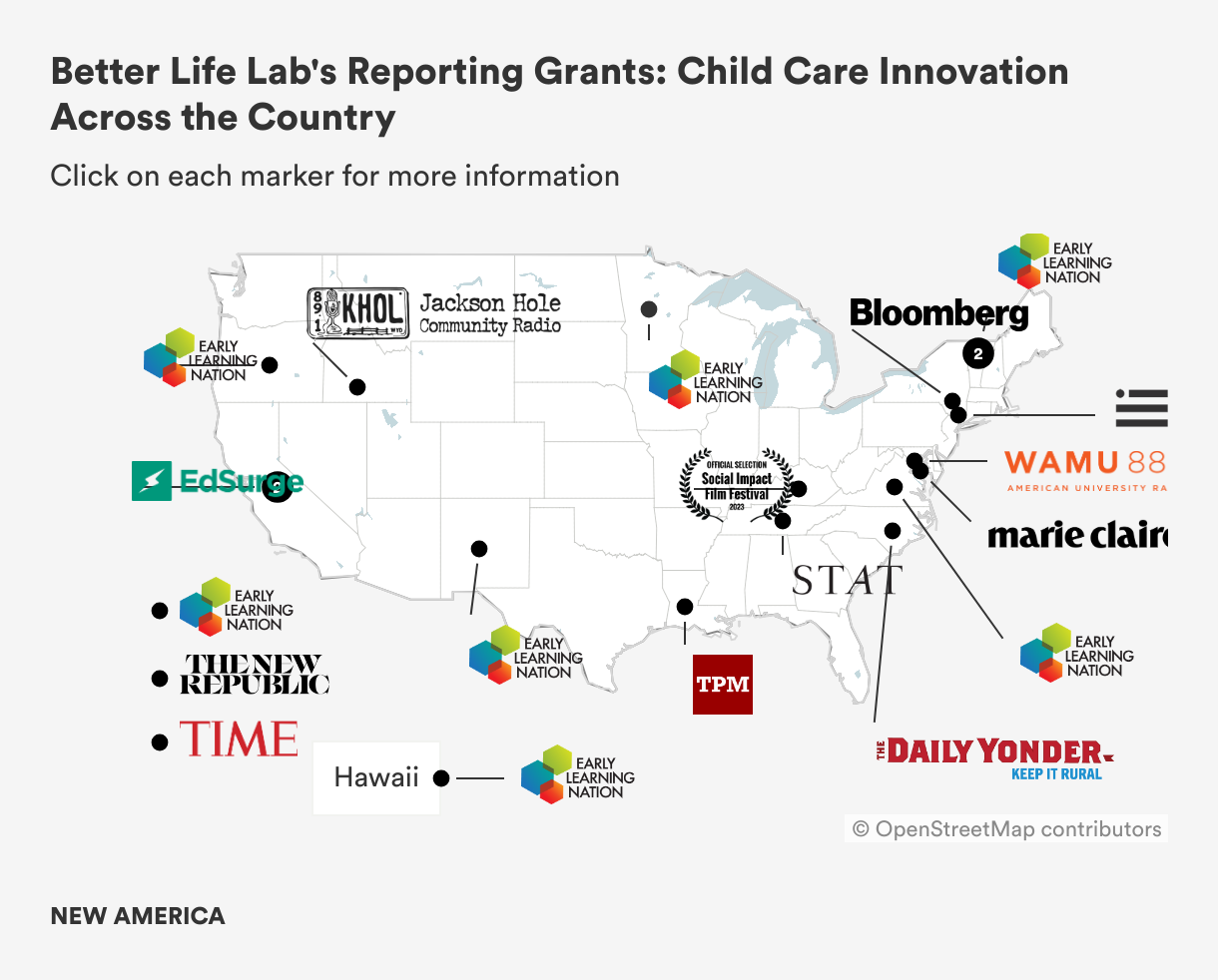
Below is a list of 17 stories supported by Better Life Lab’s reporting grants. To read the full article, click on the link before each story summary. Stories are listed by date of publication.
Child Care Is in Chaos. Private Equity and For-Profit Chains Are Swooping In
As the industry consolidates, it runs the risk of putting profits ahead of kids—and setting back the movement for universal child care.
By Elliot Haspel, New Republic
October 28, 2022
Author and former educator Elliot Haspel wrote an article for the New Republic about the growing influence of private equity in the child care sector. There had been rumblings about investor-backed chains working against universal child care measures (later confirmed by New York Times reporting, which quoted Haspel’s work in their story), and Haspel had heard several anecdotes about chains gaining market share as independent programs failed due to challenging economic conditions. Researching this more, it became clear that the chains are operating with little scrutiny—especially compared to those in other countries—and that there were several unexamined ways in which chains work against goals of comprehensive, high-quality, accessible and affordable child care.
How Child Care in Oregon Is Saving the Construction Trade
A statewide apprenticeship program with generous child care subsidies trains and recruits workers.
By Rebecca Gale, Early Learning Nation
January 30, 2023
The construction boom in Oregon had reached a tipping point—90 percent of construction companies said they didn’t have enough qualified workers to meet demand. The state of Oregon wanted to create a pipeline to train more workers and offered child care as one of the benefits for its apprenticeship program. Journalist Rebecca Gale interviewed workers in the program who spoke about what a difference such a benefit makes, particularly in a field like construction that often requires nontraditional hours and can require travel. Having reliable, affordable child care allowed more people to get training and complete their program, which then leads to a stable, quality job and a better outcome for the entire family.
The Power of a Rural Community Collaborative
Idaho’s Teton Valley draws a roadmap to address its child care crisis.
By Natalie Schachar, KHOL Jackson Hole Community Radio
February 6, 2023
In this online story, journalist Natalie Schachar highlights that child care is a critical concern in Teton Valley, Idaho, which has seen the closure of various facilities within the last two years. But amid the crisis, members of the community have come together to form Teton Valley’s Collaborative. The group has already gained approval to pursue a lease on a nearly half acre parcel of school district property where a donated house could be moved and turned into a child care facility. They have also helped advocate for an existing child care center, Building Blocks, to keep its current lease and completed an application for a $1 million dollar grant for early care and education from the Idaho Workforce Development Council. Through their efforts, kids might get care and parents might get some relief. Schachar also reported two additional stories connected to the research of this piece, “Community Members Seek Use of Teton School District Property for Childcare Facility” in Teton Valley News and “Amid Child,” which ran on Jackson Hole Community Radio.
Educator Burnout: Another Child Care Struggle
Facing educator burnout and high rates of depression, educators come up with ways to retain staff and focus on mental well-being.
By Rebecca Gale, Early Learning Nation
February 28, 2023
Hiring and retaining staff has always been a struggle, but journalist Rebecca Gale spoke to centers who say this is the worst it’s ever been—exacerbated by low morale and low wages. Researchers found that depressive symptoms jumped from 19 percent to 32 percent between 2019 and 2022, and teachers were more likely to report every symptom of depression, including restless sleep, poor appetite, or feeling lonely. Many were leaving their positions in child care to work in fast-food or retail to make more money. Before the COVID-19 pandemic, one child care center explained they could hire workers for $9 or $10 an hour and expect to have some stability. Now the center offers $11 to $13 hourly—straining what the families who use the center can afford to pay—and are still having trouble retaining employees. Gale spoke with child care center directors about what can be done to improve staffing at centers across the country, and why the need for more public funds like those provided through the American Rescue Plan are crucial to giving the hard-working staff a livable wage without burdening the families already paying a significant amount of their take-home pay on child care.
Home-Based Care: Fixing the Child Care Drought in Rural America
Some rural counties are trying an approach to tackle child care shortages: A new program supports home-based child care providers with resources, education, and grants.
By Anne Vilen, The Daily Yonder
March 7, 2023
Child care advocates in one rural North Carolina county are focusing on home-based child care to address child care shortages. Supported by national, state, and regional funders, the shift to home-based care is designed to bolster a rural economy that runs on seasonal work, small businesses, and low-wage work with nontraditional hours. The initiative also promises to provide quality child care for rural families and get more children ready for kindergarten by age five. Reporter Anne Vilen’s interest in small town child care solutions began 25 years ago when her own children attended home-based child care. A generation later, her conversation with small town movers and shakers, and the women who care for children in rural communities, reveals a visionary infrastructure-building solution that starts with valuing the women who are already taking care of our kids—at home.
DC Is Giving Preschool Teachers a Pay Bump. Here’s How It’s Making a Difference to Them
The DC Council passed a law in 2022 to boost pay for the District’s early childhood teachers as an annual bonus payment of up to $14,000 for teachers of children between zero and five years old in preschools and daycares in the District.
By Emily Berman, WAMU
March 14, 2023
Emily Berman, a seasoned radio reporter, covered how DC child care providers were impacted by the DC Council’s plan to boost pay for the city’s early care and education teachers. The Pay Equity Fund, which taxed the District’s highest earners, sent an annual bonus payment for up to $14,000 for teachers of children between zero and five years in preschools and child care centers in DC. The goal had been to provide more mechanisms for child care workers to be paid more in line with school teachers. Even though the providers who spoke to Berman echoed how grateful they were to receive the bonus payment, it translated into just $200 more per week, which is still not enough for many to make a living wage and not have to work a second (or third) job, as many of those interviewed had to do.
The U.S. Finally Started Building a Functional Child Care System during the Pandemic. We’re About to Tear It Down.
Pandemic-era funding led to a host of creative local child care solutions. The looming funding cliff puts the country at risk of backsliding on all the progress made over the last three years—progress that has left a deep impact on Americans’ lives.
By Bryce Covert, Talking Points Memo
April 14, 2023
The federal government sent states historic amounts of funding during the pandemic to support the child care sector. Journalist Bryce Covert decided to look at what states actually did with that money. Did they all accept it? What did they use it for? Covert found that across all states, both blue and red, the money was put to innovative and important uses such as substantially expanding eligibility to child care assistance, making the assistance low-cost or even free for families, and compensating providers in fairer, more robust ways. The pandemic experiment proved that states are not only eager to build a better child care system, but have great ideas about what the system of the future should look like—they just don’t have the money. And, unfortunately, as the funding starts to run out we’re at risk of losing all of that forward progress.
How to Fix Crumbling Child Care Infrastructure
U.S. cities and states are starting to think about early childhood facilities the same way they plan for schools and public transportation.
By Kendra Hurley, Bloomberg
April 25, 2023
Kendra Hurley’s story explores a topic that is an under-reported yet crucial piece of the child care crisis: facilities. Early education programs rarely generate enough revenue to cover the costs of facility upkeep, expansion, or construction. Steep facility costs drive down worker wages, push up tuition costs, and fuel the child care shortage. They also leave kids in unhealthy environments and parents and their employers stranded when facilities close for emergency repairs. Yet the federal government does not treat child care as an infrastructure problem.
As the country emerged from COVID lockdowns, Hurley noticed a promising trend develop: Several local and state leaders were looking to grow child care programs using classic planning tools. Officials in Honolulu had taken stock of public land and property that might house low- or no-rent early education facilities. Colorado and California revamped land zoning policies to make it easier for family child care to grow. New York City carved out new tax perks for property owners and employers willing to help construct child care. Hurley’s story, which ran in Bloomberg’s CityLab, highlights these and other low-cost examples of cities and states planning for child care as infrastructure.
Why Saving New York City’s Universal Preschool Matters for the Country
The high demand for New York City’s 3K for All universal pre-K program means that not all families who qualify can get a spot.
By Kelly Clancy, New America’s The Thread
May 25, 2023
Journalist, writer, and political scientist Kelly Clancy reported on the state of 3K and pre-K for all in New York City, and why families who qualify for a spot in the City’s program cannot access one. She interviewed members of city council, union members, parents, former NYC Department of Education members, and researchers to understand the shifts between the de Blasio administration and the Adams administration in terms of the expansion and funding of universal pre-K in the city. The different tactics between the administrations created vastly different outcomes: De Blasio created an aggressive outreach strategy to recruit students into the program, envisioning an eventual process of expanding to universal child care. Adams, however, has invested less in recruiting and has pushed to defund the program—justifying this decision by citing a lack of demand—and moving toward a more traditional “means tested” approach. Clancy found that the political forces that shape the city leadership can affect who gets into a program and which families understand how to apply and when: The result being that fewer families have the opportunity for the 3K and pre-K program, even though the City has demonstrated a willingness and capability to serve more families. Clancy’s reported piece ran in The Thread, New America’s digital magazine.
More Hospitals Are Offering Child Care. But They Shouldn’t Have To
On-site child care is a valuable benefit for health care employees, but is depending on a generous employer the best way to fix the child care crisis?
By Rebecca Gale, Stat News
May 30, 2023
The lack of federal child care infrastructure means that the health care industry is stepping in to create its own child care systems. Journalist Rebecca Gale’s piece for Stat News focused on the how and why of hospitals and health care systems taking action to combat a staff recruitment and retention crisis that is particularly acute for nurses, who are overwhelmingly women and who resigned from hospital work in huge numbers during the first two years of the pandemic. Gale’s piece covered several hospital systems, some of which serve as the largest employer in their region, offering child care options both as a perk to employees and as a way to reduce absenteeism. While this may be a good solution for those families affected, it still indicates a broader need for better public policy solutions, like federal investment in child care. Stat News is a publication geared toward people connected to the healthcare industry.
Invisible Care Work of Family, Friends, and Neighbors: A Two-Part Series
The work of family, friends, and neighbors in caring for children is critical, but it often goes unseen in an already overlooked child care workforce. Connections to organizations and resources can make a difference for family, friend, and neighbor child care providers.
By Ashley Álvarez, EdSurge
June 2, 2023
‘The Truth Is, I Love the Work’
June 7, 2023
The two-piece article series shared the experiences of five California-based child care providers often referred to as family, friend, and neighbor providers (FFNs). The first article, “A Job That No One Sees,” focused on highlighting the challenges experienced by three of the five providers, including economic precarity and lack of systemic supports. The second article, “The Truth Is, I Love the Work,” focused on the resources the outside organization First Five California provided the remaining two interviewees. These supports strengthened their ability to provide the best care to the children of their community, one in Los Angeles and the other in the agricultural city of Salinas. In reading this series, readers will be struck by the commitment and skill of these FFNs in the face of challenging circumstances. The women—all Central American immigrant women from low-income backgrounds—have a commitment to supporting the families they work with despite low wages, minimal institutional support, and a perceived social devaluation of their labor. As advocates and policymakers consider how to move toward a universal, just child care infrastructure, the voices of FFNs are critical to understanding a historically undervalued workforce and the resources needed to support them. The series was written by Ashley Álvarez, a current undergraduate student at Harvard University and an aspiring early childhood and K-12 professional.
When Summer Camp Doesn’t Work for Your Kid
The lack of federal infrastructure for child care is particularly challenging for kids who are a poor fit for traditional summer camps and have few other options.
By Rebecca Gale, TIME
June 3, 2023
Writing from the first-person perspective of someone trying to find child care for a child with special needs, journalist Rebecca Gale reported on the summer camp conundrum for parents, which is exacerbated in America by the lack of any federal infrastructure to support parents of young children. There are very limited options for school-age children for child care in the hours when school is not open, and the options for neurodivergent or special needs children who can’t readily participate in group environments without additional support is even more limited. Without federal investment in a broader child care system, kids with special needs will have to seek out limited options, or parents will have to take a step away from work to care for them.
Did COVID Break Child Care? Or Was It Already Broken?
A graphic explainer on how COVID-19 impacted child care and why the lack of federal investment has made the U.S. child care system untenable for many.
By Rebecca Gale and Dianne Kirsch (Illustrator), Early Learning Nation
June 21, 2023
The child care system is complicated, and the lack of federal investment and infrastructure means it is up to individual families to come up with solutions. When child care centers closed during the emergency phase of the pandemic, many parents had no other option and had to curtail, shift, or abandon work responsibilities to care for their children. This became a crisis the country could no longer ignore, especially when women began leaving their jobs citing child care responsibilities as the reason why. But advocates who have studied child care have long understood it wasn’t COVID that broke the system, it exposed the broken system for what it was.
As part of our larger storytelling series, this was our first foray into graphic stories to reach a wider audience using different mediums. With minimalist line art and vivid colors, drawn by artist and illustrator Dianne Kirsch, this comic unravels the ripple effect of the broken child care system on working families, child care workers, and employers. By using visual storytelling, each frame carries a powerful message, compelling viewers to reflect on the urgent need for reform and federal investment.
“Beyond the Scope of What They Could Manage”: Navigating Care for Children with Invisible Disorders
For parents of challenging children, the scant child care options mean wage and career setbacks.
By Rebecca Gale, Marie Claire
July 17, 2023
Journalist Rebecca Gale explored how parents with challenging children can face additional obstacles in securing child care. Without reliable child care—or with anxiety about a child being kicked out of care, camp, or school—parents often opt for jobs that allow for more flexibility but often pay less. Without a federal infrastructure in place for child care, the children who have behavior challenges and require more staffing will be harder to find care for and the parents will have to make arrangements to be more available—often at the expense of furthering their careers or being able to support their families.
A System on Life Support: A Kentucky Town Tries to Save Child Care
A documentary film, selected for the Social Impact Film Festival in New York and Bare Bones Music & Documentary Festival in Oklahoma, shows a Kentucky town’s efforts to fund high-quality care.
By Rachel Haeseley
Long before the COVID-19 pandemic, about 50 percent of Kentucky was already considered a “child care desert,” meaning there is more demand for the service than there are available spots, and many child care teachers and providers were already earning poverty wages even as strapped parents struggled to afford child care tuition. Kentucky’s already fragile child care sector, like in other states, made it through the COVID-19 pandemic as a result of emergency federal funds from the American Rescue Plan. But with those dollars set to end, child care centers and parents alike are bracing themselves for tuition hikes, potential closures, and teacher shortages. Filmmaker Rachel Haeseley produced, directed, and edited this documentary after becoming a parent during the COVID-19 pandemic and having to navigate the sparse child care landscape in her home state of Kentucky.
With so much at stake and no federal solution in sight, A System on Life Support highlights a unique grassroots effort in Owensboro, Kentucky, determined to find a local fix. The Greater Owensboro Partnership for Early Development is comprised of parents, teachers, community leaders, philanthropists, and business partners with one common goal: to not only keep Kentucky’s shaky child care infrastructure afloat, but to find local solutions that will strengthen the system—for good—so our children, families, communities, businesses, and economy can flourish.
Overview of Historic Child Care Wins in Three States: A Series
A series on how three states—New Mexico, Vermont, and Minnesota—expanded funding and access in a push for universal child care.
By Rebecca Gale, Early Learning Nation
On Tomorrow’s Ballot, New Mexico Votes on Funding Universal Child Care
November 7, 2022
With $125 Million Hanging in the Air, Vermont Sets the Stage for National Child Care
June 13, 2023
Vermont Makes Child Care History with a Bipartisan Veto Override
June 27, 2023
Minnesota Makes Major Strides on Behalf of Children and Families
July 25, 2023
Journalist Rebecca Gale created a series documenting state-specific progress on child care as measures passed through the state legislatures and through ballot initiatives. Her stories for Early Learning Nation focused on the historic child care victories in New Mexico to expand funding and eligibility for child care through a ballot initiative, Vermont’s expanded funding and eligibility for child care through the state legislature via a veto-override, and Minnesota’s record funding for child care programs throughout the state, including a statewide paid family leave program.
The Lahaina Fires Illuminate Our Immense Unpreparedness of Weather-Related Disasters
A spotlight on care and the vulnerability of young children in an age of climate disasters.
By Haley Swenson, Early Learning Nation
August 30, 2023
Better Life Lab fellow Haley Swenson reported on the Maui wildfire disaster and its impact on young children and the child care sector in Hawaii. Swenson interviewed local Maui child care providers and advocates about their needs following the fires and highlighted their critical efforts to support children and families. Swenson also interviewed national child care policy expert Elliot Haspel on how the lack of federal funding and infrastructure for young children leaves them particularly vulnerable to climate disasters.