Property Restitution and Compensation in Ukraine
The Russian invasion of Ukraine in February 2022 resulted in the sudden displacement of more than 10 million Ukrainians, internally and internationally. Some Ukrainians have already begun to return home even as the conflict is ongoing. The International Organization for Migration reported in September 2023 that more than 4.5 million people have returned to their homes in Ukraine and forecast that many others will follow. Still, 6.3 million Ukrainians are refugees globally, while an additional 3.7 million remain internally displaced.
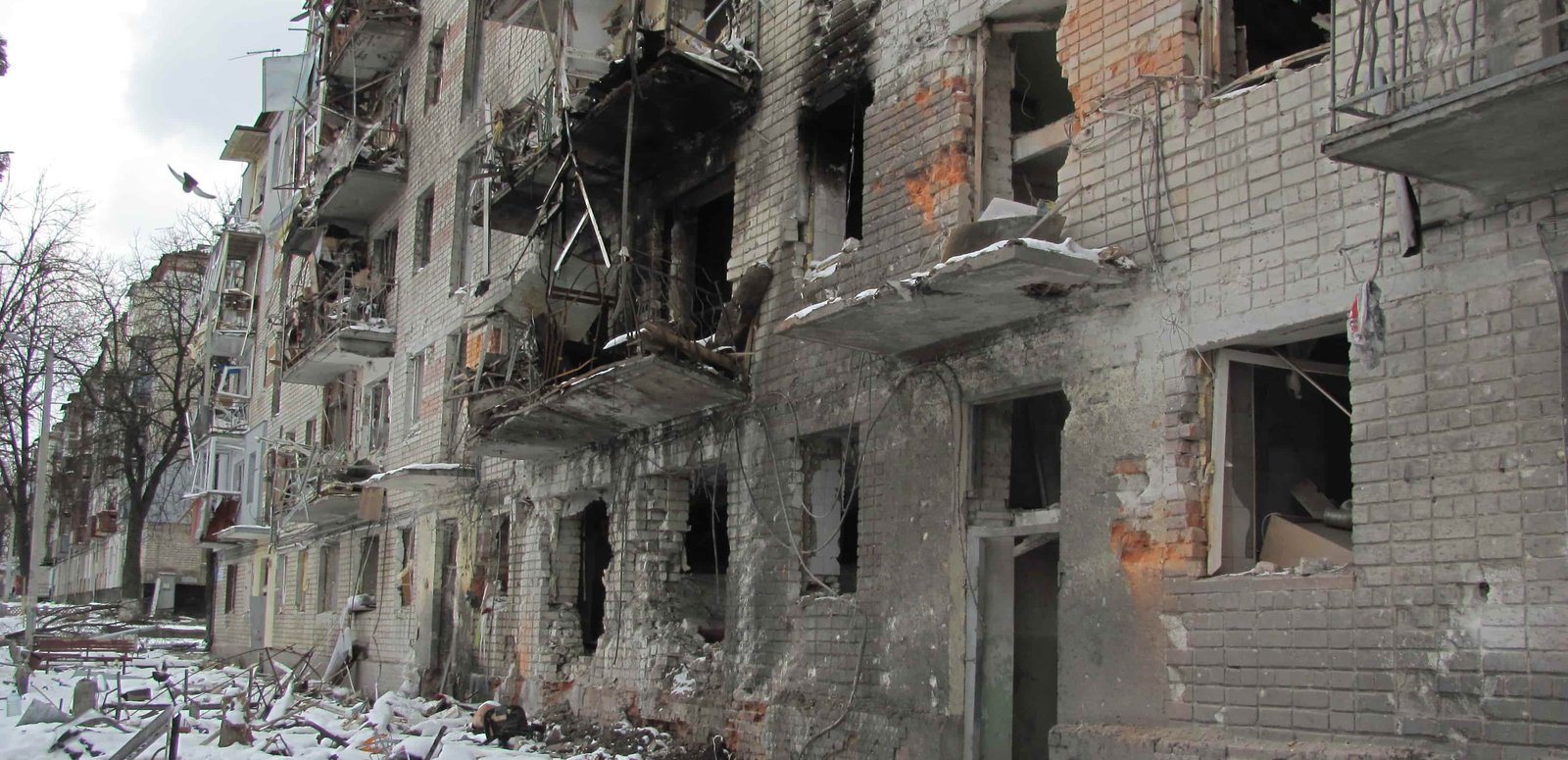
Despite ongoing hostilities, the Government of Ukraine, with help from local and international partners, is already rebuilding the country. Reconstruction includes both property restitution—the return of private property to displaced persons—and financial compensation for property that has been damaged or destroyed. The task is a considerable challenge, given the scale of both displacement and property destruction. Estimates vary, but some 1.5 million homes may have been damaged or destroyed due to the conflict, as of mid-2023.
Global Context: Challenges with Property Restitution and Compensation
The abandonment, destruction, and occupation of homes and other property are an unfortunate yet common aspect of modern warfare. After conflicts end, governments, humanitarian organizations, and development partners strive to identify and return property to its rightful owners, sometimes through an official land commission or a mass claims restitution process, and also to provide financial compensation to owners of damaged or destroyed properties.
Post-conflict compensation and restitution processes are expensive, unreliable, and time-consuming. Property records are frequently missing, destroyed, or inaccurate. On-the-ground combatants often deliberately destroy homes, businesses, and infrastructure to further inflict harm on civilian populations, exacerbating restitution challenges.
During the protracted conflict in the Caucasus’ Nagorno-Karabakh region in the 1990s and 2000s, for example, Armenian forces destroyed nearly all Azerbaijani homes and businesses in some towns. In Kosovo, retreating Serbian forces stole property records, eventually creating challenges in rebuilding and re-establishing functional land markets. More than 20 years after the conflict, related issues continue to hinder economic growth in the country. And most recently, in Iraq, the Islamic State confiscated and later sold displaced Iraqis’ homes and land, using the revenue to further fund its terrorist activities.
After such war crimes, defeated political and military opponents, along with women and other marginalized groups, disproportionately struggle to reclaim property. Mass displacement can last decades and sometimes generations. In the interim, property can change ownership several times and even become legally held by others, including political and economic elites or opposing ethnic, sectarian, or religious groups.
In Burundi, for example, a half century of intermittent war, displacement, and violence has resulted in an incomprehensible patchwork of competing claims, sometimes involving families who have lived on occupied property for generations. The grievances of displaced families and individuals intensify in the meantime and can transform into political or insurgent movements.
The longer post-conflict restitution processes last, the more likely a country is to fall back into conflict or to experience knock-on impacts caused by housing instability, such as the growth of slums and other crowded and substandard living conditions, long after the conflict formally concludes. In order to facilitate rapid property restitution, the United Nations’ Pinheiro Principles, which provide international guidelines for housing, land, and property restitution, recommend that states accept a wide range of evidence regarding property ownership post-conflict to lower the evidence burden on displaced populations. Even with the help of these principles, however, restitution efforts often take decades.
Housing, Land, and Property Rights in Ukraine
Property restitution and compensation in Ukraine will be influenced in large part by the pre-war conditions of the country’s public infrastructure and records related to housing, land, and property rights.
Russia’s Destruction of Ukrainian Infrastructure
Video recorded by U.S. journalist Zarina Zabrisky for a New America event on February 21, 2023, documenting Russia’s destruction of Ukrainian homes, apartment buildings, and other civilian infrastructure.
Source: Zarina Zabrisky
After the dissolution of the Soviet Union and the independence of Ukraine in 1991, the Government of Ukraine developed and repeatedly reformed its housing, land, and property registration systems. Beginning in 2013, housing records were digitized into the electronic State Register of Property Rights (SRPR), although this registry was only 40 percent complete at the time of the Russian invasion. Many property rights records issued prior to 2013 are not contained in the digital SRPR, and inclusion of records from Crimea and occupied territories in Donetsk and Luhansk regions is significantly lower.
Many existing records are also prone to error, in part because the administration of housing, land, and property rights is shared among nearly half a dozen state agencies. Pre-war, for instance, there were data discrepancies for approximately 200,000 land parcels between the state real estate registry and the state land cadastre, a database that combines parcel geometrics with land ownership data and other information. Errors in the cadastre in large part resulted from inaccurate information in the original paper-based records.
The Russian invasion exacerbated these property registration challenges. Official capacity in the public administration of housing, land, and property rights was significantly reduced in 2022, due to the deliberate destruction and looting of government offices as well as the displacement of staff. Unsurprisingly, there is currently a temporary ban on government-recognized property transactions in occupied territories. Further, many returning refugees and internally displaced persons whose property records were not digitized prior to the invasion will likely have trouble proving rightful occupancy of houses and other property, as physical records are likely to be lost or destroyed during conflict.
Based on an analysis by the Kyiv School of Economics, damaged housing stock in Ukraine amounts to more than $55 billion as of June 2023. This includes more than 19,100 multifamily apartment buildings and 147,800 single-family homes. The eastern Donetsk and Luhansk regions along with Kharkiv, Kherson, Mariupol, Mykolaiv, and other major cities, are most affected.
Housing, Land, and Property Rights in Crimea and Eastern Ukraine
Crimea and parts of Eastern Ukraine have been occupied since 2014 or illegally annexed by the Russian Federation. These parts of Ukraine present additional property rights–related challenges. In some cases, third parties may have seized abandoned homes and other property. There are also reported cases of forced eviction and forced transfer of property to new owners.
Property in areas occupied prior to 2022 is not legally eligible for compensation, according to East-SOS in an interview. As a worst-case scenario, and based on previous agreements and cease-fires from post-Soviet conflicts, Russia could continue to occupy some or all of these Ukrainian territories over the long term, and property in these areas would become permanently inaccessible to rightful owners. The Government of Ukraine will then need to determine if property in the regions is defined as permanently or temporarily lost and to accommodate citizens through compensation or housing assistance or both.
Lessons from the Caucasus suggest a costly compensation and rehousing process that could create political and social divisions, as host communities may see new arrivals as benefiting at their expense. In Azerbaijan, the government provided housing and financial support for nearly a decade to 1 million families displaced by the Nagorno-Karabakh conflict. Yet the benefits provided to these households were perceived as unfair by Azerbaijanis who were not displaced but were also struggling economically.
Despite widespread destruction, Ukraine possesses several advantages to plan and implement property restitution and compensation processes. The Government of Ukraine is both innovative and digitally sophisticated, with access to excellent satellite imagery even before the invasion, and has created a working group to plan around housing, land, and property rights issues resulting from the conflict. Dozens of large and small communities are actively developing reconstruction plans, often supported by international donors.
Can Ukraine Transform Post-Crisis Property Compensation and Reconstruction?
- Overview
- Property Restitution and Compensation in Ukraine
- The Diia Portal and the eRecovery Property Compensation Program
- Strengths of Diia and the eRecovery Program
- Challenges of Diia and the eRecovery Program
- Recommendations for Improving Diia and the eRecovery Program
- Conclusion
- Additional Resources