Pennies on the Dollar Report
Acknowledgments
This report was produced as part of New America’s ongoing work on disability, which is supported by the Ford Foundation. We are grateful to the foundation for its support. The findings and conclusions contained within are those of the authors and do not necessarily reflect positions or policies of the foundation. The authors would like to thank Lisa Guernsey and Sabrina Detlef for their editing support; Katherine Portnoy, Amanda Dean, Natalya Brill, and Simon Brown for their communications and data visualization support.
Introduction
The American Dream often consists of finding a good job, having a roof over your head, enjoying friendships and fulfilling community relationships, and engaging meaningfully in activities each day. People with disabilities1 have more opportunities to achieve this dream than ever before, thanks to the nearly 34-year-old Americans with Disabilities Act (ADA), and a series of other federal and state laws and regulations that have created a more equal system of rights. Equal opportunity, full participation, and independent living—three of the four goals of the ADA—seem more like realities for many than in decades past.
Yet, the final goal of the ADA, economic self-sufficiency, still remains far beyond reach for many. Despite progress, relics of the past remain cemented in public policy. One such relic is subminimum wage.2 For people with disabilities, this 85-year-old policy is a roadblock to participating fully and equitably in the workforce.
In 1938, Congress passed a law that created a subminimum wage: a rate of compensation that allows employers to pay people with disabilities as little as pennies per hour. Back then, this was applauded as a step forward to provide employment for people with disabilities, but today, the wage and the attitudes that enable it are seen as unjust and backward. Forward-looking states across the country have been taking steps to eliminate the subminimum wage and to change labor policies to support people with disabilities.
Maine is one example. In 2020, Maine passed legislation3 that eliminated the subminimum wage and adopted the Employment First systems framework, which centers on the idea that all individuals, regardless of support need and disability, should participate in competitive integrated employment.4 Maine also enacted a suite of policies, including Medicaid expansion, tax-advantaged savings accounts, and better counseling on employment benefits. It also applied for and received funds through a federal competitive grant program called the Disability Innovation Fund. Maine now ranks as a top state in the nation for promoting employment for disabled people.
Maine is not alone. Although the subminimum wage policy is often kept in the shadows, for those that know it well, it has been reported on, advocated for and against, been the subject of several Government Accountability Office (GAO) reports in recent years, and largely scrutinized. Despite this attention, few, if any, analyses have been conducted at a national scale to understand the state of the subminimum wage in all 50 states plus the District of Columbia (DC). Data from the Wage and Hour Division of the U.S. Department of Labor (DOL), though available, is inconsistent, cannot be tracked longitudinally, and is only useful when considering how it applies to employers’ use of certificates for a section of the antiquated 1938 law known as 14(c). Those looking to better understand this issue often run into roadblocks when seeking deeper analyses or research.
This report examines, state by state, the policies that drive the use or elimination of subminimum wage, as well as the programs each state provides to more comprehensively support individuals with disabilities as they seek meaningful employment and fair wages. Analyzing and comparing policies across all states allows for a national perspective on the drive to eliminate the subminimum wage. It also highlights other employment-related policies used to support individuals with disabilities. We hope our report not only provides an opportunity for stakeholders to dive into their own state’s policies and practices but helps map out best practices. Whether it is Maine or Mississippi, Oregon or Iowa, our analysis offers evidence of sweeping and often surprising progress. States around the country, blue and red, rural and urban, are making significant headway in lasting ways, leading to an improved quality of life and competitive integrated employment for disabled workers in the United States.
Citations
- This report uses person-first and identity-first language throughout. This choice honors the preferences, cultures, and identities within the disability community.
- Subminimum wage, Section 14(c), and 14(c) certificates are used interchangeably throughout this report. Section 14(c) is the specific section in the Fair Labor Standards Act that authorizes the use of a subminimum wage. Subminimum wage is a shorthand name for the practice. 14(c) certificates are the certificates employers hold to pay disabled employees a subminimum wage.
- LegiScan, “Maine House Bill 1874,” March 17, 2020, https://legiscan.com/ME/bill/LD1874/2019.
- For more about Employment First, see two resources from the U.S. Department of Labor, Office of Disability Employment Policy: "Employment First Initiative," https://www.dol.gov/agencies/odep/initiatives/employment-first; and "Competitive Integrated Employment," https://www.dol.gov/agencies/odep/program-areas/cie. Competitive integrated employment is work that is performed on a full-time or part-time basis for which an individual is compensated at or above minimum wage, receiving the same level of benefits provided to other employees without disabilities, at a location where the employee interacts with other individuals without disabilities, and presented opportunities for advancement similar to other employees without disabilities. For full legal definition, see Appendix I.
Background
History of Section 14(c)
The origin story for the subminimum wage begins in 1938 at the beginning of President Franklin D. Roosevelt’s second term. During the Great Depression, hundreds of thousands of workers were laid off, and those who weren’t were subjected to worsening and unjust labor conditions, long hours, and low wages.5 Together with U.S. Secretary of Labor Frances Perkins, the president created a new law (which Congress approved) known as the Fair Labor Standards Act (FLSA).6 It had three primary goals: abolish child labor, establish regulations for overtime pay, and set a minimum wage.
During the legislation’s creation, Perkins suggested the creation of a “subminimum wage,” a lower wage adjusted to one’s productivity rate that could be used for “substandard workers.”7 By this, she was referring to “persons who by reason of illness or age or something else are not up to normal production.”8 As the legislation progressed, there was no consensus about how the term substandard workers should be interpreted. Some argued that people in the South were slower and less production-oriented and therefore “substandard.” Others saw this as a way to continue paying Black workers less.
In the end, the law stated that subminimum wages could be used for the employment of individuals “whose earning capacity is impaired by age or physical or mental deficiency or injury.”9
The intent was to encourage employers to hire individuals with disabilities if they could pay them based on their productivity rather than a standard minimum wage. At that time, the subminimum wage was envisioned as a way to create employment and training opportunities for people with disabilities, crucial at a time when many were institutionalized and excluded from education systems. This concept was written as section 14(c) of the law, and it has remained nearly unchanged since.
Section 14(c) in Practice
In practice, a subminimum wage can only be paid to disabled employees hired by entities holding a 14(c) certificate approved by the DOL. Entities maintain an active certificate for two years and then must reapply through the DOL’s website.10 The certificate allows entities to pay workers with disabilities below the established federal minimum wage and requires the entities to calculate a “commensurate wage” for the disabled employee based on two factors:
- the prevailing wage paid to workers without disabilities doing similar work; and
- the productivity of the worker with a disability compared with workers without disabilities.11
According to a January 2023 GAO report, workers paid under 14(c) certificates made an average of $4.15 per hour, with more than half being paid less than $3.50 per hour and some making less than $0.25 an hour.12 Today, approximately 43,000 people receive compensation under 14(c) certificates.13
Entities holding 14(c) certificates fall into one of four categories: school work experience programs, business establishments, hospitals and residential care facilities, and community rehabilitation programs (CRPs).14 Today, more than 90 percent of certificate holders are CRPs,15 which are nonprofit organizations. The CRPs provide work to disabled employees under the 14(c) certificate for portions of the day and often provide additional day habilitation services that include activities to support personal and health care, social engagement, daily living, and community participation.16 As it is not unusual for workers with disabilities employed under section 14(c) to work only part time, the day habilitation provides additional services for the rest of the day. The subminimum wage work and day habilitation services are typically only available in facilities that keep people with disabilities separated from non-disabled workers.17
Due to the segregated nature of the settings, the federal government has heavily scrutinized CRPs. In 2020, after a lengthy review, hearing, and comment period, the U.S. Commission on Civil Rights released a report18 stating that subminimum wage violates the civil rights of people with disabilities. The Department of Justice (DOJ) has been actively involved, engaging in litigation in both Oregon19 and Rhode Island.20 Under the settlements, both states no longer use subminimum wage. In October 2023, the DOJ issued guidance on employment for people with disabilities that mandates that state and local governments are to provide employment services in the most integrated setting.21
Controversy with Section 14(c)
The primary proponents of maintaining the subminimum wage are families of older adults who have been employed under 14(c) certificates for many years, sometimes decades. Many aging individuals with disabilities did not grow up with the ADA and were not afforded the same opportunities as disabled youth today. A lack of inclusive schools, workforce training, and job opportunities with accommodations created a situation where taking a subminimum wage job was often the only choice. Thus, some families push to maintain the subminimum wage, not to keep low wages but to support and maintain the employment of their loved ones.
Youth and adults with disabilities under 30 have grown up with the ADA, which has meant more inclusive education, opportunities in higher education, workforce training, and self-advocacy training to seek accommodations. Only a small percentage of young people participate in today’s programs that pay a subminimum wage, despite disability type.22 Advocates for eliminating the subminimum wage include individuals with disabilities who have transitioned out of subminimum wage work, individuals in states and employed by companies that have transitioned away from subminimum wage, and larger employers and corporate entities.
The movement to eliminate subminimum wage is gaining steam. The DOJ continues to challenge the policy;23 federal government reports with startling data have been piling up;24 and the oversight agency, DOL, is conducting a comprehensive review.25 Put simply, the subminimum wage is at odds with the direction of disability policy now and the goals of the ADA, which are to achieve equal opportunity and economic self-sufficiency.
Citations
- This report uses person-first and identity-first language throughout. This choice honors the preferences, cultures, and identities within the disability community.
- Subminimum wage, Section 14(c), and 14(c) certificates are used interchangeably throughout this report. Section 14(c) is the specific section in the Fair Labor Standards Act that authorizes the use of a subminimum wage. Subminimum wage is a shorthand name for the practice. 14(c) certificates are the certificates employers hold to pay disabled employees a subminimum wage.
- LegiScan, “Maine House Bill 1874,” March 17, 2020, https://legiscan.com/ME/bill/LD1874/2019.
- For more about Employment First, see two resources from the U.S. Department of Labor, Office of Disability Employment Policy: "Employment First Initiative," https://www.dol.gov/agencies/odep/initiatives/employment-first; and "Competitive Integrated Employment," https://www.dol.gov/agencies/odep/program-areas/cie. Competitive integrated employment is work that is performed on a full-time or part-time basis for which an individual is compensated at or above minimum wage, receiving the same level of benefits provided to other employees without disabilities, at a location where the employee interacts with other individuals without disabilities, and presented opportunities for advancement similar to other employees without disabilities. For full legal definition, see Appendix I.
- Throughout this report, the term state refers to all 50 states and the District of Columbia.
- For more on the history behind the Fair Labor Standards Act, see Nathaniel Ruby and Ross Eisenbrey, Celebrating 75 Years of the Fair Labor Standards Act (Sofia, Bulgaria: Economic Policy Institute, June 25, 2013), https://policycommons.net/artifacts/1413090/celebrating-75-years-of-the-fair-labor-standards-act/2027353/.
- For more on this law, see U.S. Department of Labor, "The Fair Labor Standards Act of 1938," https://www.dol.gov/general/aboutdol/history/flsa1938.
- Sarah A. Donovan, The Fair Labor Standards Act (FLSA): An Overview (Washington, DC: Congressional Research Service, March 8, 2023), https://crsreports.congress.gov/product/pdf/R/R42713.
- Joint Hearings before the Senate Committee on Education and Labor and the House Committee on Labor, Fair Labor Standards Act of 1937, 75th Cong., 1st sess., June 4, 1937.
- The full text of Section 14(c) as originally published in 1938, outlining the subminimum wage can be found on page 38 of the Fair Labor Standards Act of 1938, https://www.govinfo.gov/content/pkg/COMPS-1514/pdf/COMPS-1514.pdf.
- Department of Labor, “Materials for Employers with Section 14(c) Certificates,” http://www.dol.gov/agencies/whd/workers-with-disabilities/employers.
- Fair Labor Standards Act of 1938, Pub. L. No. 117-328, §14(c)(1)(B) and §14(c)(1)(C), (2022), https://www.govinfo.gov/content/pkg/COMPS-1514/pdf/COMPS-1514.pdf.
- Subminimum Wage Program: DOL Could Do More to Ensure Timely Oversight (Washington, DC: U.S. Government Accountability Office, January 2023), 17, https://www.gao.gov/assets/gao-23-105116.pdf.
- Department of Labor, “14(c) Certificate Holders,” http://www.dol.gov/agencies/whd/workers-with-disabilities/section-14c/certificate-holders.
- For more explanation of these categories, see the graphic on page 7 within the GAO report, Subminimum Wage Program: DOL Could Do More to Ensure Timely Oversight (Washington, DC: U.S. Government Accountability Office, January 2023), https://www.gao.gov/assets/gao-23-105116.pdf. Also see the definition of CRP in Appendix I.
- From the New Deal to the Real Deal: Joining the Industries of the Future (Washington, DC: National Council on Disability, October 2018), https://www.ncd.gov/report/national-disability-employment-policy-from-the-new-deal-to-the-real-deal-joining-the-industries-of-the-future/.
- For a description of day habilitation services, see Appendix I.
- For a detailed discussion on integration requirements of the ADA, segregation of workers with disabilities, and the impact of the Olmstead ruling on subminimum wage, see p. 18-29 of Subminimum Wages: Impacts on the Rights of People with Disabilities (Washington, DC: U.S. Commission on Civil Rights, 2020), https://www.usccr.gov/files/2020/2020-09-17-Subminimum-Wages-Report.pdf.
- Subminimum Wages, https://www.usccr.gov/reports/2020/subminimum-wages-impacts-civil-rights-people-disabilities.
- U.S. Department of Justice, Lane et al. v. Brown et al., settlement agreement, in effect 2015, finalized 2022, https://archive.ada.gov/olmstead/documents/lane_sa.pdf.
- U.S. Department of Justice, "Rhode Island Olmstead Statewide Agreement," April 9, 2014, https://archive.ada.gov/olmstead/documents/ri-olmstead-statewide-agreement.pdf.
- U.S. Department of Justice, Office of Public Affairs, "Justice Department Issues Guidance on Americans with Disabilities Act and Employment Services for People with Disabilities," press release, October 31, 2023, https://www.justice.gov/opa/pr/justice-department-issues-guidance-americans-disabilities-act-and-employment-services-people.
- Subminimum Wage Program, https://www.gao.gov/products/gao-23-105116. Only 4 percent of workers employed under 14(c) certificates as of August 2021 were between ages 18–21 as compared to 26 percent who were 55 years or older, as seen in Table 3 on p. 26.
- U.S. Department of Justice, Office of Public Affairs, "Justice Department Issues Guidance on Americans with Disabilities Act and Employment Services for People with Disabilities," press release, October 31, 2023, https://www.justice.gov/opa/pr/justice-department-issues-guidance-americans-disabilities-act-and-employment-services-people.
- See Subminimum Wages: Impacts on the Rights of People with Disabilities and Rhode Island Olmstead Statewide Agreement. Subminimum Wages, https://www.usccr.gov/files/2020/2020-09-17-Subminimum-Wages-Report.pdf and Rhode Island Olmstead Statewide Agreement, https://archive.ada.gov/olmstead/documents/ri-olmstead-statewide-agreement.pdf.
Momentum to Change the Subminimum Wage
A growing number of states and the federal government are decreasing the use of section 14(c), eliminating it altogether, and increasing competitive integrated employment opportunities for disabled people. This trend has been developing for the last decade but has picked up speed in the last six years.
State Policy
Across all states, use of the subminimum wage has been steadily decreasing for nearly a decade. In 2015, New Hampshire became the first state to eliminate the subminimum wage through legislation when it passed Senate Bill 47, repealing the authorization for subminimum wage. Between 2018 and 2023, the number of workers employed under section 14(c) across all states shrank from approximately 130,000 to 43,000. Today, 10 states have fully eliminated subminimum wage in a codified way, two have eliminated it without any legislation or official policy action, and five are actively phasing it out.
This shift is exemplified by Melwood,26 one of the largest employers of people with disabilities in the country, which eliminated the use of subminimum wage in 2013 and relinquished its 14(c) certificate in 2016. It has successfully transitioned to paying employees with disabilities competitive wages in more integrated settings in Maryland, Virginia, and DC.
States have also increasingly adopted the Employment First27 model, a national framework for changing employment systems to support disabled people in the workforce with real jobs and real wages.28 Employment First is based on the idea that all people, including those with disabilities that require high levels of support, should be employed in the general workforce. States have engaged with Employment First initiatives in different ways, including legislation, executive orders, agency administration directives or policy, and proclamations.
Federal Policy
The federal landscape is also changing. Since its enactment in 2014, the Workforce Innovation and Opportunity Act (WIOA) has played a pivotal role in the shift from subminimum wage employment to competitive integrated employment for youth through two key provisions. First, WIOA mandated that vocational rehabilitation (VR) agencies allocate at least 15 percent of federal funds for pre-employment transition services29 to youth with disabilities. This stipulation prioritized early support for students with disabilities, providing a range of activities such as job exploration counseling, work-based learning experiences, and self-advocacy training. Second, WIOA’s Section 511 imposed limitations on subminimum wage employment, encouraging a move toward competitive integrated employment for youth with disabilities.
Ongoing federal legislative efforts reflect a commitment to end subminimum wage. Most notably, the bipartisan and bicameral Transformation to Competitive Integrated Employment Act was re-introduced in February 2023 by Senator Bob Casey (D-Pa.), Representative Bobby Scott (D-Va.), Senator Steve Daines (R-Mont.), and Representative Cathy McMorris Rodgers (R-Wash.).30 It aims to prohibit new 14(c) certificates, phase out existing certificates over a five-year period, and provide crucial support through grants for business and program model transformation. In addition, the federal U.S. AbilityOne Commission, which administers AbilityOne employment programs across the country serving people who are blind or have other severe disabilities, ended subminimum wage for all its contracts in 2022. “While payment of subminimum wages has been declining in the program for years,” the announcement read, “it is past time to ensure that all employees are fairly compensated for their work.”31 That same year, multiple agencies32 co-released guidance to support state and local efforts for blending, braiding, and sequencing funding to further expand competitive integrated employment options.
The federally mandated Vocational Rehabilitation (VR) program plays a central and crucial role in supporting disabled workers on their path to employment and economic self-sufficiency. Operating through state agencies, VR provides a range of services, including counseling, training, and job placement, with the goal of facilitating competitive integrated employment for disabled workers. The Disability Innovation Fund (DIF), a competitive grant program funded with unspent VR money managed by the U.S. Department of Education, supports creative approaches within the VR framework. Beginning in 2021, states have had the opportunity to apply for three rounds of funding to support projects that advance career pathways through apprenticeships, assist individuals transitioning from subminimum wage to competitive integrated employment, and pilot cohesive service delivery models for youth with disabilities. By encouraging innovative approaches, the DIF contributes to the ongoing evolution and improvement of VR services across the United States.
Comprehensive Support Programs
Many other programs influence employment opportunities and outcomes for disabled workers, though they may not always appear to target employment specifically. Medicaid expansion, benefits counseling, and tax-deferred savings accounts have positive ripple effects on employment for disabled people. States are taking advantage of these programs by expanding services and offering more programs to increase employment opportunities for disabled workers.
Medicaid is a critical program providing health care, home care services, and more for people with disabilities. Medicaid may also provide personal care attendants, enabling individuals to not only get ready for work but be supported at work. Medicaid may also provide funding for work-based services such as supported employment33 and community-integration supports to enable disabled workers to obtain competitive integrated employment.34 Medicaid expansion, which is still controversial in a few states, is crucial for these services as it is through home and community-based services under the Medicaid waivers that the services are provided.
Many disabled workers struggle with earnings and savings, especially during a transition from an older program paying a subminimum wage to competitive integrated employment. Benefits counseling programs are designed to alleviate concerns about the impact of potential earnings on their existing benefits and to encourage individuals to enter the workforce without fear of losing essential supports such as Supplemental Security Income, housing assistance, food assistance, and Medicaid. Benefits counseling programs match individuals with a benefits counselor who helps them and their families address fears and concerns.35 Part of benefits counseling may include opening an ABLE account, a tax-advantaged savings account for people with disabilities,36 to further encourage and support savings. Benefits counseling may also assist individuals navigate the transition to new supports as they earn a higher income in employment.
In short, enabling people with disabilities to benefit from meaningful employment and fair wages will require more than just eliminating the subminimum wage. To get a fuller picture of states’ progress, we identified, in this report, how programs like these are developing across all states.
Citations
- This report uses person-first and identity-first language throughout. This choice honors the preferences, cultures, and identities within the disability community.
- Subminimum wage, Section 14(c), and 14(c) certificates are used interchangeably throughout this report. Section 14(c) is the specific section in the Fair Labor Standards Act that authorizes the use of a subminimum wage. Subminimum wage is a shorthand name for the practice. 14(c) certificates are the certificates employers hold to pay disabled employees a subminimum wage.
- LegiScan, “Maine House Bill 1874,” March 17, 2020, https://legiscan.com/ME/bill/LD1874/2019.
- For more about Employment First, see two resources from the U.S. Department of Labor, Office of Disability Employment Policy: "Employment First Initiative," https://www.dol.gov/agencies/odep/initiatives/employment-first; and "Competitive Integrated Employment," https://www.dol.gov/agencies/odep/program-areas/cie. Competitive integrated employment is work that is performed on a full-time or part-time basis for which an individual is compensated at or above minimum wage, receiving the same level of benefits provided to other employees without disabilities, at a location where the employee interacts with other individuals without disabilities, and presented opportunities for advancement similar to other employees without disabilities. For full legal definition, see Appendix I.
- Throughout this report, the term state refers to all 50 states and the District of Columbia.
- For more on the history behind the Fair Labor Standards Act, see Nathaniel Ruby and Ross Eisenbrey, Celebrating 75 Years of the Fair Labor Standards Act (Sofia, Bulgaria: Economic Policy Institute, June 25, 2013), https://policycommons.net/artifacts/1413090/celebrating-75-years-of-the-fair-labor-standards-act/2027353/.
- For more on this law, see U.S. Department of Labor, "The Fair Labor Standards Act of 1938," https://www.dol.gov/general/aboutdol/history/flsa1938.
- Sarah A. Donovan, The Fair Labor Standards Act (FLSA): An Overview (Washington, DC: Congressional Research Service, March 8, 2023), https://crsreports.congress.gov/product/pdf/R/R42713.
- Joint Hearings before the Senate Committee on Education and Labor and the House Committee on Labor, Fair Labor Standards Act of 1937, 75th Cong., 1st sess., June 4, 1937.
- The full text of Section 14(c) as originally published in 1938, outlining the subminimum wage can be found on page 38 of the Fair Labor Standards Act of 1938, https://www.govinfo.gov/content/pkg/COMPS-1514/pdf/COMPS-1514.pdf.
- Department of Labor, “Materials for Employers with Section 14(c) Certificates,” http://www.dol.gov/agencies/whd/workers-with-disabilities/employers.
- Fair Labor Standards Act of 1938, Pub. L. No. 117-328, §14(c)(1)(B) and §14(c)(1)(C), (2022), https://www.govinfo.gov/content/pkg/COMPS-1514/pdf/COMPS-1514.pdf.
- Subminimum Wage Program: DOL Could Do More to Ensure Timely Oversight (Washington, DC: U.S. Government Accountability Office, January 2023), 17, https://www.gao.gov/assets/gao-23-105116.pdf.
- Department of Labor, “14(c) Certificate Holders,” http://www.dol.gov/agencies/whd/workers-with-disabilities/section-14c/certificate-holders.
- For more explanation of these categories, see the graphic on page 7 within the GAO report, Subminimum Wage Program: DOL Could Do More to Ensure Timely Oversight (Washington, DC: U.S. Government Accountability Office, January 2023), https://www.gao.gov/assets/gao-23-105116.pdf. Also see the definition of CRP in Appendix I.
- From the New Deal to the Real Deal: Joining the Industries of the Future (Washington, DC: National Council on Disability, October 2018), https://www.ncd.gov/report/national-disability-employment-policy-from-the-new-deal-to-the-real-deal-joining-the-industries-of-the-future/.
- For a description of day habilitation services, see Appendix I.
- For a detailed discussion on integration requirements of the ADA, segregation of workers with disabilities, and the impact of the Olmstead ruling on subminimum wage, see p. 18-29 of Subminimum Wages: Impacts on the Rights of People with Disabilities (Washington, DC: U.S. Commission on Civil Rights, 2020), https://www.usccr.gov/files/2020/2020-09-17-Subminimum-Wages-Report.pdf.
- Subminimum Wages, https://www.usccr.gov/reports/2020/subminimum-wages-impacts-civil-rights-people-disabilities.
- U.S. Department of Justice, Lane et al. v. Brown et al., settlement agreement, in effect 2015, finalized 2022, https://archive.ada.gov/olmstead/documents/lane_sa.pdf.
- U.S. Department of Justice, "Rhode Island Olmstead Statewide Agreement," April 9, 2014, https://archive.ada.gov/olmstead/documents/ri-olmstead-statewide-agreement.pdf.
- U.S. Department of Justice, Office of Public Affairs, "Justice Department Issues Guidance on Americans with Disabilities Act and Employment Services for People with Disabilities," press release, October 31, 2023, https://www.justice.gov/opa/pr/justice-department-issues-guidance-americans-disabilities-act-and-employment-services-people.
- Subminimum Wage Program, https://www.gao.gov/products/gao-23-105116. Only 4 percent of workers employed under 14(c) certificates as of August 2021 were between ages 18–21 as compared to 26 percent who were 55 years or older, as seen in Table 3 on p. 26.
- U.S. Department of Justice, Office of Public Affairs, "Justice Department Issues Guidance on Americans with Disabilities Act and Employment Services for People with Disabilities," press release, October 31, 2023, https://www.justice.gov/opa/pr/justice-department-issues-guidance-americans-disabilities-act-and-employment-services-people.
- See Subminimum Wages: Impacts on the Rights of People with Disabilities and Rhode Island Olmstead Statewide Agreement. Subminimum Wages, https://www.usccr.gov/files/2020/2020-09-17-Subminimum-Wages-Report.pdf and Rhode Island Olmstead Statewide Agreement, https://archive.ada.gov/olmstead/documents/ri-olmstead-statewide-agreement.pdf.
- Department of Labor, Office of Disability Employment Policy, “Section 14(c) Review,” https://www.dol.gov/agencies/odep/14cEngagement#:~:text=On%20September%2026%2C%202023%2C%20Acting,workers%20whose%20disabilities%20impact%20their.
- Melwood (website), "Melwood CEO Testifies Before U.S. Commission on Civil Rights, Calling for Abolishment of Subminimum Wage Laws," press release, November 22, 2019, https://melwood.org/newsroom/uncategorized/melwood-ceo-testifies-before-u-s-commission-on-civil-rights-calling-for-abolishment-of-subminimum-wage-laws/.
- U.S. Department of Labor, Office of Disability Employment Policy, "Employment First Initiative," https://www.dol.gov/agencies/odep/initiatives/employment-first. For a detailed definition of Employment First, see Appendix I.
- Association of People Supporting Employment First (APSE), "About," https://apse.org/about-2/.
- For a detailed definition of vocational rehabilitation and pre-employment transitions services, see Appendix I.
- S. 533, H.R. 1263. The legislation was first introduced in January 2019 in the 116th Congress (S.260, H.R. 873) as the Transformation to Competitive Employment Act. For more details, see Congressman Bobby Scott (website), “Scott, Casey, McMorris Rodgers, Daines to Reintroduce Bipartisan, Bicameral Bill to Help Workers with Disabilities Find Good-Paying Jobs,” press release, February 27, 2023, https://bobbyscott.house.gov/media-center/press-releases/scott-casey-mcmorris-rodgers-daines-reintroduce-bipartisan-bicameral.
- AbilityOne Commission, "14(c) Final Rule News Statement," press release, July 21, 2022, https://www.abilityone.gov/commission/documents/14(c)%20Final%20Rule%20News%20Statement%2020220721%20post.pdf.
- U.S. Department of Labor, et al., "Federal Joint Communication to State and Local Governments: Resource Leveraging & Service Coordination to Increase Competitive Integrated Employment for Individuals with Disabilities," August 3, 2022, https://www.dol.gov/sites/dolgov/files/ODEP/pdf/ResourceLeveragingServiceCoordinationToIncreaseCIE8-12-22.pdf.
- For a definition of supported employment, see Appendix I.
- Medicaid.gov, "Employment Services," https://www.medicaid.gov/medicaid/long-term-services-supports/employment-initiatives/employment-services/index.html.
- Association of People Supporting Employment First (APSE), "Benefits Counseling Guide," revised April 22, 2019, https://apse.org/wp-content/uploads/2014/01/Benefits-Counseling-Guide-.pdf.
Methodology
Below, we describe our three-phase methodology for the report: (1) data compilation, (2) report card scoring, and (3) report card analysis. A more detailed description, including how the publicly available spreadsheet was built and a more detailed scoring methodology, can be found in Appendix II.
Phase One: Data Compilation
Subminimum wage data have been historically difficult to find and analyze, involving the compilation of a significant amount of data from multiple sources.
We gathered data from the DOL’s Wage and Hour Division,37 which is made freely available to the public quarterly regarding the status of subminimum wage across the country. In addition, we used data from state participation in the Disability Innovation Fund,38 Employment First Initiatives,39 Medicaid expansion,40 and ABLE programs.41 We also examined states’ websites to find policy efforts on the use of subminimum wages and evidence of benefits counseling. We were interested in whether (a) Work Incentives Planning and Assistance (WIPA) and (b) other benefits counseling programs are partly available or offered statewide.
Phase Two: Report Card Scoring
Once the data were compiled, we scored each state for the report card on four categories: (1) policy engagement with subminimum wage, (2) use of subminimum wage in state from 2018 to 2023, (3) proactive employment policy and funding initiatives, and (4) support for individuals’ financial security. A rubric, found in Appendix III, was developed to track and score each category. Figure 1 provides detail on the category makeup and the rating breakdown.
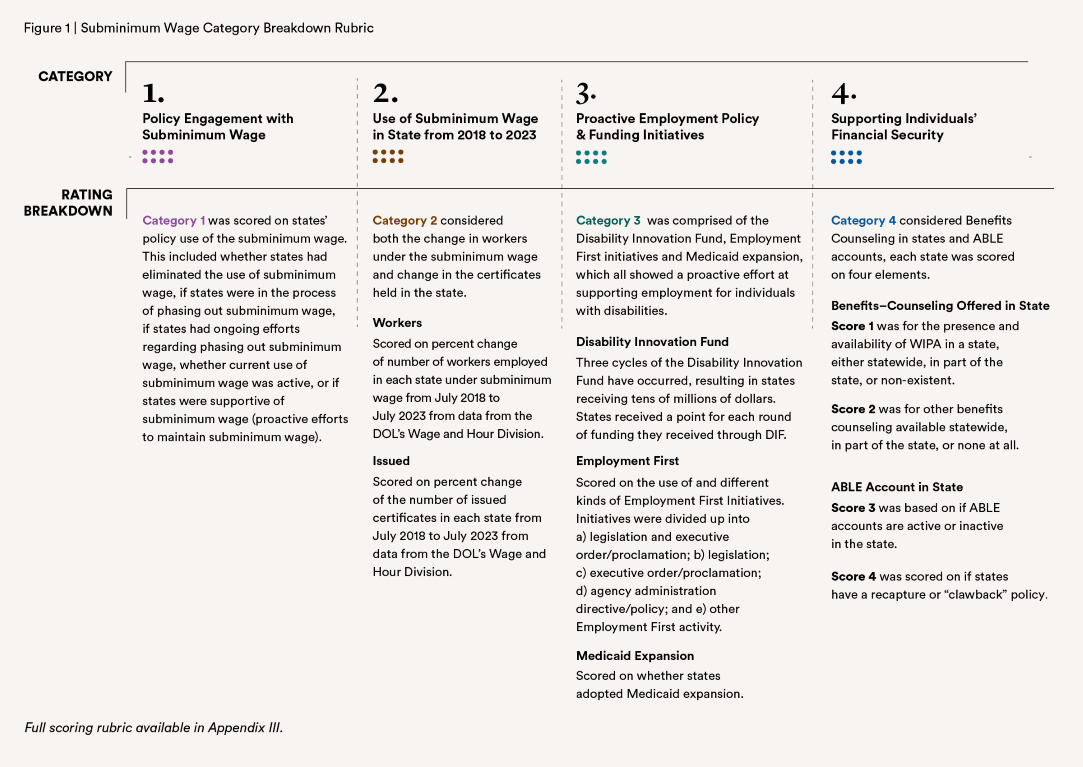
After each category was scored, total state scores were calculated by computing the average score across the four categories, giving a final report card score for each state.
Phase Three: Report Card Analysis
After we scored each state, we developed a set of new data sheets to display the data, review the category scores and final state scores, and send the preliminary data for peer review. Our findings are described below in detail.
Citations
- This report uses person-first and identity-first language throughout. This choice honors the preferences, cultures, and identities within the disability community.
- Subminimum wage, Section 14(c), and 14(c) certificates are used interchangeably throughout this report. Section 14(c) is the specific section in the Fair Labor Standards Act that authorizes the use of a subminimum wage. Subminimum wage is a shorthand name for the practice. 14(c) certificates are the certificates employers hold to pay disabled employees a subminimum wage.
- LegiScan, “Maine House Bill 1874,” March 17, 2020, https://legiscan.com/ME/bill/LD1874/2019.
- For more about Employment First, see two resources from the U.S. Department of Labor, Office of Disability Employment Policy: "Employment First Initiative," https://www.dol.gov/agencies/odep/initiatives/employment-first; and "Competitive Integrated Employment," https://www.dol.gov/agencies/odep/program-areas/cie. Competitive integrated employment is work that is performed on a full-time or part-time basis for which an individual is compensated at or above minimum wage, receiving the same level of benefits provided to other employees without disabilities, at a location where the employee interacts with other individuals without disabilities, and presented opportunities for advancement similar to other employees without disabilities. For full legal definition, see Appendix I.
- Throughout this report, the term state refers to all 50 states and the District of Columbia.
- For more on the history behind the Fair Labor Standards Act, see Nathaniel Ruby and Ross Eisenbrey, Celebrating 75 Years of the Fair Labor Standards Act (Sofia, Bulgaria: Economic Policy Institute, June 25, 2013), https://policycommons.net/artifacts/1413090/celebrating-75-years-of-the-fair-labor-standards-act/2027353/.
- For more on this law, see U.S. Department of Labor, "The Fair Labor Standards Act of 1938," https://www.dol.gov/general/aboutdol/history/flsa1938.
- Sarah A. Donovan, The Fair Labor Standards Act (FLSA): An Overview (Washington, DC: Congressional Research Service, March 8, 2023), https://crsreports.congress.gov/product/pdf/R/R42713.
- Joint Hearings before the Senate Committee on Education and Labor and the House Committee on Labor, Fair Labor Standards Act of 1937, 75th Cong., 1st sess., June 4, 1937.
- The full text of Section 14(c) as originally published in 1938, outlining the subminimum wage can be found on page 38 of the Fair Labor Standards Act of 1938, https://www.govinfo.gov/content/pkg/COMPS-1514/pdf/COMPS-1514.pdf.
- Department of Labor, “Materials for Employers with Section 14(c) Certificates,” http://www.dol.gov/agencies/whd/workers-with-disabilities/employers.
- Fair Labor Standards Act of 1938, Pub. L. No. 117-328, §14(c)(1)(B) and §14(c)(1)(C), (2022), https://www.govinfo.gov/content/pkg/COMPS-1514/pdf/COMPS-1514.pdf.
- Subminimum Wage Program: DOL Could Do More to Ensure Timely Oversight (Washington, DC: U.S. Government Accountability Office, January 2023), 17, https://www.gao.gov/assets/gao-23-105116.pdf.
- Department of Labor, “14(c) Certificate Holders,” http://www.dol.gov/agencies/whd/workers-with-disabilities/section-14c/certificate-holders.
- For more explanation of these categories, see the graphic on page 7 within the GAO report, Subminimum Wage Program: DOL Could Do More to Ensure Timely Oversight (Washington, DC: U.S. Government Accountability Office, January 2023), https://www.gao.gov/assets/gao-23-105116.pdf. Also see the definition of CRP in Appendix I.
- From the New Deal to the Real Deal: Joining the Industries of the Future (Washington, DC: National Council on Disability, October 2018), https://www.ncd.gov/report/national-disability-employment-policy-from-the-new-deal-to-the-real-deal-joining-the-industries-of-the-future/.
- For a description of day habilitation services, see Appendix I.
- For a detailed discussion on integration requirements of the ADA, segregation of workers with disabilities, and the impact of the Olmstead ruling on subminimum wage, see p. 18-29 of Subminimum Wages: Impacts on the Rights of People with Disabilities (Washington, DC: U.S. Commission on Civil Rights, 2020), https://www.usccr.gov/files/2020/2020-09-17-Subminimum-Wages-Report.pdf.
- Subminimum Wages, https://www.usccr.gov/reports/2020/subminimum-wages-impacts-civil-rights-people-disabilities.
- U.S. Department of Justice, Lane et al. v. Brown et al., settlement agreement, in effect 2015, finalized 2022, https://archive.ada.gov/olmstead/documents/lane_sa.pdf.
- U.S. Department of Justice, "Rhode Island Olmstead Statewide Agreement," April 9, 2014, https://archive.ada.gov/olmstead/documents/ri-olmstead-statewide-agreement.pdf.
- U.S. Department of Justice, Office of Public Affairs, "Justice Department Issues Guidance on Americans with Disabilities Act and Employment Services for People with Disabilities," press release, October 31, 2023, https://www.justice.gov/opa/pr/justice-department-issues-guidance-americans-disabilities-act-and-employment-services-people.
- Subminimum Wage Program, https://www.gao.gov/products/gao-23-105116. Only 4 percent of workers employed under 14(c) certificates as of August 2021 were between ages 18–21 as compared to 26 percent who were 55 years or older, as seen in Table 3 on p. 26.
- U.S. Department of Justice, Office of Public Affairs, "Justice Department Issues Guidance on Americans with Disabilities Act and Employment Services for People with Disabilities," press release, October 31, 2023, https://www.justice.gov/opa/pr/justice-department-issues-guidance-americans-disabilities-act-and-employment-services-people.
- See Subminimum Wages: Impacts on the Rights of People with Disabilities and Rhode Island Olmstead Statewide Agreement. Subminimum Wages, https://www.usccr.gov/files/2020/2020-09-17-Subminimum-Wages-Report.pdf and Rhode Island Olmstead Statewide Agreement, https://archive.ada.gov/olmstead/documents/ri-olmstead-statewide-agreement.pdf.
- Department of Labor, Office of Disability Employment Policy, “Section 14(c) Review,” https://www.dol.gov/agencies/odep/14cEngagement#:~:text=On%20September%2026%2C%202023%2C%20Acting,workers%20whose%20disabilities%20impact%20their.
- Melwood (website), "Melwood CEO Testifies Before U.S. Commission on Civil Rights, Calling for Abolishment of Subminimum Wage Laws," press release, November 22, 2019, https://melwood.org/newsroom/uncategorized/melwood-ceo-testifies-before-u-s-commission-on-civil-rights-calling-for-abolishment-of-subminimum-wage-laws/.
- U.S. Department of Labor, Office of Disability Employment Policy, "Employment First Initiative," https://www.dol.gov/agencies/odep/initiatives/employment-first. For a detailed definition of Employment First, see Appendix I.
- Association of People Supporting Employment First (APSE), "About," https://apse.org/about-2/.
- For a detailed definition of vocational rehabilitation and pre-employment transitions services, see Appendix I.
- S. 533, H.R. 1263. The legislation was first introduced in January 2019 in the 116th Congress (S.260, H.R. 873) as the Transformation to Competitive Employment Act. For more details, see Congressman Bobby Scott (website), “Scott, Casey, McMorris Rodgers, Daines to Reintroduce Bipartisan, Bicameral Bill to Help Workers with Disabilities Find Good-Paying Jobs,” press release, February 27, 2023, https://bobbyscott.house.gov/media-center/press-releases/scott-casey-mcmorris-rodgers-daines-reintroduce-bipartisan-bicameral.
- AbilityOne Commission, "14(c) Final Rule News Statement," press release, July 21, 2022, https://www.abilityone.gov/commission/documents/14(c)%20Final%20Rule%20News%20Statement%2020220721%20post.pdf.
- U.S. Department of Labor, et al., "Federal Joint Communication to State and Local Governments: Resource Leveraging & Service Coordination to Increase Competitive Integrated Employment for Individuals with Disabilities," August 3, 2022, https://www.dol.gov/sites/dolgov/files/ODEP/pdf/ResourceLeveragingServiceCoordinationToIncreaseCIE8-12-22.pdf.
- For a definition of supported employment, see Appendix I.
- Medicaid.gov, "Employment Services," https://www.medicaid.gov/medicaid/long-term-services-supports/employment-initiatives/employment-services/index.html.
- Association of People Supporting Employment First (APSE), "Benefits Counseling Guide," revised April 22, 2019, https://apse.org/wp-content/uploads/2014/01/Benefits-Counseling-Guide-.pdf.
- ABLE National Resource Center, "What Are ABLE Accounts?" https://www.ablenrc.org/what-is-able/what-are-able-acounts/.
- Department of Labor, Wage and Hour Division, “14(c) Certificate Holders,” http://www.dol.gov/agencies/whd/workers-with-disabilities/section-14c/certificate-holders.
- Rehabilitation Services Administration, "RSA Programs," https://rsa.ed.gov/about/programs.
- Association of People Supporting Employment First (APSE), "Employment First Map," https://apse.org/home-v2-2/employment-first/.
- Kaiser Family Foundation, "Status of State Medicaid Expansion Decisions: Interactive Map," https://www.kff.org/medicaid/issue-brief/status-of-state-medicaid-expansion-decisions-interactive-map/; and Kaiser Family Foundation, "State Activity Around Expanding Medicaid Under the Affordable Care Act," https://www.kff.org/health-reform/state-indicator/state-activity-around-expanding-medicaid-under-the-affordable-care-act/?currentTimeframe=0&sortModel=%7B%22colId%22:%22Location%22,%22sort%22:%22asc%22%7D.
Findings
By providing each state a total score, we were able to rank states from 1 to 51 across the four categories. In addition, we ranked each state from 1 to 51 within each of the four categories. This findings section details the total state rankings and each of the category rankings, with specific state mentions and highlights. A deeper analysis can be found in the discussion section of the report.
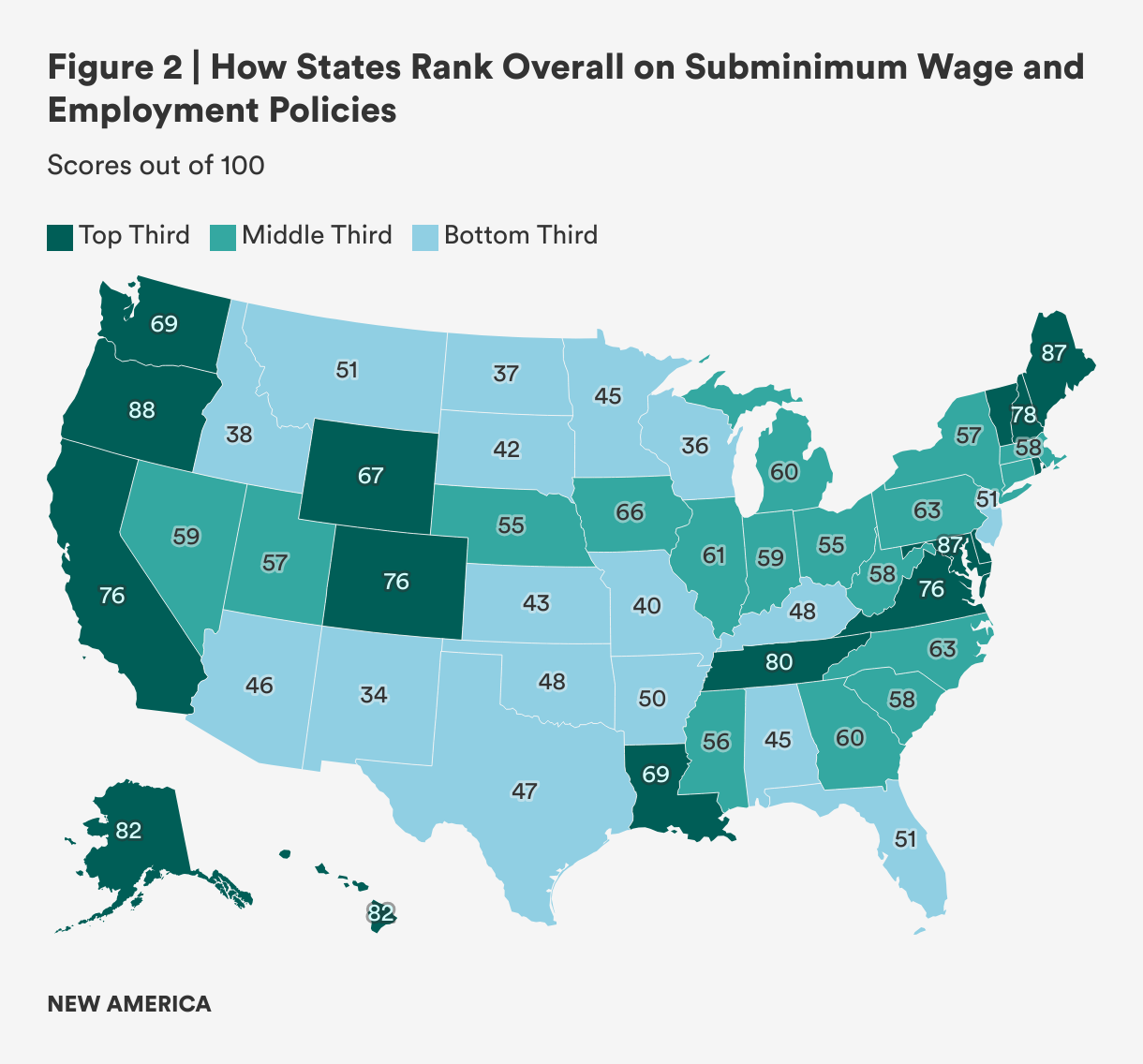
Figure 2, shown above, is a map of the United States showing the total subminimum wage score for each state from the average of all four categories. It also shows states rankings color-coded into the top third of states, middle third of states, and bottom third of states by scores.
Total State Rankings
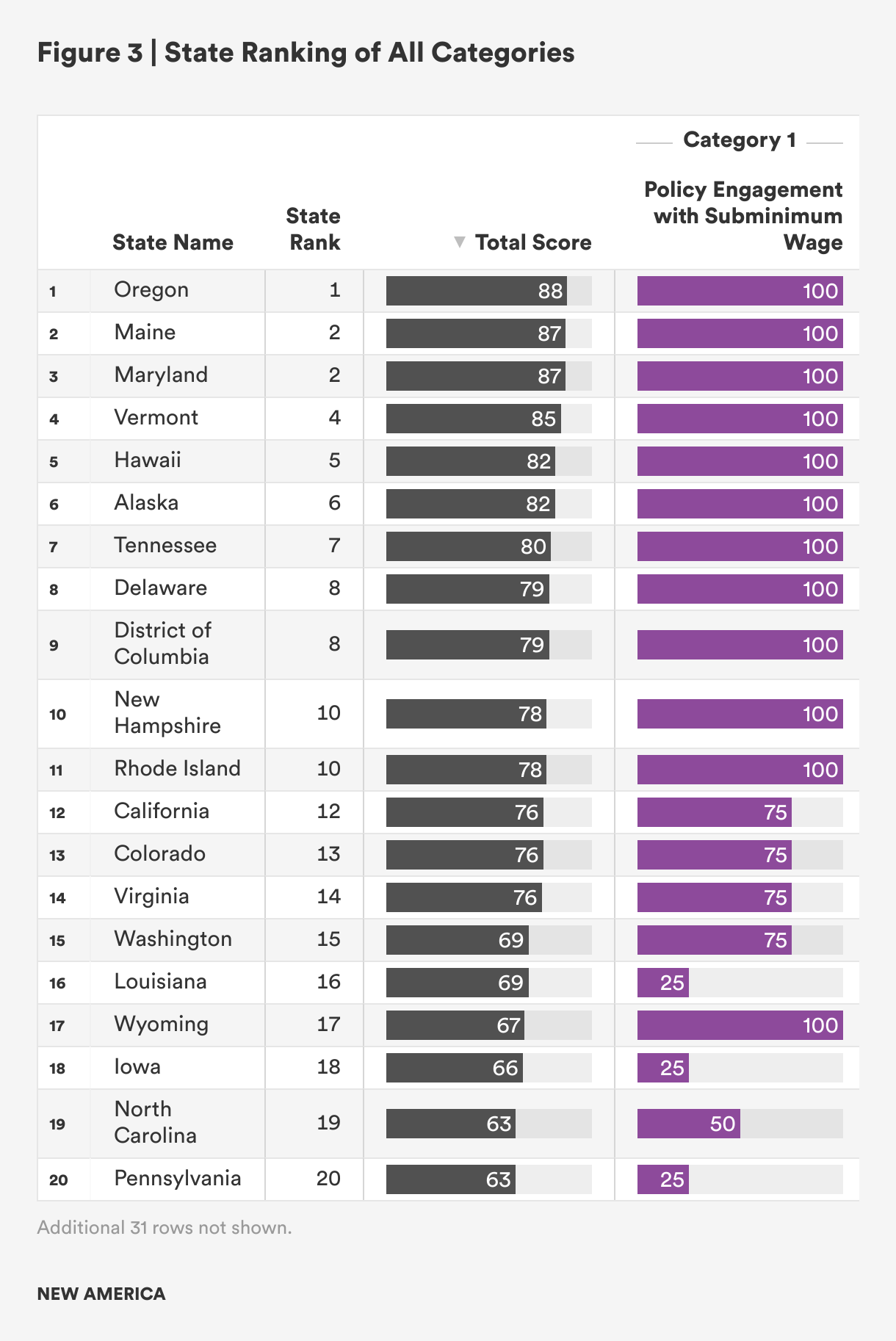
Figure 3 displays the state rankings and total scores across the four categories. Figure 3 also displays the scores for each state within each category that resulted in the total score. Oregon, Maine, Maryland, Vermont, Hawaii, Alaska, Tennessee, Delaware, DC, New Hampshire, and Rhode Island received the top 10 scores, respectively, with Maine and Maryland receiving the same total score to both rank second, Delaware and DC both ranking eighth, and New Hampshire and Rhode Island receiving the same total score to both rank 10th. Ranked lowest, from 42nd to 51st, are Arizona, Alabama, Minnesota, Kansas, South Dakota, Missouri, Idaho, North Dakota, Wisconsin, and New Mexico (note that in February 2024 after the report had been finalized, the Kansas governor signed legislation to phase out the subminimum wage; this would likely impact Kansas's ranking in future analyses). Some states have the same overall ranking, as it was possible to receive the same total score. While clustering was more common within the categories discussed below, there were a few instances of clustering in the total scores.
The total possible score was 100, with the highest scoring state, Oregon, receiving 88.19. The lowest scoring state, New Mexico, received 33.96. The range in the top 11 states (top 10 ranking) was only approximately 10 points and the range within the states with the lowest scores was approximately 11 points.
Rankings by Category
Figures 4 through 7 demonstrate state scores and rankings for each of the four categories.
Figure 4 shows the results of the rankings for Category 1: Policy Engagement with Subminimum Wage. This category included data related to maintaining or phasing out subminimum wage. Based on the data calculated, each state received a score and rank displayed in Figure 3. Many states had the same score and states are listed alphabetically if they have the same rank. Alaska, Delaware, DC, Hawaii, Maine, Maryland, New Hampshire, Oregon, Rhode Island, Tennessee, Vermont, and Wyoming all received a 100 and tied for rank 1. These states have eliminated subminimum wage. This grouped California, Colorado, South Carolina, Virginia, and Washington in the next rank (13) with a score of 75, the next highest score. This group of states have active phase-out procedures underway. A score of 50 was equivalent to having ongoing efforts to remove subminimum wage. A score of 25 was equivalent to using subminimum wage at this time without information available on an active process to remove. Kansas and Missouri both scored 0. These two states received no points, as instead of trying to eliminate the subminimum wage, they were acting to maintain and use subminimum wage at the time of our analysis.
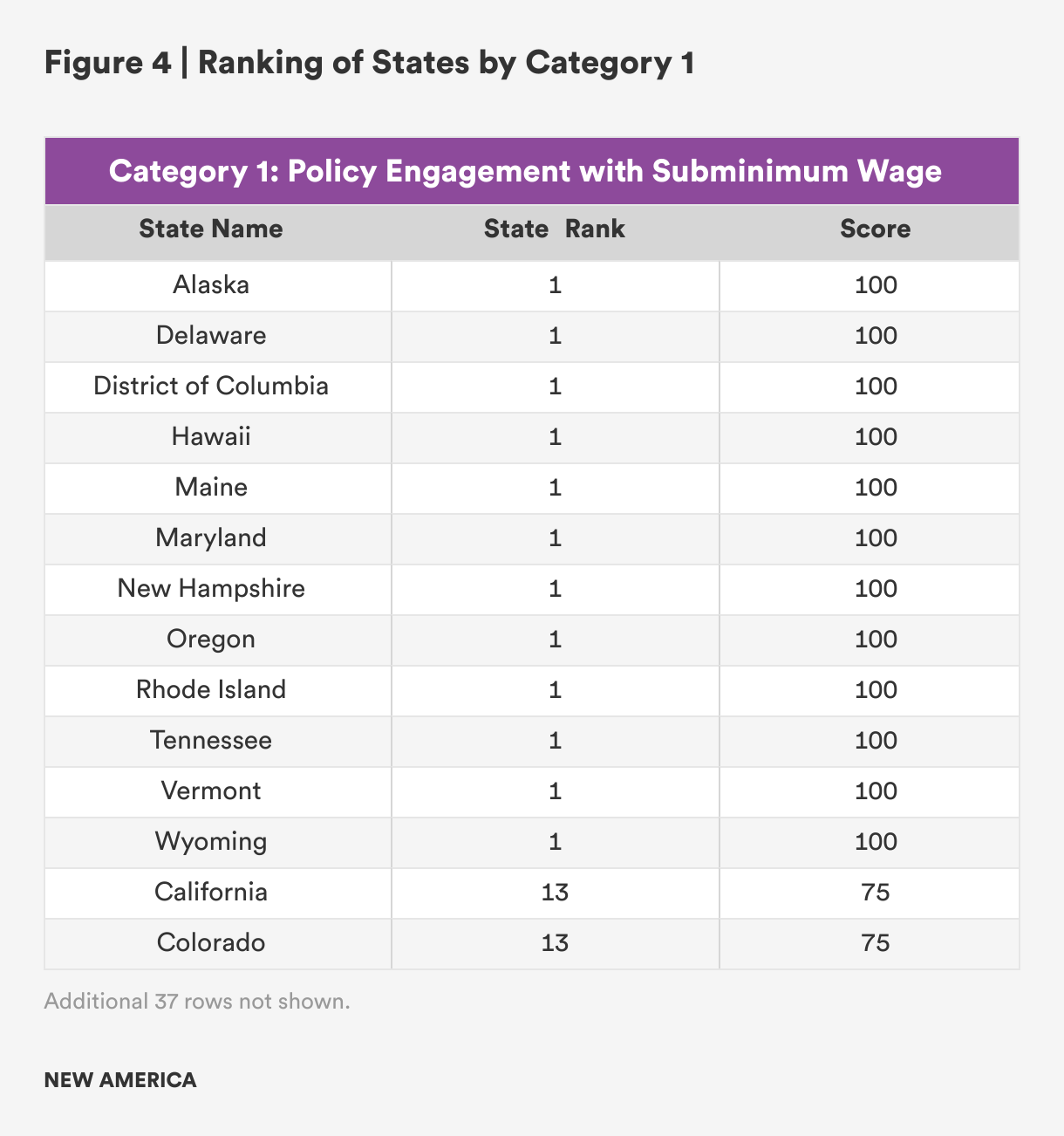
Figure 5 shows the second category, on the use of subminimum wage, with data from July 2018 and July 2023. There was some clustering of scores and ranks at the top, with more variation throughout the rest of the category. States that had previously eliminated subminimum wage (New Hampshire and Vermont) and states that moved to eliminate it (Alaska, Delaware, DC, Hawaii, Maine, Oregon, Rhode Island, Tennessee, and Wyoming) all received a score of 100 out of 100 and ranked 1.
This category showed change over time. More reduction and change resulted in a higher score, as we measured and scored percentage of change from 2018 to 2023 for workers paid under the 14(c) certificates and the number of issued certificates to employers. States that began with low numbers and still made a significant reduction received a high score, just as states that began with high numbers and made a significant reduction. States that kept numbers steady had less of a percent reduction and earned a lower score.
Twenty-three states had scores of 75 or higher in this category. Fifteen states had scores less than 50. Missouri had the least overall change in number of workers employed under 14(c) certificates and reduction in use of certificates, resulting in a ranking of 51 and score of 19.7.
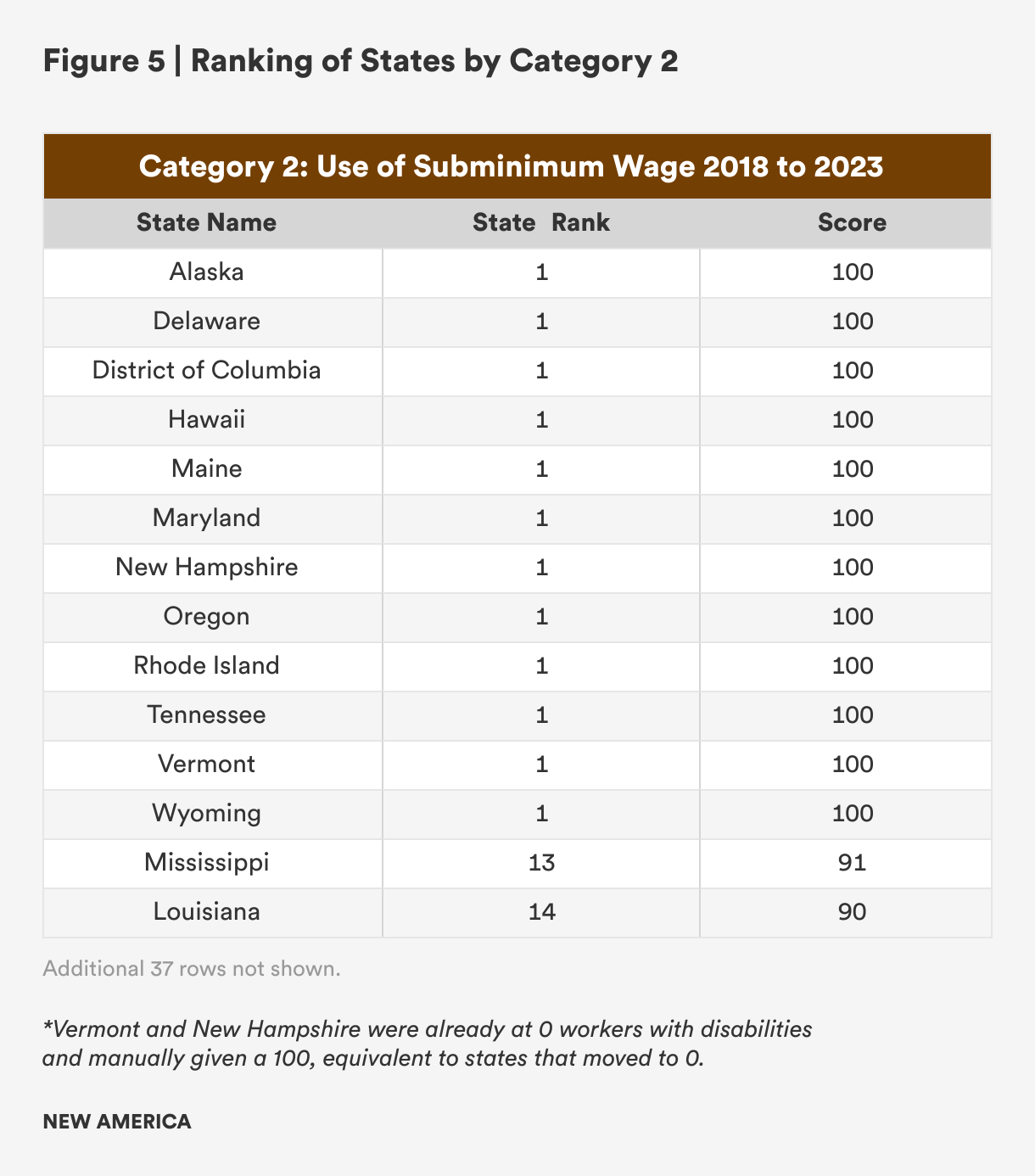
Figure 6 represents the third category, proactive employment policy and funding initiatives. This category included information from three distinct groups of data: the DIF, Employment First, and Medicaid expansion. Despite three separate elements of data used to build this category, there was still quite a bit of clustering because of the binary nature of the scoring. The total score displayed for each state is the average of the three elements. Thus, the category represents state employment system supports for the (a) reduction of subminimum wage, (b) expansion of employment opportunities for disabled workers, and (c) appropriate support within employment.
California, Illinois, Pennsylvania, Vermont, and Virginia received the highest score of 88.9 out of 100 and each received a rank of 1. Alabama, Mississippi, and Tennessee received a 33.3, the lowest score of the states and a rank of 49. Most states clustered around ranks 20 and 30, with scores of 66.7 and 61.1, respectively. The majority of the states, 37, scored 61.1 or above. This was a very strong category for most of the states.
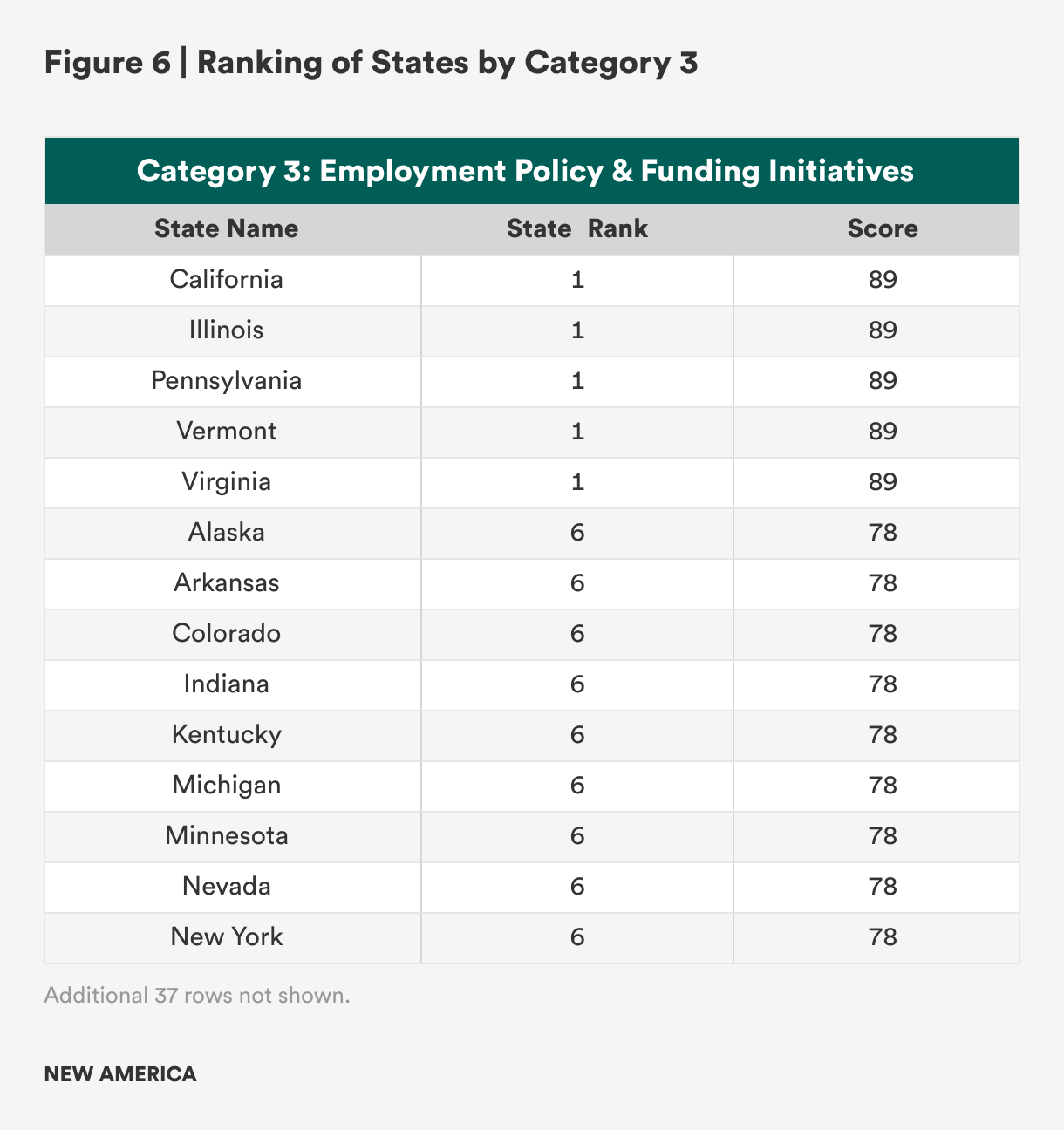
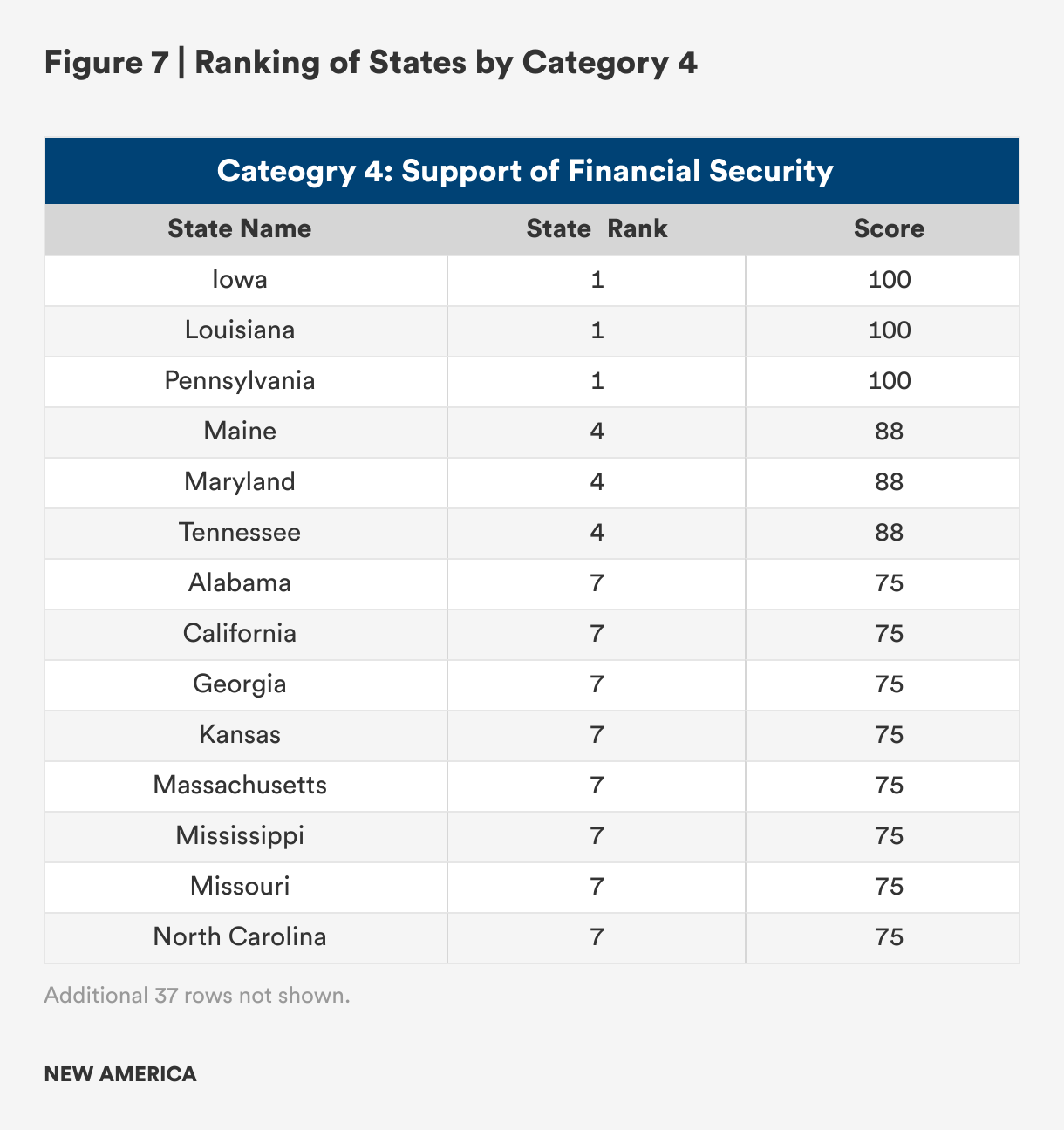
Figure 7 shows the fourth and final category, support for individuals’ financial security. This category included benefits information from a variety of datasets. Data came from WIPA, general benefits provided in states, and ABLE account information. The goal of this category was to capture statewide information about how disabled employees are supported through the web of benefits navigation when they transition from subminimum wage to minimum wage.
The total state score is an average of four different scores in the category. Like the other categories, there was some clustering, particularly around the middle-range scores. Iowa, Louisiana, and Pennsylvania all received scores of 100, resulting in ranks of 1. Maine, Maryland, and Tennessee were close behind, with scores of 87.5 and ranks of 4. Idaho, New Mexico, Wisconsin, and Wyoming received scores of 25 and ranks of 46. Most states, 34, received scores between 50 and 75, ranking between 7 and 33, respectively. North Dakota and South Dakota received scores of 0, resulting in ranks of 50. This category significantly separated out states with a big impact on total scores and rankings, seen in the top 18 and bottom 11.
Citations
- This report uses person-first and identity-first language throughout. This choice honors the preferences, cultures, and identities within the disability community.
- Subminimum wage, Section 14(c), and 14(c) certificates are used interchangeably throughout this report. Section 14(c) is the specific section in the Fair Labor Standards Act that authorizes the use of a subminimum wage. Subminimum wage is a shorthand name for the practice. 14(c) certificates are the certificates employers hold to pay disabled employees a subminimum wage.
- LegiScan, “Maine House Bill 1874,” March 17, 2020, https://legiscan.com/ME/bill/LD1874/2019.
- For more about Employment First, see two resources from the U.S. Department of Labor, Office of Disability Employment Policy: "Employment First Initiative," https://www.dol.gov/agencies/odep/initiatives/employment-first; and "Competitive Integrated Employment," https://www.dol.gov/agencies/odep/program-areas/cie. Competitive integrated employment is work that is performed on a full-time or part-time basis for which an individual is compensated at or above minimum wage, receiving the same level of benefits provided to other employees without disabilities, at a location where the employee interacts with other individuals without disabilities, and presented opportunities for advancement similar to other employees without disabilities. For full legal definition, see Appendix I.
- Throughout this report, the term state refers to all 50 states and the District of Columbia.
- For more on the history behind the Fair Labor Standards Act, see Nathaniel Ruby and Ross Eisenbrey, Celebrating 75 Years of the Fair Labor Standards Act (Sofia, Bulgaria: Economic Policy Institute, June 25, 2013), https://policycommons.net/artifacts/1413090/celebrating-75-years-of-the-fair-labor-standards-act/2027353/.
- For more on this law, see U.S. Department of Labor, "The Fair Labor Standards Act of 1938," https://www.dol.gov/general/aboutdol/history/flsa1938.
- Sarah A. Donovan, The Fair Labor Standards Act (FLSA): An Overview (Washington, DC: Congressional Research Service, March 8, 2023), https://crsreports.congress.gov/product/pdf/R/R42713.
- Joint Hearings before the Senate Committee on Education and Labor and the House Committee on Labor, Fair Labor Standards Act of 1937, 75th Cong., 1st sess., June 4, 1937.
- The full text of Section 14(c) as originally published in 1938, outlining the subminimum wage can be found on page 38 of the Fair Labor Standards Act of 1938, https://www.govinfo.gov/content/pkg/COMPS-1514/pdf/COMPS-1514.pdf.
- Department of Labor, “Materials for Employers with Section 14(c) Certificates,” http://www.dol.gov/agencies/whd/workers-with-disabilities/employers.
- Fair Labor Standards Act of 1938, Pub. L. No. 117-328, §14(c)(1)(B) and §14(c)(1)(C), (2022), https://www.govinfo.gov/content/pkg/COMPS-1514/pdf/COMPS-1514.pdf.
- Subminimum Wage Program: DOL Could Do More to Ensure Timely Oversight (Washington, DC: U.S. Government Accountability Office, January 2023), 17, https://www.gao.gov/assets/gao-23-105116.pdf.
- Department of Labor, “14(c) Certificate Holders,” http://www.dol.gov/agencies/whd/workers-with-disabilities/section-14c/certificate-holders.
- For more explanation of these categories, see the graphic on page 7 within the GAO report, Subminimum Wage Program: DOL Could Do More to Ensure Timely Oversight (Washington, DC: U.S. Government Accountability Office, January 2023), https://www.gao.gov/assets/gao-23-105116.pdf. Also see the definition of CRP in Appendix I.
- From the New Deal to the Real Deal: Joining the Industries of the Future (Washington, DC: National Council on Disability, October 2018), https://www.ncd.gov/report/national-disability-employment-policy-from-the-new-deal-to-the-real-deal-joining-the-industries-of-the-future/.
- For a description of day habilitation services, see Appendix I.
- For a detailed discussion on integration requirements of the ADA, segregation of workers with disabilities, and the impact of the Olmstead ruling on subminimum wage, see p. 18-29 of Subminimum Wages: Impacts on the Rights of People with Disabilities (Washington, DC: U.S. Commission on Civil Rights, 2020), https://www.usccr.gov/files/2020/2020-09-17-Subminimum-Wages-Report.pdf.
- Subminimum Wages, https://www.usccr.gov/reports/2020/subminimum-wages-impacts-civil-rights-people-disabilities.
- U.S. Department of Justice, Lane et al. v. Brown et al., settlement agreement, in effect 2015, finalized 2022, https://archive.ada.gov/olmstead/documents/lane_sa.pdf.
- U.S. Department of Justice, "Rhode Island Olmstead Statewide Agreement," April 9, 2014, https://archive.ada.gov/olmstead/documents/ri-olmstead-statewide-agreement.pdf.
- U.S. Department of Justice, Office of Public Affairs, "Justice Department Issues Guidance on Americans with Disabilities Act and Employment Services for People with Disabilities," press release, October 31, 2023, https://www.justice.gov/opa/pr/justice-department-issues-guidance-americans-disabilities-act-and-employment-services-people.
- Subminimum Wage Program, https://www.gao.gov/products/gao-23-105116. Only 4 percent of workers employed under 14(c) certificates as of August 2021 were between ages 18–21 as compared to 26 percent who were 55 years or older, as seen in Table 3 on p. 26.
- U.S. Department of Justice, Office of Public Affairs, "Justice Department Issues Guidance on Americans with Disabilities Act and Employment Services for People with Disabilities," press release, October 31, 2023, https://www.justice.gov/opa/pr/justice-department-issues-guidance-americans-disabilities-act-and-employment-services-people.
- See Subminimum Wages: Impacts on the Rights of People with Disabilities and Rhode Island Olmstead Statewide Agreement. Subminimum Wages, https://www.usccr.gov/files/2020/2020-09-17-Subminimum-Wages-Report.pdf and Rhode Island Olmstead Statewide Agreement, https://archive.ada.gov/olmstead/documents/ri-olmstead-statewide-agreement.pdf.
- Department of Labor, Office of Disability Employment Policy, “Section 14(c) Review,” https://www.dol.gov/agencies/odep/14cEngagement#:~:text=On%20September%2026%2C%202023%2C%20Acting,workers%20whose%20disabilities%20impact%20their.
- Melwood (website), "Melwood CEO Testifies Before U.S. Commission on Civil Rights, Calling for Abolishment of Subminimum Wage Laws," press release, November 22, 2019, https://melwood.org/newsroom/uncategorized/melwood-ceo-testifies-before-u-s-commission-on-civil-rights-calling-for-abolishment-of-subminimum-wage-laws/.
- U.S. Department of Labor, Office of Disability Employment Policy, "Employment First Initiative," https://www.dol.gov/agencies/odep/initiatives/employment-first. For a detailed definition of Employment First, see Appendix I.
- Association of People Supporting Employment First (APSE), "About," https://apse.org/about-2/.
- For a detailed definition of vocational rehabilitation and pre-employment transitions services, see Appendix I.
- S. 533, H.R. 1263. The legislation was first introduced in January 2019 in the 116th Congress (S.260, H.R. 873) as the Transformation to Competitive Employment Act. For more details, see Congressman Bobby Scott (website), “Scott, Casey, McMorris Rodgers, Daines to Reintroduce Bipartisan, Bicameral Bill to Help Workers with Disabilities Find Good-Paying Jobs,” press release, February 27, 2023, https://bobbyscott.house.gov/media-center/press-releases/scott-casey-mcmorris-rodgers-daines-reintroduce-bipartisan-bicameral.
- AbilityOne Commission, "14(c) Final Rule News Statement," press release, July 21, 2022, https://www.abilityone.gov/commission/documents/14(c)%20Final%20Rule%20News%20Statement%2020220721%20post.pdf.
- U.S. Department of Labor, et al., "Federal Joint Communication to State and Local Governments: Resource Leveraging & Service Coordination to Increase Competitive Integrated Employment for Individuals with Disabilities," August 3, 2022, https://www.dol.gov/sites/dolgov/files/ODEP/pdf/ResourceLeveragingServiceCoordinationToIncreaseCIE8-12-22.pdf.
- For a definition of supported employment, see Appendix I.
- Medicaid.gov, "Employment Services," https://www.medicaid.gov/medicaid/long-term-services-supports/employment-initiatives/employment-services/index.html.
- Association of People Supporting Employment First (APSE), "Benefits Counseling Guide," revised April 22, 2019, https://apse.org/wp-content/uploads/2014/01/Benefits-Counseling-Guide-.pdf.
- ABLE National Resource Center, "What Are ABLE Accounts?" https://www.ablenrc.org/what-is-able/what-are-able-acounts/.
- Department of Labor, Wage and Hour Division, “14(c) Certificate Holders,” http://www.dol.gov/agencies/whd/workers-with-disabilities/section-14c/certificate-holders.
- Rehabilitation Services Administration, "RSA Programs," https://rsa.ed.gov/about/programs.
- Association of People Supporting Employment First (APSE), "Employment First Map," https://apse.org/home-v2-2/employment-first/.
- Kaiser Family Foundation, "Status of State Medicaid Expansion Decisions: Interactive Map," https://www.kff.org/medicaid/issue-brief/status-of-state-medicaid-expansion-decisions-interactive-map/; and Kaiser Family Foundation, "State Activity Around Expanding Medicaid Under the Affordable Care Act," https://www.kff.org/health-reform/state-indicator/state-activity-around-expanding-medicaid-under-the-affordable-care-act/?currentTimeframe=0&sortModel=%7B%22colId%22:%22Location%22,%22sort%22:%22asc%22%7D.
Discussion and Takeaways
This report produced a first of its kind dataset, available here, and results that shed light on the use of and elimination of the subminimum wage and the programs that provide the comprehensive support disabled workers need. Among the many lessons embedded in each state’s data, we see three key takeaways that carry over from state to state.
Most States are Moving Away from Subminimum Wage Employment
Over the past six years, there has been a marked trend toward phasing out the use of subminimum wage, as demonstrated in Figure 5. The reduction in use of subminimum wage parallels an increase in the employment of disabled workers in the workforce, with historic levels of labor force participation.42 Many states are moving in the direction of supporting workers with disabilities in a more comprehensive way, as shown in the results. Using the Wage and Hour data from July 2023, we see that no state has more than 4,000 workers with disabilities paid a subminimum wage, and the vast majority (36) have less than 1,000 workers with disabilities paid a subminimum wage. This is a significant change from just six years ago, when only 18 states had less than 1,000 workers with disabilities paid a subminimum wage.
Further demonstrating this change is the percent change in workers and percent change in issued certificates as described in the findings section and shown as rankings in Figure 5. An impressive 46 states had a 50 percent or more reduction in workers paid under 14(c) certificates from 2018 to 2023. One state to mention is Mississippi, with a remarkable 94.8 percent decrease in workers paid a subminimum wage from 2018 to 2023. Not only was the percentage high, the number of workers was also high—a drop of nearly 1,500 workers. Iowa is another state that had a remarkable decrease in workers paid a subminimum wage from 2018 to 2023, a decrease of 84.1 percent. Like Mississippi, Iowa also had a large decrease in the number of people employed, not only the percentage, reducing the number of workers paid under 14(c) certificates by 2,034.
As of the writing of this report, 12 states have no workers with disabilities paid a subminimum wage because of fully eliminating their 14(c) certificates or via other means; an additional five states are in process of phasing it out. Our analysis demonstrates the dramatic shift away from subminimum wage employment, with 17 states at or moving to zero and many others on a similar trajectory. After years of stagnation, most states are making changes to move away from subminimum wage employment.
Any State Can Move to Eliminate Subminimum Wage
The top 21 ranked states, all with scores higher than 60 out of 100 as displayed in Figures 2 and 3, show a range of different characteristics, such as population size, location, physical size, and political views. Several of these states are large, with strong urban cores, such as California, Maryland, and Illinois. Other states had smaller populations such as Rhode Island, Alaska, Vermont, and Wyoming. Several states are rural, while others are more urban. Some of the states are more centrally located in the United States while others are coastal. Finally, critically important to the policy recommendations found later in this report, there is a range of political views demonstrated across the top 21 states, from very progressive states to traditionally conservative states and others in between.
Equally important, the states with the lowest scores showed less differentiation but still some diversity across characteristics. The states ranked 38 through 51 had total scores below 50. These states did have fewer large urban cores than those in the top 21. Several of these states scored in the middle to upper ranges of category 2 (use of subminimum wage) and category 3 (employment policy and funding initiatives). However, nearly all of these states significantly struggled with policy engagement of subminimum wage and financial security support.
This diversity of characteristics demonstrates that phasing out and eliminating the subminimum wage is not limited to a state type, specific characteristics, or political leanings. Any state can phase out or eliminate it.
A Comprehensive System of Support Creates Lasting Change
Previous research on subminimum wage has primarily focused on use of the 14(c) certificate or, separately, on the employment of workers with disabilities in competitive integrated employment. Workers with disabilities transitioning from low-wage work need comprehensive supports as they enter the workforce; our research looked at multiple factors that have been shown to make a difference for disabled workers, including Medicaid, funding initiatives, proactive employment policies, benefits counseling, and financial support. While the total score for each state has two categories focused on subminimum wage (policy and use), the comprehensive supports significantly factor into the final score.
For example, as shown in Figure 3, we found no sign of policy engagement in Louisiana to eliminate subminimum wage (category 1), resulting in a score of 25. But through other efforts, Louisiana has significantly reduced the use of subminimum wage between 2018 and 2023, resulting in a 90.1 in category 2. Louisiana also has employment policies and funding initiatives to support disabled workers (category 3) resulting in a 61.1 and scored a 100 in the final category of support of financial security. Louisiana is an example of a state that is on its way to eliminating the subminimum wage and supporting disabled workers through comprehensive supports. Iowa, West Virginia, and Nebraska are three other states, among several others in the ranks between 18 through 35, that have less action on the policy front to eliminate subminimum wage but scored well in the other three categories, demonstrating comprehensive supports and setting the stage for the elimination of the subminimum wage in coming years.
States can look at each other’s efforts, including policy changes, comprehensive supports, and employment systems, to see how lasting change can be made. For example, Massachusetts, Iowa, Michigan, Washington, Connecticut, Georgia, Colorado, Louisiana, Mississippi, Tennessee, and Maryland are examples of states that had significant decreases (more than 80 percent) in the use of subminimum wage from 2018 to 2023. Some of these states excel in the other three categories. Some are building capacity. But all are creating lasting change for their workers with disabilities.
Our data provide a point-in-time view of how states are doing on their path toward eliminating subminimum wage and supporting disabled workers. Taken together—state policy change to phase out or eliminate subminimum wage, reduction in use of subminimum wage, proactive employment policies, and support of financial security—the categories provide insight into how many states have an employment system that enables success for their disabled employees as a transition from subminimum wage occurs.
Citations
- This report uses person-first and identity-first language throughout. This choice honors the preferences, cultures, and identities within the disability community.
- Subminimum wage, Section 14(c), and 14(c) certificates are used interchangeably throughout this report. Section 14(c) is the specific section in the Fair Labor Standards Act that authorizes the use of a subminimum wage. Subminimum wage is a shorthand name for the practice. 14(c) certificates are the certificates employers hold to pay disabled employees a subminimum wage.
- LegiScan, “Maine House Bill 1874,” March 17, 2020, https://legiscan.com/ME/bill/LD1874/2019.
- For more about Employment First, see two resources from the U.S. Department of Labor, Office of Disability Employment Policy: "Employment First Initiative," https://www.dol.gov/agencies/odep/initiatives/employment-first; and "Competitive Integrated Employment," https://www.dol.gov/agencies/odep/program-areas/cie. Competitive integrated employment is work that is performed on a full-time or part-time basis for which an individual is compensated at or above minimum wage, receiving the same level of benefits provided to other employees without disabilities, at a location where the employee interacts with other individuals without disabilities, and presented opportunities for advancement similar to other employees without disabilities. For full legal definition, see Appendix I.
- Throughout this report, the term state refers to all 50 states and the District of Columbia.
- For more on the history behind the Fair Labor Standards Act, see Nathaniel Ruby and Ross Eisenbrey, Celebrating 75 Years of the Fair Labor Standards Act (Sofia, Bulgaria: Economic Policy Institute, June 25, 2013), https://policycommons.net/artifacts/1413090/celebrating-75-years-of-the-fair-labor-standards-act/2027353/.
- For more on this law, see U.S. Department of Labor, "The Fair Labor Standards Act of 1938," https://www.dol.gov/general/aboutdol/history/flsa1938.
- Sarah A. Donovan, The Fair Labor Standards Act (FLSA): An Overview (Washington, DC: Congressional Research Service, March 8, 2023), https://crsreports.congress.gov/product/pdf/R/R42713.
- Joint Hearings before the Senate Committee on Education and Labor and the House Committee on Labor, Fair Labor Standards Act of 1937, 75th Cong., 1st sess., June 4, 1937.
- The full text of Section 14(c) as originally published in 1938, outlining the subminimum wage can be found on page 38 of the Fair Labor Standards Act of 1938, https://www.govinfo.gov/content/pkg/COMPS-1514/pdf/COMPS-1514.pdf.
- Department of Labor, “Materials for Employers with Section 14(c) Certificates,” http://www.dol.gov/agencies/whd/workers-with-disabilities/employers.
- Fair Labor Standards Act of 1938, Pub. L. No. 117-328, §14(c)(1)(B) and §14(c)(1)(C), (2022), https://www.govinfo.gov/content/pkg/COMPS-1514/pdf/COMPS-1514.pdf.
- Subminimum Wage Program: DOL Could Do More to Ensure Timely Oversight (Washington, DC: U.S. Government Accountability Office, January 2023), 17, https://www.gao.gov/assets/gao-23-105116.pdf.
- Department of Labor, “14(c) Certificate Holders,” http://www.dol.gov/agencies/whd/workers-with-disabilities/section-14c/certificate-holders.
- For more explanation of these categories, see the graphic on page 7 within the GAO report, Subminimum Wage Program: DOL Could Do More to Ensure Timely Oversight (Washington, DC: U.S. Government Accountability Office, January 2023), https://www.gao.gov/assets/gao-23-105116.pdf. Also see the definition of CRP in Appendix I.
- From the New Deal to the Real Deal: Joining the Industries of the Future (Washington, DC: National Council on Disability, October 2018), https://www.ncd.gov/report/national-disability-employment-policy-from-the-new-deal-to-the-real-deal-joining-the-industries-of-the-future/.
- For a description of day habilitation services, see Appendix I.
- For a detailed discussion on integration requirements of the ADA, segregation of workers with disabilities, and the impact of the Olmstead ruling on subminimum wage, see p. 18-29 of Subminimum Wages: Impacts on the Rights of People with Disabilities (Washington, DC: U.S. Commission on Civil Rights, 2020), https://www.usccr.gov/files/2020/2020-09-17-Subminimum-Wages-Report.pdf.
- Subminimum Wages, https://www.usccr.gov/reports/2020/subminimum-wages-impacts-civil-rights-people-disabilities.
- U.S. Department of Justice, Lane et al. v. Brown et al., settlement agreement, in effect 2015, finalized 2022, https://archive.ada.gov/olmstead/documents/lane_sa.pdf.
- U.S. Department of Justice, "Rhode Island Olmstead Statewide Agreement," April 9, 2014, https://archive.ada.gov/olmstead/documents/ri-olmstead-statewide-agreement.pdf.
- U.S. Department of Justice, Office of Public Affairs, "Justice Department Issues Guidance on Americans with Disabilities Act and Employment Services for People with Disabilities," press release, October 31, 2023, https://www.justice.gov/opa/pr/justice-department-issues-guidance-americans-disabilities-act-and-employment-services-people.
- Subminimum Wage Program, https://www.gao.gov/products/gao-23-105116. Only 4 percent of workers employed under 14(c) certificates as of August 2021 were between ages 18–21 as compared to 26 percent who were 55 years or older, as seen in Table 3 on p. 26.
- U.S. Department of Justice, Office of Public Affairs, "Justice Department Issues Guidance on Americans with Disabilities Act and Employment Services for People with Disabilities," press release, October 31, 2023, https://www.justice.gov/opa/pr/justice-department-issues-guidance-americans-disabilities-act-and-employment-services-people.
- See Subminimum Wages: Impacts on the Rights of People with Disabilities and Rhode Island Olmstead Statewide Agreement. Subminimum Wages, https://www.usccr.gov/files/2020/2020-09-17-Subminimum-Wages-Report.pdf and Rhode Island Olmstead Statewide Agreement, https://archive.ada.gov/olmstead/documents/ri-olmstead-statewide-agreement.pdf.
- Department of Labor, Office of Disability Employment Policy, “Section 14(c) Review,” https://www.dol.gov/agencies/odep/14cEngagement#:~:text=On%20September%2026%2C%202023%2C%20Acting,workers%20whose%20disabilities%20impact%20their.
- Melwood (website), "Melwood CEO Testifies Before U.S. Commission on Civil Rights, Calling for Abolishment of Subminimum Wage Laws," press release, November 22, 2019, https://melwood.org/newsroom/uncategorized/melwood-ceo-testifies-before-u-s-commission-on-civil-rights-calling-for-abolishment-of-subminimum-wage-laws/.
- U.S. Department of Labor, Office of Disability Employment Policy, "Employment First Initiative," https://www.dol.gov/agencies/odep/initiatives/employment-first. For a detailed definition of Employment First, see Appendix I.
- Association of People Supporting Employment First (APSE), "About," https://apse.org/about-2/.
- For a detailed definition of vocational rehabilitation and pre-employment transitions services, see Appendix I.
- S. 533, H.R. 1263. The legislation was first introduced in January 2019 in the 116th Congress (S.260, H.R. 873) as the Transformation to Competitive Employment Act. For more details, see Congressman Bobby Scott (website), “Scott, Casey, McMorris Rodgers, Daines to Reintroduce Bipartisan, Bicameral Bill to Help Workers with Disabilities Find Good-Paying Jobs,” press release, February 27, 2023, https://bobbyscott.house.gov/media-center/press-releases/scott-casey-mcmorris-rodgers-daines-reintroduce-bipartisan-bicameral.
- AbilityOne Commission, "14(c) Final Rule News Statement," press release, July 21, 2022, https://www.abilityone.gov/commission/documents/14(c)%20Final%20Rule%20News%20Statement%2020220721%20post.pdf.
- U.S. Department of Labor, et al., "Federal Joint Communication to State and Local Governments: Resource Leveraging & Service Coordination to Increase Competitive Integrated Employment for Individuals with Disabilities," August 3, 2022, https://www.dol.gov/sites/dolgov/files/ODEP/pdf/ResourceLeveragingServiceCoordinationToIncreaseCIE8-12-22.pdf.
- For a definition of supported employment, see Appendix I.
- Medicaid.gov, "Employment Services," https://www.medicaid.gov/medicaid/long-term-services-supports/employment-initiatives/employment-services/index.html.
- Association of People Supporting Employment First (APSE), "Benefits Counseling Guide," revised April 22, 2019, https://apse.org/wp-content/uploads/2014/01/Benefits-Counseling-Guide-.pdf.
- ABLE National Resource Center, "What Are ABLE Accounts?" https://www.ablenrc.org/what-is-able/what-are-able-acounts/.
- Department of Labor, Wage and Hour Division, “14(c) Certificate Holders,” http://www.dol.gov/agencies/whd/workers-with-disabilities/section-14c/certificate-holders.
- Rehabilitation Services Administration, "RSA Programs," https://rsa.ed.gov/about/programs.
- Association of People Supporting Employment First (APSE), "Employment First Map," https://apse.org/home-v2-2/employment-first/.
- Kaiser Family Foundation, "Status of State Medicaid Expansion Decisions: Interactive Map," https://www.kff.org/medicaid/issue-brief/status-of-state-medicaid-expansion-decisions-interactive-map/; and Kaiser Family Foundation, "State Activity Around Expanding Medicaid Under the Affordable Care Act," https://www.kff.org/health-reform/state-indicator/state-activity-around-expanding-medicaid-under-the-affordable-care-act/?currentTimeframe=0&sortModel=%7B%22colId%22:%22Location%22,%22sort%22:%22asc%22%7D.
- ABLE National Resource Center, "Choose the Program That’s Right for You!" https://www.ablenrc.org/select-a-state-program/.
Policy Recommendations
Since the creation of section 14(c) and the subminimum wage, the opportunities and possibilities for disabled workers have completely changed. Historically, there have been long-held paternalistic ideas about the ability of individuals with disabilities to hold a job and contribute to society. The subminimum wage proliferates low expectations for people with disabilities and implies that paying them at all for their work is an act of charity. The subminimum wage says that some pay is “good enough” even if the very existence of the subminimum wage makes individuals with disabilities second-class workers. Subminimum wage holds people with disabilities to outdated narratives about disability and blocks opportunities for economic self-sufficiency as promised in the ADA.
People with disabilities need a modern framework for employment and employment supports that promote equity, dignity, and integration. Our research shows that change is not only possible but achievable relatively quickly, as we identified many steps that both states and the federal government have taken to advance these ideals. We have three policy recommendations aimed at building on this progress.
Phase Out Section 14(c)
As of the publication of this report, 12 states have fully eliminated the subminimum wage and five are actively phasing it out. Most states are moving away from subminimum wage employment. To ensure equal and fair employment opportunities for disabled workers, section 14(c) should be phased out of the Fair Labor Standards Act by federal policymakers. In the meantime, states can make legislative and other policy changes to eliminate the use of subminimum wage.
Take a Holistic Approach
States should participate in national efforts to expand Medicaid, bolster benefits counseling, or adopt other employment policies to promote competitive integrated employment as they eliminate subminimum wage. States that have already stopped using subminimum wage or are in the process of phasing it out should consider what next steps they might take to support employees with disabilities.
Collect Better Data
Current data available from the DOL Wage and Hour Division about use of 14(c) certificates are extremely limited in scope and are not useful longitudinally. Better data are needed to ensure that as states eliminate their use of subminimum wage, opportunities for competitive integrated employment are growing. Several states, such as Colorado and Maryland, required in their legislation eliminating 14(c) certificates that data be collected on the transition of subminimum wage employees and employers.43 This is an important accountability measure to ensure that eliminating subminimum wage increases opportunities for people. Developing a more robust and longitudinal dataset allows better policies for each state and for federal policymakers. Further, the data allow families to be informed and understand why decisions were made. The long-term economic success of disabled workers and transitioned employment settings can be tracked and shared widely.
Citations
- This report uses person-first and identity-first language throughout. This choice honors the preferences, cultures, and identities within the disability community.
- Subminimum wage, Section 14(c), and 14(c) certificates are used interchangeably throughout this report. Section 14(c) is the specific section in the Fair Labor Standards Act that authorizes the use of a subminimum wage. Subminimum wage is a shorthand name for the practice. 14(c) certificates are the certificates employers hold to pay disabled employees a subminimum wage.
- LegiScan, “Maine House Bill 1874,” March 17, 2020, https://legiscan.com/ME/bill/LD1874/2019.
- For more about Employment First, see two resources from the U.S. Department of Labor, Office of Disability Employment Policy: "Employment First Initiative," https://www.dol.gov/agencies/odep/initiatives/employment-first; and "Competitive Integrated Employment," https://www.dol.gov/agencies/odep/program-areas/cie. Competitive integrated employment is work that is performed on a full-time or part-time basis for which an individual is compensated at or above minimum wage, receiving the same level of benefits provided to other employees without disabilities, at a location where the employee interacts with other individuals without disabilities, and presented opportunities for advancement similar to other employees without disabilities. For full legal definition, see Appendix I.
- Throughout this report, the term state refers to all 50 states and the District of Columbia.
- For more on the history behind the Fair Labor Standards Act, see Nathaniel Ruby and Ross Eisenbrey, Celebrating 75 Years of the Fair Labor Standards Act (Sofia, Bulgaria: Economic Policy Institute, June 25, 2013), https://policycommons.net/artifacts/1413090/celebrating-75-years-of-the-fair-labor-standards-act/2027353/.
- For more on this law, see U.S. Department of Labor, "The Fair Labor Standards Act of 1938," https://www.dol.gov/general/aboutdol/history/flsa1938.
- Sarah A. Donovan, The Fair Labor Standards Act (FLSA): An Overview (Washington, DC: Congressional Research Service, March 8, 2023), https://crsreports.congress.gov/product/pdf/R/R42713.
- Joint Hearings before the Senate Committee on Education and Labor and the House Committee on Labor, Fair Labor Standards Act of 1937, 75th Cong., 1st sess., June 4, 1937.
- The full text of Section 14(c) as originally published in 1938, outlining the subminimum wage can be found on page 38 of the Fair Labor Standards Act of 1938, https://www.govinfo.gov/content/pkg/COMPS-1514/pdf/COMPS-1514.pdf.
- Department of Labor, “Materials for Employers with Section 14(c) Certificates,” http://www.dol.gov/agencies/whd/workers-with-disabilities/employers.
- Fair Labor Standards Act of 1938, Pub. L. No. 117-328, §14(c)(1)(B) and §14(c)(1)(C), (2022), https://www.govinfo.gov/content/pkg/COMPS-1514/pdf/COMPS-1514.pdf.
- Subminimum Wage Program: DOL Could Do More to Ensure Timely Oversight (Washington, DC: U.S. Government Accountability Office, January 2023), 17, https://www.gao.gov/assets/gao-23-105116.pdf.
- Department of Labor, “14(c) Certificate Holders,” http://www.dol.gov/agencies/whd/workers-with-disabilities/section-14c/certificate-holders.
- For more explanation of these categories, see the graphic on page 7 within the GAO report, Subminimum Wage Program: DOL Could Do More to Ensure Timely Oversight (Washington, DC: U.S. Government Accountability Office, January 2023), https://www.gao.gov/assets/gao-23-105116.pdf. Also see the definition of CRP in Appendix I.
- From the New Deal to the Real Deal: Joining the Industries of the Future (Washington, DC: National Council on Disability, October 2018), https://www.ncd.gov/report/national-disability-employment-policy-from-the-new-deal-to-the-real-deal-joining-the-industries-of-the-future/.
- For a description of day habilitation services, see Appendix I.
- For a detailed discussion on integration requirements of the ADA, segregation of workers with disabilities, and the impact of the Olmstead ruling on subminimum wage, see p. 18-29 of Subminimum Wages: Impacts on the Rights of People with Disabilities (Washington, DC: U.S. Commission on Civil Rights, 2020), https://www.usccr.gov/files/2020/2020-09-17-Subminimum-Wages-Report.pdf.
- Subminimum Wages, https://www.usccr.gov/reports/2020/subminimum-wages-impacts-civil-rights-people-disabilities.
- U.S. Department of Justice, Lane et al. v. Brown et al., settlement agreement, in effect 2015, finalized 2022, https://archive.ada.gov/olmstead/documents/lane_sa.pdf.
- U.S. Department of Justice, "Rhode Island Olmstead Statewide Agreement," April 9, 2014, https://archive.ada.gov/olmstead/documents/ri-olmstead-statewide-agreement.pdf.
- U.S. Department of Justice, Office of Public Affairs, "Justice Department Issues Guidance on Americans with Disabilities Act and Employment Services for People with Disabilities," press release, October 31, 2023, https://www.justice.gov/opa/pr/justice-department-issues-guidance-americans-disabilities-act-and-employment-services-people.
- Subminimum Wage Program, https://www.gao.gov/products/gao-23-105116. Only 4 percent of workers employed under 14(c) certificates as of August 2021 were between ages 18–21 as compared to 26 percent who were 55 years or older, as seen in Table 3 on p. 26.
- U.S. Department of Justice, Office of Public Affairs, "Justice Department Issues Guidance on Americans with Disabilities Act and Employment Services for People with Disabilities," press release, October 31, 2023, https://www.justice.gov/opa/pr/justice-department-issues-guidance-americans-disabilities-act-and-employment-services-people.
- See Subminimum Wages: Impacts on the Rights of People with Disabilities and Rhode Island Olmstead Statewide Agreement. Subminimum Wages, https://www.usccr.gov/files/2020/2020-09-17-Subminimum-Wages-Report.pdf and Rhode Island Olmstead Statewide Agreement, https://archive.ada.gov/olmstead/documents/ri-olmstead-statewide-agreement.pdf.
- Department of Labor, Office of Disability Employment Policy, “Section 14(c) Review,” https://www.dol.gov/agencies/odep/14cEngagement#:~:text=On%20September%2026%2C%202023%2C%20Acting,workers%20whose%20disabilities%20impact%20their.
- Melwood (website), "Melwood CEO Testifies Before U.S. Commission on Civil Rights, Calling for Abolishment of Subminimum Wage Laws," press release, November 22, 2019, https://melwood.org/newsroom/uncategorized/melwood-ceo-testifies-before-u-s-commission-on-civil-rights-calling-for-abolishment-of-subminimum-wage-laws/.
- U.S. Department of Labor, Office of Disability Employment Policy, "Employment First Initiative," https://www.dol.gov/agencies/odep/initiatives/employment-first. For a detailed definition of Employment First, see Appendix I.
- Association of People Supporting Employment First (APSE), "About," https://apse.org/about-2/.
- For a detailed definition of vocational rehabilitation and pre-employment transitions services, see Appendix I.
- S. 533, H.R. 1263. The legislation was first introduced in January 2019 in the 116th Congress (S.260, H.R. 873) as the Transformation to Competitive Employment Act. For more details, see Congressman Bobby Scott (website), “Scott, Casey, McMorris Rodgers, Daines to Reintroduce Bipartisan, Bicameral Bill to Help Workers with Disabilities Find Good-Paying Jobs,” press release, February 27, 2023, https://bobbyscott.house.gov/media-center/press-releases/scott-casey-mcmorris-rodgers-daines-reintroduce-bipartisan-bicameral.
- AbilityOne Commission, "14(c) Final Rule News Statement," press release, July 21, 2022, https://www.abilityone.gov/commission/documents/14(c)%20Final%20Rule%20News%20Statement%2020220721%20post.pdf.
- U.S. Department of Labor, et al., "Federal Joint Communication to State and Local Governments: Resource Leveraging & Service Coordination to Increase Competitive Integrated Employment for Individuals with Disabilities," August 3, 2022, https://www.dol.gov/sites/dolgov/files/ODEP/pdf/ResourceLeveragingServiceCoordinationToIncreaseCIE8-12-22.pdf.
- For a definition of supported employment, see Appendix I.
- Medicaid.gov, "Employment Services," https://www.medicaid.gov/medicaid/long-term-services-supports/employment-initiatives/employment-services/index.html.
- Association of People Supporting Employment First (APSE), "Benefits Counseling Guide," revised April 22, 2019, https://apse.org/wp-content/uploads/2014/01/Benefits-Counseling-Guide-.pdf.
- ABLE National Resource Center, "What Are ABLE Accounts?" https://www.ablenrc.org/what-is-able/what-are-able-acounts/.
- Department of Labor, Wage and Hour Division, “14(c) Certificate Holders,” http://www.dol.gov/agencies/whd/workers-with-disabilities/section-14c/certificate-holders.
- Rehabilitation Services Administration, "RSA Programs," https://rsa.ed.gov/about/programs.
- Association of People Supporting Employment First (APSE), "Employment First Map," https://apse.org/home-v2-2/employment-first/.
- Kaiser Family Foundation, "Status of State Medicaid Expansion Decisions: Interactive Map," https://www.kff.org/medicaid/issue-brief/status-of-state-medicaid-expansion-decisions-interactive-map/; and Kaiser Family Foundation, "State Activity Around Expanding Medicaid Under the Affordable Care Act," https://www.kff.org/health-reform/state-indicator/state-activity-around-expanding-medicaid-under-the-affordable-care-act/?currentTimeframe=0&sortModel=%7B%22colId%22:%22Location%22,%22sort%22:%22asc%22%7D.
- ABLE National Resource Center, "Choose the Program That’s Right for You!" https://www.ablenrc.org/select-a-state-program/.
- In December 2023, the employment participation rate for disabled workers was 40.8 percent, compared to 77.3 percent for nondisabled workers. This is an increase from December 2022, when the rate was 39 percent (a larger increase than nondisabled workers from 2022–23). Kessler Foundation, "NTIDE December 2023 Jobs Report: People with Disabilities Maintain Strong Employment Levels through End of Year, Staying at Historic Highs," press release, January 5, 2023, https://kesslerfoundation.org/press-release/ntide-december-2023-jobs-report-people-disabilities-maintain-strong-employment-levels. Note this press release was from January 2024 but included a typo in the data of the source.
Conclusion
The subminimum wage is a political and personal topic, yet often kept in the shadows when it comes to employment discussions. However, 17 states have taken action to either eliminate the use of subminimum wage or are actively phasing it out. This report shows that regardless of geographical location, political makeup, density, or other characteristics, many states have created lasting change for their workers with disabilities. The various approaches taken by states with high rankings provide a road map for other states, identifying multiple possible routes to take. In the year 2024, it is long past time to ensure that workers with disabilities no longer receive pennies on the dollar.
Citations
- This report uses person-first and identity-first language throughout. This choice honors the preferences, cultures, and identities within the disability community.
- Subminimum wage, Section 14(c), and 14(c) certificates are used interchangeably throughout this report. Section 14(c) is the specific section in the Fair Labor Standards Act that authorizes the use of a subminimum wage. Subminimum wage is a shorthand name for the practice. 14(c) certificates are the certificates employers hold to pay disabled employees a subminimum wage.
- LegiScan, “Maine House Bill 1874,” March 17, 2020, https://legiscan.com/ME/bill/LD1874/2019.
- For more about Employment First, see two resources from the U.S. Department of Labor, Office of Disability Employment Policy: "Employment First Initiative," https://www.dol.gov/agencies/odep/initiatives/employment-first; and "Competitive Integrated Employment," https://www.dol.gov/agencies/odep/program-areas/cie. Competitive integrated employment is work that is performed on a full-time or part-time basis for which an individual is compensated at or above minimum wage, receiving the same level of benefits provided to other employees without disabilities, at a location where the employee interacts with other individuals without disabilities, and presented opportunities for advancement similar to other employees without disabilities. For full legal definition, see Appendix I.
- Throughout this report, the term state refers to all 50 states and the District of Columbia.
- For more on the history behind the Fair Labor Standards Act, see Nathaniel Ruby and Ross Eisenbrey, Celebrating 75 Years of the Fair Labor Standards Act (Sofia, Bulgaria: Economic Policy Institute, June 25, 2013), https://policycommons.net/artifacts/1413090/celebrating-75-years-of-the-fair-labor-standards-act/2027353/.
- For more on this law, see U.S. Department of Labor, "The Fair Labor Standards Act of 1938," https://www.dol.gov/general/aboutdol/history/flsa1938.
- Sarah A. Donovan, The Fair Labor Standards Act (FLSA): An Overview (Washington, DC: Congressional Research Service, March 8, 2023), https://crsreports.congress.gov/product/pdf/R/R42713.
- Joint Hearings before the Senate Committee on Education and Labor and the House Committee on Labor, Fair Labor Standards Act of 1937, 75th Cong., 1st sess., June 4, 1937.
- The full text of Section 14(c) as originally published in 1938, outlining the subminimum wage can be found on page 38 of the Fair Labor Standards Act of 1938, https://www.govinfo.gov/content/pkg/COMPS-1514/pdf/COMPS-1514.pdf.
- Department of Labor, “Materials for Employers with Section 14(c) Certificates,” http://www.dol.gov/agencies/whd/workers-with-disabilities/employers.
- Fair Labor Standards Act of 1938, Pub. L. No. 117-328, §14(c)(1)(B) and §14(c)(1)(C), (2022), https://www.govinfo.gov/content/pkg/COMPS-1514/pdf/COMPS-1514.pdf.
- Subminimum Wage Program: DOL Could Do More to Ensure Timely Oversight (Washington, DC: U.S. Government Accountability Office, January 2023), 17, https://www.gao.gov/assets/gao-23-105116.pdf.
- Department of Labor, “14(c) Certificate Holders,” http://www.dol.gov/agencies/whd/workers-with-disabilities/section-14c/certificate-holders.
- For more explanation of these categories, see the graphic on page 7 within the GAO report, Subminimum Wage Program: DOL Could Do More to Ensure Timely Oversight (Washington, DC: U.S. Government Accountability Office, January 2023), https://www.gao.gov/assets/gao-23-105116.pdf. Also see the definition of CRP in Appendix I.
- From the New Deal to the Real Deal: Joining the Industries of the Future (Washington, DC: National Council on Disability, October 2018), https://www.ncd.gov/report/national-disability-employment-policy-from-the-new-deal-to-the-real-deal-joining-the-industries-of-the-future/.
- For a description of day habilitation services, see Appendix I.
- For a detailed discussion on integration requirements of the ADA, segregation of workers with disabilities, and the impact of the Olmstead ruling on subminimum wage, see p. 18-29 of Subminimum Wages: Impacts on the Rights of People with Disabilities (Washington, DC: U.S. Commission on Civil Rights, 2020), https://www.usccr.gov/files/2020/2020-09-17-Subminimum-Wages-Report.pdf.
- Subminimum Wages, https://www.usccr.gov/reports/2020/subminimum-wages-impacts-civil-rights-people-disabilities.
- U.S. Department of Justice, Lane et al. v. Brown et al., settlement agreement, in effect 2015, finalized 2022, https://archive.ada.gov/olmstead/documents/lane_sa.pdf.
- U.S. Department of Justice, "Rhode Island Olmstead Statewide Agreement," April 9, 2014, https://archive.ada.gov/olmstead/documents/ri-olmstead-statewide-agreement.pdf.
- U.S. Department of Justice, Office of Public Affairs, "Justice Department Issues Guidance on Americans with Disabilities Act and Employment Services for People with Disabilities," press release, October 31, 2023, https://www.justice.gov/opa/pr/justice-department-issues-guidance-americans-disabilities-act-and-employment-services-people.
- Subminimum Wage Program, https://www.gao.gov/products/gao-23-105116. Only 4 percent of workers employed under 14(c) certificates as of August 2021 were between ages 18–21 as compared to 26 percent who were 55 years or older, as seen in Table 3 on p. 26.
- U.S. Department of Justice, Office of Public Affairs, "Justice Department Issues Guidance on Americans with Disabilities Act and Employment Services for People with Disabilities," press release, October 31, 2023, https://www.justice.gov/opa/pr/justice-department-issues-guidance-americans-disabilities-act-and-employment-services-people.
- See Subminimum Wages: Impacts on the Rights of People with Disabilities and Rhode Island Olmstead Statewide Agreement. Subminimum Wages, https://www.usccr.gov/files/2020/2020-09-17-Subminimum-Wages-Report.pdf and Rhode Island Olmstead Statewide Agreement, https://archive.ada.gov/olmstead/documents/ri-olmstead-statewide-agreement.pdf.
- Department of Labor, Office of Disability Employment Policy, “Section 14(c) Review,” https://www.dol.gov/agencies/odep/14cEngagement#:~:text=On%20September%2026%2C%202023%2C%20Acting,workers%20whose%20disabilities%20impact%20their.
- Melwood (website), "Melwood CEO Testifies Before U.S. Commission on Civil Rights, Calling for Abolishment of Subminimum Wage Laws," press release, November 22, 2019, https://melwood.org/newsroom/uncategorized/melwood-ceo-testifies-before-u-s-commission-on-civil-rights-calling-for-abolishment-of-subminimum-wage-laws/.
- U.S. Department of Labor, Office of Disability Employment Policy, "Employment First Initiative," https://www.dol.gov/agencies/odep/initiatives/employment-first. For a detailed definition of Employment First, see Appendix I.
- Association of People Supporting Employment First (APSE), "About," https://apse.org/about-2/.
- For a detailed definition of vocational rehabilitation and pre-employment transitions services, see Appendix I.
- S. 533, H.R. 1263. The legislation was first introduced in January 2019 in the 116th Congress (S.260, H.R. 873) as the Transformation to Competitive Employment Act. For more details, see Congressman Bobby Scott (website), “Scott, Casey, McMorris Rodgers, Daines to Reintroduce Bipartisan, Bicameral Bill to Help Workers with Disabilities Find Good-Paying Jobs,” press release, February 27, 2023, https://bobbyscott.house.gov/media-center/press-releases/scott-casey-mcmorris-rodgers-daines-reintroduce-bipartisan-bicameral.
- AbilityOne Commission, "14(c) Final Rule News Statement," press release, July 21, 2022, https://www.abilityone.gov/commission/documents/14(c)%20Final%20Rule%20News%20Statement%2020220721%20post.pdf.
- U.S. Department of Labor, et al., "Federal Joint Communication to State and Local Governments: Resource Leveraging & Service Coordination to Increase Competitive Integrated Employment for Individuals with Disabilities," August 3, 2022, https://www.dol.gov/sites/dolgov/files/ODEP/pdf/ResourceLeveragingServiceCoordinationToIncreaseCIE8-12-22.pdf.
- For a definition of supported employment, see Appendix I.
- Medicaid.gov, "Employment Services," https://www.medicaid.gov/medicaid/long-term-services-supports/employment-initiatives/employment-services/index.html.
- Association of People Supporting Employment First (APSE), "Benefits Counseling Guide," revised April 22, 2019, https://apse.org/wp-content/uploads/2014/01/Benefits-Counseling-Guide-.pdf.
- ABLE National Resource Center, "What Are ABLE Accounts?" https://www.ablenrc.org/what-is-able/what-are-able-acounts/.
- Department of Labor, Wage and Hour Division, “14(c) Certificate Holders,” http://www.dol.gov/agencies/whd/workers-with-disabilities/section-14c/certificate-holders.
- Rehabilitation Services Administration, "RSA Programs," https://rsa.ed.gov/about/programs.
- Association of People Supporting Employment First (APSE), "Employment First Map," https://apse.org/home-v2-2/employment-first/.
- Kaiser Family Foundation, "Status of State Medicaid Expansion Decisions: Interactive Map," https://www.kff.org/medicaid/issue-brief/status-of-state-medicaid-expansion-decisions-interactive-map/; and Kaiser Family Foundation, "State Activity Around Expanding Medicaid Under the Affordable Care Act," https://www.kff.org/health-reform/state-indicator/state-activity-around-expanding-medicaid-under-the-affordable-care-act/?currentTimeframe=0&sortModel=%7B%22colId%22:%22Location%22,%22sort%22:%22asc%22%7D.
- ABLE National Resource Center, "Choose the Program That’s Right for You!" https://www.ablenrc.org/select-a-state-program/.
- In December 2023, the employment participation rate for disabled workers was 40.8 percent, compared to 77.3 percent for nondisabled workers. This is an increase from December 2022, when the rate was 39 percent (a larger increase than nondisabled workers from 2022–23). Kessler Foundation, "NTIDE December 2023 Jobs Report: People with Disabilities Maintain Strong Employment Levels through End of Year, Staying at Historic Highs," press release, January 5, 2023, https://kesslerfoundation.org/press-release/ntide-december-2023-jobs-report-people-disabilities-maintain-strong-employment-levels. Note this press release was from January 2024 but included a typo in the data of the source.
Appendix I: Definitions of Key Terms
Community Rehabilitation Programs (CRPs)
“Community rehabilitation programs provide vocational rehabilitation and other services to individuals with disabilities and represent the vast majority of 14(c) employers.”
“Community Rehabilitation Programs:
- Specialize in the employment of workers with disabilities and may also provide rehabilitation
- Sometimes referred to as supported employment worksites
- Receive [Department of Labor Wage and Hour Division]-issued 14(c) certificates for a 2-year period.”
- Subminimum Wage Program: DOL Could Do More to Ensure Timely Oversight (Washington, DC: U.S. Government Accountability Office, January 2023), summary and p. 7.
Competitive Integrated Employment
“The term ‘competitive integrated employment’ means work that is performed on a full-time or part-time basis (including self-employment)—
(A) for which an individual—
(i) is compensated at a rate that—
(I)(aa) shall be not less than the higher of the rate specified in section 6(a)(1) of the Fair Labor Standards Act of 1938 (29 U.S.C. 206(a)(1)) or the rate specified in the applicable State or local minimum wage law; and
(bb) is not less than the customary rate paid by the employer for the same or similar work performed by other employees who are not individuals with disabilities, and who are similarly situated in similar occupations by the same employer and who have similar training, experience, and skills; or
(II) in the case of an individual who is self employed, yields an income that is comparable to the income received by other individuals who are not individuals with disabilities, and who are self employed in similar occupations or on similar tasks and who have similar training, experience, and skills; and
(ii) is eligible for the level of benefits provided to other employees;
(B) that is at a location where the employee interacts with other persons who are not individuals with disabilities (not including supervisory personnel or individuals who are providing services to such employee) to the same extent that individuals who are not individuals with disabilities and who are in comparable positions interact with other persons; and
(C) that, as appropriate, presents opportunities for advancement that are similar to those for other employees who are not individuals with disabilities and who have similar positions.”
- Rehabilitation Act of 1973, as amended by the Workforce Innovation and Opportunity Act, Sec. 404(5).
An expansion of the definition of competitive integrated employment:
“(9) Competitive integrated employment means work that—
(i) Is performed on a full-time or part-time basis (including self-employment) and for which an individual is compensated at a rate that–
(A) Is not less than the higher of the rate specified in section 6(a)(1) of
the Fair Labor Standards Act of 1938 (29 U.S.C. 206(a)(1)) or the rate
required under the applicable State or local minimum wage law for the
place of employment;
(B) Is not less than the customary rate paid by the employer for the
same or similar work performed by other employees who are not
individuals with disabilities and who are similarly situated in similar
occupations by the same employer and who have similar training,
experience, and skills; and
(C) In the case of an individual who is self-employed, yields an income that is comparable to the income received by other individuals who are not individuals with disabilities and who are self-employed in similar occupations or on similar tasks and who have similar training, experience, and skills; and
(D) Is eligible for the level of benefits provided to other employees; and (ii) Is at a location—
(A) Typically found in the community; and
(B) Where the employee with a disability interacts for the purpose of performing the duties of the position with other employees within the particular work unit and the entire work site, and, as appropriate to the work performed, other persons (e.g., customers and vendors), who are not individuals with disabilities (not including supervisory personnel or individuals who are providing services to such employee) to the same extent that employees who are not individuals with disabilities and who are in comparable positions interact with these persons; and
(iii) Presents, as appropriate, opportunities for advancement that are similar to those for other employees who are not individuals with disabilities and who have similar positions.”
- Workforce Innovation and Opportunity Act regulations (§ 361.5(c)(9)) finalized on August 19, 2016.
Day Habilitation
Day habilitation does not have a single definition in use. Day habilitation services may include personal assistance services, daily living activities, peer support services, leisure and recreational activities, community life-skills, and more.
An example definition of integrated day services can be found in the Transformation to Competitive Integrated Employment Act.
Services –
“(i) designed to assist such people in developing skills and abilities to reside successfully in home and community-based settings;
(ii) provided in accordance with a person-centered written plan of care;
(iii) created using evidence-based practices that lead to such people—
(I) maintaining competitive integrated employment;
(II) achieving independent living; or
(III) maximizing socioeconomic self-sufficiency, optimal independence,
and full participation in the community;
(iv) provided in a community location that is not specifically intended for people with disabilities;
(v) provided in a location that—
(I) allows the people receiving the services to interact with people without disabilities to the fullest extent possible; and
(II) makes it possible for the people receiving the services to access
community resources that are not specifically intended for people with
disabilities and to have the same opportunity to participate in the
community as people who do not have a disability;
(vi) provided in multiple locations to allow the individual receiving the services to have options, thereby—
(I) optimizing individual initiative, autonomy, and independence; and
(II) facilitating choice regarding services and supports, and choice regarding the provider of such services; and
(vii) in compliance with the final rule of the Department of Health and Human Services entitled “Medicaid Program; State Plan Home and Community-Based Services, 5-Year Period for Waivers, Provider Payment Reassignment, and Home and Community-Based Setting Requirements for Community First Choice and Home and Community-Based Services (HCBS) Waivers.”
Employment First
“Employment First is a national systems-change framework centered on the premise that all individuals, including those individuals with the most significant disabilities, are capable of full participation in competitive integrated employment and community life. Under this approach, publicly-financed systems are urged to align policies, regulatory guidance, and reimbursement structures to commit to [competitive integrated employment] as the priority option with respect to the use of publicly-financed day and employment services for youth and adults with significant disabilities.”
- Department of Labor, Office of Disability Employment Policy, “Employment First”.
Pre-Employment Transition Services
SEC. 113. [29 U.S.C. 733] PROVISION OF PRE-EMPLOYMENT TRANSITION SERVICES
“(a) IN GENERAL.—From the funds reserved under section 110(d), and any funds made available from State, local, or private funding sources, each State shall ensure that the designated State unit, in collaboration with the local educational agencies involved, shall provide, or arrange for the provision of, pre-employment transition services for all students with disabilities in need of such services who are eligible or potentially eligible for services under this title.
(b) REQUIRED ACTIVITIES.—Funds available under subsection (a) shall be used to make available to students with disabilities described in subsection (a)—
(1) job exploration counseling;
(2) work-based learning experiences, which may include in-school or after
school opportunities, or experience outside the traditional school setting
(including internships), that is provided in an integrated environment to the
maximum extent possible;
(3) counseling on opportunities for enrollment in comprehensive transition
or postsecondary educational programs at institutions of higher education;
(4) workplace readiness training to develop social skills and independent
living; and
(5) instruction in self-advocacy, which may include peer mentoring.
(c) AUTHORIZED ACTIVITIES.—Funds available under subsection (a) and remaining after the provision of the required activities described in subsection (b) may be used to improve the transition of students with disabilities described in subsection (a) from school to postsecondary education or an employment outcome by—
(1) implementing effective strategies to increase the likelihood of independent living and inclusion in communities and competitive integrated workplaces;
(2) developing and improving strategies for individuals with intellectual disabilities and individuals with significant disabilities to live independently, participate in postsecondary education experiences, and obtain and retain competitive integrated employment;
(3) providing instruction to vocational rehabilitation counselors, school transition personnel, and other persons supporting students with disabilities; (4) disseminating information about innovative, effective, and efficient approaches to achieve the goals of this section;
(5) coordinating activities with transition services provided by local educational agencies under the Individuals with Disabilities Education Act (20 U.S.C. 1400 et seq.);
(6) applying evidence-based findings to improve policy, procedure, practice, and the preparation of personnel, in order to better achieve the goals of this section;
(7) developing model transition demonstration projects;
(8) establishing or supporting multi-state or regional partnerships involving States, local educational agencies, designated State units, developmental disability agencies, private businesses, or other participants to achieve the goals of this section; and
(9) disseminating information and strategies to improve the transition to postsecondary activities of individuals who are members of traditionally unserved populations.
(d) PRE-EMPLOYMENT TRANSITION COORDINATION.—Each local office of a designated State unit shall carry out responsibilities consisting of—
(1) attending individualized education program meetings for students with
disabilities, when invited;
(2) working with the local workforce development boards, one-stop centers,
and employers to develop work opportunities for students with disabilities,
including internships, summer employment and other employment
opportunities available throughout the school year, and apprenticeships;
(3) work with schools, including those carrying out activities under section
614(d)(1)(A)(i)(VIII) of the Individuals with Disabilities Education Act (20 U.S.C.
1414(d)(1)(A)(i)(VIII)), to coordinate and ensure the provision of
pre-employment transition services under this section; and
(4) when invited, attend person-centered planning meetings for individuals
receiving services under title XIX of the Social Security Act (42 U.S.C. 1396 et
seq.).”
- Part B of Title I of the Rehabilitation Act of 1973 was amended by the Workforce Innovation and Opportunity Act with the following section, added a new term “Pre-Employment Transition Services”.
Supported Employment and Supported Employment Services
“(38) Supported Employment means competitive integrated employment, including customized employment, or employment in an integrated work setting in which individuals are working on a short-term basis toward competitive integrated employment, that is individualized and customized consistent with the strengths, abilities, interests, and informed choice of the individuals involved, for individuals with the most significant disabilities—
(A)(i) for whom competitive integrated employment has not historically
occurred; or
(ii) for whom competitive integrated employment has been interrupted or intermittent as a result of a significant disability; and
(B) who, because of the nature and severity of their disability, need intensive supported employment services and extended services […], in order to perform the work involved.
(39) SUPPORTED EMPLOYMENT SERVICES.—The term ‘‘supported employment services’’ means ongoing support services, including customized employment, needed to support and maintain an individual with a most significant disability in supported employment, that—
(A) are provided singly or in combination and are organized and made available in such a way as to assist an eligible individual to achieve competitive integrated employment;
(B) are based on a determination of the needs of an eligible individual, as specified in an individualized plan for employment; and
(C) are provided by the designated State unit for a period of not more than 24 months, except that period may be extended, if necessary, in order to achieve the employment outcome identified in the individualized plan for employment.”
- As defined in the Rehabilitation Act of 1973, as amended by the Workforce Innovation and Opportunity Act, Sec. 404(38) and (39).
Vocational Rehabilitation
“Vocational rehabilitation (VR), a state-supported division of services, assists individuals with disabilities who are pursuing meaningful careers. VR assists those individuals to secure gainful employment commensurate with their abilities and capabilities through local job searches and awareness of self-employment and telecommuting opportunities. Some states have separate VR agencies serving individuals who are blind and visually impaired.”
- JAN (Job Accommodation Network, Office of Disability Employment Policy), “State Vocational Rehabilitation Agencies”.
- Legal and complete definition of vocational rehabilitation may be found in the Rehabilitation Act of 1973, Sec. 103.
Citations
- This report uses person-first and identity-first language throughout. This choice honors the preferences, cultures, and identities within the disability community.
- Subminimum wage, Section 14(c), and 14(c) certificates are used interchangeably throughout this report. Section 14(c) is the specific section in the Fair Labor Standards Act that authorizes the use of a subminimum wage. Subminimum wage is a shorthand name for the practice. 14(c) certificates are the certificates employers hold to pay disabled employees a subminimum wage.
- LegiScan, “Maine House Bill 1874,” March 17, 2020, https://legiscan.com/ME/bill/LD1874/2019.
- For more about Employment First, see two resources from the U.S. Department of Labor, Office of Disability Employment Policy: "Employment First Initiative," https://www.dol.gov/agencies/odep/initiatives/employment-first; and "Competitive Integrated Employment," https://www.dol.gov/agencies/odep/program-areas/cie. Competitive integrated employment is work that is performed on a full-time or part-time basis for which an individual is compensated at or above minimum wage, receiving the same level of benefits provided to other employees without disabilities, at a location where the employee interacts with other individuals without disabilities, and presented opportunities for advancement similar to other employees without disabilities. For full legal definition, see Appendix I.
- Throughout this report, the term state refers to all 50 states and the District of Columbia.
- For more on the history behind the Fair Labor Standards Act, see Nathaniel Ruby and Ross Eisenbrey, Celebrating 75 Years of the Fair Labor Standards Act (Sofia, Bulgaria: Economic Policy Institute, June 25, 2013), https://policycommons.net/artifacts/1413090/celebrating-75-years-of-the-fair-labor-standards-act/2027353/.
- For more on this law, see U.S. Department of Labor, "The Fair Labor Standards Act of 1938," https://www.dol.gov/general/aboutdol/history/flsa1938.
- Sarah A. Donovan, The Fair Labor Standards Act (FLSA): An Overview (Washington, DC: Congressional Research Service, March 8, 2023), https://crsreports.congress.gov/product/pdf/R/R42713.
- Joint Hearings before the Senate Committee on Education and Labor and the House Committee on Labor, Fair Labor Standards Act of 1937, 75th Cong., 1st sess., June 4, 1937.
- The full text of Section 14(c) as originally published in 1938, outlining the subminimum wage can be found on page 38 of the Fair Labor Standards Act of 1938, https://www.govinfo.gov/content/pkg/COMPS-1514/pdf/COMPS-1514.pdf.
- Department of Labor, “Materials for Employers with Section 14(c) Certificates,” http://www.dol.gov/agencies/whd/workers-with-disabilities/employers.
- Fair Labor Standards Act of 1938, Pub. L. No. 117-328, §14(c)(1)(B) and §14(c)(1)(C), (2022), https://www.govinfo.gov/content/pkg/COMPS-1514/pdf/COMPS-1514.pdf.
- Subminimum Wage Program: DOL Could Do More to Ensure Timely Oversight (Washington, DC: U.S. Government Accountability Office, January 2023), 17, https://www.gao.gov/assets/gao-23-105116.pdf.
- Department of Labor, “14(c) Certificate Holders,” http://www.dol.gov/agencies/whd/workers-with-disabilities/section-14c/certificate-holders.
- For more explanation of these categories, see the graphic on page 7 within the GAO report, Subminimum Wage Program: DOL Could Do More to Ensure Timely Oversight (Washington, DC: U.S. Government Accountability Office, January 2023), https://www.gao.gov/assets/gao-23-105116.pdf. Also see the definition of CRP in Appendix I.
- From the New Deal to the Real Deal: Joining the Industries of the Future (Washington, DC: National Council on Disability, October 2018), https://www.ncd.gov/report/national-disability-employment-policy-from-the-new-deal-to-the-real-deal-joining-the-industries-of-the-future/.
- For a description of day habilitation services, see Appendix I.
- For a detailed discussion on integration requirements of the ADA, segregation of workers with disabilities, and the impact of the Olmstead ruling on subminimum wage, see p. 18-29 of Subminimum Wages: Impacts on the Rights of People with Disabilities (Washington, DC: U.S. Commission on Civil Rights, 2020), https://www.usccr.gov/files/2020/2020-09-17-Subminimum-Wages-Report.pdf.
- Subminimum Wages, https://www.usccr.gov/reports/2020/subminimum-wages-impacts-civil-rights-people-disabilities.
- U.S. Department of Justice, Lane et al. v. Brown et al., settlement agreement, in effect 2015, finalized 2022, https://archive.ada.gov/olmstead/documents/lane_sa.pdf.
- U.S. Department of Justice, "Rhode Island Olmstead Statewide Agreement," April 9, 2014, https://archive.ada.gov/olmstead/documents/ri-olmstead-statewide-agreement.pdf.
- U.S. Department of Justice, Office of Public Affairs, "Justice Department Issues Guidance on Americans with Disabilities Act and Employment Services for People with Disabilities," press release, October 31, 2023, https://www.justice.gov/opa/pr/justice-department-issues-guidance-americans-disabilities-act-and-employment-services-people.
- Subminimum Wage Program, https://www.gao.gov/products/gao-23-105116. Only 4 percent of workers employed under 14(c) certificates as of August 2021 were between ages 18–21 as compared to 26 percent who were 55 years or older, as seen in Table 3 on p. 26.
- U.S. Department of Justice, Office of Public Affairs, "Justice Department Issues Guidance on Americans with Disabilities Act and Employment Services for People with Disabilities," press release, October 31, 2023, https://www.justice.gov/opa/pr/justice-department-issues-guidance-americans-disabilities-act-and-employment-services-people.
- See Subminimum Wages: Impacts on the Rights of People with Disabilities and Rhode Island Olmstead Statewide Agreement. Subminimum Wages, https://www.usccr.gov/files/2020/2020-09-17-Subminimum-Wages-Report.pdf and Rhode Island Olmstead Statewide Agreement, https://archive.ada.gov/olmstead/documents/ri-olmstead-statewide-agreement.pdf.
- Department of Labor, Office of Disability Employment Policy, “Section 14(c) Review,” https://www.dol.gov/agencies/odep/14cEngagement#:~:text=On%20September%2026%2C%202023%2C%20Acting,workers%20whose%20disabilities%20impact%20their.
- Melwood (website), "Melwood CEO Testifies Before U.S. Commission on Civil Rights, Calling for Abolishment of Subminimum Wage Laws," press release, November 22, 2019, https://melwood.org/newsroom/uncategorized/melwood-ceo-testifies-before-u-s-commission-on-civil-rights-calling-for-abolishment-of-subminimum-wage-laws/.
- U.S. Department of Labor, Office of Disability Employment Policy, "Employment First Initiative," https://www.dol.gov/agencies/odep/initiatives/employment-first. For a detailed definition of Employment First, see Appendix I.
- Association of People Supporting Employment First (APSE), "About," https://apse.org/about-2/.
- For a detailed definition of vocational rehabilitation and pre-employment transitions services, see Appendix I.
- S. 533, H.R. 1263. The legislation was first introduced in January 2019 in the 116th Congress (S.260, H.R. 873) as the Transformation to Competitive Employment Act. For more details, see Congressman Bobby Scott (website), “Scott, Casey, McMorris Rodgers, Daines to Reintroduce Bipartisan, Bicameral Bill to Help Workers with Disabilities Find Good-Paying Jobs,” press release, February 27, 2023, https://bobbyscott.house.gov/media-center/press-releases/scott-casey-mcmorris-rodgers-daines-reintroduce-bipartisan-bicameral.
- AbilityOne Commission, "14(c) Final Rule News Statement," press release, July 21, 2022, https://www.abilityone.gov/commission/documents/14(c)%20Final%20Rule%20News%20Statement%2020220721%20post.pdf.
- U.S. Department of Labor, et al., "Federal Joint Communication to State and Local Governments: Resource Leveraging & Service Coordination to Increase Competitive Integrated Employment for Individuals with Disabilities," August 3, 2022, https://www.dol.gov/sites/dolgov/files/ODEP/pdf/ResourceLeveragingServiceCoordinationToIncreaseCIE8-12-22.pdf.
- For a definition of supported employment, see Appendix I.
- Medicaid.gov, "Employment Services," https://www.medicaid.gov/medicaid/long-term-services-supports/employment-initiatives/employment-services/index.html.
- Association of People Supporting Employment First (APSE), "Benefits Counseling Guide," revised April 22, 2019, https://apse.org/wp-content/uploads/2014/01/Benefits-Counseling-Guide-.pdf.
- ABLE National Resource Center, "What Are ABLE Accounts?" https://www.ablenrc.org/what-is-able/what-are-able-acounts/.
- Department of Labor, Wage and Hour Division, “14(c) Certificate Holders,” http://www.dol.gov/agencies/whd/workers-with-disabilities/section-14c/certificate-holders.
- Rehabilitation Services Administration, "RSA Programs," https://rsa.ed.gov/about/programs.
- Association of People Supporting Employment First (APSE), "Employment First Map," https://apse.org/home-v2-2/employment-first/.
- Kaiser Family Foundation, "Status of State Medicaid Expansion Decisions: Interactive Map," https://www.kff.org/medicaid/issue-brief/status-of-state-medicaid-expansion-decisions-interactive-map/; and Kaiser Family Foundation, "State Activity Around Expanding Medicaid Under the Affordable Care Act," https://www.kff.org/health-reform/state-indicator/state-activity-around-expanding-medicaid-under-the-affordable-care-act/?currentTimeframe=0&sortModel=%7B%22colId%22:%22Location%22,%22sort%22:%22asc%22%7D.
- ABLE National Resource Center, "Choose the Program That’s Right for You!" https://www.ablenrc.org/select-a-state-program/.
- In December 2023, the employment participation rate for disabled workers was 40.8 percent, compared to 77.3 percent for nondisabled workers. This is an increase from December 2022, when the rate was 39 percent (a larger increase than nondisabled workers from 2022–23). Kessler Foundation, "NTIDE December 2023 Jobs Report: People with Disabilities Maintain Strong Employment Levels through End of Year, Staying at Historic Highs," press release, January 5, 2023, https://kesslerfoundation.org/press-release/ntide-december-2023-jobs-report-people-disabilities-maintain-strong-employment-levels. Note this press release was from January 2024 but included a typo in the data of the source.
Appendix II: Detailed Methodology
This appendix describes our project methodology in more detail and provides information on where to locate the publicly available spreadsheet we created for the purpose of this report.
Phase One: Data Compilation
Subminimum wage data have been historically difficult to find and analyze. Phase one was the most significant phase of the methods for this report, as it involved compiling a significant amount of data from multiple sources.
First, we gathered the most easily available data. This included data from the DOL’s Wage and Hour Division44 on the status of subminimum wage across the country, which is made available to the public each quarter. Included in these datasets are the number of workers employed in each state under subminimum wage and the number of issued certificates. That information was added to the primary spreadsheet for July 2023, the most recent date available at the time of collection.45 We also used data no longer available on the Wage and Hour website but that had been collected and saved over a period of years. We used the July 2018 dataset as a baseline for comparison. The same data—number of workers employed under subminimum wage and number of issued certificates by state—were added to the primary spreadsheet for July 2018.
To further examine states’ use of subminimum wage, we reviewed state websites and related media. We wanted to know if states had eliminated the use of subminimum wage, were in the process of phasing out subminimum wage, had ongoing efforts regarding phasing out subminimum wage, were using subminimum wage, or were supportive of subminimum wage (proactive efforts to maintain subminimum wage). Based on the Wage and Hour data previously collected, we quickly identified the states that had eliminated subminimum wage, as they had zero workers in the 2023 dataset. News articles were also helpful in finding phase-out efforts. Two states, Kansas and Missouri, were identified as having efforts that were proactive in maintaining and supporting the use of subminimum wage. Every state was given, at the time of the data collection in fall 2023, a specific classification for engagement with subminimum wage.
We also collected data on state participation in the Disability Innovation Fund,46 a competitive grant program that redistributes funds from the Rehabilitation Services Administration VR program that would have otherwise been returned to the treasury. Three cycles of the Disability Innovation Fund have yielded tens of millions of dollars. The amount of funds states received within each cycle, if they received funds, was captured in our analysis.
Next, we gathered data from several nongovernmental sources. First, to examine the use of Employment First Initiatives, we used data47 from the Association of People Supporting Employment First (APSE). Information for each state on Employment First activities was added to the spreadsheet under the following categories: (a) legislation and executive order/proclamation; (b) legislation; (c) executive order/proclamation; (d) agency administration directive/policy; and (e) other Employment First activity. Every state had some Employment First activity as of the time of our data gathering.
We examined Medicaid expansion across the states. We were interested in whether states had adopted Medicaid expansion, rather than evaluating the specific waivers within each state. Using information from KFF,48 a nonprofit health organization formerly known as the Kaiser Family Foundation, we added the status of state adoption (adopted, not adopted) to the spreadsheet.
We gathered information regarding ABLE programs, using information available from the ABLE National Resource Center website.49 We were interested in two components of these tax-deferred savings accounts: (1) are ABLE programs active in states?, and (2) do states have a recapture or “clawback” policy?50 For Louisiana, further research was needed to determine that no clawback was present.51
Finally, using state website searches, we collected information on benefits counseling. We were interested in whether (a) Work Incentives Planning and Assistance (WIPA) and (b) other benefits counseling programs are offered across each state or partially within each state. If no reference to benefits counseling was found after searches of various state websites, states received a “could not identify,” to note that benefits counseling may exist but is burdensome to find. The data were captured in the spreadsheet for WIPA and for other benefits counseling.
Phase Two: Report Card Scoring
Once the data were compiled, we scored each state for the report card on four categories: (1) policy engagement with subminimum wage, (2) use of subminimum wage in state from 2018 to 2023, (3) proactive employment policy and funding initiatives, and (4) support for individuals’ financial security. Figure 8, found in Appendix III, was developed to track and score each category.
The policy engagement category contained the data related to maintaining or phasing out subminimum wage. These efforts were scored on a 0 to 4 scale, with 0 representing supportive measures of use of subminimum wage (proactive use to maintain subminimum wage) and 4 representing an eliminated subminimum wage. Scores were then multiplied by 25 to get a total out of 100.
The use of the subminimum wage category used the data described above from July 2018 and July 2023, resulting in a change over those years in the number of workers employed under subminimum wage certificates and a change in the number of issued certificates. Scores were calculated for each of the data groups: change in number of workers from 2018 to 2023 and change in issued certificates from 2018 to 2023. For change in number of workers, the difference between the total workers employed under the 14(c) certificate from 2018 to 2023 was then divided by the worker total in 2018 to get a percent change difference. The same process was followed for change in issued certificates. The difference between the total issued certificates from 2018 to 2023 was then divided by the issued certificates total in 2018 to get a percent change difference. The two numbers—percent change in workers and percent change in issued certificates—were averaged for a final score for this category.
The third category, proactive employment policy and funding initiatives, included data from three distinct groups, resulting in three separate scores that were averaged for a total category score. First, Disability Innovation Fund (DIF) for rounds one, two, and three were included. The score for DIF was 1 for receiving funding for a round or 0 for not receiving funding, totaled across the three rounds, and multiplied by 33.33333. Next was Employment First scoring. Based on the categories from the spreadsheet described above, states received the following scores: (a) 2 points for legislation & executive order/proclamation, legislation, or executive order/proclamation; (b) 1 point for agency admin directive/policy; (c) 0.5 points for other Employment First activity; and (d) 0 points for having nothing scored. The scores were multiplied by 50. States that adopted Medicaid expansion received a 1, with a multiplier of 100. The three scores were averaged, for a total category score.
The fourth category, support for individuals’ financial security, included various types of benefits information and point values based on use within the state. For WIPA, described above, states could receive a 1 for statewide use or 0.5 for partial use within the state. Other benefits allowed the state to receive a 1, with partial offerings within the state receiving a 0.5. ABLE programs in the state yielded 1 point. Not having a clawback from ABLE Accounts yielded an additional 1 point. The four categories were then added up and multiplied by 25, for a resulting category score.
All states received scores for each of the four categories. A new spreadsheet was created with state names and final category scores. Total state scores were calculated by computing the average score across the four categories. This resulted in a final report card score for each state.
Phase Three: Report Card Analysis
At the conclusion of the report card scoring, we developed a set of new data sheets to display the data and review the category scores and final state scores.
The total category scores and final scores were moved to data sheets to review top states and bottom states so we could compare them with the literature review to ensure what was found matched general knowledge and our findings were triangulated. These new data sheets were shared with several individuals familiar with subminimum wage data so we could get feedback on our scoring methodology and initial findings. While this review was underway, we completed data entry reviews and conducted mathematical reviews to ensure data consistency. No changes were made to scoring methodology from this phase.
Citations
- This report uses person-first and identity-first language throughout. This choice honors the preferences, cultures, and identities within the disability community.
- Subminimum wage, Section 14(c), and 14(c) certificates are used interchangeably throughout this report. Section 14(c) is the specific section in the Fair Labor Standards Act that authorizes the use of a subminimum wage. Subminimum wage is a shorthand name for the practice. 14(c) certificates are the certificates employers hold to pay disabled employees a subminimum wage.
- LegiScan, “Maine House Bill 1874,” March 17, 2020, https://legiscan.com/ME/bill/LD1874/2019.
- For more about Employment First, see two resources from the U.S. Department of Labor, Office of Disability Employment Policy: "Employment First Initiative," https://www.dol.gov/agencies/odep/initiatives/employment-first; and "Competitive Integrated Employment," https://www.dol.gov/agencies/odep/program-areas/cie. Competitive integrated employment is work that is performed on a full-time or part-time basis for which an individual is compensated at or above minimum wage, receiving the same level of benefits provided to other employees without disabilities, at a location where the employee interacts with other individuals without disabilities, and presented opportunities for advancement similar to other employees without disabilities. For full legal definition, see Appendix I.
- Throughout this report, the term state refers to all 50 states and the District of Columbia.
- For more on the history behind the Fair Labor Standards Act, see Nathaniel Ruby and Ross Eisenbrey, Celebrating 75 Years of the Fair Labor Standards Act (Sofia, Bulgaria: Economic Policy Institute, June 25, 2013), https://policycommons.net/artifacts/1413090/celebrating-75-years-of-the-fair-labor-standards-act/2027353/.
- For more on this law, see U.S. Department of Labor, "The Fair Labor Standards Act of 1938," https://www.dol.gov/general/aboutdol/history/flsa1938.
- Sarah A. Donovan, The Fair Labor Standards Act (FLSA): An Overview (Washington, DC: Congressional Research Service, March 8, 2023), https://crsreports.congress.gov/product/pdf/R/R42713.
- Joint Hearings before the Senate Committee on Education and Labor and the House Committee on Labor, Fair Labor Standards Act of 1937, 75th Cong., 1st sess., June 4, 1937.
- The full text of Section 14(c) as originally published in 1938, outlining the subminimum wage can be found on page 38 of the Fair Labor Standards Act of 1938, https://www.govinfo.gov/content/pkg/COMPS-1514/pdf/COMPS-1514.pdf.
- Department of Labor, “Materials for Employers with Section 14(c) Certificates,” http://www.dol.gov/agencies/whd/workers-with-disabilities/employers.
- Fair Labor Standards Act of 1938, Pub. L. No. 117-328, §14(c)(1)(B) and §14(c)(1)(C), (2022), https://www.govinfo.gov/content/pkg/COMPS-1514/pdf/COMPS-1514.pdf.
- Subminimum Wage Program: DOL Could Do More to Ensure Timely Oversight (Washington, DC: U.S. Government Accountability Office, January 2023), 17, https://www.gao.gov/assets/gao-23-105116.pdf.
- Department of Labor, “14(c) Certificate Holders,” http://www.dol.gov/agencies/whd/workers-with-disabilities/section-14c/certificate-holders.
- For more explanation of these categories, see the graphic on page 7 within the GAO report, Subminimum Wage Program: DOL Could Do More to Ensure Timely Oversight (Washington, DC: U.S. Government Accountability Office, January 2023), https://www.gao.gov/assets/gao-23-105116.pdf. Also see the definition of CRP in Appendix I.
- From the New Deal to the Real Deal: Joining the Industries of the Future (Washington, DC: National Council on Disability, October 2018), https://www.ncd.gov/report/national-disability-employment-policy-from-the-new-deal-to-the-real-deal-joining-the-industries-of-the-future/.
- For a description of day habilitation services, see Appendix I.
- For a detailed discussion on integration requirements of the ADA, segregation of workers with disabilities, and the impact of the Olmstead ruling on subminimum wage, see p. 18-29 of Subminimum Wages: Impacts on the Rights of People with Disabilities (Washington, DC: U.S. Commission on Civil Rights, 2020), https://www.usccr.gov/files/2020/2020-09-17-Subminimum-Wages-Report.pdf.
- Subminimum Wages, https://www.usccr.gov/reports/2020/subminimum-wages-impacts-civil-rights-people-disabilities.
- U.S. Department of Justice, Lane et al. v. Brown et al., settlement agreement, in effect 2015, finalized 2022, https://archive.ada.gov/olmstead/documents/lane_sa.pdf.
- U.S. Department of Justice, "Rhode Island Olmstead Statewide Agreement," April 9, 2014, https://archive.ada.gov/olmstead/documents/ri-olmstead-statewide-agreement.pdf.
- U.S. Department of Justice, Office of Public Affairs, "Justice Department Issues Guidance on Americans with Disabilities Act and Employment Services for People with Disabilities," press release, October 31, 2023, https://www.justice.gov/opa/pr/justice-department-issues-guidance-americans-disabilities-act-and-employment-services-people.
- Subminimum Wage Program, https://www.gao.gov/products/gao-23-105116. Only 4 percent of workers employed under 14(c) certificates as of August 2021 were between ages 18–21 as compared to 26 percent who were 55 years or older, as seen in Table 3 on p. 26.
- U.S. Department of Justice, Office of Public Affairs, "Justice Department Issues Guidance on Americans with Disabilities Act and Employment Services for People with Disabilities," press release, October 31, 2023, https://www.justice.gov/opa/pr/justice-department-issues-guidance-americans-disabilities-act-and-employment-services-people.
- See Subminimum Wages: Impacts on the Rights of People with Disabilities and Rhode Island Olmstead Statewide Agreement. Subminimum Wages, https://www.usccr.gov/files/2020/2020-09-17-Subminimum-Wages-Report.pdf and Rhode Island Olmstead Statewide Agreement, https://archive.ada.gov/olmstead/documents/ri-olmstead-statewide-agreement.pdf.
- Department of Labor, Office of Disability Employment Policy, “Section 14(c) Review,” https://www.dol.gov/agencies/odep/14cEngagement#:~:text=On%20September%2026%2C%202023%2C%20Acting,workers%20whose%20disabilities%20impact%20their.
- Melwood (website), "Melwood CEO Testifies Before U.S. Commission on Civil Rights, Calling for Abolishment of Subminimum Wage Laws," press release, November 22, 2019, https://melwood.org/newsroom/uncategorized/melwood-ceo-testifies-before-u-s-commission-on-civil-rights-calling-for-abolishment-of-subminimum-wage-laws/.
- U.S. Department of Labor, Office of Disability Employment Policy, "Employment First Initiative," https://www.dol.gov/agencies/odep/initiatives/employment-first. For a detailed definition of Employment First, see Appendix I.
- Association of People Supporting Employment First (APSE), "About," https://apse.org/about-2/.
- For a detailed definition of vocational rehabilitation and pre-employment transitions services, see Appendix I.
- S. 533, H.R. 1263. The legislation was first introduced in January 2019 in the 116th Congress (S.260, H.R. 873) as the Transformation to Competitive Employment Act. For more details, see Congressman Bobby Scott (website), “Scott, Casey, McMorris Rodgers, Daines to Reintroduce Bipartisan, Bicameral Bill to Help Workers with Disabilities Find Good-Paying Jobs,” press release, February 27, 2023, https://bobbyscott.house.gov/media-center/press-releases/scott-casey-mcmorris-rodgers-daines-reintroduce-bipartisan-bicameral.
- AbilityOne Commission, "14(c) Final Rule News Statement," press release, July 21, 2022, https://www.abilityone.gov/commission/documents/14(c)%20Final%20Rule%20News%20Statement%2020220721%20post.pdf.
- U.S. Department of Labor, et al., "Federal Joint Communication to State and Local Governments: Resource Leveraging & Service Coordination to Increase Competitive Integrated Employment for Individuals with Disabilities," August 3, 2022, https://www.dol.gov/sites/dolgov/files/ODEP/pdf/ResourceLeveragingServiceCoordinationToIncreaseCIE8-12-22.pdf.
- For a definition of supported employment, see Appendix I.
- Medicaid.gov, "Employment Services," https://www.medicaid.gov/medicaid/long-term-services-supports/employment-initiatives/employment-services/index.html.
- Association of People Supporting Employment First (APSE), "Benefits Counseling Guide," revised April 22, 2019, https://apse.org/wp-content/uploads/2014/01/Benefits-Counseling-Guide-.pdf.
- ABLE National Resource Center, "What Are ABLE Accounts?" https://www.ablenrc.org/what-is-able/what-are-able-acounts/.
- Department of Labor, Wage and Hour Division, “14(c) Certificate Holders,” http://www.dol.gov/agencies/whd/workers-with-disabilities/section-14c/certificate-holders.
- Rehabilitation Services Administration, "RSA Programs," https://rsa.ed.gov/about/programs.
- Association of People Supporting Employment First (APSE), "Employment First Map," https://apse.org/home-v2-2/employment-first/.
- Kaiser Family Foundation, "Status of State Medicaid Expansion Decisions: Interactive Map," https://www.kff.org/medicaid/issue-brief/status-of-state-medicaid-expansion-decisions-interactive-map/; and Kaiser Family Foundation, "State Activity Around Expanding Medicaid Under the Affordable Care Act," https://www.kff.org/health-reform/state-indicator/state-activity-around-expanding-medicaid-under-the-affordable-care-act/?currentTimeframe=0&sortModel=%7B%22colId%22:%22Location%22,%22sort%22:%22asc%22%7D.
- ABLE National Resource Center, "Choose the Program That’s Right for You!" https://www.ablenrc.org/select-a-state-program/.
- In December 2023, the employment participation rate for disabled workers was 40.8 percent, compared to 77.3 percent for nondisabled workers. This is an increase from December 2022, when the rate was 39 percent (a larger increase than nondisabled workers from 2022–23). Kessler Foundation, "NTIDE December 2023 Jobs Report: People with Disabilities Maintain Strong Employment Levels through End of Year, Staying at Historic Highs," press release, January 5, 2023, https://kesslerfoundation.org/press-release/ntide-december-2023-jobs-report-people-disabilities-maintain-strong-employment-levels. Note this press release was from January 2024 but included a typo in the data of the source.
- Colorado Senate Bill 21-039, https://leg.colorado.gov/sites/default/files/2021a_039_signed.pdf; and Maryland Senate Bill 417, https://mgaleg.maryland.gov/2016RS/bills/sb/sb0417f.pdf.
- Department of Labor, “14(c) Certificate Holders,” https://www.dol.gov/agencies/whd/workers-with-disabilities/section-14c/certificate-holders.
- At the time of publication, more recent data are available and may differ from the data used in the report. Authors note the changes in the data are minor and are providing the link for readers in footnote 45, as the topic of subminimum wage has ever-changing data and policies.
- Rehabilitation Services Administration, "RSA Programs," https://rsa.ed.gov/about/programs/.
- Association of People Supporting Employment First (APSE), "Employment First Map," https://apse.org/home-v2-2/employment-first/.
- Kaiser Family Foundation, “Status of State Medicaid Expansion Decisions: Interactive Map,” December 1, 2023, https://www.kff.org/medicaid/issue-brief/status-of-state-medicaid-expansion-decisions-interactive-map/; and KFF, “Status of State Action on the Medicaid Expansion Decision,” December 1, 2023, https://www.kff.org/health-reform/state-indicator/state-activity-around-expanding-medicaid-under-the-affordable-care-act/?currentTimeframe=0&sortModel=%7B%22colId%22:%22Location%22,%22sort%22:%22asc%22%7D.
- ABLE, “Choose the Program That’s Right for You!” interactive map, https://www.ablenrc.org/select-a-state-program/.
- Recapture or clawback policy means remaining funds at the time of a beneficiary’s death are returned to the state to reimburse for Medicaid services from the individual’s ABLE account.
Appendix III: Scoring Rubric for Subminimum Wage Use, State by State
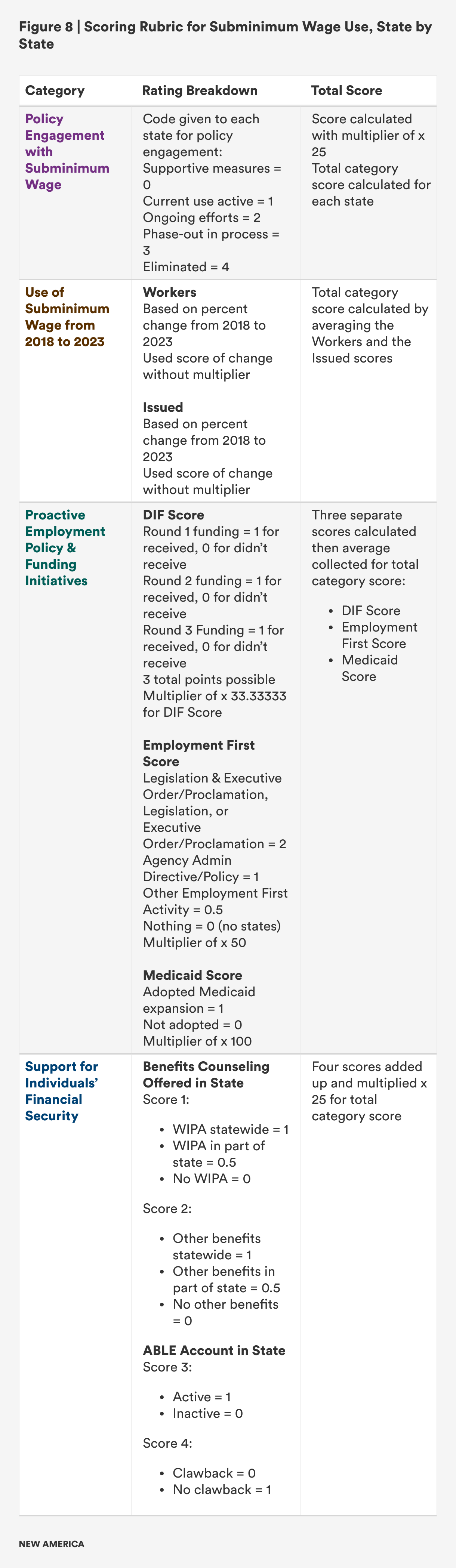
Citations
- This report uses person-first and identity-first language throughout. This choice honors the preferences, cultures, and identities within the disability community.
- Subminimum wage, Section 14(c), and 14(c) certificates are used interchangeably throughout this report. Section 14(c) is the specific section in the Fair Labor Standards Act that authorizes the use of a subminimum wage. Subminimum wage is a shorthand name for the practice. 14(c) certificates are the certificates employers hold to pay disabled employees a subminimum wage.
- LegiScan, “Maine House Bill 1874,” March 17, 2020, https://legiscan.com/ME/bill/LD1874/2019.
- For more about Employment First, see two resources from the U.S. Department of Labor, Office of Disability Employment Policy: "Employment First Initiative," https://www.dol.gov/agencies/odep/initiatives/employment-first; and "Competitive Integrated Employment," https://www.dol.gov/agencies/odep/program-areas/cie. Competitive integrated employment is work that is performed on a full-time or part-time basis for which an individual is compensated at or above minimum wage, receiving the same level of benefits provided to other employees without disabilities, at a location where the employee interacts with other individuals without disabilities, and presented opportunities for advancement similar to other employees without disabilities. For full legal definition, see Appendix I.
- Throughout this report, the term state refers to all 50 states and the District of Columbia.
- For more on the history behind the Fair Labor Standards Act, see Nathaniel Ruby and Ross Eisenbrey, Celebrating 75 Years of the Fair Labor Standards Act (Sofia, Bulgaria: Economic Policy Institute, June 25, 2013), https://policycommons.net/artifacts/1413090/celebrating-75-years-of-the-fair-labor-standards-act/2027353/.
- For more on this law, see U.S. Department of Labor, "The Fair Labor Standards Act of 1938," https://www.dol.gov/general/aboutdol/history/flsa1938.
- Sarah A. Donovan, The Fair Labor Standards Act (FLSA): An Overview (Washington, DC: Congressional Research Service, March 8, 2023), https://crsreports.congress.gov/product/pdf/R/R42713.
- Joint Hearings before the Senate Committee on Education and Labor and the House Committee on Labor, Fair Labor Standards Act of 1937, 75th Cong., 1st sess., June 4, 1937.
- The full text of Section 14(c) as originally published in 1938, outlining the subminimum wage can be found on page 38 of the Fair Labor Standards Act of 1938, https://www.govinfo.gov/content/pkg/COMPS-1514/pdf/COMPS-1514.pdf.
- Department of Labor, “Materials for Employers with Section 14(c) Certificates,” http://www.dol.gov/agencies/whd/workers-with-disabilities/employers.
- Fair Labor Standards Act of 1938, Pub. L. No. 117-328, §14(c)(1)(B) and §14(c)(1)(C), (2022), https://www.govinfo.gov/content/pkg/COMPS-1514/pdf/COMPS-1514.pdf.
- Subminimum Wage Program: DOL Could Do More to Ensure Timely Oversight (Washington, DC: U.S. Government Accountability Office, January 2023), 17, https://www.gao.gov/assets/gao-23-105116.pdf.
- Department of Labor, “14(c) Certificate Holders,” http://www.dol.gov/agencies/whd/workers-with-disabilities/section-14c/certificate-holders.
- For more explanation of these categories, see the graphic on page 7 within the GAO report, Subminimum Wage Program: DOL Could Do More to Ensure Timely Oversight (Washington, DC: U.S. Government Accountability Office, January 2023), https://www.gao.gov/assets/gao-23-105116.pdf. Also see the definition of CRP in Appendix I.
- From the New Deal to the Real Deal: Joining the Industries of the Future (Washington, DC: National Council on Disability, October 2018), https://www.ncd.gov/report/national-disability-employment-policy-from-the-new-deal-to-the-real-deal-joining-the-industries-of-the-future/.
- For a description of day habilitation services, see Appendix I.
- For a detailed discussion on integration requirements of the ADA, segregation of workers with disabilities, and the impact of the Olmstead ruling on subminimum wage, see p. 18-29 of Subminimum Wages: Impacts on the Rights of People with Disabilities (Washington, DC: U.S. Commission on Civil Rights, 2020), https://www.usccr.gov/files/2020/2020-09-17-Subminimum-Wages-Report.pdf.
- Subminimum Wages, https://www.usccr.gov/reports/2020/subminimum-wages-impacts-civil-rights-people-disabilities.
- U.S. Department of Justice, Lane et al. v. Brown et al., settlement agreement, in effect 2015, finalized 2022, https://archive.ada.gov/olmstead/documents/lane_sa.pdf.
- U.S. Department of Justice, "Rhode Island Olmstead Statewide Agreement," April 9, 2014, https://archive.ada.gov/olmstead/documents/ri-olmstead-statewide-agreement.pdf.
- U.S. Department of Justice, Office of Public Affairs, "Justice Department Issues Guidance on Americans with Disabilities Act and Employment Services for People with Disabilities," press release, October 31, 2023, https://www.justice.gov/opa/pr/justice-department-issues-guidance-americans-disabilities-act-and-employment-services-people.
- Subminimum Wage Program, https://www.gao.gov/products/gao-23-105116. Only 4 percent of workers employed under 14(c) certificates as of August 2021 were between ages 18–21 as compared to 26 percent who were 55 years or older, as seen in Table 3 on p. 26.
- U.S. Department of Justice, Office of Public Affairs, "Justice Department Issues Guidance on Americans with Disabilities Act and Employment Services for People with Disabilities," press release, October 31, 2023, https://www.justice.gov/opa/pr/justice-department-issues-guidance-americans-disabilities-act-and-employment-services-people.
- See Subminimum Wages: Impacts on the Rights of People with Disabilities and Rhode Island Olmstead Statewide Agreement. Subminimum Wages, https://www.usccr.gov/files/2020/2020-09-17-Subminimum-Wages-Report.pdf and Rhode Island Olmstead Statewide Agreement, https://archive.ada.gov/olmstead/documents/ri-olmstead-statewide-agreement.pdf.
- Department of Labor, Office of Disability Employment Policy, “Section 14(c) Review,” https://www.dol.gov/agencies/odep/14cEngagement#:~:text=On%20September%2026%2C%202023%2C%20Acting,workers%20whose%20disabilities%20impact%20their.
- Melwood (website), "Melwood CEO Testifies Before U.S. Commission on Civil Rights, Calling for Abolishment of Subminimum Wage Laws," press release, November 22, 2019, https://melwood.org/newsroom/uncategorized/melwood-ceo-testifies-before-u-s-commission-on-civil-rights-calling-for-abolishment-of-subminimum-wage-laws/.
- U.S. Department of Labor, Office of Disability Employment Policy, "Employment First Initiative," https://www.dol.gov/agencies/odep/initiatives/employment-first. For a detailed definition of Employment First, see Appendix I.
- Association of People Supporting Employment First (APSE), "About," https://apse.org/about-2/.
- For a detailed definition of vocational rehabilitation and pre-employment transitions services, see Appendix I.
- S. 533, H.R. 1263. The legislation was first introduced in January 2019 in the 116th Congress (S.260, H.R. 873) as the Transformation to Competitive Employment Act. For more details, see Congressman Bobby Scott (website), “Scott, Casey, McMorris Rodgers, Daines to Reintroduce Bipartisan, Bicameral Bill to Help Workers with Disabilities Find Good-Paying Jobs,” press release, February 27, 2023, https://bobbyscott.house.gov/media-center/press-releases/scott-casey-mcmorris-rodgers-daines-reintroduce-bipartisan-bicameral.
- AbilityOne Commission, "14(c) Final Rule News Statement," press release, July 21, 2022, https://www.abilityone.gov/commission/documents/14(c)%20Final%20Rule%20News%20Statement%2020220721%20post.pdf.
- U.S. Department of Labor, et al., "Federal Joint Communication to State and Local Governments: Resource Leveraging & Service Coordination to Increase Competitive Integrated Employment for Individuals with Disabilities," August 3, 2022, https://www.dol.gov/sites/dolgov/files/ODEP/pdf/ResourceLeveragingServiceCoordinationToIncreaseCIE8-12-22.pdf.
- For a definition of supported employment, see Appendix I.
- Medicaid.gov, "Employment Services," https://www.medicaid.gov/medicaid/long-term-services-supports/employment-initiatives/employment-services/index.html.
- Association of People Supporting Employment First (APSE), "Benefits Counseling Guide," revised April 22, 2019, https://apse.org/wp-content/uploads/2014/01/Benefits-Counseling-Guide-.pdf.
- ABLE National Resource Center, "What Are ABLE Accounts?" https://www.ablenrc.org/what-is-able/what-are-able-acounts/.
- Department of Labor, Wage and Hour Division, “14(c) Certificate Holders,” http://www.dol.gov/agencies/whd/workers-with-disabilities/section-14c/certificate-holders.
- Rehabilitation Services Administration, "RSA Programs," https://rsa.ed.gov/about/programs.
- Association of People Supporting Employment First (APSE), "Employment First Map," https://apse.org/home-v2-2/employment-first/.
- Kaiser Family Foundation, "Status of State Medicaid Expansion Decisions: Interactive Map," https://www.kff.org/medicaid/issue-brief/status-of-state-medicaid-expansion-decisions-interactive-map/; and Kaiser Family Foundation, "State Activity Around Expanding Medicaid Under the Affordable Care Act," https://www.kff.org/health-reform/state-indicator/state-activity-around-expanding-medicaid-under-the-affordable-care-act/?currentTimeframe=0&sortModel=%7B%22colId%22:%22Location%22,%22sort%22:%22asc%22%7D.
- ABLE National Resource Center, "Choose the Program That’s Right for You!" https://www.ablenrc.org/select-a-state-program/.
- In December 2023, the employment participation rate for disabled workers was 40.8 percent, compared to 77.3 percent for nondisabled workers. This is an increase from December 2022, when the rate was 39 percent (a larger increase than nondisabled workers from 2022–23). Kessler Foundation, "NTIDE December 2023 Jobs Report: People with Disabilities Maintain Strong Employment Levels through End of Year, Staying at Historic Highs," press release, January 5, 2023, https://kesslerfoundation.org/press-release/ntide-december-2023-jobs-report-people-disabilities-maintain-strong-employment-levels. Note this press release was from January 2024 but included a typo in the data of the source.
- Colorado Senate Bill 21-039, https://leg.colorado.gov/sites/default/files/2021a_039_signed.pdf; and Maryland Senate Bill 417, https://mgaleg.maryland.gov/2016RS/bills/sb/sb0417f.pdf.
- Department of Labor, “14(c) Certificate Holders,” https://www.dol.gov/agencies/whd/workers-with-disabilities/section-14c/certificate-holders.
- At the time of publication, more recent data are available and may differ from the data used in the report. Authors note the changes in the data are minor and are providing the link for readers in footnote 45, as the topic of subminimum wage has ever-changing data and policies.
- Rehabilitation Services Administration, "RSA Programs," https://rsa.ed.gov/about/programs/.
- Association of People Supporting Employment First (APSE), "Employment First Map," https://apse.org/home-v2-2/employment-first/.
- Kaiser Family Foundation, “Status of State Medicaid Expansion Decisions: Interactive Map,” December 1, 2023, https://www.kff.org/medicaid/issue-brief/status-of-state-medicaid-expansion-decisions-interactive-map/; and KFF, “Status of State Action on the Medicaid Expansion Decision,” December 1, 2023, https://www.kff.org/health-reform/state-indicator/state-activity-around-expanding-medicaid-under-the-affordable-care-act/?currentTimeframe=0&sortModel=%7B%22colId%22:%22Location%22,%22sort%22:%22asc%22%7D.
- ABLE, “Choose the Program That’s Right for You!” interactive map, https://www.ablenrc.org/select-a-state-program/.
- Recapture or clawback policy means remaining funds at the time of a beneficiary’s death are returned to the state to reimburse for Medicaid services from the individual’s ABLE account.
More About the Authors

Lillie Heigl
Policy Analyst, Education Policy & Disability, PreK-12

Kimberly Knackstedt, PhD
Principal Consultant, Unlock Access, LLC

Elena Silva
Senior Director, PreK–12 Education
Related