A Chapter of: What We Know About Fusion Voting
System-Wide Effects
The United States is currently experiencing instability and uncertainty, with democracy itself under threat. High polarization is eroding the political middle, which was once maintained by cross-partisan coalitions, and giving way to extremism. This is uncharted territory, and it is unclear how fusion voting would affect these broader political patterns, as it has not been tested in this context. Consequently, this section is speculative and in that it seeks to delineate—based on historical and theoretical assumptions—how fusion voting could potentially strengthen the political center, reduce polarization, and lead to deeper electoral reforms.
Whether fusion voting gives rise to parties that serve as moderating forces will depend on the state-level distribution of partisans and on state-level demographics. In some states, fusion voting can promote and strengthen parties to the left and the right of the current parties, as has happened in New York. In other states, fusion voting might encourage the creation of moderate minor parties and can help bridge moderate Democrats and moderate Republicans. This results in unclear effects of fusion voting on polarization and extremism, though we see the potential for fusion voting to reduce extreme partisanship if minor parties create new and more flexible partisan identities. Finally, we describe pathways through which fusion voting could precipitate deeper electoral reforms and identify important roadblocks that need to be addressed for fusion voting to be a stepping stone toward a true multiparty system.
Rise of Moderate Parties Depends on State-Level Partisan Distribution and Demographics
The current momentum for fusion voting is based on its potential to restore moderate political forces in American politics and create new partisan options for voters who no longer feel represented by their parties. Specifically, as the Republican Party has moved to the far-right, fusion voting could facilitate the emergence of a moderate party that endorses candidates committed to democracy and provides a way for disaffected Republican voters to vote for these candidates on the moderate party line. For this to happen, moderate parties have to emerge, and voters have to be willing to vote on their ballot line, even if it ultimately means that they are voting for an opposing major party candidate. Whether these premises hold are open empirical questions.
Political parties emerge from a combination of electoral supply and demand, and their survival often depends on the permissiveness of the electoral system and whether they garner enough electoral support. Fusion voting can make the system more permissive to the extent that minor parties are willing to endorse major party candidates. But the supply and demand dynamics will be affected by a variety of state-level factors, including the willingness of political entrepreneurs to start a party and fuse with major parties and the partisan and demographic composition of the electorate.
In states like New York and Connecticut today, moderate parties have not re-emerged given the contemporary political landscape of these states. In fact, the influential minor parties in New York are on the flanks of the ideological spectrum. This was not always the case. The Liberal Party, although it started as a progressive party seeking to pull Democrats to more liberal positions, was able to play a moderating role by endorsing Democrats and Republicans and providing decisive vote shares to their candidacies. It was able to do so because it initially offered a clear programmatic agenda that appealed to a broad enough segment of the electorate and because there were liberal Republican and conservative Democratic candidates for the party to endorse. As middle-class voters moved out of New York City and the demographics of the electorate changed, the support base of the Liberal Party eroded, contributing to its ultimate decline.54 States with a more equal distribution of partisan voters may offer more fertile ground for moderate parties to emerge today.
In addition to having the partisan and demographic electoral base, any potential moderate party has to face two additional issues to succeed in a fusion voting system: One is the availability of major party candidates to endorse, and the other is what they offer to voters in terms of policy.
The ability to endorse or withhold an endorsement to candidates in the major parties is one of the main tools that fusion systems give minor parties to influence the major parties. By endorsing moderate candidates in the Democratic and Republican parties, a moderate minor party may be able to pull the parties to the center and strengthen the political middle. This presumes, however, that there will be moderate candidates to endorse in the major parties, which in many states is becoming increasingly unlikely on the Republican side. While the short supply of moderate candidates in certain districts could represent a challenge for moderate parties seeking to endorse a candidate with fusion ballots, it could open up political space for minor parties to run their own candidates—especially in districts that established parties write off as a sure victory for the other party.
Barbara Dudley, an Oregon Working Families Party (WFP) member, acknowledged that in Oregon, “[the WFP] actually cross-nominated a few key Republicans who supported [their] issues, but there is no such thing anymore…the extreme division between the two parties has caught up with Oregon.” Even the middle-of-the-road Independent Party of Oregon has fewer opportunities to cross-nominate. Dudley added that historically, “Independents have cross-nominated both Republicans and Democrats, but as the Republicans have gone further and further to the far-right, the Independent Party cross-nominates Democrats far more often.” If moderate minor parties do not find candidates to endorse in the Republican Party, then they lose one of the main leverage channels available to them and the ability to pull the party to the middle. Moderate minor parties may still provide a home to disaffected Republican voters who no longer feel at home in their party, but they are unlikely to moderate Republican politicians.
Of course, the supply of candidates is not static, and moderate parties can themselves encourage candidates to moderate or inspire moderate candidates to run for office by offering their ballot line and mobilizing resources. This is the theory of change of the recently formed United Kansas Party, a moderate party that seeks to capitalize on voter disaffection, the growing number of independent voters in the state, and increasing frustration with the two-party system. By giving their ballot line to Democratic or Republican candidates who align with their stated policy agenda, the United Kansas Party hopes to create a moderating force in Kansas politics.55 This approach has worked in the past, and time will tell if it works in today’s nationalized and extremely polarized politics.
Finally, any potential moderate party that seeks to be a year-round party to influence politics must also figure out its policy program. While the moderate label is appealing by itself to voters, defining what the moderate party stands for and explaining how it differs from the major parties is important to secure electoral support from voters over the long term. Defining a policy program will also guide how the moderate party uses any potential leverage it gets from elections to influence the policymaking process and ensure that the parties are influential moderate forces and not just electoral vehicles.
Ambiguous Potential Effects on Polarization and Extremism
Fusion voting is promoted as a way to lessen polarization. By facilitating the emergence of a moderate party and allowing for more minor parties to actively participate in coalitional politics and influence the major parties, fusion voting could disrupt the zero-sum dynamics that have come to characterize American politics. To our knowledge, there is no systematic research exploring whether fusion voting can achieve these outcomes in the current political climate—it remains an open question that will have to be assessed when more states adopt fusion voting. For now, we identify the possible mechanisms through which fusion voting could mitigate polarization and clarify what types of polarization it could affect, be it elite-level ideological polarization or affective polarization.
Focusing first on elite-level polarization, the degree of ideological differences between elected officials and party leaders, most of the academic literature emphasizes a multiplicity of causes and aggravating factors of elite-level ideological polarization—including the realignment of the party system following the Civil Rights movement in the 1960s, a rise in economic inequality, and the increasingly razor-thin margins for control of the Senate and Congress.56 Notably, the connection between electoral systems and elite-level ideological polarization is unclear. It is not obvious, then, how fusion voting would be able to revert the effects of the underlying causes of elite-level ideological polarization. Contemporary polarization in the United States is also characterized by asymmetry, with the Republican Party moving far more to the right than the Democratic Party has moved to the left. For fusion voting to reduce this polarization, it would have to mostly moderate the Republican Party.
One possible mechanism to reduce elite-level ideological polarization is that fusion voting facilitates the emergence of a moderate party that pulls the major parties to the ideological middle, which helps elect moderate candidates. The ballot line of a moderate minor party can provide the bridge that traditionally Republican voters need to be able to vote for a moderate Democrat. The hopes are that these dynamics provide an exit ramp to Republican voters who no longer feel at home within the Republican party and do not want to vote for far-right candidates. As explained in other sections, this is not a guaranteed outcome of fusion voting everywhere. In some contexts, fusion voting could contribute to more polarization if it strengthens parties on the fringes. In New York, for example, the WFP tends to pull the Democratic Party to the left while the Conservative Party tends to pull the Republican Party farther to the right, which could end up widening the ideological space between candidates from the two main parties. It is also not guaranteed that enough partisan voters would vote on a minor party line for an opposing party candidate.
Increasingly, however, elite-level polarization has also inflected views of democracy in the United States, and new, unexpected coalitions could arise to protect democracy. In this case, a moderate party could become the party of politicians and citizens on the center-right who are committed to democratic values. In competitive races, the moderate party could endorse Democratic candidates, but in races that usually go to Republicans, the Democratic party could endorse the moderate party candidate. At a time when democracy is on the ballot, fusion voting could help bring about much-needed coalitions that stand up for democracy and revitalize electoral competition. These are new political dynamics for the United States, so this argument is yet to be tested and faces the formidable challenge of voters prioritizing partisanship over democracy.57 But if fusion voting is successful at encouraging new partisan options, it might give voters who care about democracy a meaningful way to use their vote to protect democracy instead of having to weigh policy and partisan concerns versus democratic values.
“At a time when democracy is on the ballot, fusion voting could help bring about much-needed coalitions that stand up for democracy and revitalize electoral competition.”
Affective polarization—the degree to which members of a party dislike members of the other party while liking those of their own—may be more directly linked to electoral institutions. The winner-take-all nature of single-member districts forces binary choices that lead to zero-sum dynamics and encourages an “us-vs-them” approach to politics. While there is much debate about whether the mass public is ideologically polarized, there is a lot of evidence that the public is affectively polarized.58 Behind the rise of affective polarization is the increasing importance of partisanship to social identity.59
For fusion voting to reduce affective polarization, it would have to disrupt this link between partisanship and identity. Proportional systems do this by giving voters more choices on the ballot. In one election, voters can vote for one party, and in another, they may change their minds and vote for a different party, making partisanship less relevant to identity. The existence of multiple parties also makes coalitions more likely, meaning that politicians from different parties are forced to govern together, which helps dispel the idea that members from competing parties are mortal enemies.60 To the extent that fusion voting gives people the choice to vote for different parties—allowing voters to think of themselves as something other than just Democrats or just Republicans—and creates opportunities for coalitional government, then it might have a chance at mitigating affective polarization. This argument assumes that voters actually use the ballot lines of minor parties and that fusion voting leads to the continued existence of several minor parties.
We are not aware of research that quantitatively links fusion voting with changes in affective polarization, but we see this as a promising and feasible avenue for research using survey experiments. Experimentally varying whether survey respondents use fusion ballots or providing them with minor party alternatives can provide credible ways of measuring whether fusion voting has an impact on affective polarization, albeit in a controlled environment.
Possible Pathway Toward Proportional Representation
Fusion voting has the potential to galvanize efforts toward proportional representation in the United States by empowering parties other than the Democratic and Republican parties. Stronger minor parties may demand reforms to the electoral system to solidify their power, or major parties may promote reforms to safeguard their positions. But fusion voting may also hamper efforts toward a genuine multiparty democracy if major parties co-opt minor parties or if it strengthens the major parties by discouraging the creation of strong alternatives.
Historically, countries have transitioned to proportional representation because of the emergence of credible electoral threats61 or as a way to accommodate and break opposition parties in authoritarian regimes.62 For there to be a willingness to reform the system, the existing parties must feel threatened, which means that minor parties must spoil elections by running their own candidates, as argued by Matthew Shugart.63 Fusion voting discourages the spoiling of elections by allowing minor parties to receive votes on their lines, having those votes count toward a major party candidate, and encouraging parties to function without their own candidates. For fusion voting to lead to proportional representation, minor parties would have to flex their electoral strength and spoil elections or run their own candidates to pose a credible threat to the two major parties. They could also use their leverage to advocate for specific policies on electoral reforms.
The path to a multiparty system and proportional representation could be different in the United States. Electoral reform in various states and cities has happened thanks to citizens and civil society organizing, ballot initiatives, and the fortuitous alignment of interests. These efforts may gain momentum and eventually be able to secure more widespread reforms that make the electoral system more permissive. Or maybe some exogenous event catalyzes electoral reform and leads to a more permissive system.
“Fusion voting can provide the training wheels for minor political parties and voters to participate actively in a proportional electoral system when the time arrives.”
If that happens, minor parties that have emerged through fusion voting and have already developed a brand and a party infrastructure can take full advantage of the more permissive electoral system and start competing independently. At the same time, fusion voting can help voters get used to voting for different parties and encourage the creation of new partisan identities and constituencies for electoral reforms that lead to proportional representation. In this sense, fusion voting can provide the training wheels for minor political parties and voters to participate actively in a proportional electoral system when the time arrives. As Joe Dinkin argued, “Having fusion has…been helpful at generating the voter habits and infrastructure relevance to be able to make occasional plays for more traditional third-party wins.”
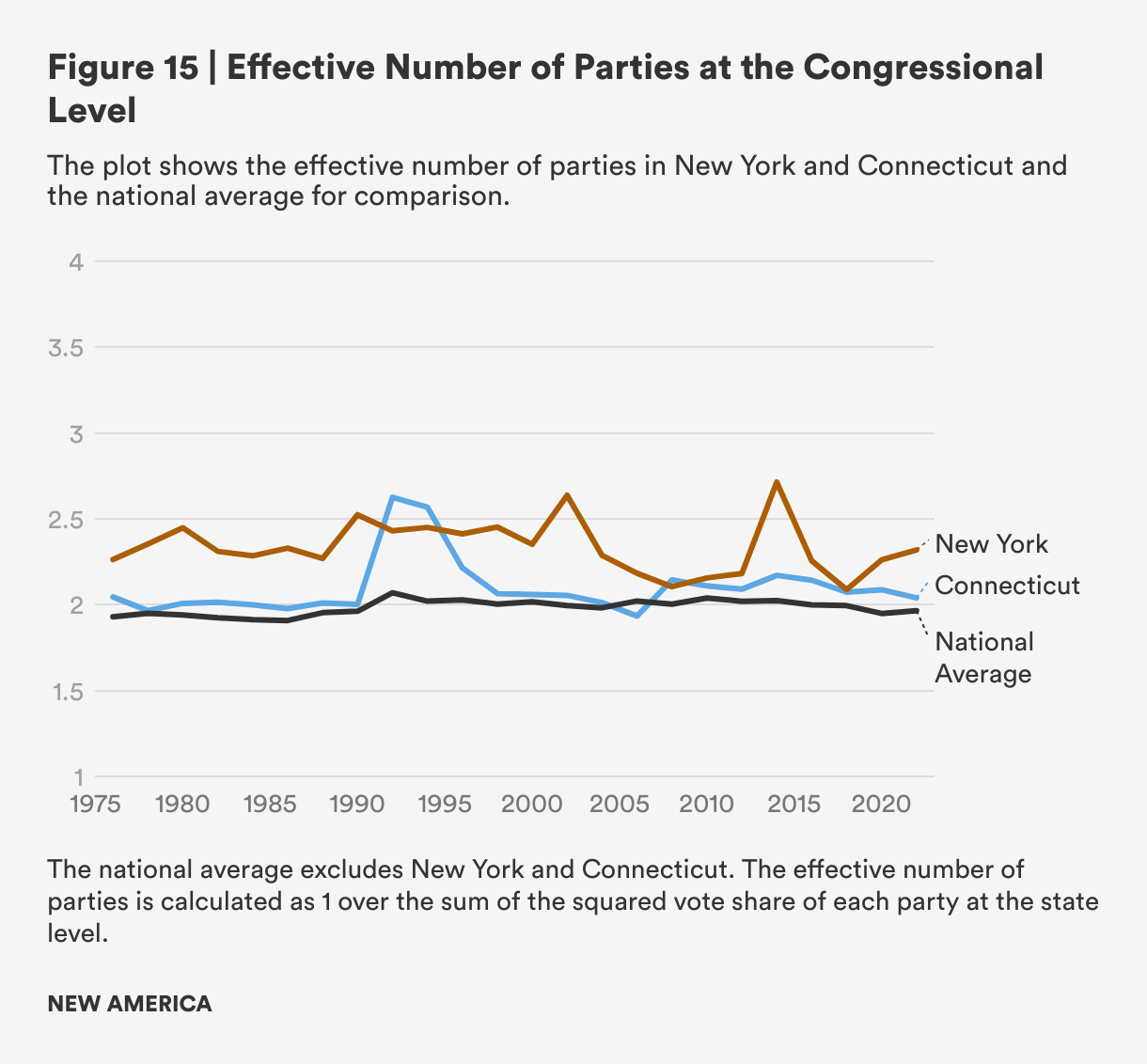
Looking at the effective number of parties in states with and without fusion, we see that there have been time periods when New York and Connecticut have sustained an effective number of parties greater than the national average. The effective number of parties is a weighted average of the number of parties based on their electoral performance.64 In New York, from 1976 to the early 2000s, the effective number of parties hovered below 2.5 and peaked at 2.7 in 2014, thanks to the votes garnered by parties like the Conservative Party, the Liberal Party, the Right to Life Party, and eventually, the WFP. In Connecticut, the effective number of parties has mostly remained close to the national average of basically two, except in 1992 and 1994 when the A Connecticut Party had a strong showing. The experience of New York, in particular, shows that fusion voting can contribute to more parties in a system of winner-take-all elections.
Questions remain about how to sustain a greater number of parties and how to push that number to three, four, or even more. Without putting forward their own candidates that can win elections and without increasing the district magnitude, it is challenging for minor parties to grow significantly. Minor parties face a tough predicament in a system of single-member districts and fusion voting: If they run their own candidates in a winner-take-all system, they risk not having a seat on the table, but if they fuse, they gain access, but they often, but not always, forego having their own candidates and ability to grow the party, remaining tethered to a major party.
The experience of the Green Party in New York illustrates this dilemma. As WFP co-founder Bob Master said, “[The Green Party] lost its ballot line, and we basically haven’t heard from the Green Party since.” At a time when climate change and environmental concerns are a top issue among certain groups of voters, the Green Party could be an influential party. But because they do not cross-endorse, they lose access, explains Master: “If they were cross-endorsing and requiring candidates to make commitments on a range of climate-related issues, they would be the center of progressive politics in the state. But because they’re running candidates who will only lose, they’re irrelevant.” Fusion provides a lifeline to minor parties in the American electoral system by giving them a way to remain relevant without spoiling a race, but it can also limit their ability to grow as they remain tied to major parties to remain electorally viable. The growing dissatisfaction with the two major parties and surging interest in partisan alternatives could strengthen the position of minor parties in fusion systems and give them more opportunities to run their own candidates.
By giving minor parties a way to participate in politics and incentivizing them to develop their party infrastructure and brand, fusion voting can be a starting step toward a multiparty system and, eventually, to proportional representation. However, deeper reforms are needed to strengthen minor parties and allow them to grow independently from a major party.
Citations
- Soyer, Left in the Center.
- United Kansas, “About,” Accessed May 28, 2024, https://unitedkansas.com/about.
- For an overview, see Nolan McCarty, Polarization: What Everyone Needs to Know (Oxford, UK: Oxford University Press, 2019).
- Matthew H. Graham and Milan W. Svolik, “Democracy in America? Partisanship, polarization, and the robustness of support for democracy in the United States,” American Political Science Review 114, no. 2 (2020): 392–409, https://www.cambridge.org/core/journals/american-political-science-review/article/abs/democracy-in-america-partisanship-polarization-and-the-robustness-of-support-for-democracy-in-the-united-states/C7C72745B1AD1FF9E363BBFBA9E18867.
- See Shanto Iyengar et al., “The Origins and Consequences of Affective Polarization in the United States,” Annual Review of Political Science 22 (2019): 129–146, https://www.researchgate.net/publication/329562443_The_Origins_and_Consequences_of_Affective_Polarization_in_the_United_States.
- Iyengar et al., “The Origins and Consequences of Affective Polarization in the United States,” https://www.researchgate.net/publication/329562443_The_Origins_and_Consequences_of_Affective_Polarization_in_the_United_States; See also Lilliana Mason, Uncivil Agreement: How Politics Became Our Identity (Chicago: University of Chicago Press, 2018).
- See Will Horne, “How Multiparty Coalition Governance Moderates Partisan Hostility,” in The Realistic Promise of Multiparty Democracy in the United States (Washington, DC: New America, 2024), https://www.newamerica.org/political-reform/reports/the-realistic-promise-of-multiparty-democracy-in-the-united-states/.
- Carles Boix, “Setting the Rules of the Game: The Choice of Electoral Systems in Advanced Democracies,” American Political Science Review 93, no. 3 (1999): 609–624, https://www.jstor.org/stable/2585577; Ernesto Calvo, “The Competitive Road to Proportional Representation: Partisan Biases and Electoral Regime Change Under Increasing Party Competition,” World Politics 61, no. 2 (2009): 254–295, https://www.jstor.org/stable/40263483; Lucas Leemann and Isabela Mares, “The Adoption of Proportional Representation,” Journal of Politics 76, no. 2 (2014): 461–478, https://www.jstor.org/stable/10.1017/s0022381613001394.
- Gabriel L. Negretto and Giancarlo Visconti, “Electoral reform under limited party competition: The adoption of proportional representation in Latin America,” Latin American Politics and Society 60, no. 1 (2018): 27–51, https://www.jstor.org/stable/44684430; Alberto Diaz-Cayeros and Beatriz Magaloni, “Party dominance and the logic of electoral design in Mexico’s transition to democracy,” Journal of Theoretical Politics 13, no. 3 (2001): 271–293, https://journals.sagepub.com/doi/10.1177/095169280101300303.
- See Shugart, “What role for ‘fusion voting’?” https://fruitsandvotes.wordpress.com/2023/12/27/what-role-for-fusion-voting-limitations-and-a-potential-open-improvement/.
- The effective number of parties is a widely used measure in comparative politics that allows for better comparisons across party systems. It takes into account not just the count of parties but the electoral strength of parties as calculated by their vote or seat shares.