A Chapter of: What We Know About Fusion Voting
Effects on Voters and Politicians
Fusion voting has the potential to facilitate voting and re-engage voters who feel disaffected with the current state of politics. Fusion voting can make it easier to vote thanks to outreach and educational efforts by minor parties and the additional information that fusion ballots provide about fused candidates. Fusion voting can also re-engage voters by providing a way for them to send a stronger message with their vote. As Working Families Party (WFP) co-founder Bob Master said, fusion allows voters to “vote their values,” which can make it easier for a voter to show up to the polls and vote for a candidate with whom they don’t align fully. By doing so, fusion voting can make elections more informative for parties and politicians.
In this section, we focus on the effects of fusion on voters and politicians. Regardless of broader political dynamics, we would expect fusion to give more information to voters and politicians and to be a tractable balloting system for voters. We explain how fusion voting provides more information to voters and present some evidence on the topic. We then show that fusion is associated with increases in voter turnout in certain circumstances and identify some research showing that fusion ballots are not confusing for voters. The empirical research on the micro-foundations of fusion voting—how it affects individual voters and politicians—is limited, and many questions remain unanswered. Yet, this is an area where clever surveys and polling experiments could quickly improve our understanding of fusion voting.
Fusion Ballots Provide More Information to Voters and Politicians
A benefit of fusion voting is that fusion ballots can convey more information about candidates and the electorate. When voters see the name of a candidate followed by a party label other than Democrat or Republican, they may infer additional characteristics about candidates and their policy positions and priorities. This additional information from the ballot can help candidates stand out and prove particularly useful for voters in races that do not receive much media coverage, such as local elections. For parties and politicians, the results of elections done with fusion ballots are more informative than elections done without fusion because the votes coming from fused lines can be indicative of a particular policy demand, a political message the electorate is trying to send, discontent among the electorate, and the electoral strength of minor parties.
The additional information provided by fusion’s cross-nominations can reduce the costs associated with voting. Voters who do not follow politics or do not have the bandwidth to research all the candidates that appear on the ballot may use the fused ballot as a heuristic, choosing to vote for those candidates that have been endorsed by their preferred minor party. By simplifying the vote choice process, fusion voting may increase the likelihood that voters will turn out to vote. Barbara Dudley, a member of the Oregon WFP, summarized this function, saying that fusion “is not just about endorsements…it shows up on the ballot. So for the less engaged citizen who’s not reading the left press all the time or reading any press all the time, they see that somebody is a Democrat/Working Families [candidate] and somebody else is not…and that makes a difference to people.” Dudley elaborated that seeing the cross-nomination on the ballot gives “the signal that your kind of people, your tribe, approves of this person, and this person has agreed to support the issues that matter to your tribe…it is a good housekeeping seal of approval.”
For candidates, the minor party brand can also help them distinguish themselves and communicate their values. At the height of its power, the Liberal Party of New York was a highly coveted endorsement because its attendant party label helped candidates convey liberal values to voters. When Robert F. Kennedy’s liberal credentials were in question during his run for the New York Senate seat in 1964, the Liberal Party brand helped make the case to voters that Kennedy was committed to liberal causes.15 When Republican candidates wanted to signal progressive values to be able to win citywide races in New York City, the Liberal Party brand gave them “the progressive imprimatur that was absolutely imperative if they hoped to capture the mayoralty.”16
For fusion ballots to provide additional information to voters, minor parties need to develop a strong and recognizable brand. The experience of parties using independent-related labels illustrates the power of a strong brand. In several of our interviews, it came up that one of the reasons why the Independence Party in New York was so successful was because it had an appealing brand, and voters wanted to identify themselves as independent on the ballot. Joe Dinkin, a WFP campaign director, said that “the number of votes that the Independence Party in New York used to get is some evidence [of the power of] the brand of the Independence Party, even if it did not [reflect] the reality of what the organization was.” Dudley agreed with this argument, explaining that in Oregon, “there were many eras and many races where the Independent Party was the most sought-after line because of their name and only that.” Candidates also often seek the nomination of minor parties with descriptive names to use the minor party brand as a way to signal their policy priorities. Andrew Cuomo, for instance, ran with the Women’s Equality Party when running for governor of New York to ostensibly signal his support of the Women’s Equality Act; George Pataki ran with the “Tax Cut Now” Party to signal that he would reduce taxes if elected; and many New York Republicans have run with the ballot line of the “Right to Life” Party to communicate their opposition to abortion.17
Party brands must also be consistent to be informative to voters: The candidates endorsed by a party must deliver policies aligned with what the brand promised if elected.18 Doing otherwise risks diluting the brand of the party, making it less useful for voters when selecting candidates.19 Minor parties that offer a cohesive programmatic platform and choose candidates based on that platform, will have an easier time building a consistent brand—in turn, making it more likely that they survive through more election cycles—than minor parties that do not offer a clear platform. The experience of the Liberal Party is instructive. Karen Scharff, a founding member of the WFP and former leader of Citizen Action of New York, said that the Liberal Party “got very confused and kept changing [what it stood for] over time, and nobody knew what it was anymore.” Eventually, the party became a “patronage mill,” as described by Bill Lipton, another WFP co-founder, and ultimately disappeared.
We know of only one empirical study that tests whether fusion ballots help voters learn about the ideological positions of parties. Eric Loepp and Benjamin Melusky carried out a survey experiment that presented participants with ballots that had different combinations of fused candidacies or no fused candidacies at all.20 The experimental nature of their study allowed them to compare the perceived party ideological positions between participants who used fused ballots and those who did not have fused ballots: If a fused ballot conveyed information that helped voters update their beliefs about a party’s ideology, then participants who used a fused ballot would have different perceptions of a party’s ideology than those who did not. Loepp and Melusky, however, find no evidence that fusion ballots have any effect on the perceived ideology of major or minor parties among participants.21
The absence of a significant effect is largely due to voters already having a clear idea of the party’s ideology, so new information does not alter their beliefs. This suggests that the power of the minor party brand comes from seeing the party label prior to voting during the campaign and not from seeing the party label on the ballot itself. In their experiment, participants rated the Republican and Conservative parties as similarly conservative, so whether they appeared fused or not fused on a ballot did not affect perceptions of where they stood. Indeed, the only scenario in which fusion had a small effect on perceptions of party ideology was when a major party was fused with a relatively unknown minor party, and voters could update their perceptions based on new information.22 Whether these findings generalize to other settings or to actual elections—when parties are actively campaigning and the media spotlight is on candidates—is an open question.
“In a two-party system where voters often have to engage in strategic voting, these results do not indicate if voters voted begrudgingly for the candidate, if voters agree entirely with the platform of the party, or if voters wanted to send a message.”
Elections carried out with fusion ballots also provide more informative results to parties and politicians. Without fusion ballots, electoral results indicate who wins, by how much, and where. But in a two-party system where voters often have to engage in strategic voting, these results do not indicate if voters voted begrudgingly for the candidate, if voters agree entirely with the platform of the party, or if voters wanted to send a message with their vote in addition to electing the candidate. Fusion ballots allow for this additional information to come through in the electoral results by separating the votes for the same candidates by the different parties that endorsed them. The vote shares obtained from the minor party lines can inform major parties about the popularity of the platforms of minor parties, what direction voters want the party to move toward, and the strength of minor parties. As we discuss in greater detail later in the report, this information can influence the behavior of politicians in the legislative process.
Fusion Ballots May Increase Turnout
Fusion voting can increase voter turnout through its effects on parties and voters. On the party side, third parties have strong incentives to engage with voters and mobilize them to the polls to clear the electoral threshold that keeps them on the ballot in future elections and increase their policy influence by garnering more votes on their line. To the extent that parties care about being able to participate in future elections or about their policy influence, they will invest resources to mobilize voters to vote on their line. If such mobilization efforts reduce the cost of voting for voters, we would expect turnout to increase with fusion. The success of the Liberal Party of New York, for example, was largely dependent on its ability to drive voter turnout, which it did by investing in a dense network of labor unions and party clubs throughout districts and neighborhoods.23
Fusion can also increase turnout through its direct effects on voters. For fusion voting to affect the decision to turn out to vote or not, voters need to be aware of fusion ballots in their district, know which parties are fusing with which, and perceive a meaningful difference between the parties fusing. If voters are aware of fusion ballots, then fusion ballots give voters more choices without spoiling their vote, which can encourage voters to turn out to vote because they now have multiple options and may find a party that is closer to their views. As previously explained, fusion ballots can also provide information to voters that reduces the costs of voting, potentially facilitating greater turnout.
Fusion ballots can also allow voters to use their vote for a third party to better express their policy preferences, which can increase turnout among voters who want to use their vote expressively as opposed to as a way to select a candidate. As Karen Scharff said, “Fusion gives voters a way to self-identify with a set of principles and platforms that then makes the voting more relevant to them, more interesting, and more worthwhile…which is even more true now when people are more and more turned off by the political system and the two parties.” According to Vermont’s Lieutenant Governor David Zuckerman, “there are people who wouldn’t have voted at all if a third party wasn’t on the ballot,” echoing arguments that more choices on the ballot would increase voter turnout.
Thus, even in districts that are safe for a Democratic or Republican candidate, we could expect increases in voter turnout if fusion allows voters to add nuance to their votes. For instance, the vote of a Democratic voter in a deep blue district is not pivotal. Without fusion, that voter may opt not to turn out because the winner will always be the Democratic candidate. With a fused ballot, however, the outcome may be the same, but the voter may use the fused lines to express a stance on a particular issue or platform or to send a message to the Democratic candidate. “It allows people to express their choices in a way that makes it clearer what they’re voting for,” said Scharff. Reinforcing this notion, Bob Master suggested that “voters who vote for the Republicans on the Conservative Party lines are saying, I am an anti-abortion Republican, I am not some Republican in name only.”
Another mechanism through which fusion voting can increase voter turnout is if it makes elections more competitive. In more competitive elections, the probability that a voter is pivotal in the election and their vote matters in deciding the outcome increases. As the probability that a vote can be pivotal increases, voters may be more motivated to turn out because their vote matters more. There is a cyclical nature to the argument here: Fusion leads to more competitive elections by increasing turnout, and turnout increases because elections are more competitive.
“Fusion leads to more competitive elections by increasing turnout, and turnout increases because elections are more competitive.”
It is also theoretically possible for fusion voting to have no effect on turnout or even to depress turnout. If voters are not aware of fusion voting, then fusion voting would not affect voter turnout (it could still have an effect through the third parties if they are mobilizing voters). If voters are confused by the multiple choices on the ballot because they are unfamiliar with how fusion ballots work, or if voters do not perceive a meaningful difference between the fused parties, fusion would not boost turnout or could even discourage it.
One published study examines the effect of fusion on turnout in a special election for a seat in the Nassau County Legislature in New York, finding that the fusion of the Democratic candidate and the WFP increased turnout.24 The special election was carried out soon after the death of a recently elected Democratic candidate; the deceased candidate’s son decided to run for the seat, endorsed by the WFP, the Independence Party, and the Liberal Party. The study hinges on the premise that a counterfactual to the vote share of the Democratic candidate in the special election is the vote share of the deceased Democratic candidate in the general election since the WFP had not endorsed the candidate in that election.
Under this assumption, the researchers find that each additional vote on the WFP line resulted in between 0.6 and 1.03 extra votes for the Democrat in the special election, as the “WFP induced people to come to the polls who would not otherwise have voted.”25 A methodological concern in the study, however, is the validity of the counterfactual: The candidates are different, the death of the candidate could have galvanized voters, the electorate for a special election can differ from that of a general election, and so on. For this reason, it is not clear that the fusion of the WFP with the Democratic candidate led to changes in turnout as opposed to a variety of other factors.
Our own analysis of turnout rates in congressional elections in New York and Connecticut suggests that fusion ballots might have a modest effect on turnout levels under certain conditions.26 In this analysis, described in greater detail in The Realistic Promise of Multiparty Democracy in the United States, we compare turnout rates in races with and without fusion within the same congressional districts over the same decade to account for changes in redistricting and for other district-specific characteristics.
Accounting for presidential election years—when turnout is higher—and for turnout in the previous electoral cycle, we find that races in which Democratic candidates are endorsed by minor parties have a turnout level that is 1.6 to 2.8 points higher than in races where they are not endorsed, depending on the model used. Turnout levels are about 2.2 points higher in races where Republicans are endorsed by minor parties relative to races where they are not. However, any association between fusion and turnout disappears once we account for the influence of incumbency.
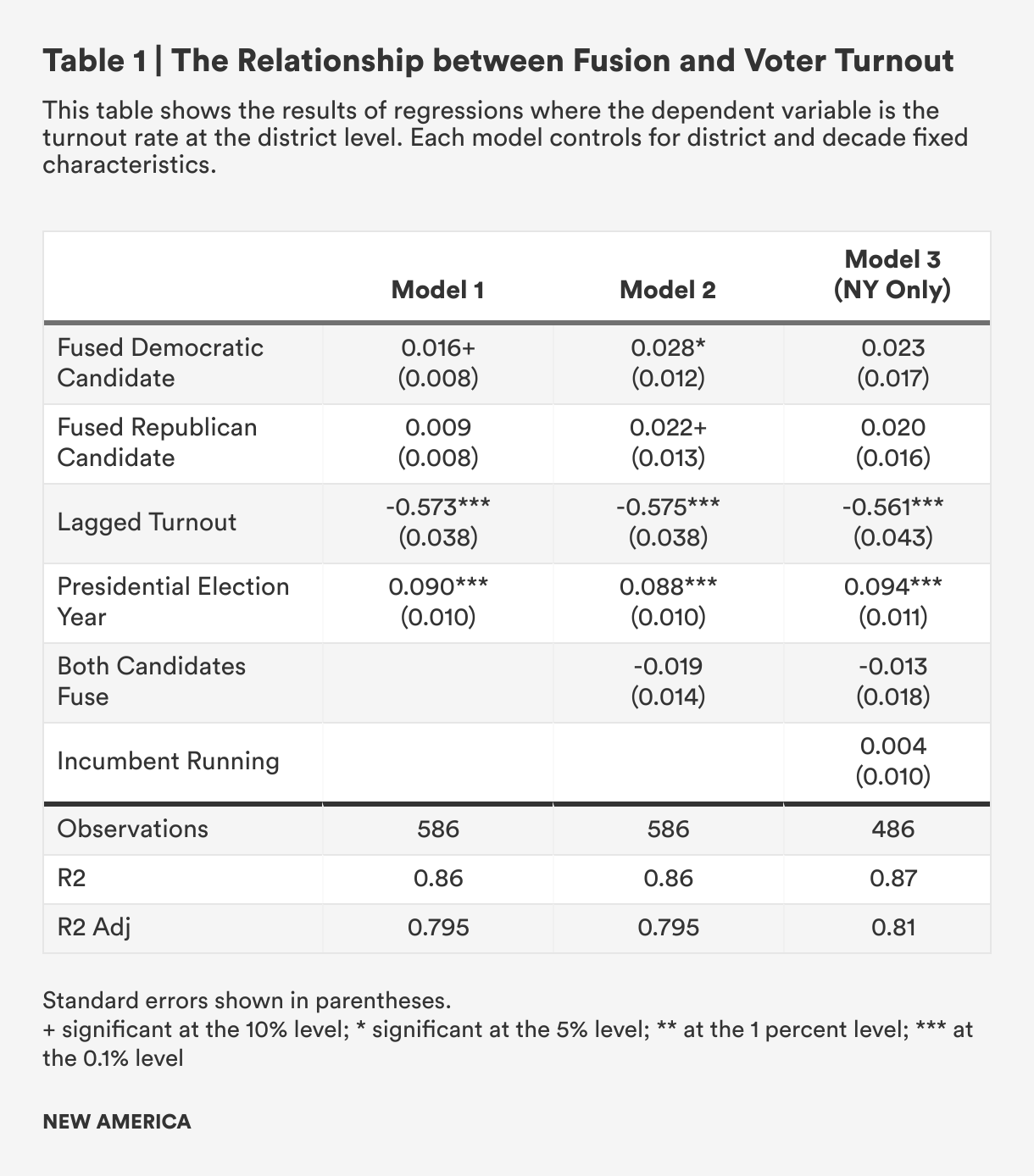
As with other sections of this report, it is important to emphasize that such an analysis describes an association between fusion ballots and turnout and cannot be interpreted as causal. Fusion endorsements are not made randomly and may be influenced by factors that also affect turnout. If, for example, a minor party endorses candidates that are already popular, then higher turnout levels in their races would reflect that pre-existing popularity and not the endorsement.
Fusion Voting Is Not Confusing to Voters
Critics of fusion voting argue that listing a candidate twice on the ballot under different party lines confuses voters and can lead to mistakes. Another concern is that fusion ballots get overcrowded and confuse voters. In legal cases considering the renewed legalization of fusion ballots, the importance of making the voting process easy for voters has outweighed the associational rights of parties.27
Avoiding voter confusion is a legitimate concern, but there is no systematic evidence that fusion ballots are more confusing than regular ballots. In their survey experiment, Loepp and Melusky measured how long participants took to vote and the number of clicks they made when voting.28 They found that participants did not take longer or click more times when using fusion ballots compared to those who did not use fusion ballots when casting their votes. They also asked participants to rate their voting experiences and again found no differences between those who voted with and without fusion ballots: Both groups found both types of ballots to be clear and understandable and reported that it was easy to pick a candidate at the same rate. Loepp and Melusky also found that survey participants who live in states that allow fusion ballots are faster at submitting their ballot than those who live in states that do not have fusion. This last finding suggests that the use of fusion over time would increase familiarity with this type of ballot.
Beyond survey experiments, the experience of election workers managing elections in fusion states also indicates that fusion voting is not confusing to voters. As described in the legal brief submitted in favor of fusion voting in New Jersey, election administrators report receiving few questions from voters confused about fusion ballots, with “no more than a handful of [election administration] inquiries involve questions about fusion.”29 Moreover, according to Miles Rapoport, the former Secretary of State of Connecticut, “concerns of ballot overcrowding…are unwarranted and have never…materialized.”30
Our own analysis confirms this last statement. In the 2022 elections for the House of Representatives, neither New York nor Connecticut had the highest average number of candidates in congressional races. Ranked by the average number of candidates per district, from highest to lowest, Connecticut was number 14 with an average of three candidates per district, and New York was number 42 with an average of 2.11 candidates per district. In terms of the average number of parties contesting elections, each of which would have its own line and contribute to a longer ballot, neither Connecticut nor New York had the highest average number of parties. Counting independent candidates as a party, Connecticut ranked in the ninth place, with an average of 3.8 parties contesting elections in 2022, and New York ranked in the 12th position, with an average of 3.5 parties contesting elections. Vermont, New Jersey, Colorado, Tennessee, Alaska, Delaware, and Wyoming all had an average of four parties or more on the ballot (Alaska had a final four voting system in place).
While voters may initially find any new electoral system confusing, voter confusion is something that can be addressed with the right information and the right ballot design, so it should not be an impediment to reform. Different ballot designs can be tested, and parties can play an important role in informing voters about how to use fusion ballots.
The party members we interviewed agreed that sometimes voters are initially confused about fusion but that an important task of a minor party in a fusion system is to educate voters about fusion ballots. Joe Dinkin, the WFP’s campaign director, recalled explaining to voters that fusion ballots allowed them to choose their party and their candidate. Bob Master, WFP co-founder, acknowledged that voters at first often do not understand how “the same candidate can be on two different lines…but they get used to it.” He added that one effective way to educate voters about fusion ballots is to explain that it allows them “to vote their values or to send a message with their vote.” Lindsay Farrell, a senior political strategist for the WFP, agreed: “Just say if you vote for a candidate on our line instead of the major party line, your vote still counts to elect that candidate, and it also sends a message.” These messaging strategies echo those used by the Liberal Party when it was first making appeals to voters by saying that a vote on the Liberal Party line would serve two purposes: (1) reelect Franklin Delano Roosevelt and (2) “build a permanent party with progressive principles.”31
For Steve Hughes, a senior strategist for the WFP, talking to voters about fusion also opens up discussions about parties and the role of minor parties in the current system. Hughes explained that “being able to educate people about fusion requires being able to educate about parties…what parties are to begin with, and that we could be so audacious to be the protagonists of our own political future.” Dinkin pointed out that talking about parties with voters is challenging because people “don’t rate parties particularly high…[but] what if there was a party that you did have and that you liked? It’s hard to get people to imagine that.” He added that it takes resources and scale to successfully have these conversations with voters.
Citations
- Soyer, Left in the Center.
- Soyer, Left in the Center.
- Eric Loepp and Benjamin Melusky, “They’re With Me: Signaling Policy Credentials Through Ballot Fusion,” Western Political Science Association, March 2022, http://www.wpsanet.org/papers/docs/WPSA2022MeluskyLoepp.pdf.
- For more on party brands, see Noam Lupu, “Brand Dilution and the Breakdown of Political Parties in Latin America,” World Politics 66, no. 4 (2014): 561–602, https://www.jstor.org/stable/24577580.
- Lupu, “Brand Dilution and the Breakdown of Political Parties in Latin America,” https://www.jstor.org/stable/24577580.
- Eric Loepp and Benjamin Melusky, “Why Is This Candidate Listed Twice? The Behavioral and Electoral Consequences of Fusion Voting,” Election Law Journal: Rules, Politics, and Policy 21, no. 2 (2022): 105–123, https://www.researchgate.net/publication/358111257_Why_Is_This_Candidate_Listed_Twice_The_Behavioral_and_Electoral_Consequences_of_Fusion_Voting.
- Loepp and Melusky, “Why Is This Candidate Listed Twice?” https://www.researchgate.net/publication/358111257_Why_Is_This_Candidate_Listed_Twice_The_Behavioral_and_Electoral_Consequences_of_Fusion_Voting.
- Loepp and Melusky, “Why Is This Candidate Listed Twice?” https://www.researchgate.net/publication/358111257_Why_Is_This_Candidate_Listed_Twice_The_Behavioral_and_Electoral_Consequences_of_Fusion_Voting.
- Soyer, Left in the Center.
- Melissa R. Michelson and Scott J. Susin, “What’s in a Name: The Power of Fusion Politics in a Local Election,” Polity 36, no. 2 (2004): 301–321, https://www.journals.uchicago.edu/doi/abs/10.1086/POLv36n2ms3235483.
- Michelson and Susin, “What’s in a Name,” https://www.journals.uchicago.edu/doi/abs/10.1086/POLv36n2ms3235483.
- Oscar Pocasangre, “Fusion Voting in New York and Connecticut: An Analysis of Congressional Races From 1976–2022,” in The Realistic Promise of Multiparty Democracy in the United States (Washington, DC: New America, 2024), https://www.newamerica.org/political-reform/reports/the-realistic-promise-of-multiparty-democracy-in-the-united-states/.
- Swamp v. Kennedy, 950 F.2d 383 (1991), as cited in Loepp and Melusky, “Why Is This Candidate Listed Twice?” https://www.researchgate.net/publication/358111257_Why_Is_This_Candidate_Listed_Twice_The_Behavioral_and_Electoral_Consequences_of_Fusion_Voting.
- Loepp and Melusky, “Why Is This Candidate Listed Twice?” https://www.researchgate.net/publication/358111257_Why_Is_This_Candidate_Listed_Twice_The_Behavioral_and_Electoral_Consequences_of_Fusion_Voting.
- Brief of Appellants in Re Tom Malinowski, Petition for Nomination for General Election, at Superior Court of New Jersey Appellate Division, Docket No. A-3542-21T2.
- As cited in Brief of Appellants in Re Tom Malinowski, Petition for Nomination for General Election, at Superior Court of New Jersey Appellate Division, Docket No. A-3542-21T2.
- Soyer, Left in the Center.