A Chapter of: What We Know About Fusion Voting
Introduction
The two-party system in the United States has resulted in a variety of political problems, including voter disaffection, polarization, and extremism and the flattening of electoral conflict into binary us-vs-them dynamics. Majorities of Americans disapprove of both the Democratic and Republican parties and think that a third party is needed.1 And yet, new parties are unable to emerge and participate in politics in a meaningful way because of the country’s electoral rules.
Fusion voting—the electoral practice of allowing minor parties to cross-nominate major party candidates on their ballot line—promises to alleviate many of these problems by injecting much-needed competition into elections, strengthening minor parties, and moderating the party system without necessarily changing the electoral system. It is a party-centered reform that seeks to strengthen minor parties and give them a way to participate in elections without spoiling races.
The current push for re-legalizing fusion voting is inspired by the role that minor parties played in the nineteenth century when fusion was legal across the country and that minor parties have continued playing in states where fusion is still practiced. Historical accounts and contemporary anecdotal evidence suggest that fusion voting could facilitate the formation of coalitions by giving minor parties a more prominent and influential role in elections and the policymaking process. As new minor parties emerge, they can become the political home of disaffected voters who no longer feel at home within their party but are not willing to vote for the opposite party. Fusion voting could also disrupt pernicious trends in American politics by giving voters more choices at the ballot box, allowing a way to express a more nuanced vote, and creating new partisan identities that could reduce animosity toward other parties.
“Fusion voting could facilitate the formation of coalitions by giving minor parties a more prominent and influential role in elections and the policymaking process.”
This report seeks to provide a comprehensive overview of fusion voting, how it is supposed to improve American politics, and the existing evidence about its impact. Much of the evidence on the effects of fusion voting comes from historical and anecdotal case studies, and there is scarce systematic, empirical research on the topic. Where possible, the report brings in original analysis of elections in New York and Connecticut, the two states where fusion voting in its traditional disaggregated form is actively used, to complement existing research. Still, there are many open questions. Many of these questions about the impact of fusion voting will only be answerable once more states re-legalize fusion voting, but we identify various questions that can be addressed sooner.
After explaining how fusion works and tracing a brief history of fusion voting, this report focuses on three main areas: (1) the effects of fusion on voters and politicians, (2) the impact on parties and the party system, and (3) how fusion voting would affect broader political outcomes like polarization and deeper electoral reforms. We find some evidence that, under certain conditions, fusion voting provides voters with more information about candidates and is associated with greater voter turnout. We find no evidence that fusion ballots are confusing for voters. This is an area where survey experiments could help us improve our understanding of the effects of fusion ballots on voters in different contexts across the country.
We also find that fusion voting brings in more votes for the major parties, making some elections more competitive. Fusion creates incentives for the emergence of minor parties and investments in their organizational and mobilizational infrastructure. But minor parties that endorse major party candidates through fused ballots still face many impediments to their growth, such as a lack of direct access to office through their own candidates. Fusion also gives minor parties influence when minor parties are able to provide decisive votes in elections, although in New York and Connecticut this is increasingly rare as districts have become less competitive. Still, based on historical examples, we observe that the power of fusion voting in states like New York and Connecticut has come from minor parties contributing decisive votes in pivotal races for control of a legislative body or an office. We provide various examples of cases where minor parties, like the now defunct Liberal Party of New York and the active Working Families Party in New York and Connecticut, used their influence from fusion ballots to help pass legislation. More rigorous research is needed, however, to identify the impact of fusion voting on the ability of minor parties to influence policy.
Our assessment of the effects of fusion voting on system-wide outcomes—like the resurgence of a political center, reductions in polarization, or possibilities for deeper electoral reforms—is more speculative because fusion voting has not been tested in different contexts in the current political climate. We identify various mechanisms through which fusion voting could lead to these broader outcomes, but we are left with more questions than concrete answers. We conclude with a list of these questions and suggestions for how to approach them.
“Fusion voting is an expression of the right of political parties to come together and nominate candidates.”
While it is important to study the effects of fusion voting to understand how it works and what to expect out of it, it is equally important to remember that fusion voting is an expression of the right of political parties to come together and nominate candidates. There are normative reasons rooted in the First Amendment to advocate for the restoration of fusion voting as a way to allow parties to fully avail themselves of political rights.2 As long as fusion voting does not infringe on the ability of other groups to exercise their rights—such as by making voting more difficult—it should be taken to represent a step forward in the ability of citizens to fully exercise their political rights, both individually as voters and collectively through parties.
How Fusion Works
Fusion voting refers to a system in which political parties can nominate a candidate eligible for the office, even if that candidate is the nominee of another party. Voters can cast their vote for a candidate under the party line they prefer, and each party’s votes are then pooled together in support of the common candidate. This practice allows minor parties to emerge, form strategic or practical alliances, introduce new perspectives, and give voters more choices while participating in elections in a meaningful way that does not spoil a race.3
For a minor party to nominate a major party candidate, it must first secure ballot access. New York, for example, has a more permissive system than Connecticut for allowing minor parties to emerge and fuse, as they can be formed with signature petitions to start nominating candidates from other parties in that same electoral cycle. In Connecticut, for a minor party to endorse another party’s candidate, it must have won at least 15,000 votes in a previous state election for governor, secretary of state, state treasurer, state comptroller, or attorney general.4 Minor parties can maintain ballot access for future elections by meeting certain criteria. In New York, a minor party must obtain the highest of either 2 percent of the vote share or 130,000 votes in races for governor and president every two years. In Connecticut, a minor party must obtain at least 1 percent of the total vote share cast for an office to maintain its status.
The fused candidacies appear on different lines or columns depending on the design of the ballot. In state elections in New York, for example, the candidates appear on different lines. The Seneca County sample ballot (Figure 1) shows various fusion candidacies for the 2022 election. At the governor level, Kathy Hochul appears on both the Democratic and Working Families lines, while Lee Zeldin appears on both the Republican and Conservative lines. In the congressional race, the Democratic candidate is not endorsed by other parties, whereas Republican Claudia Tenney also appears as a Conservative Party candidate.
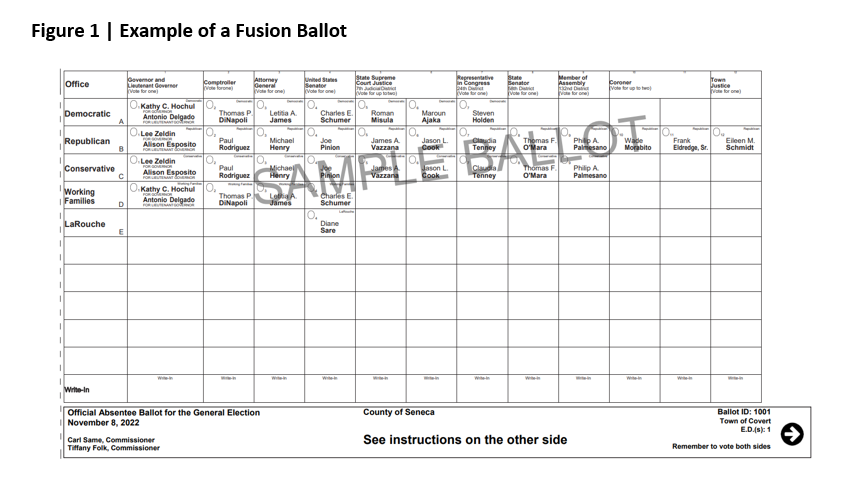
Official Website of Seneca County, New York
When votes are counted, each party’s votes are tallied up separately, and then the votes for the fused candidacies are aggregated for the final results. This makes it possible to distinguish the votes that minor parties get on their own line from those of the major party, unlike in aggregated fusion or “dual-labeling” systems where it’s impossible to disentangle the two. In doing so, disaggregated fusion voting—as practiced in New York and Connecticut—provides a clear picture of the electoral strength of minor parties.
A Brief History of Fusion Voting
Today, fusion voting is actively used only in New York and Connecticut in its disaggregated form and in Oregon and Vermont in its aggregated form. It is currently legal in Idaho and Mississippi but not used, and it remained legal but rarely used in Delaware and South Carolina until it was banned in 2011 and 2022, respectively.5 California allows for fusion ballots only in presidential elections. But in the nineteenth century, fusion was more the norm than the exception, and it was instrumental to the success of minor parties and fluid coalitional politics that instigated important policy changes at the time.
Prior to the Civil War, fusion voting was believed to have empowered anti-slavery factions and the creation of parties like the Free Soil Party, the Liberty Party, and the Anti-Nebraska Party.6 Coalitions between these parties and anti-slavery politicians of the major parties helped push the abolitionist movement into the political limelight. After the Civil War came the heyday of fusion voting and minor parties. In the North, it was common for Democrats to fuse with the Populist Party to form a coalition of wage earners and farmers in opposition to Gilded Age Republicans.7 In the South, fusion helped formalize electoral coalitions between newly enfranchised African Americans and poor white farmers in opposition to the rich merchants that made up the Democratic Party.
During this period, minor parties were able to succeed at the ballot box. Peter Argersinger’s account of the history of fusion voting in the late nineteenth century describes how minor parties “received at least 20 percent [of the popular vote] in one or more elections from 1874 to 1892 in more than half of the non-Southern states” and “held the balance of power at least once in every state but Vermont” from 1878 to 1892.8 The Populist Party, one of the most successful third parties of the time, emerged toward the end of this period, along with other influential minor parties like the Greenback Party and the Silver Party.
Bernard Tamas’s analysis of the electoral performance of minor parties in congressional elections since 1870 offers a contrasting view—that fusion voting was widespread in only three national elections following the Civil War.9 Tamas also shows that in the nineteenth century, elections when fusion ballots were used the most did not correspond to elections when minor parties obtained the most votes. Based on this analysis, Tamas argues that it is not clear if fusion helped strengthen minor parties or if minor parties that were already strong are the ones more likely to cross-endorse a major party candidate.
Fusion voting eventually went out of use in most states at the turn of the century with the introduction of the Australian ballot—secret ballots printed by the state and not by the parties. With states now controlling access to the ballot, the major parties—particularly the Republican Party—were quick to enact ballot access qualifications and rules that effectively banned fusion, such as requiring that candidates are only listed once.
In some states, however, fusion voting continued or made brief comebacks. In New Jersey, Governor Woodrow Wilson reintroduced fusion ballots in 1911 in an effort to give voters more influence over elections, but they were once again banned in the 1920s.10 In New York, fusion ballots remained legal, and their legal standing was solidified with judicial decisions in 1910 and 1911 and later with the Wilson-Pakula Act of 1947.
New York’s continued use of fusion voting facilitated the organization of influential third parties in the state, including the American Labor Party in the 1930s, the Liberal Party in the 1940s, the Conservative Party in the 1960s, and the Working Families Party (WFP) in the late 1990s. At its apogee, the Liberal Party contributed a meaningful, often decisive, number of votes to both Democratic and Republican candidates in its efforts to “strengthen the liberal wings of both parties” and used that electoral strength to advocate for progressive policies in the state.11 It was said that Democratic candidates could not win statewide races if the Liberal Party ran its own candidates and spoiled the election, while no Republican could win in New York City without the support of the Liberal Party.12 The party achieved impressive political influence by providing the winning votes in various races at all levels of government. The Liberal Party’s top-heavy leadership, shifting demographics, and excessive and often corrupt use of patronage ultimately spelled its demise, but the “year-round minor party” model it pioneered inspired the rise of other influential minor parties in the state, such as the Conservative Party and the WFP, which continue to participate actively in New York politics and have contributed to important policy decisions.
“Fusion would revitalize the political center and provide a partisan home to disaffected voters who no longer feel welcomed in the major parties.”
The next chapter of the history of fusion voting in the United States is currently being written as efforts are underway to relegalize fusion voting in various states. The impetus for bringing back fusion voting in states other than New York and Connecticut comes from the argument that fusion would revitalize the political center and provide a partisan home to disaffected voters who no longer feel welcomed in the major parties, particularly within the Republican Party.
There are some parallels between the context that gave rise to the Liberal Party and the current political climate that give grounds to this argument, but some important differences will inflect the reemergence of fusion voting today with different electoral dynamics. As Daniel Soyer explains, the emergence of the Liberal Party happened at a time when the political system was in flux and soon to experience a partisan realignment; the Liberal Party positioned itself to catch disaffected Democrats “disgusted with their party’s white supremacist and machine wings and…liberal, internationalist [Republicans].”13 There are certainly many disaffected voters today, including many Republicans who are similarly disgusted with the extreme wing that has taken over the party, and many more voters who would appreciate more options on their ballots. The key difference today is that the major parties are extremely polarized in contrast to the blurred partisan lines of the mid-twentieth century when there were liberal Republicans and conservative Democrats and the Liberal Party could easily build its progressive coalition with these politicians. This means that fusion voting will probably facilitate new unlikely coalitions that are currently not represented by the left–right partisan dimensions, much like it did during other periods of high polarization.
Fusion around the World
Fusion voting is used in other countries as part of formal electoral coalitions, allowing multiple parties to pool their votes. This is most common in races for single-winner offices, like the presidency, but forms of fusion do occur in legislative races in both majoritarian and proportional systems.
In Mexico, for example, candidates appear under different party labels, and votes for each party are counted separately by party prior to aggregating the total vote count for each candidate. Below is a sample ballot for the 2012 presidential election in which the Institutional Revolutionary Party and the Green Parties fused in support of Enrique Peña Nieto, and the Party of the Democratic Revolution, Labor Party, and Movimiento Ciudadano parties fused in support of Andrés Manuel López Obrador.
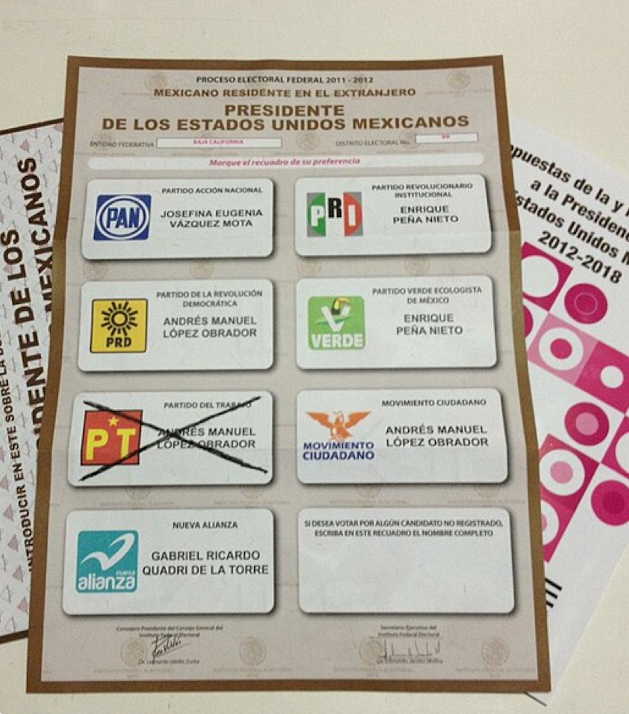
Wikimedia Commons/Lguweqaakljgh
In proportional electoral systems, parties can form formal alliances in the practice known as apparentment.14 Each party list is shown separately on the ballot, but the votes for the parties under apparentment are pooled together to determine the number of seats the coalition wins. Then, seats are allocated proportionally based on the individual vote shares of each party.
Citations
- “The Republican and Democratic parties” in Americans’ Dismal Views of the Nation’s Politics (Washington, DC: Pew Research Center, 2023), https://www.pewresearch.org/politics/2023/09/19/the-republican-and-democratic-parties/; Victor Y. Wu and Joseph Bafumi, “Disaffected Partisans Who Want a Third Party Are Just as Polarized,” Party Politics (2024), https://doi.org/10.1177/13540688241249035.
- For more on this, see Andy Craig, “The First Amendment and Fusion Voting,” Cato at Liberty (blog), Cato Institute, September 26, 2022, https://www.cato.org/blog/first-amendment-fusion-voting.
- Under dual-labeling systems or aggregated fusion, the candidate’s name is followed by the labels of each endorsing party on the same line. This system does not allow distinguishing between each party’s vote shares, but it still provides many of the same benefits of disaggregated fusion, like allowing candidates to distinguish themselves from others and providing more information to voters. For more on the distinctions between the two systems, see Maresa Strano and Joel Rogers, “More Than Semantics: Distinguishing Dual Labeling From Traditional Fusion Voting,” Ballot Access News, September 16, 2023, https://ballot-access.org/2023/09/16/more-than-semantics-distinguishing-dual-labeling-from-traditional-fusion-voting/.
- See Connecticut General Statutes, Nominations and Political Parties: Cross Endorsement of a Candidate, Title 9 - Elections, Chapter 153 (9-373b), https://www.cga.ct.gov/current/pub/chap_153.htm#sec_9-373b.
- From 1976 to 2022, only 14 candidates for Congress from South Carolina ran on fused ballots. From 1967 to 2016, only five candidates for the South Carolina Senate and 34 candidates for the state legislature ran on fused ballots. In Delaware, fusion was not used for any congressional candidate from 1976 until it was banned, it was used once for a state senate candidacy in 2010 and for 10 candidates for the state legislature in 2008 and 2010.
- See “Fusion in American History,” Center for Ballot Freedom, https://centerforballotfreedom.org/fusion-in-american-history/.
- This section paraphrases from Maresa Strano and Joel Rogers, “More Than Semantics: Distinguishing Dual Labeling From Traditional Fusion Voting,” Ballot Access News, September 16, 2023, https://ballot-access.org/2023/09/16/more-than-semantics-distinguishing-dual-labeling-from-traditional-fusion-voting/.
- For a more detailed history of fusion voting, see Peter H. Argersiner, “‘A Place on the Ballot’: Fusion Politics and Anti Fusion Laws,” American Historical Review 85, no. 2 (1980): 287–306, https://doi.org/10.2307/1860557.
- Bernard Tamas, “Does Fusion Undermine American Third Parties? An Analysis of House Elections from 1870 to 2016,” New Political Science 39, no. 4 (2017): 609–626, https://doi.org/10.1080/07393148.2017.1378294.
- See Brief of Appellants in Re Tom Malinowski, Petition for Nomination for General Election, at Superior Court of New Jersey Appellate Division, Docket No. A-3542-21T2.
- Daniel Soyer, Left in the Center: The Liberal Party of New York and the Rise and Fall of American Social Democracy (Ithaca, NY: Cornell University Press, 2022).
- Soyer, Left in the Center.
- Soyer, Left in the Center.
- Daniel Bochsler, “Who Gains from Apparentments Under D’Hondt?” Electoral Studies 29, no. 4 (2010): 617–627, https://www.zora.uzh.ch/id/eprint/48546/; Arend Lijphart, “Apparentment” in International Encyclopedia of Elections (Washington, DC: CQ Press, 2000): 16–17.