A Chapter of: Varying Degrees 2024
Funding
Because concerns about college affordability are so pressing, we asked several questions about how higher education should be funded, and by whom. Over the past seven years, Varying Degrees has asked Americans who should fund higher education: the government, because it is good for society; or students and their families, because they personally benefit. This question has seen a decline, since we started asking, in those believing the government should be responsible, particularly since 2020. This year just over half of Americans—56 percent—believe the government has the primary responsibility for funding higher education, with 43 percent believing individuals should fund higher education because they personally benefit (see Figure 20).
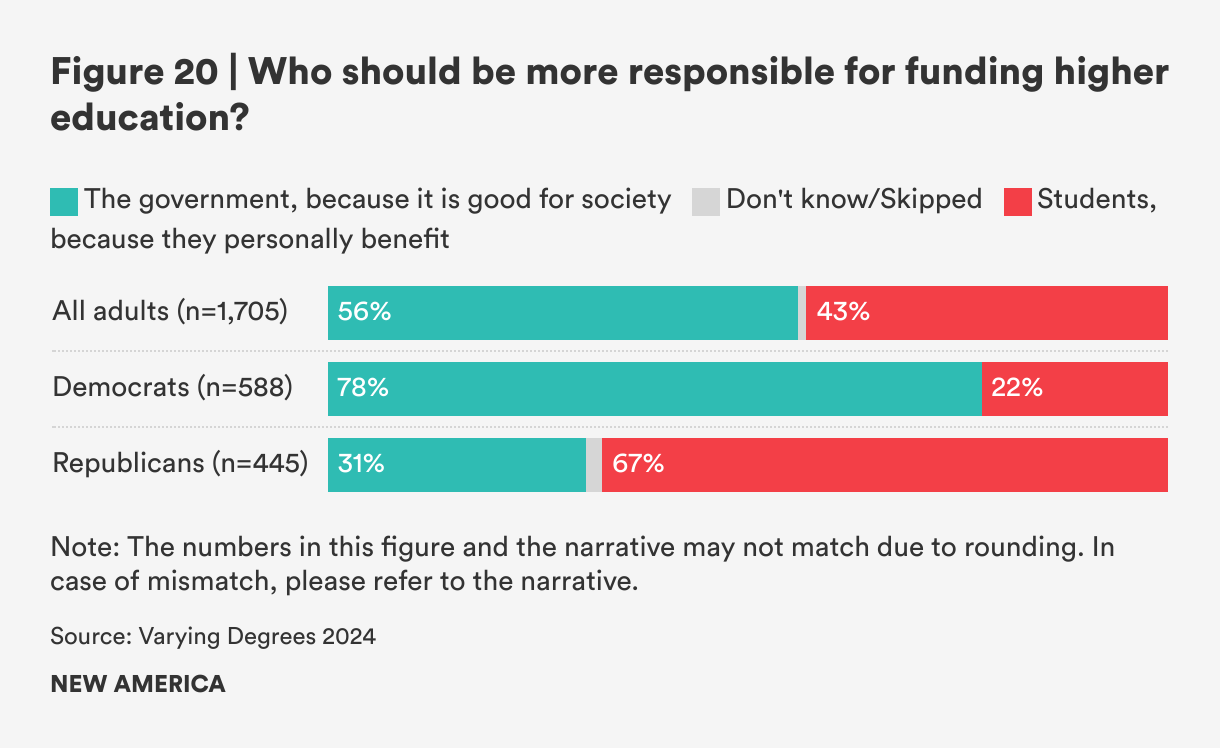
There has always been a sharp partisan divide in the response to this question, and this year was no exception. Nearly eight out of ten Democrats believe that the government should fund higher education because it is good for society, whereas nearly seven out of ten Republicans believe that students should fund higher education because they personally benefit.
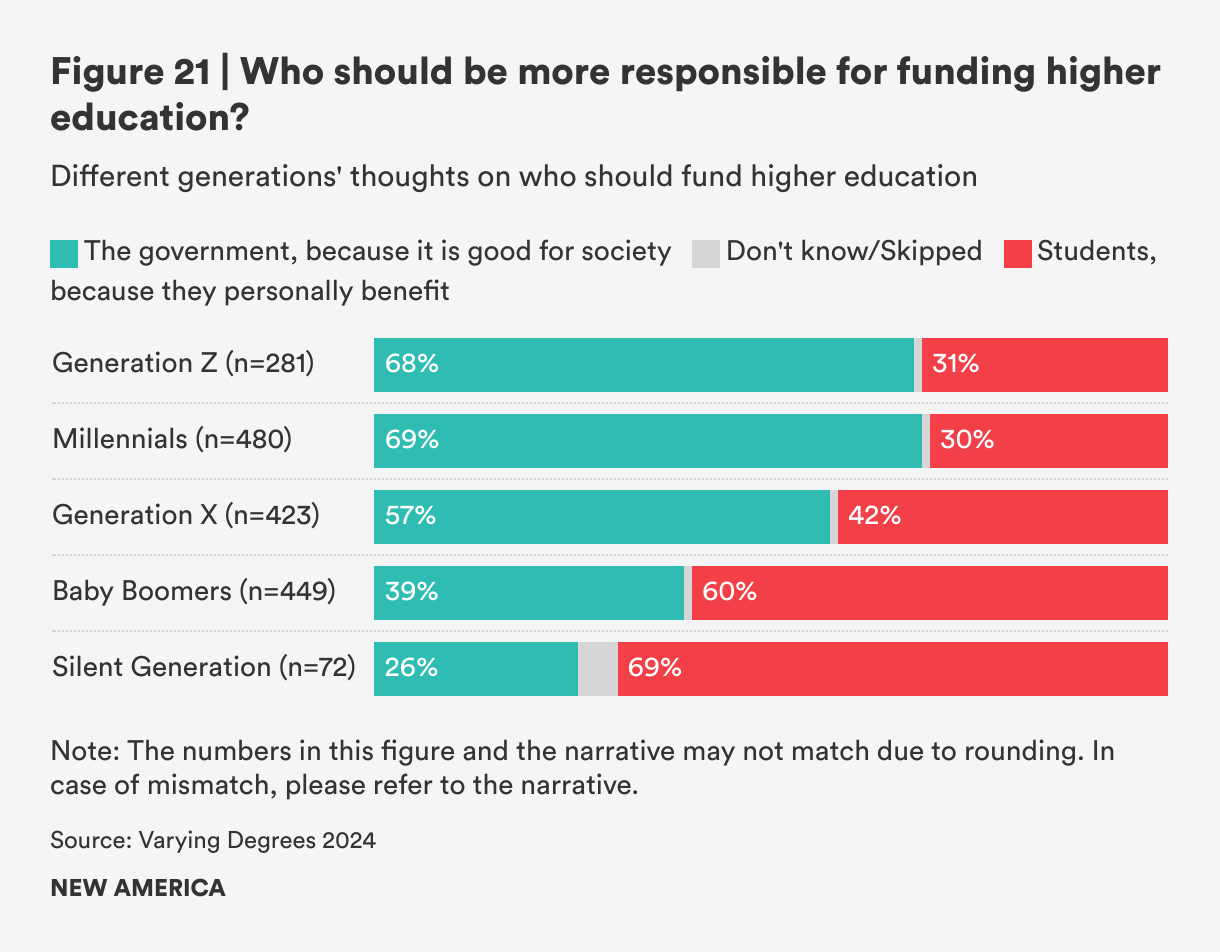
There is also a divide between Baby Boomers and other generations. The majority of members of Generation Z, Millennials, and Generation X all believe that the government has the primary responsibility for funding higher education; a majority of Baby Boomers believe that students do (see Figure 21).10
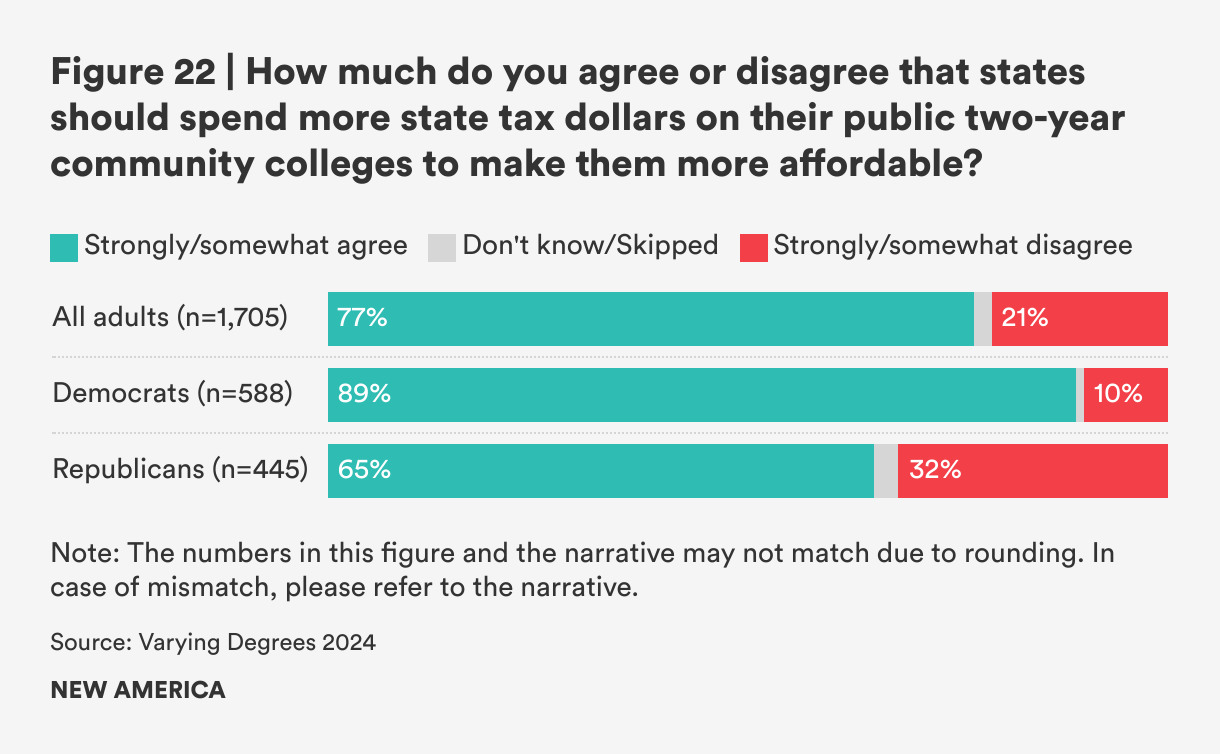
Interestingly, despite the declining belief that the government should be the primary funder of higher education, about seven out of ten of Americans agree that states should spend more tax dollars on public two- and four-year colleges and universities because it is a public good. A majority of both Democrats and Republicans agree, though at different rates (89 percent of Democrats agree versus 55 percent of Republicans) (see Figure 22).
To understand with greater nuance where Americans think the responsibility for funding higher education should fall, we asked who should be mainly responsible for funding education after high school and who should be second-most responsible. Response options included: the federal government, state government, students and families through savings, and students and families through loans.
Answers to these questions reveal whether Americans view higher education as a collective good that should be funded by the government or an individual benefit. Just over a third of Americans (35 percent) believe that the federal government should be mainly responsible for funding higher education, and those respondents are likely the ones who drive the response that the second-most responsible funder should be state governments (40 percent). Whereas another third of Americans tend to have a more individualistic attitude with 33 percent saying the main funder should be students and families through earnings and savings. These respondents are likely among the 22 percent saying the secondary funder should be students and families through student loans (see Figure 23).
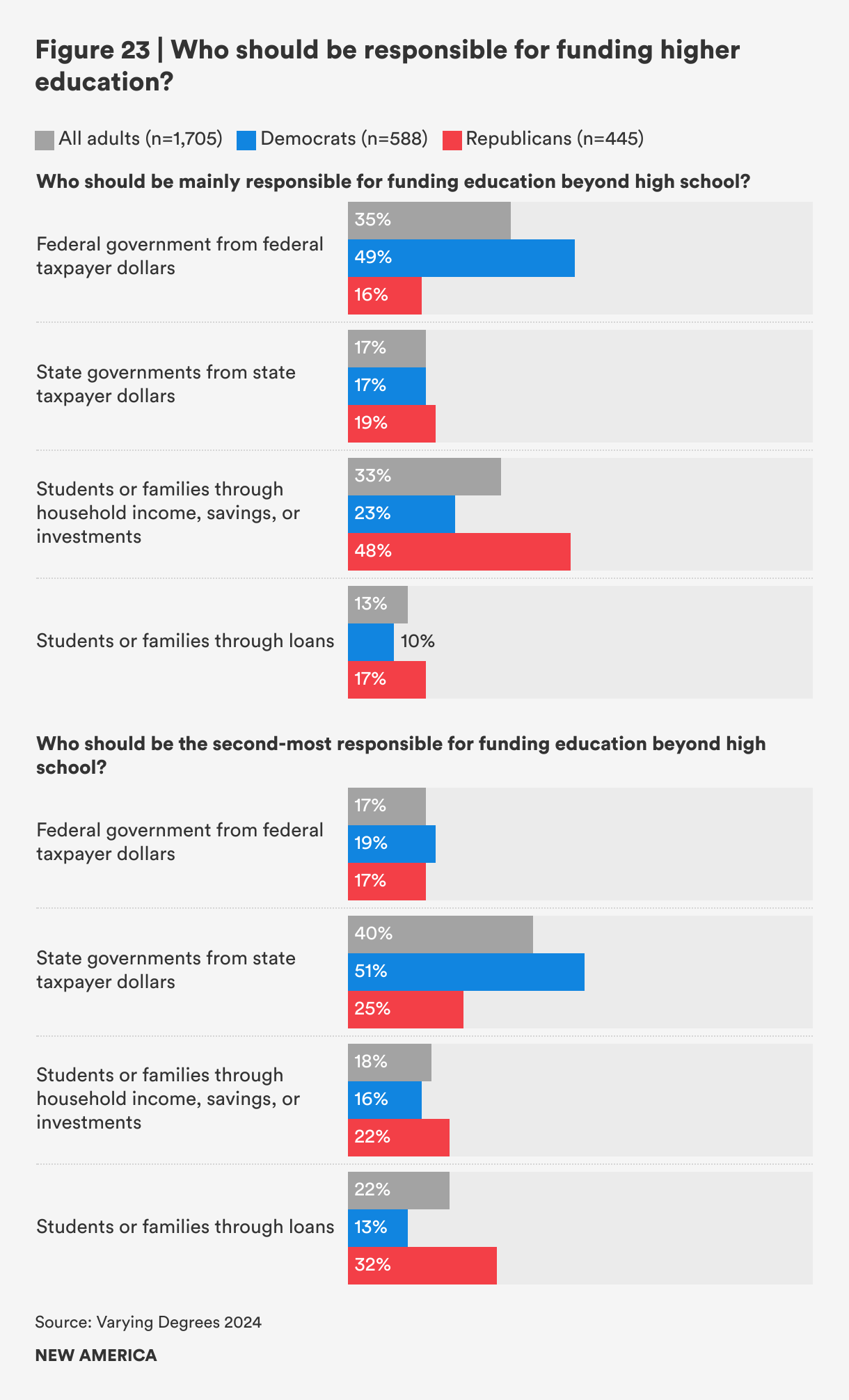
Like the previous question on who should fund higher education, this question on responsibility of funding shows a partisan divide. Democrats tend to have a collective benefit view of how higher education should be funded. Nearly half (49 percent) of Democrats believe the federal government is mainly responsible for funding higher education, with over half believing that the second funder should be state governments.
Republicans are more likely to have individualistic views. Nearly half of Republicans (48 percent) believe that students and families, through savings and earnings, should be mainly responsible for funding higher education. And a plurality of Republicans (32 percent) say the secondary funder should be students and families through loans.
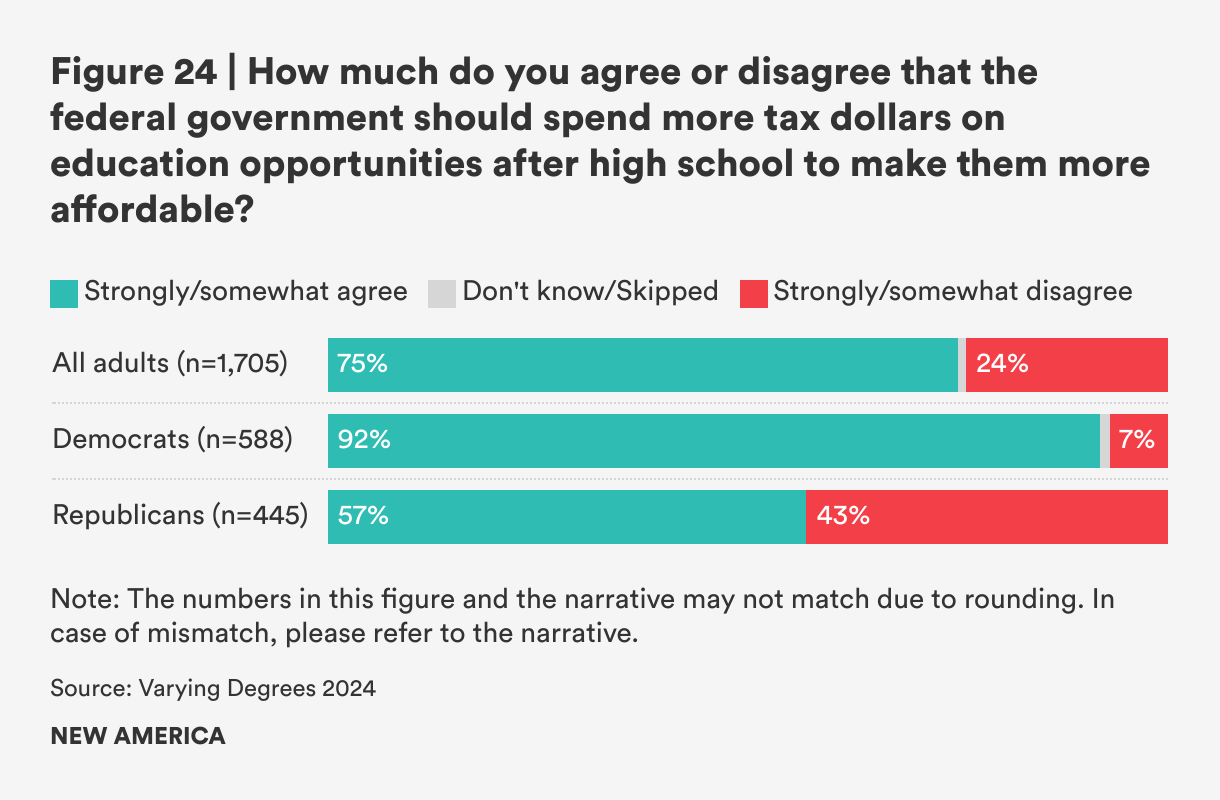
Regardless of who Americans think should fund higher education, a majority (75 percent) believe that the federal government should spend more tax dollars on education opportunities after high school to make them more affordable. And while Democrats and Republicans have divergent views on who should fund higher education, a majority of Americans from both parties agree that federal money should be used to lower the cost of college, albeit at different rates (92 percent of Democrats agree, compared with 57 percent of Republicans) (see Figure 24).
Americans are Comfortable Making Community College Tuition-Free
During the last two years of the Obama administration, the idea of the federal government funding a free college option in partnership with states took hold. Over the years, Congress has explored the idea of free college, coming close to passing legislation on this as part of President Biden’s Build Back Better framework.11 This policy idea could help more Americans afford college.
According to our survey, a majority of Americans (60 percent) believe that decreased funding from state governments is a major reason why the cost of attending public colleges and universities has increased, highlighting the need for federal and state governments to work together to improve college affordability. In our survey, Americans broadly support having the government provide funding to make public two-year colleges free. However, they are more divided about having the government do so for four-year public colleges and universities.
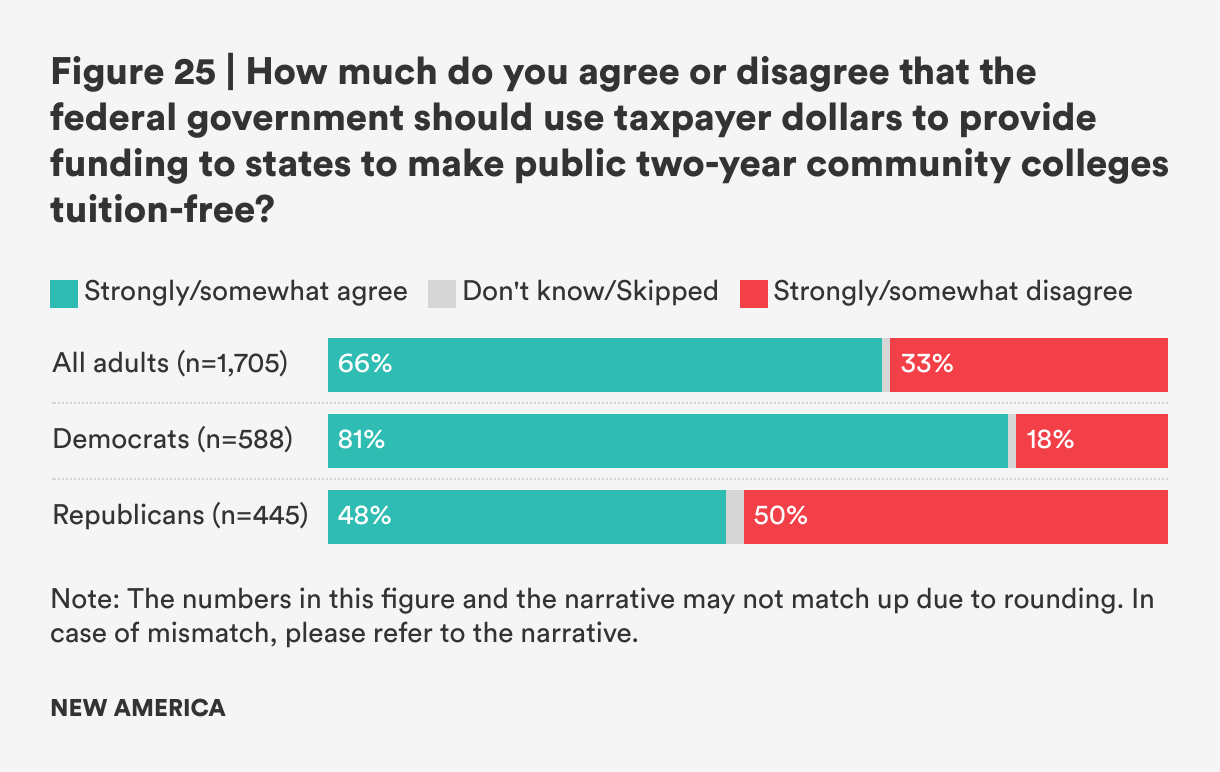
This year we asked whether survey respondents agree that the federal government should provide funding to states to make public two-year colleges tuition-free. Free community college receives fairly broad support—approximately two-thirds of Americans agree that the federal government should help fund a free community college option. Democrats are far more supportive of the idea (81 percent) than Republicans (48 percent) (see Figure 25).
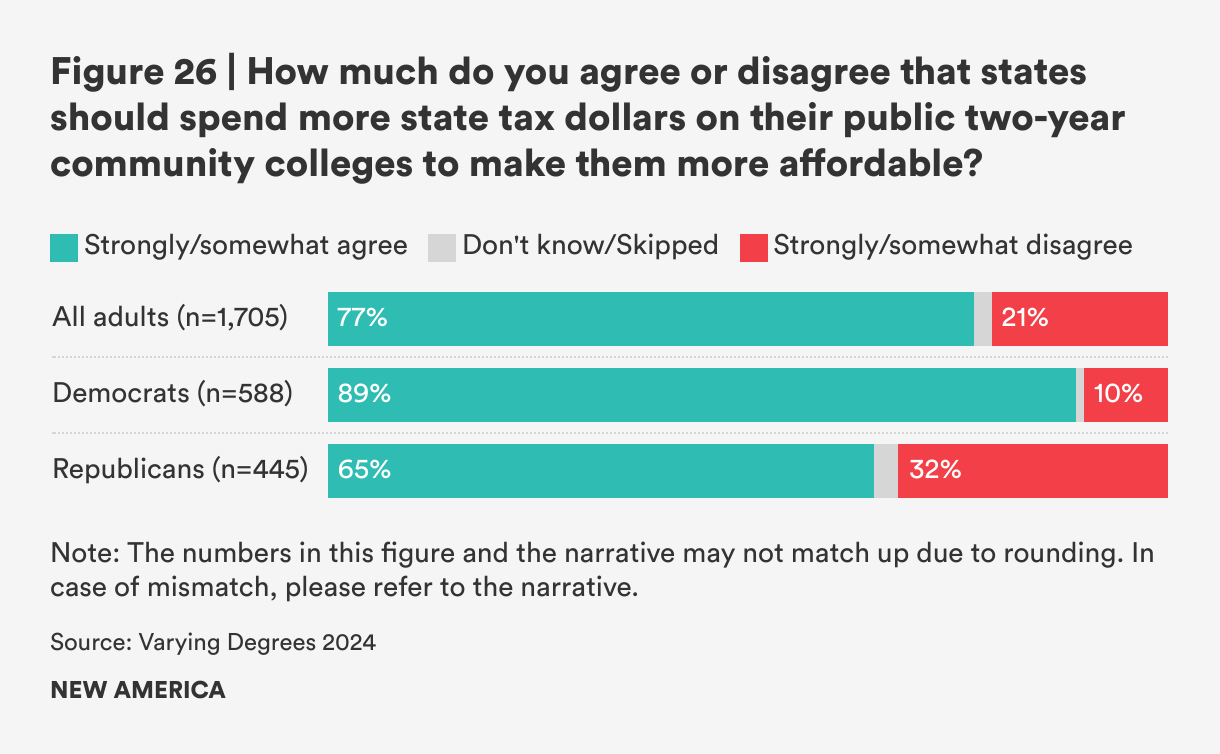
Slightly more than three-quarters (77 percent) of Americans believe that states should spend more tax dollars on public two-year community colleges to make them more affordable. There is strong bipartisan support for the idea, with 89 percent of Democrats and 65 percent of Republicans agreeing (see Figure 26).
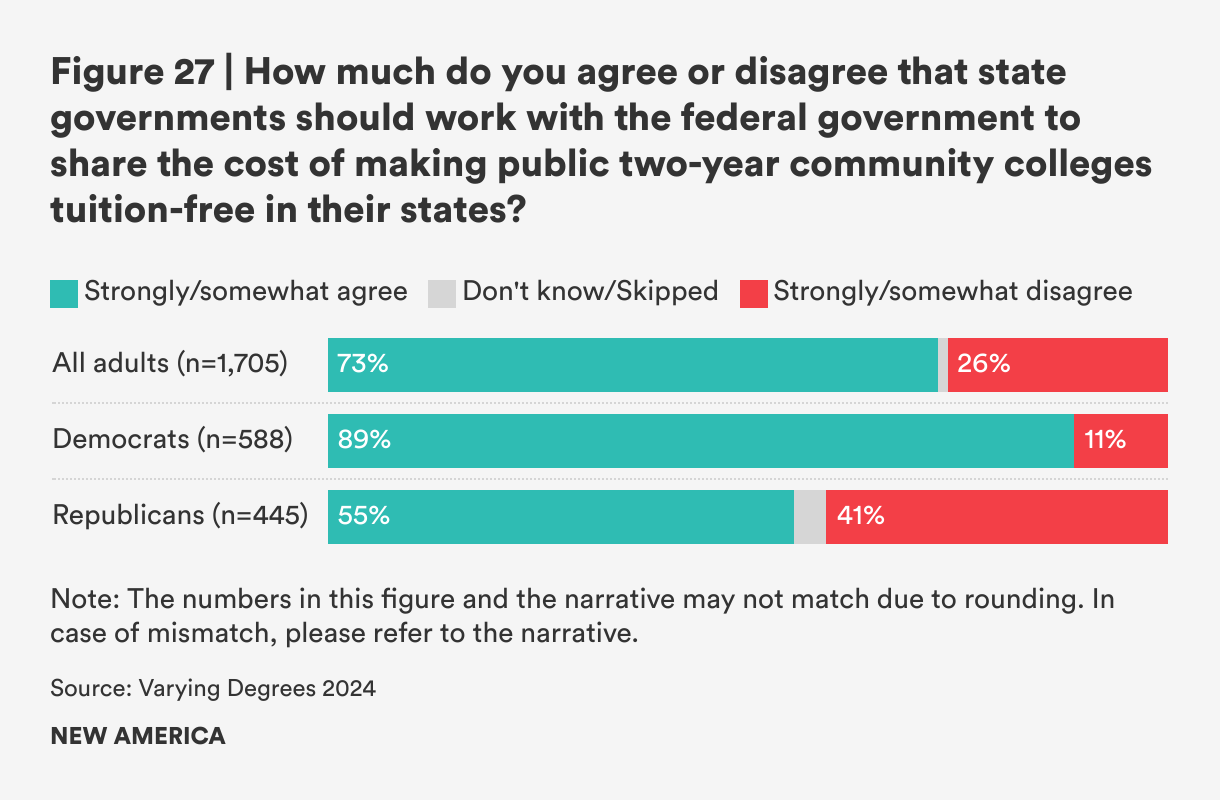
Americans also agree (72 percent) that state governments should share the cost of making public community colleges tuition-free with the federal government. Nearly nine out of ten Democrats support the idea (88 percent); a slight majority of Republicans (55 percent) do so as well (see Figure 27).
Americans are More Conflicted on Funding a Tuition-Free Public Four-Year Option
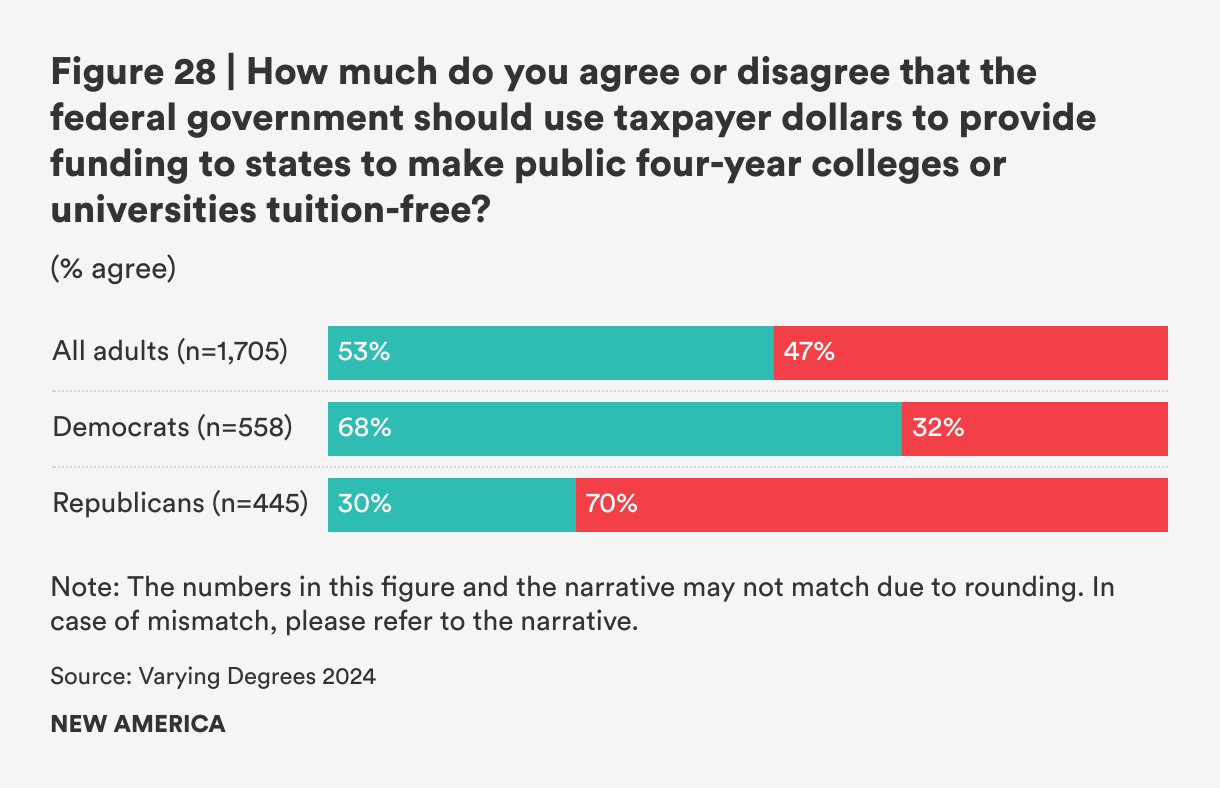
Americans are split over whether the federal government should provide funding to states to make public four-year colleges and universities tuition-free. Just about half (52 percent) agree that federal dollars should be provided to states for a free public four-year option. Two-thirds of Democrats (67 percent) support having the federal government help finance a free four-year option, but only 29 percent of Republicans agree (see Figure 28).
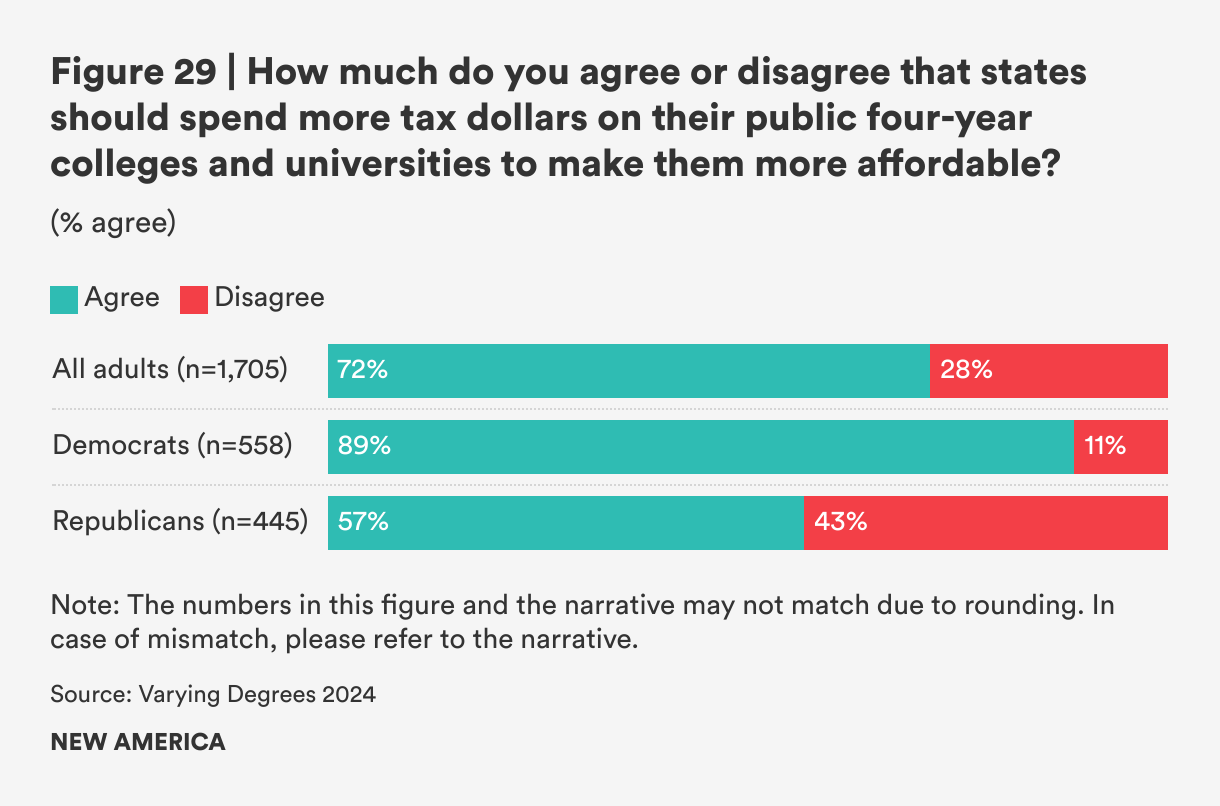
A majority of Americans believe that states also have a role to play in making public four-year colleges and universities more affordable. About seven in ten (71 percent) of Americans agree that states should spend more tax dollars to make public four-year colleges and universities more affordable. A majority of both Democrats and Republicans agree, albeit at very different rates (88 percent of Democrats versus 55 percent of Republicans) (see Figure 29).
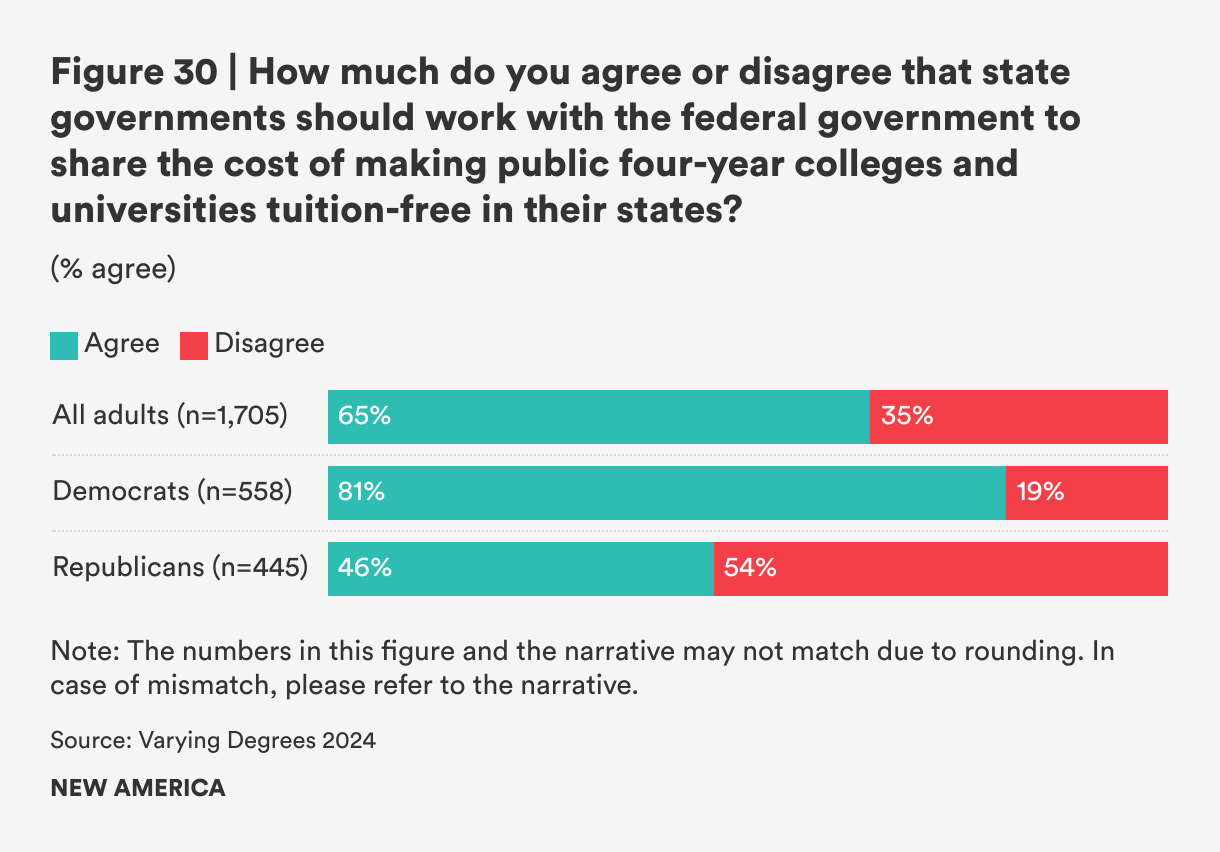
Americans also agree (64 percent) that state governments should share the cost of making public four-year colleges and universities tuition-free. There is a partisan divide on this question, with 80 percent of Democrats agreeing and only 45 percent of Republicans agreeing (see Figure 30).
Americans Want More Need-Based Grant Aid for Students
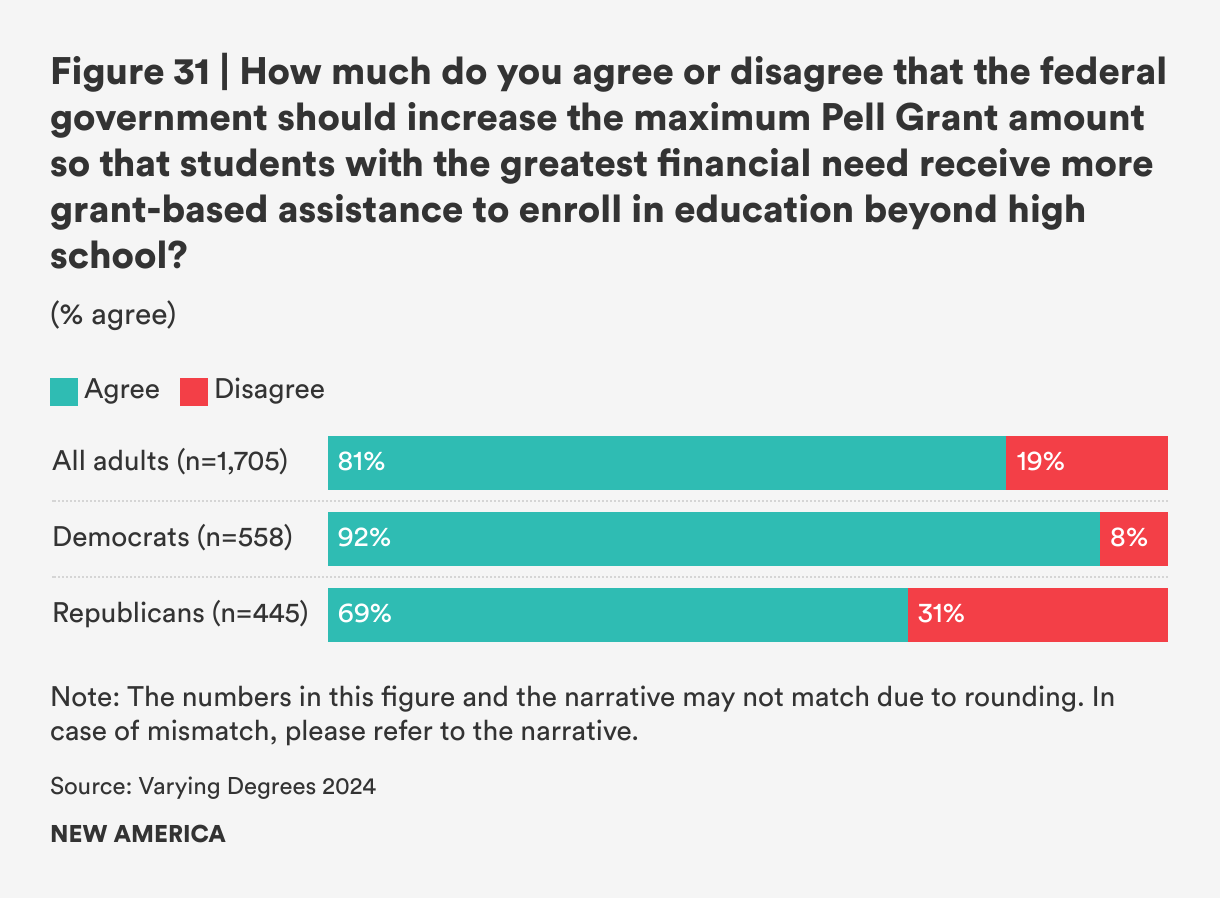
The Pell Grant program is the largest federal student aid program that is based on financial need. While there have been incremental increases in the maximum Pell Grant award over the years, Pell has not kept up with inflation and the rising cost of college. It is unsurprising, therefore, that a vast majority of Americans (80 percent) agree that the federal government should increase the maximum award so that students with the greatest financial need receive more grant-based assistance. Increasing Pell Grant funding receives broad support (though at varying levels) across many demographics including party identification and race and ethnicity (see Figure 31).
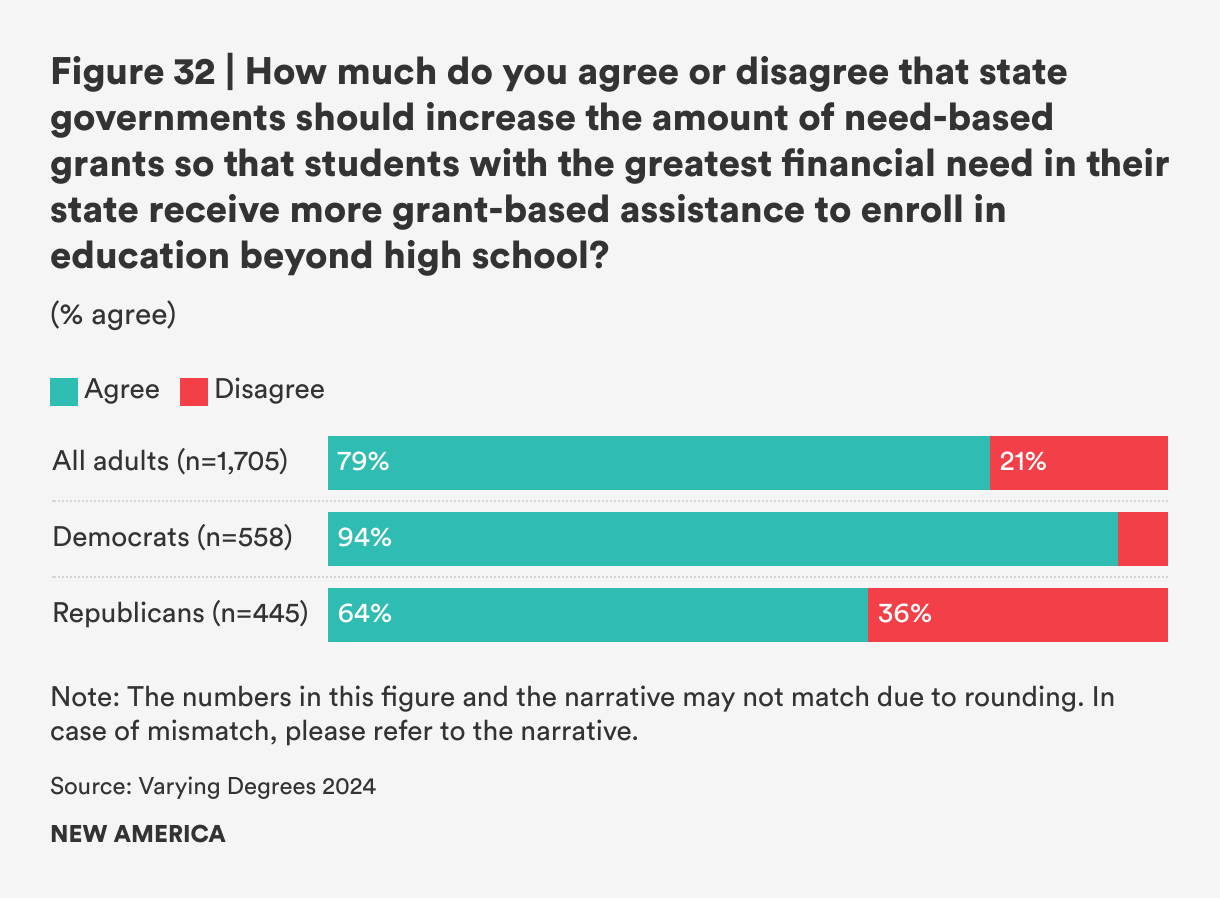
Although each state grant program has different requirements for students to participate, more than three-quarters of Americans (78 percent) agree that states should increase the amount of need-based grants to focus resources on students who could use the financial help the most.12 Targeting state grants to those with financial need also has bipartisan support (see Figure 32).
Americans Feel Comfortable Spending Taxpayer Dollars on Public Colleges and Universities, but Less So on Private Institutions
A majority of Americans feel comfortable with their own taxpayer dollars supporting public two-year (76 percent agree), public four-year (67 percent agree), and minority-serving institutions (MSIs) (64 percent agree). Support for using taxpayer dollars on private institutions, both nonprofit and for-profit, is lower: just 45 percent of Americans are comfortable with spending these funds on private nonprofit institutions, and only 32 percent are comfortable with spending them on private for-profit institutions (see Figure 33).
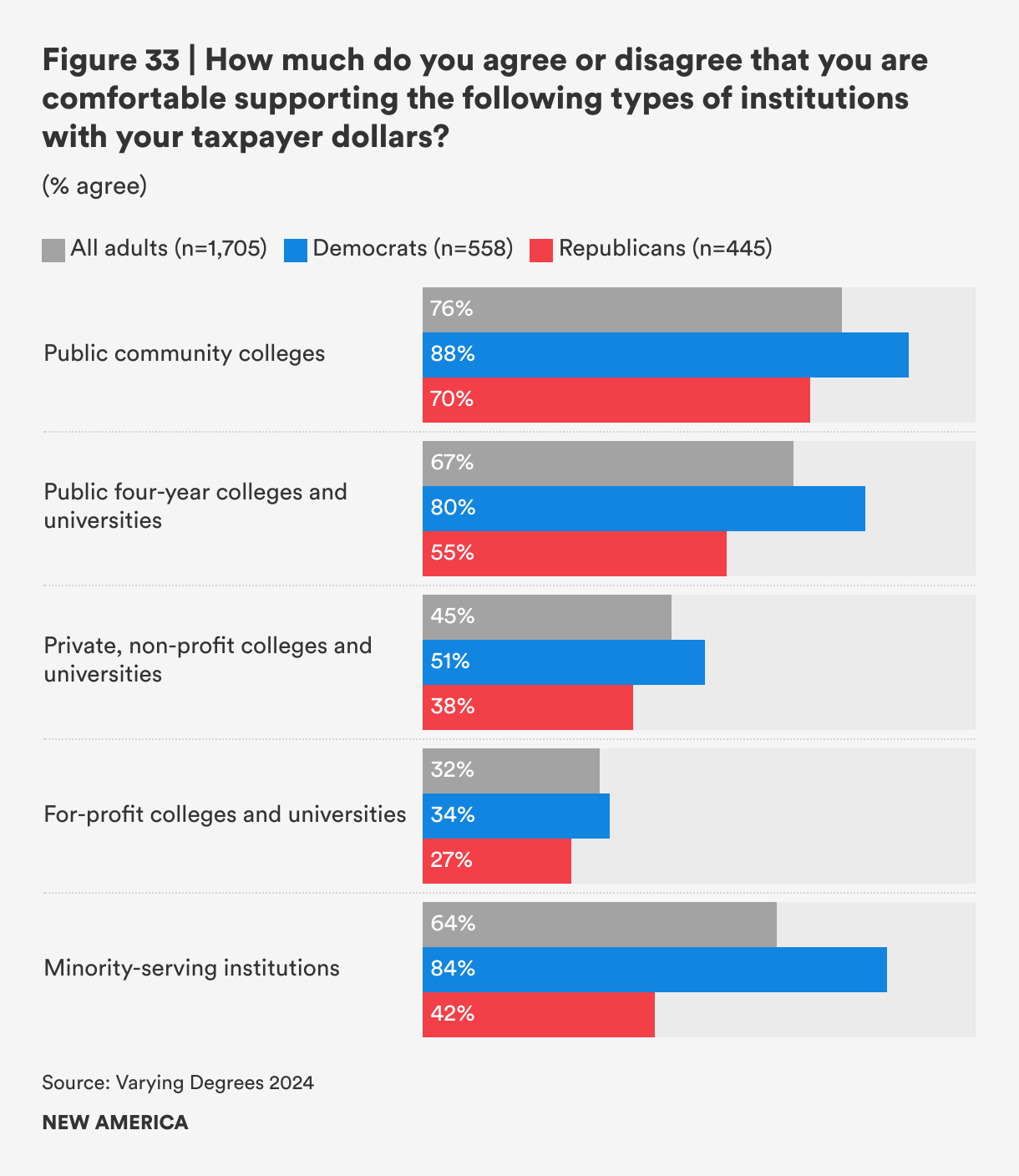
Both Democrats and Republicans express support for financing public two- and four-year colleges with their taxpayer dollars. Democrats show particularly high levels of support, with 88 percent comfortable with their taxpayer dollars going to community colleges and 80 percent showing support for using them to finance public four-year universities. About half of Democrats (51 percent) support their tax dollars going to private nonprofit colleges and universities, compared to only 38 percent of Republicans.
Both groups do have something they agree on: they are uncomfortable with their taxpayer dollars going to for-profit institutions. Only 34 percent of Democrats and 27 percent of Republicans agree that taxpayer dollars should go to the private for-profit sector.
As in previous years, Democrats and Republicans have divergent views on taxpayer support for MSIs. A sizable majority of Democrats (84 percent) agree with spending tax dollars on MSIs, whereas only 42 percent of Republicans do.
Americans, however, do not feel strongly that the federal government and states underfund the country’s colleges and universities. About half think that community colleges, public four-year institutions, and MSIs are underfunded by both federal and state governments. Just under a third of Americans agree that the federal and state governments underfund private nonprofit and for-profit institutions (see Figure 34).
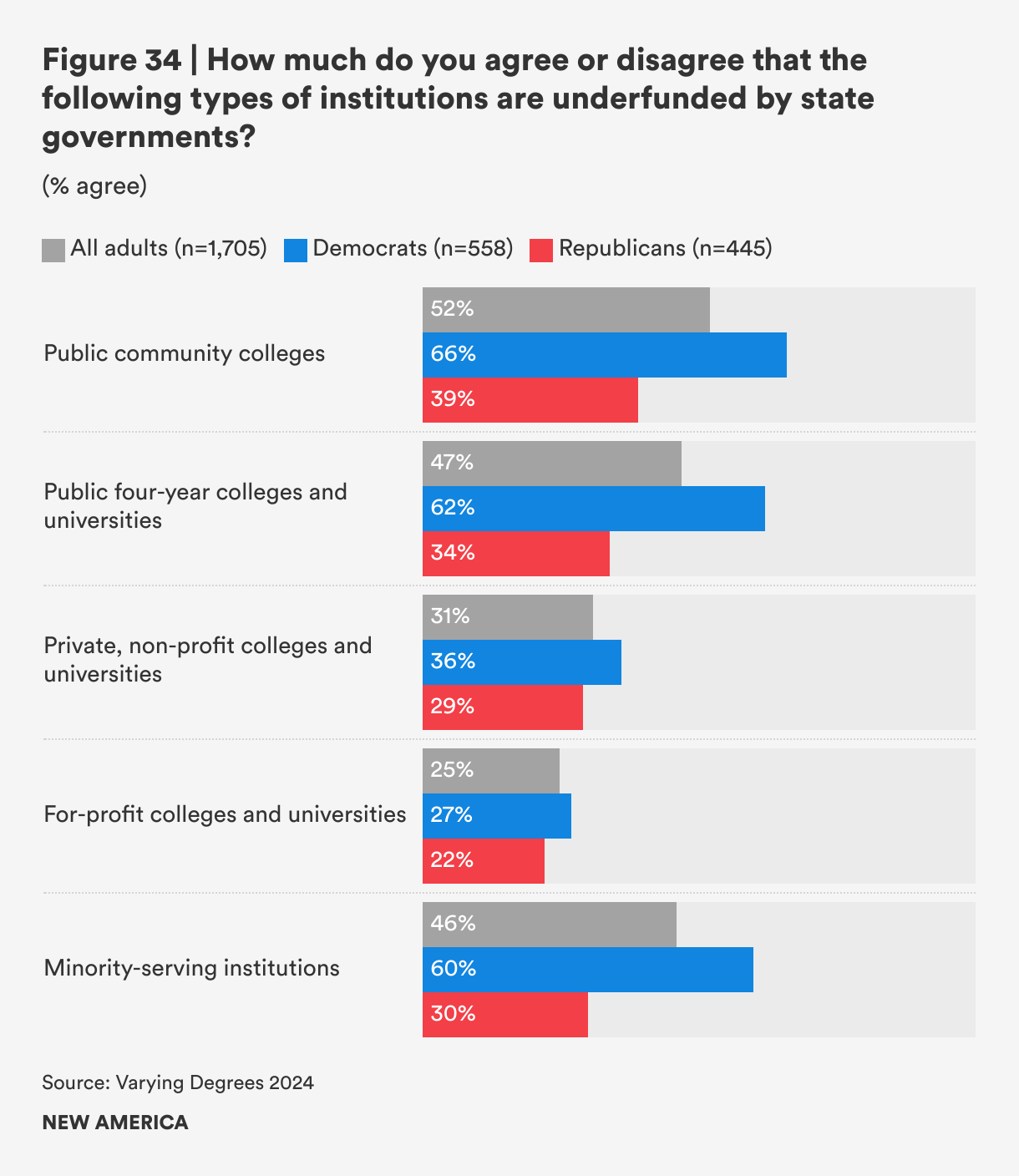
Big partisan differences emerge between Democrats and Republicans on whether the federal or state governments underfund particular sectors of higher education. The biggest difference emerges with MSIs. Approximately 60 percent of Democrats agree that both states and the federal government underfund these institutions, compared to 30 percent of Republicans.

Citations
- In the Varying Degrees survey, Generation Z includes people who were born in and before 1995, Millennials include those born between 1980 and 1994, Generation X includes those born between 1965 and 1979, Baby Boomers include those born between 1946 and 1964, and the Silent Generation includes those born in and before 1945.
- For more information on President Biden’s free college plan, see Peter Granville, “President Biden’s Free Community College Plan Matters Now More Than Ever,” The Century Foundation, March 30, 2023, https://tcf.org/content/commentary/president-bidens-free-community-college-plan-matters-now-more-than-ever/.
- For more information on how disparate state grant programs are, see Ivy Love, Edward Conroy, Iris Palmer, and Sarah Sattelmeyer, “We Shouldn’t Have to Choose between Maintaining and Bettering Our Lives”: An Analysis of Older and Parenting College Students (Washington, DC: New America, November 2023), https://www.newamerica.org/education-policy/reports/we-shouldnt-have-to-choose-between-maintaining-and-bettering-our-lives-an-analysis-of-older-and-parenting-college-students/.