Varying Degrees 2024
Abstract
Varying Degrees 2024 continues to explore Americans’ perspectives on a variety of higher education issues, including value, affordability, funding, and accountability. The findings this year show Americans’ confidence in higher education declines in a few areas. But at the same time, they still believe higher education is worth it and support more investment from the state and federal government to make it more affordable.
Acknowledgments
Varying Degrees was funded by the Bill & Melinda Gates Foundation. New America thanks the foundation for its support. The findings and conclusions contained within are those of the authors and do not necessarily reflect positions or policies of the foundation. The authors would like to thank Sabrina Detlef for her copyediting support, and Katherine Portnoy, Amanda Dean, Natalya Brill, and Naomi Mourduch Toubman for their communications and data visualization support.
Executive Summary
It has been eight years since we started the Varying Degrees annual survey to follow how Americans think about higher education. Over the years, the survey has showcased layers of public opinion on complex issues related to college value, funding, and accountability. It might sound conflicting, but even when Americans are not happy with higher education, a majority still see the value of gaining a postsecondary credential and would like to see greater state and federal funding to make college more affordable.
However, the 2024 survey, which samples 1,705 adults, shows that Americans’ confidence in the current state of higher education is trending downward. Only 36 percent of Americans think higher education is fine how it is (see image below). Seventy-five percent of Americans think higher education offers a good return on investment for the student, compared to nearly 80 percent in 2019. The share of Americans who think that higher education is having a positive impact on the way things are going in the country today has dropped by 16 percentage points since 2019, to just 54 percent. Having said that, more than 70 percent of Americans still want their children or family members to earn at least some postsecondary education (see image below). More than 75 percent think that the value of an associate and a bachelor’s degree is worth it even if students need to borrow to attend.
Cost continues to be a pain point when it comes to enrolling in college. We added questions to this year’s survey to understand how the public perceives the issue of affordability and whether it thinks the state and federal government should step in to make higher education more affordable. The survey found that more than 80 percent of Americans believe that the cost of attending colleges or universities is the biggest factor that blocks any individual from enrolling. And while fewer Americans think that the responsibility of funding college should fall on the government compared to previous years (see image below), they still see a role for federal and state government in making public higher education more affordable, either through increasing need-based grants or creating a federal-state partnership to make public colleges tuition-free.
The survey findings show that even when Americans’ confidence in the state of higher education might be shaky, hope is not lost: there are approaches institutions and policymakers can take to restore public trust.
Other findings include:
- Democrats and Republicans are aligned on a few higher education issues, despite their differences in many policy areas. Both groups similarly do not think higher education is fine right now (36 and 39 percent of Democrats and Republicans, respectively) and agree that cost is the biggest barrier to enrollment for most individuals (87 and 78 percent of Democrats and Republicans, respectively).
- Americans would like to see candidates address the issue of college affordability in the coming election. More than 70 percent of them (85 percent of Democrats and 66 percent of Republicans) said the candidates’ stance on higher education affordability will be important to their votes (see image below).
- Americans continue to want greater transparency on key indicators of education quality, as in previous years. A majority of Americans agree that institutions should lose access to taxpayer dollars if students have poor outcomes.
Preface
Higher education in the United States is a complex system. It includes more than 6,000 colleges and universities with a wide range of educational programs that vary in length and focus. Federal and state governments have created a number of financial aid programs, including grants and loans, to help students, especially low-income students, afford higher education. With help from the government available, any student who would like to enroll should theoretically be able to find an affordable program that matches their interests. But the situation isn’t that simple. Even when students receive grants and scholarships to help them pay for college, the total cost of attending (which goes beyond tuition and fees) can still be unaffordable for many students unless they take out student loans. What is more, uncertain college outcomes and the tight labor market may convince many to get a job instead of enrolling in school.
Considering the high cost and potential debt of college and the state of the economy, students and their families can’t help but wonder if pursuing higher education is still worth it. In general, the answer is yes. Research shows that those with a bachelor’s degree earn significantly more than those with only a high school diploma, and, over time, the higher income will mean more wealth for these graduates. Unfortunately, though, college does not pay off for everyone. First, not every student who enrolls in college graduates. Only 60 percent of students at four-year colleges graduate within six years. At community colleges, the number is worse: only a third complete their programs after three years. And second, not all programs are high-quality and prepare students with the skills and knowledge necessary for the workforce. For example, many students enrolled at for-profit institutions found themselves worse off than before, unable to realize the earning gains they expected while being faced with student debt.1
In recent years the question of whether college is worth it comes up often in the media.2 Not only are students in doubt, but the general public is concerned as well. A Gallup poll in 2023 showed that only 36 percent of Americans have confidence in higher education, down from 57 percent in 2015.3 A Pew survey in 2024 found that only half of Americans think colleges and universities are having a positive impact on the country, down from 60 percent in 2012.4 Public trust for higher education may be declining, but this does not necessarily indicate that Americans think enrolling in college is no longer worth it, or say much about how they feel about different sectors of higher education, or how they think the system should change. Just as the higher education system is complex, so too are the opinions of Americans.
Varying Degrees, New America’s annual nationally representative survey, has documented the complexity of Americans’ opinions about higher education for the past eight years. Our year-to-year findings show that while a majority of Americans are unhappy with the way higher education operates, they still recognize the benefits of having a postsecondary credential and still want their children and family members to pursue one. And they want to see more investment from the state and federal government to make college more affordable. Even if Americans have lost confidence in the overall state of higher education, they still want more investment from the government to make college more accessible and affordable. Policymakers and college administrators need to keep this complexity in mind as they are working to restore public trust in the system.
In Varying Degrees 2024, we continue to ask questions about college cost and value for different types of postsecondary credentials, across different sectors of colleges and universities, trying to get at the complexity of the system.5 This year’s survey shows that a majority of Americans still think education after high school offers a good return on investment and support greater government spending to make colleges more affordable; however, compared to 2023, there has been some decline in public support for these ideas. While it is too early to tell whether the decline signals a downward trend, it is definitely a cause for concern.
Varying Degrees this year not only focuses on our core issues related to value, funding, and accountability, it also asks Americans extensively about college affordability, and their opinion about policy proposals to reduce the cost of attending. Findings from these questions will be helpful to policy debates as the country is preparing for the 2024 election. In addition, the survey, for the first time, asks about the use of artificial intelligence (AI) in higher education to understand where the public stands on the growing integration of AI into teaching and learning. This report and a follow-up series will discuss these findings more in depth. To explore the complete results of the survey, please refer to the data tool.6
Citations
- For more information on for-profit students’ outcomes, see Luis Armona, Rajashri Chakrabarti, and Michael F. Lovenheim, Student Debt and Default: The Role of For-Profit Colleges, Staff Report No. 811 (New York: Federal Reserve Bank of New York, April 2017, revised October 2021), https://www.newyorkfed.org/medialibrary/media/research/staff_reports/sr811.pdf; Stephanie Riegg Cellini, and Latika Chaudhary, “The Labor Market Returns to a For-Profit College Education,” National Bureau of Economic Research, Working Paper No. 18343, August 2012, Revised April 2014, https://www.nber.org/system/files/working_papers/w18343/w18343.pdf; and Rebecca Silliman and David Schleifer, Who Profits? Students’ Experiences at For-Profit Colleges (New York: Public Agenda, January 2023), https://publicagenda.org/wp-content/uploads/Public-Agenda-For-Profit-Higher-Ed-2023.pdf.
- For more information regarding the criticism of the value of college, see Paul Tough, “Americans Are Losing Faith in the Value of College. Whose Fault Is That?,” The New York Times Magazine, September 5, 2023, https://www.nytimes.com/2023/09/05/magazine/college-worth-price.html; and Douglas Belkin, “Why Americans Have Lost Faith in the Value of College,” The Wall Street Journal, January 19, 2024, https://www.wsj.com/us-news/education/why-americans-have-lost-fait-in-the-value-of-college-b6b635f2.
- Megan Brenan, “Americans’ Confidence in Higher Education Down Sharply,” Gallup, July 11, 2023, https://news.gallup.com/poll/508352/americans-confidence-higher-education-down-sharply.aspx.
- Pew Research Center, From Businesses and Banks to Colleges and Churches: Americans’ Views of U.S. Institutions (Washington, DC: Pew Research Center, February, 2024), https://www.pewresearch.org/wp-content/uploads/sites/20/2024/02/PP_2024.02.01_institutions_REPORT.pdf.
- Varying Degrees 2024 has a sample size of 1,705 Americans adults, with oversamples of Black, Latinx and Asian Americans. The margin of error is ±3.12 percentage points. To learn more about the methodology of the survey, please refer to the appendix.
- Explore our data tool https://www.newamerica.org/education-policy/reports/varying-degrees-2024/explore-the-data.
Value
Varying Degrees has been keeping track of how Americans perceive higher education value since its inaugural survey in 2017. Our value questions focus on how Americans feel about the benefit and return on investment of postsecondary credentials, whether higher education is worth investing in, and different sectors of higher education.
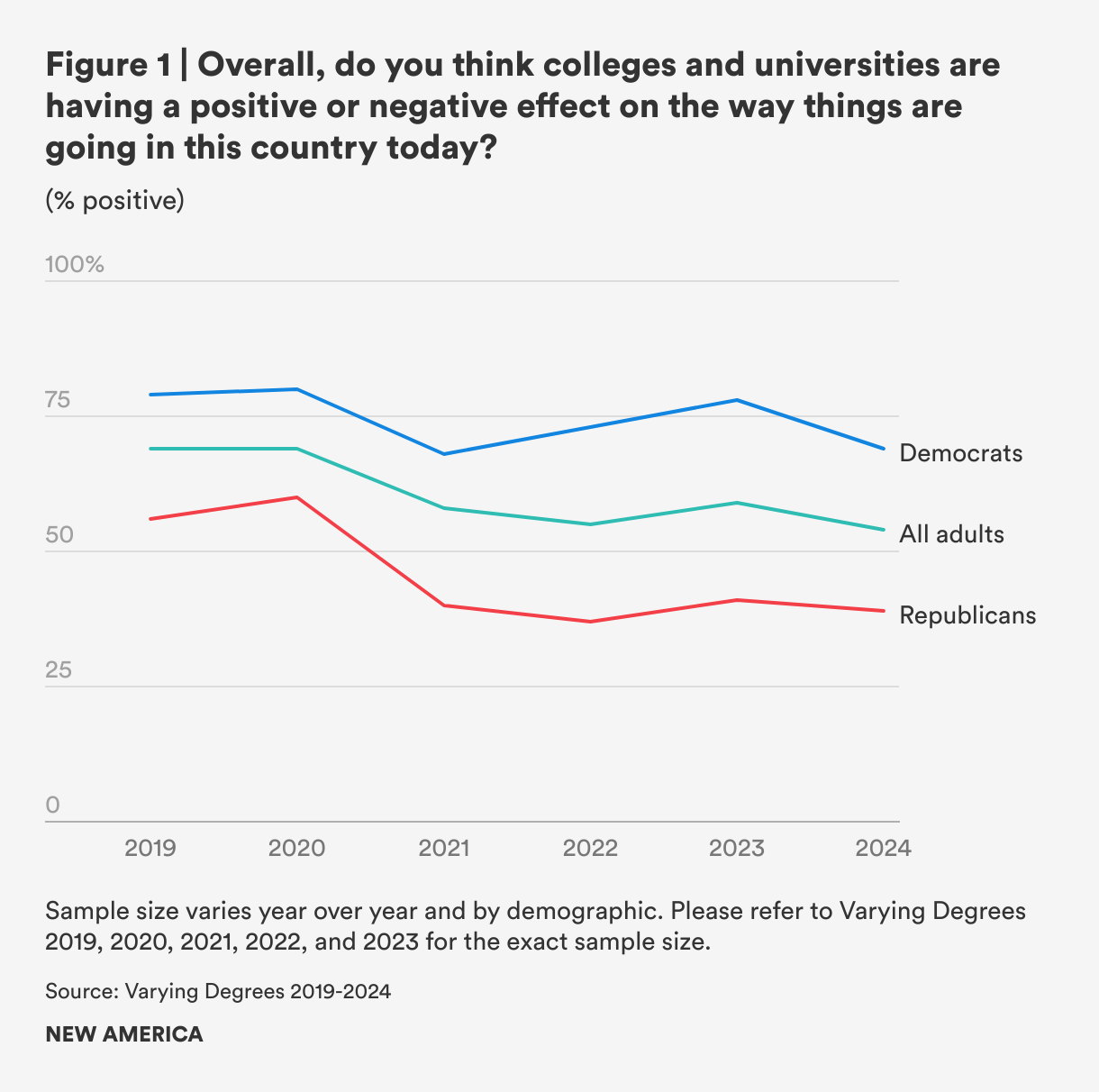
The decline in Americans’ confidence in the value of higher education is shown in many questions this year. Just half of Americans (54 percent) think colleges and universities are having a positive impact on the ways things are going in the country today, dropping slightly from 59 percent in 2023. There has always been a gap between Democrats and Republicans in their response to this question, and this gap has been widening since 2021 (see Figure 1). In 2024, 69 percent of Democrats, compared to 39 percent of Republicans, think colleges and universities are having a positive impact.
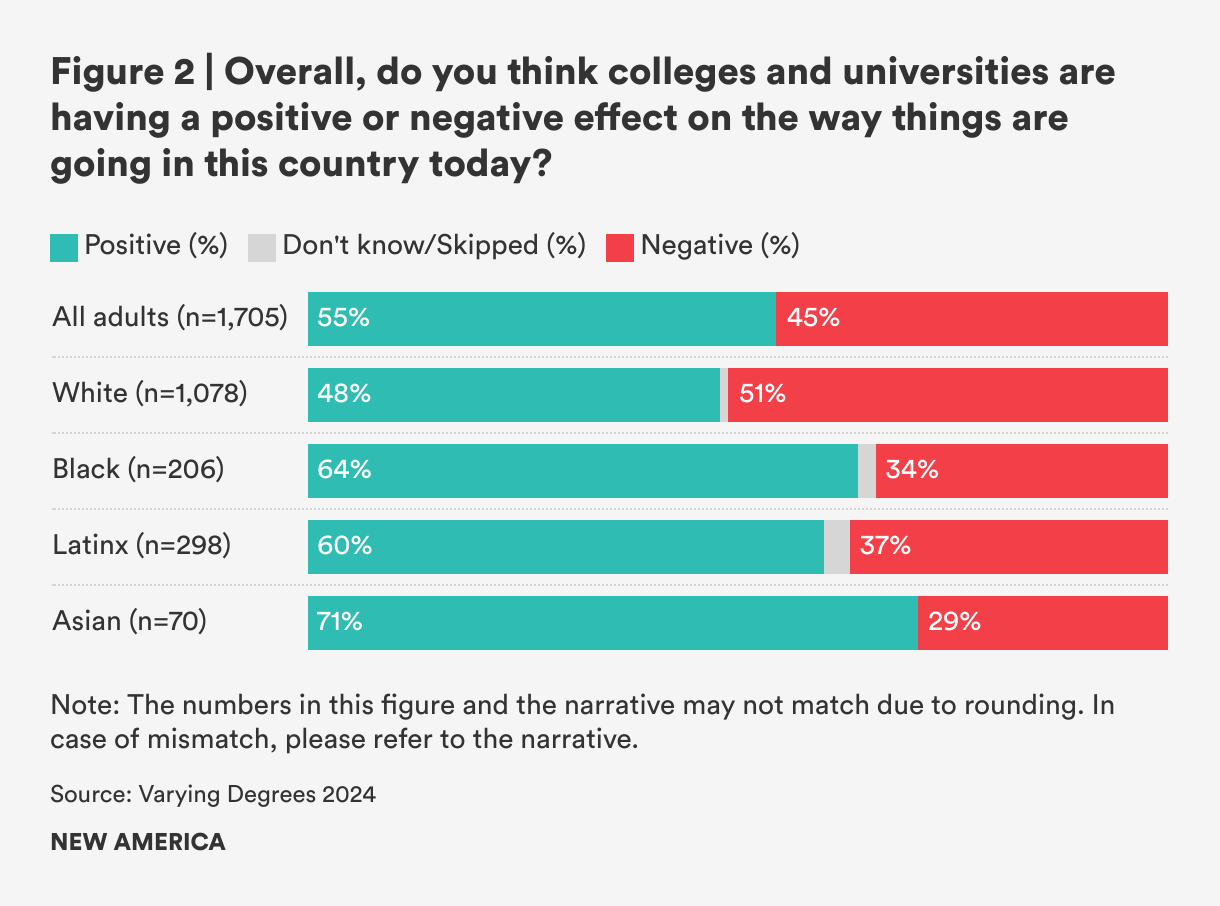
There is also a gap between how white Americans and people of color perceive the impact of colleges and universities. While only around half of white Americans think colleges are having a positive impact, 64 percent of Black, 60 percent of Latinx, and 71 percent of Asian Americans think so (see Figure 2).
Americans continue to be unhappy overall with the direction of higher education in this country. While the number fluctuated and has trended slightly upward since 2017, a majority of Americans still do not believe higher education is fine how it is. This year, the number of Americans who agree that higher education is fine declined five percentage points from 2023, to 36 percent. Democrats and Republicans, who do not often see eye to eye, turn out to be aligned on this question: only 36 percent of Democrats and 39 percent of Republicans agree (see Figure 3). As shown in the figure, the alignment between Democrats and Republicans is a more recent trend, starting in 2022.
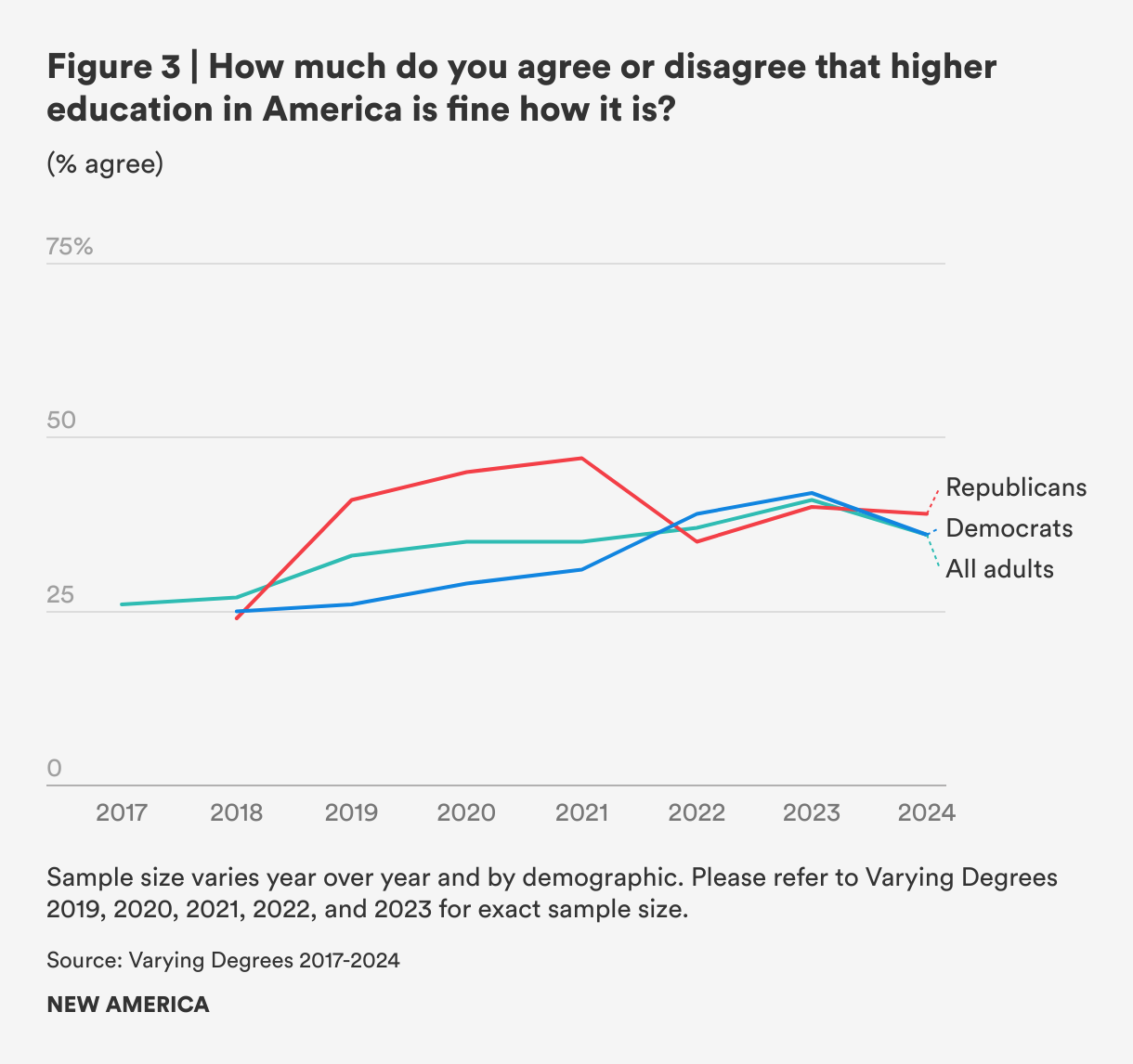
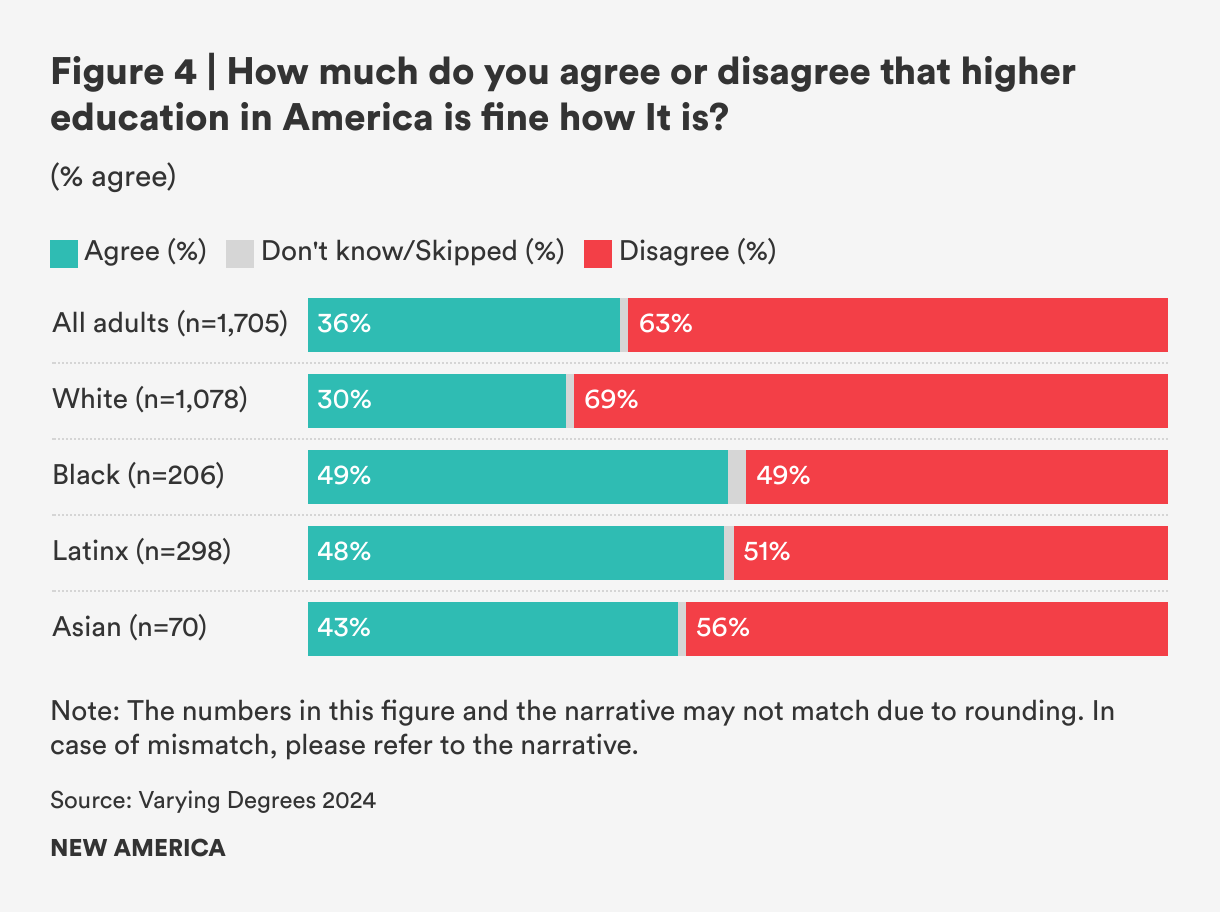
White Americans and other groups, on the other hand, differ significantly on this question. While only 30 percent of white Americans agree with the statement, nearly half of Black and Latinx and 43 percent of Asian Americans agree. Like the alignment between Democrats and Republicans, the difference between white Americans and people of color on this question first appeared in 2022 (see Figure 4).
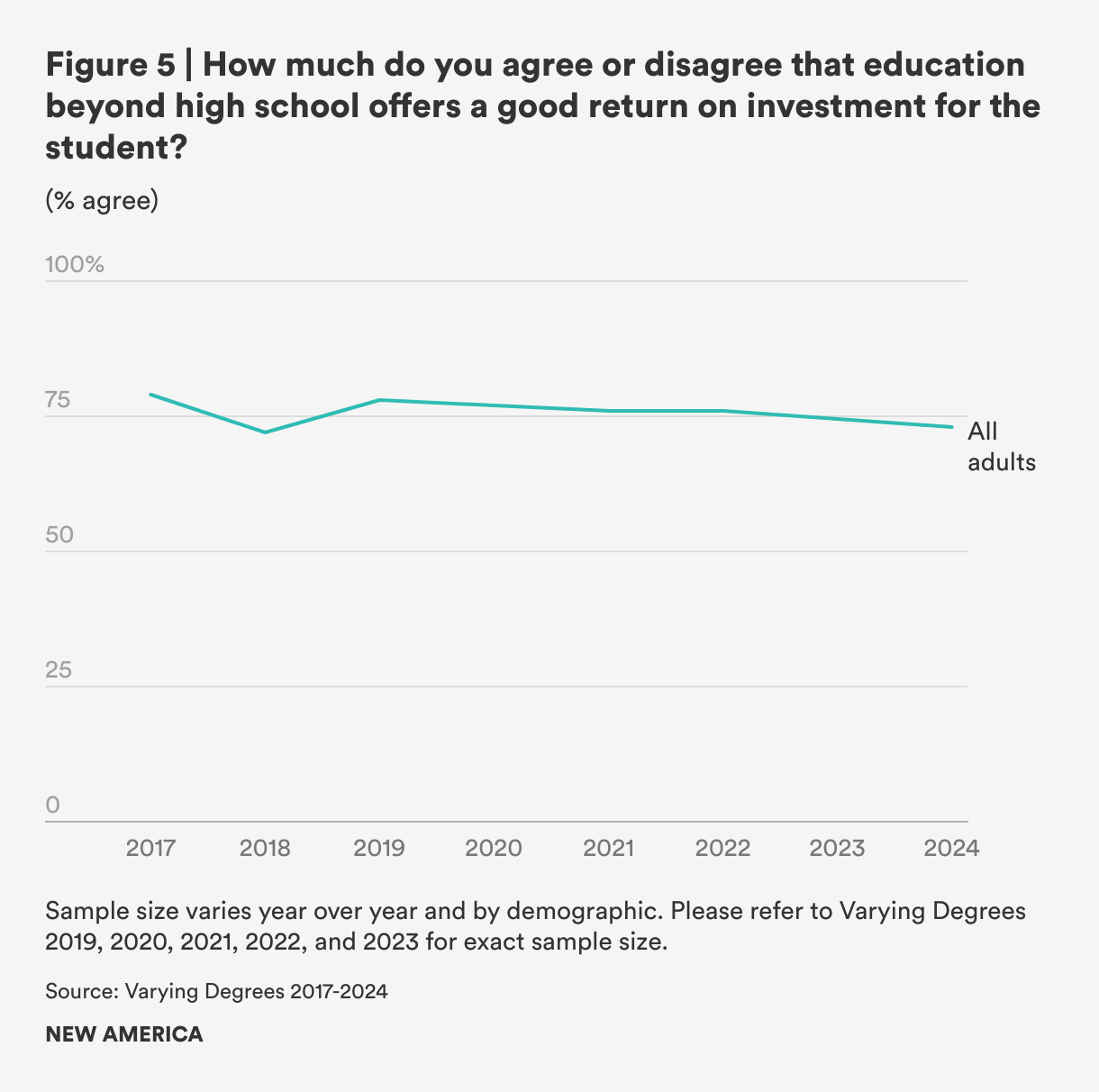
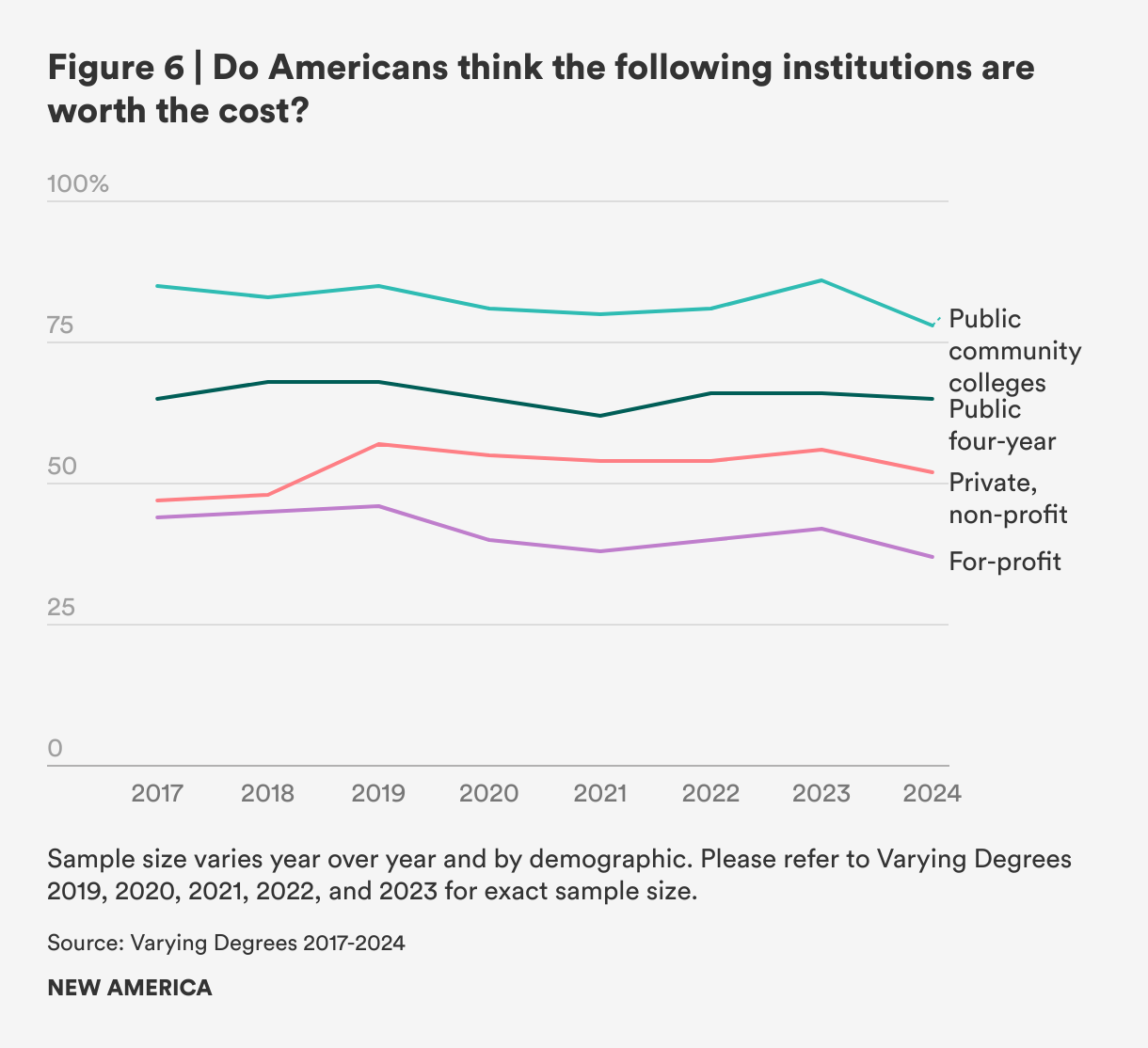
Three in four Americans think higher education still offers a good return on investment for students; however, this number has been on a downward trend since 2019 (see Figure 5). And even when a majority still think public higher education is still worth the cost, all sectors of higher education, from community colleges to for-profit institutions, have experienced a decline in this number since 2019 (see Figure 6).
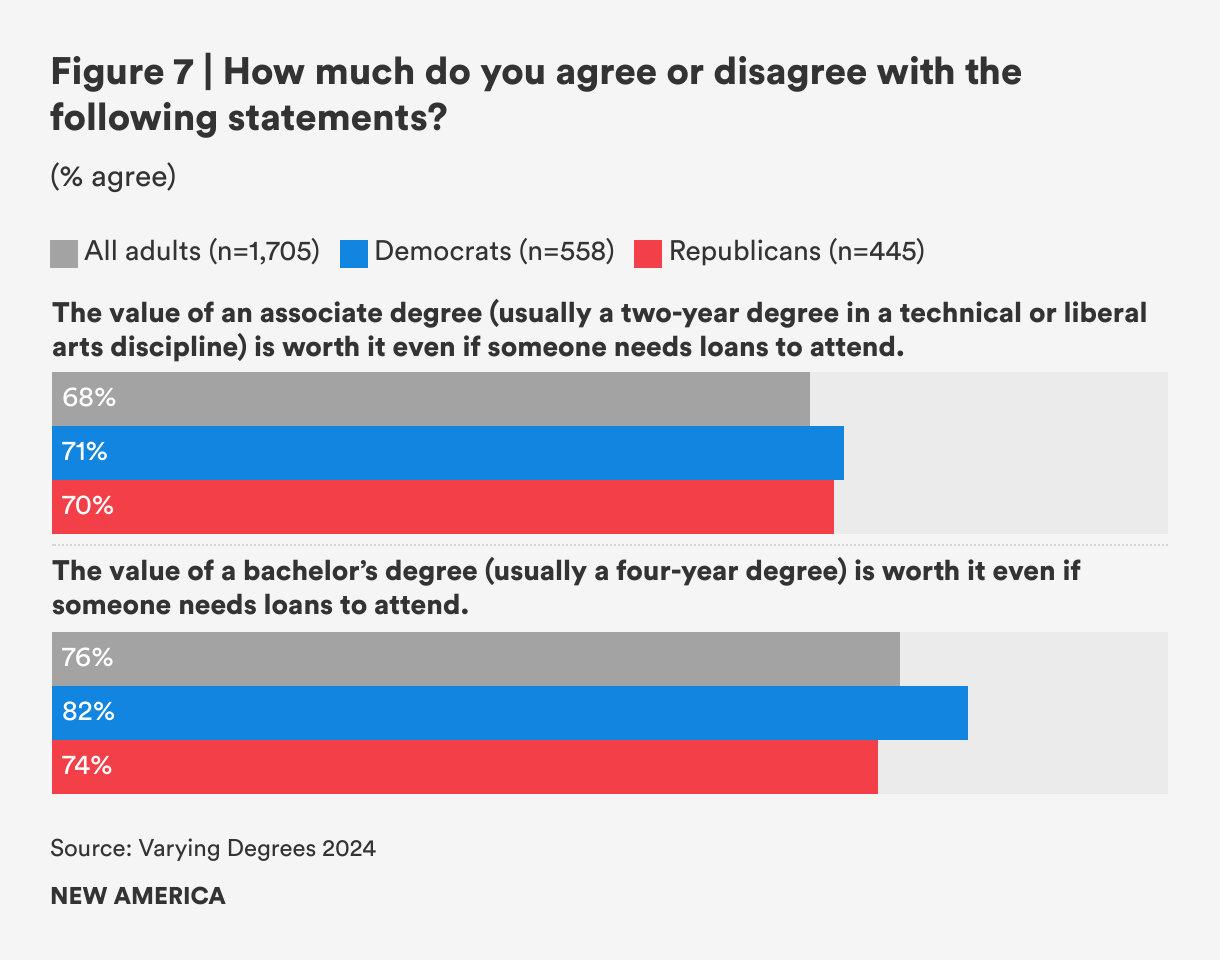
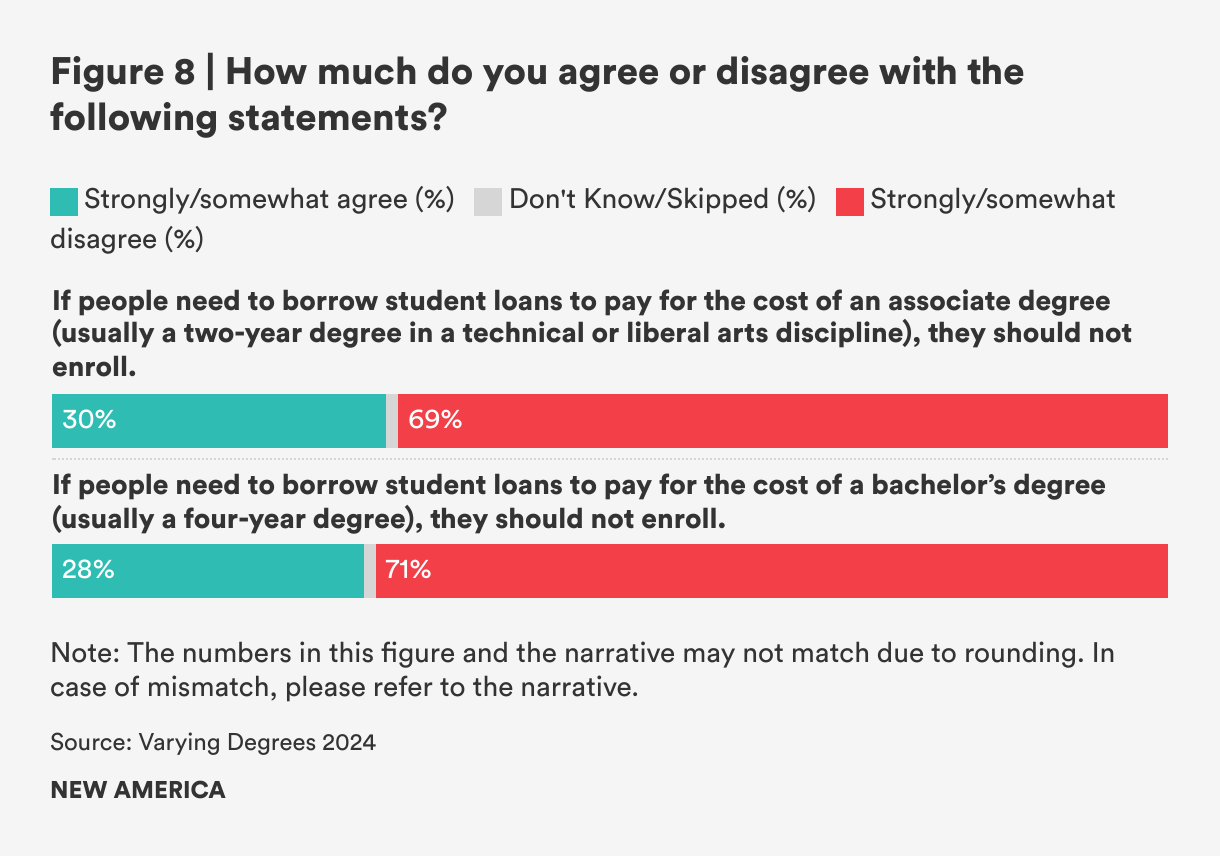
For the first time this year, we asked whether the value of an associate and bachelor’s degree is worth it, even if students need to borrow: 68 and 76 percent of Americans, respectively, agree it is (see Figure 7). A majority of both Democrats and Republicans also agree with these statements. Only three in ten Americans think that individuals should not enroll in an associate (30 percent) or bachelor’s (28 percent) programs if they need to take out loans to do so (see Figure 8).
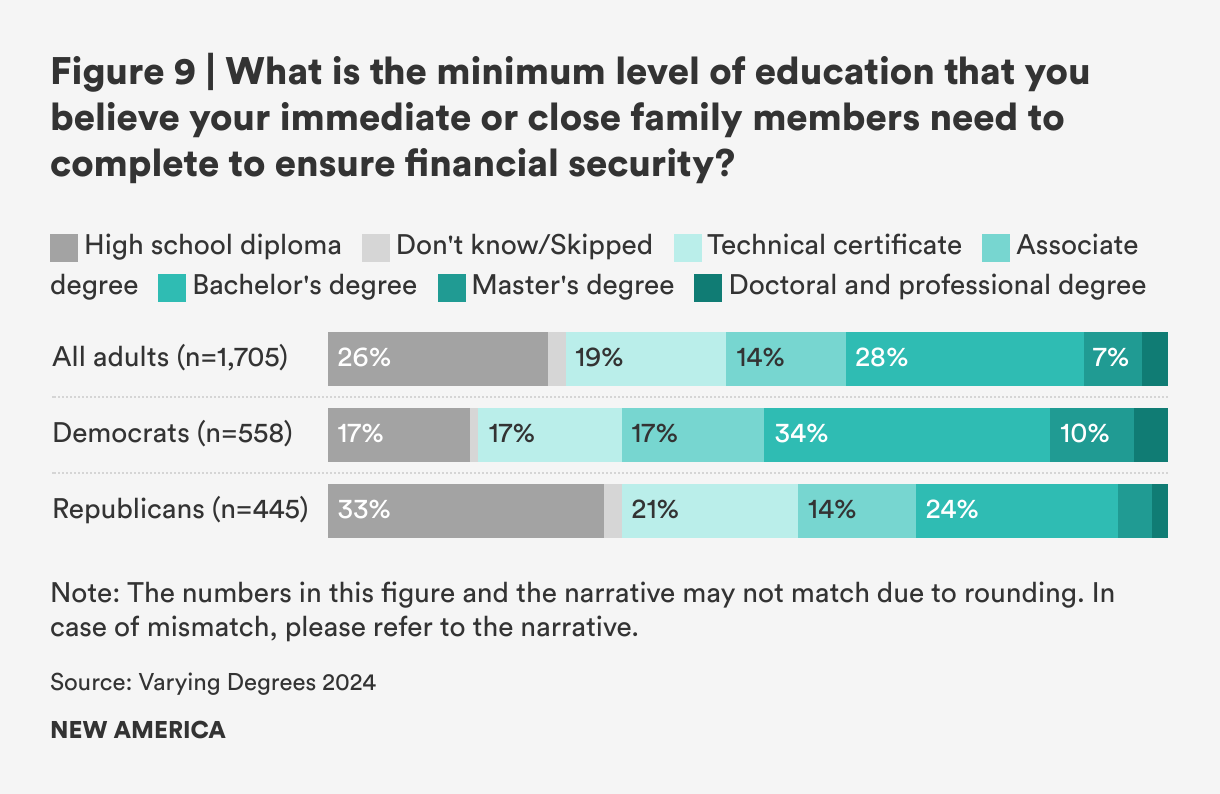
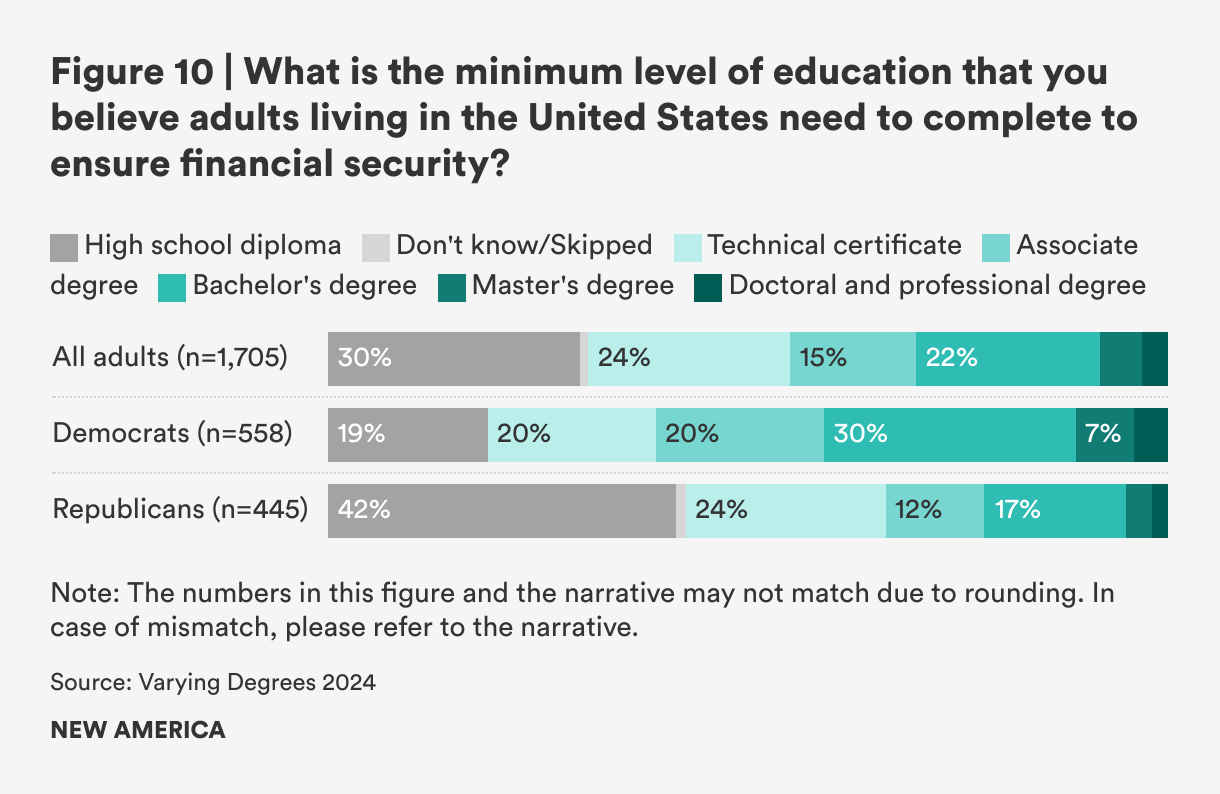
Probably one of the strongest indicators of how people feel about the value of a higher education degree personally is the finding that just one in four Americans believes that their children or family members and that less than a third believe that other adults in the U.S. need a high school diploma to ensure financial security (see Figures 9 and 10). Among those who would like their children and close family members to have at least some education after high school, a majority would like them to have at least a bachelor’s degree.
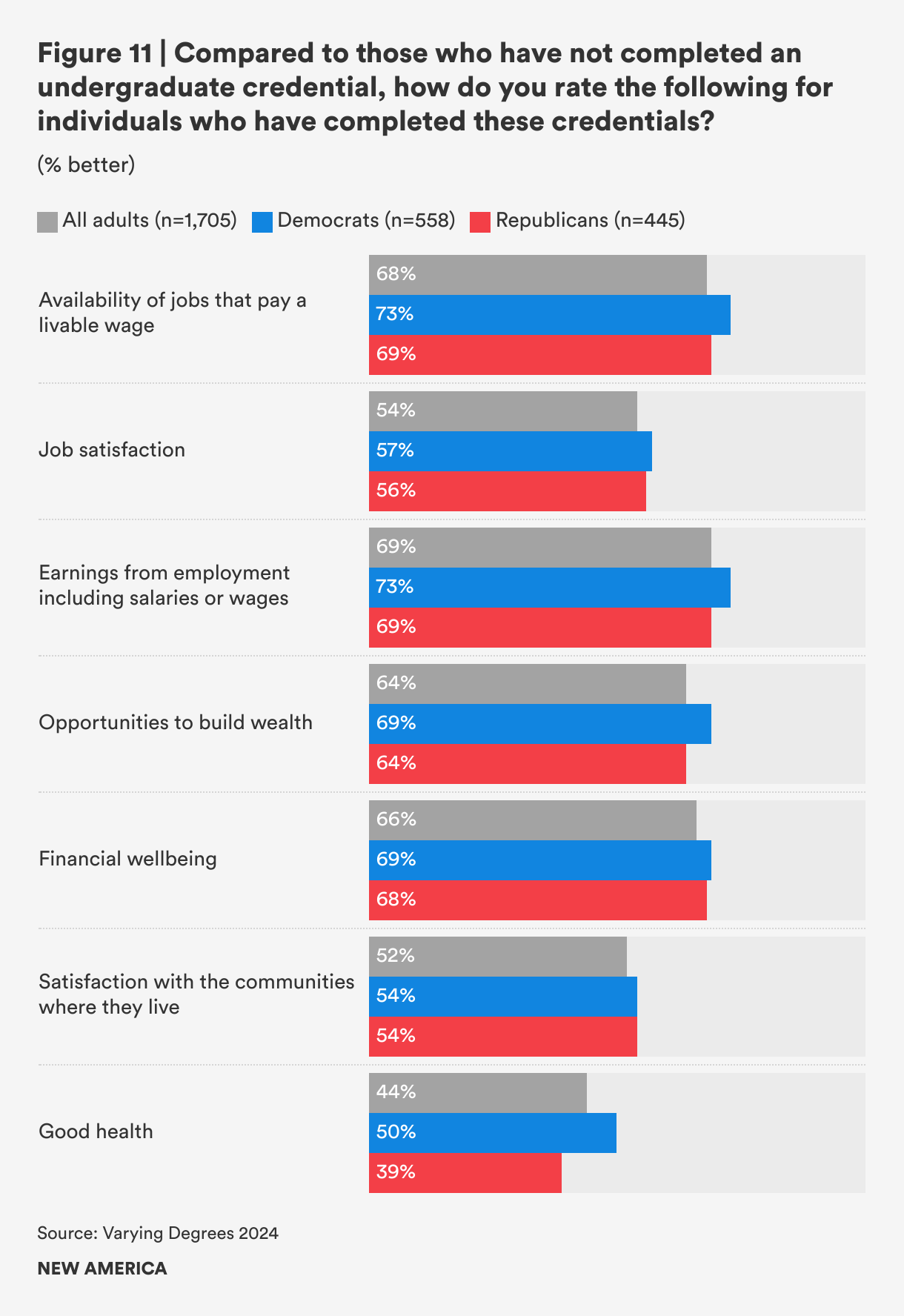
Americans might feel mixed about the value of higher education depending on the question, but they still believe there are overall benefits to individuals and society that higher credentials bring. Two-thirds agree that those with at least some higher education will have better access to good jobs, better earnings, and greater financial well-being (see Figure 11). Democrats and Republicans agree at similar rates.
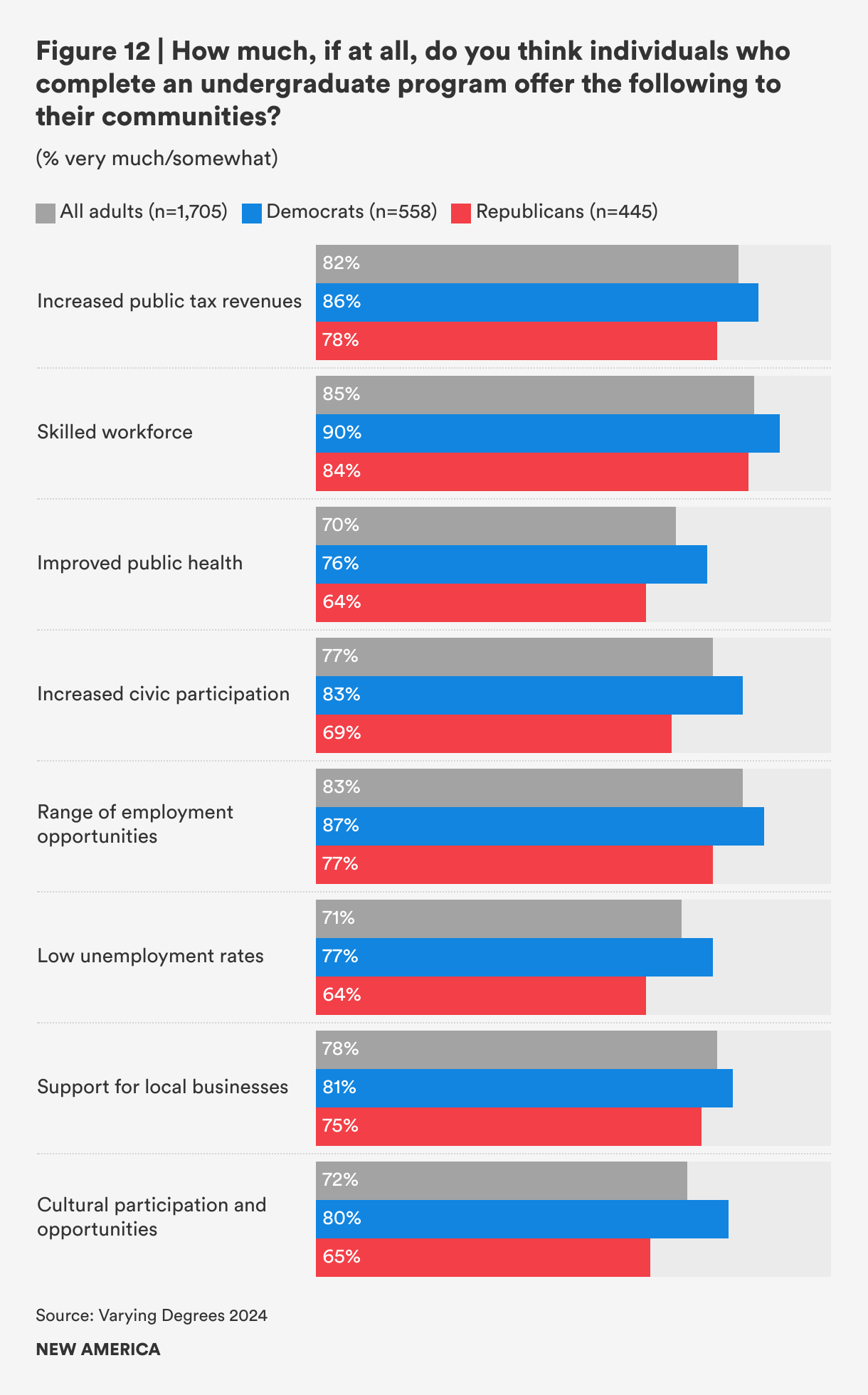
When it comes to the benefits that those with higher education might bring to their communities, more than 80 percent of Americans agree that they increase tax revenues, contribute to a skilled workforce, and create more jobs. Three in four believe that those with postsecondary credentials vote and volunteer more often and offer greater support for local businesses (see Figure 12). And while there is some gap in their responses, a majority of both Democrats and Republicans agree with these statements.
Affordability
The latest analysis of the cost of college conducted by College Board shows that when adjusted for inflation, tuition and fees have actually gone down in recent years. However, costs are still considered at an all-time high across all sectors.7 Americans have been concerned about college costs for decades: a Pew survey in 2011 shows that three in four Americans did not think higher education was affordable.8 The decline in public confidence for higher education is reflected in this frustration with the rising cost. This year, we dug deeper to better understand how Americans perceive college affordability.
Nine in ten Americans believe that people are choosing not to enroll in higher education because they cannot afford the price of college. Eight in ten Americans think that this lack of affordability is the biggest barrier to enrollment for low-income students and those who are the first in their families to attend college. Seven in ten believe cost presents the biggest barrier for students of color (see Figure 13).
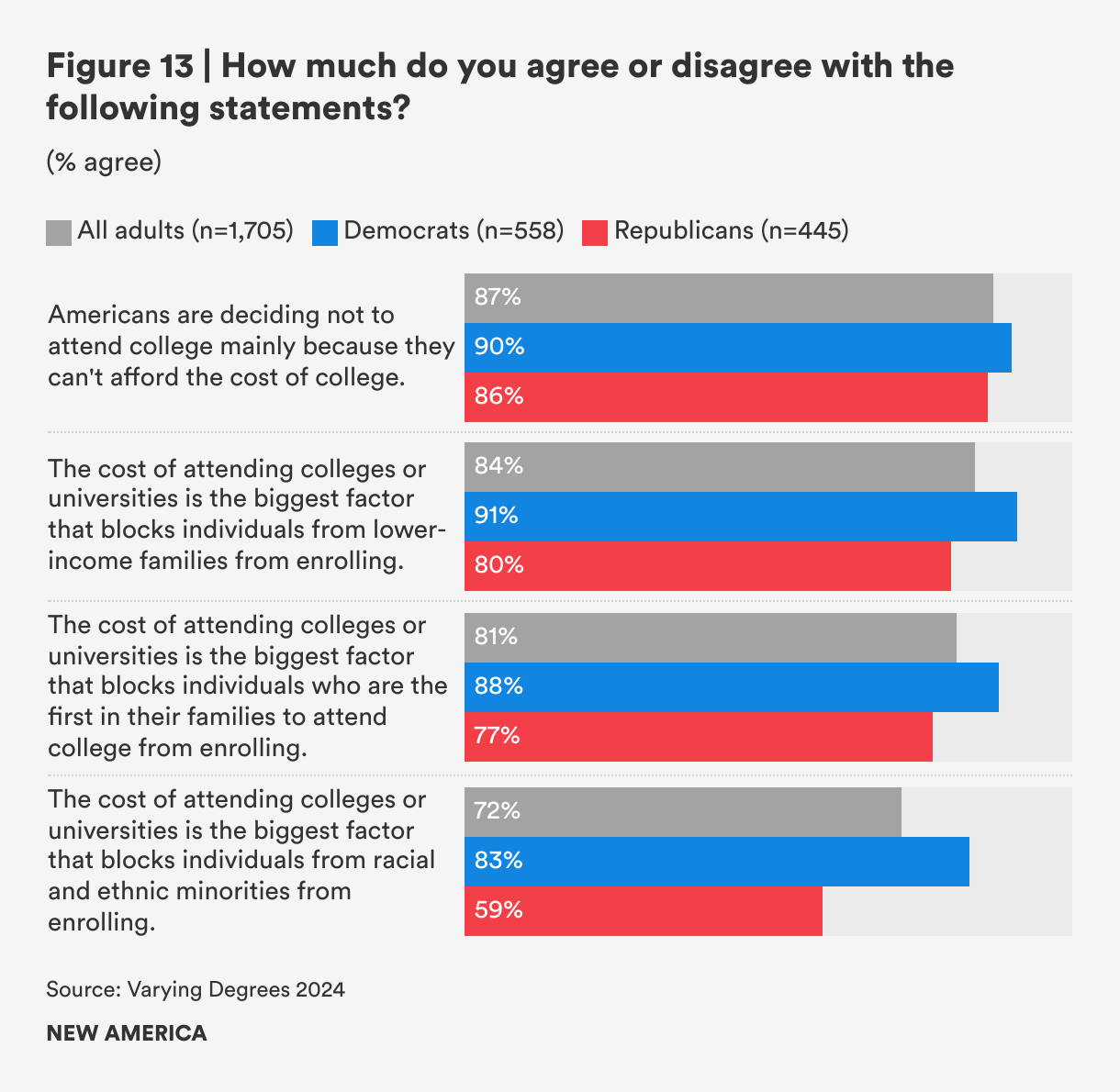
A majority of Democrats and Republicans agree that cost is the biggest barrier to enrollment for both low-income (91 percent of Democrats and 80 percent of Republicans) and first-generation students (88 percent of Democrats and 77 percent of Republicans). But when it comes to students of color, the split grows larger between the two parties: 83 percent of Democrats agree, compared to only 59 percent of Republicans.
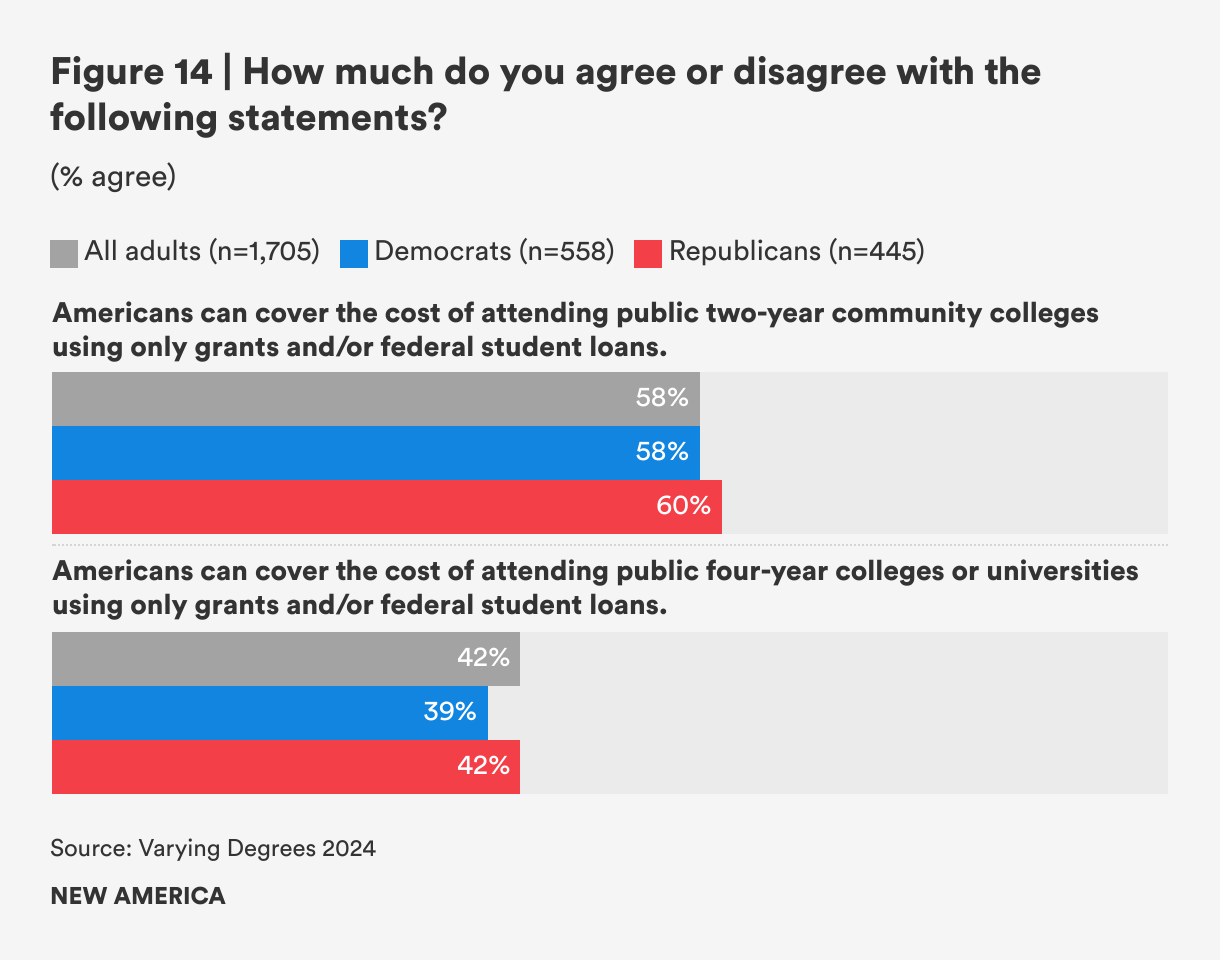
Nearly 60 percent of Americans believe that students can cover the cost of attending a two-year community college using only grants and federal student loans, but just 42 percent think students can do so at a four-year college (see Figure 14). Democrats and Republicans are similarly aligned on these questions.
Americans Believe Access to High-Quality and Affordable Higher Education is Unequal
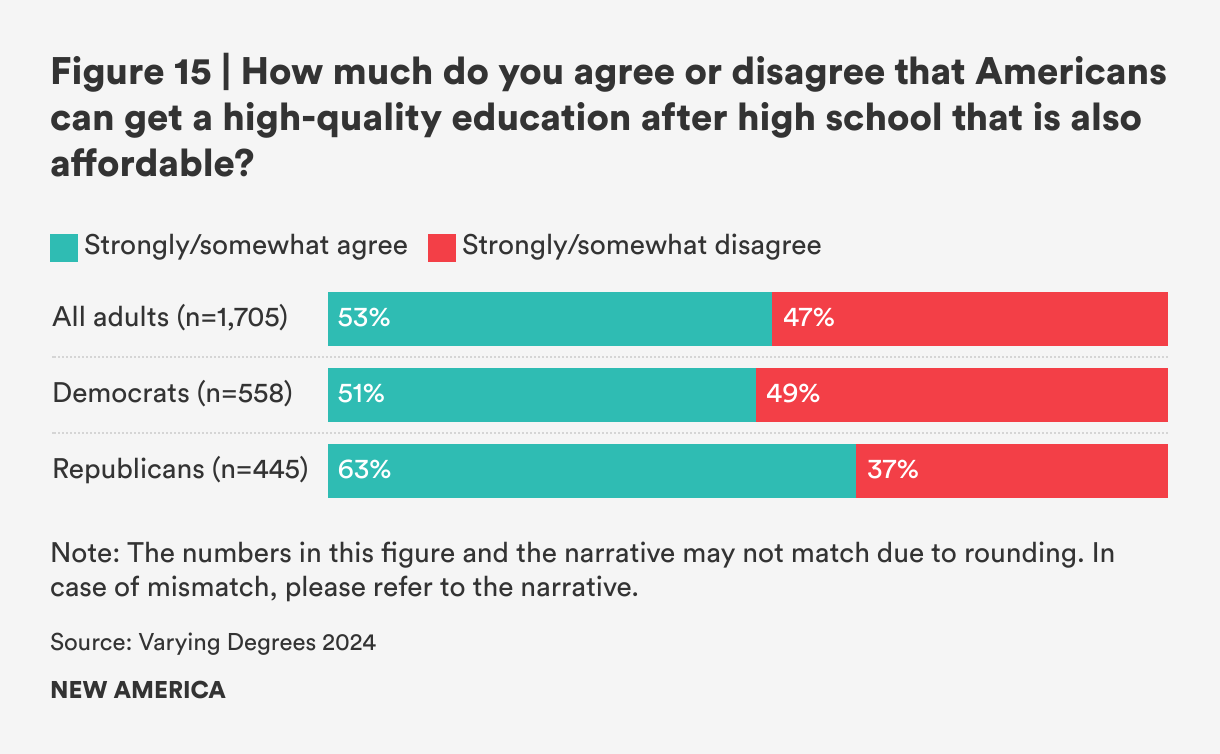
As in previous years, Americans are split on whether someone can get a high-quality education after high school that is also affordable. About half (53 percent) agree that it is possible. Here, Republicans (63 percent) are more likely than Democrats (51 percent) to agree (see Figure 15). This partisan gap has remained consistent since 2019.
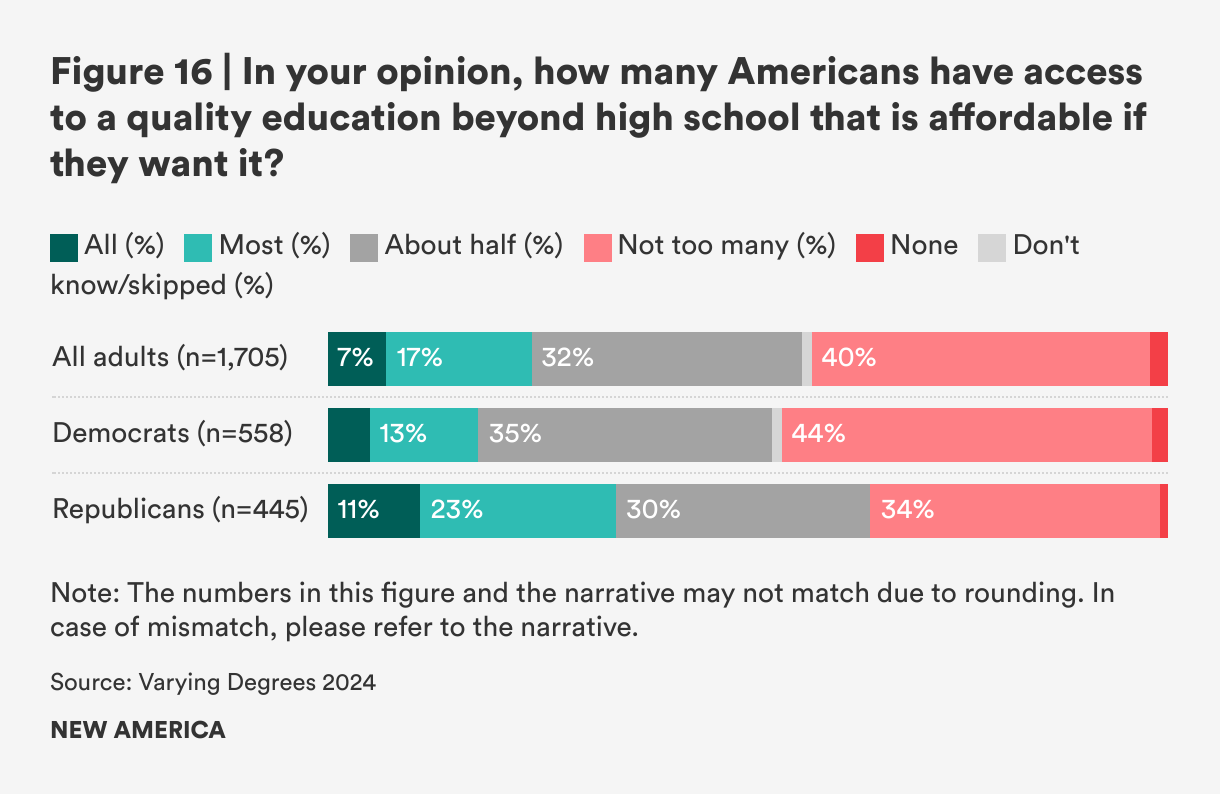
This year, the survey asked Americans to gauge how many people can access quality and affordable higher education if they want it: 25 percent said all or most people, 32 percent said half, and 42 percent said not too many, or none can (see Figure 16). Twice as many Republicans (34 percent) as Democrats (18 percent) believe that most people can access high-quality and affordable higher education if they want to enroll. Having said that, a third of Republicans still think that affordable higher education is inaccessible for most people.
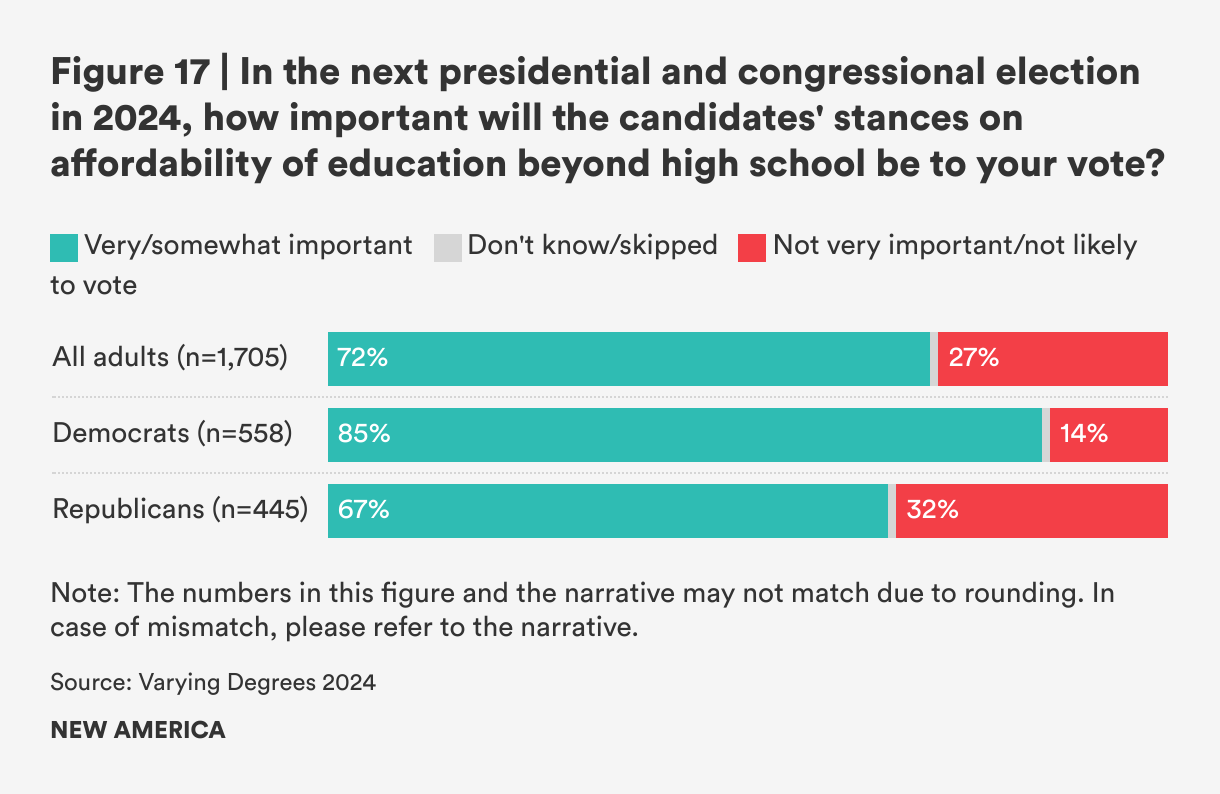
As the 2024 presidential election nears, 71 percent of Americans indicate that candidates’ stances on higher education affordability will be important in determining which candidate they support. Democrats (85 percent) feel the strongest about this, but a majority of Republicans (66 percent), Independents (66 percent), and those who do not affiliate with any of these political descriptors (60 percent) also see the candidates’ positions on college affordability as important (see Figure 17).
Americans’ Perceptions Versus Reality on How Students Can Afford Higher Education
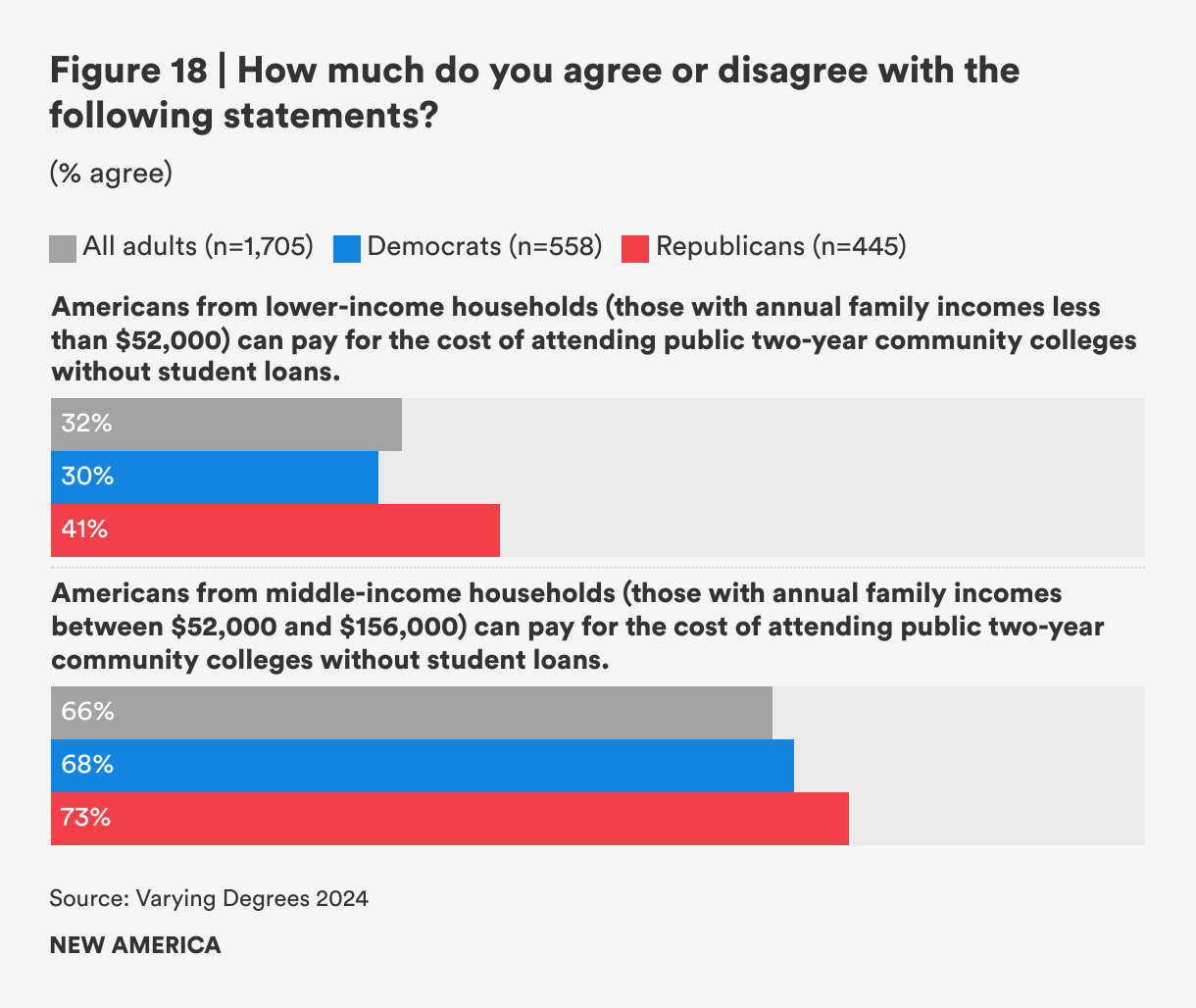
We added questions this year that measure the perceived affordability of two-year and four-year colleges for lower- and middle-income families. One in three Americans believe that those from lower-income households can afford the cost of enrolling in a community college without taking out student loans, compared to two-thirds who believe the same for those from middle-income households (see Figure 18).
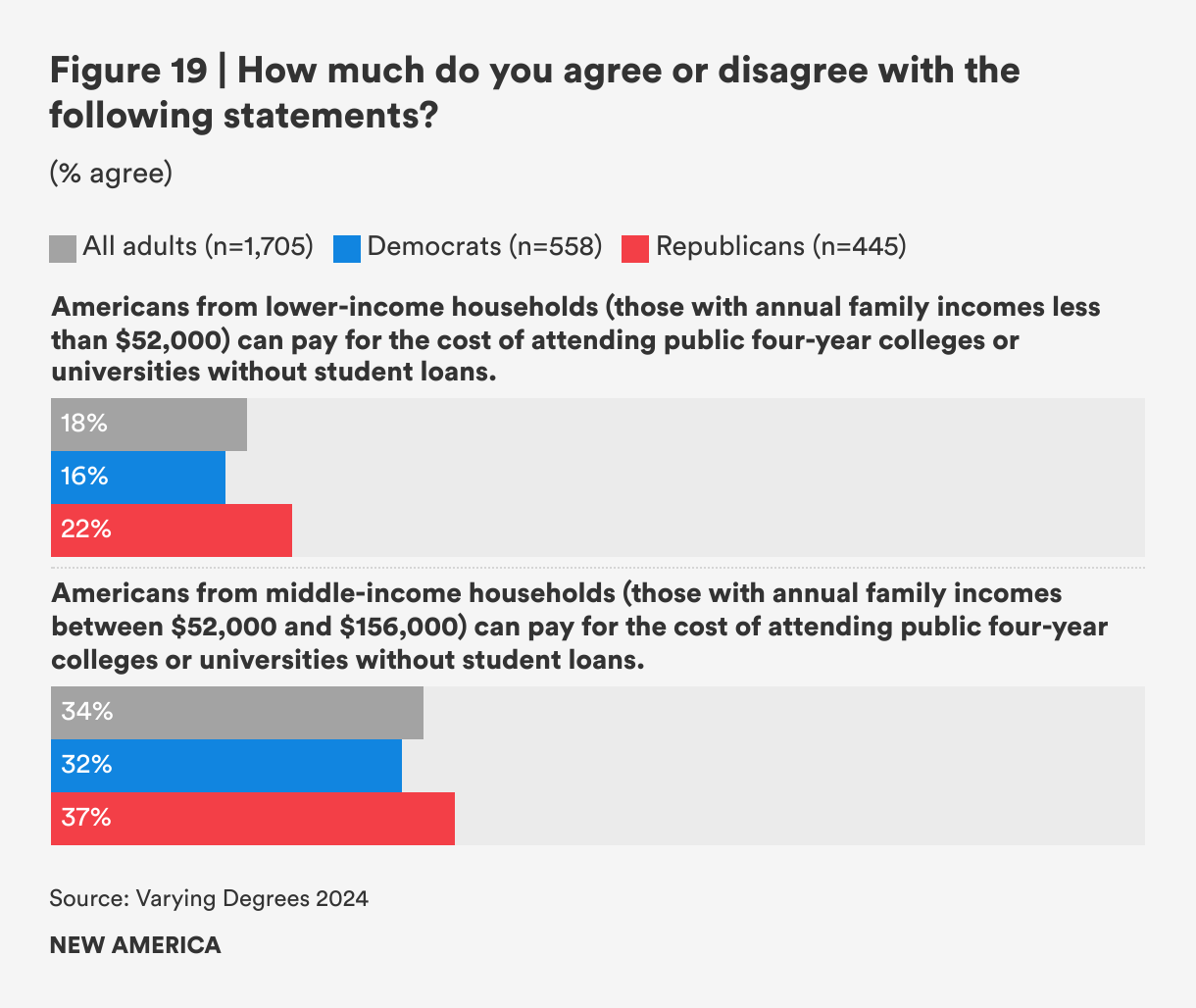
Americans are less confident about students’ ability to afford the cost of attending public four-year colleges without using student loans. Just 18 percent believe that students from lower-income households can afford to attend without loans, compared to 34 percent for those from middle-income households (see Figure 19).
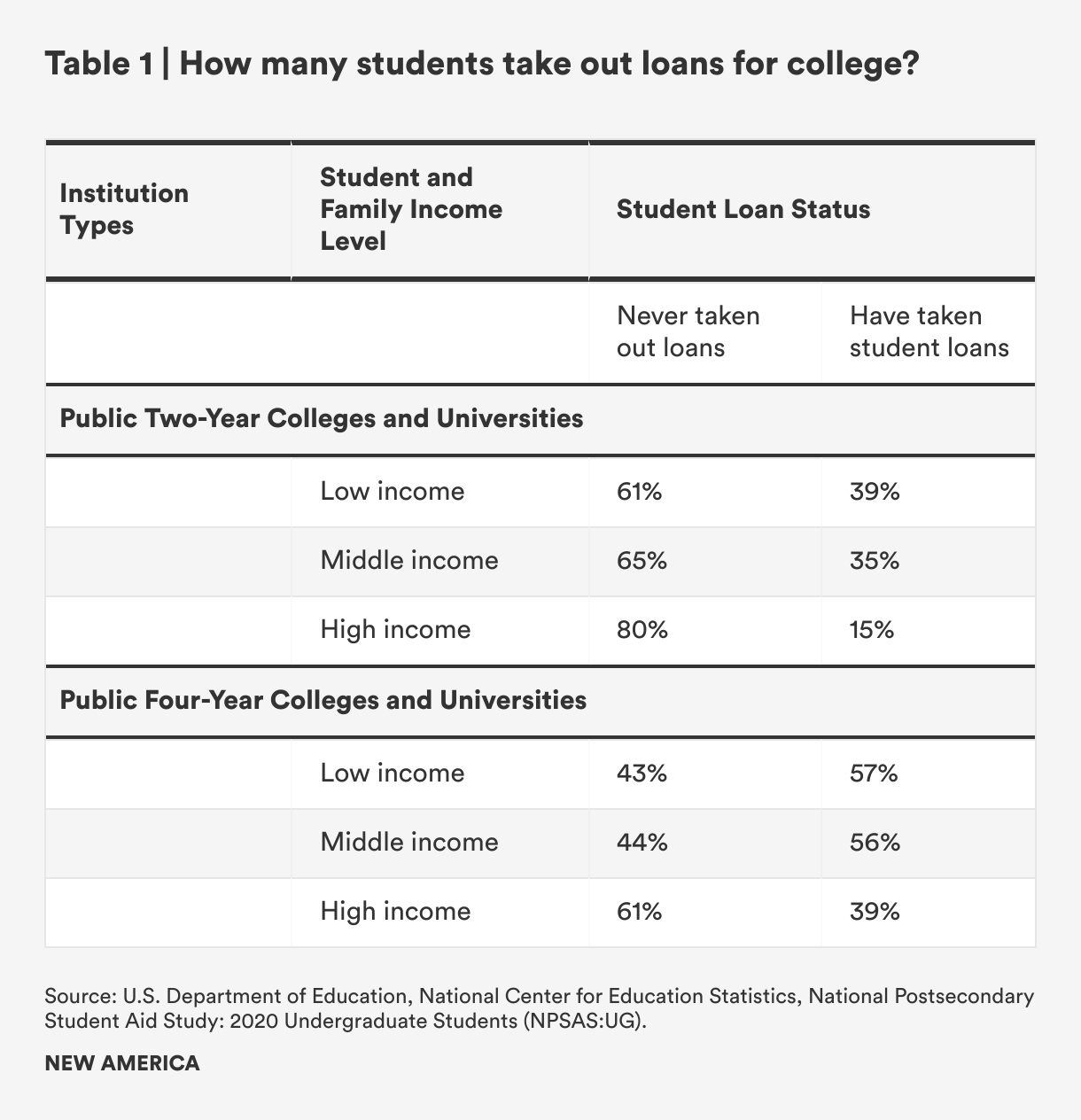
In reality, the latest data from the National Postsecondary Student Aid Survey show that students from lower- and middle-income families rely on loans to cover the cost of public colleges at similar rates to each other.9 In 2020, 39 percent of low-income students and 35 percent of middle-income families at community colleges had taken out student loans, compared to 57 percent of low-income students and 56 percent of middle-income students at public four-year colleges (see Table 1). The data show that even with grants and scholarships, many low- and middle-income students still have to rely on student loans to enroll.
Citations
- Jennifer Ma and Matea Pender, Trends in College Pricing and Student Aid 2023 (New York: College Board, 2023), https://research.collegeboard.org/media/pdf/Trends%20Report%202023%20Updated.pdf.
- Paul Taylor, Kim Parker, Richard Fry, D’Vera Cohn, Wendy Wang, Gavriel Velasco, and Daniel Dockterman, Is College Worth It? College Presidents, Public Assess Value, Quality and Mission of Higher Education (Washington, DC: Pew Research Center, May 2011), https://www.pewresearch.org/wp-content/uploads/sites/3/2011/05/higher-ed-report.pdf.
- U.S. Department of Education, National Center for Education Statistics, National Postsecondary Student Aid Study: 2020 Undergraduate Students (NPSAS:UG), https://nces.ed.gov/datalab/powerstats/table/jaqjfo.
Funding
Because concerns about college affordability are so pressing, we asked several questions about how higher education should be funded, and by whom. Over the past seven years, Varying Degrees has asked Americans who should fund higher education: the government, because it is good for society; or students and their families, because they personally benefit. This question has seen a decline, since we started asking, in those believing the government should be responsible, particularly since 2020. This year just over half of Americans—56 percent—believe the government has the primary responsibility for funding higher education, with 43 percent believing individuals should fund higher education because they personally benefit (see Figure 20).
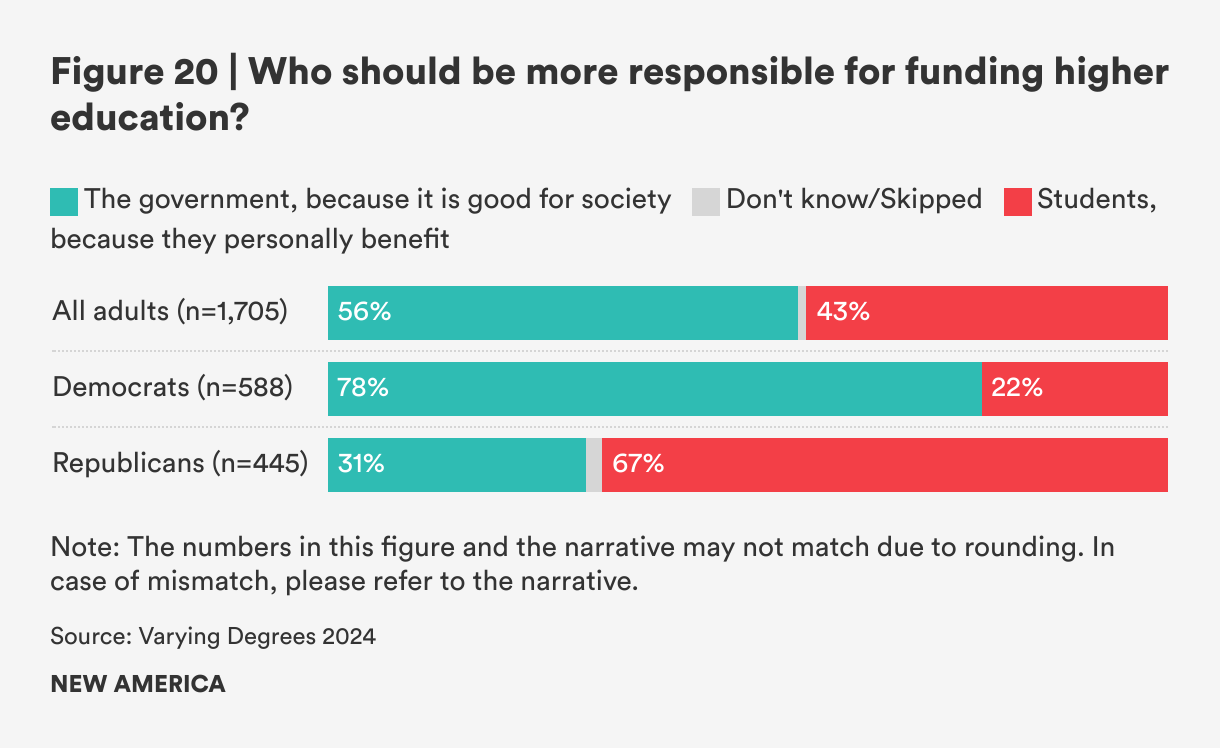
There has always been a sharp partisan divide in the response to this question, and this year was no exception. Nearly eight out of ten Democrats believe that the government should fund higher education because it is good for society, whereas nearly seven out of ten Republicans believe that students should fund higher education because they personally benefit.
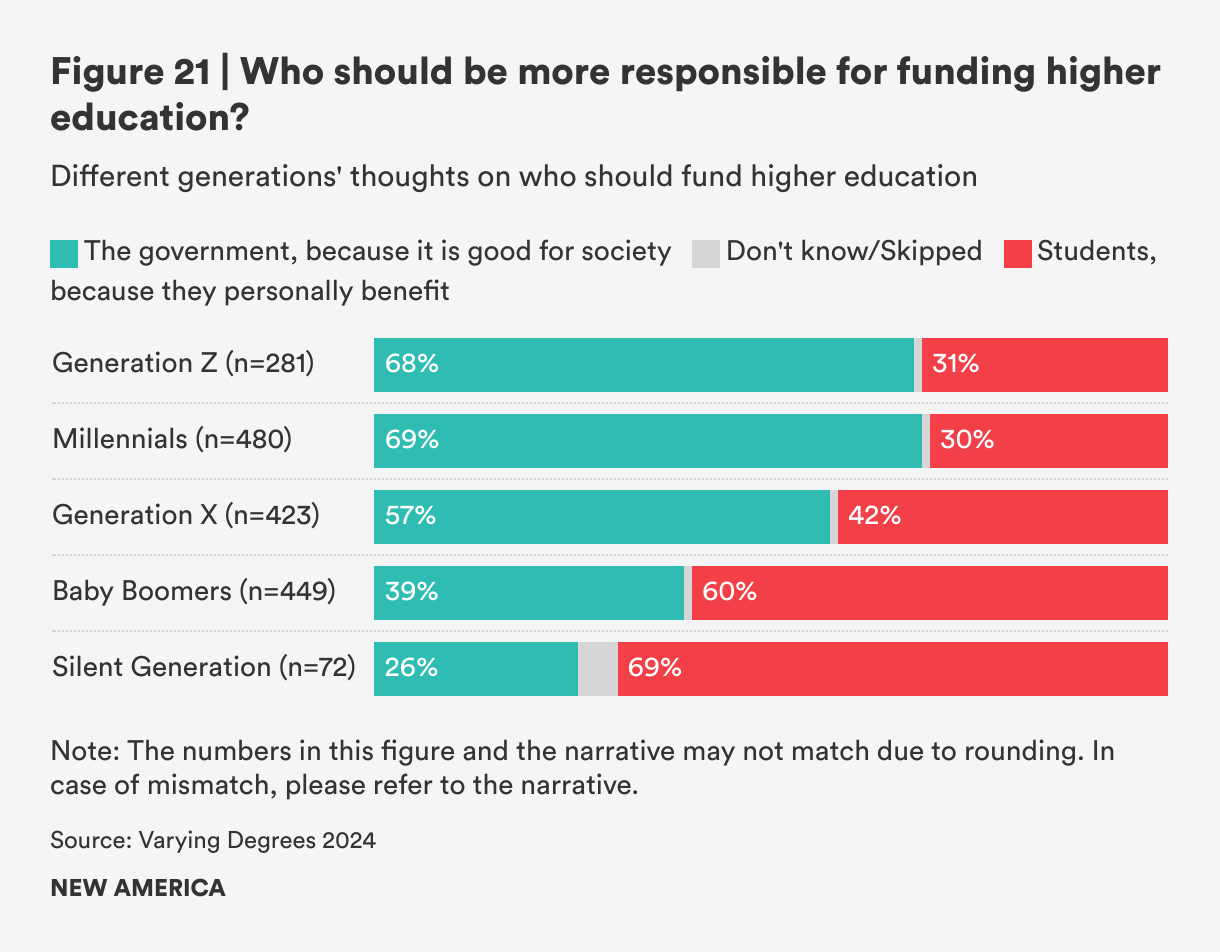
There is also a divide between Baby Boomers and other generations. The majority of members of Generation Z, Millennials, and Generation X all believe that the government has the primary responsibility for funding higher education; a majority of Baby Boomers believe that students do (see Figure 21).10
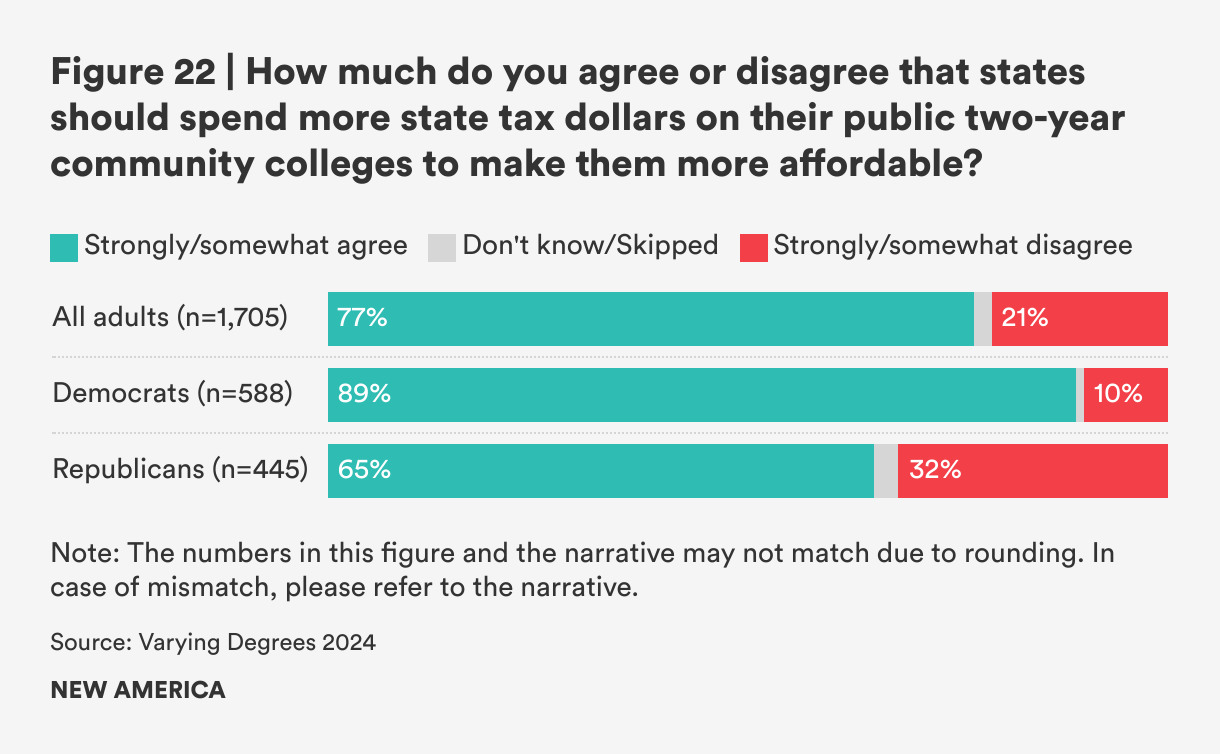
Interestingly, despite the declining belief that the government should be the primary funder of higher education, about seven out of ten of Americans agree that states should spend more tax dollars on public two- and four-year colleges and universities because it is a public good. A majority of both Democrats and Republicans agree, though at different rates (89 percent of Democrats agree versus 55 percent of Republicans) (see Figure 22).
To understand with greater nuance where Americans think the responsibility for funding higher education should fall, we asked who should be mainly responsible for funding education after high school and who should be second-most responsible. Response options included: the federal government, state government, students and families through savings, and students and families through loans.
Answers to these questions reveal whether Americans view higher education as a collective good that should be funded by the government or an individual benefit. Just over a third of Americans (35 percent) believe that the federal government should be mainly responsible for funding higher education, and those respondents are likely the ones who drive the response that the second-most responsible funder should be state governments (40 percent). Whereas another third of Americans tend to have a more individualistic attitude with 33 percent saying the main funder should be students and families through earnings and savings. These respondents are likely among the 22 percent saying the secondary funder should be students and families through student loans (see Figure 23).
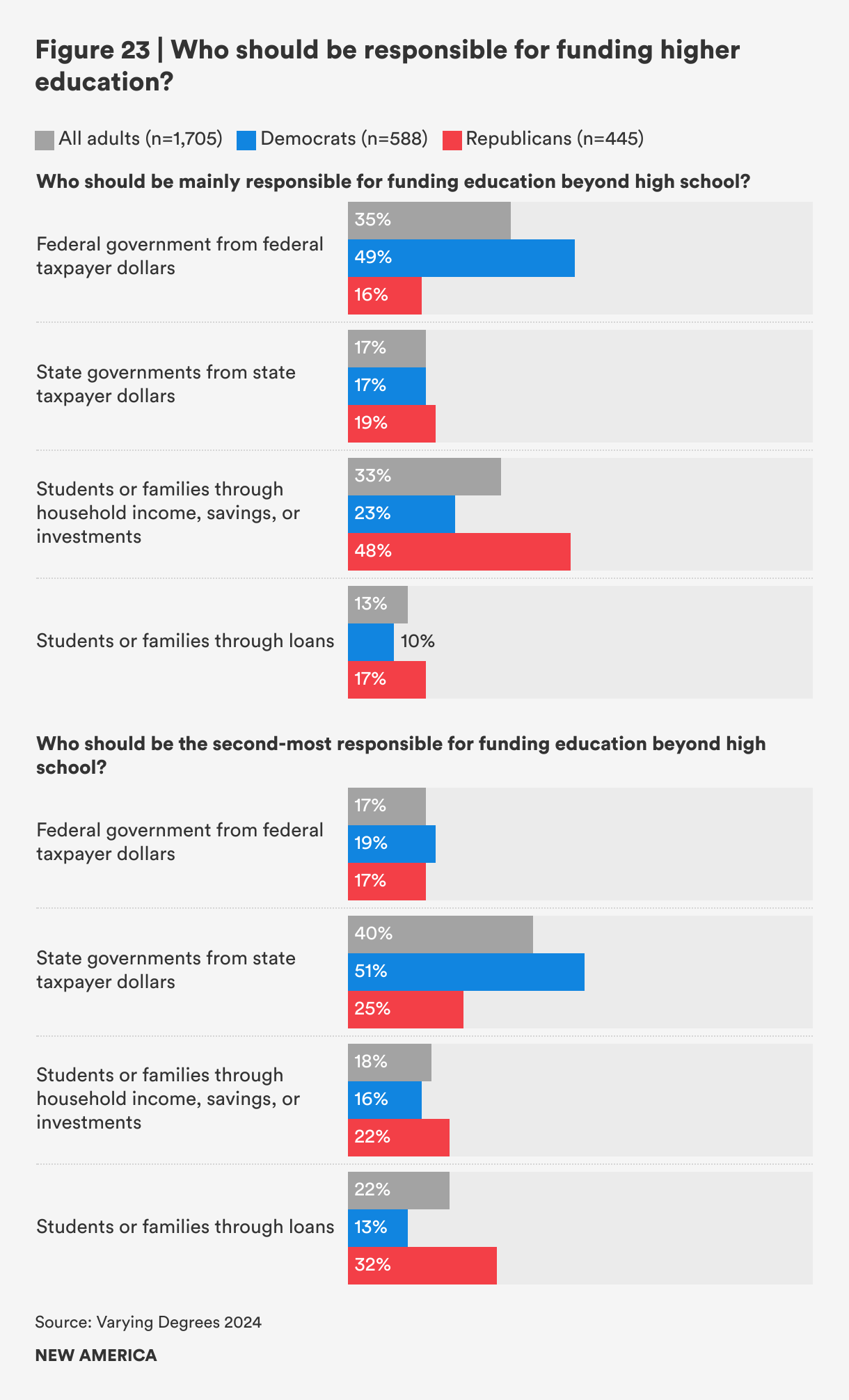
Like the previous question on who should fund higher education, this question on responsibility of funding shows a partisan divide. Democrats tend to have a collective benefit view of how higher education should be funded. Nearly half (49 percent) of Democrats believe the federal government is mainly responsible for funding higher education, with over half believing that the second funder should be state governments.
Republicans are more likely to have individualistic views. Nearly half of Republicans (48 percent) believe that students and families, through savings and earnings, should be mainly responsible for funding higher education. And a plurality of Republicans (32 percent) say the secondary funder should be students and families through loans.
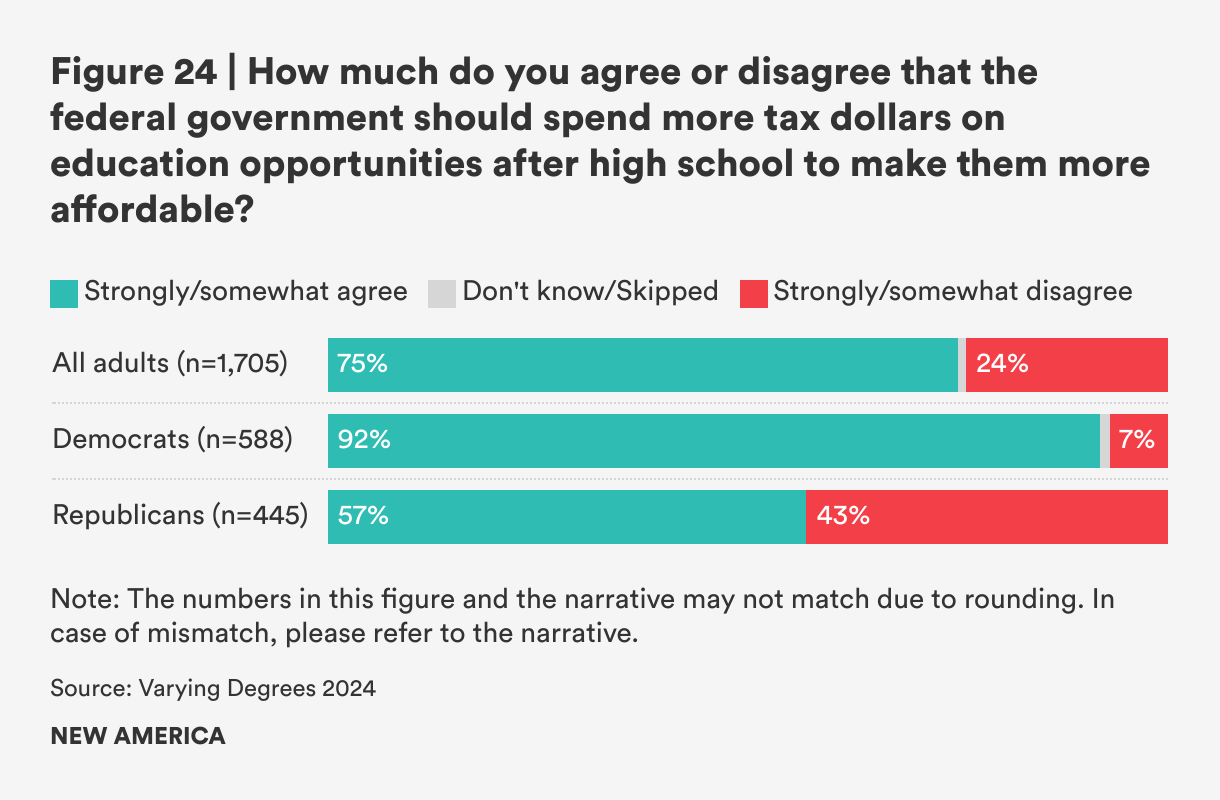
Regardless of who Americans think should fund higher education, a majority (75 percent) believe that the federal government should spend more tax dollars on education opportunities after high school to make them more affordable. And while Democrats and Republicans have divergent views on who should fund higher education, a majority of Americans from both parties agree that federal money should be used to lower the cost of college, albeit at different rates (92 percent of Democrats agree, compared with 57 percent of Republicans) (see Figure 24).
Americans are Comfortable Making Community College Tuition-Free
During the last two years of the Obama administration, the idea of the federal government funding a free college option in partnership with states took hold. Over the years, Congress has explored the idea of free college, coming close to passing legislation on this as part of President Biden’s Build Back Better framework.11 This policy idea could help more Americans afford college.
According to our survey, a majority of Americans (60 percent) believe that decreased funding from state governments is a major reason why the cost of attending public colleges and universities has increased, highlighting the need for federal and state governments to work together to improve college affordability. In our survey, Americans broadly support having the government provide funding to make public two-year colleges free. However, they are more divided about having the government do so for four-year public colleges and universities.
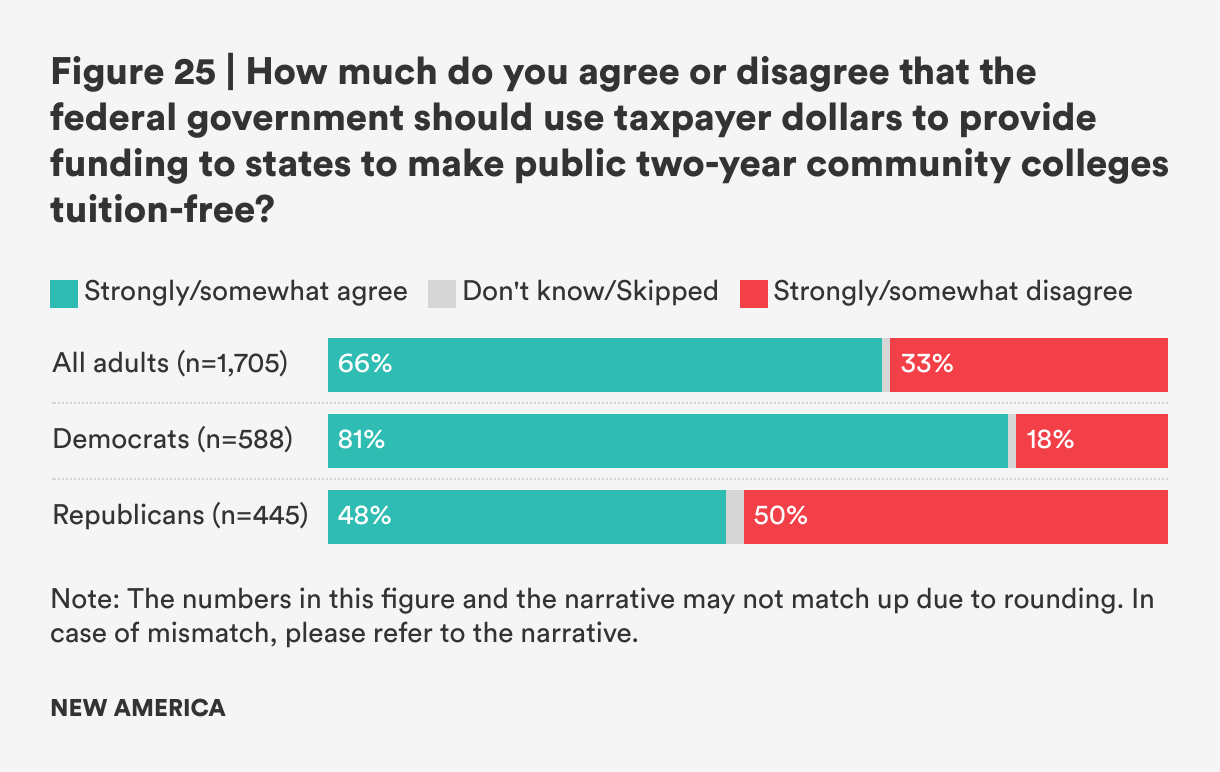
This year we asked whether survey respondents agree that the federal government should provide funding to states to make public two-year colleges tuition-free. Free community college receives fairly broad support—approximately two-thirds of Americans agree that the federal government should help fund a free community college option. Democrats are far more supportive of the idea (81 percent) than Republicans (48 percent) (see Figure 25).
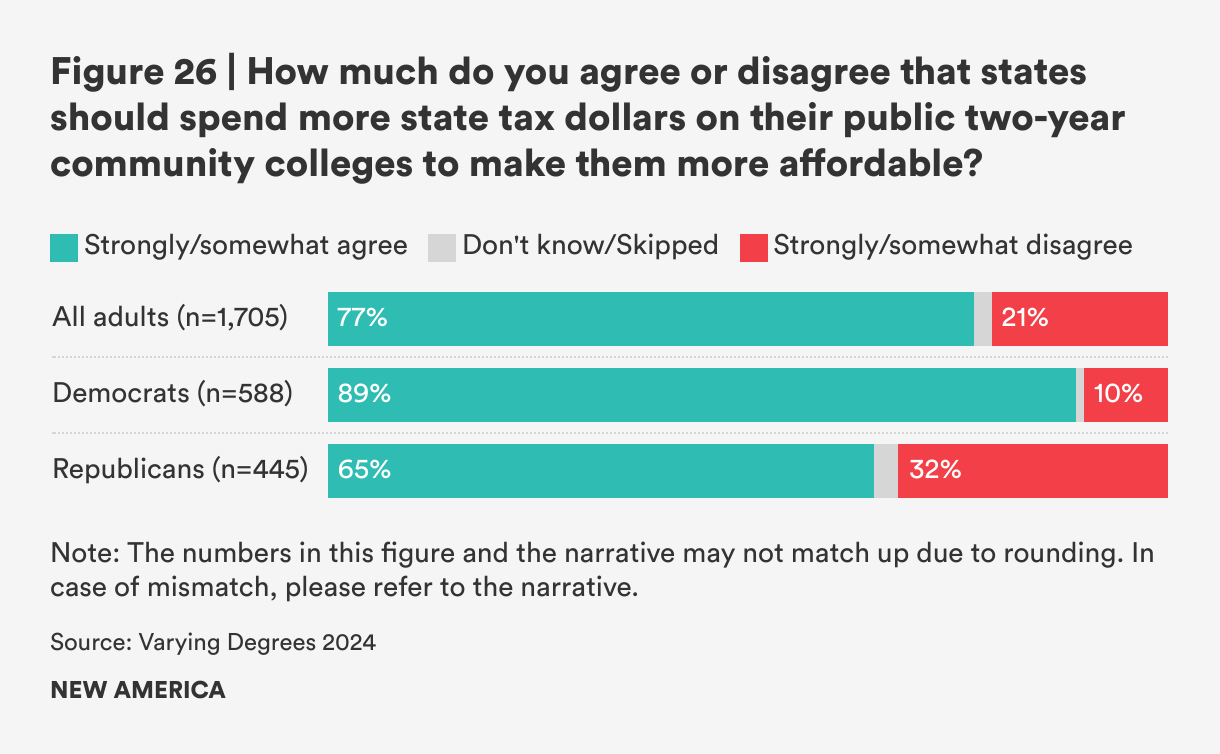
Slightly more than three-quarters (77 percent) of Americans believe that states should spend more tax dollars on public two-year community colleges to make them more affordable. There is strong bipartisan support for the idea, with 89 percent of Democrats and 65 percent of Republicans agreeing (see Figure 26).
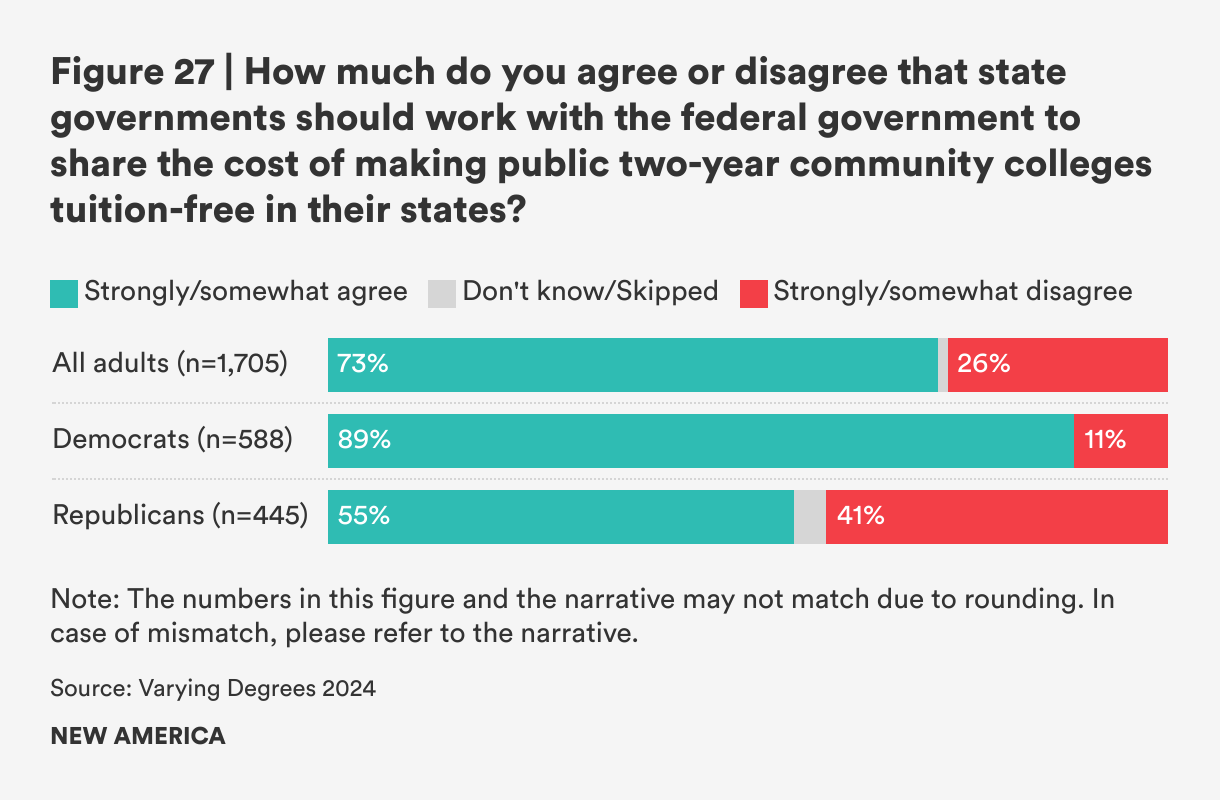
Americans also agree (72 percent) that state governments should share the cost of making public community colleges tuition-free with the federal government. Nearly nine out of ten Democrats support the idea (88 percent); a slight majority of Republicans (55 percent) do so as well (see Figure 27).
Americans are More Conflicted on Funding a Tuition-Free Public Four-Year Option
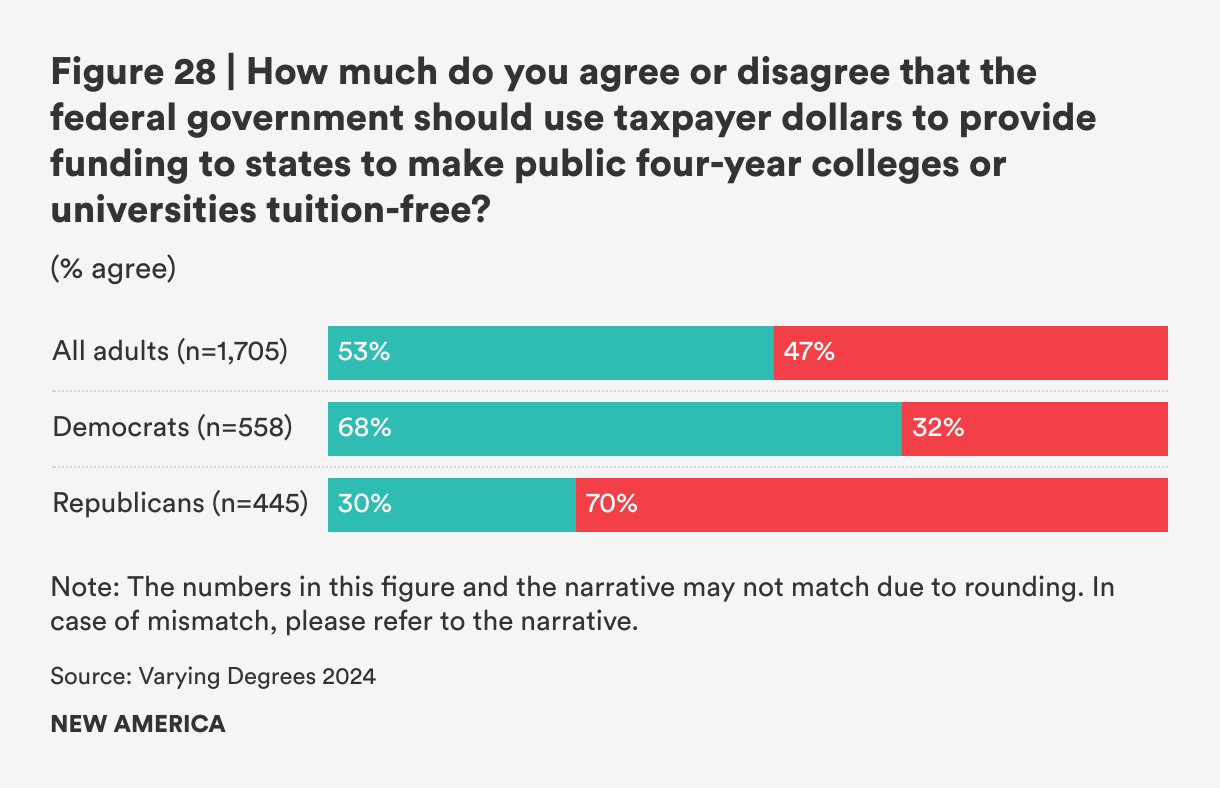
Americans are split over whether the federal government should provide funding to states to make public four-year colleges and universities tuition-free. Just about half (52 percent) agree that federal dollars should be provided to states for a free public four-year option. Two-thirds of Democrats (67 percent) support having the federal government help finance a free four-year option, but only 29 percent of Republicans agree (see Figure 28).
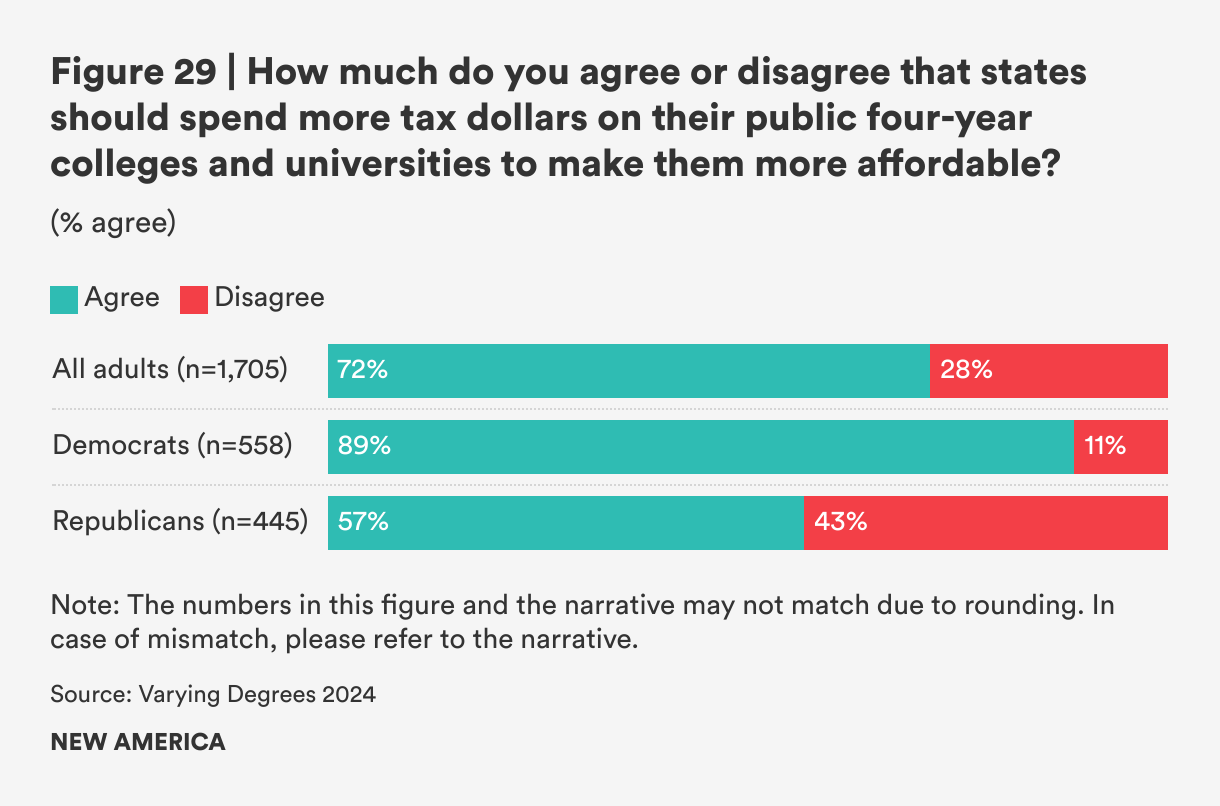
A majority of Americans believe that states also have a role to play in making public four-year colleges and universities more affordable. About seven in ten (71 percent) of Americans agree that states should spend more tax dollars to make public four-year colleges and universities more affordable. A majority of both Democrats and Republicans agree, albeit at very different rates (88 percent of Democrats versus 55 percent of Republicans) (see Figure 29).
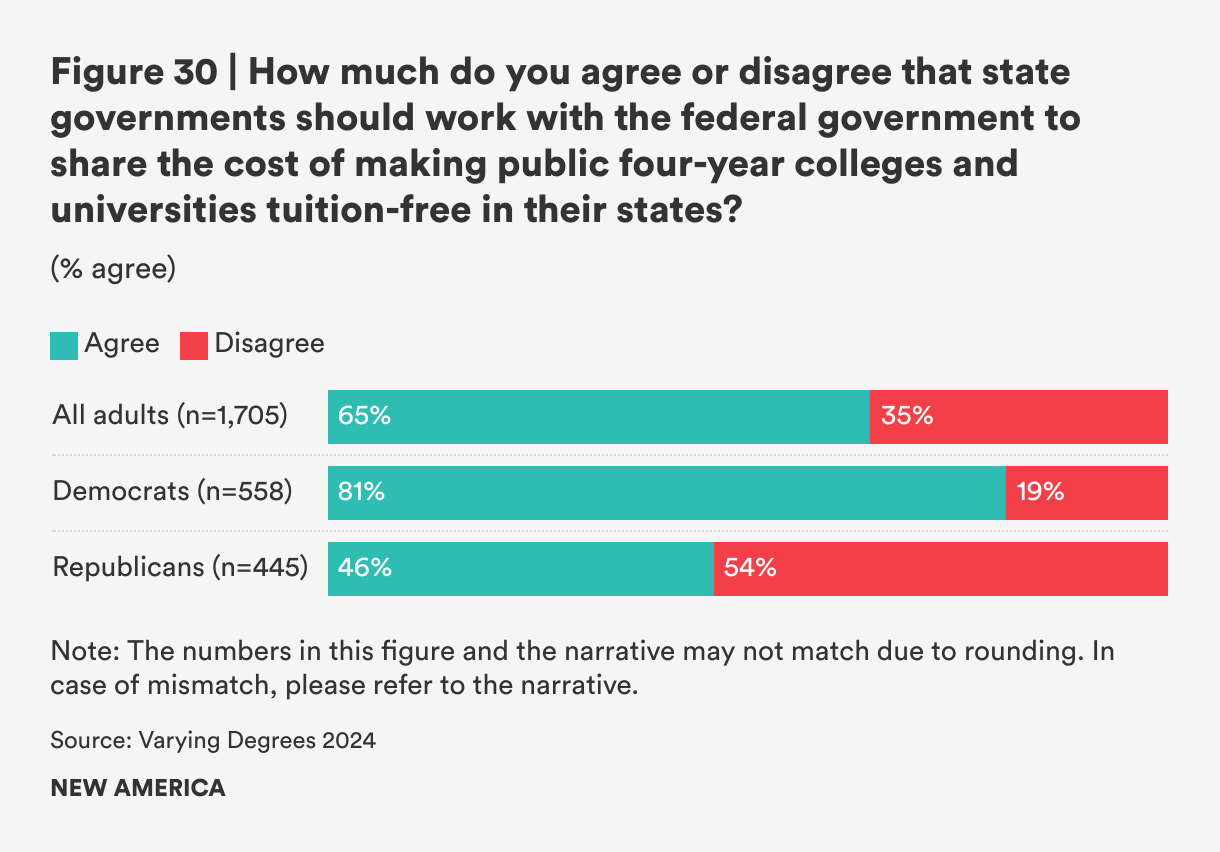
Americans also agree (64 percent) that state governments should share the cost of making public four-year colleges and universities tuition-free. There is a partisan divide on this question, with 80 percent of Democrats agreeing and only 45 percent of Republicans agreeing (see Figure 30).
Americans Want More Need-Based Grant Aid for Students
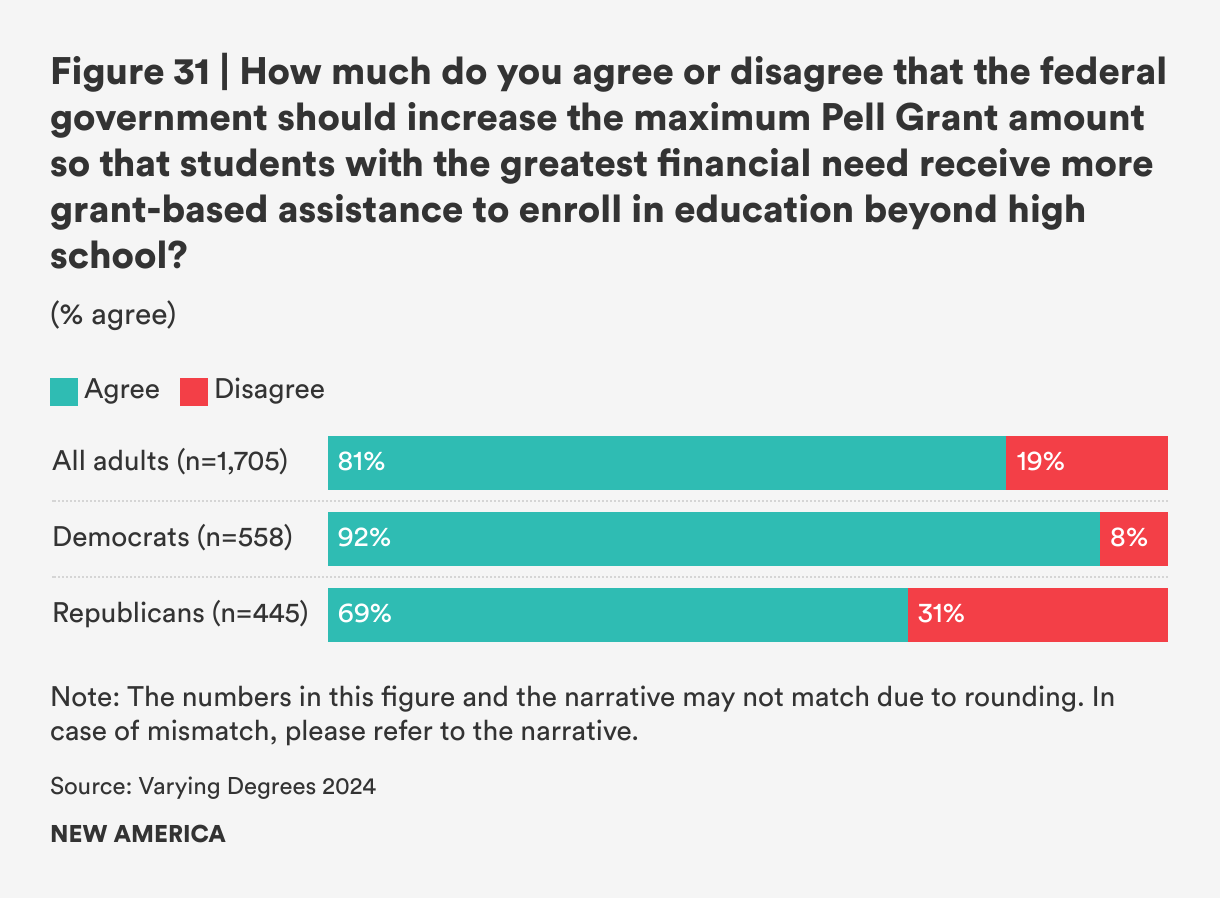
The Pell Grant program is the largest federal student aid program that is based on financial need. While there have been incremental increases in the maximum Pell Grant award over the years, Pell has not kept up with inflation and the rising cost of college. It is unsurprising, therefore, that a vast majority of Americans (80 percent) agree that the federal government should increase the maximum award so that students with the greatest financial need receive more grant-based assistance. Increasing Pell Grant funding receives broad support (though at varying levels) across many demographics including party identification and race and ethnicity (see Figure 31).
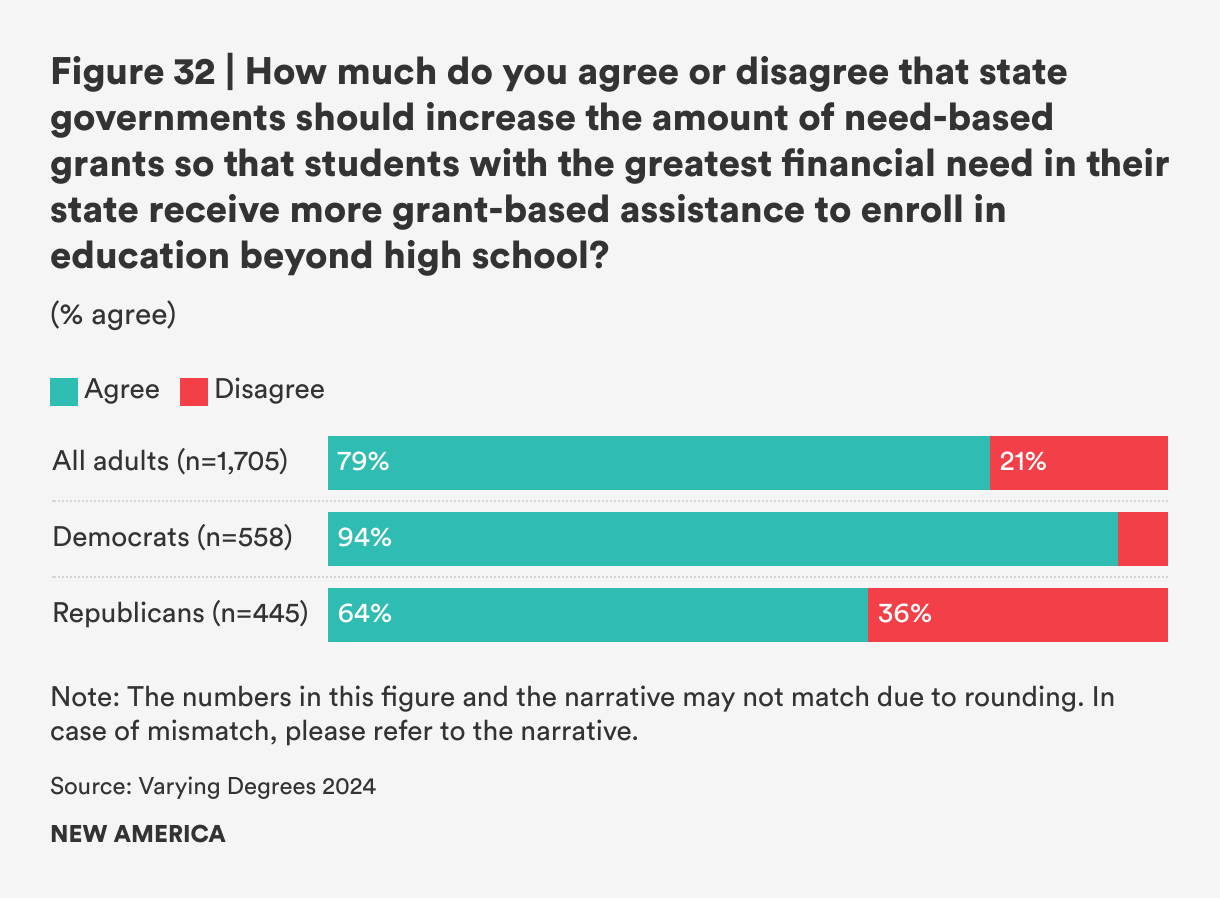
Although each state grant program has different requirements for students to participate, more than three-quarters of Americans (78 percent) agree that states should increase the amount of need-based grants to focus resources on students who could use the financial help the most.12 Targeting state grants to those with financial need also has bipartisan support (see Figure 32).
Americans Feel Comfortable Spending Taxpayer Dollars on Public Colleges and Universities, but Less So on Private Institutions
A majority of Americans feel comfortable with their own taxpayer dollars supporting public two-year (76 percent agree), public four-year (67 percent agree), and minority-serving institutions (MSIs) (64 percent agree). Support for using taxpayer dollars on private institutions, both nonprofit and for-profit, is lower: just 45 percent of Americans are comfortable with spending these funds on private nonprofit institutions, and only 32 percent are comfortable with spending them on private for-profit institutions (see Figure 33).
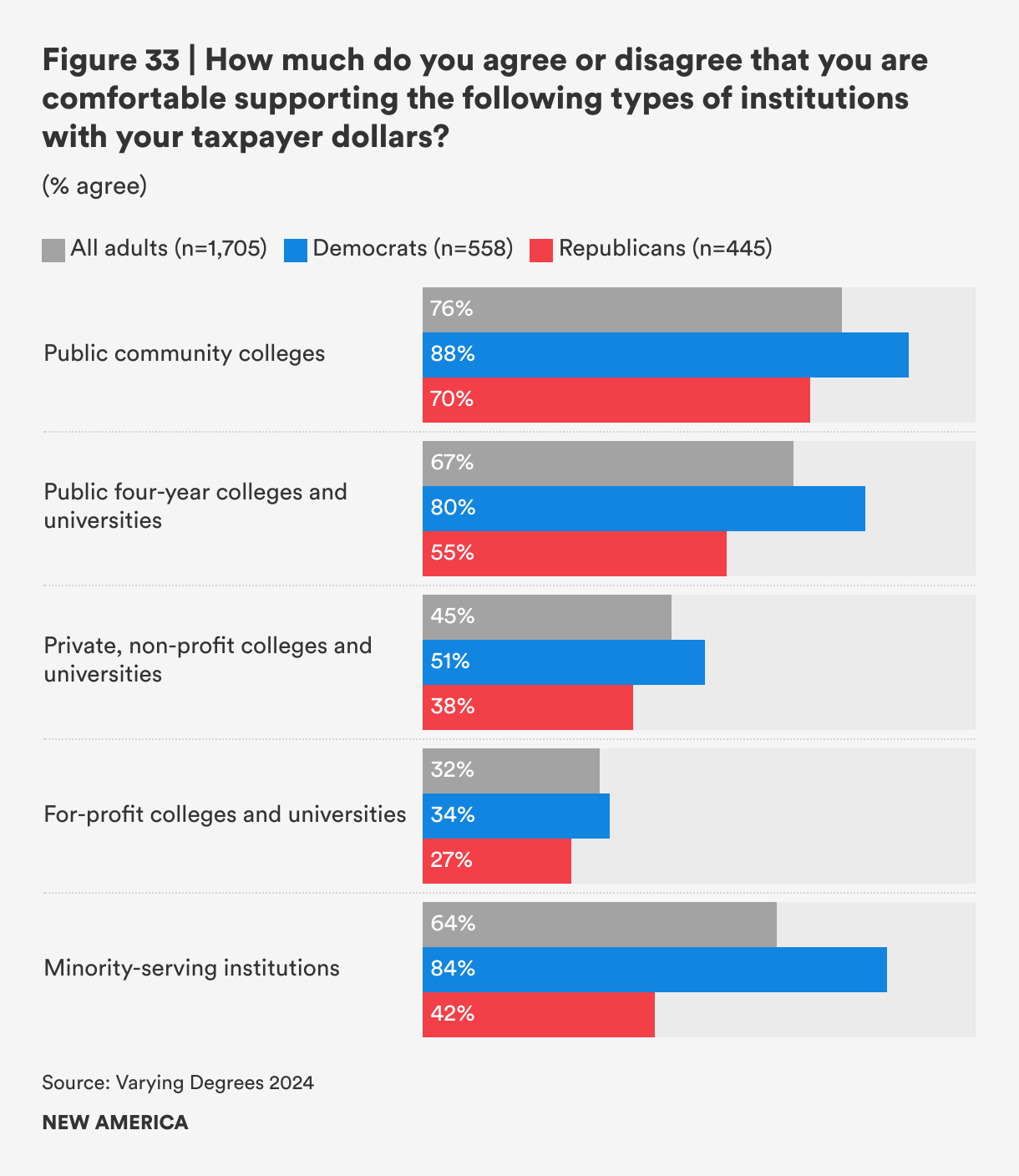
Both Democrats and Republicans express support for financing public two- and four-year colleges with their taxpayer dollars. Democrats show particularly high levels of support, with 88 percent comfortable with their taxpayer dollars going to community colleges and 80 percent showing support for using them to finance public four-year universities. About half of Democrats (51 percent) support their tax dollars going to private nonprofit colleges and universities, compared to only 38 percent of Republicans.
Both groups do have something they agree on: they are uncomfortable with their taxpayer dollars going to for-profit institutions. Only 34 percent of Democrats and 27 percent of Republicans agree that taxpayer dollars should go to the private for-profit sector.
As in previous years, Democrats and Republicans have divergent views on taxpayer support for MSIs. A sizable majority of Democrats (84 percent) agree with spending tax dollars on MSIs, whereas only 42 percent of Republicans do.
Americans, however, do not feel strongly that the federal government and states underfund the country’s colleges and universities. About half think that community colleges, public four-year institutions, and MSIs are underfunded by both federal and state governments. Just under a third of Americans agree that the federal and state governments underfund private nonprofit and for-profit institutions (see Figure 34).
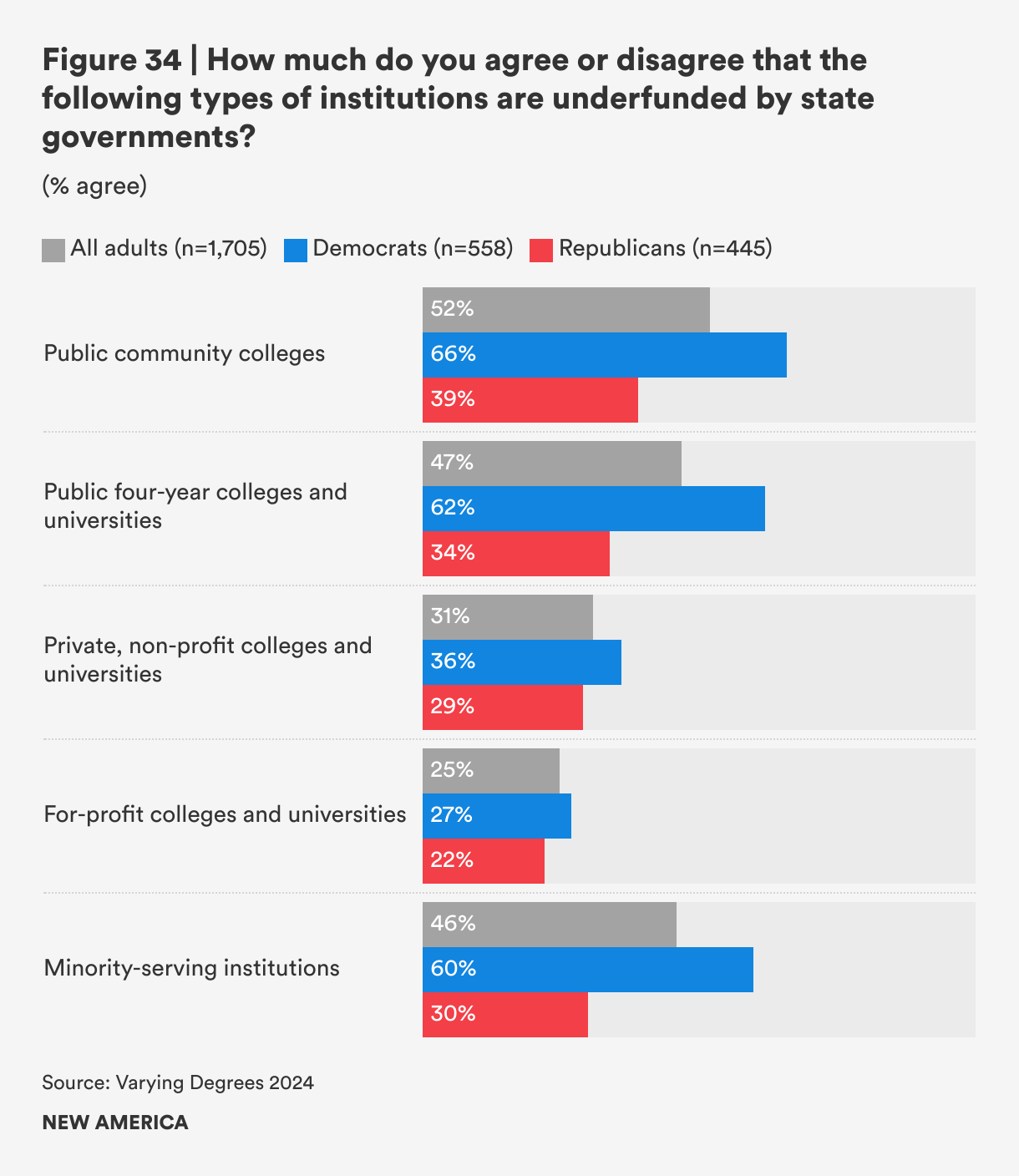
Big partisan differences emerge between Democrats and Republicans on whether the federal or state governments underfund particular sectors of higher education. The biggest difference emerges with MSIs. Approximately 60 percent of Democrats agree that both states and the federal government underfund these institutions, compared to 30 percent of Republicans.
Citations
- In the Varying Degrees survey, Generation Z includes people who were born in and before 1995, Millennials include those born between 1980 and 1994, Generation X includes those born between 1965 and 1979, Baby Boomers include those born between 1946 and 1964, and the Silent Generation includes those born in and before 1945.
- For more information on President Biden’s free college plan, see Peter Granville, “President Biden’s Free Community College Plan Matters Now More Than Ever,” The Century Foundation, March 30, 2023, https://tcf.org/content/commentary/president-bidens-free-community-college-plan-matters-now-more-than-ever/.
- For more information on how disparate state grant programs are, see Ivy Love, Edward Conroy, Iris Palmer, and Sarah Sattelmeyer, “We Shouldn’t Have to Choose between Maintaining and Bettering Our Lives”: An Analysis of Older and Parenting College Students (Washington, DC: New America, November 2023), https://www.newamerica.org/education-policy/reports/we-shouldnt-have-to-choose-between-maintaining-and-bettering-our-lives-an-analysis-of-older-and-parenting-college-students/.
Accountability
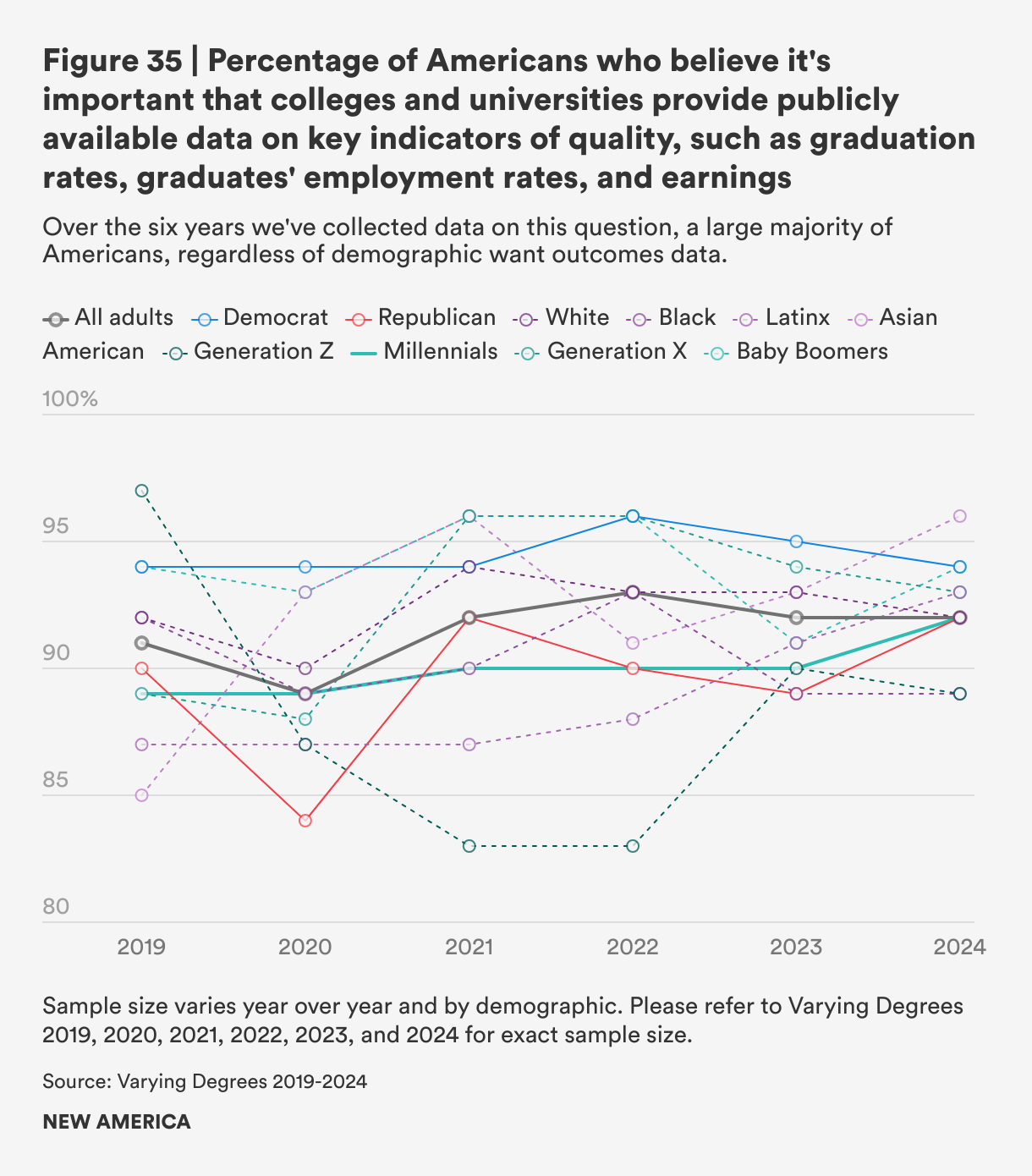
Because Americans believe state and federal governments should use taxpayer dollars to make higher education more affordable, we also wanted to understand how they feel about holding institutions accountable for that investment. Since 2019 Varying Degrees has been asking how important it is for colleges and universities to provide publicly available data on key indicators of institutional quality such as graduation rates, graduates’ employment rates, and graduates’ earnings. Over the years, Americans have made clear that data transparency is important, with near universal agreement across party line, age, and race and ethnicity (see Figure 35).
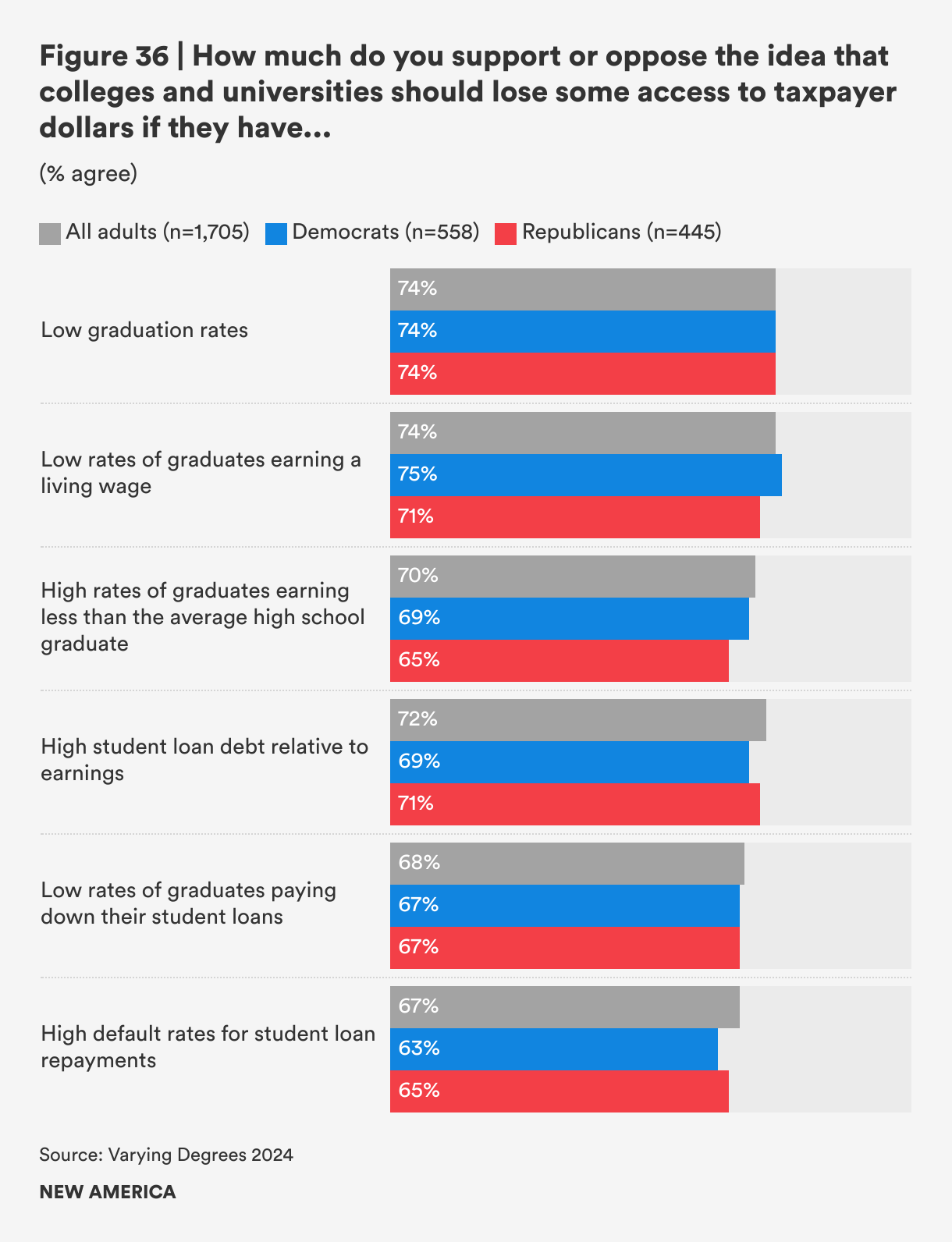
Americans also support the idea that colleges and universities should lose access to taxpayer dollars if they have poor outcomes such as low graduation rates, low rates of graduates earning a living wage, and high rates of graduates earning less than the average high school graduate. As in previous years, approximately 65 to 75 percent of Americans agree that institutions should lose access to taxpayer dollars if students have poor outcomes (see Figure 36). Democrats and Republicans agree that institutions should be held accountable for their outcomes.
Americans Do Not Believe Any Sector of Higher Education Spends Money Wisely or Runs Efficiently
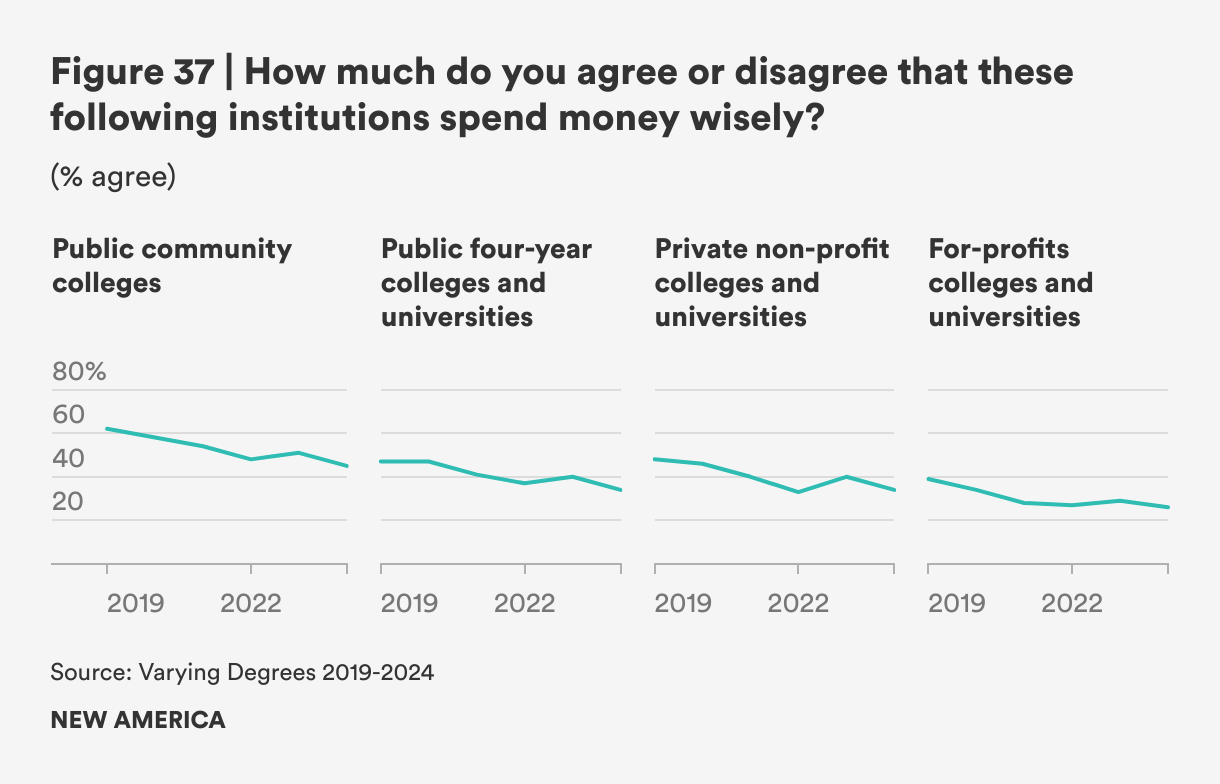
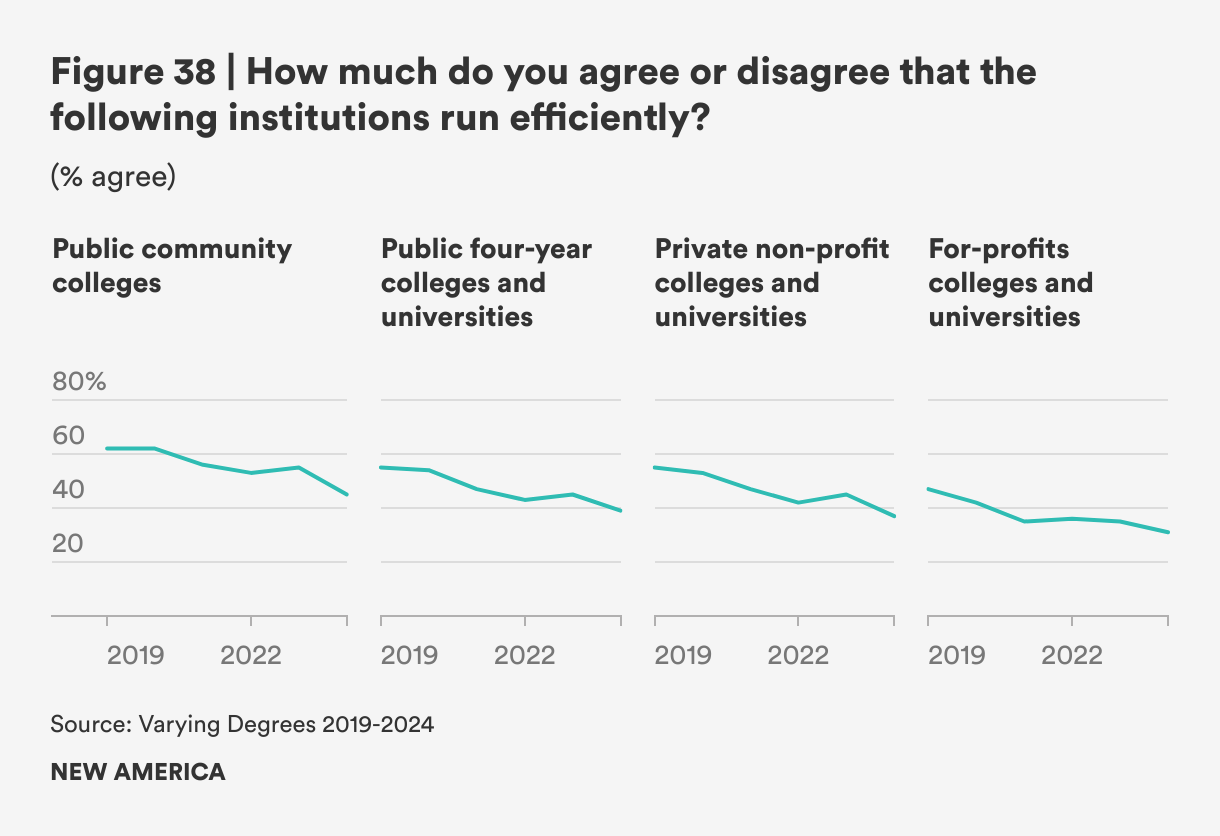
In previous years, when we have asked if certain sectors of higher education spend money wisely or run efficiently, there has only been agreement that the public sector of higher education does. No longer. This year, for the first time, Americans did not think any sector of higher education spends money wisely or runs efficiently. This perception may help explain some of the souring Americans expressed on the value of higher education overall. Just under half of Americans believe that community colleges spend money wisely (45 percent) and run efficiently (45 percent). The numbers decline from there for all other sectors. The lowest is the for-profit sector, where only 26 percent of Americans agree that institutions spend money wisely and only 31 percent agree that they run efficiently (see Figures 37 and 38).
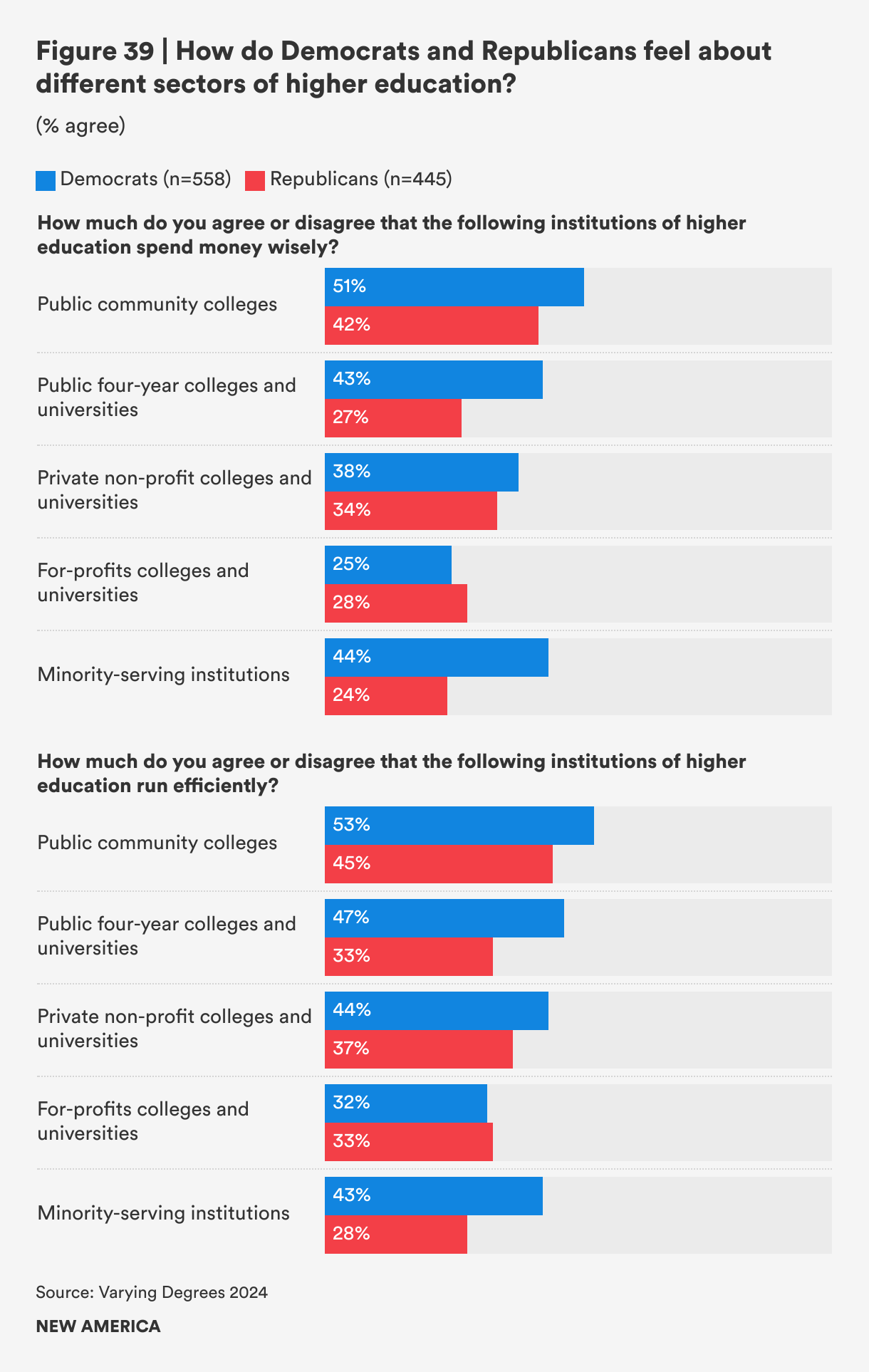
Republicans are more skeptical than Democrats that colleges operate efficiently and spend their money wisely. There is only one sector where the parties agree; neither Democrats nor Republicans agree that for-profit institutions run efficiently or spend money wisely (See Figure 39).
Explore the Data
Error: Data visualization bundle URL missing.
Appendix: Methodology
Survey Overview
Study Target Population: General Population Age 18+
Sample Units: 9,311
Completed Units: 1,705
Expected Eligibility Rate: 100%
Observed Eligibility Rate: 100%
Margin of Error: ±3.12 percentage points (pp)
Design Effect: 1.72
Survey Field Period: March 1, 2024 – March 25, 2024
Median Duration (minutes): 23
Sampling Approach
A general population sample 18 years and older was selected from NORC’s AmeriSpeak Panel for this study. An oversample of African Americans, Asian/Pacific Islander Americans, and Hispanic Americans was added to the sample to achieve client-specified complete survey targets for these demographic groups. The sample was selected from the AmeriSpeak Panel using sampling strata based on age, race/Hispanic ethnicity, educational attainment, and gender (48 sampling strata in total).
Survey Sample
A total of 9,311 AmeriSpeak Panel members were initially selected for the Varying Degrees 2024 sample. Of this total, 1,963 individuals finished the survey, however, only 1,705 respondents fully completed the survey based on the survey’s completion criteria. In post-processing, 158 cases were removed because they: 1) completed the survey in less than one-third the median duration, 2) skipped or refused more than half of the eligible survey items, or 3) straight-lined eligible grid items.
Varying Degrees 2024 Instrument
The Varying Degrees instrument collects information about the public’s perceptions of a variety of aspects related to U.S. postsecondary education. The instrument is designed to collect information to serve two purposes. First, the instrument must be able to illuminate findings that are responsive to current contexts that influence public opinion. Second, the instrument must also collect information about the public’s perceptions over time to illuminate trends.
The Varying Degrees 2024 instrument consisted of ten sections:
- Enrollment and Borrowing Status
- Employment and Financial Security
- Higher Education Value and Accountability
- Affordability
- Higher Education Funding
- Higher Education Institutions by Sector
- College Admission and Selection
- Online and In-person Education and Artificial Intelligence
- Higher Education Impact
- Respondent and Household Demographic Information
The survey was offered in English and Spanish, and it was administered in two modes depending on the preference of the respondent provided during the panel recruitment: 1) self-administered by the respondent online via the Web; or 2) administered over the telephone by a live interviewer.
Fielding the Survey
For the main survey, a small, randomly selected sub-sample of AmeriSpeak web-mode panelists were invited to the survey as a part of a soft launch on Friday, March 1, 2024. The initial data from the soft launch were reviewed to confirm that there were no processing or programming errors. Once reviewed, the remainder of sampled AmeriSpeak panelists were invited to the survey on Monday, March 4, 2024.
If invited, AmeriSpeak panelists can take the survey online through the password-protected AmeriSpeak Mobile App, the password-protected AmeriSpeak Web portal, or by following a link in the email invitation sent to them. To encourage study cooperation, NORC sent the initial invitation and various email reminders to sampled web-mode panelists (i.e., soft launch, total sample, oversamples, and remaining sample) between Friday, March 1, and Sunday, March 24. SMS or text messages were sent to panelists who have agreed to receive such messages on Saturday, March 16. To administer the phone survey, NORC dialed sampled panelists who prefer to take surveys on the phone between Wednesday, March 6 and Sunday, March 24. Panelists were offered the cash equivalent of $3 for completing this survey.
More About the Authors

Sophie Nguyen
Senior Policy Manager, Higher Education

Rachel Fishman
Director, Higher Education

Olivia Cheche
Program Associate, Higher Education
Issues
Programs/Projects/Initiatives
Related