A Chapter of: Governing the House with Multiple Parties
Multipartyism in Action
Imagine we amend the Uniform Congressional District Act (UCDA) and require that all states draw proportional multimember House districts. These new districts make several viable parties other than Democrats and Republicans. If we can accept this premise, then how might the new multiparty House work?
This section gives a broad overview of what U.S. multipartyism might look like, including the electoral system, party coalitions, bargaining, and majority formation. These are not recommendations but instead observations about what multipartyism looks like in some countries and expectations about what it might look like in the U.S. House in particular. While lawmakers and politicians would ultimately decide how the system would work, we believe that their incentives would push them, more or less, in the directions we outline.
Multipartyism in the Comparative Perspective
The United States would be a multiparty presidential separation-of-powers system, a type of system typically found in Latin America. However, we can also learn important lessons from parliamentary systems, which most often come to mind when people think of multiparty democracy and have received the most scholarly attention. Though presidential and parliamentary systems are different, they have much in common. Fundamentally, they both involve building majority coalitions.49
In multiparty parliamentary systems, legislators are elected by voters and then bargain among themselves to select a government consisting of a cabinet and a head of state. Typically, the legislature has the option to bring down the government and call for snap elections that potentially upend the balance of power and allow a new government to form. In multiparty presidential systems, presidents and legislators are elected independently to fixed terms. The president serves as head of state and appoints the cabinet.50 Legislators can remove the president through impeachment, but otherwise, a government can only be replaced in the next scheduled election.
It is rare for a single party to win a majority of the seats in any multiparty legislature. Thus, the majorities that organize the legislature are usually coalitions of several parties that must reach an agreement on procedures and leadership. Going forward, we will call the constellation of parties that make up the majority of the House a procedural coalition or procedural majority.51
The agreements to form the procedural coalition involve compromise. Some of the compromises involve specific policies, while others involve cabinet appointments or legislative rules. The procedural coalition may establish a formal agreement, codifying the details of the negotiations so that they will remain binding for the term of the coalition.52 Generally, procedural coalitions reflect a broad agreement that compromises across the parties are based on their vote share.53
In many parliamentary systems, procedural coalitions form after the election. The party that won the most seats typically gets the first opportunity to build a majority coalition. The process of coalition formation involves much public and private back and forth, some of it performative, some of it genuine. On average, this post-election negotiation process takes a month, shorter than the two-month period between U.S. elections and the seating of a new Congress.54 However, the duration can vary. The Netherlands, which has the most proportional system in Europe and the most legislative parties, typically takes the longest to form a coalition—on average, about three months.55 Generally, high polarization and excessive legislative fragmentation contribute to longer negotiation periods.56
Though post-election coalitions are more common in parliamentary systems, about a quarter of all procedural coalitions emerge from pre-election coalitions. That is, multiple parties agree amongst themselves that if they win a majority of seats between them, they will govern as a coalition. It helps voters pick the government they want to support early on and improves the chances of a smooth coalition formation post-election.57
Obviously, tensions emerge as events challenge a coalition. Individual coalition partners still strive to differentiate themselves. Parties sometimes engage in public displays in the legislative process, including introducing amendments, to show their supporters they are fighting for core policies.58 Sometimes coalitions fall apart, and a successful no-confidence vote leads to a call for a new election.59 In the U.S. system, there is no option to call new elections if a procedural coalition breaks down. This means parties would need to work out their differences or face a continued impasse until the next election.
While some of the coalition formation dynamics seen in parliamentary democracies would probably occur in a multiparty House, the fact that the United States is a presidential system would also lead to some major differences. Most importantly, presidential systems tend to impose a binary structure on legislative politics, where some parties are aligned with the president and some parties are opposed to the president.60 This government vs. opposition dynamic tends to limit the possibilities for bargaining, as parties cannot credibly stray too far outside the boundaries set by presidential politics.61 It also creates pressure for parties to form pre-electoral coalitions around presidential candidates rather than post-electoral coalitions. Because presidential elections are inherently winner-take-all elections, leading presidential candidates from the larger parties have a clear interest in assembling the largest support coalition.
Smaller parties, which are unlikely to ever field a winning presidential candidate on their own, have good reasons to attach to a potential winner early. They can offer their support in exchange for promises of cabinet positions or policy enactments, particularly if they have particular priorities.62 Pre-electoral coalitions enable smaller parties to enhance election prospects, negotiate policy influence, gain government roles, and secure future electoral support. Joining a coalition may improve the ability of a smaller party to gain resources and visibility and help them win lower-level elections.63 As with any winner-take-all election, being on a winning team is better than being a spoiler or a wasted vote.
“As with any winner-take-all election, being on a winning team is better than being a spoiler or a wasted vote.”
Pre-electoral coalitions also help improve stability in presidential systems by negotiating policy and positions up front, sharing resources, and building trust: “By joining a pre-electoral coalition, parties surrender the possibility of controlling the presidency themselves but gain support and credibility through the coalition. This compensation provided by the formateur party strengthens the bond between coalition partners.”64 As with parliamentary systems, coalitions in presidential systems form more easily across fewer and better-connected parties.65
Because pre-electoral coalitions are common in presidential systems, voters are often voting for the coalition they would like to see in the majority. And because voters can choose both a president and a congressional representative separately, they can both support a broader coalition and the specific part of the coalition they feel represents them best. For example, a right-leaning voter who does not like Donald Trump but still supports him over the Democratic nominee could cast a vote for Trump as president but a center-right party that promises to serve as a check on Trump for Congress. By contrast, in a parliamentary system, where coalitions more commonly form after the election, voters have much less control. They might vote for a party that, post-election, ends up aligning with the left or right coalition they wanted to keep out of power.
Multipartyism in the United States
Based on the experiences of other countries, we expect that multiparty presidentialism in the United States would share some similarities with our current president-dominated electoral system. The presidency would remain a winner-take-all office, and there would be strong incentives for the parties on the left and the right to consolidate behind one candidate each in two pre-electoral coalitions. This would largely mirror the current party structure, just with better-defined and more publicly visible intra-coalition factions. For example, a voter on the right who would have formerly affiliated with Republicans could now choose among a few right-leaning parties. Those parties would likely emphasize (or at least acknowledge) their alignment with the right coalition and its presidential candidate and their opposition to the left coalition and its candidate.
The process through which the parties form pre-electoral coalitions would probably be somewhat different in the United States than in other countries. The Electoral College creates more than 50 winner-take-all contests across the country, so there are incentives for similar parties to line up behind the same candidate. If they do not, then they will probably split the vote and cause the opposition candidate to be elected.66 In Latin American countries, presidents are usually elected in two-round elections. In the first round, many parties put forward presidential candidates. The pre-electoral coalitions then form around the two candidates who advance to the second round (usually one left candidate and one right candidate). The United States does not have a two-round system, so the pre-electoral coalitions would have to be organized in some other way. One possibility is that the presidential primary system evolves so that all presidential candidates must run in either a right-bloc primary or left-bloc primary, as third-party bids would not be allowed in the general election. The primaries would effectively be the first round, and then the regular presidential election would be the second round. This would, of course, create complications, but it could work if reforms to presidential primaries and ballot access are adopted.67
After the election, the pre-electoral coalitions would operate in the House as two blocs, with the more numerous bloc constituting the majority procedural coalition that organizes the House. It is possible that neither pre-electoral coalition would win enough seats to form a procedural coalition.68 In this case, the larger coalition would need to adjust its priorities to bring in additional parties as coalition partners or at least neutralize enough opposition so that a plurality coalition could organize the House.
Coalition partners brought on after the election would most likely be those that did not affiliate with either major pre-electoral coalition—probably small, centrist parties that switch from one bloc to the other, depending on the election. Unlike in our current politics, these truly independent parties would almost certainly be viable in a proportional system if they could clear a minimum threshold for representation. These parties would inject some fluidity into the system as they could align with left parties on some issues and right parties on other issues. More so than the parties that are permanent members of the left and right blocs, we expect these parties to act as “free agents.”69 The number and nature of these parties would depend on the exact details of the party system, but given the success in the United States of politicians who don’t fit cleanly into the left-right political spectrum (e.g., Ross Perot and Donald Trump), it would be surprising if they didn’t win some seats.
The pre- and post-election negotiations would almost certainly involve bargaining over positions with agenda-setting powers, like committee chairs and cabinet seats, and the final negotiated agreement would likely match policy jurisdictions to party interests. For example, if the left bloc controls the House, a working-class labor party might control the committee with jurisdiction over labor, while a party supported by knowledge economy workers might control the committee with jurisdiction over tax policy. In addition to committee chairs, the coalition would have to decide on leaders who would manage their procedural majority more broadly, including the House Speaker. These coalition leaders would probably be drawn from the ranks of the individual party leaders. In the next section, we give more specific suggestions for how power could be balanced between committees and majority coalition leaders as well as among the leaders of the different parties within the majority coalition.
Once organized, we expect that the parties that make up the procedural majority would have some incentives to work outside their coalition on legislation, at least compared to factions in the current system. In addition to their distinct policy priorities, parties would want to differentiate themselves from their coalition partners on some issues to appeal to their base and woo more voters. This would be similar to how southern Democrats and northeastern Republicans distinguished themselves from the national party brands in the mid-twentieth century. For example, the moderate right-bloc parties might be able to grow their voter base by working with left-bloc parties on policies that expand high-skilled immigration, even if other right-bloc parties opposed them.
Parties would be less concerned with maintaining the coalition’s overall brand as it would be a less important public good than in the current system. However, like coalition politics in the mid-twentieth century, the parties would also face some constraints in their positioning given the centrality of presidents in American politics and their desire to maintain influence within the coalition. Presidential politics drive public opinion about legislative parties, and much congressional discourse and voting revolves around supporting or opposing the president.70 This would likely continue in some form as parties aligned with the president would not want to undercut him on a regular basis.
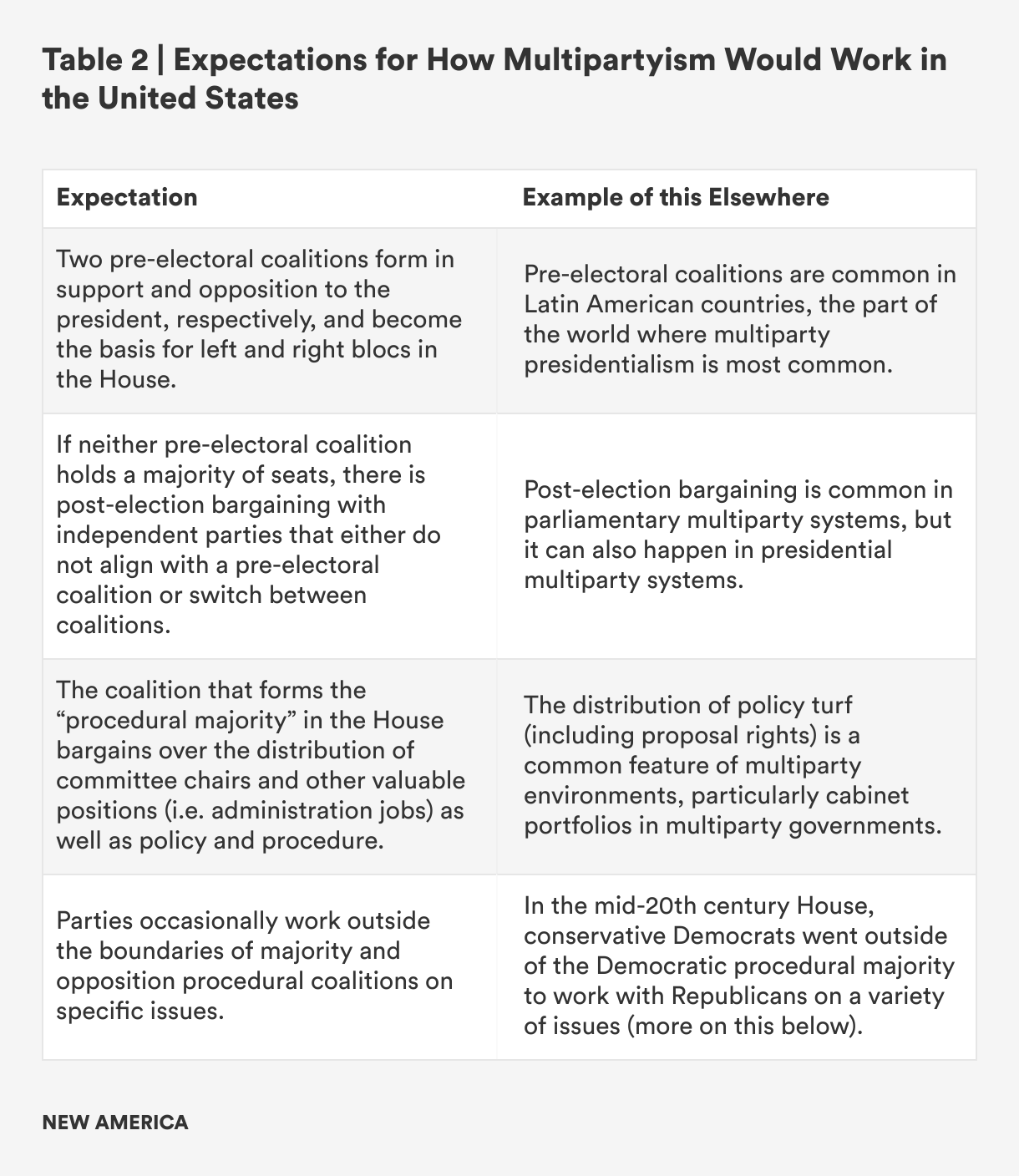
Overall, we expect House multipartyism to be somewhat constrained by the binary nature of presidential elections and left-right politics. This would prevent the House from becoming completely fluid and free-for-all, where factions regularly shift their allegiances. However, we also do not expect things to be exactly the same as in the current system. The incentives and ability to maintain a lock-step procedural majority—now a constellation of parties rather than a single majority party—would be quite different from those in the existing system. The various factions that currently exist in American politics would have more formal recognition as standalone parties but less reason to work exclusively with the factions with whom they share a party in the current system. So, there probably would be somewhat greater coalition shifting from issue to issue. We summarize our expectations for the multiparty House in Table 2.
An Example to Follow: The Mid-Twentieth Century House
For an example of how the multiparty House might operate, we turn to the Congress of the mid-twentieth century, where there was significant fragmentation in the Democratic majority that controlled the House. While Democrats held the procedural majority, a bipartisan conservative coalition of Republicans and southern Democrats aligned on many policy matters.71 As a result, the House had a fluid and decentralized governing arrangement where members of the procedural majority, namely liberal Democrats, were often (but not always) on the losing side of major policy decisions. Speakers like Sam Rayburn served as brokers who worked to bring various factions together rather than as iron-fisted leaders.72 The standing committees, assigned by seniority, largely controlled the chamber, and the Rules Committee, run by the conservative coalition, largely proscribed the limits of the possible.
This bipartisan governing arrangement was very different from the one we’ve seen in recent congresses, including the 118th. In the mid-twentieth century Congress, there was regular bipartisan policy action on matters beyond must-pass issues like government funding and raising the debt ceiling.73 In modern Congresses, majority party members do not go outside their procedural coalition to work with the minority unless they view it as absolutely essential. The same goes for the minority party in reverse. Why help members of the majority party win reelection unless they are offering significant concessions?
“In the mid-twentieth century Congress, there was regular bipartisan policy action on matters beyond must-pass issues like government funding and raising the debt ceiling.”
This logic did not hold in the mid-twentieth century Congress, though, because both parties, for a time, believed that moving away from bipartisan governance would involve unacceptable costs. Democrats decided they’d rather maintain the procedural majority than push conservatives out of the party. And Republicans decided they’d rather wield power by working with conservative Democrats than sharpen the contrasts between the parties and risk losing their influence. These incentives changed over time as politics nationalized and parties became more internally homogenous, with members sharing more common goals. In turn, the parties developed top-down leadership structures that worked to advance members’ common partisan interests and cautioned against bipartisanship.
As we’ve seen, rising polarization in the late-twentieth and twenty-first centuries did not lead to glorious partisan victories. While the “success” of government is both subjective and determined by many factors beyond its institutional structure, Congress passed more major laws and addressed a larger share of its agenda in the era with more bipartisan governance.74 In other words, Congress arguably worked better, or at least got more stuff done, when cross-party policy majorities formed on many different issues and members were not stuck in partisan procedural coalitions directed by powerful leaders.
The mid-twentieth century Congress provides an example of how the multiparty Congress could work. However, a stylized example of how something worked in the past is not a plan for making it reoccur in the future. The question is, how do we make a multiparty House look more like the mid-twentieth century version than the 118th Congress version? Both feature internally divided procedural majorities, but the results have been very different. In the next section, we discuss ways that the House could work differently to take advantage of the possibilities of a more pluralistic system while also hedging against the risks.

Citations
- Josep Colomer and Gabriel Negretto, “Can Presidentialism Work Like Parliamentarism?” Government and Opposition 40, no. 1 (2005): 60–89, https://www.cambridge.org/core/journals/government-and-opposition/article/abs/can-presidentialism-work-like-parliamentarism1/9BA40C991FBEF5A7A07EFC70EDB99575.
- The United States is one of the few countries where the president’s cabinet nominees must be confirmed by the legislature. See Carlos Galina, “The U.S. Process for Confirming a Cabinet Takes Longer Than Almost All Other Countries,” Center for the Presidential Transition, May 5, 2021, https://presidentialtransition.org/blog/the-u-s-process-for-confirming-a-cabinet-takes-longer/.
- We are simplifying terms here as the procedural coalition and the organization coalition perform different tasks but usually consist of the same members. See Jenkins and Stewart III, Fighting for the Speakership.
- Kaare Strøm, Wolfgang Müller, and Daniel Markham Smith, “Parliamentary Control of Coalition Governments,” Annual Review of Political Science 13, no. 1 (2010): 517–35, https://www.annualreviews.org/content/journals/10.1146/annurev.polisci.10.071105.104340.
- Lanny Martin and George Vanberg, “Parties and Policymaking in Multiparty Governments: The Legislative Median, Ministerial Autonomy, and the Coalition Compromise,” American Journal of Political Science 58, no. 4 (2014): 979–96, https://onlinelibrary.wiley.com/doi/abs/10.1111/ajps.12099.
- Sona Golder, “Bargaining Delays in the Government Formation Process,” Comparative Political Studies 43, no. 1 (2010): 3–32, https://journals.sagepub.com/doi/10.1177/0010414009341714.
- Alejandro Ecker and Thomas Meyer, “The Duration of Government Formation Processes in Europe,” Research and Politics 2, no. 4 (2015): 1–9, https://journals.sagepub.com/doi/10.1177/2053168015622796.
- Golder, “Bargaining Delays in the Government Formation Process,” https://journals.sagepub.com/doi/10.1177/2053168015622796.
- Sona Golder, “Pre-Electoral Coalition Formation in Parliamentary Democracies,” British Journal of Political Science 36, (Spring 2006): 193–212, https://www.cambridge.org/core/journals/british-journal-of-political-science/article/abs/preelectoral-coalition-formation-in-parliamentary-democracies/E20B729DB038D7C920215319A2B1A094.
- David Fortunato, The Cycle of Coalition: How Parties and Voters Interact under Coalition Governance (Cambridge, United Kingdom: Cambridge University Press, 2021).
- Henning Bergmann, Hanna Bäck, and Thomas Saalfeld, “Party-System Polarisation, Legislative Institutions and Cabinet Survival in 28 Parliamentary Democracies, 1945–2019,” West European Politics 45, no. 3 (2022): 612–37, https://www.tandfonline.com/doi/abs/10.1080/01402382.2020.1870345.
- Cesar Zucco, “Ideology or What? Legislative Behavior in Multiparty Presidential Settings,” Journal of Politics 71, no. 3 (2009): 1076–92, https://www.journals.uchicago.edu/doi/abs/10.1017/S0022381609090896.
- An example of an extremely flexible system can be found in Denmark, where governments—which usually represent a minority of legislative parties—form issue-specific agreements with opposition parties not represented in the government. These agreements, called forlig, effectively create a majority governing coalition for specific issues. See Christoffer Green-Pedersen and Asbjørn Skjæveland, Governments in Action: Consensual Politics and Minority Governments, in Oxford Handbook of Danish Politics (Oxford, United Kingdom: Oxford University Press, 2020), 230–41.
- This process is similar to the ways in which the “invisible primary” works in the U.S. presidential nomination system. Candidates compete for endorsements, and important individuals and groups make demands in exchange for such endorsements. In a multiparty system, however, the key endorsements are both more visible and more concentrated. See Martin Cohen, David Karol, Hans Noel, and John Zaller, The Party Decides: Presidential Nominations Before and After Reform (Chicago, IL: Chicago University Press, 2008).
- Andre Borges, Mathieu Turgeon, and Adrian Albala, “Electoral Incentives to Coalition Formation in Multiparty Presidential Systems,” Party Politics 27, no. 6 (2020): 1279–89, https://journals.sagepub.com/doi/abs/10.1177/1354068820953527.
- Adrian Albala, Andre Borges, and Lucas Couto, “Pre-Electoral Coalitions and Cabinet Stability in Presidential Systems,” British Journal of Politics and International Relations 25, no. 1 (2021): 64–82, https://journals.sagepub.com/doi/10.1177/13691481211056852.
- Gabriel Negretto, “Minority Presidents and Democratic Performance in Latin America,” Latin American Politics and Society 48, no. 3 (2006): 63–92, https://www.cambridge.org/core/journals/latin-american-politics-and-society/article/abs/minority-presidents-and-democratic-performance-in-latin-america/93035CD649B59F05CDF2B631AEDA8CF9.
- Even if this coalition splitting happened once or twice, we expect the parties would learn from this system and get better at coalition-building over time.
- Some of the reforms that might turn U.S. presidential elections into an effective two-round system could include establishing a single national primary date, establishing uniform standards for participating and running in primaries, or making it very difficult (or impossible) for anyone other than the right bloc and left bloc nominees to make the general election ballots.
- This has been a somewhat unlikely scenario in Latin America, where, from 1980 to 2008, president-aligned majority coalitions governed about 48 percent of the time and president-opposed majority coalitions governed about 20 percent of the time. This latter arrangement is called a divided government in our current system. It might be more common in the United States than Latin America given the tendency of voters to “balance” the president’s party in midterm elections. However, one major difference in proportional elections is that small swings in voter support are less likely to result in wild swings in seats than they do in majoritarian elections. Eduardo Alemán and George Tsebelis, “Legislative Institutions and Agenda Setting,” in Legislative Institutions and Lawmaking in Latin America, ed. Eduardo Alemán and George Tsebelis (Oxford, United Kingdom: Oxford University Press, 2016): 1–31; Robert Erikson, “The Puzzle of Midterm Loss,” Journal of Politics 50 (1988): 1011–29, https://www.uvm.edu/~dguber/POLS125/articles/erikson1.pdf.
- They could also be influential in organizing the House. For example, they might decline to join a pre-electoral coalition but then participate in post-electoral coalition negotiations if neither side obtains a majority of seats.
- Benjamin Noble, “Presidential Cues and the Nationalization of Congressional Rhetoric, 1973–2016,” American Journal of Political Science (Fall 2023), https://onlinelibrary.wiley.com/doi/10.1111/ajps.12822; Matthew Lebo and Andrew O’Geen, “The President’s Role in the Partisan Congressional Arena,” Journal of Politics 73, no. 3 (2011) 718–34, https://www.jstor.org/stable/10.1017/s0022381611000417; Frances E. Lee, Beyond Ideology: Politics, Principles, and Partisanship in the U.S. Senate (Chicago, IL: University of Chicago Press, 2009).
- These issues included blocking civil rights legislation, crushing communism, increasing defense spending, and much else.
- Cooper and Brady, “Institutional Context and Leadership Style,” https://www.cambridge.org/core/journals/american-political-science-review/article/abs/institutional-context-and-leadership-style-the-house-from-cannon-to-rayburn/01B96B2A80CB32D45E32069B42619F6B.
- This is not to say we should praise the anti-Civil Rights, anti-labor, and anti-Communism legislation that the conservative coalition pushed. The central point is not the content of the policies but rather that they were sometimes able to take action on bills that split the majority coalition.
- David R. Mayhew, Divided We Govern: Party Control, Lawmaking, and Investigations, 1946–1990 (New Haven, CT: Yale University Press, 1991).