A Chapter of: Governing the House with Multiple Parties
Proportional Representation and Multipartyism in the United States
If the two-party system is responsible for the rise of toxic identity politics among the politically engaged, fails to represent people who are heterodox or less politically engaged, and has contributed to the rise of polarized and leadership-driven politics in Congress, then why don’t we join most other advanced democracies and get rid of it?
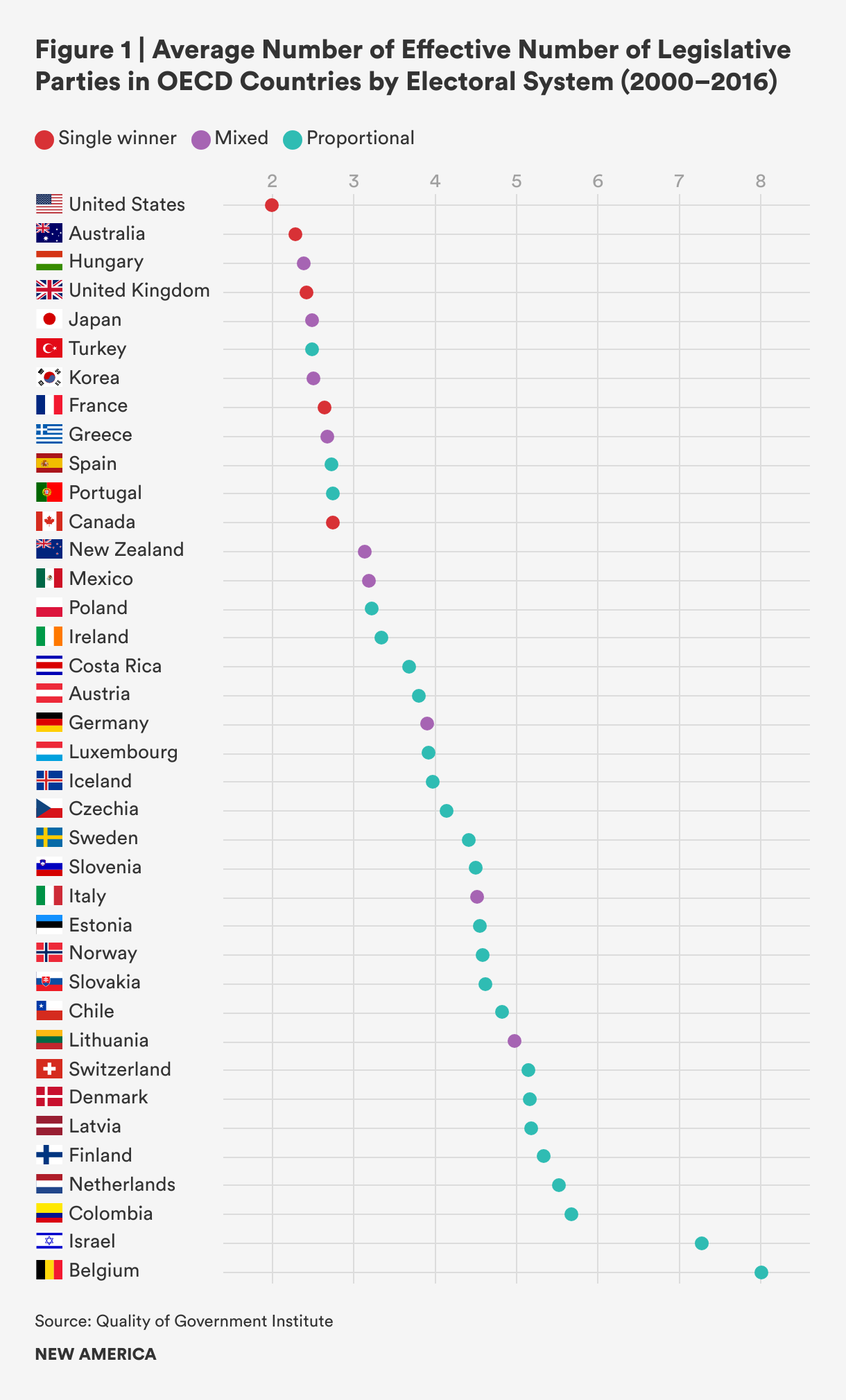
The United States is a global outlier when it comes to our party system. As Figure 1 shows, we have the lowest effective number of legislative parties of any OECD country.29 If there were more legislative parties, we would likely see a wider range of perspectives represented in Congress. For example, the rebels who toppled McCarthy might form their own party and officially disassociate themselves from the leaders they have long accused of being sellouts.
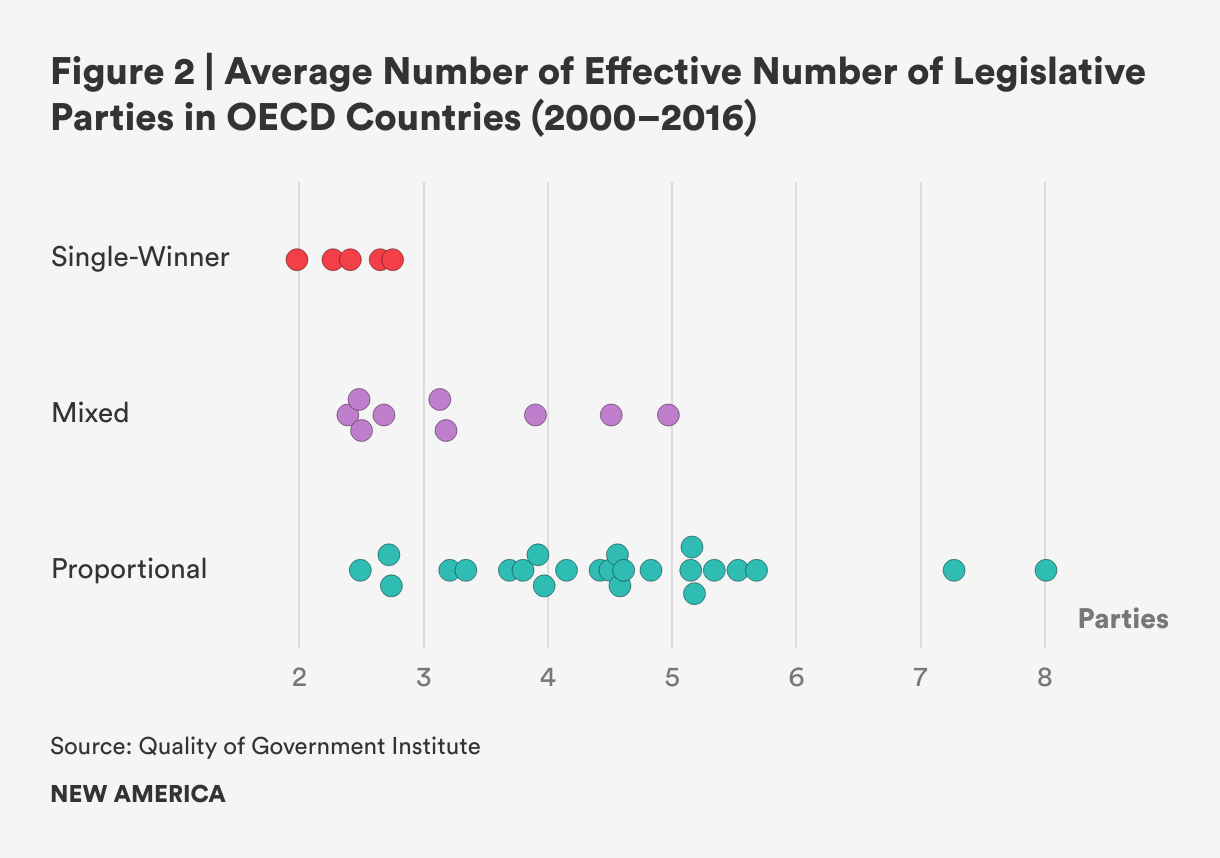
The most direct way out of the two-party binary is adopting a new electoral system that would make new parties viable.30 In most systems of proportional representation (the system used by most democracies), candidates run in multi-member districts and seats are allocated based on the relative number of votes received by the various parties. In our current system, legislative candidates run in single-member districts, and whoever gets the most votes wins the single seat, even if the margin is 51 percent to 49 percent. In a proportional system, a 51-49 percent margin in a district would split multiple seats evenly between the parties. Most democracies use proportional representation, and these countries almost always have more than two parties. Figure 2 shows a clear trend where countries that use proportional representation have a larger number of effective legislative parties.
Proportional representation is possible in the U.S. House because the Constitution does not say that House districts must be single-member. Debates about how to design electoral systems were in a nascent stage in 1787,31 and the founders were silent on how elections would be conducted. The design of the electoral system is critical, though, because it largely determines the number of competitive parties.32 Thus, the founding document’s silence about electoral design is a key part of our “unwritten Constitution”—the informal institutions and procedures that shape American governance.33
“Proportional representation is possible in the U.S. House because the Constitution does not say that House districts must be single-member.”
In the face of this silence, the states adopted a hybrid system with both single-winner majoritarianism and at-large bloc voting.34 Given concerns about malapportionment and racial disenfranchisement in the 1960s, Congress passed the Uniform Congressional District Act (UCDA), which required that all states use single-member districts for House elections.35 States use different methods to determine the winners of these elections (i.e., first-past-the-post, runoffs, and more recently, ranked choice), but the commonality across all districts is that only one winner will emerge from each contest, so there are strategic incentives to consolidate around the two most viable choices.36
While amending the UCDA would be a relatively simple technical change to electoral law, doing so would have significant effects on our elections and governing system. Reformers have, thus far, devoted significantly more attention to the former, even though governance is equally important in American politics. We first review proportional representation as an electoral reform and then consider it as a governance reform.
Proportional Representation as an Electoral Reform
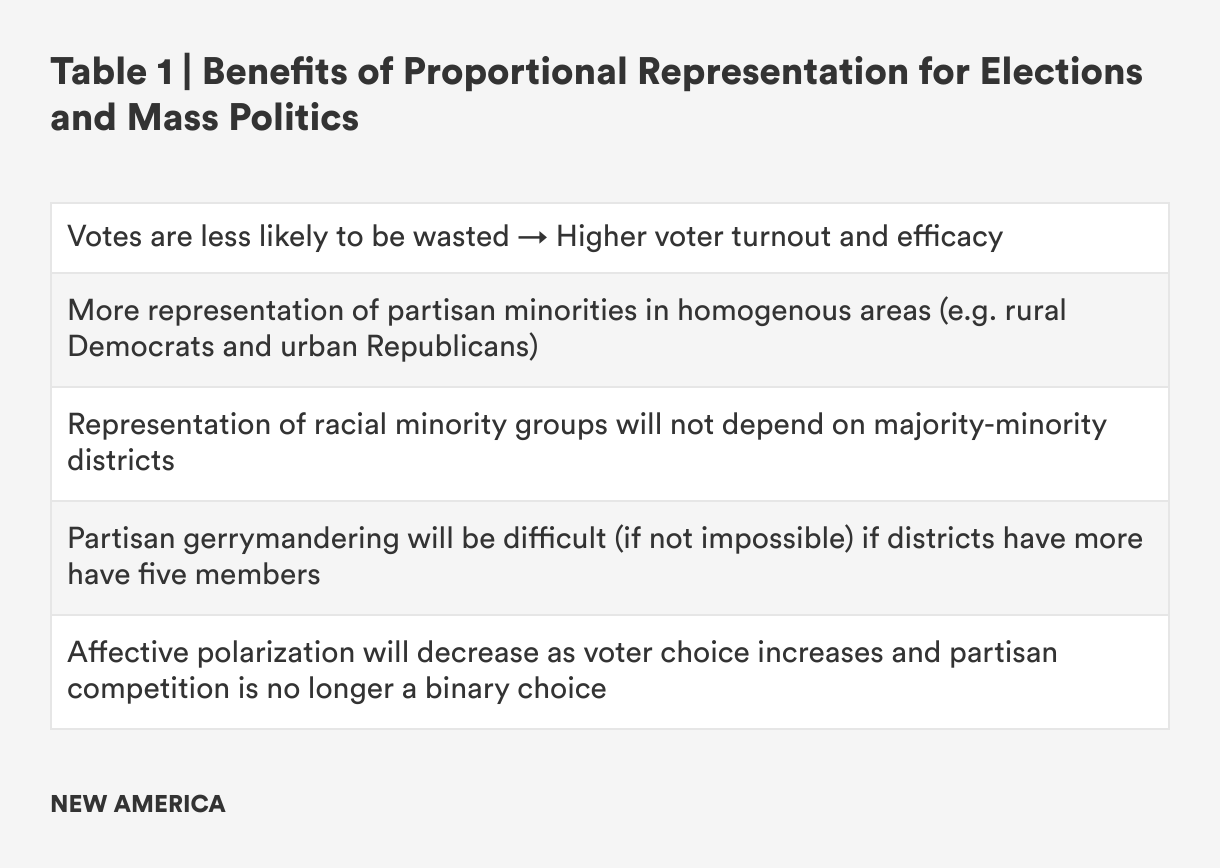
If we amended the UCDA to mandate that states use multimember districts and proportionally allocate votes when electing representatives, then it is almost guaranteed that more than two parties would be viable in House elections. We, along with many other scholars, believe that if a modest number of members are elected in each district, a proportional system will make our politics more representative, our electorate more engaged, and soften the all-or-nothing binary.37 While the benefits of proportional representation for elections and voters are not the focus of this paper, it is worth highlighting a few of them.
Proportional representation would make citizens’ votes count more equally. In multimember districts—which are a necessary feature of proportional representation— parties can win seats even if they are well short of a majority. Accordingly, fewer votes are wasted than in lopsided single-member districts, where voters can abstain without affecting the outcome. This would likely improve voter turnout and ease the urban-rural divide, as Democratic voters in conservative rural areas and Republican voters in liberal urban areas would be able to secure some representation even though they are vastly outnumbered. For example, Massachusetts Republicans would be able to elect some members of the state’s congressional delegation. Under the current system, Republican voters are about one-third of the electorate but are so thinly spread across the state that Democrats control all nine House seats. Similarly, Democrats do not hold any of Oklahoma’s five congressional districts despite winning a third of the vote in 2020.38
“A proportional system will make our politics more representative, our electorate more engaged, and soften the all-or-nothing binary.”
Racial and ethnic minorities would also receive fairer representation as long as most parties continue to support and value non-white candidates (given demographic trends, we have good reason to think that they will). In a proportional system, their representation would no longer depend on majority-minority districts mandated by the Voting Rights Act, which tend to “pack” minority groups in geographically concentrated areas and limit the possibilities for multiracial and multiethnic coalitions.
More generally, as long as districts elect at least five members, proportional representation would effectively end gerrymandering in American politics by making it very difficult (if not impossible) to draw lines that benefit one party or group over the others.39 Control of the House would no longer depend so much on lawyers and experts litigating the fairness of district lines and tit-for-tat gerrymanders in blue and red states.
Finally, proportional representation would move American politics away from zero-sum partisan competition. In a closely divided two-party system, each party only has one mortal enemy (the other), and a vote for one is effectively a vote against the other. As a result, the parties try to win votes through demonization. Proportional representation would give voters more options, and they would no longer feel that they must vote for a flawed candidate from one party because the other party is evil incarnate. Shifting coalitional alliances would soften the out-party hatred consuming U.S. politics.40 The binary rigidity in our current system would begin to be replaced by more nuance and complexity, lessening affective polarization and partisan identity politics.41
Proportional representation promotes a politics where different perspectives are represented, and Americans must learn to accept and live with each other. This is a more natural fit for a large and diverse nation like the United States than a single-winner system where two opponents focus on defeating each other for narrow majority control.42 It has worked well to build social cohesion in countries like the Netherlands and Switzerland, which have been able to overcome considerable religious and linguistic divisions over their histories.43 The salutary effects of this electoral system are summarized in Table 1.
Proportional Representation as a Governance Reform
While reformers have mostly focused on how proportional representation would affect elections, this is just one stage of the political process. Much less thought has gone into how a multiparty system would affect governance or the processes through which elected officials organize institutions and then create and implement public policy. Given that our basic governing institutions are enshrined in the Constitution (presidency, separation of powers, bicameralism, etc.) and cannot easily be changed, we must ask how multipartyism would work within what already exists.
Some of the benefits of proportional representation for governance follow naturally from the electoral changes. Most notably, proportional representation will change the composition of people who are elected to Congress. To the extent that gerrymandering and the rural-urban divide have prevented more moderate or cross-pressured representatives from entering Congress in the first place (e.g., conservatives from cities, liberals from the countryside, or anyone whose potential voting support coalition is currently too diluted to represent a majority in any single district), proportional representation would alleviate this problem.
“Given that our basic governing institutions are enshrined in the Constitution and cannot easily be changed, we must ask how multipartyism would work within what already exists.”
When Illinois used a form of proportional representation prior to the 1980s, lawmakers reported less rural-urban polarization, greater civility, and better representation of political minorities.44 If similar conditions were recreated in Congress, there could be downstream effects, as high-quality and more moderate candidates would no longer perceive Congress to be hopelessly polarized and be more attracted to run and serve.45
Changing the types of people who get elected opens up many possibilities, as Congress is, after all, made up of people who decide which issues are prioritized. Ultimately, all governing is coalition governing. In any legislature, multiple governing coalitions are possible across individuals, factions, and parties. But these coalitions can only be built by the representatives who get elected. The wide array of possibilities creates a significant challenge in taking the current dynamics of the two-party, single-member district House and projecting them forward into a multiparty, multi-member district House. Politics would simply look very different in ways we cannot anticipate.
But, as with all reforms, we must be careful about unintended consequences. Institutional reformers have been wrong before, and the consequences were not trivial.46 There are certainly reasonable concerns that more parties might make governing even more fractious and incoherent, worsen problems of gridlock and immobilism, and empower the president at Congress’s expense.47
We do not deny these are possible outcomes. But we also see ways in which more parties and a more proportional electoral system might improve governing and increase problem solving capacity. In other words, a range of outcomes is possible. Our goal here is not to proclaim a definitive analysis of what would happen but rather to anticipate how governing and institutional dynamics might change and consider how particular institutional design choices might foster compromise and collective problem-solving in a multiparty Congress.
“Many countries with multiple parties have better policy representation, legislative accountability, and government stability.”
Though we draw considerably on the history of Congress and the practices of state and international legislatures throughout, our judgments are necessarily speculative. Lawmakers are the ones who actually implement political reforms. The contingent choices they make and the norms they establish will be far more important than ideas and plans from outside advocates. And, while it is not guaranteed, we think there are pathways to success. Many countries with multiple parties have better policy representation, legislative accountability, and government stability.48 New Zealand transitioned to multipartyism while remaining one of the world’s most prosperous and politically stable countries. If other countries can make it work, it must also be possible in the United States.

Citations
- The effective number of legislative parties accounts for both the number of parties and their relative sizes. For more, see Taylor, Shugart, Lijphart, and Grofman, A Different Democracy, 174.
- Duverger’s Law states that single-member winner districts (district magnitude M = 1) will result in a two-party system; Gary Cox generalized this, claiming that the number of competitive parties in a district (P) is the sum of the district magnitude plus 1 (P = M+1). This is due to strategic considerations in electoral coordination. Duverger’s Law and its generalization does not hold in Canada and some federalist systems like India due to the presence of strong regional parties. Maurice Duverger, Political Parties: Their Organization and Activity in the Modern State (New York: Methuen & Co., 1954); Gary Cox, Making Votes Count: Strategic Coordination in the World’s Electoral Systems (Cambridge, United Kingdom: Cambridge University Press, 1997).
- Single-winner majoritarian was the only election being used at the time (and for decades afterwards), making it “the only game in town.” See Robert Dahl, How Democratic Is the American Constitution? (New Haven, CT: Yale University Press, 2003), 56.
- However, it is not the only factor and causation runs in both directions. See Josep Colomer, “It’s Parties That Choose Electoral Systems: (Or, Duverger’s Laws Upside Down),” Political Studies 53, no. 1-21 (2005), https://journals.sagepub.com/doi/10.1111/j.1467-9248.2005.00514.x.
- Dahl, How Democratic Is the American Constitution?.
- Multimember districts are used in a bloc voting system, but the individual contests are still decided by winner-take-all standards rather than proportional representation. This allows the party with more than 50 percent of the vote to potentially capture all of the seats in a district and disenfranchise the minority party. Grant Tudor and Beau Tremitiere, Towards Proportional Representation for the U.S. House: Amending the Uniform Congressional District Act (Washington, DC: Protect Democracy, 2023), https://protectdemocracy.org/work/proportional-representation-ucda/.
- The House had originally mandated single-member districts in the 1842 Apportionment Act, but several states using at-large bloc ignored this limitation as they believed it to be unconstitutional. See Tudor and Tremitiere, Towards Proportional Representation for the U.S. House, https://protectdemocracy.org/work/proportional-representation-ucda/.
- Cox, Making Votes Count.
- We caveat this because the particular details of the proportional system matter greatly. We would be most enthusiastic about an electoral system that encourages the formation of five to six legislative parties rather than one that encourages fragmentation. See John Carey and Oscar Pocasangre, Can Proportional Representation Lead to Better Governance? (Washington, DC: Protect Democracy, 2024), https://protectdemocracy.org/work/can-proportional-representation-create-better-governance/.
- Peter Miller and Michael Li, “PR Can Reduce the Impact of Gerrymandering,” Democracy: A Journal of Ideas 70 (Fall 2023), https://democracyjournal.org/magazine/70/pr-can-reduce-the-impact-of-gerrymandering/.
- Miller and Li, “PR Can Reduce the Impact of Gerrymandering,” https://democracyjournal.org/magazine/70/pr-can-reduce-the-impact-of-gerrymandering/.
- Will Horne, James Adams, and Noam Gidron, “The Way we Were: How Histories of Co-Governance Alleviate Partisan Hostility,” Comparative Political Studies 56, no. 3 (2023): 299–325, https://journals.sagepub.com/doi/abs/10.1177/00104140221100197.
- Lilliana Mason, Uncivil Agreement: How Politics Became Our Identity (Chicago, IL: University of Chicago Press, 2018).
- Lee Drutman, Elections, Political Parties, and Multiracial, Multiethnic Democracy: How The United States Gets It Wrong (New York: NYU Law Review, 2021), https://www.nyulawreview.org/wp-content/uploads/2021/10/Drutman-ONLINE.pdf.
- Switzerland also solves its problem of different regional language and culture blocs through a heavy dose of localism. See Dahl, How Democratic Is the American Constitution?.
- Grant Tudor and Cerin Lindgrensavage, “The Lost Illinois Elections Experiment” (Protect Democracy unpublished brief), 2024.
- Danielle Thomsen, Opting Out of Congress: Partisan Polarization and the Decline of Moderate Candidates (Cambridge, United Kingdom: Cambridge University Press, 2017).
- Julian Zelizer, On Capitol Hill: The Struggle to Reform Congress and Its Consequences, 1948–2000 (Cambridge, United Kingdom: Cambridge University Press, 2006).
- Ruth Bloch Rubin and Gregory Elinson, “More Parties, More Problems? Why PR Might Not Work,” Democracy: A Journal of Ideas 70 (Fall 2023), https://democracyjournal.org/magazine/70/more-parties-more-problems-why-pr-might-not-work/.
- Carey and Pocasangre, Can Proportional Representation Lead to Better Governance?, https://protectdemocracy.org/work/can-proportional-representation-create-better-governance/.