A Chapter of: Kansas and Fusion Voting: Democratic Participation and Responsive Representation in the Sunflower State
Dynamic Alliances and Responsive Representation in Kansas Politics
Cross-nomination was present as early as Kansas’s first gubernatorial election after receiving statehood in 1862.4 For the remainder of the nineteenth century, Kansans utilized cooperative voting to win seats in the Kansas legislature and support their preferred candidates in federal elections. Many of these reform parties came and went with lifespans of just a few election cycles. The limited lifespan of minor parties is largely the consequence of a focus on single issues such as “currency contraction, unequal distribution of the tax burden, political corruption, distribution of public lands,…the difficulties experienced by Kansas farmers resulting from the whims of nature, the rise and fall of the market, mounting surpluses, and their utter dependence on railroad transportation.”5 Equally important, reform candidates and parties emerged as responses to Republican failures to address these issues and concerns. Republicans served as governors for 30 of the 32 years between 1861 and 1893. All of the state’s U.S. Senators between 1861 and 1891 were Republicans, as were 18 of 19 Representatives.6
1872–1890: Kansas Reform Parties against the Dominant Republicans and the Losing Democrats
1872 saw one of the earliest coalitions in Kansas politics: the Liberal-Republican Coalition. This coalition was made up of reform-oriented members of the Republican Party who fused with Democrats to advocate for a return to classic Republican values over concerns about increasingly centralized government and widespread corruption.7 The Liberal-Republican Coalition had minimal success in Kansas electoral politics, however, as its campaign centered more on the personalities of its candidates than its platform.8 Nonetheless, the Liberal-Republican movement clearly displayed Kansas voters’ assumption that the party and election system were flexible and adaptive to new and changing issues.
Similarly demonstrating the evolution of political organizations during this period, the Greenback Party emerged in 1873.9 Lasting through the 1880s in various forms, the Greenbacks were an anti-monopoly coalition that supported currency expansion, women’s suffrage, worker protections, and the exclusion of Chinese workers on the railroads.10 Although beginning in the Midwest, Greenbackism became a national movement that garnered some success in the 1876 presidential election—Peter Cooper, the Greenbacks’ nominee, finished third with 6 percent of the vote in Kansas.11 While the Kansas Greenbacks refused an offer from the Democrats to fuse in the 1876 gubernatorial race, they won 42 seats in the state legislature, mainly by fusing with Republicans.12
By the late 1880s, the Populist (or “People’s”) Party emerged as the most influential minor party.13 The party emerged from the Farmers Alliance, a national organization of farmers that sought to advance agrarian interests as environmental, banking, transportation, and market factors crippled much of the farm industry. Populists championed many of the agrarian interests of past reform movements and relied on farmers’ and laborers’ perceptions of neglect by both Republicans and Democrats to garner support.14 The Populists’ platform prioritized issues that had received scant attention from either major party: “railroad regulation, usury and interest regulation, labor legislation, tax reform, stockyard regulation,” and “unemployment relief,” among others.15
In order to succeed, Populists needed to attract voters from other parties. In particular, they needed to overcome the Republican majority that had existed since statehood. The bitter legacies of “Bloody Kansas,” the antislavery movement, the Civil War, and the role Kansas played in the fight to preserve the Union was foundational to the success of the Republican Party in Kansas. Democrats were associated with the defeated South, immigrants in the East, and opposition to prohibition, and thus viewed as “rebels” and “traitors.”16 Accordingly, Democrats were uncompetitive in Kansas politics. In fact, only one Democratic candidate for governor between 1862 and 1936 won at least 50 percent of the state vote. On the other hand, in the nine elections from 1862 to 1880, Republican gubernatorial candidates carried 90 percent of the state’s counties.17
1890–1898: Interparty Cooperation Challenges Republican Control
The pathway to political victory meant shifting voters away from traditional Republicanism. While a transformation of the Republican party itself was foreclosed, third-party activity and fusion coalitions presented a more feasible pathway.
During the 1890s, some members of the Populist Party did not want to affiliate with the Democrats. Populist leaders were solely focused on winning over dissatisfied Republicans and urged the Populist Party to fuse with Republicans instead.18 Still, others within the Populist Party rejected fusion and hoped their party could become a majority on its own.19 Similarly, some Democrats considered fusion proposals “only on calculations of political bargaining and practical politics,”20 while others saw parallels between Populist goals and their own. At the same time, Kansas Republicans launched intense attacks on Populism and their fusion strategy while simultaneously recognizing the growing electoral appeal of Populist policies (which led to the adoption of many of their ideas).21
The event that brought these issues to the forefront was the 1890 election. The Populists formed their new party that year and immediately named a slate of candidates. In 1888, the Republican candidate for governor had won over 54 percent of ballots, while the Democrat took 32 percent.22 But in 1890, the incumbent Republican won just 39 percent of the vote and the Democrat a mere 24 percent.23 The upstart Populists took 36 percent, more than 100,000 votes.24 Populists, with a mix of standalone and fusion candidates, won 91 state representative seats—nearly 75 percent of the Kansas legislature.25 In the preceding state house, there had been 121 Republicans, two Democrats, and two Union Laborites—after the 1890 election, Republicans held only 26 seats.26 The dominant Republicans also lost five of their seven Congressional seats.27 As a result of their success in the Kansas legislature, Populist William A. Peffer (a former Republican) was chosen to replace U.S. Senator John J. Ingalls, a Republican who held the seat for 18 years.28
With control of the legislature, Populists turned their attention to capturing executive offices and the courts. In 1890, the Populist and Democratic candidates could garner a combined 60 percent of the vote. Fearing the potential of being cast aside as an even less relevant “third party,” Kansas Democrats saw fusion as their path to survival. At their 1892 state convention, the Democrats “declared for complete fusion and nominated the entire elected and state ticket” of the Populists.29 The Populist convention also endorsed the combined ticket approach.30
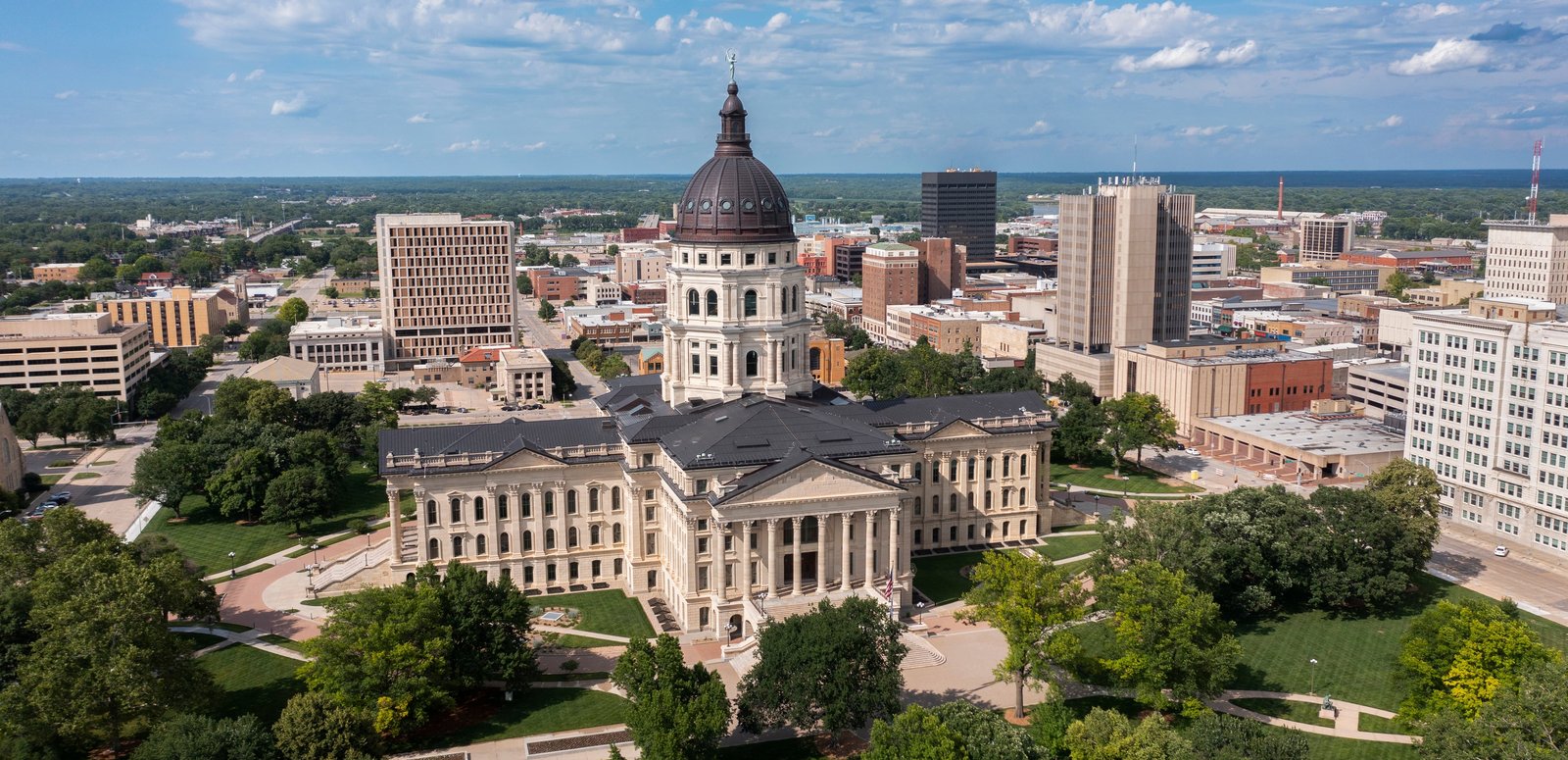
Fusion achieved impressive results for Populists in 1892.31 James Weaver and James Field, the first Populist presidential and vice presidential candidates, captured just over 50 percent of the state’s vote.32 The Democrat, former President Grover Cleveland, was not on an official ballot. Similarly, Democrats did not run a candidate for governor but instead put their support behind Populist Lorenzo D. Lewelling, who won more than 50 percent of the vote.33 Populist-aligned candidates also won a majority in the State Senate and garnered an equal split with Republicans in the State House.34 Such narrow margins in the House led to a legislative war between the Populists and Republicans, as both claimed they had won a majority of seats. The conflict almost led to actual bloodshed when cannons and other guns were stationed on the Capitol grounds.35 Despite this chaos, with control of the governorship and the upper house, Populists went on to codify an electoral system designed to safeguard their success for elections to come.36
Citations
- In 1862, “Democrats combined with Anti-Lane Republicans to support Union candidate.” Clarence J. Hein and Charles A. Sullivant, Kansas Votes: Gubernatorial Elections, 1859–1956 (Lawrence, KS: University of Kansas Governmental Research Center, 1957), 4, https://babel.hathitrust.org/cgi/pt?id=mdp.39015081958004. The similar strategy in the 1864 presidential contest has already been noted.
- Robert G. Fogg, The Greenback Movement in Kansas 1874–1884 (Wichita, KS: Wichita State University, 1954), 26, https://soar.wichita.edu/handle/10057/25008.
- Fogg, The Greenback Movement in Kansas, 26, https://soar.wichita.edu/handle/10057/25008; “Former Governors: Kansas,” National Governors’ Association, https://www.nga.org/former-governors/kansas/.
- Andrew L. Slap, The Doom of Reconstruction: The Liberal Republicans in the Civil War (New York: Fordham University Press, 2006), xxv.
- Earle Dudley Ross, The Liberal Republican Movement (New York: Henry Holt and Company, 1919), 150–60, https://www.loc.gov/item/19012223/. Notably, the Liberal-Republican presidential candidate, Horace Greeley (a Republican), received about 32 percent of the state’s vote, while the “straight” Democrat won less than 1 percent. “1872 Presidential General Election Results: Kansas,” in Dave Leip’s Atlas of U.S. Presidential Elections, https://bit.ly/4fw9GNP.
- Fogg, The Greenback Movement in Kansas, 10–11, https://soar.wichita.edu/handle/10057/25008; Ryan A. Stephans, Greenbackers & Populists: The Failures and Successes of Agrarian Reform Movements in Douglas County, Kansas, 1874–1904 (Emporia, KS: Emporia State University, May 2011), 7, https://esirc.emporia.edu/bitstream/handle/123456789/675/Ryan%20Stephans.pdf.
- Fogg, The Greenback Movement in Kansas, 33, https://soar.wichita.edu/handle/10057/25008.
- “1876 Presidential Election Statistics,” in Dave Leip’s Atlas of U.S. Presidential Elections, https://bit.ly/3SJ6zbn. Demonstrating Republican control, Rutherford Hayes easily won the state in a landslide with more than 63 percent of the vote, while Samuel Tilden, the Democrat, received only about 30 percent of the ballots.
- Fogg, The Greenback Movement in Kansas, 24–27, https://soar.wichita.edu/handle/10057/25008.
- O. Gene Clanton, Kansas Populism: Ideas and Men (Lawrence, KS: University Press of Kansas, 1969), 1, https://doi.org/10.1353/book.81133.
- Peter H. Argersinger, The Limits of Agrarian Radicalism: Western Populism and American Politics (Lawrence, KS: University Press of Kansas, 1995), 21, 105.
- Peter H. Argersinger, “Populists in Power: Public Policy and Legislative Behavior,” Journal of Interdisciplinary History 18, no. 1 (Summer 1987): 83, https://doi.org/10.2307/204729.
- Fogg, The Greenback Movement in Kansas, 44, https://soar.wichita.edu/handle/10057/25008.
- Clanton, Kansas Populism, 20, https://doi.org/10.1353/book.81133.
- Argersinger, The Limits of Agrarian Radicalism, 102–103.
- Argersinger, The Limits of Agrarian Radicalism, 105.
- Argersinger, The Limits of Agrarian Radicalism, 103.
- Argersinger, The Limits of Agrarian Radicalism, 103. These kinds of debates took place around the country. In the South, Populists sought alliances with the Republicans against Democrats, who had controlled the region since the end of Reconstruction.
- Hein and Sullivant, Kansas Votes, 25, https://babel.hathitrust.org/cgi/pt?id=mdp.39015081958004.
- Hein and Sullivant, Kansas Votes, 27, https://babel.hathitrust.org/cgi/pt?id=mdp.39015081958004.
- Hein and Sullivant, Kansas Votes, 27, https://babel.hathitrust.org/cgi/pt?id=mdp.39015081958004.
- D. Scott Barton, “Party Switching and Kansas Populism,” The Historian 52, no. 3 (May 1990): 453, https://www.jstor.org/stable/24448020.
- Barton, “Party Switching and Kansas Populism,” 457, https://www.jstor.org/stable/24448020.
- Peter H. Argersinger, “Road to a Republican Waterloo: The Farmers’ Alliance and the Election of 1890 in Kansas,” Kansas Historical Quarterly 33, no. 4 (Winter 1967): 443, https://www.kancoll.org/khq/1967/67_4_argersinger.htm.
- Argersinger, “Road to a Republican Waterloo,” 443, https://www.kancoll.org/khq/1967/67_4_argersinger.htm.
- Argersinger, The Limits of Agrarian Radicalism, 112.
- Barton, “Party Switching and Kansas Populism,” 459–60, https://www.jstor.org/stable/24448020.
- See R. Alton Lee, “Anti-Fusion Election Laws in Populist Kansas,” Heritage of the Great Plains 46, no. 2 (Winter 2014): 9, https://esirc.emporia.edu/bitstream/handle/123456789/3386/R.%20Alton%20Lee.pdf.
- Lee, “Anti-Fusion Election Laws in Populist Kansas,” 9, https://esirc.emporia.edu/bitstream/handle/123456789/3386/R.%20Alton%20Lee.pdf; June G. Cabe and Charles A. Sullivant, Kansas Votes: National Elections, 1859–1956 (Lawrence, KS: University of Kansas Government Research Center, 1957), 20–21, https://archive.org/details/kansasvotesnatio00cabe.
- Hein and Sullivant, Kansas Votes, 29, https://babel.hathitrust.org/cgi/pt?id=mdp.39015081958004.
- Lee, “Anti-Fusion Election Laws in Populist Kansas,” 9, https://esirc.emporia.edu/bitstream/handle/123456789/3386/R.%20Alton%20Lee.pdf.
- Lee, “Anti-Fusion Election Laws in Populist Kansas,” 9, https://esirc.emporia.edu/bitstream/handle/123456789/3386/R.%20Alton%20Lee.pdf. See also Peter H. Argersinger, “‘A Place on the Ballot’: Fusion Politics and Fusion Laws,” American Historical Review 85, no. 2 (Apr. 1980): 288, https://doi.org/10.2307/1860557; Robert W. Richmond, Kansas: A Land of Contrasts, 3rd ed. (Wheeling, IL: Forum Press, 1989), 191–194.
- Lee, “Anti-Fusion Election Laws in Populist Kansas,” 10, https://esirc.emporia.edu/bitstream/handle/123456789/3386/R.%20Alton%20Lee.pdf.