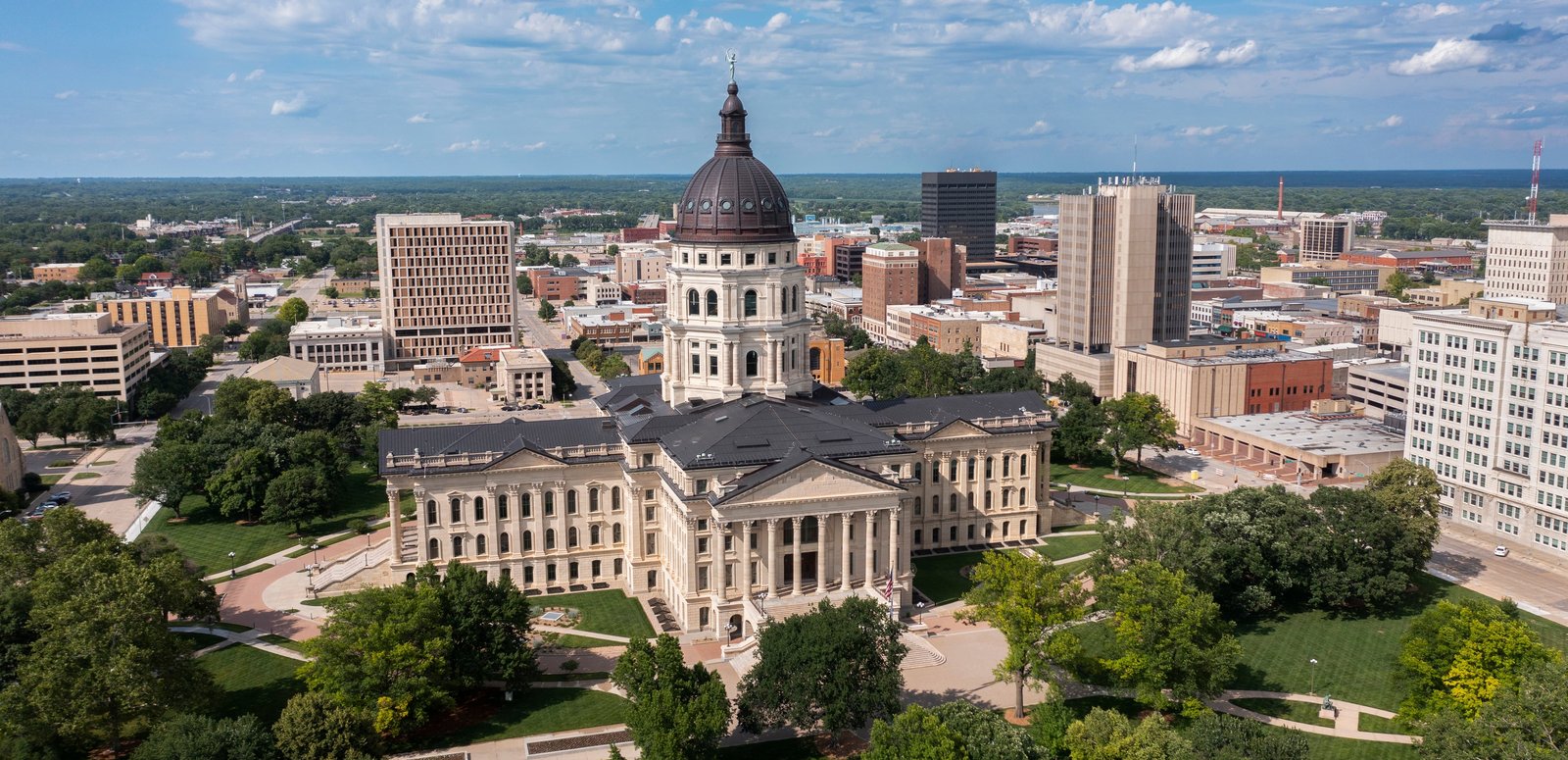
Kansas and Fusion Voting: Democratic Participation and Responsive Representation in the Sunflower State
Abstract
A majority of Americans desire more electoral choice than the current two-party system provides, a duopoly sustained by voting rules such as single-member districts and winner-take-all elections. These rules discourage minority party candidates and voters from participating, fearing wasted votes or spoiled elections. Historically, Kansas politics suffered from such dysfunction but thrived under “fusion” voting, which allows multiple parties to support a single candidate. This system fostered coalition-building and increased representation, exemplified by the successful fusion of the Populist and Democratic parties in the 1890s, leading to significant electoral victories and robust democratic engagement.
Acknowledgments
Thanks to James Hunt, Jack Santucci, Zachary Watterson, Amelia Spooner, Carli Sley, Benjamin Rutan, Francy Luna Diaz, and Lily Bohlke for their many contributions to the research and analysis incorporated in this text. All remaining errors are mine.
Editorial disclosure: The views expressed in this report are solely those of the author(s) and do not reflect the views of New America, its staff, fellows, funders, or board of directors.
Downloads
Introduction
A majority of Americans desire more electoral choice than that offered by our current two-party Democrat-Republican duopoly.1 That duopoly arises principally from voting rules enacted by those parties themselves, not our Constitution. Among the most important of these rules is a commitment to single-member districts for democratic elections and the award of plenary power of any elective office to whatever candidate wins a plurality of votes. Such a “single-member district, winner takes all” system discourages party organization of candidates with values held by a minority, and voters holding those values will be reluctant to express them at the ballot box—in both cases for fear of “wasting” votes on candidates with no chance of winning or “spoiling” an election by imprudently choosing the “perfect” over the “acceptable” and ensuring victory of their least desired candidate. At times of broad national consensus on national identity and lowered policy differences among the parties, this duopoly can be functional for popular democratic government. When those conditions do not exist, however, and especially when the electorate is roughly equally divided between sharply opposing views of identity, it is a guarantor of everyday dysfunction and unstable swings in policy.2
Current Kansas politics suffers from such dysfunction, along with the representation-suppressing effects on minority political sentiment familiar from the single-member-district plurality-voting-winner-takes-all (SMDPV) system at the root of the two-party duopoly. But it wasn’t always so. For a long stretch of its history, Kansas had “fusion” voting, where multiple parties aligned to nominate the same candidate for office. Without disturbing the basics of an SMDPV system, this device increased the representativeness of the system by removing much of the wasted vote and spoiler problems that otherwise suppress the voicing of minority political values. It also improved the health of the overall system by underwriting multiparty coalition-building of the sort typically needed for effective governance.
Fusion voting’s use in Kansas is particularly illustrative of its potential to foster fluid political association and elevate new and pressing issues to the political mainstream. In the state’s first presidential election, Kansas voters cast almost 80 percent of their ballots for the fusion ticket (“National Union”) of Abraham Lincoln, a Republican, and Andrew Johnson, a Democrat. High levels of participatory democracy and voter enthusiasm in Kansas continued in the three decades after the Civil War, reaching its apex in the 1890s with the union of the Populist and Democratic Parties in Kansas, which represents one of the most successful fusions of disparate parties in the nation’s history. In the 1892 and 1896 elections, the fused Populist and Democratic Parties captured Kansas’s entire executive branch, won the state’s electoral votes in the presidential election, elected a majority to the state supreme court, and sent multiple representatives to Congress, including a U.S. Senator. Such electoral success by a minor party went unmatched elsewhere in the United States.
Yet at the turn of the twentieth century, Republican lawmakers—wishing to eliminate political competition—banned fusion and ushered in one-party control. Republicans have governed the state unchallenged for most of the past 120 years, and political evolution or competition has become all but nonexistent. Recognizing this reality, in March 2024, the newly formed political party United Kansas announced its intention to revive fusion voting, pledging to give its nomination to the major party candidate that best represents its values in a given race to “allow new voices and ideas in the political arena.”3 This development presents an opportunity to examine the history of fusion voting in Kansas and its use as a mechanism of political expression and cross-partisan collaboration.
What follows is a narrative of Kansas’s political history and its experience with fusion voting. First, we describe how the more fluid fusion-permissive system of early Kansas allowed for dynamic political alliances and realignments. Such dynamism allowed for a more representative and responsive political system for Kansans. Second, we detail how fusion was codified into Kansas law with the implementation of the Australian Ballot. Third, we explore how the electoral success of fusion led to a calculated attack on its legality by the party, which was defeated by the fusion strategy. The fusion ban ended the dynamic political alliances that had shaped Kansas politics since the Lincoln-Johnson ticket and effectively eliminated the risk of diverse governing coalitions. With fusion outlawed, we then detail the effective one-party Republican state and how supporters of other parties and candidates were banished to the periphery of Kansas politics.
Citations
- Americans’ Dismal View of the Nation’s Politics (Washington, DC: Pew Research Center, 2023), https://www.pewresearch.org/politics/2023/09/19/americans-dismal-views-of-the-nations-politics/.
- For discussion of both the history and current consequences, see Micah Sifry, Spoiling for a Fight: Third-Party Politics in America (New York: Routledge, 2003); Lee Drutman, Breaking the Two-Party Doom Loop: The Case for Multiparty Democracy in America (New York: Oxford University Press, 2019); and Lee Drutman, More Parties, Better Parties: The Case for Pro-Parties Democracy Reform (Washington, DC: New America, 2023), https://www.newamerica.org/political-reform/reports/more-parties-better-parties/.
- Laura MacMillan, “New Kansas political party promises new era of politics,” KSN Kansas, March 12, 2024, https://www.ksn.com/news/your-local-election-hq/new-kansas-political-party-promises-new-era-of-politics/; “About,” United Kansas, https://unitedkansas.com/about.
Dynamic Alliances and Responsive Representation in Kansas Politics
Cross-nomination was present as early as Kansas’s first gubernatorial election after receiving statehood in 1862.4 For the remainder of the nineteenth century, Kansans utilized cooperative voting to win seats in the Kansas legislature and support their preferred candidates in federal elections. Many of these reform parties came and went with lifespans of just a few election cycles. The limited lifespan of minor parties is largely the consequence of a focus on single issues such as “currency contraction, unequal distribution of the tax burden, political corruption, distribution of public lands,…the difficulties experienced by Kansas farmers resulting from the whims of nature, the rise and fall of the market, mounting surpluses, and their utter dependence on railroad transportation.”5 Equally important, reform candidates and parties emerged as responses to Republican failures to address these issues and concerns. Republicans served as governors for 30 of the 32 years between 1861 and 1893. All of the state’s U.S. Senators between 1861 and 1891 were Republicans, as were 18 of 19 Representatives.6
1872–1890: Kansas Reform Parties against the Dominant Republicans and the Losing Democrats
1872 saw one of the earliest coalitions in Kansas politics: the Liberal-Republican Coalition. This coalition was made up of reform-oriented members of the Republican Party who fused with Democrats to advocate for a return to classic Republican values over concerns about increasingly centralized government and widespread corruption.7 The Liberal-Republican Coalition had minimal success in Kansas electoral politics, however, as its campaign centered more on the personalities of its candidates than its platform.8 Nonetheless, the Liberal-Republican movement clearly displayed Kansas voters’ assumption that the party and election system were flexible and adaptive to new and changing issues.
Similarly demonstrating the evolution of political organizations during this period, the Greenback Party emerged in 1873.9 Lasting through the 1880s in various forms, the Greenbacks were an anti-monopoly coalition that supported currency expansion, women’s suffrage, worker protections, and the exclusion of Chinese workers on the railroads.10 Although beginning in the Midwest, Greenbackism became a national movement that garnered some success in the 1876 presidential election—Peter Cooper, the Greenbacks’ nominee, finished third with 6 percent of the vote in Kansas.11 While the Kansas Greenbacks refused an offer from the Democrats to fuse in the 1876 gubernatorial race, they won 42 seats in the state legislature, mainly by fusing with Republicans.12
By the late 1880s, the Populist (or “People’s”) Party emerged as the most influential minor party.13 The party emerged from the Farmers Alliance, a national organization of farmers that sought to advance agrarian interests as environmental, banking, transportation, and market factors crippled much of the farm industry. Populists championed many of the agrarian interests of past reform movements and relied on farmers’ and laborers’ perceptions of neglect by both Republicans and Democrats to garner support.14 The Populists’ platform prioritized issues that had received scant attention from either major party: “railroad regulation, usury and interest regulation, labor legislation, tax reform, stockyard regulation,” and “unemployment relief,” among others.15
In order to succeed, Populists needed to attract voters from other parties. In particular, they needed to overcome the Republican majority that had existed since statehood. The bitter legacies of “Bloody Kansas,” the antislavery movement, the Civil War, and the role Kansas played in the fight to preserve the Union was foundational to the success of the Republican Party in Kansas. Democrats were associated with the defeated South, immigrants in the East, and opposition to prohibition, and thus viewed as “rebels” and “traitors.”16 Accordingly, Democrats were uncompetitive in Kansas politics. In fact, only one Democratic candidate for governor between 1862 and 1936 won at least 50 percent of the state vote. On the other hand, in the nine elections from 1862 to 1880, Republican gubernatorial candidates carried 90 percent of the state’s counties.17
1890–1898: Interparty Cooperation Challenges Republican Control
The pathway to political victory meant shifting voters away from traditional Republicanism. While a transformation of the Republican party itself was foreclosed, third-party activity and fusion coalitions presented a more feasible pathway.
During the 1890s, some members of the Populist Party did not want to affiliate with the Democrats. Populist leaders were solely focused on winning over dissatisfied Republicans and urged the Populist Party to fuse with Republicans instead.18 Still, others within the Populist Party rejected fusion and hoped their party could become a majority on its own.19 Similarly, some Democrats considered fusion proposals “only on calculations of political bargaining and practical politics,”20 while others saw parallels between Populist goals and their own. At the same time, Kansas Republicans launched intense attacks on Populism and their fusion strategy while simultaneously recognizing the growing electoral appeal of Populist policies (which led to the adoption of many of their ideas).21
The event that brought these issues to the forefront was the 1890 election. The Populists formed their new party that year and immediately named a slate of candidates. In 1888, the Republican candidate for governor had won over 54 percent of ballots, while the Democrat took 32 percent.22 But in 1890, the incumbent Republican won just 39 percent of the vote and the Democrat a mere 24 percent.23 The upstart Populists took 36 percent, more than 100,000 votes.24 Populists, with a mix of standalone and fusion candidates, won 91 state representative seats—nearly 75 percent of the Kansas legislature.25 In the preceding state house, there had been 121 Republicans, two Democrats, and two Union Laborites—after the 1890 election, Republicans held only 26 seats.26 The dominant Republicans also lost five of their seven Congressional seats.27 As a result of their success in the Kansas legislature, Populist William A. Peffer (a former Republican) was chosen to replace U.S. Senator John J. Ingalls, a Republican who held the seat for 18 years.28
With control of the legislature, Populists turned their attention to capturing executive offices and the courts. In 1890, the Populist and Democratic candidates could garner a combined 60 percent of the vote. Fearing the potential of being cast aside as an even less relevant “third party,” Kansas Democrats saw fusion as their path to survival. At their 1892 state convention, the Democrats “declared for complete fusion and nominated the entire elected and state ticket” of the Populists.29 The Populist convention also endorsed the combined ticket approach.30
Fusion achieved impressive results for Populists in 1892.31 James Weaver and James Field, the first Populist presidential and vice presidential candidates, captured just over 50 percent of the state’s vote.32 The Democrat, former President Grover Cleveland, was not on an official ballot. Similarly, Democrats did not run a candidate for governor but instead put their support behind Populist Lorenzo D. Lewelling, who won more than 50 percent of the vote.33 Populist-aligned candidates also won a majority in the State Senate and garnered an equal split with Republicans in the State House.34 Such narrow margins in the House led to a legislative war between the Populists and Republicans, as both claimed they had won a majority of seats. The conflict almost led to actual bloodshed when cannons and other guns were stationed on the Capitol grounds.35 Despite this chaos, with control of the governorship and the upper house, Populists went on to codify an electoral system designed to safeguard their success for elections to come.36
Citations
- Americans’ Dismal View of the Nation’s Politics (Washington, DC: Pew Research Center, 2023), https://www.pewresearch.org/politics/2023/09/19/americans-dismal-views-of-the-nations-politics/.
- For discussion of both the history and current consequences, see Micah Sifry, Spoiling for a Fight: Third-Party Politics in America (New York: Routledge, 2003); Lee Drutman, Breaking the Two-Party Doom Loop: The Case for Multiparty Democracy in America (New York: Oxford University Press, 2019); and Lee Drutman, More Parties, Better Parties: The Case for Pro-Parties Democracy Reform (Washington, DC: New America, 2023), https://www.newamerica.org/political-reform/reports/more-parties-better-parties/.
- Laura MacMillan, “New Kansas political party promises new era of politics,” KSN Kansas, March 12, 2024, https://www.ksn.com/news/your-local-election-hq/new-kansas-political-party-promises-new-era-of-politics/; “About,” United Kansas, https://unitedkansas.com/about.
- In 1862, “Democrats combined with Anti-Lane Republicans to support Union candidate.” Clarence J. Hein and Charles A. Sullivant, Kansas Votes: Gubernatorial Elections, 1859–1956 (Lawrence, KS: University of Kansas Governmental Research Center, 1957), 4, https://babel.hathitrust.org/cgi/pt?id=mdp.39015081958004. The similar strategy in the 1864 presidential contest has already been noted.
- Robert G. Fogg, The Greenback Movement in Kansas 1874–1884 (Wichita, KS: Wichita State University, 1954), 26, https://soar.wichita.edu/handle/10057/25008.
- Fogg, The Greenback Movement in Kansas, 26, https://soar.wichita.edu/handle/10057/25008; “Former Governors: Kansas,” National Governors’ Association, https://www.nga.org/former-governors/kansas/.
- Andrew L. Slap, The Doom of Reconstruction: The Liberal Republicans in the Civil War (New York: Fordham University Press, 2006), xxv.
- Earle Dudley Ross, The Liberal Republican Movement (New York: Henry Holt and Company, 1919), 150–60, https://www.loc.gov/item/19012223/. Notably, the Liberal-Republican presidential candidate, Horace Greeley (a Republican), received about 32 percent of the state’s vote, while the “straight” Democrat won less than 1 percent. “1872 Presidential General Election Results: Kansas,” in Dave Leip’s Atlas of U.S. Presidential Elections, https://bit.ly/4fw9GNP.
- Fogg, The Greenback Movement in Kansas, 10–11, https://soar.wichita.edu/handle/10057/25008; Ryan A. Stephans, Greenbackers & Populists: The Failures and Successes of Agrarian Reform Movements in Douglas County, Kansas, 1874–1904 (Emporia, KS: Emporia State University, May 2011), 7, https://esirc.emporia.edu/bitstream/handle/123456789/675/Ryan%20Stephans.pdf.
- Fogg, The Greenback Movement in Kansas, 33, https://soar.wichita.edu/handle/10057/25008.
- “1876 Presidential Election Statistics,” in Dave Leip’s Atlas of U.S. Presidential Elections, https://bit.ly/3SJ6zbn. Demonstrating Republican control, Rutherford Hayes easily won the state in a landslide with more than 63 percent of the vote, while Samuel Tilden, the Democrat, received only about 30 percent of the ballots.
- Fogg, The Greenback Movement in Kansas, 24–27, https://soar.wichita.edu/handle/10057/25008.
- O. Gene Clanton, Kansas Populism: Ideas and Men (Lawrence, KS: University Press of Kansas, 1969), 1, https://doi.org/10.1353/book.81133.
- Peter H. Argersinger, The Limits of Agrarian Radicalism: Western Populism and American Politics (Lawrence, KS: University Press of Kansas, 1995), 21, 105.
- Peter H. Argersinger, “Populists in Power: Public Policy and Legislative Behavior,” Journal of Interdisciplinary History 18, no. 1 (Summer 1987): 83, https://doi.org/10.2307/204729.
- Fogg, The Greenback Movement in Kansas, 44, https://soar.wichita.edu/handle/10057/25008.
- Clanton, Kansas Populism, 20, https://doi.org/10.1353/book.81133.
- Argersinger, The Limits of Agrarian Radicalism, 102–103.
- Argersinger, The Limits of Agrarian Radicalism, 105.
- Argersinger, The Limits of Agrarian Radicalism, 103.
- Argersinger, The Limits of Agrarian Radicalism, 103. These kinds of debates took place around the country. In the South, Populists sought alliances with the Republicans against Democrats, who had controlled the region since the end of Reconstruction.
- Hein and Sullivant, Kansas Votes, 25, https://babel.hathitrust.org/cgi/pt?id=mdp.39015081958004.
- Hein and Sullivant, Kansas Votes, 27, https://babel.hathitrust.org/cgi/pt?id=mdp.39015081958004.
- Hein and Sullivant, Kansas Votes, 27, https://babel.hathitrust.org/cgi/pt?id=mdp.39015081958004.
- D. Scott Barton, “Party Switching and Kansas Populism,” The Historian 52, no. 3 (May 1990): 453, https://www.jstor.org/stable/24448020.
- Barton, “Party Switching and Kansas Populism,” 457, https://www.jstor.org/stable/24448020.
- Peter H. Argersinger, “Road to a Republican Waterloo: The Farmers’ Alliance and the Election of 1890 in Kansas,” Kansas Historical Quarterly 33, no. 4 (Winter 1967): 443, https://www.kancoll.org/khq/1967/67_4_argersinger.htm.
- Argersinger, “Road to a Republican Waterloo,” 443, https://www.kancoll.org/khq/1967/67_4_argersinger.htm.
- Argersinger, The Limits of Agrarian Radicalism, 112.
- Barton, “Party Switching and Kansas Populism,” 459–60, https://www.jstor.org/stable/24448020.
- See R. Alton Lee, “Anti-Fusion Election Laws in Populist Kansas,” Heritage of the Great Plains 46, no. 2 (Winter 2014): 9, https://esirc.emporia.edu/bitstream/handle/123456789/3386/R.%20Alton%20Lee.pdf.
- Lee, “Anti-Fusion Election Laws in Populist Kansas,” 9, https://esirc.emporia.edu/bitstream/handle/123456789/3386/R.%20Alton%20Lee.pdf; June G. Cabe and Charles A. Sullivant, Kansas Votes: National Elections, 1859–1956 (Lawrence, KS: University of Kansas Government Research Center, 1957), 20–21, https://archive.org/details/kansasvotesnatio00cabe.
- Hein and Sullivant, Kansas Votes, 29, https://babel.hathitrust.org/cgi/pt?id=mdp.39015081958004.
- Lee, “Anti-Fusion Election Laws in Populist Kansas,” 9, https://esirc.emporia.edu/bitstream/handle/123456789/3386/R.%20Alton%20Lee.pdf.
- Lee, “Anti-Fusion Election Laws in Populist Kansas,” 9, https://esirc.emporia.edu/bitstream/handle/123456789/3386/R.%20Alton%20Lee.pdf. See also Peter H. Argersinger, “‘A Place on the Ballot’: Fusion Politics and Fusion Laws,” American Historical Review 85, no. 2 (Apr. 1980): 288, https://doi.org/10.2307/1860557; Robert W. Richmond, Kansas: A Land of Contrasts, 3rd ed. (Wheeling, IL: Forum Press, 1989), 191–194.
- Lee, “Anti-Fusion Election Laws in Populist Kansas,” 10, https://esirc.emporia.edu/bitstream/handle/123456789/3386/R.%20Alton%20Lee.pdf.
Populist Election Laws and a Fusion System
The success of the Populist Party in 1892 led to a series of major reforms to Kansas’s election law. Primarily, Kansas did away with the party ballot and elections administered by the parties.37 Under the older system, which had prevailed in Kansas for all of its prior political history, the parties prepared and distributed their own ballots. In 1893, Kansas moved to a secret ballot administered and regulated by the state itself.38 Amid these changes, the Populist Party sought to protect its hard-won gains by protecting fusion.
1880s: The Introduction of the Australian Ballot System
Voting in the United States throughout much of the nineteenth century was a highly public practice. Citizens with access to the franchise participated openly, often by voice in a public hall or courtyard.39 But as parties became more prominent in American politics, they began to administer elections themselves. This included substantial organization, transportation to polls, and the distribution and printing of ballots.40 Parties printed their own ballots consisting of strips of paper prepared and handed out to voters.41 Often, such strips were of distinct colors that were tailored to the respective party.42 Thus, when voters went to submit their ballots, it was readily apparent who the voter had chosen. This process served the function of helping voters—many of whom were illiterate—understand who their vote would go to. But under this public voting system, bribery and intimidation were also rampant.43
In order to counter such distortions of truly free citizen expression, states began to reform how they administered their elections at the end of the nineteenth century.44 Massachusetts was the first state to adopt the Australian Ballot System statewide, otherwise known as the “secret ballot.”45 During the 1880s, nearly a dozen states followed Massachusetts’ lead and adopted the use of the secret ballot.46 The implementation of the secret ballot required “an official ballot printed at public expense and distributed only by public election officers at the polling place.”47 As a result, elections were publicly administered in accordance with uniform rules and regulations on the time and place of elections; the size, type, and design of official ballots; and the qualification criteria for candidate placement on ballots. Obviously, this gave those in charge of election administration new power, also potentially abused, to shape election results.
1893: Kansas Implements the Australian Ballot, and Fusion is Codified into Election Law
Kansas adopted the Australian Ballot System in 1893 as part of a larger election law package. The initial bill introduced in the Kansas Senate provided “for the printing and distribution of ballots at the public expense for nominating of candidates for public office, to regulate the manner of holding elections, and to enforce the secrecy of the ballot, and to provide punishment for the violation of this act.”48 In addition to its Australian Ballot provisions, it included a host of other technical and administrative details regulating elections in Kansas.49
The provisions included the role of “judges” of the election.50 In essence, these were local party representatives whose job was to oversee the proper functioning of the election law. In Kansas, as in other states, election laws allowed competing parties to have representation among the judges, although no more than two could be from the same political party.51 The selection of these judges prompted an amendment to the pending legislation by Representative J.F. Greenlee, a Republican from Hutchison.52 Greenlee suggested the following language, which became part of the law:
“That when two or more parties holding political views diametrically opposed to each other unite and vote on the same ticket, they shall be deemed and held to constitute one party under the provisions of this act.”53
The amendment reflects several issues with fusion as practiced in Kansas. The amendment expressly authorized what had been a prominent feature of Kansas elections since statehood. It also indicated that even Republican partisans who would go on to embrace anti-fusion laws years later recognized the inherent legality of fusion. And the law made it impossible for Populists and Democrats to constitute all of the three judges of election in a particular location. Ultimately, the 1893 election law confirmed that political parties in Kansas possessed the legal right to cross-nominate candidates, and such candidates could appear in multiple places on the official ballot.54
The public reacted positively to election reforms. The newspaper the Weekly Star and Kansan wrote:
“A great deal has been said about the provisions of this law depriving a party that has fused with another at the preceding election of any representation upon election boards. We can see nothing objectionable about this regulation as to judges and clerks, in which there is no allusion to fusion….Of cours[e], in case of a complete fusion between two parties they could only count as one under this law; but where[,] as in this county last fall, the fusion is only partial and each party to it has separate tickets [in the] field, they will preserve their identity, even though most of their candidates, or all but one, are the same….The law itself is a good one, and its results must prove beneficial…”55
While the 1893 law considered two parties as one for purposes of selecting judges of election, it continued to preserve the legal right of Kansas parties to cooperate using fusion cross-endorsements. The law, even if in a back-handed manner, permitted fusion as an acceptable political strategy that was both election-specific and permitted different combinations for different elections.
The 1893 law contained several additional protections for fusion, thereby expanding its democratic impact. Section 6, Chapter 78 of Session Laws of 1893 allowed parties to identify themselves using up to five words,56 allowing for combinations of parties to be listed on official ballots. Additionally, Section 14 of the law, which described ballot forms, allowed parties to write their nominees under their recognized name or designation—even if there was no official label or title for the party.57 Moreover, fused candidates could be listed under both of the parties they represented.58 Accordingly, the 1983 law afforded voters, as well as candidates, greater electoral choice and more accurately reflected political preferences.
Citations
- Americans’ Dismal View of the Nation’s Politics (Washington, DC: Pew Research Center, 2023), https://www.pewresearch.org/politics/2023/09/19/americans-dismal-views-of-the-nations-politics/.
- For discussion of both the history and current consequences, see Micah Sifry, Spoiling for a Fight: Third-Party Politics in America (New York: Routledge, 2003); Lee Drutman, Breaking the Two-Party Doom Loop: The Case for Multiparty Democracy in America (New York: Oxford University Press, 2019); and Lee Drutman, More Parties, Better Parties: The Case for Pro-Parties Democracy Reform (Washington, DC: New America, 2023), https://www.newamerica.org/political-reform/reports/more-parties-better-parties/.
- Laura MacMillan, “New Kansas political party promises new era of politics,” KSN Kansas, March 12, 2024, https://www.ksn.com/news/your-local-election-hq/new-kansas-political-party-promises-new-era-of-politics/; “About,” United Kansas, https://unitedkansas.com/about.
- In 1862, “Democrats combined with Anti-Lane Republicans to support Union candidate.” Clarence J. Hein and Charles A. Sullivant, Kansas Votes: Gubernatorial Elections, 1859–1956 (Lawrence, KS: University of Kansas Governmental Research Center, 1957), 4, https://babel.hathitrust.org/cgi/pt?id=mdp.39015081958004. The similar strategy in the 1864 presidential contest has already been noted.
- Robert G. Fogg, The Greenback Movement in Kansas 1874–1884 (Wichita, KS: Wichita State University, 1954), 26, https://soar.wichita.edu/handle/10057/25008.
- Fogg, The Greenback Movement in Kansas, 26, https://soar.wichita.edu/handle/10057/25008; “Former Governors: Kansas,” National Governors’ Association, https://www.nga.org/former-governors/kansas/.
- Andrew L. Slap, The Doom of Reconstruction: The Liberal Republicans in the Civil War (New York: Fordham University Press, 2006), xxv.
- Earle Dudley Ross, The Liberal Republican Movement (New York: Henry Holt and Company, 1919), 150–60, https://www.loc.gov/item/19012223/. Notably, the Liberal-Republican presidential candidate, Horace Greeley (a Republican), received about 32 percent of the state’s vote, while the “straight” Democrat won less than 1 percent. “1872 Presidential General Election Results: Kansas,” in Dave Leip’s Atlas of U.S. Presidential Elections, https://bit.ly/4fw9GNP.
- Fogg, The Greenback Movement in Kansas, 10–11, https://soar.wichita.edu/handle/10057/25008; Ryan A. Stephans, Greenbackers & Populists: The Failures and Successes of Agrarian Reform Movements in Douglas County, Kansas, 1874–1904 (Emporia, KS: Emporia State University, May 2011), 7, https://esirc.emporia.edu/bitstream/handle/123456789/675/Ryan%20Stephans.pdf.
- Fogg, The Greenback Movement in Kansas, 33, https://soar.wichita.edu/handle/10057/25008.
- “1876 Presidential Election Statistics,” in Dave Leip’s Atlas of U.S. Presidential Elections, https://bit.ly/3SJ6zbn. Demonstrating Republican control, Rutherford Hayes easily won the state in a landslide with more than 63 percent of the vote, while Samuel Tilden, the Democrat, received only about 30 percent of the ballots.
- Fogg, The Greenback Movement in Kansas, 24–27, https://soar.wichita.edu/handle/10057/25008.
- O. Gene Clanton, Kansas Populism: Ideas and Men (Lawrence, KS: University Press of Kansas, 1969), 1, https://doi.org/10.1353/book.81133.
- Peter H. Argersinger, The Limits of Agrarian Radicalism: Western Populism and American Politics (Lawrence, KS: University Press of Kansas, 1995), 21, 105.
- Peter H. Argersinger, “Populists in Power: Public Policy and Legislative Behavior,” Journal of Interdisciplinary History 18, no. 1 (Summer 1987): 83, https://doi.org/10.2307/204729.
- Fogg, The Greenback Movement in Kansas, 44, https://soar.wichita.edu/handle/10057/25008.
- Clanton, Kansas Populism, 20, https://doi.org/10.1353/book.81133.
- Argersinger, The Limits of Agrarian Radicalism, 102–103.
- Argersinger, The Limits of Agrarian Radicalism, 105.
- Argersinger, The Limits of Agrarian Radicalism, 103.
- Argersinger, The Limits of Agrarian Radicalism, 103. These kinds of debates took place around the country. In the South, Populists sought alliances with the Republicans against Democrats, who had controlled the region since the end of Reconstruction.
- Hein and Sullivant, Kansas Votes, 25, https://babel.hathitrust.org/cgi/pt?id=mdp.39015081958004.
- Hein and Sullivant, Kansas Votes, 27, https://babel.hathitrust.org/cgi/pt?id=mdp.39015081958004.
- Hein and Sullivant, Kansas Votes, 27, https://babel.hathitrust.org/cgi/pt?id=mdp.39015081958004.
- D. Scott Barton, “Party Switching and Kansas Populism,” The Historian 52, no. 3 (May 1990): 453, https://www.jstor.org/stable/24448020.
- Barton, “Party Switching and Kansas Populism,” 457, https://www.jstor.org/stable/24448020.
- Peter H. Argersinger, “Road to a Republican Waterloo: The Farmers’ Alliance and the Election of 1890 in Kansas,” Kansas Historical Quarterly 33, no. 4 (Winter 1967): 443, https://www.kancoll.org/khq/1967/67_4_argersinger.htm.
- Argersinger, “Road to a Republican Waterloo,” 443, https://www.kancoll.org/khq/1967/67_4_argersinger.htm.
- Argersinger, The Limits of Agrarian Radicalism, 112.
- Barton, “Party Switching and Kansas Populism,” 459–60, https://www.jstor.org/stable/24448020.
- See R. Alton Lee, “Anti-Fusion Election Laws in Populist Kansas,” Heritage of the Great Plains 46, no. 2 (Winter 2014): 9, https://esirc.emporia.edu/bitstream/handle/123456789/3386/R.%20Alton%20Lee.pdf.
- Lee, “Anti-Fusion Election Laws in Populist Kansas,” 9, https://esirc.emporia.edu/bitstream/handle/123456789/3386/R.%20Alton%20Lee.pdf; June G. Cabe and Charles A. Sullivant, Kansas Votes: National Elections, 1859–1956 (Lawrence, KS: University of Kansas Government Research Center, 1957), 20–21, https://archive.org/details/kansasvotesnatio00cabe.
- Hein and Sullivant, Kansas Votes, 29, https://babel.hathitrust.org/cgi/pt?id=mdp.39015081958004.
- Lee, “Anti-Fusion Election Laws in Populist Kansas,” 9, https://esirc.emporia.edu/bitstream/handle/123456789/3386/R.%20Alton%20Lee.pdf.
- Lee, “Anti-Fusion Election Laws in Populist Kansas,” 9, https://esirc.emporia.edu/bitstream/handle/123456789/3386/R.%20Alton%20Lee.pdf. See also Peter H. Argersinger, “‘A Place on the Ballot’: Fusion Politics and Fusion Laws,” American Historical Review 85, no. 2 (Apr. 1980): 288, https://doi.org/10.2307/1860557; Robert W. Richmond, Kansas: A Land of Contrasts, 3rd ed. (Wheeling, IL: Forum Press, 1989), 191–194.
- Lee, “Anti-Fusion Election Laws in Populist Kansas,” 10, https://esirc.emporia.edu/bitstream/handle/123456789/3386/R.%20Alton%20Lee.pdf.
- Lee, “Anti-Fusion Election Laws in Populist Kansas,” 10, https://esirc.emporia.edu/bitstream/handle/123456789/3386/R.%20Alton%20Lee.pdf.
- Lee, “Anti-Fusion Election Laws in Populist Kansas,” 10–11, https://esirc.emporia.edu/bitstream/handle/123456789/3386/R.%20Alton%20Lee.pdf.
- Eldon Cobbs Evans, A History of the Australian Ballot System in the United States (Chicago, IL: University of Chicago Press, 1917), 2, https://catalog.hathitrust.org/Record/001143141.
- Argersinger, “‘A Place on the Ballot,’” 290, https://doi.org/10.2307/1860557.
- Argersinger, “‘A Place on the Ballot,’” 290, https://doi.org/10.2307/1860557.
- Evans, A History of the Australian Ballot System, 6, https://catalog.hathitrust.org/Record/001143141.
- Peter H. Argersinger, “Regulating Democracy: Election Laws and Dakota Politics, 1889–1902,” in The Limits of Agrarian Radicalism, 157. Some observers have noted that such ballot reforms could also restrict smaller parties’ access to the ballot. See also Howard A. Scarrow, “Duverger’s Law, Fusion, and the Decline of American ‘Third’ Parties,” Western Political Quarterly 39, no. 4 (Dec. 1986): 637–638, https://doi.org/10.2307/448267.
- Evans, A History of the Australian Ballot System, 18–21, https://catalog.hathitrust.org/Record/001143141.
- Evans, A History of the Australian Ballot System, 17, 19, https://catalog.hathitrust.org/Record/001143141; “Trial of Australian Ballot,” Louisville Courier-Journal, November 16, 1889, https://www.proquest.com/docview/1036754555. Kentucky was actually the first state to enact an Australian Ballot, but the act only applied to the city of Louisville, because the state constitution required viva voce voting at state elections.
- John H. Wigmore, “Ballot Reform: Its Constitutionality,” American Law Review 23 (Sept./Oct. 1889): 719, https://www.proquest.com/docview/125724278.
- Argersinger, “‘A Place on the Ballot,’” 291, https://doi.org/10.2307/1860557.
- The election bill as adopted, which ran to more than 15 printed pages, is in State of Kansas, Session Laws of 1893 (Topeka, KS: Hamilton Printing Co., 1893), 106–124.
- State of Kansas, Session Laws of 1893, 106–124.
- Lee, “Anti-Fusion Election Laws in Populist Kansas,” 13, https://esirc.emporia.edu/bitstream/handle/123456789/3386/R.%20Alton%20Lee.pdf.
- Lee, “Anti-Fusion Election Laws in Populist Kansas,” 14, https://esirc.emporia.edu/bitstream/handle/123456789/3386/R.%20Alton%20Lee.pdf.
- Advance Sheets of the Handbook of the Kansas Legislature, 1893 (Topeka, KS: George W. Crane, 1893), 10.
- State of Kansas, Session Laws of 1893, 114.
- Argersinger, “‘A Place on the Ballot,’” 296, https://doi.org/10.2307/1860557.
- “The Election Law,” Weekly Star and Kansan, April 14, 1893, 2, https://kansashistoricalopencontent.newspapers.com/image/118110217/.
- State of Kansas, Session Laws of 1893, 107.
- State of Kansas, Session Laws of 1893, 110–111.
- State of Kansas, Session Laws of 1893, 110–112. More specifically, the law allowed for the names of candidates of “all nominations for any political party or group of petitioners being placed under the party appellation or title of such party or group, as designated by them in the certificates of nomination or petitions.” Simply put, this law allowed the candidates, parties, and groups of voters, and not the state government, to choose how they would appear on the ballot. This was a core reflection of fusion democracy.
The Demise of Kansas Fusion
The democratic protections enshrined in the 1893 election reform law were short-lived. In 1894, voters—in their first experience with the secret ballot—struggled with the transition to the mechanics of the uniform ballot.59 Voters had grown accustomed to choosing a ballot by their desired party’s color. The transition to the Australian Ballot at first “mystified many voters”60 and resulted in reduced voter turnout, which in some respects was by design and worked to the disadvantage of the Populists.61 Some supporters of the Australian Ballot, particularly Republicans, saw the new voting process as a way to eliminate votes from the physically disabled or illiterate.62 To combat this potential anti-democratic feature of the Australian Ballot, the state mandated that two election officials from different parties assist disabled or illiterate prospective voters.63 Even with this protective measure, however, voter turnout decreased in the 1894 election.64 As a result, Populist candidates suffered while there were “tremendous Republican gains.”65 Republicans regained the governorship and expanded their control of the House with a margin, while Populists maintained a majority in the Kansas Senate.66 These results put at risk the very reforms Populists had made just the year before.
Perhaps the biggest reason for the political shift was that Populists and Democrats declined to fuse. This was the result of various factors, including, ironically, the 1893 election law. It also mattered that Democrats disliked Populist support for women’s suffrage and prohibition and that the national economic depression could be blamed on the conservative presidency of Democrat Grover Cleveland. In any case, in Kansas, the election produced a significant shift back toward Republicanism in the executive and legislative branches. A Republican won the governor’s office with 49 percent of the vote. The Populist incumbent received 39 percent, while the Democrat received a mere 9 percent. In the State House, the Republicans gained an almost three-to-one majority over the Populists. The 1894 election highlighted the electoral consequences when the forces opposing traditional Republican rule failed to work in concert.67
1896 Election: Fusion Succeeds One More Time
Chastened by the failure of 1894’s separate ticket strategy and deeply affected by the dramatic presidential race between Williams Jennings Bryan and William McKinley, Democrats and Populists once again joined forces in 1896.68 The results seemed to confirm the electoral benefits of fusion. Populists were elected governor, lieutenant governor, attorney general, treasurer, and auditor—a feat that a non-Republican has not again repeated in the state’s history.69 Populists also controlled both houses of the legislature, a majority of the state’s Congressional delegation, and even the chief justice of the State Supreme Court.70 Furthermore, Williams Jennings Bryan, the Democratic candidate for president, won the state’s electoral votes.71 The only other Democrats to ever win the state’s electoral votes were Woodrow Wilson (1912 and 1916), Franklin Roosevelt (in 1932 and 1936), and Lyndon Johnson (in 1964).72
In 1897, Republicans then proposed an anti-fusion law that was rebuffed by the unified Populists and Democrats.73 The proposed anti-fusion law sought to amend the 1893 election law to limit the number of times a candidate could appear on a ballot, which would have effectively ended fusion cross-nominations.74 Specifically, the Republicans sought to add “that no name shall appear on the ballot more than once.”75 Democrats and Populists in the legislature defeated the anti-fusion proposal.76
1898 and 1900 Elections: Populism and Fusion in Decline
The fusion strategy, despite its success in 1896, faced increasing challenges. Williams Jennings Bryan’s presidential loss, the gradual recovery from the economic depression (which undermined the urgency of the Populist reform agenda), and the Spanish-American War all played a role.77 In 1898, Kansas Populists tried fusion again, but even the combined tickets lost—something that had not happened in 1892 or 1896.78 The incumbent Populist governor, John Leedy, won only 46 percent of the combined vote.79 Republicans emerged triumphant, winning control of the legislature and nearly all of their congressional races, sweeping the executive offices, and reclaiming control over the lower house.80
Once more, Populists and Democrats aligned for the 1900 election, but they could not cut into Republican Governor William Stanley’s support. Not only were the Republicans back in charge of the entire executive branch, but by the time the Kansas legislature met in early 1901, Republicans had amassed supermajorities in both chambers.
With newfound supermajorities, Republicans made quick work of undoing the 1893 laws and pushing further to limit fusion. In his first address to the Kansas legislature, Governor Stanley classified fusion as “a fraud [that] should not be tolerated” and requested that the legislature immediately prohibit any candidate’s name from “appearing on the ballot ‘more than once for the same office.’”81 Fusion was squarely in the crosshairs of the Republicans.
The Republicans did not miss their mark. Chapter 177 of Session Laws of 1901 limited parties to one candidate for each office, and minor parties would have to qualify their candidates by having 5 percent of all qualified voters sign for the candidate.82 This new restriction to party designations also limited write-ins to the “blank column” section of the ballot.83 Equally important, Section 6 of Chapter 177 limited the party names listed on the official ballots to “not more than two words” (previously five) and outlawed the use of a compound or hyphenated word to designate a political party.84 Furthermore, under the law candidates could not accept two or more nominations for the same office.85 This meant that a “Populist-Democrat Party” label could no longer be affixed on ballots. The 1890s statutes were undone, and fusion was abolished.86
Democrats and Populists viewed the changes as disastrous and illegal. Republicans were undoing a practice that went back to the beginning of the state’s history. At their state convention in May 1902, Democrats made repeal of “the prohibitory [anti-fusion] law” their “paramount issue for [the] Kansas campaign.”87 The Populist Party convention adopted a resolution stating that:
“The liberty of the people is not only menaced but overthrown by such a subversion of the election laws….Until this infamous law can be wiped from our statutes we are deprived of our equal rights under the laws, in plain violation of the provisions of the constitution.”88
However, neither Democrats nor Populists were ever able to overturn the 1901 ban on fusion. To this day, these anti-fusion provisions remain in place, and fusion is not a possibility for candidates, voters, or political parties in Kansas seeking to enhance their profile or challenge the dominant political party. Over time, the state legislature would go on to enact a number of other complementary anti-fusion laws, further ensuring that alliances could not be formed, regardless of the method and timing of nominations or type of parties involved.89
With a comprehensive ban on fusion, Kansas politics lack a mechanism for voters to fully exercise their voting rights, including the right to freely combine with others to elect candidates to office.90 The historical record makes clear that the electoral reforms of the early twentieth century were not a neutral attempt to reform the election system.91 Rather, the record establishes that the anti-fusion laws were born out of a desire to limit political competition and establish effective one-party rule in Kansas.92
Citations
- Americans’ Dismal View of the Nation’s Politics (Washington, DC: Pew Research Center, 2023), https://www.pewresearch.org/politics/2023/09/19/americans-dismal-views-of-the-nations-politics/.
- For discussion of both the history and current consequences, see Micah Sifry, Spoiling for a Fight: Third-Party Politics in America (New York: Routledge, 2003); Lee Drutman, Breaking the Two-Party Doom Loop: The Case for Multiparty Democracy in America (New York: Oxford University Press, 2019); and Lee Drutman, More Parties, Better Parties: The Case for Pro-Parties Democracy Reform (Washington, DC: New America, 2023), https://www.newamerica.org/political-reform/reports/more-parties-better-parties/.
- Laura MacMillan, “New Kansas political party promises new era of politics,” KSN Kansas, March 12, 2024, https://www.ksn.com/news/your-local-election-hq/new-kansas-political-party-promises-new-era-of-politics/; “About,” United Kansas, https://unitedkansas.com/about.
- In 1862, “Democrats combined with Anti-Lane Republicans to support Union candidate.” Clarence J. Hein and Charles A. Sullivant, Kansas Votes: Gubernatorial Elections, 1859–1956 (Lawrence, KS: University of Kansas Governmental Research Center, 1957), 4, https://babel.hathitrust.org/cgi/pt?id=mdp.39015081958004. The similar strategy in the 1864 presidential contest has already been noted.
- Robert G. Fogg, The Greenback Movement in Kansas 1874–1884 (Wichita, KS: Wichita State University, 1954), 26, https://soar.wichita.edu/handle/10057/25008.
- Fogg, The Greenback Movement in Kansas, 26, https://soar.wichita.edu/handle/10057/25008; “Former Governors: Kansas,” National Governors’ Association, https://www.nga.org/former-governors/kansas/.
- Andrew L. Slap, The Doom of Reconstruction: The Liberal Republicans in the Civil War (New York: Fordham University Press, 2006), xxv.
- Earle Dudley Ross, The Liberal Republican Movement (New York: Henry Holt and Company, 1919), 150–60, https://www.loc.gov/item/19012223/. Notably, the Liberal-Republican presidential candidate, Horace Greeley (a Republican), received about 32 percent of the state’s vote, while the “straight” Democrat won less than 1 percent. “1872 Presidential General Election Results: Kansas,” in Dave Leip’s Atlas of U.S. Presidential Elections, https://bit.ly/4fw9GNP.
- Fogg, The Greenback Movement in Kansas, 10–11, https://soar.wichita.edu/handle/10057/25008; Ryan A. Stephans, Greenbackers & Populists: The Failures and Successes of Agrarian Reform Movements in Douglas County, Kansas, 1874–1904 (Emporia, KS: Emporia State University, May 2011), 7, https://esirc.emporia.edu/bitstream/handle/123456789/675/Ryan%20Stephans.pdf.
- Fogg, The Greenback Movement in Kansas, 33, https://soar.wichita.edu/handle/10057/25008.
- “1876 Presidential Election Statistics,” in Dave Leip’s Atlas of U.S. Presidential Elections, https://bit.ly/3SJ6zbn. Demonstrating Republican control, Rutherford Hayes easily won the state in a landslide with more than 63 percent of the vote, while Samuel Tilden, the Democrat, received only about 30 percent of the ballots.
- Fogg, The Greenback Movement in Kansas, 24–27, https://soar.wichita.edu/handle/10057/25008.
- O. Gene Clanton, Kansas Populism: Ideas and Men (Lawrence, KS: University Press of Kansas, 1969), 1, https://doi.org/10.1353/book.81133.
- Peter H. Argersinger, The Limits of Agrarian Radicalism: Western Populism and American Politics (Lawrence, KS: University Press of Kansas, 1995), 21, 105.
- Peter H. Argersinger, “Populists in Power: Public Policy and Legislative Behavior,” Journal of Interdisciplinary History 18, no. 1 (Summer 1987): 83, https://doi.org/10.2307/204729.
- Fogg, The Greenback Movement in Kansas, 44, https://soar.wichita.edu/handle/10057/25008.
- Clanton, Kansas Populism, 20, https://doi.org/10.1353/book.81133.
- Argersinger, The Limits of Agrarian Radicalism, 102–103.
- Argersinger, The Limits of Agrarian Radicalism, 105.
- Argersinger, The Limits of Agrarian Radicalism, 103.
- Argersinger, The Limits of Agrarian Radicalism, 103. These kinds of debates took place around the country. In the South, Populists sought alliances with the Republicans against Democrats, who had controlled the region since the end of Reconstruction.
- Hein and Sullivant, Kansas Votes, 25, https://babel.hathitrust.org/cgi/pt?id=mdp.39015081958004.
- Hein and Sullivant, Kansas Votes, 27, https://babel.hathitrust.org/cgi/pt?id=mdp.39015081958004.
- Hein and Sullivant, Kansas Votes, 27, https://babel.hathitrust.org/cgi/pt?id=mdp.39015081958004.
- D. Scott Barton, “Party Switching and Kansas Populism,” The Historian 52, no. 3 (May 1990): 453, https://www.jstor.org/stable/24448020.
- Barton, “Party Switching and Kansas Populism,” 457, https://www.jstor.org/stable/24448020.
- Peter H. Argersinger, “Road to a Republican Waterloo: The Farmers’ Alliance and the Election of 1890 in Kansas,” Kansas Historical Quarterly 33, no. 4 (Winter 1967): 443, https://www.kancoll.org/khq/1967/67_4_argersinger.htm.
- Argersinger, “Road to a Republican Waterloo,” 443, https://www.kancoll.org/khq/1967/67_4_argersinger.htm.
- Argersinger, The Limits of Agrarian Radicalism, 112.
- Barton, “Party Switching and Kansas Populism,” 459–60, https://www.jstor.org/stable/24448020.
- See R. Alton Lee, “Anti-Fusion Election Laws in Populist Kansas,” Heritage of the Great Plains 46, no. 2 (Winter 2014): 9, https://esirc.emporia.edu/bitstream/handle/123456789/3386/R.%20Alton%20Lee.pdf.
- Lee, “Anti-Fusion Election Laws in Populist Kansas,” 9, https://esirc.emporia.edu/bitstream/handle/123456789/3386/R.%20Alton%20Lee.pdf; June G. Cabe and Charles A. Sullivant, Kansas Votes: National Elections, 1859–1956 (Lawrence, KS: University of Kansas Government Research Center, 1957), 20–21, https://archive.org/details/kansasvotesnatio00cabe.
- Hein and Sullivant, Kansas Votes, 29, https://babel.hathitrust.org/cgi/pt?id=mdp.39015081958004.
- Lee, “Anti-Fusion Election Laws in Populist Kansas,” 9, https://esirc.emporia.edu/bitstream/handle/123456789/3386/R.%20Alton%20Lee.pdf.
- Lee, “Anti-Fusion Election Laws in Populist Kansas,” 9, https://esirc.emporia.edu/bitstream/handle/123456789/3386/R.%20Alton%20Lee.pdf. See also Peter H. Argersinger, “‘A Place on the Ballot’: Fusion Politics and Fusion Laws,” American Historical Review 85, no. 2 (Apr. 1980): 288, https://doi.org/10.2307/1860557; Robert W. Richmond, Kansas: A Land of Contrasts, 3rd ed. (Wheeling, IL: Forum Press, 1989), 191–194.
- Lee, “Anti-Fusion Election Laws in Populist Kansas,” 10, https://esirc.emporia.edu/bitstream/handle/123456789/3386/R.%20Alton%20Lee.pdf.
- Lee, “Anti-Fusion Election Laws in Populist Kansas,” 10, https://esirc.emporia.edu/bitstream/handle/123456789/3386/R.%20Alton%20Lee.pdf.
- Lee, “Anti-Fusion Election Laws in Populist Kansas,” 10–11, https://esirc.emporia.edu/bitstream/handle/123456789/3386/R.%20Alton%20Lee.pdf.
- Eldon Cobbs Evans, A History of the Australian Ballot System in the United States (Chicago, IL: University of Chicago Press, 1917), 2, https://catalog.hathitrust.org/Record/001143141.
- Argersinger, “‘A Place on the Ballot,’” 290, https://doi.org/10.2307/1860557.
- Argersinger, “‘A Place on the Ballot,’” 290, https://doi.org/10.2307/1860557.
- Evans, A History of the Australian Ballot System, 6, https://catalog.hathitrust.org/Record/001143141.
- Peter H. Argersinger, “Regulating Democracy: Election Laws and Dakota Politics, 1889–1902,” in The Limits of Agrarian Radicalism, 157. Some observers have noted that such ballot reforms could also restrict smaller parties’ access to the ballot. See also Howard A. Scarrow, “Duverger’s Law, Fusion, and the Decline of American ‘Third’ Parties,” Western Political Quarterly 39, no. 4 (Dec. 1986): 637–638, https://doi.org/10.2307/448267.
- Evans, A History of the Australian Ballot System, 18–21, https://catalog.hathitrust.org/Record/001143141.
- Evans, A History of the Australian Ballot System, 17, 19, https://catalog.hathitrust.org/Record/001143141; “Trial of Australian Ballot,” Louisville Courier-Journal, November 16, 1889, https://www.proquest.com/docview/1036754555. Kentucky was actually the first state to enact an Australian Ballot, but the act only applied to the city of Louisville, because the state constitution required viva voce voting at state elections.
- John H. Wigmore, “Ballot Reform: Its Constitutionality,” American Law Review 23 (Sept./Oct. 1889): 719, https://www.proquest.com/docview/125724278.
- Argersinger, “‘A Place on the Ballot,’” 291, https://doi.org/10.2307/1860557.
- The election bill as adopted, which ran to more than 15 printed pages, is in State of Kansas, Session Laws of 1893 (Topeka, KS: Hamilton Printing Co., 1893), 106–124.
- State of Kansas, Session Laws of 1893, 106–124.
- Lee, “Anti-Fusion Election Laws in Populist Kansas,” 13, https://esirc.emporia.edu/bitstream/handle/123456789/3386/R.%20Alton%20Lee.pdf.
- Lee, “Anti-Fusion Election Laws in Populist Kansas,” 14, https://esirc.emporia.edu/bitstream/handle/123456789/3386/R.%20Alton%20Lee.pdf.
- Advance Sheets of the Handbook of the Kansas Legislature, 1893 (Topeka, KS: George W. Crane, 1893), 10.
- State of Kansas, Session Laws of 1893, 114.
- Argersinger, “‘A Place on the Ballot,’” 296, https://doi.org/10.2307/1860557.
- “The Election Law,” Weekly Star and Kansan, April 14, 1893, 2, https://kansashistoricalopencontent.newspapers.com/image/118110217/.
- State of Kansas, Session Laws of 1893, 107.
- State of Kansas, Session Laws of 1893, 110–111.
- State of Kansas, Session Laws of 1893, 110–112. More specifically, the law allowed for the names of candidates of “all nominations for any political party or group of petitioners being placed under the party appellation or title of such party or group, as designated by them in the certificates of nomination or petitions.” Simply put, this law allowed the candidates, parties, and groups of voters, and not the state government, to choose how they would appear on the ballot. This was a core reflection of fusion democracy.
- “Fusion Beaten In Kansas,” New York Times, November 8, 1893, https://timesmachine.nytimes.com/timesmachine/1893/11/08/109732526.pdf.
- “Fusion Beaten In Kansas,” https://timesmachine.nytimes.com/timesmachine/1893/11/08/109732526.pdf.
- Lee A. Dew, Populist Fusion Movements as an Instrument of Political Reform, 1890–1900 (Pittsburg, KS: Pittsburg State University, 1957), 42, https://digitalcommons.pittstate.edu/etd/118.
- Lee, “Anti-Fusion Election Laws in Populist Kansas,” 12, https://esirc.emporia.edu/bitstream/handle/123456789/3386/R.%20Alton%20Lee.pdf.
- Lee, “Anti-Fusion Election Laws in Populist Kansas,” 12, https://esirc.emporia.edu/bitstream/handle/123456789/3386/R.%20Alton%20Lee.pdf.
- Hein and Sullivant, Kansas Votes, 31, https://babel.hathitrust.org/cgi/pt?id=mdp.39015081958004.
- “Fusion Beaten In Kansas,” https://timesmachine.nytimes.com/timesmachine/1893/11/08/109732526.pdf.
- Stephans, Greenbackers & Populists, 64, https://esirc.emporia.edu/bitstream/handle/123456789/675/Ryan%20Stephans.pdf; Hein and Sullivant, Kansas Votes, 29, https://babel.hathitrust.org/cgi/pt?id=mdp.39015081958004.
- William Frank Zornow, Kansas: A History of the Jayhawk State (Norman, OK: University of Oklahoma Press, 1957), 202–203.
- Dew, Populist Fusion Movements as an Instrument of Political Reform, 82, https://digitalcommons.pittstate.edu/etd/118.
- Stephans, Greenbackers & Populists, 59, https://esirc.emporia.edu/bitstream/handle/123456789/675/Ryan%20Stephans.pdf.
- Cabe and Sullivant, Kansas Votes, 102–147, https://archive.org/details/kansasvotesnatio00cabe; Margaret Briggs, Candidates for State Office: 1859–1908 (Emporia, KS: Emporia State University School of Library Science Monograph Series #5, 1981), 16–29.
- Briggs, Candidates for State Office: 1859–1908, 16–29.
- “Election Statistics,” The American Presidency Project at University of California, Santa Barbara, https://www.presidency.ucsb.edu/statistics/elections.
- Argersinger, “‘A Place on the Ballot,’” 300, https://doi.org/10.2307/1860557.
- Senate Journal: Proceedings of the Senate of the State of Kansas (Topeka, KS: 1897), 787, 884–85, 1111.
- “Session of January 26th, 1897” in Proceedings of the Senate of the State of Kansas, 786–787.
- Argersinger, “‘A Place on the Ballot,’” 300, https://doi.org/10.2307/1860557; Senate Journal: Proceedings of the Senate of the State of Kansas, 787, 884–85, 1111.
- Stephans, Greenbackers & Populists, 68–69, https://esirc.emporia.edu/bitstream/handle/123456789/675/Ryan%20Stephans.pdf.
- Dew, Populist Fusion Movements as an Instrument of Political Reform, 99–101, https://digitalcommons.pittstate.edu/etd/118.
- Hein and Sullivant, Kansas Votes, 35, https://babel.hathitrust.org/cgi/pt?id=mdp.39015081958004.
- John D. Hicks, “The Third Party Tradition in American Politics,” Mississippi Valley Historical Review 20, no. 1 (June 1933): 394–395, https://doi.org/10.2307/1902325; Stephans, Greenbackers & Populists, 68–69, https://esirc.emporia.edu/bitstream/handle/123456789/675/Ryan%20Stephans.pdf.
- Lee, “Anti-Fusion Election Laws in Populist Kansas,” 18, https://esirc.emporia.edu/bitstream/handle/123456789/3386/R.%20Alton%20Lee.pdf.
- State of Kansas, Session Laws of 1901 (Topeka, KS: W.Y. Morgan, 1901), 311–331.
- State of Kansas, Session Laws of 1901, 311–313.
- State of Kansas, Session Laws of 1901, 317–320.
- State of Kansas, Session Laws of 1901, 316–317.
- Lee, “Anti-Fusion Election Laws in Populist Kansas,” 21, https://esirc.emporia.edu/bitstream/handle/123456789/3386/R.%20Alton%20Lee.pdf.
- “Thirsty Democrats: They Make Resubmission of the Prohibitory Law Their Paramount Issue for Kansas Campaign,” Los Angeles Times, May 23, 1902, 11, https://www.proquest.com/docview/164089422.
- “Fusion Effected in Kansas: Hot Time in Populist Convention Before Ticket Was Completed,” Washington Post, June 25, 1902, 1, https://www.proquest.com/docview/144360397.
- See, e.g., Kansas Statutes Annotated § 25-213, 25-306, 25-306e, 25–613.
- Argersinger, “‘A Place on the Ballot,’” 303, https://doi.org/10.2307/1860557.
- Argersinger, “‘A Place on the Ballot,’” 304, https://doi.org/10.2307/1860557.
- Lee, “Anti-Fusion Election Laws in Populist Kansas,” 21, https://esirc.emporia.edu/bitstream/handle/123456789/3386/R.%20Alton%20Lee.pdf.
Long-Term Effects of Kansas’s Fusion Ban: Single-Party Hegemony and the Two-Party Duopoly
The intent and effect of the 1901 reform law was overtly known at the time of its passage. The St. Louis Post-Dispatch wrote that the “new law forbids fusion.…No matter what the two parties may do, complete, or even a complete approximation of, fusion, under the new election law, is impossible in Kansas.”93 Simply, “the outlook…for successful fusion this year is not hopeful.”94 The 1902 elections showed that fusion, and party competition itself, was indeed dead in Kansas.
The results of the 1902 election manifested the success of the Republican law. The first effect was a massive decline in voter turnout. While more than 350,000 votes were cast in the 1900 governor’s race, just 287,000 were cast in 1902—a nearly 20 percent decline.95 Most dramatically, Populist-Fusion votes in the governor’s contest fell from 164,000 to just 635 votes.96 As intended, the anti-fusion law disenfranchised any political efforts opposed to the dominant Republican party.97 Populists and their former supporters were now left with Hobson’s choice: A sizable minority of Populist fusion voters had to decide between casting a symbolic protest vote for a minor third party or simply not voting at all.98 Altogether, the 1902 election marked a return to Kansas’s pre-fusion political alignments: The Republican and Democratic vote shares correlated significantly with the Republican and Democratic vote of the 1880s.99 Accordingly, Democrats were unable to mount an electoral challenge, and Republicans were again solidly in control. The enhanced political competition during the fusion era was a thing of the past.
The ban on fusion in Kansas also resulted in a sobering reality: a largely one-party state. Between 1899 and 1923, Kansas had just one Democratic governor, who won in 1912 by 29 votes (out of nearly 350,000 cast).100 This upset occurred in an odd year—the upstart Bull Moose Party, led by former President Theodore Roosevelt, split the traditional Republican vote. Moreover, between 1915 and 1957, Kansas would see just three Democratic governors.101 Since 1901, Kansas has had just two Democratic U.S. Senators.102
One-party dominance of the state legislature has been even more dramatic. After winning back both houses from the Fusionists in 1901, the Republicans have almost never surrendered control of the legislature.103 With the lone exception when Democrats used the Bull Moose phenomenon to control the Kansas legislature very briefly in 1913–1914, Republicans have never lost control of both houses of the legislature.104 In fact, in the 123 years since the 1901 legislature, the party has only lost control of one house of the legislature twice, in 1977–1978 and 1991–1992, for a total of four of the past 123 years.105
The anti-fusion approach was not unique to Kansas. In the late nineteenth and early twentieth centuries, the majority parties in many states enacted laws limiting suffrage or creating legal structures that were intended to establish one-party rule.106 Sometimes, the motivation was benign, as with the Australian Ballot. The goal there was to establish a rational, bureaucratic form of “scientific government,” with centralized election authority and “experts” to run elections.107 Less justifiable was the attempt to use political power to weaken democracy, particularly if it involved bringing women, young people, immigrants, and the poor into politics. Historian Michael McGerr has documented how election laws helped create the “vanishing voter.”108 He showed that turnout in presidential elections (outside the South, where turnout was already low due to Jim Crow restrictions) declined from an average of 86 percent in 1896–1900 to 58 percent between 1900–1926. In Congressional elections, the decline was even more profound, from 70 percent in 1894–1896 to 42 percent in 1922–1926. McGerr concluded that the prior operation of elections in the late nineteenth century had “made it easier for men to envision new [political] alternatives and organize to bring them to life.”109
Historian Mark Wahlgren Summers assessed the anti-democratic efforts—like the one in Kansas—as part of a paradigm in which the political establishment shut off any valves of political competition.110 Summers observes that the political leaders who were challenged by reformers, like the Populists, were unable to surrender their authority graciously. In the late nineteenth century, they resorted to tactics such as slander, manipulation, deceit, trickery, fraud, and violence. Laws banning fusion, while seemingly less reprobate, had a similar effect on political competition and voter choice.
According to Summers, leading politicians of the established parties did not want big turnouts and, thus, actively worked to ensure that only their supporters were able to vote. To do this, Kansas Republicans of 1901 sought to establish a narrow definition of the “people.” Accordingly, voter registration rules, identity requirements, and government-printed ballots all sought to segregate the ballot box from those entitled to participate in democracy from those excluded from it—which included fusion parties and supporters. The result was a severe contraction of the more participatory democracy of the late nineteenth century. A comparative analysis of the 1900 and 1902 elections in Kansas reveals that political competition in the state simply vanished along with the Populist Party, resulting in nearly 123 years of Republicans controlling the legislature.111
Such one-party dominance was emblematic of the anti-fusion reforms that swept the nation at the turn of the nineteenth and twentieth centuries. Outside of Kansas, a prime example of how election law was used to exclude voters and install one-party systems during this era comes from the South. North Carolina had similarly experienced fusion between the Populists and Republicans to wrest control from the dominant Democratic Party in the 1894 election.112 There, fusion brought together white former Democrats and members of the mostly Black Republican party. North Carolina’s Fusionists won the state legislature and, like the Kansas Fusionists in 1893, enacted a series of election reforms, including redesigning ballots to allow illiterate citizens to vote (which led to an increase of registered voters by over 80,000).113 They also authorized self-governance at the community level, which Jim Crow Democrats opposed in majority Black communities. In 1896, as in Kansas, fusion helped the Republicans shut Democrats out of power for the first time since Reconstruction.114 Only 26 Democrats were elected to the 120-member House, and only seven in the 50-member Senate.115 All statewide offices, including the governor’s, were held by Populists or Republicans.116
However, as in Kansas, fusion’s success prompted a swift response. In the 1898 election, a “White Supremacy Campaign” led by future U.S. Senator Furnifold M. Simmons, chairman of the Democratic Executive Committee, brought Democrats back to power with violence, threats, racial fear-mongering, and brutal identity politics.117 Shouts of “negro rule” and “negro domination,” along with extensive fraud at the ballot box, swept the Democrats to a resounding victory in the 1898 election.118 Once back in power, Democrats delivered the North Carolina version of Kansas’s anti-fusion legislation. They changed the Constitution and passed sweeping election laws, including ending fusion, which were designed to disenfranchise their opponents—particularly African Americans.119 Would-be voters now faced a battery of barriers, including the literacy test, a “Grandfather Clause” that was intended to prevent Black voting, poll taxes, and eventually the White Primary, which ensured that internally controlled Democratic primaries were the only real elections.120 Although over 330,000 persons cast ballots in the 1896 presidential election, only about 200,000 did so in 1904.121
Overall, the result was very similar to that in Kansas: one-party dominance. After Republican Governor Daniel Russell left office in 1901, North Carolina would not elect another Republican to the state’s highest office until 1972, and it would not send another African American to the U.S. Congress until 1992.122 Both houses of the state legislature were controlled by Democrats for over 90 years, from 1901 to 1995.123 The motives and functions of North Carolina election laws mirrored those in Kansas.124
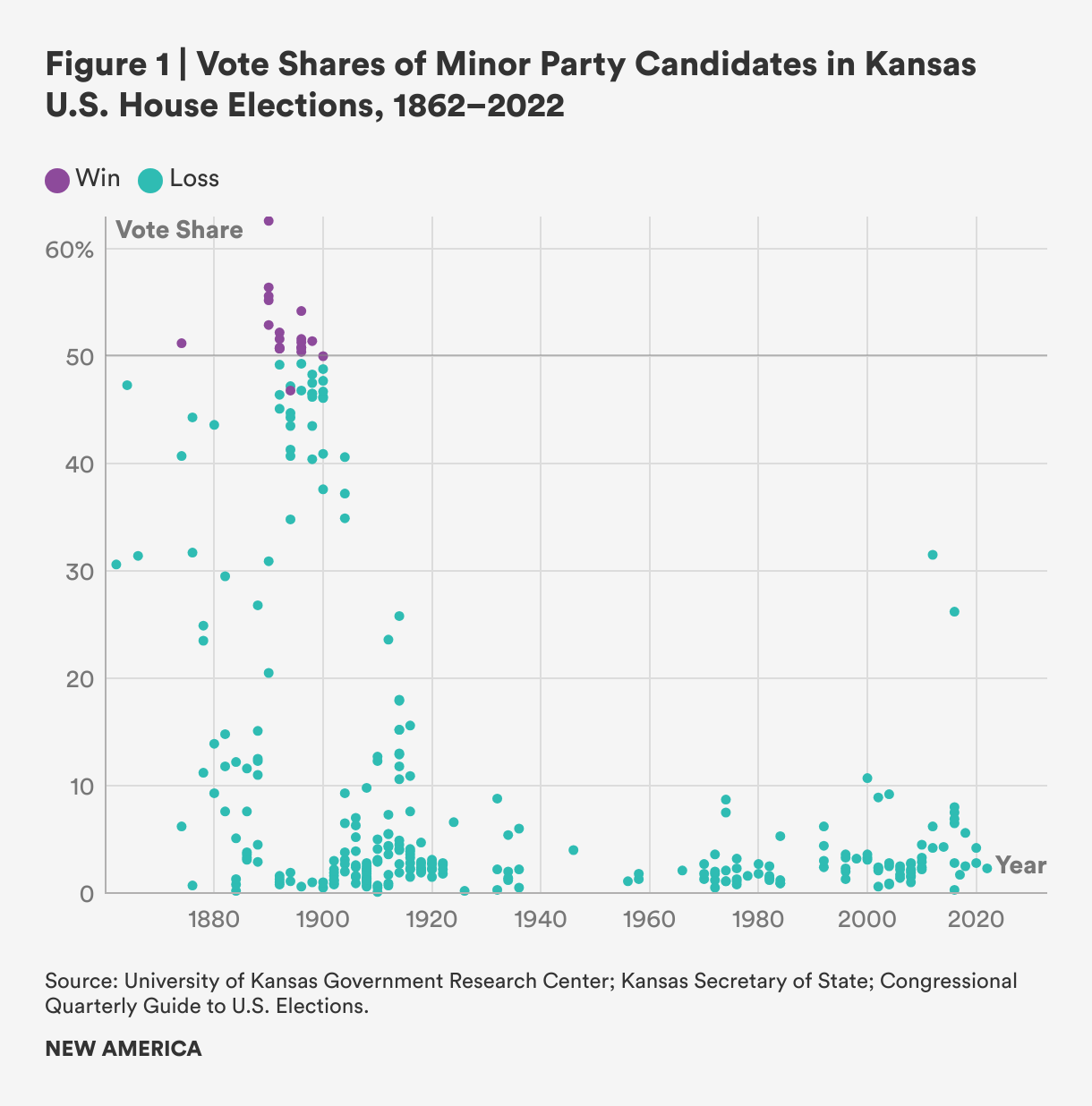
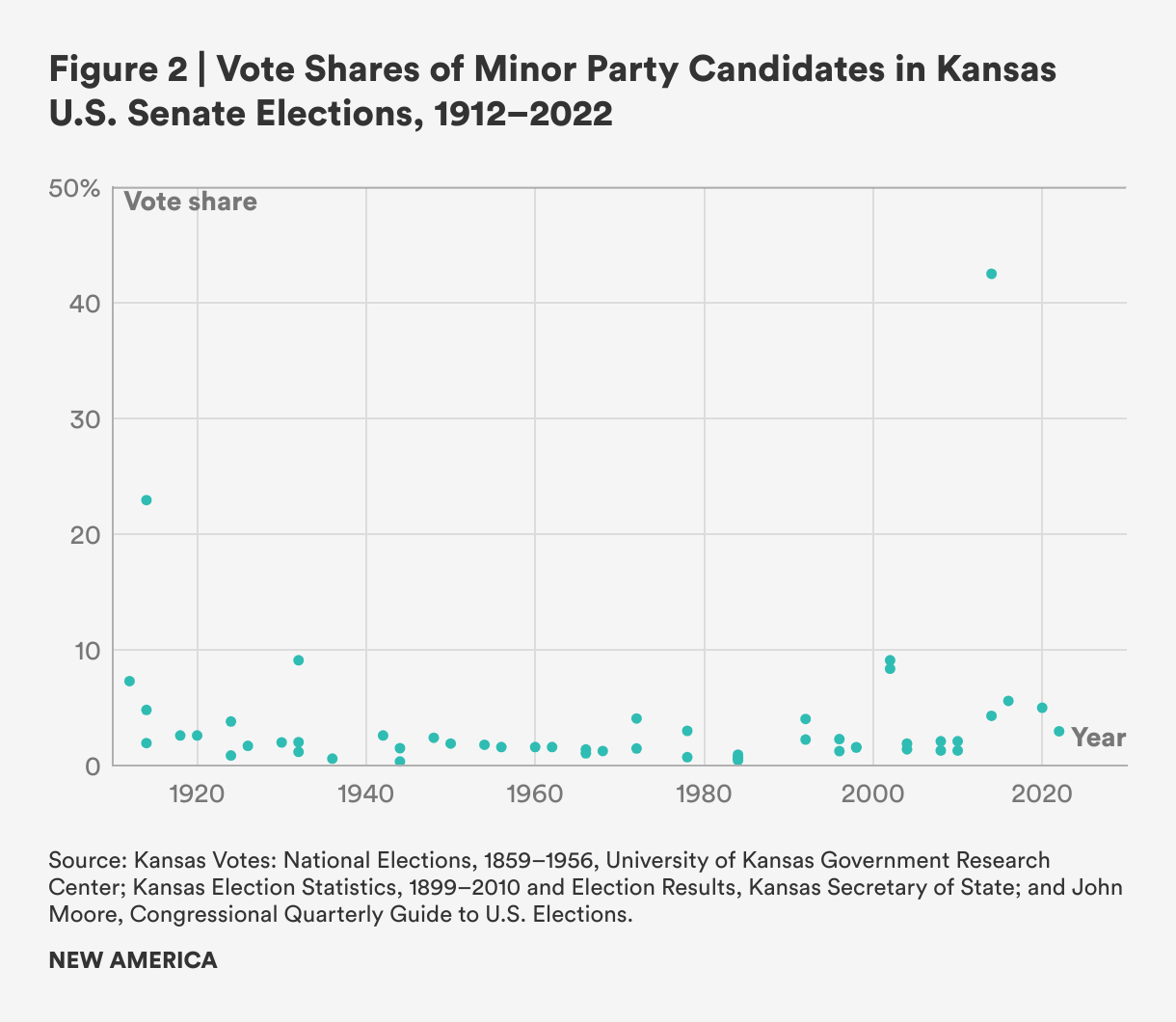
Anti-fusion legislation in Kansas has not only affected individual voters but has had a dramatically negative impact on parties outside the permitted duopoly. Since the prohibition of fusion, electoral victory has been all but nonexistent for Kansas’s minor parties. No minor-party candidate has won a statewide or federal election in Kansas since the passage of the 1901 fusion ban. The most recent occurrence was the 1900 victory of the Democratic and Populist Party that nominated Congressional candidate Alfred Jackson.125 Virtually all recorded minor-party victories at the federal and statewide level—19 out of 20 minor-party U.S. Representatives and both minor-party governors—occurred between 1890 and 1900, when fusion was permitted.126 Since fusion’s ban, minor-party candidates in federal and statewide elections have rarely surpassed single-digit support.127 The handful of candidates who have garnered substantial support all did so in races without Democratic challengers (for example, Independent Senate candidate Greg Orman earned 42.5 percent of the vote in his 2014 race, and Libertarian Congressional candidate Joel Balam earned 31.5 percent in 2012).128 In three- or four-way races with both major parties offering candidates, minor parties have been relegated to political footnotes. Figures 1 and 2 below illustrate the total collapse of minor party vote share post-1901 in Kansas elections for the U.S. House and Senate.129
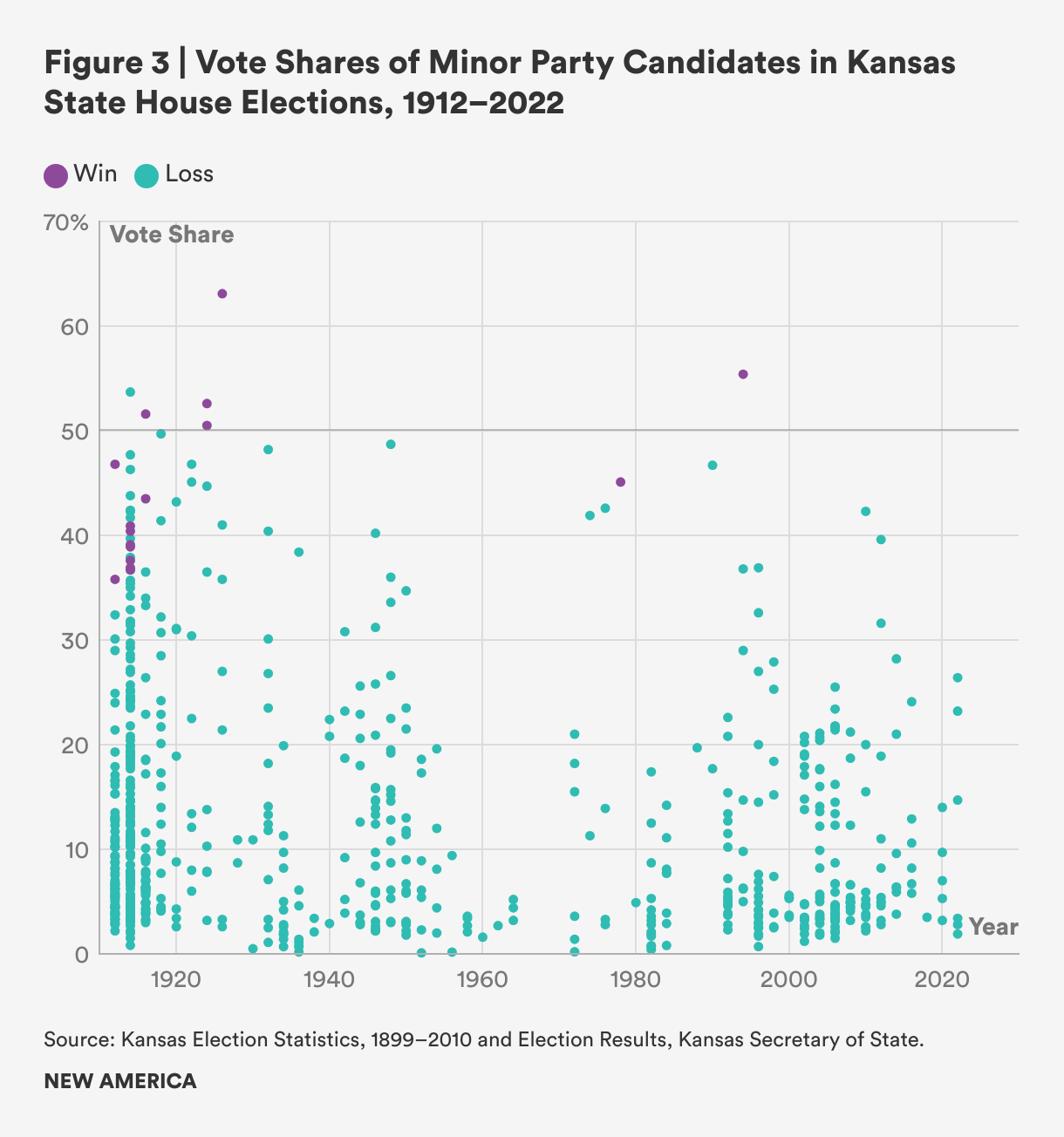
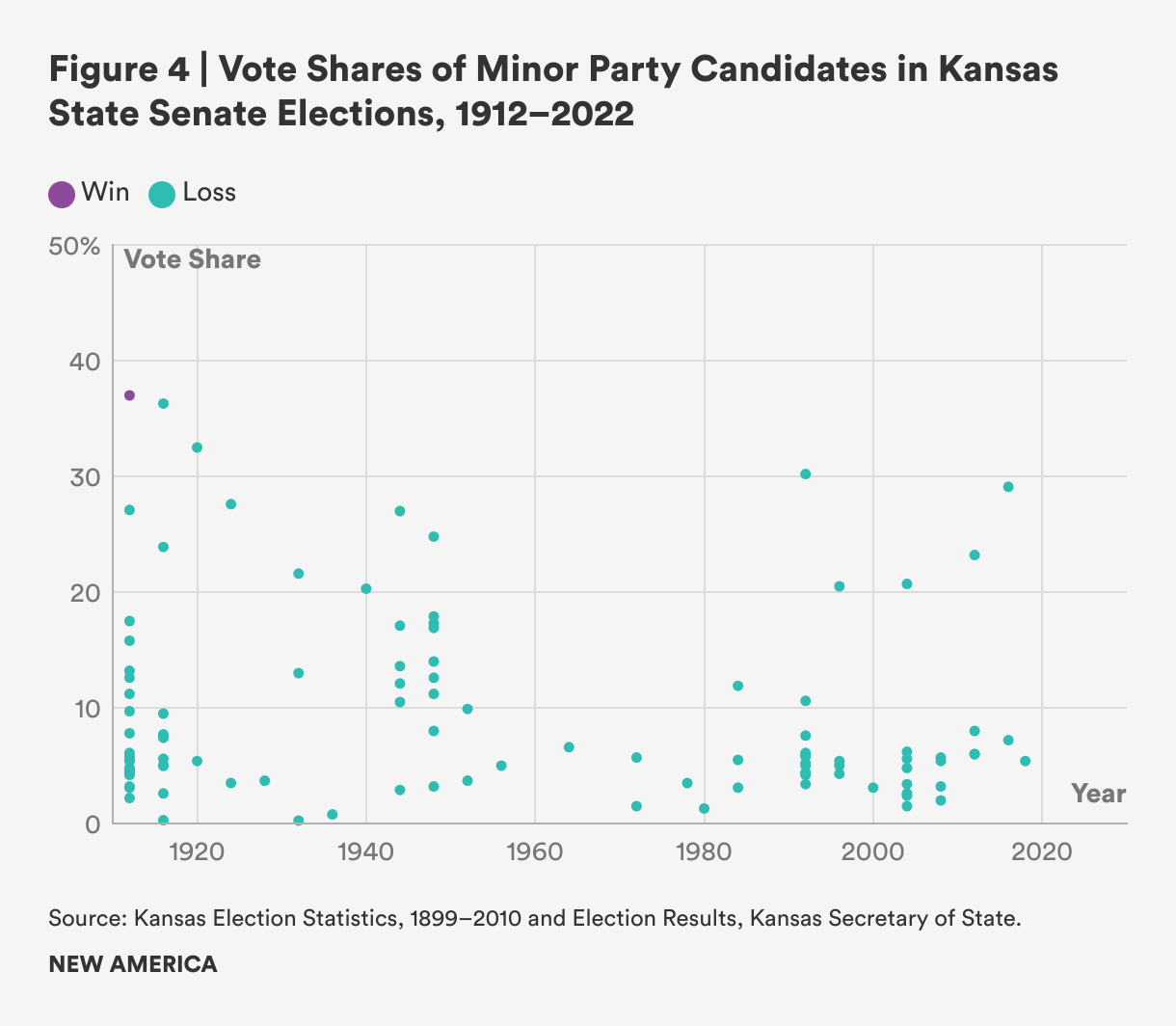
Predictably, minor-party performance in state legislative elections has likewise deteriorated since fusion’s prohibition. Since 1912, all but 17 state legislative races—99.8 percent of elections in this time period—have been won by Democratic or Republican candidates.130 As noted, there has not been a single non-Republican majority in both houses of the legislature since 1914.131 Only two minor-party legislators have served in the past 50 years.132 Before the 1901 fusion ban, minor parties not only consistently held dozens of seats in the Kansas legislature but commanded majorities several times in the last decade of the nineteenth century. In the election of 1890, for instance, Populists won 91 state representative seats, nearly 75 percent of the Kansas legislature.
Minor-party vote share in Kansas’s gubernatorial elections rivals the paltry performance of third-party candidates for the U.S. Senate. Since the 1901 prohibition of fusion, a minor-party candidate for governor has garnered more than 10 percent of the vote just five times. Compare that to the four pre-fusion ban instances where a minor-party candidate garnered over 45 percent of the vote, including two victories.
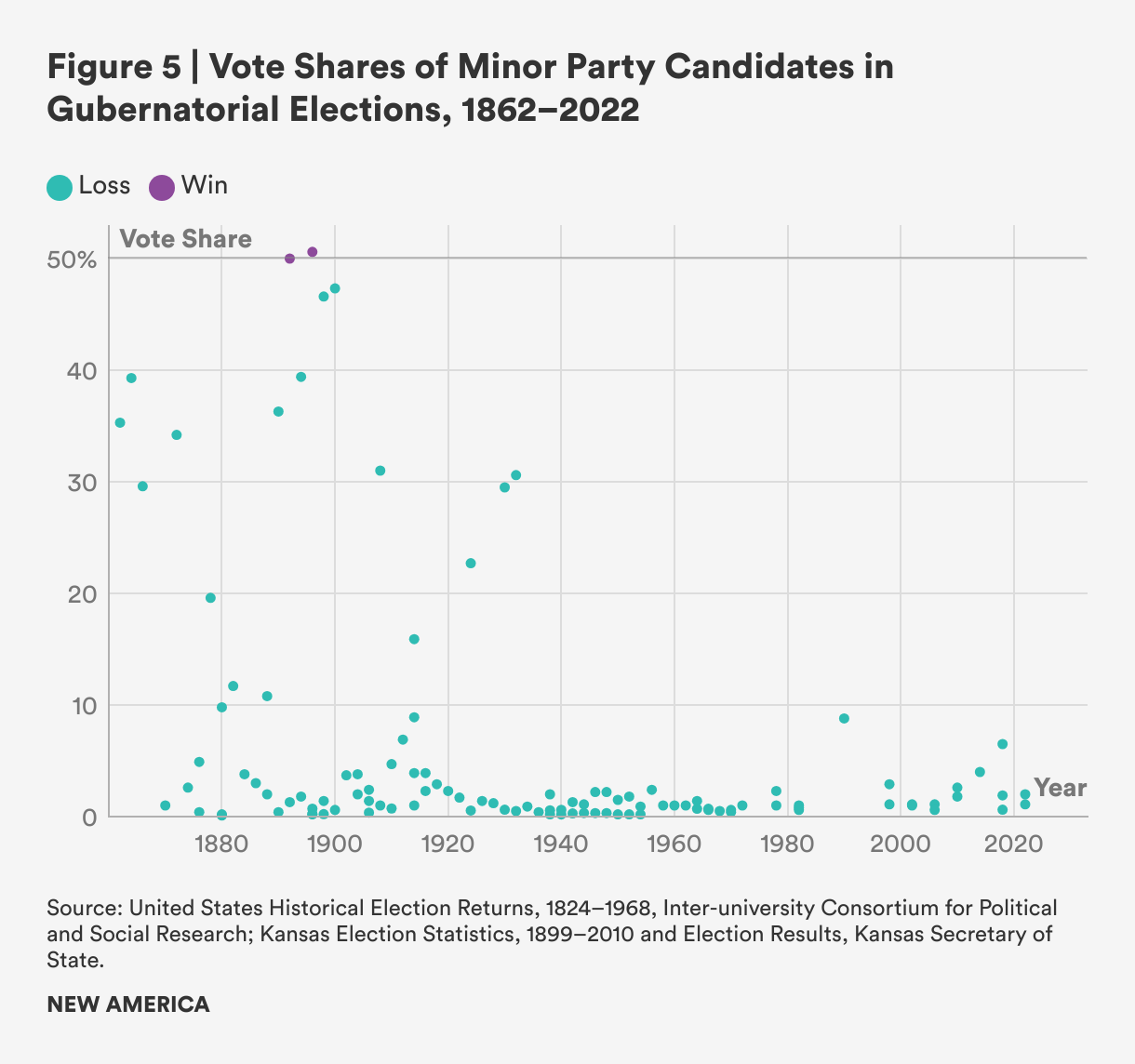
The dynamic political alliances and realignments that fusion-enabled tickets facilitated in Kansas all but disappeared following the outlaw of fusion. Minor party activity has been reduced to negligible rates.
Citations
- Americans’ Dismal View of the Nation’s Politics (Washington, DC: Pew Research Center, 2023), https://www.pewresearch.org/politics/2023/09/19/americans-dismal-views-of-the-nations-politics/.
- For discussion of both the history and current consequences, see Micah Sifry, Spoiling for a Fight: Third-Party Politics in America (New York: Routledge, 2003); Lee Drutman, Breaking the Two-Party Doom Loop: The Case for Multiparty Democracy in America (New York: Oxford University Press, 2019); and Lee Drutman, More Parties, Better Parties: The Case for Pro-Parties Democracy Reform (Washington, DC: New America, 2023), https://www.newamerica.org/political-reform/reports/more-parties-better-parties/.
- Laura MacMillan, “New Kansas political party promises new era of politics,” KSN Kansas, March 12, 2024, https://www.ksn.com/news/your-local-election-hq/new-kansas-political-party-promises-new-era-of-politics/; “About,” United Kansas, https://unitedkansas.com/about.
- In 1862, “Democrats combined with Anti-Lane Republicans to support Union candidate.” Clarence J. Hein and Charles A. Sullivant, Kansas Votes: Gubernatorial Elections, 1859–1956 (Lawrence, KS: University of Kansas Governmental Research Center, 1957), 4, https://babel.hathitrust.org/cgi/pt?id=mdp.39015081958004. The similar strategy in the 1864 presidential contest has already been noted.
- Robert G. Fogg, The Greenback Movement in Kansas 1874–1884 (Wichita, KS: Wichita State University, 1954), 26, https://soar.wichita.edu/handle/10057/25008.
- Fogg, The Greenback Movement in Kansas, 26, https://soar.wichita.edu/handle/10057/25008; “Former Governors: Kansas,” National Governors’ Association, https://www.nga.org/former-governors/kansas/.
- Andrew L. Slap, The Doom of Reconstruction: The Liberal Republicans in the Civil War (New York: Fordham University Press, 2006), xxv.
- Earle Dudley Ross, The Liberal Republican Movement (New York: Henry Holt and Company, 1919), 150–60, https://www.loc.gov/item/19012223/. Notably, the Liberal-Republican presidential candidate, Horace Greeley (a Republican), received about 32 percent of the state’s vote, while the “straight” Democrat won less than 1 percent. “1872 Presidential General Election Results: Kansas,” in Dave Leip’s Atlas of U.S. Presidential Elections, https://bit.ly/4fw9GNP.
- Fogg, The Greenback Movement in Kansas, 10–11, https://soar.wichita.edu/handle/10057/25008; Ryan A. Stephans, Greenbackers & Populists: The Failures and Successes of Agrarian Reform Movements in Douglas County, Kansas, 1874–1904 (Emporia, KS: Emporia State University, May 2011), 7, https://esirc.emporia.edu/bitstream/handle/123456789/675/Ryan%20Stephans.pdf.
- Fogg, The Greenback Movement in Kansas, 33, https://soar.wichita.edu/handle/10057/25008.
- “1876 Presidential Election Statistics,” in Dave Leip’s Atlas of U.S. Presidential Elections, https://bit.ly/3SJ6zbn. Demonstrating Republican control, Rutherford Hayes easily won the state in a landslide with more than 63 percent of the vote, while Samuel Tilden, the Democrat, received only about 30 percent of the ballots.
- Fogg, The Greenback Movement in Kansas, 24–27, https://soar.wichita.edu/handle/10057/25008.
- O. Gene Clanton, Kansas Populism: Ideas and Men (Lawrence, KS: University Press of Kansas, 1969), 1, https://doi.org/10.1353/book.81133.
- Peter H. Argersinger, The Limits of Agrarian Radicalism: Western Populism and American Politics (Lawrence, KS: University Press of Kansas, 1995), 21, 105.
- Peter H. Argersinger, “Populists in Power: Public Policy and Legislative Behavior,” Journal of Interdisciplinary History 18, no. 1 (Summer 1987): 83, https://doi.org/10.2307/204729.
- Fogg, The Greenback Movement in Kansas, 44, https://soar.wichita.edu/handle/10057/25008.
- Clanton, Kansas Populism, 20, https://doi.org/10.1353/book.81133.
- Argersinger, The Limits of Agrarian Radicalism, 102–103.
- Argersinger, The Limits of Agrarian Radicalism, 105.
- Argersinger, The Limits of Agrarian Radicalism, 103.
- Argersinger, The Limits of Agrarian Radicalism, 103. These kinds of debates took place around the country. In the South, Populists sought alliances with the Republicans against Democrats, who had controlled the region since the end of Reconstruction.
- Hein and Sullivant, Kansas Votes, 25, https://babel.hathitrust.org/cgi/pt?id=mdp.39015081958004.
- Hein and Sullivant, Kansas Votes, 27, https://babel.hathitrust.org/cgi/pt?id=mdp.39015081958004.
- Hein and Sullivant, Kansas Votes, 27, https://babel.hathitrust.org/cgi/pt?id=mdp.39015081958004.
- D. Scott Barton, “Party Switching and Kansas Populism,” The Historian 52, no. 3 (May 1990): 453, https://www.jstor.org/stable/24448020.
- Barton, “Party Switching and Kansas Populism,” 457, https://www.jstor.org/stable/24448020.
- Peter H. Argersinger, “Road to a Republican Waterloo: The Farmers’ Alliance and the Election of 1890 in Kansas,” Kansas Historical Quarterly 33, no. 4 (Winter 1967): 443, https://www.kancoll.org/khq/1967/67_4_argersinger.htm.
- Argersinger, “Road to a Republican Waterloo,” 443, https://www.kancoll.org/khq/1967/67_4_argersinger.htm.
- Argersinger, The Limits of Agrarian Radicalism, 112.
- Barton, “Party Switching and Kansas Populism,” 459–60, https://www.jstor.org/stable/24448020.
- See R. Alton Lee, “Anti-Fusion Election Laws in Populist Kansas,” Heritage of the Great Plains 46, no. 2 (Winter 2014): 9, https://esirc.emporia.edu/bitstream/handle/123456789/3386/R.%20Alton%20Lee.pdf.
- Lee, “Anti-Fusion Election Laws in Populist Kansas,” 9, https://esirc.emporia.edu/bitstream/handle/123456789/3386/R.%20Alton%20Lee.pdf; June G. Cabe and Charles A. Sullivant, Kansas Votes: National Elections, 1859–1956 (Lawrence, KS: University of Kansas Government Research Center, 1957), 20–21, https://archive.org/details/kansasvotesnatio00cabe.
- Hein and Sullivant, Kansas Votes, 29, https://babel.hathitrust.org/cgi/pt?id=mdp.39015081958004.
- Lee, “Anti-Fusion Election Laws in Populist Kansas,” 9, https://esirc.emporia.edu/bitstream/handle/123456789/3386/R.%20Alton%20Lee.pdf.
- Lee, “Anti-Fusion Election Laws in Populist Kansas,” 9, https://esirc.emporia.edu/bitstream/handle/123456789/3386/R.%20Alton%20Lee.pdf. See also Peter H. Argersinger, “‘A Place on the Ballot’: Fusion Politics and Fusion Laws,” American Historical Review 85, no. 2 (Apr. 1980): 288, https://doi.org/10.2307/1860557; Robert W. Richmond, Kansas: A Land of Contrasts, 3rd ed. (Wheeling, IL: Forum Press, 1989), 191–194.
- Lee, “Anti-Fusion Election Laws in Populist Kansas,” 10, https://esirc.emporia.edu/bitstream/handle/123456789/3386/R.%20Alton%20Lee.pdf.
- Lee, “Anti-Fusion Election Laws in Populist Kansas,” 10, https://esirc.emporia.edu/bitstream/handle/123456789/3386/R.%20Alton%20Lee.pdf.
- Lee, “Anti-Fusion Election Laws in Populist Kansas,” 10–11, https://esirc.emporia.edu/bitstream/handle/123456789/3386/R.%20Alton%20Lee.pdf.
- Eldon Cobbs Evans, A History of the Australian Ballot System in the United States (Chicago, IL: University of Chicago Press, 1917), 2, https://catalog.hathitrust.org/Record/001143141.
- Argersinger, “‘A Place on the Ballot,’” 290, https://doi.org/10.2307/1860557.
- Argersinger, “‘A Place on the Ballot,’” 290, https://doi.org/10.2307/1860557.
- Evans, A History of the Australian Ballot System, 6, https://catalog.hathitrust.org/Record/001143141.
- Peter H. Argersinger, “Regulating Democracy: Election Laws and Dakota Politics, 1889–1902,” in The Limits of Agrarian Radicalism, 157. Some observers have noted that such ballot reforms could also restrict smaller parties’ access to the ballot. See also Howard A. Scarrow, “Duverger’s Law, Fusion, and the Decline of American ‘Third’ Parties,” Western Political Quarterly 39, no. 4 (Dec. 1986): 637–638, https://doi.org/10.2307/448267.
- Evans, A History of the Australian Ballot System, 18–21, https://catalog.hathitrust.org/Record/001143141.
- Evans, A History of the Australian Ballot System, 17, 19, https://catalog.hathitrust.org/Record/001143141; “Trial of Australian Ballot,” Louisville Courier-Journal, November 16, 1889, https://www.proquest.com/docview/1036754555. Kentucky was actually the first state to enact an Australian Ballot, but the act only applied to the city of Louisville, because the state constitution required viva voce voting at state elections.
- John H. Wigmore, “Ballot Reform: Its Constitutionality,” American Law Review 23 (Sept./Oct. 1889): 719, https://www.proquest.com/docview/125724278.
- Argersinger, “‘A Place on the Ballot,’” 291, https://doi.org/10.2307/1860557.
- The election bill as adopted, which ran to more than 15 printed pages, is in State of Kansas, Session Laws of 1893 (Topeka, KS: Hamilton Printing Co., 1893), 106–124.
- State of Kansas, Session Laws of 1893, 106–124.
- Lee, “Anti-Fusion Election Laws in Populist Kansas,” 13, https://esirc.emporia.edu/bitstream/handle/123456789/3386/R.%20Alton%20Lee.pdf.
- Lee, “Anti-Fusion Election Laws in Populist Kansas,” 14, https://esirc.emporia.edu/bitstream/handle/123456789/3386/R.%20Alton%20Lee.pdf.
- Advance Sheets of the Handbook of the Kansas Legislature, 1893 (Topeka, KS: George W. Crane, 1893), 10.
- State of Kansas, Session Laws of 1893, 114.
- Argersinger, “‘A Place on the Ballot,’” 296, https://doi.org/10.2307/1860557.
- “The Election Law,” Weekly Star and Kansan, April 14, 1893, 2, https://kansashistoricalopencontent.newspapers.com/image/118110217/.
- State of Kansas, Session Laws of 1893, 107.
- State of Kansas, Session Laws of 1893, 110–111.
- State of Kansas, Session Laws of 1893, 110–112. More specifically, the law allowed for the names of candidates of “all nominations for any political party or group of petitioners being placed under the party appellation or title of such party or group, as designated by them in the certificates of nomination or petitions.” Simply put, this law allowed the candidates, parties, and groups of voters, and not the state government, to choose how they would appear on the ballot. This was a core reflection of fusion democracy.
- “Fusion Beaten In Kansas,” New York Times, November 8, 1893, https://timesmachine.nytimes.com/timesmachine/1893/11/08/109732526.pdf.
- “Fusion Beaten In Kansas,” https://timesmachine.nytimes.com/timesmachine/1893/11/08/109732526.pdf.
- Lee A. Dew, Populist Fusion Movements as an Instrument of Political Reform, 1890–1900 (Pittsburg, KS: Pittsburg State University, 1957), 42, https://digitalcommons.pittstate.edu/etd/118.
- Lee, “Anti-Fusion Election Laws in Populist Kansas,” 12, https://esirc.emporia.edu/bitstream/handle/123456789/3386/R.%20Alton%20Lee.pdf.
- Lee, “Anti-Fusion Election Laws in Populist Kansas,” 12, https://esirc.emporia.edu/bitstream/handle/123456789/3386/R.%20Alton%20Lee.pdf.
- Hein and Sullivant, Kansas Votes, 31, https://babel.hathitrust.org/cgi/pt?id=mdp.39015081958004.
- “Fusion Beaten In Kansas,” https://timesmachine.nytimes.com/timesmachine/1893/11/08/109732526.pdf.
- Stephans, Greenbackers & Populists, 64, https://esirc.emporia.edu/bitstream/handle/123456789/675/Ryan%20Stephans.pdf; Hein and Sullivant, Kansas Votes, 29, https://babel.hathitrust.org/cgi/pt?id=mdp.39015081958004.
- William Frank Zornow, Kansas: A History of the Jayhawk State (Norman, OK: University of Oklahoma Press, 1957), 202–203.
- Dew, Populist Fusion Movements as an Instrument of Political Reform, 82, https://digitalcommons.pittstate.edu/etd/118.
- Stephans, Greenbackers & Populists, 59, https://esirc.emporia.edu/bitstream/handle/123456789/675/Ryan%20Stephans.pdf.
- Cabe and Sullivant, Kansas Votes, 102–147, https://archive.org/details/kansasvotesnatio00cabe; Margaret Briggs, Candidates for State Office: 1859–1908 (Emporia, KS: Emporia State University School of Library Science Monograph Series #5, 1981), 16–29.
- Briggs, Candidates for State Office: 1859–1908, 16–29.
- “Election Statistics,” The American Presidency Project at University of California, Santa Barbara, https://www.presidency.ucsb.edu/statistics/elections.
- Argersinger, “‘A Place on the Ballot,’” 300, https://doi.org/10.2307/1860557.
- Senate Journal: Proceedings of the Senate of the State of Kansas (Topeka, KS: 1897), 787, 884–85, 1111.
- “Session of January 26th, 1897” in Proceedings of the Senate of the State of Kansas, 786–787.
- Argersinger, “‘A Place on the Ballot,’” 300, https://doi.org/10.2307/1860557; Senate Journal: Proceedings of the Senate of the State of Kansas, 787, 884–85, 1111.
- Stephans, Greenbackers & Populists, 68–69, https://esirc.emporia.edu/bitstream/handle/123456789/675/Ryan%20Stephans.pdf.
- Dew, Populist Fusion Movements as an Instrument of Political Reform, 99–101, https://digitalcommons.pittstate.edu/etd/118.
- Hein and Sullivant, Kansas Votes, 35, https://babel.hathitrust.org/cgi/pt?id=mdp.39015081958004.
- John D. Hicks, “The Third Party Tradition in American Politics,” Mississippi Valley Historical Review 20, no. 1 (June 1933): 394–395, https://doi.org/10.2307/1902325; Stephans, Greenbackers & Populists, 68–69, https://esirc.emporia.edu/bitstream/handle/123456789/675/Ryan%20Stephans.pdf.
- Lee, “Anti-Fusion Election Laws in Populist Kansas,” 18, https://esirc.emporia.edu/bitstream/handle/123456789/3386/R.%20Alton%20Lee.pdf.
- State of Kansas, Session Laws of 1901 (Topeka, KS: W.Y. Morgan, 1901), 311–331.
- State of Kansas, Session Laws of 1901, 311–313.
- State of Kansas, Session Laws of 1901, 317–320.
- State of Kansas, Session Laws of 1901, 316–317.
- Lee, “Anti-Fusion Election Laws in Populist Kansas,” 21, https://esirc.emporia.edu/bitstream/handle/123456789/3386/R.%20Alton%20Lee.pdf.
- “Thirsty Democrats: They Make Resubmission of the Prohibitory Law Their Paramount Issue for Kansas Campaign,” Los Angeles Times, May 23, 1902, 11, https://www.proquest.com/docview/164089422.
- “Fusion Effected in Kansas: Hot Time in Populist Convention Before Ticket Was Completed,” Washington Post, June 25, 1902, 1, https://www.proquest.com/docview/144360397.
- See, e.g., Kansas Statutes Annotated § 25-213, 25-306, 25-306e, 25–613.
- Argersinger, “‘A Place on the Ballot,’” 303, https://doi.org/10.2307/1860557.
- Argersinger, “‘A Place on the Ballot,’” 304, https://doi.org/10.2307/1860557.
- Lee, “Anti-Fusion Election Laws in Populist Kansas,” 21, https://esirc.emporia.edu/bitstream/handle/123456789/3386/R.%20Alton%20Lee.pdf.
- “Little Chance for Fusion Now: Kansas Democrats and Populists in a Stew,” St. Louis Post-Dispatch, May 4, 1902, 3, https://www.proquest.com/docview/579597552.
- “Little Chance for Fusion Now,” https://www.proquest.com/docview/579597552.
- Hein and Sullivant, Kansas Votes, https://babel.hathitrust.org/cgi/pt?id=mdp.39015081958004. Compare page 37 (1900 election vote total of 350,611) with page 39 (1902 election vote total of 287,169).
- Hein and Sullivant, Kansas Votes, https://babel.hathitrust.org/cgi/pt?id=mdp.39015081958004.
- Argersinger, “‘A Place on the Ballot,’” 303, https://doi.org/10.2307/1860557.
- Argersinger, “‘A Place on the Ballot,’” 303, https://doi.org/10.2307/1860557.
- Argersinger, “‘A Place on the Ballot,’” 303, https://doi.org/10.2307/1860557.
- Hein and Sullivant, Kansas Votes, 49, https://babel.hathitrust.org/cgi/pt?id=mdp.39015081958004.
- Hein and Sullivant, Kansas Votes, 52–93, https://babel.hathitrust.org/cgi/pt?id=mdp.39015081958004.
- Cabe and Sullivant, Kansas Votes, 70–71, https://archive.org/details/kansasvotesnatio00cabe.
- See generally Kansas Election Statistics, 1899–2010 (Topeka, KS: Office of the Kansas Secretary of State, Kansas Government Information Online Library, 2021), https://kgi.contentdm.oclc.org/digital/collection/p16884coll129/id/0/rec/1.
- See generally “Official Statement of Votes Cast at the General Election, November 5, 1912” in Kansas Election Statistics, 1899–2010, https://kgi.contentdm.oclc.org/digital/collection/p16884coll129/id/0/rec/1.
- See generally “1976 Primary Election and 1976 General Election” and “1990 Primary and General Elections” in Kansas Election Statistics, 1899–2010, https://kgi.contentdm.oclc.org/digital/collection/p16884coll129/id/0/rec/1.
- Argersinger, The Limits of Agrarian Radicalism, 175.
- Robert H. Wiebe, The Search for Order, 1870–1920 (New York: Hill & Wang, 1967), 168–170.
- Michael E. McGerr, The Decline of Popular Politics: The American North, 1865–1928 (New York: Oxford University Press, 1986).
- McGerr, The Decline of Popular Politics, 205–206, 218.
- Mark Wahlgren Summers, Party Games: Getting, Keeping, and Using Power in Gilded Age Politics (Chapel Hill, NC: University of North Carolina Press, 2004), 252, 260, 277.
- Summers, Party Games, 252, 260, 277; McGerr, A Fierce Discontent, 216.
- Ronnie W. Faulkner, “Fusion Politics,” North Carolina History Project, https://northcarolinahistory.org/encyclopedia/fusion-politics/.
- Faulkner, “Fusion Politics,” https://northcarolinahistory.org/encyclopedia/fusion-politics.
- Faulkner, “Fusion Politics,” https://northcarolinahistory.org/encyclopedia/fusion-politics.
- Faulkner, “Fusion Politics,” https://northcarolinahistory.org/encyclopedia/fusion-politics.
- Faulkner, “Fusion Politics,” https://northcarolinahistory.org/encyclopedia/fusion-politics.
- Faulkner, “Fusion Politics,” https://northcarolinahistory.org/encyclopedia/fusion-politics.
- Faulkner, “Fusion Politics,” https://northcarolinahistory.org/encyclopedia/fusion-politics.
- Faulkner, “Fusion Politics,” https://northcarolinahistory.org/encyclopedia/fusion-politics.
- James L. Hunt, “Fusion of Republicans and Populists,” in Encyclopedia of North Carolina (Chapel Hill, NC: University of North Carolina Press, 2006), https://www.ncpedia.org/fusion-republicans-and-populists.
- Compare “1896 Presidential General Election Results: North Carolina,” https://bit.ly/3M0Othr, with “1904 Presidential General Election Results: North Carolina,” https://bit.ly/3YDRvzM, in Dave Leip’s Atlas of U.S. Presidential Elections.
- Nicholas Graham, “The Election of 1898 in North Carolina: An Introduction,” North Carolina Collection, June 2005, https://exhibits.lib.unc.edu/exhibits/show/1898/history.
- “The Balance of Power in N.C. Politics Since Reconstruction,” Carolina Journal, November 23, 2020, https://www.carolinajournal.com/the-balance-of-power-in-the-n-c-general-assembly-since-reconstruction/.
- The story was essentially identical in all of the former Confederate states. All used election laws to ban Black voting and reduce ballots from poorer and less educated whites. One historian has calculated the following percentages of men not voting in elections between 1904 and 1908: Alabama, 76 percent; Arkansas, 57 percent; Florida, 75 percent; Georgia, 78 percent; Louisiana, 81 percent; Mississippi, 84 percent; North Carolina, 48 percent; South Carolina, 79 percent; Tennessee, 52 percent; Texas, 64 percent; Virginia, 72 percent. Considering that women of any race could not vote in those elections, the actual electorate was reduced to only 10–20 percent of the adult population. See J. Morgan Kousser, The Shaping of Southern Politics: Suffrage Restriction and the Establishment of the One-Party South, 1880–1910 (New Haven, CT: Yale University Press, 1974), 226.
- Cabe and Sullivant, Kansas Votes, 41, https://archive.org/details/kansasvotesnatio00cabe.
- See generally Cabe and Sullivant, Kansas Votes, https://archive.org/details/kansasvotesnatio00cabe.
- See generally Cabe and Sullivant, Kansas Votes, 102–147, https://archive.org/details/kansasvotesnatio00cabe; Kansas Election Statistics, 1899–2010, https://kgi.contentdm.oclc.org/digital/collection/p16884coll129/id/0/rec/1.
- “Election Results,” Kansas Secretary of State, https://sos.ks.gov/elections/election-results.html.
- Displayed data retrieved from Cabe and Sullivant, Kansas Votes, https://archive.org/details/kansasvotesnatio00cabe; Kansas Election Statistics, 1899–2010, https://kgi.contentdm.oclc.org/digital/collection/p16884coll129/id/0/rec/1; “Election Results,” https://sos.ks.gov/elections/election-results.html; John L. Moore, Congressional Quarterly Guide to U.S. Elections, 6th Edition (Washington, DC: CQ Press, 2009); “United States Historical Election Returns, 1824–1968,” Inter-university Consortium for Political and Social Research, April 26, 1999, https://doi.org/10.3886/ICPSR00001.v3. Each data point represents one minor-party candidate in one race. Fusion candidates cross-nominated by several parties, including Populists, Republicans, or Democrats, are contained in this dataset and similarly represented by one point.
- Kansas Election Statistics, 1899–2010, https://kgi.contentdm.oclc.org/digital/collection/p16884coll129/id/0/rec/1.
- Kansas Election Statistics, 1899–2010, https://kgi.contentdm.oclc.org/digital/collection/p16884coll129/id/0/rec/1.
- Kansas Election Statistics, 1899–2010, https://kgi.contentdm.oclc.org/digital/collection/p16884coll129/id/0/rec/1.
Conclusion
Today, wide swaths of the electorate lament the lack of meaningful choice beyond the two major parties. As shown throughout this historical survey, there is nothing new about this frustration. The irony is that in the 1890s, Kansans had a better chance of overcoming barriers to full participation in elections. During that time, Kansas voters used that opportunity to raise new issues, elect new kinds of candidates, and create laws consistent with their values. To do so, they thought creatively about how politics could work. They developed organizations and strategies that allowed them to challenge and defeat the political party that had controlled the state since its beginning. That was no simple task, as the ensuing 120 years have demonstrated. One of the major contributors to that era’s political competition and vibrancy was the practice of fusion, which allowed cooperation on the ballot between different political parties. In essence, it was coalition-building, something seemingly inherent in any successful political environment.
But, the political opponents of fusion responded by simply outlawing cooperation between political parties. The anti-fusion laws were not attempts to create some kind of rational and controlled two-party election system. Rather, they reflected a political desire to cement a one-party rule. And there can be no doubt that anti-fusion laws in Kansas have been overwhelmingly successful in achieving these ends. Since the ban on fusion in 1901, Kansas has maintained a near-total absence of meaningful competitive party activity. For more than 120 years, Jayhawk politics has been a classic case of Republican hegemony. Yet, Kansas retains enormous discretion to set the rules and bounds of its elections in ways that can restore and promote the pluralism that defined the 1890s.
The aim of this report is to educate the public and the courts on (i) the political context in which Kansas’s fusion restrictions were adopted and (ii) the systemic and long-term effects of those restrictions. We hope that by highlighting Kansas’s history with fusion, as well as the anti-democratic motivations behind its abolition, we can assist decision makers who are evaluating the legality of the currently enacted fusion ban.
Citations
- Americans’ Dismal View of the Nation’s Politics (Washington, DC: Pew Research Center, 2023), https://www.pewresearch.org/politics/2023/09/19/americans-dismal-views-of-the-nations-politics/.
- For discussion of both the history and current consequences, see Micah Sifry, Spoiling for a Fight: Third-Party Politics in America (New York: Routledge, 2003); Lee Drutman, Breaking the Two-Party Doom Loop: The Case for Multiparty Democracy in America (New York: Oxford University Press, 2019); and Lee Drutman, More Parties, Better Parties: The Case for Pro-Parties Democracy Reform (Washington, DC: New America, 2023), https://www.newamerica.org/political-reform/reports/more-parties-better-parties/.
- Laura MacMillan, “New Kansas political party promises new era of politics,” KSN Kansas, March 12, 2024, https://www.ksn.com/news/your-local-election-hq/new-kansas-political-party-promises-new-era-of-politics/; “About,” United Kansas, https://unitedkansas.com/about.
- In 1862, “Democrats combined with Anti-Lane Republicans to support Union candidate.” Clarence J. Hein and Charles A. Sullivant, Kansas Votes: Gubernatorial Elections, 1859–1956 (Lawrence, KS: University of Kansas Governmental Research Center, 1957), 4, https://babel.hathitrust.org/cgi/pt?id=mdp.39015081958004. The similar strategy in the 1864 presidential contest has already been noted.
- Robert G. Fogg, The Greenback Movement in Kansas 1874–1884 (Wichita, KS: Wichita State University, 1954), 26, https://soar.wichita.edu/handle/10057/25008.
- Fogg, The Greenback Movement in Kansas, 26, https://soar.wichita.edu/handle/10057/25008; “Former Governors: Kansas,” National Governors’ Association, https://www.nga.org/former-governors/kansas/.
- Andrew L. Slap, The Doom of Reconstruction: The Liberal Republicans in the Civil War (New York: Fordham University Press, 2006), xxv.
- Earle Dudley Ross, The Liberal Republican Movement (New York: Henry Holt and Company, 1919), 150–60, https://www.loc.gov/item/19012223/. Notably, the Liberal-Republican presidential candidate, Horace Greeley (a Republican), received about 32 percent of the state’s vote, while the “straight” Democrat won less than 1 percent. “1872 Presidential General Election Results: Kansas,” in Dave Leip’s Atlas of U.S. Presidential Elections, https://bit.ly/4fw9GNP.
- Fogg, The Greenback Movement in Kansas, 10–11, https://soar.wichita.edu/handle/10057/25008; Ryan A. Stephans, Greenbackers & Populists: The Failures and Successes of Agrarian Reform Movements in Douglas County, Kansas, 1874–1904 (Emporia, KS: Emporia State University, May 2011), 7, https://esirc.emporia.edu/bitstream/handle/123456789/675/Ryan%20Stephans.pdf.
- Fogg, The Greenback Movement in Kansas, 33, https://soar.wichita.edu/handle/10057/25008.
- “1876 Presidential Election Statistics,” in Dave Leip’s Atlas of U.S. Presidential Elections, https://bit.ly/3SJ6zbn. Demonstrating Republican control, Rutherford Hayes easily won the state in a landslide with more than 63 percent of the vote, while Samuel Tilden, the Democrat, received only about 30 percent of the ballots.
- Fogg, The Greenback Movement in Kansas, 24–27, https://soar.wichita.edu/handle/10057/25008.
- O. Gene Clanton, Kansas Populism: Ideas and Men (Lawrence, KS: University Press of Kansas, 1969), 1, https://doi.org/10.1353/book.81133.
- Peter H. Argersinger, The Limits of Agrarian Radicalism: Western Populism and American Politics (Lawrence, KS: University Press of Kansas, 1995), 21, 105.
- Peter H. Argersinger, “Populists in Power: Public Policy and Legislative Behavior,” Journal of Interdisciplinary History 18, no. 1 (Summer 1987): 83, https://doi.org/10.2307/204729.
- Fogg, The Greenback Movement in Kansas, 44, https://soar.wichita.edu/handle/10057/25008.
- Clanton, Kansas Populism, 20, https://doi.org/10.1353/book.81133.
- Argersinger, The Limits of Agrarian Radicalism, 102–103.
- Argersinger, The Limits of Agrarian Radicalism, 105.
- Argersinger, The Limits of Agrarian Radicalism, 103.
- Argersinger, The Limits of Agrarian Radicalism, 103. These kinds of debates took place around the country. In the South, Populists sought alliances with the Republicans against Democrats, who had controlled the region since the end of Reconstruction.
- Hein and Sullivant, Kansas Votes, 25, https://babel.hathitrust.org/cgi/pt?id=mdp.39015081958004.
- Hein and Sullivant, Kansas Votes, 27, https://babel.hathitrust.org/cgi/pt?id=mdp.39015081958004.
- Hein and Sullivant, Kansas Votes, 27, https://babel.hathitrust.org/cgi/pt?id=mdp.39015081958004.
- D. Scott Barton, “Party Switching and Kansas Populism,” The Historian 52, no. 3 (May 1990): 453, https://www.jstor.org/stable/24448020.
- Barton, “Party Switching and Kansas Populism,” 457, https://www.jstor.org/stable/24448020.
- Peter H. Argersinger, “Road to a Republican Waterloo: The Farmers’ Alliance and the Election of 1890 in Kansas,” Kansas Historical Quarterly 33, no. 4 (Winter 1967): 443, https://www.kancoll.org/khq/1967/67_4_argersinger.htm.
- Argersinger, “Road to a Republican Waterloo,” 443, https://www.kancoll.org/khq/1967/67_4_argersinger.htm.
- Argersinger, The Limits of Agrarian Radicalism, 112.
- Barton, “Party Switching and Kansas Populism,” 459–60, https://www.jstor.org/stable/24448020.
- See R. Alton Lee, “Anti-Fusion Election Laws in Populist Kansas,” Heritage of the Great Plains 46, no. 2 (Winter 2014): 9, https://esirc.emporia.edu/bitstream/handle/123456789/3386/R.%20Alton%20Lee.pdf.
- Lee, “Anti-Fusion Election Laws in Populist Kansas,” 9, https://esirc.emporia.edu/bitstream/handle/123456789/3386/R.%20Alton%20Lee.pdf; June G. Cabe and Charles A. Sullivant, Kansas Votes: National Elections, 1859–1956 (Lawrence, KS: University of Kansas Government Research Center, 1957), 20–21, https://archive.org/details/kansasvotesnatio00cabe.
- Hein and Sullivant, Kansas Votes, 29, https://babel.hathitrust.org/cgi/pt?id=mdp.39015081958004.
- Lee, “Anti-Fusion Election Laws in Populist Kansas,” 9, https://esirc.emporia.edu/bitstream/handle/123456789/3386/R.%20Alton%20Lee.pdf.
- Lee, “Anti-Fusion Election Laws in Populist Kansas,” 9, https://esirc.emporia.edu/bitstream/handle/123456789/3386/R.%20Alton%20Lee.pdf. See also Peter H. Argersinger, “‘A Place on the Ballot’: Fusion Politics and Fusion Laws,” American Historical Review 85, no. 2 (Apr. 1980): 288, https://doi.org/10.2307/1860557; Robert W. Richmond, Kansas: A Land of Contrasts, 3rd ed. (Wheeling, IL: Forum Press, 1989), 191–194.
- Lee, “Anti-Fusion Election Laws in Populist Kansas,” 10, https://esirc.emporia.edu/bitstream/handle/123456789/3386/R.%20Alton%20Lee.pdf.
- Lee, “Anti-Fusion Election Laws in Populist Kansas,” 10, https://esirc.emporia.edu/bitstream/handle/123456789/3386/R.%20Alton%20Lee.pdf.
- Lee, “Anti-Fusion Election Laws in Populist Kansas,” 10–11, https://esirc.emporia.edu/bitstream/handle/123456789/3386/R.%20Alton%20Lee.pdf.
- Eldon Cobbs Evans, A History of the Australian Ballot System in the United States (Chicago, IL: University of Chicago Press, 1917), 2, https://catalog.hathitrust.org/Record/001143141.
- Argersinger, “‘A Place on the Ballot,’” 290, https://doi.org/10.2307/1860557.
- Argersinger, “‘A Place on the Ballot,’” 290, https://doi.org/10.2307/1860557.
- Evans, A History of the Australian Ballot System, 6, https://catalog.hathitrust.org/Record/001143141.
- Peter H. Argersinger, “Regulating Democracy: Election Laws and Dakota Politics, 1889–1902,” in The Limits of Agrarian Radicalism, 157. Some observers have noted that such ballot reforms could also restrict smaller parties’ access to the ballot. See also Howard A. Scarrow, “Duverger’s Law, Fusion, and the Decline of American ‘Third’ Parties,” Western Political Quarterly 39, no. 4 (Dec. 1986): 637–638, https://doi.org/10.2307/448267.
- Evans, A History of the Australian Ballot System, 18–21, https://catalog.hathitrust.org/Record/001143141.
- Evans, A History of the Australian Ballot System, 17, 19, https://catalog.hathitrust.org/Record/001143141; “Trial of Australian Ballot,” Louisville Courier-Journal, November 16, 1889, https://www.proquest.com/docview/1036754555. Kentucky was actually the first state to enact an Australian Ballot, but the act only applied to the city of Louisville, because the state constitution required viva voce voting at state elections.
- John H. Wigmore, “Ballot Reform: Its Constitutionality,” American Law Review 23 (Sept./Oct. 1889): 719, https://www.proquest.com/docview/125724278.
- Argersinger, “‘A Place on the Ballot,’” 291, https://doi.org/10.2307/1860557.
- The election bill as adopted, which ran to more than 15 printed pages, is in State of Kansas, Session Laws of 1893 (Topeka, KS: Hamilton Printing Co., 1893), 106–124.
- State of Kansas, Session Laws of 1893, 106–124.
- Lee, “Anti-Fusion Election Laws in Populist Kansas,” 13, https://esirc.emporia.edu/bitstream/handle/123456789/3386/R.%20Alton%20Lee.pdf.
- Lee, “Anti-Fusion Election Laws in Populist Kansas,” 14, https://esirc.emporia.edu/bitstream/handle/123456789/3386/R.%20Alton%20Lee.pdf.
- Advance Sheets of the Handbook of the Kansas Legislature, 1893 (Topeka, KS: George W. Crane, 1893), 10.
- State of Kansas, Session Laws of 1893, 114.
- Argersinger, “‘A Place on the Ballot,’” 296, https://doi.org/10.2307/1860557.
- “The Election Law,” Weekly Star and Kansan, April 14, 1893, 2, https://kansashistoricalopencontent.newspapers.com/image/118110217/.
- State of Kansas, Session Laws of 1893, 107.
- State of Kansas, Session Laws of 1893, 110–111.
- State of Kansas, Session Laws of 1893, 110–112. More specifically, the law allowed for the names of candidates of “all nominations for any political party or group of petitioners being placed under the party appellation or title of such party or group, as designated by them in the certificates of nomination or petitions.” Simply put, this law allowed the candidates, parties, and groups of voters, and not the state government, to choose how they would appear on the ballot. This was a core reflection of fusion democracy.
- “Fusion Beaten In Kansas,” New York Times, November 8, 1893, https://timesmachine.nytimes.com/timesmachine/1893/11/08/109732526.pdf.
- “Fusion Beaten In Kansas,” https://timesmachine.nytimes.com/timesmachine/1893/11/08/109732526.pdf.
- Lee A. Dew, Populist Fusion Movements as an Instrument of Political Reform, 1890–1900 (Pittsburg, KS: Pittsburg State University, 1957), 42, https://digitalcommons.pittstate.edu/etd/118.
- Lee, “Anti-Fusion Election Laws in Populist Kansas,” 12, https://esirc.emporia.edu/bitstream/handle/123456789/3386/R.%20Alton%20Lee.pdf.
- Lee, “Anti-Fusion Election Laws in Populist Kansas,” 12, https://esirc.emporia.edu/bitstream/handle/123456789/3386/R.%20Alton%20Lee.pdf.
- Hein and Sullivant, Kansas Votes, 31, https://babel.hathitrust.org/cgi/pt?id=mdp.39015081958004.
- “Fusion Beaten In Kansas,” https://timesmachine.nytimes.com/timesmachine/1893/11/08/109732526.pdf.
- Stephans, Greenbackers & Populists, 64, https://esirc.emporia.edu/bitstream/handle/123456789/675/Ryan%20Stephans.pdf; Hein and Sullivant, Kansas Votes, 29, https://babel.hathitrust.org/cgi/pt?id=mdp.39015081958004.
- William Frank Zornow, Kansas: A History of the Jayhawk State (Norman, OK: University of Oklahoma Press, 1957), 202–203.
- Dew, Populist Fusion Movements as an Instrument of Political Reform, 82, https://digitalcommons.pittstate.edu/etd/118.
- Stephans, Greenbackers & Populists, 59, https://esirc.emporia.edu/bitstream/handle/123456789/675/Ryan%20Stephans.pdf.
- Cabe and Sullivant, Kansas Votes, 102–147, https://archive.org/details/kansasvotesnatio00cabe; Margaret Briggs, Candidates for State Office: 1859–1908 (Emporia, KS: Emporia State University School of Library Science Monograph Series #5, 1981), 16–29.
- Briggs, Candidates for State Office: 1859–1908, 16–29.
- “Election Statistics,” The American Presidency Project at University of California, Santa Barbara, https://www.presidency.ucsb.edu/statistics/elections.
- Argersinger, “‘A Place on the Ballot,’” 300, https://doi.org/10.2307/1860557.
- Senate Journal: Proceedings of the Senate of the State of Kansas (Topeka, KS: 1897), 787, 884–85, 1111.
- “Session of January 26th, 1897” in Proceedings of the Senate of the State of Kansas, 786–787.
- Argersinger, “‘A Place on the Ballot,’” 300, https://doi.org/10.2307/1860557; Senate Journal: Proceedings of the Senate of the State of Kansas, 787, 884–85, 1111.
- Stephans, Greenbackers & Populists, 68–69, https://esirc.emporia.edu/bitstream/handle/123456789/675/Ryan%20Stephans.pdf.
- Dew, Populist Fusion Movements as an Instrument of Political Reform, 99–101, https://digitalcommons.pittstate.edu/etd/118.
- Hein and Sullivant, Kansas Votes, 35, https://babel.hathitrust.org/cgi/pt?id=mdp.39015081958004.
- John D. Hicks, “The Third Party Tradition in American Politics,” Mississippi Valley Historical Review 20, no. 1 (June 1933): 394–395, https://doi.org/10.2307/1902325; Stephans, Greenbackers & Populists, 68–69, https://esirc.emporia.edu/bitstream/handle/123456789/675/Ryan%20Stephans.pdf.
- Lee, “Anti-Fusion Election Laws in Populist Kansas,” 18, https://esirc.emporia.edu/bitstream/handle/123456789/3386/R.%20Alton%20Lee.pdf.
- State of Kansas, Session Laws of 1901 (Topeka, KS: W.Y. Morgan, 1901), 311–331.
- State of Kansas, Session Laws of 1901, 311–313.
- State of Kansas, Session Laws of 1901, 317–320.
- State of Kansas, Session Laws of 1901, 316–317.
- Lee, “Anti-Fusion Election Laws in Populist Kansas,” 21, https://esirc.emporia.edu/bitstream/handle/123456789/3386/R.%20Alton%20Lee.pdf.
- “Thirsty Democrats: They Make Resubmission of the Prohibitory Law Their Paramount Issue for Kansas Campaign,” Los Angeles Times, May 23, 1902, 11, https://www.proquest.com/docview/164089422.
- “Fusion Effected in Kansas: Hot Time in Populist Convention Before Ticket Was Completed,” Washington Post, June 25, 1902, 1, https://www.proquest.com/docview/144360397.
- See, e.g., Kansas Statutes Annotated § 25-213, 25-306, 25-306e, 25–613.
- Argersinger, “‘A Place on the Ballot,’” 303, https://doi.org/10.2307/1860557.
- Argersinger, “‘A Place on the Ballot,’” 304, https://doi.org/10.2307/1860557.
- Lee, “Anti-Fusion Election Laws in Populist Kansas,” 21, https://esirc.emporia.edu/bitstream/handle/123456789/3386/R.%20Alton%20Lee.pdf.
- “Little Chance for Fusion Now: Kansas Democrats and Populists in a Stew,” St. Louis Post-Dispatch, May 4, 1902, 3, https://www.proquest.com/docview/579597552.
- “Little Chance for Fusion Now,” https://www.proquest.com/docview/579597552.
- Hein and Sullivant, Kansas Votes, https://babel.hathitrust.org/cgi/pt?id=mdp.39015081958004. Compare page 37 (1900 election vote total of 350,611) with page 39 (1902 election vote total of 287,169).
- Hein and Sullivant, Kansas Votes, https://babel.hathitrust.org/cgi/pt?id=mdp.39015081958004.
- Argersinger, “‘A Place on the Ballot,’” 303, https://doi.org/10.2307/1860557.
- Argersinger, “‘A Place on the Ballot,’” 303, https://doi.org/10.2307/1860557.
- Argersinger, “‘A Place on the Ballot,’” 303, https://doi.org/10.2307/1860557.
- Hein and Sullivant, Kansas Votes, 49, https://babel.hathitrust.org/cgi/pt?id=mdp.39015081958004.
- Hein and Sullivant, Kansas Votes, 52–93, https://babel.hathitrust.org/cgi/pt?id=mdp.39015081958004.
- Cabe and Sullivant, Kansas Votes, 70–71, https://archive.org/details/kansasvotesnatio00cabe.
- See generally Kansas Election Statistics, 1899–2010 (Topeka, KS: Office of the Kansas Secretary of State, Kansas Government Information Online Library, 2021), https://kgi.contentdm.oclc.org/digital/collection/p16884coll129/id/0/rec/1.
- See generally “Official Statement of Votes Cast at the General Election, November 5, 1912” in Kansas Election Statistics, 1899–2010, https://kgi.contentdm.oclc.org/digital/collection/p16884coll129/id/0/rec/1.
- See generally “1976 Primary Election and 1976 General Election” and “1990 Primary and General Elections” in Kansas Election Statistics, 1899–2010, https://kgi.contentdm.oclc.org/digital/collection/p16884coll129/id/0/rec/1.
- Argersinger, The Limits of Agrarian Radicalism, 175.
- Robert H. Wiebe, The Search for Order, 1870–1920 (New York: Hill & Wang, 1967), 168–170.
- Michael E. McGerr, The Decline of Popular Politics: The American North, 1865–1928 (New York: Oxford University Press, 1986).
- McGerr, The Decline of Popular Politics, 205–206, 218.
- Mark Wahlgren Summers, Party Games: Getting, Keeping, and Using Power in Gilded Age Politics (Chapel Hill, NC: University of North Carolina Press, 2004), 252, 260, 277.
- Summers, Party Games, 252, 260, 277; McGerr, A Fierce Discontent, 216.
- Ronnie W. Faulkner, “Fusion Politics,” North Carolina History Project, https://northcarolinahistory.org/encyclopedia/fusion-politics/.
- Faulkner, “Fusion Politics,” https://northcarolinahistory.org/encyclopedia/fusion-politics.
- Faulkner, “Fusion Politics,” https://northcarolinahistory.org/encyclopedia/fusion-politics.
- Faulkner, “Fusion Politics,” https://northcarolinahistory.org/encyclopedia/fusion-politics.
- Faulkner, “Fusion Politics,” https://northcarolinahistory.org/encyclopedia/fusion-politics.
- Faulkner, “Fusion Politics,” https://northcarolinahistory.org/encyclopedia/fusion-politics.
- Faulkner, “Fusion Politics,” https://northcarolinahistory.org/encyclopedia/fusion-politics.
- Faulkner, “Fusion Politics,” https://northcarolinahistory.org/encyclopedia/fusion-politics.
- James L. Hunt, “Fusion of Republicans and Populists,” in Encyclopedia of North Carolina (Chapel Hill, NC: University of North Carolina Press, 2006), https://www.ncpedia.org/fusion-republicans-and-populists.
- Compare “1896 Presidential General Election Results: North Carolina,” https://bit.ly/3M0Othr, with “1904 Presidential General Election Results: North Carolina,” https://bit.ly/3YDRvzM, in Dave Leip’s Atlas of U.S. Presidential Elections.
- Nicholas Graham, “The Election of 1898 in North Carolina: An Introduction,” North Carolina Collection, June 2005, https://exhibits.lib.unc.edu/exhibits/show/1898/history.
- “The Balance of Power in N.C. Politics Since Reconstruction,” Carolina Journal, November 23, 2020, https://www.carolinajournal.com/the-balance-of-power-in-the-n-c-general-assembly-since-reconstruction/.
- The story was essentially identical in all of the former Confederate states. All used election laws to ban Black voting and reduce ballots from poorer and less educated whites. One historian has calculated the following percentages of men not voting in elections between 1904 and 1908: Alabama, 76 percent; Arkansas, 57 percent; Florida, 75 percent; Georgia, 78 percent; Louisiana, 81 percent; Mississippi, 84 percent; North Carolina, 48 percent; South Carolina, 79 percent; Tennessee, 52 percent; Texas, 64 percent; Virginia, 72 percent. Considering that women of any race could not vote in those elections, the actual electorate was reduced to only 10–20 percent of the adult population. See J. Morgan Kousser, The Shaping of Southern Politics: Suffrage Restriction and the Establishment of the One-Party South, 1880–1910 (New Haven, CT: Yale University Press, 1974), 226.
- Cabe and Sullivant, Kansas Votes, 41, https://archive.org/details/kansasvotesnatio00cabe.
- See generally Cabe and Sullivant, Kansas Votes, https://archive.org/details/kansasvotesnatio00cabe.
- See generally Cabe and Sullivant, Kansas Votes, 102–147, https://archive.org/details/kansasvotesnatio00cabe; Kansas Election Statistics, 1899–2010, https://kgi.contentdm.oclc.org/digital/collection/p16884coll129/id/0/rec/1.
- “Election Results,” Kansas Secretary of State, https://sos.ks.gov/elections/election-results.html.
- Displayed data retrieved from Cabe and Sullivant, Kansas Votes, https://archive.org/details/kansasvotesnatio00cabe; Kansas Election Statistics, 1899–2010, https://kgi.contentdm.oclc.org/digital/collection/p16884coll129/id/0/rec/1; “Election Results,” https://sos.ks.gov/elections/election-results.html; John L. Moore, Congressional Quarterly Guide to U.S. Elections, 6th Edition (Washington, DC: CQ Press, 2009); “United States Historical Election Returns, 1824–1968,” Inter-university Consortium for Political and Social Research, April 26, 1999, https://doi.org/10.3886/ICPSR00001.v3. Each data point represents one minor-party candidate in one race. Fusion candidates cross-nominated by several parties, including Populists, Republicans, or Democrats, are contained in this dataset and similarly represented by one point.
- Kansas Election Statistics, 1899–2010, https://kgi.contentdm.oclc.org/digital/collection/p16884coll129/id/0/rec/1.
- Kansas Election Statistics, 1899–2010, https://kgi.contentdm.oclc.org/digital/collection/p16884coll129/id/0/rec/1.
- Kansas Election Statistics, 1899–2010, https://kgi.contentdm.oclc.org/digital/collection/p16884coll129/id/0/rec/1.
More About the Author

Joel Rogers
Noam Chomsky Professor of Law, Public Affairs, and Sociology at the University of Wisconsin–Madison