Findings
Collectivism Rooted in the Immigrant Experience
In the early part of the focus group, interviewees were asked about the ways they foster the community where they live and what they gain from routinely participating in groups and group activities in their communities. The participants identified the groups they belong to ranging from spiritual development, such as church, to social and recreational events and professional development networks. Participants spoke at length about the deep sense of belonging and interconnectedness they found in spending time with their neighbors and community members of the same culture. Participants reported that the groups they belong to help them identify and seek out essential resources and services, create new social support infrastructure, and promote civic and youth engagement.
Furthermore, participants shared that the groups provided them with an opportunity to share their unique skill sets and hone new talents alongside others with similar lived experiences, strengthening their sense of fulfillment and belonging. A theme that came up repeatedly was the need to adapt to a culture that was not designed for them and find a sense of belonging without losing a sense of pride in and connection to their culture of origin. Many participants talked about being insular but interacting with other groups to find common ground, form alliances, and build coalitions to build belonging and safety. In this sense, participants are building micro-party-like structures within their communities.
Across all five groups, participants were then asked to talk about the core values that most resonated with them and how their core values relate to their politics.13 The most common values that surfaced across the board were justice, fairness, honesty, authenticity, unity, education, and trust. Throughout the focus group conversations, all these values were encompassed by an overarching value of collectivism and service to others. In every session, without any prompting, the conversation from beginning to end was grounded in the “we” and not the “I.”
Many participants expressed great hope in the young people in their communities, and in the youth of the world more broadly, to be agents of future civic change and political engagement. Often, young people were also seen as a bridge between members of their community who were not able to vote and the ballot box. All sessions included conversations about young people building power, including the importance of education, both in a formal sense but also the education that young people get from their elders and communities.
In Their Words: Collectivism and the Immigrant Experience
- “From a spiritual perspective, we are on Earth to be of service to each other. That is survival. Particularly in raising children.”
- “Being young and educated, if you are not engaged with the community, you can lose that collective mindset. The American influence is what has people thinking about just getting ahead.”
- “It’s a very Hmong mindset to say ‘What do WE need,’ whereas the American mindset is ‘How does this benefit ME.’”
- “Education is something that makes us equal. Not just school though.
- It’s sharing with each other and learning from each other. This conversation today is education because we are sharing with one another.”
- “I don’t tolerate injustice. I will advocate for justice. Education is the base for a society to progress, so others can also be lifted up.”
- “Community is what allows you to share values and serves as a place of trust and safety.”
- “We build the infrastructure for the community that we feel Eritreans are left out of.”
- “There is a lot to learn and share, first with my kids. Push them to be informed and come out of the shadows. If I can’t vote, they can vote for me. My son doesn’t vote, but I need to talk to him about what I have learned today and make him do it.”
Thirst for Civic Discourse
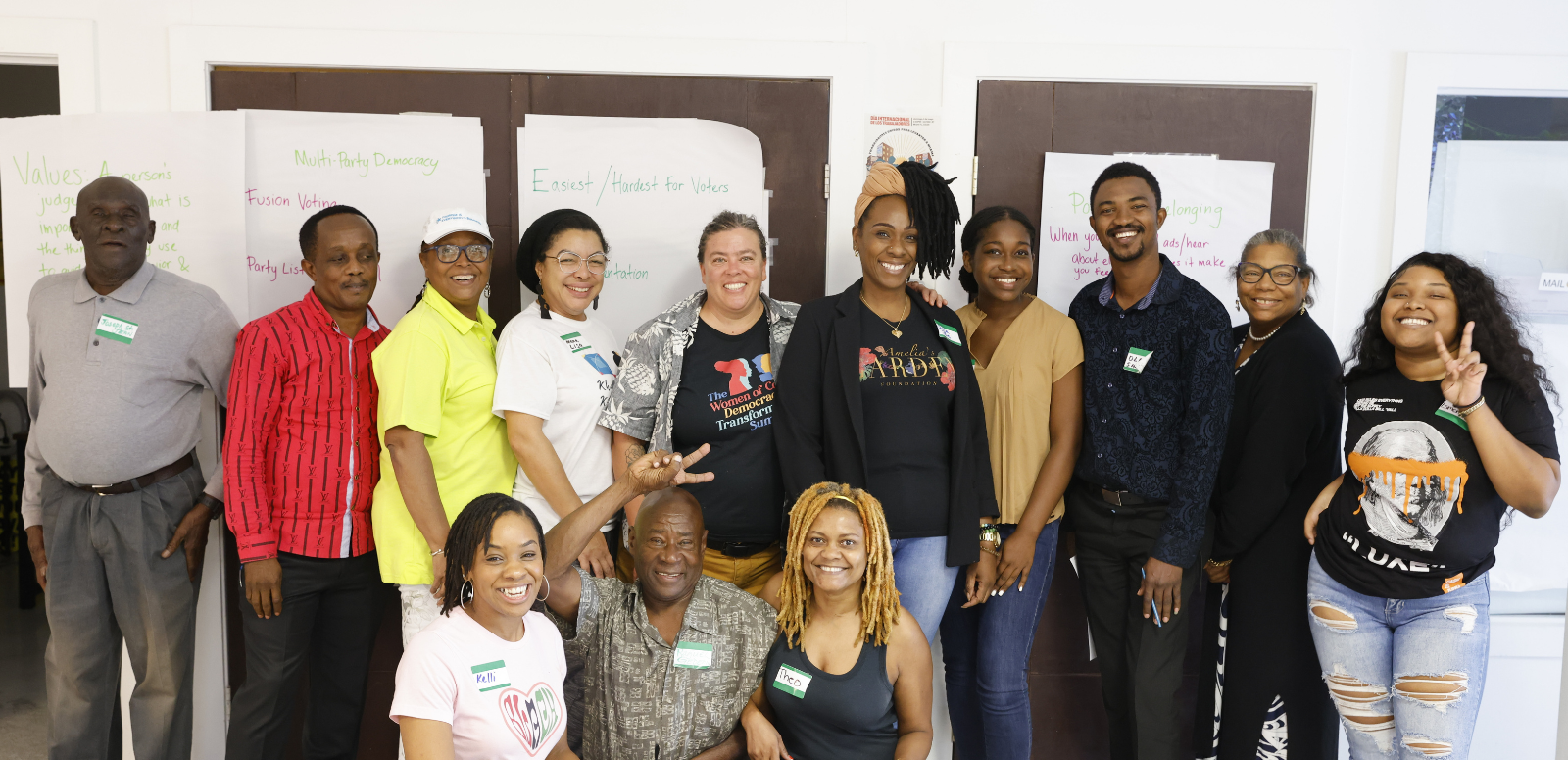
Participants in all five locations expressed gratitude to be able to participate in a long-format, candid conversation in a small, safe setting where they could discuss typically unsafe topics like politics and the immigrant experience. Many participants said they feel isolated and like they don’t quite belong in American culture, and most reported never having had a conversation like this.
Participants valued the political education that the focus group offered, and many reported leaving the conversation with a deeper understanding of the systems that create our lived experience. Most had never been in a political learning space without being asked to vote for someone or something before. People described a sense of hope and relief to openly talk about belonging and the current political climate and conveyed interest in having more conversations like these.
Many expressed a hope that their kids and other loved ones could engage in such conversations. This is a testament to the powerful shift that is possible when we open doors for civic education, engagement, and relationship-building.
In Their Words: Political and Civil Discourse
- “I became an organizer because organizers talked to me. They came to my house. They asked me questions. They gave me information. They invited me to things. Now I am doing the same thing.”
- “I feel like part of the reason we don’t talk about this is because of political tension. If you’re in a conversation where everyone thinks alike and one person thinks differently, it can derail it.”
- “I came in not knowing what to expect. I’ve been a part of focus groups before, but as an immigrant having someone take the time to go and ask what we think, it was very refreshing to stop and think about these issues.”
- “When you first come to the U.S. there is a culture shock. You’re out there being yourself, and then someone tells you what to do. Then you go into yourself, and you withdraw. Sharing your thoughts with other people lets you know that it’s ok. It’s refreshing.”
- “Change comes from these conversations. Doesn’t matter how educated you are. People listening to each other can make things better.”
- “Grateful and humbled by this experience. This kind of conversation is what the world is missing. We can talk to each other, we can disagree, but we can find our way to the greater good.”
- “I’ve never had a conversation like this about politics without someone being there to sell me on a candidate or something to vote for. Or scare me about something. Just political education. I really loved this conversation.”
- “I want to learn more about this. We don’t want to get involved because of a lot of fear. We say ‘I am not prepared,’ or ‘I don’t want to get in a fight.’ If we get prepared and we follow our shared values, we can have these conversations.”
Desire for a Political Home
Facilitators offered focus group members the following definition of politics: “Politics is the way that people living in groups make decisions. Politics is about making agreements between people so that they can live together in groups such as tribes, cities, or countries.”14 Afterwards, they shared the reflection prompt: “What comes to mind when you hear the word politics?” Participants clearly and overwhelmingly agreed that this definition is not what they think about when they hear the word “politics” and expressed their level of frustration and disillusionment with the current political landscape. Overall, the sentiment was that voting is extremely important and everyone who is eligible to vote should do so. They should vote not only for themselves but also for those in their communities who aren’t able to vote.
Participants talked in depth about how being an immigrant voter is an incredibly complex and impossible task because the political calculus includes considering what is best for the communities where they live, but also what is best for their country of origin. Participants want proper representation, and that means knowing that those elected to office will act on their behalf in good faith. They agreed that a political system is never going to be perfect but that an optimal system needs to be based on truth and trust.
When participants were asked if they identify with any current political party and how much they feel a sense of political belonging or representation, they overwhelmingly conveyed that they do not. While participants were clear on their core values and priority political issues, they lamented that those values were easily dismissed as campaign promises that received little to no follow-up by their elected officials. Participants in all locations expressed the need for greater nuance than the two-party system allows for, though some participants identified more strongly with the Democratic party on some issues (e.g., immigration and the environment) and the Republican party on others (e.g., Christian values and business). Generally, they felt deeply underrepresented by the two-party system because of the strong compromise that voting for either party would require. That being said, many of the focus group participants are ineligible to vote, but as pathways to citizenship continue to become available this serves as a clear example of where the two-party system falls short in representing minority communities.
During each focus group, participants were asked to complete a brief New York Times quiz to identify their ideal political party affiliation from a list of six hypothetical party options and were given clear definitions and descriptions of each party. Most participants identified with the Progressive Party but about one-fifth of participants identified with the American Labor and New Liberal parties, respectively. When being asked to select a political home from a more robust list of options, participants felt excited and reported wishing they indeed had more options to choose a political home from.
When asked about their openness to a political system that would allow more viewpoints, participants showed great interest in finding ways to have better representation and values alignment, including an openness to creating space for more parties. They were shown brief educational videos on different election systems that allow for more perspectives to be represented on the ballot: ranked-choice voting (single and multi-winner), mixed-member proportional representation, and fusion voting.15 It was difficult to present the participants with consistently accessible information about these systems because educational materials on these topics are not usually made with a broader audience in mind.
In each focus group, participants strongly critiqued the current U.S. election model of first-past-the-post as fundamentally unfair, though easy to understand. Instead, participants gravitated towards ranked-choice voting because it allows voters to support candidates that align with their values without engaging in an impossible political calculus. The preference for ranked-choice voting seemed to stem from the desire for a candidate-based system rather than a party-based system.
Some participants were already familiar with some of the alternative electoral systems. The Hmong group in St. Paul had experienced their city’s ranked-choice voting approach, and the Haitian participants in Miami had experienced the Haitian election system similar to fusion voting, where small parties endorse major party candidates. When participants across all five locations were discussing the different election systems, they approached the conversation from a lens of whether each system was fair, not whether it would further their individual priorities. The theory around mixed-member proportional representation was met with understanding and interest until it was revealed that parties chose the candidates for their allotted seats. Fusion made a great deal of sense to participants, but many immediately shifted to wondering what backroom deals might result in endorsements.
In Their Words: Political Parties and Priorities
- “A lot of immigrants vote based on U.S. foreign policy for their country back home. Before we think about our lives and our kids, we think about our country. The problems we face back home affect our daily lives here. We have to send more money, we have to move them. I wish the U.S. could listen to the people who experience these difficulties.”
- “It would be good to have a group that is for all the Hispanic community here—to talk about our issues, learn about what is happening [in] politics. Regardless of religion.”
- “I would belong if someone showed they wanted to bring everyone along.”
- “Politics is important because it affects everything in our life. If there were many parties, each would have a platform.”
- “Because of my age, I don’t want to set myself in stone. It feels like you have to pick a side, and I don’t want to be too set on something. Sometimes it seems like there’s a third party with great ideas and morals and feels like they fit perfectly, and I want to be open to that.”
- “If the structure allowed for more parties I would want to engage with more of them but now I have to think between the two.”
- “Prior to today, I’ve never been interested in politics. But if those parties from earlier existed I would like to vote for them.”
- “Even though I’m a hater, I’m incredibly patriotic at times. There truly is nowhere else where you can have that identity. In other places, when you come from outside, you’re told you will never be ‘X.’ But when you’re here, you are a part of it just by being here.”
Cynicism Is the Barrier
There was a theme of cynicism in all sections of the conversation in all locations, and almost every time, it was about our current state of politics. People have hope for the future but very little trust in our institutions, our politicians, and importantly, our parties. This distrust runs deep and goes back to their countries of origin, with the exception of the Hmong community where the lack of country of origin was cited frequently. The Hmong group was the least cynical, the most politically engaged, and had the most political power.
To some extent, participants in all locations expressed alignment with some stated priorities of both major parties but perceived racism from the Republican party as a major barrier to their engagement. Participants overall felt a great sense of cynicism around the profundity of American racism. There was a lot of conversation about how the “lesser of two evils” mentality is prevalent in this country and a shared understanding of how this mentality doesn’t bode well for democracy. Across the board, participants were clear that representation is important, but only if it is aligned with values. There was cynicism about politicians who looked like them but acted against the interest of the community.
In all locations, participants were clear that corruption runs deep in every country and at every level because power corrupts, and powerful people are good at finding ways to keep themselves unaccountable. There were multiple conversations about how the United States interferes in politics and elections elsewhere, and this certainly contributes to the lack of trust that surfaced around U.S. politics and political systems.
In Their Words: Disappointment, Distrust, and Cynicism
- “It is the people that I look up to that have disappointed me. When what your leaders deliver is different than what you need, that breaks your trust.”
- “In the past I was naive, thinking that if we vouch for someone and we work for them then we would see some positive change, specifically for the immigrant community. But at the end of the day it’s about power and winning and then our lives don’t matter.”
- “Seems like the same politics as Mexico. The bigger fish eats the smaller. The smaller ones have no choice but to choose a candidate from the big parties.”
- “I think about a lack of integrity—they say something behind the scenes, and they say something else to the public. From America to Africa this is consistent.”
- “That’s why we always say the lesser of two evils, many of them are evil to the core.”
- “A majority of people are selfish. They are there for themselves, staying in power for as long as they can. Once they get there they think less of us.”
- “In America we have a facade, hiding dirty politics behind altruism.”
- “I don’t like the idea of putting more power in the hands of the parties. Can voters trust the candidates that parties put forward?”
- “People used to disagree respectfully, but we don’t see that anymore. We get judged if we say one thing or another so we stay quiet. This is a beautiful country, but sometimes because of all the things going on we lose the beauty and become scared.”
Citations
- See the values exercise worksheet used here: https://acrobat.adobe.com/id/urn:aaid:sc:US:60e34567-cb0e-4913-9d2d-bd127aeeef54.
- “Politics: Simple English,” Wikipedia, Accessed August 30, 2024, https://simple.wikipedia.org/wiki/Politics.
- There were no readily available video resources to explain fusion voting.