Executive Summary
In a Pew report released in September of 2023 only 4 percent of those surveyed responded that our political system is working well.1 A growing share of Americans have an unfavorable view of both political parties, and more than 60 percent reported feeling exhausted when discussing politics.2 This data reflects the growing body of research and analysis that demonstrates how the current ways of American democracy—and particularly our two-party system—fail voters.
Many proposals are being presented as a solution to the “doom loop” of the two-party system.3 New America and several other pro-democracy nonprofits are building grassroots and grasstops strategies to build support for reforms that will pave the way for the United States to have a thriving multiparty democracy. In laying the foundation for this effort, New America partnered with Democracy Rising to conduct qualitative research about how the American public feels about our democracy, existing political structures, opportunities for change, and potential alternatives. In approaching this project, Democracy Rising determined that the most primed constituency for these conversations is immigrants and first-generation Americans. Forty million people living in the United States are either foreign-born or born here to parents born elsewhere.4 That is about one in four people; it is important to include their voices in conversations about politics and governance.
Methodology
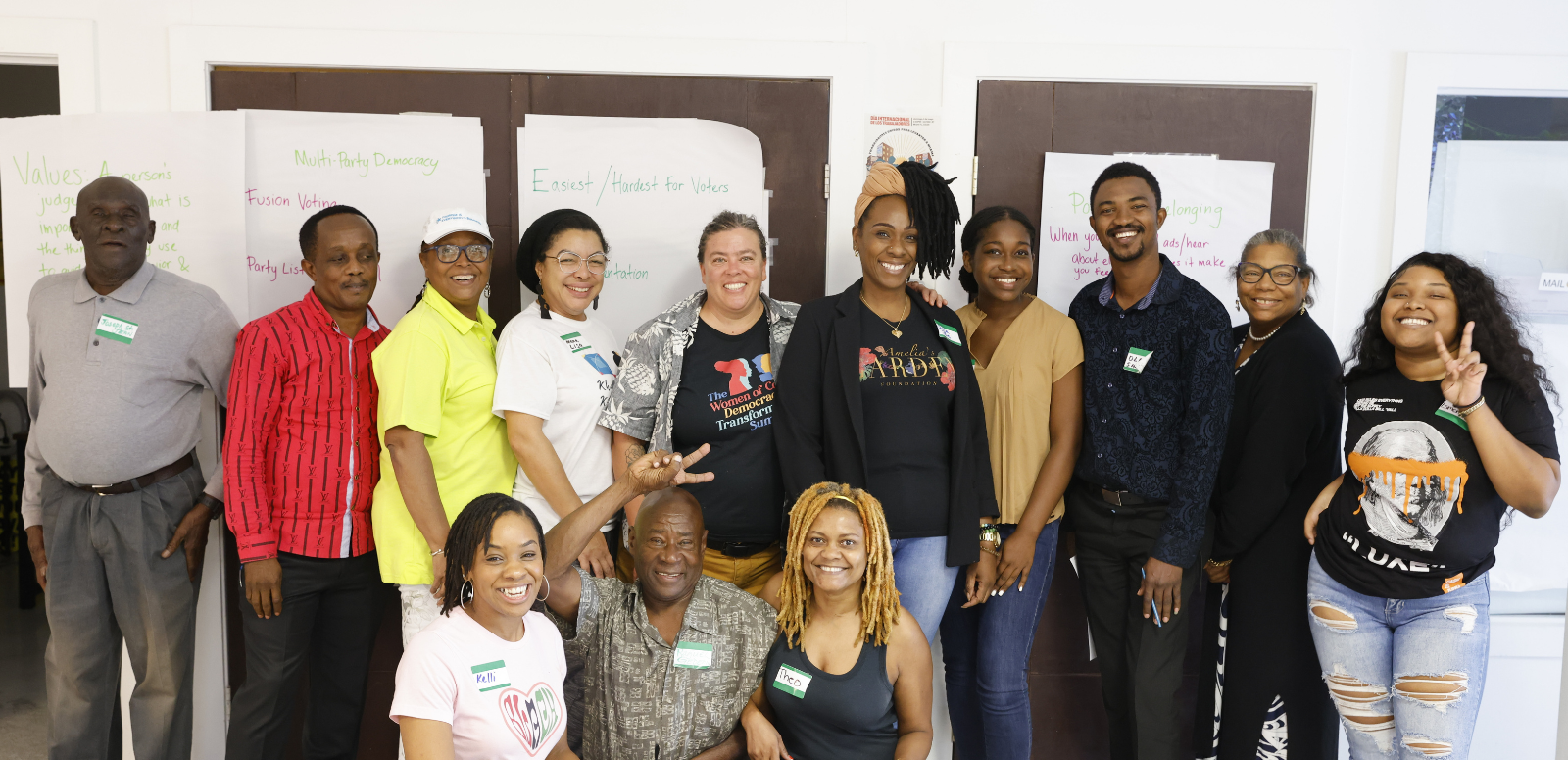
Between October 2023 and January 2024, Democracy Rising conducted five in-person focus groups with immigrant communities around the country: a Mexican community in Rock Springs, Wyoming; a Haitian community in Miami, Florida; an Eritrean community in Arlington, Virginia; a Hmong community in St. Paul, Minnesota; and a Nigerian community in Atlanta, Georgia. Rather than a standard one- or two-hour focus group, sessions for this project lasted five hours, because they were conducted using pedagogical principles of popular education.5 Additionally, the sessions provided the participants a primer on the systems and structures within American democracy that have resulted in our two-party system and proposals for alternative systems. Initial analysis was conducted by a working group. When the working group’s analysis concluded, the notes and data were then uploaded to the online platform Dedoose and reviewed by an independent researcher to determine which themes were most salient to report.
Findings
- Collectivism rooted in the immigrant experience: Participants spoke at length about the deep sense of belonging and interconnectedness they found in spending time with their neighbors and community members of the same culture. Many participants talked about being insular but having to interact with other groups to find common ground, form alliances, and build coalitions to foster belonging and safety. In this sense, participants are building micro-party-like structures within their communities.
- Thirst for civic discourse: Participants in all five locations expressed gratitude to be able to participate in a long-format, candid conversation in a small, safe setting where they could discuss typically unsafe topics like politics and the immigrant experience. Many expressed a hope that their kids and loved ones could engage in such conversations. This is a testament to the powerful shift that is possible when we open doors for civic education, engagement, and relationship-building.
- Desire for a political home: When participants were asked if they identify with any current political party, they overwhelmingly conveyed that they do not. When asked about their openness to a political system that would allow more viewpoints, participants showed great interest in finding ways to have better representation, values alignment and, creating space for more parties.
- Cynicism is the barrier: There was a theme of cynicism in all sections of the conversation in all locations—almost always about our current state of politics. People have hope for the future, but very little trust in our institutions, our politicians, and importantly, our political parties. Across the board, participants were clear that representation is important, but only if it is aligned with values.
Recommendations
- Invest in civic discourse: Voting is important, and we must make sure all eligible voters can vote in every election, but voting alone does not create a democracy. Minority communities, and especially communities with low numbers of eligible voters, are rarely engaged in political discourse. This project reinforced our belief that communities are thirsty for civic discourse and are able to do so productively given the opportunity, regardless of whether they are eligible to vote or not.
- Shift narratives around the word “party”: Participants were largely open to the idea of doing democracy differently, including the idea of having a multiparty system, however, the concept of a party itself was met with a great deal of distrust and disillusionment. For reformers to explore policies that have the intention of increasing the number of viable parties in the U.S. system, there needs to be a dedicated effort to rehabilitate the word “party.”
- Create and disseminate accessible and culturally appropriate resources: Our approach to this project allowed participants to sit and grapple with concepts that are rarely presented to a broader audience. There was interest and excitement around potential alternatives, but the existing information on these topics is geared towards an audience that is already deeply engaged in U.S. politics. We found that resources with simple and accessible language had a larger impact on the attitudes of participants towards the reform itself than those that were more technical.
- Leverage existing democratic culture and infrastructure in communities: Communities are undertaking effective democratic practices, but they often do not translate into formal structures and systems. In addition to thinking of state- and federal-level democracy building legislation, we need to assess and learn from how democracy is already being practiced formally and informally in communities.
Citations
- Americans’ Dismal Views of the Nation’s Politics (Washington, DC: Pew Research Center, 2023), https://www.pewresearch.org/politics/2023/09/19/americans-dismal-views-of-the-nations-politics/.
- Americans’ Dismal Views of the Nation’s Politics (Washington, DC: Pew Research Center, 2023), https://www.pewresearch.org/politics/2023/09/19/americans-dismal-views-of-the-nations-politics/.
- Lee Drutman, Breaking the Two-Party Doom Loop: The Case for Multiparty Democracy in America (New York: Oxford University Press, 2019).
- Mohamad Moslimani and Jeffrey S. Passel, “What the data says about immigrants in the U.S.,” Pew Research Center, July 22, 2024, https://www.pewresearch.org/short-reads/2020/08/20/key-findings-about-u-s-immigrants/.
- Popular education is a teaching methodology that centers around lived experience and through the learning process connects that lived experience with larger context. See Paolo Freire, Pedagogy of the Oppressed (London, England: Penguin Classics, 2017).