Overview of Misinformation and Disinformation
Understanding the concepts of misinformation and disinformation is critical in today’s information-saturated world. This chapter provides an in-depth overview of these phenomena, exploring their definitions, historical contexts, and the significant impact they have on society.
Definitions and Differences
The terms misinformation and disinformation are often used interchangeably, but they have distinct meanings that are crucial to appreciating their respective impacts. Realizing the distinction between these two concepts is essential because it influences how we approach the challenge of combating false information.
The fundamental difference between misinformation and disinformation lies in intent.5 The key characteristic of misinformation is the lack of intent to deceive. Those who share misinformation typically do so in a naïve way, often unaware that the information they are passing on is false. The deliberate nature of disinformation makes it a more insidious and dangerous phenomenon than misinformation because it not only seeks to mislead but also to manipulate public perception and behavior in ways that serve the interests of the disinformation creators. The tactics used in disinformation campaigns often involve exploiting emotional triggers, such as fear, anger, or outrage, to bypass rational analysis and provoke a strong, immediate reaction from the audience. This emotional manipulation makes disinformation particularly difficult to combat, as it can entrench false beliefs and polarize communities.
Another key difference is the level of organization involved and the methods of dissemination. Misinformation can spread organically through word of mouth or social networks, often as a result of individuals sharing content they believe to be true or even news outlets that do not adequately verify their sources. Disinformation, however, is typically part of a coordinated effort to achieve a specific outcome, whether political, financial, or ideological. These efforts can be highly sophisticated, involving the use of multiple channels and platforms to reach a wide audience and create a sense of credibility or legitimacy around the false information. Tactics include creating fake accounts or websites, using algorithms to amplify certain messages, or targeting specific demographics with tailored content designed to resonate with their existing beliefs and biases.
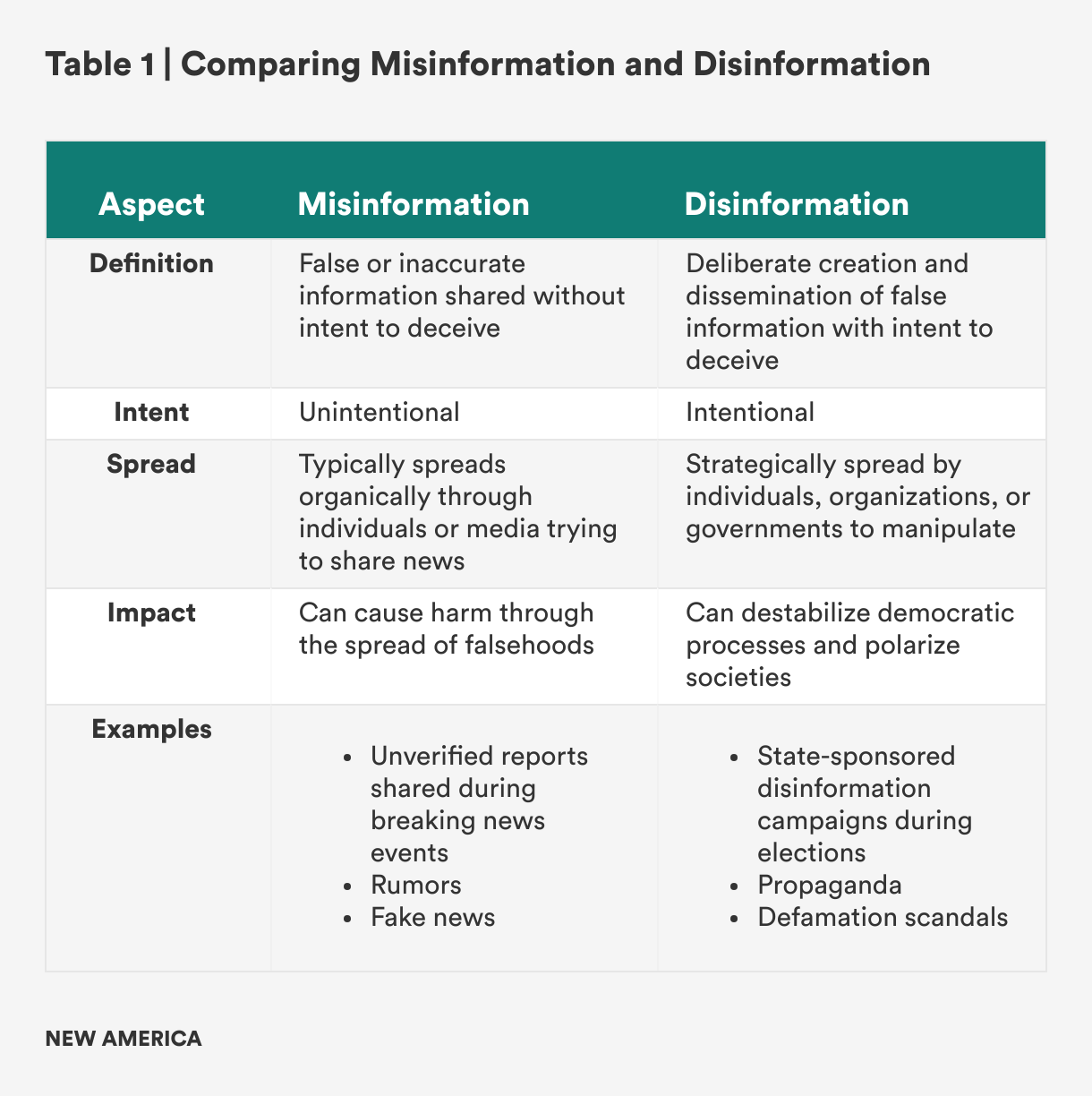
While our main focus in this report is on misinformation and disinformation, it is worth mentioning that malinformation is yet another concept that refers to the deliberate sharing of true information with the intent to cause harm or manipulate.6 Unlike misinformation, which involves false or inaccurate information spread without intent to deceive, and disinformation, which is deliberately false, malinformation involves truthful content used maliciously. Examples of malinformation include leaking private data, sharing confidential communications, or releasing damaging information at strategic moments to manipulate public perception or stir conflict. While the information itself is accurate, its context or timing is manipulated to harm individuals, groups, or institutions. This makes malinformation particularly dangerous as it can be used in smear campaigns, often without the protections afforded to outright falsehoods.
Societal Impacts
Misinformation and disinformation have far-reaching consequences for society, affecting various aspects of life, including politics, public health, social cohesion, and trust in institutions. In the political realm, disinformation campaigns often target vulnerable populations, exploiting existing divisions and amplifying tensions to achieve specific political goals. For example, during the 2016 U.S. presidential election, Russian operatives conducted a disinformation campaign aimed at sowing discord among American voters by creating fake social media accounts and targeted advertisements to influence voter behavior.7 This not only contributed to the polarization of American society, but also raised concerns about the integrity of the electoral process and the vulnerability of democratic institutions to foreign interference.
In the public health domain, the spread of false information about medical treatments, vaccines, and diseases can lead to harmful behaviors, such as vaccine hesitancy, the use of ineffective or dangerous remedies, and the rejection of evidence-based medical advice. The COVID-19 pandemic is a stark example of how misinformation can exacerbate a public health crisis. Throughout the pandemic, misinformation about the virus’s origins, transmission, and treatment spread rapidly on social media, leading to confusion, fear, and mistrust among the public. Disinformation campaigns promoting false cures, such as the use of hydroxychloroquine or the ingestion of bleach, put people’s lives at risk.8 Furthermore, misinformation about vaccines fueled vaccine hesitancy, complicating efforts to achieve herd immunity and prolonging the pandemic.
Social cohesion is another area where misinformation and disinformation can have a detrimental impact. Spreading false information that exacerbates divisions along racial, ethnic, religious, or ideological lines contributes to the polarization of societies. When people are repeatedly exposed to disinformation that reinforces their preexisting beliefs and biases, they are more likely to become entrenched in their views and less willing to engage in constructive dialogue with those who hold different opinions. This polarization can lead to increased hostility between different groups, reducing the potential for compromise and collaboration. In extreme cases, disinformation can incite violence, as seen in incidents of hate crimes or politically motivated attacks.
“Perhaps one of the most significant impacts of misinformation and disinformation is the erosion of trust in institutions, including the media, the government, and the scientific community.”
Perhaps one of the most significant impacts of misinformation and disinformation is the erosion of trust in institutions, including the media, the government, and the scientific community. When people are exposed to conflicting information, particularly from sources they perceive as credible, they may become skeptical of all information sources, leading to a phenomenon known as information nihilism.9 This skepticism can be exploited by those who seek to undermine trust in established institutions for political or ideological reasons. For example, disinformation campaigns that target mainstream media outlets, labeling them as “fake news,” can erode public trust in journalism and make it more difficult for people to distinguish between reliable and unreliable sources of information. Similarly, disinformation that casts doubt on scientific consensus, such as the denial of climate change or the safety of vaccines, can undermine public confidence in science and hinder efforts to address pressing global challenges.
Citations
- Bernd Carsten Stahl, “On the Difference or Equality of Information, Misinformation, and Disinformation: A Critical Research Perspective,” Informing Science 9 (2006): 83–96, https://www.informingscience.org/Publications/473.
- Kacper T. Gradoń, Janusz A. Hołyst, Wesley R. Moy, Julian Sienkiewicz, and Krzysztof Suchecki, “Countering Misinformation: A Multidisciplinary Approach,” Big Data & Society 8, no. 1 (2021), https://journals.sagepub.com/doi/10.1177/20539517211013848.
- Scott Shane and Mark Mazzetti, “Inside a 3-Year Russian Campaign to Influence U.S. Voters,” New York Times, February 16, 2018, https://www.nytimes.com/2018/02/16/us/politics/russia-mueller-election.html.
- “Coronavirus: Outcry after Trump Suggests Injecting Disinfectant as Treatment,” BBC News, April 24, 2020, https://www.bbc.com/news/world-us-canada-52407177.
- Justin R. Pidot, “Environmental Nihilism,” Arizona Journal of Environmental Law & Policy 10, no. 1 (Fall 2019), https://repository.arizona.edu/handle/10150/675233.