A Chapter of: Cut Short: The Broken Promises of Cosmetology Education
The Dirty Mirror: Schools Operate Despite Scandals
Big- and brand-name cosmetology schools like Paul Mitchell and Empire Beauty are often the ones promising a fast track to success in the booming beauty industry. Yet, these same institutions—despite their prominence—are frequently under scrutiny for fraud and abuse, accused of preying on the students they claim to empower.
La’ James again offers a striking example of this troubling reality. It has been sued continually for more than a decade but has escaped meaningful punishment. The school has settled several lawsuits, including one in 2020 when a group of students filed a class-action suit, alleging La’ James had violated Iowa law by illegally withholding student aid for living expenses, breaking a deal it made to them when they had enrolled.71 In 2021, a state audit revealed La’ James had continually provided misleading information about students’ financial aid, prompting yet another settlement in December 2022 with the Iowa attorney general in which it forgave $462,000 in student loans.72
The systemic legal and regulatory issues go hand in hand with the poor education quality at La’ James. Countless La’ James students have, either in court filings or through social media, cut the same pattern: Instructors were often absent, course materials were outdated, and, in some cases, they were overcharged for their programs.
One Facebook group is entirely dedicated to calling out La’ James for allegedly defrauding students in various ways.73 One student in the group posted in January 2025 that they felt trapped. “To be degraded and treated like a child by some of them,” the student wrote. “I already put too much money to quit now when I have a couple months left but I feel so depressed.”
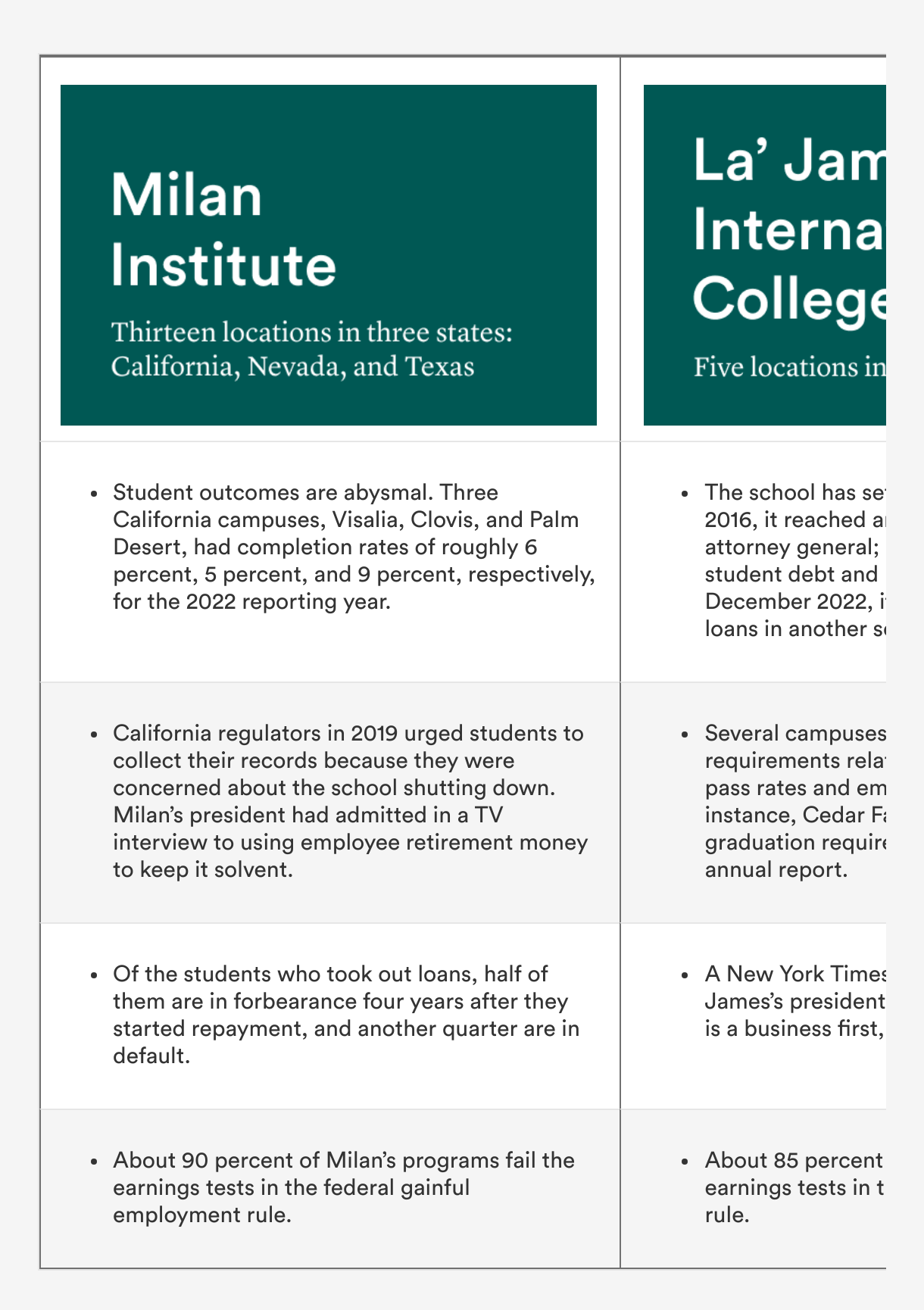
Another prominent for-profit chain, the Milan Institute of Cosmetology, has more than a dozen locations in three states and casts itself on its website as a “student-focused,” family-owned school, a down-home alternative to private equity-controlled institutions. But based on the institute’s extraordinarily poor outcomes, the school’s “student-focused” education is remarkably ineffective. According to the most recently available public data, only a small share of students across several campuses graduate on time or find employment. At its Visalia, California, campus, roughly 6 percent—or just 13 of 215 eligible students—graduated from the cosmetology program on schedule for 2022. And of the 85 students the school said were ready for employment, only about one quarter, or 24 of the available students, found jobs.74 A similar story emerges at the school’s Clovis, California, campus. Only 20 of the nearly 400 students who qualified for graduation finished the cosmetology program on time, amounting to about a 5-percent completion rate.75
At one point, it seemed the school was on the verge of shutting down. In 2019, California state regulators urged current and former Milan students to obtain financial and academic records as soon as possible.76 In September of 2019, Milan Institute President Gary Yasuda admitted in a TV interview to taking employees’ retirement money to keep the school financially solvent.77 But the school still stayed in business.
The school’s two accreditors, the Council on Occupational Education and National Accrediting Commission of Career Arts and Sciences, have also taken action78
and over the last five or so years, have put several campuses on probation or told them that they were violating accreditor standards around student outcomes and financial management.
With the glut of low-performing schools, it seems logical that more might close, or regulators might take a stricter line with them. Remarkably, these institutions—including Milan Institute, La’ James, and Empire schools—remain open and able to reap financial aid dollars.
In La’ James’s case, an individual who worked on the state lawsuits said in an interview with New America there was interest in criminally prosecuting the school. But the former official alleged La’ James’ owner hired Doug Gross, a prominent Republican lawyer who once ran for governor, to “fix” the relationship with the state and secure a settlement instead.
A couple of major cosmetology schools have shuttered, but only after serious misconduct led the U.S. Department of Education to intervene. One, Marinello Schools of Beauty, closed in 2016, following years of accusations that the school deceived students and provided a subpar education.79
In 2016, the Education Department found the institution had schemed with an unaccredited high school known as Parkridge Private School to funnel students in and earn fake diplomas and then enroll them in Marinello, but leave them with a useless credential.80
The Education Department determined Marinello had falsely certified the financial aid eligibility of students from Parkridge who lacked the accredited high school diplomas or GEDs needed to access federal financial aid. It barred five Marinello campuses from continued participation in federal financial aid programs. Marinello subsequently closed all of its 56 campuses. Marinello students had received more than $87 million in Pell Grants and loans in the 2014–15 academic year.81 The Biden administration later discharged 28,000 borrowers’ loans totaling approximately $238 million, due to widespread and substantial misrepresentations made by the school and leaving students without instructors for weeks to months.82
Similar misconduct occurred decades earlier at for-profit schools run by Wilfred American Educational Corporation.83 In the early 1990s, federal investigations had unearthed crimes that ranged from financial aid fraud to embezzlement; Wilfred Academy closed the remainder of its schools in 1994.84
In 2017, the Education Department also began discharging loan debt for students who attended the school. It took nearly 25 years for the victims of the Wildfred’s wrongdoing to receive loan forgiveness.
Cut Short: The Broken Promises of Cosmetology Education
- Introduction
- Empire’s Foundation: Federal Aid Fueled an Industry
- From Salon to Senate: Cosmetology’s Lobbying Power
- Held in Place: Locking in State Licensure Mandates
- Beauty School Blunders: The System Costs Students
- The Dirty Mirror: Schools Operate Despite Scandals
- A New Look: Rethinking Licensure Pathways
- Conclusion and Recommendations
Citations
- Detmer v. La’ James International College, Iowa District Court for Polk County, March 20, 2020, https://www.defendstudents.org/cases/detmer-v-lajames/document/LaJames-Complaint.pdf.
- Jason Clayworth, “La’ James Agrees to Return Another $462K in Iowa Student Loans,” Axios, January 3, 2023, https://www.axios.com/local/des-moines/2023/01/03/la-james-forgives-462k-iowa-student-loans.
- “I Was Defrauded by La James College,” public Facebook group, accessed January 27, 2025, https://www.facebook.com/groups/1472782659643767.
- Bureau for Private Postsecondary Education (State of California), “Milan Institute—2022 Annual Report Summary” for Visalia campus, accessed January 27, 2025, https://www.bppe.ca.gov/webapplications/annualReports/2022/details/5400411.
- Bureau for Private Postsecondary Education (State of California), “Milan Institute—2022 Annual Report Summary” for Clovis campus, accessed January 27, 2025, https://www.bppe.ca.gov/webapplications/annualReports/2022/details/81701270.
- California Department of Consumer Affairs, “State Urges Milan Institute Students to Take Steps to Obtain Their Records,” press release, October 3, 2019, https://thedcapage.blog/2019/10/03/state-urges-milan-institute-students-to-take-steps-to-obtain-their-records.
- Jeff Platt, “Milan President Admits He Took 401(k) Money to Keep School Afloat,” KBAX Fox 58, September 26, 2019, https://bakersfieldnow.com/news/local/milan-president-admits-he-took-401k-money-to-keep-school-afloat.
- DAPIP (Database of Accredited Postsecondary Institutions and Programs), U.S. Department of Education, “Milan Institute—Palm Desert,” accessed January 25, 2025, https://ope.ed.gov/dapip/#/institution-profile/229726.
- Samantha Masunaga and Chris Kirkham, “Marinello Schools of Beauty Abruptly Shuts Down After Federal Allegations,” Los Angeles Times, February 5, 2016, https://www.latimes.com/business/la-fi-marinello-closing-20160205-story.html.
- Office of Federal Student Aid, U.S. Department of Education, Final Program Review Determination—Marinello School of Beauty, April 18, 2016, https://studentaid.gov/sites/default/files/fsawg/datacenter/library/FPRD/Marinello_Schools_of_Beauty_CA_034673_04_18_2016_FPRD_Redacted.pdf.
- U.S. Department of Justice, Central District of California, “Defunct Cosmetology School’s Insurer Pays $8.6 Million to Resolve Claims that School Improperly Obtained Federal Student Loan Funds,” press release, August 24, 2016, https://www.justice.gov/usao-cdca/pr/defunct-cosmetology-school-s-insurer-pays-86-million-resolve-claims-school-improperly.
- Darleene Powells, “$238 Million Worth of Loans Held by Students Enrolled at Marinello Beauty Schools to Be Discharged,” CBS News, April 28, 2022, https://www.cbsnews.com/losangeles/news/238-million-student-loans-marinello-beauty-schools-discharged/.
- Patricia Cohen and Emily S. Rueb, “U.S. to Help Remove Debt Burden for Students Defrauded by For-Profit Chain,” New York Times, August 9, 2017, https://www.nytimes.com/2017/08/09/business/wilfred-student-debt.html.
- Emily S. Rueb, “Beauty School Students Left with Broken Promises and Large Debts,” New York Times, July 28, 2013, https://www.nytimes.com/2013/07/29/nyregion/promised-better-life-by-beauty-schools-graduates-have-little-training-and-lasting-debt.html.