A Chapter of: When Micro Goes Macro: A Nationwide Review of States’ Educator Micro-Credential Policies
Comparison to 2020 Findings
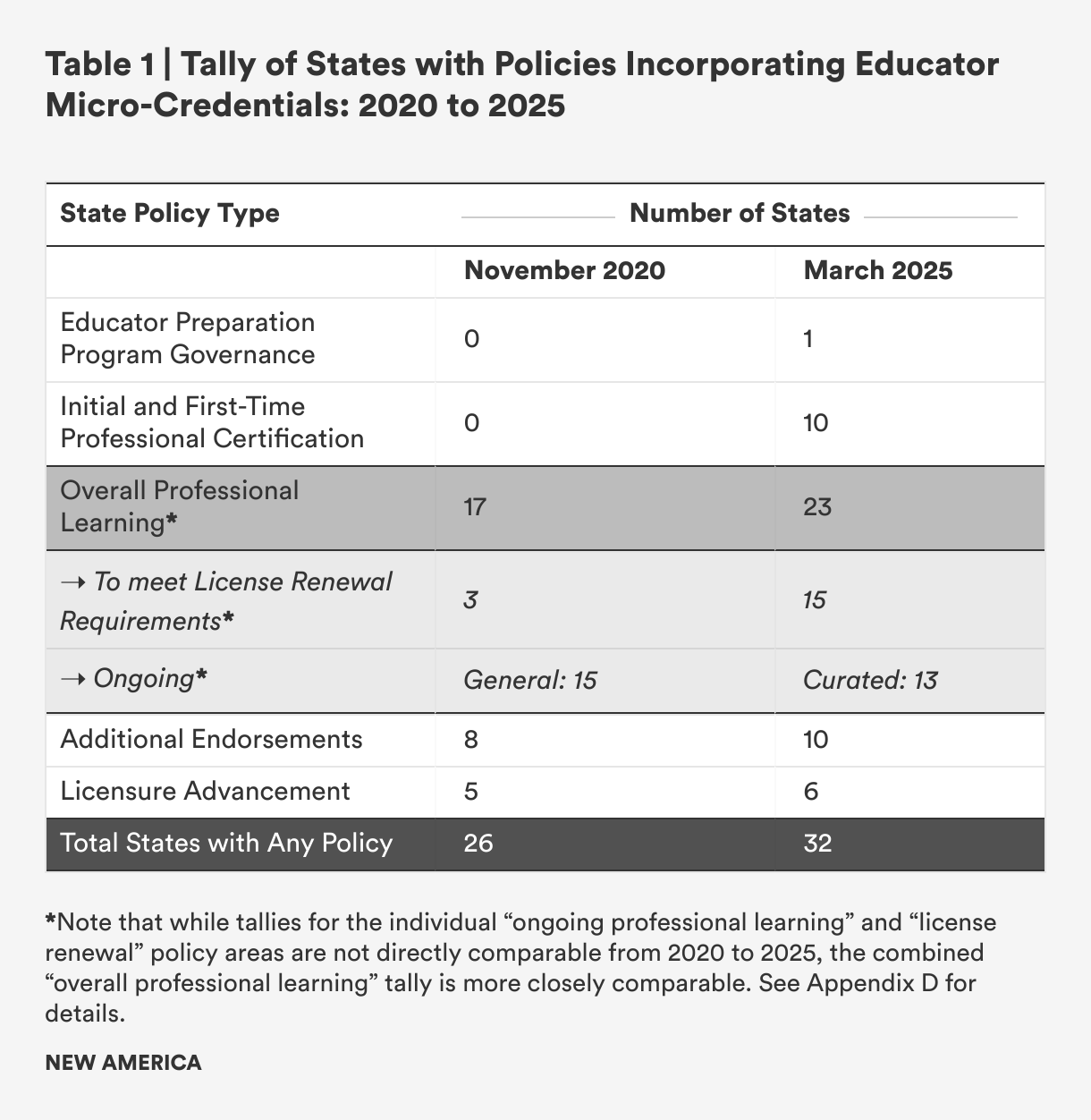
As the number of states with educator policies or other initiatives that explicitly mention micro-credentials has increased from 26 to 32 over the past four years, the biggest upticks in adoption of educator micro-credentials have been in initial and first-time professional certification and overall professional learning, whether for curated professional development or license renewal.
Similar to our findings in 2020, states are concentrating their educator micro-credential policy efforts on the average current educator, rather than on preparing and credentialing new educators or vetting the most expert educators for advancement opportunities. Due to changes in our methodology (see Appendix D), exact comparisons of the individual ongoing professional learning and license renewal categories are not possible, but looking at ongoing professional learning and license renewal in combination shows a 35 percent increase in 2025 policies incorporating educator micro-credentials relative to 2020 (23 versus 17). Conducting an apples-to-apples comparison of license renewal policies using the 2020 methodology—where only states with policies specifying exactly what value micro-credentials have in the state’s relicensure currency were counted—the 2025 state policy tally would be eight,37 still more than double that of 2020.
However, the most growth in the use of micro-credential policies was in initial and first-time professional credentialing—from zero to 10 states—due to intensified state efforts to ensure that teachers with temporary credentials have a path to demonstrating their value and continuing in the profession. It will be important to follow these efforts, as prior New America research found that most novice teachers had difficulty successfully completing high-quality educator micro-credentials without additional support.38
While the state policy tally in categories such as additional endorsements have stayed relatively static, subtle shifts have been occurring that are not apparent from the totals alone. For example, while most states that incorporate micro-credentials for additional endorsements still only do so in one or two targeted shortage areas (similar to 2020 findings), three states—Alaska, Utah, and Wyoming—now have policies authorizing the use of micro-credentials within any state-approved pathway to earning additional endorsements, which no states did in 2020. That being said, none of these states have developed state-approved pathways for all endorsement areas that include micro-credentials.
Table 1 offers a side-by-side comparison of state educator micro-credential policies relative to 2020 for each of the six policy categories examined, as well as the total number of states with any policy.

When Micro Goes Macro: A Nationwide Review of States’ Educator Micro-Credential Policies
- Executive Summary
- Introduction
- State Policy Scan Methodology
- Overall Findings
- Detailed Policy Category Findings
- Comparison to 2020 Findings
- Discussion
- Conclusions and Recommendations
- Appendix A: Understanding the High-Quality Micro-Credentialing Process and Ecosystem
- Appendix B: Interviews Conducted by Authors, Chronologically
- Appendix C: Definitions and Examples for Six Educator Policy Areas
- Appendix D: Policy Categorization Methodology Differences from 2020 to 2025
- Appendix E: Summary of State Educator Micro-Credential Policies, by Category
- Appendix F: Additional Insights on Individual State Educator Micro-Credential Policies
Citations
- We are counting South Carolina’s suggested currency for micro-credentials in guidance to LEAs, which ultimately have authority to determine the value of professional learning experiences for license renewal, in this total.
- See Arkansas teacher induction example in “Importance of Iterative Implementation” section of Tooley and Hood, Harnessing Micro-Credentials for Teacher Growth: A National Review of Early Best Practices, https://www.newamerica.org/education-policy/reports/harnessing-micro-credentials-teacher-growth/findings/#3-developing-and-implementing-state-and-local-policies.