A Chapter of: When Micro Goes Macro: A Nationwide Review of States’ Educator Micro-Credential Policies
Detailed Policy Category Findings
This section provides a more detailed look at the findings from our most current state scan for each of the six educator policy areas reviewed. See Appendix C for a glossary and examples for how policies were categorized in each of the six policy areas, Appendix E for a summary of policy results by state, and Appendix F for additional details on each state’s policies.
Educator Preparation Program Governance
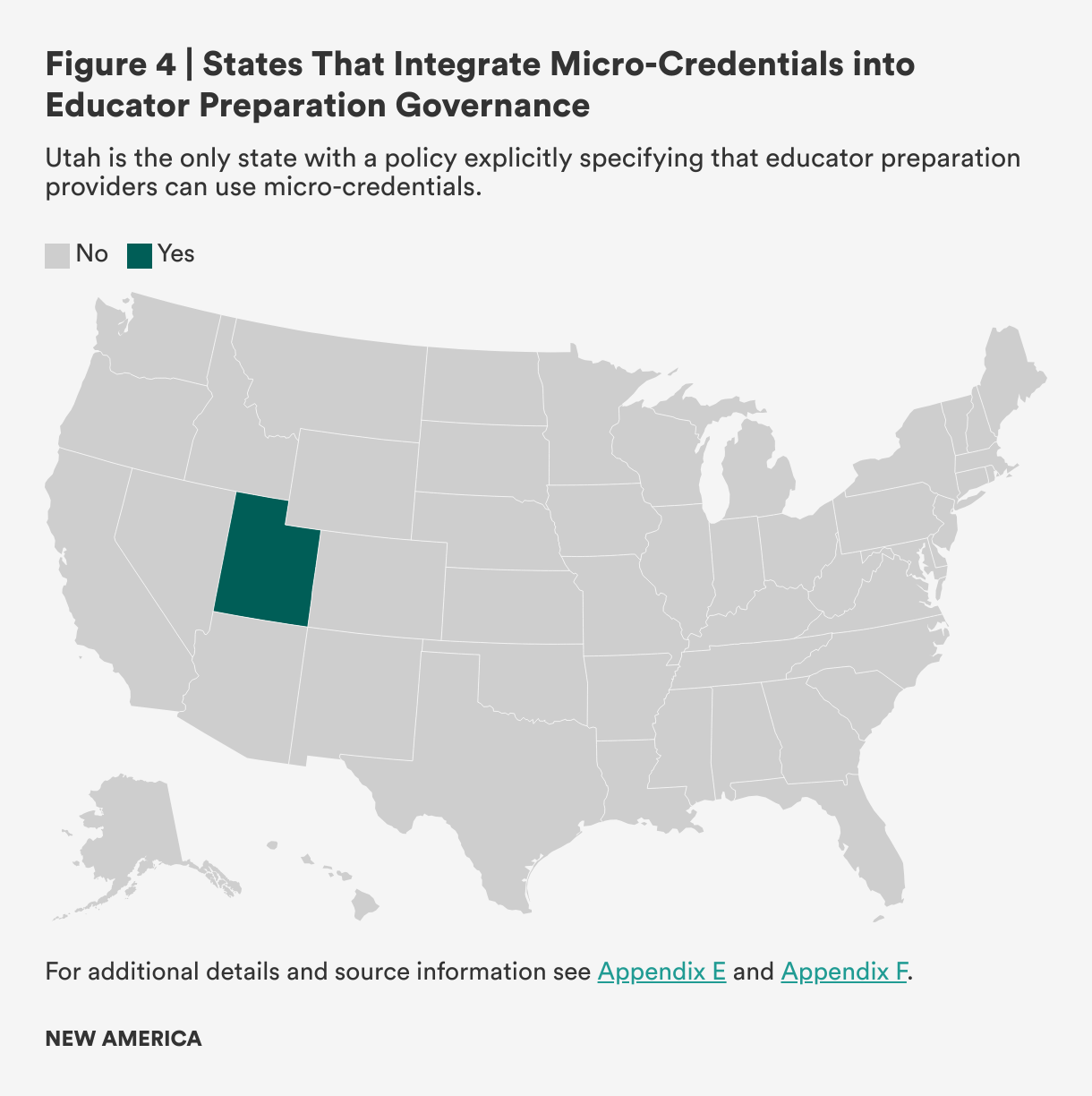
As Figure 4 indicates, Utah is the only state with an explicit policy encouraging the use of micro-credentials within educator preparation programs (EPPs).28 As part of the process of obtaining state approval to operate, Utah requires all EPPs—including those based within and outside institutions of higher education—to submit forms explaining how they are measuring each required competency in their candidates, with micro-credentials explicitly listed as an example method for competency demonstration.29 Additionally, the form that Utah’s university-based EPPs must submit to the state board of education to be approved to offer specific endorsements lists micro-credentials as one example of how candidates can demonstrate the required competencies.30
Initial and First-Time Professional Certification
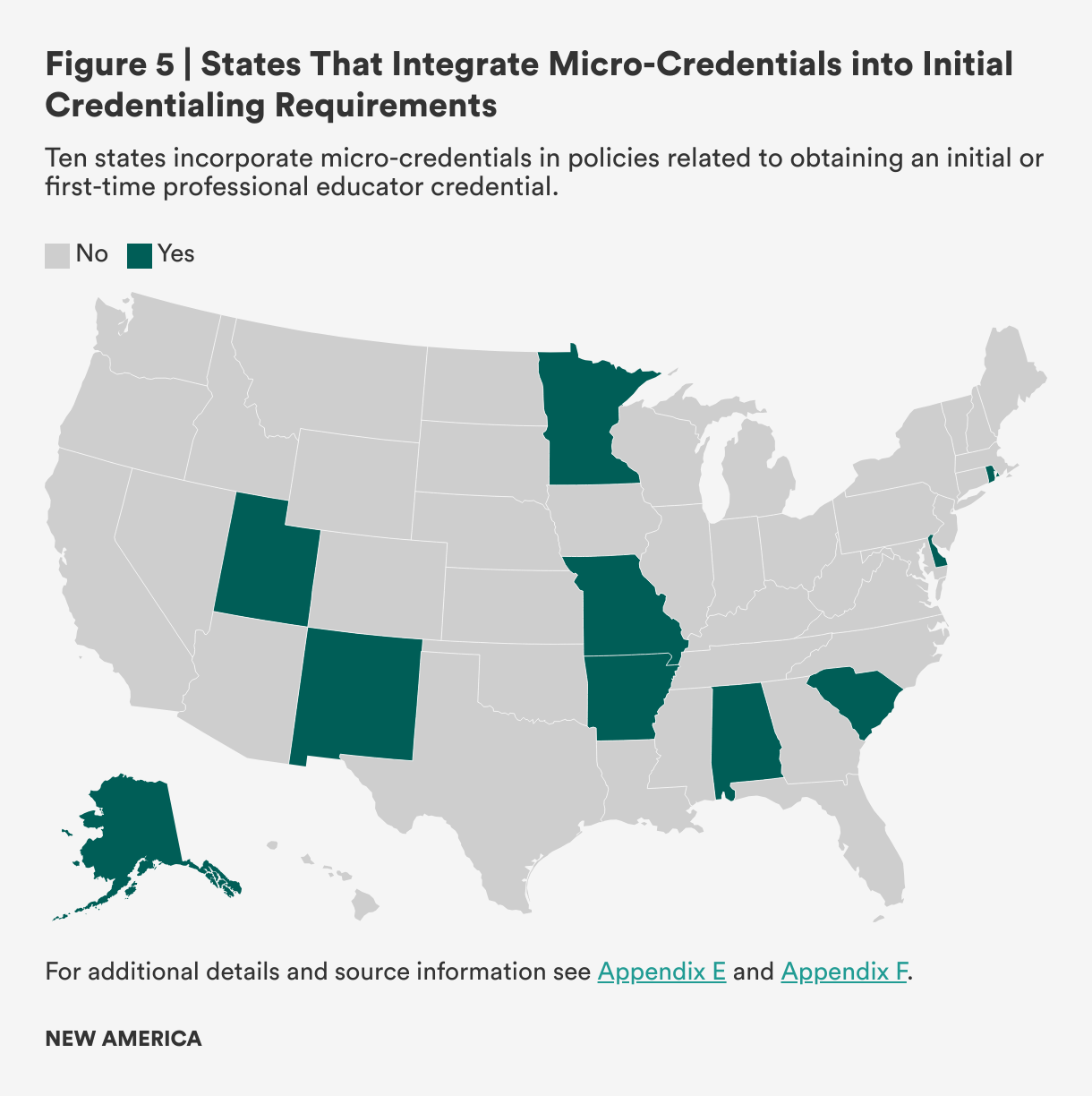
Ten states have policies explicitly allowing, encouraging, or requiring the use of micro-credentials for obtaining an initial or first-time professional educator credential: Alabama, Alaska, Arkansas, Delaware, Minnesota, Missouri, New Mexico, Rhode Island, South Carolina, and Utah (see Figure 5). Missouri is the only state with a statewide policy for initial credentialing of local administrators using micro-credentials.
States vary significantly in how explicitly and deeply micro-credentials are incorporated in their policies. South Carolina requires individuals who receive initial certification to teach through the Carolina Collaborative for Alternative Preparation pathway to complete micro-credentials to progress to the professional certificate, and the only avenue to earning an Initial Administrator Certificate for Special Education Director, Kindergarten-Grade 12 in Missouri is by completing approved micro-credentials. Alabama, Arkansas, and Delaware allow teachers with temporary certification to earn micro-credentials in lieu of passing a multiple-choice exam, although in limited circumstances; Vermont is expecting to implement a similar policy soon (see Appendix F for details). Minnesota embeds “stacks”31 of related micro-credentials into a pathway to earn a career and technical education teaching credential.
Rhode Island and Utah’s policies are more light touch, where micro-credentials are explicitly mentioned as an option but not encouraged. In Rhode Island, teachers with an initial credential must engage in professional learning to earn a professional credential, and state policy indicates that micro-credentials can count as professional learning. Utah mentions micro-credentials as one way that universities can have prospective educators demonstrate the competencies necessary to earn their credential, as well as any specific endorsement(s).
Curated Professional Development in State Priority Areas
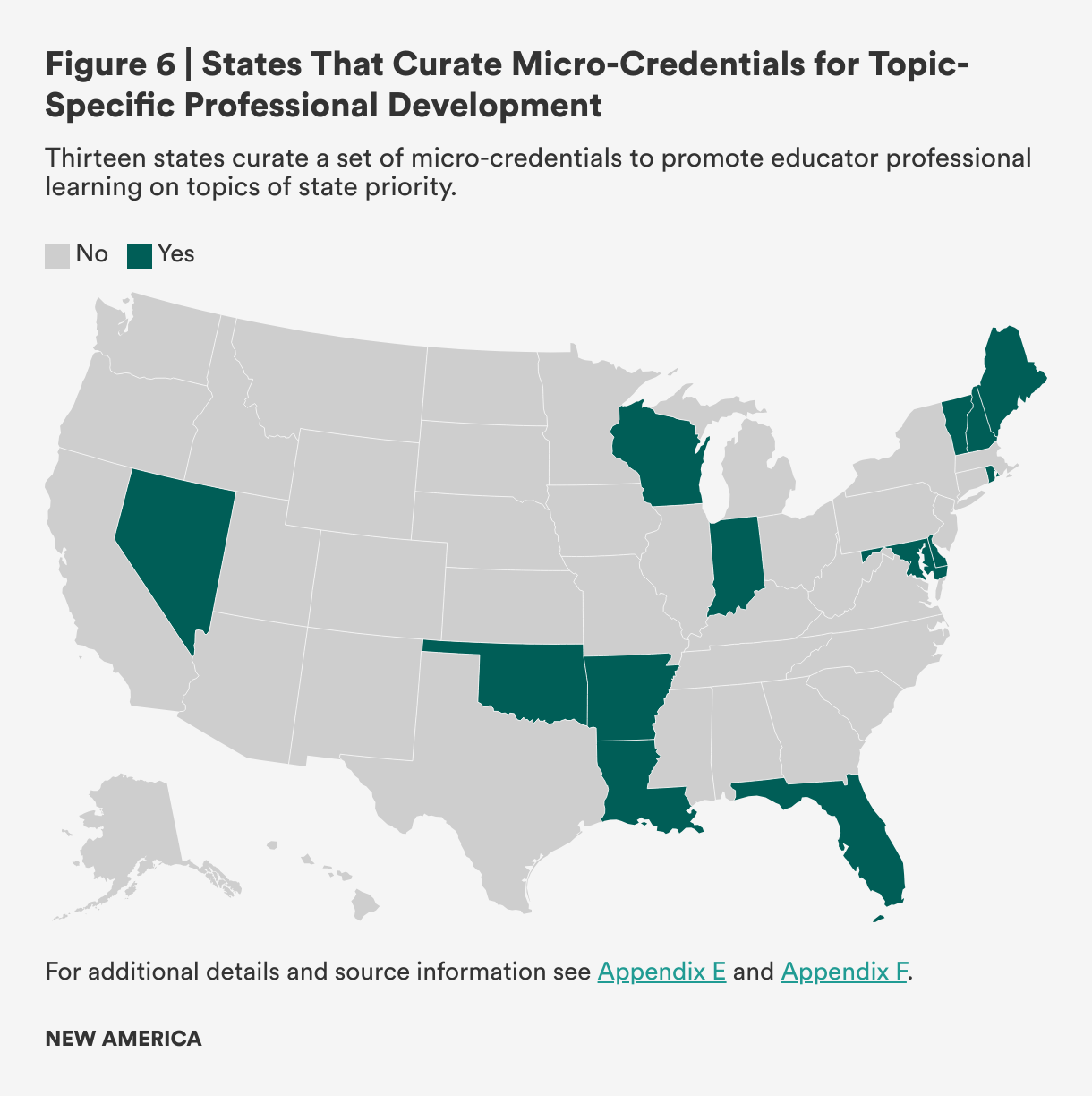
As shown in Figure 6, 13 states have curated educator micro-credentials to deliver training and promote professional learning on specific topics.32 Within the states offering this type of targeted professional development, the most prevalent focus areas are literacy (five states), educating students with disabilities (three states), computer science (two states), and educating English learners (two states). Because these professional learning opportunities are typically optional for educators but are priority areas for the states, most states are offering these at no cost to participants. Some states offer a stipend to educators completing these micro-credentials (Delaware, Florida, Maine, and Oklahoma) and/or explicitly offer credits toward relicensure (Delaware and Florida).
License Renewal
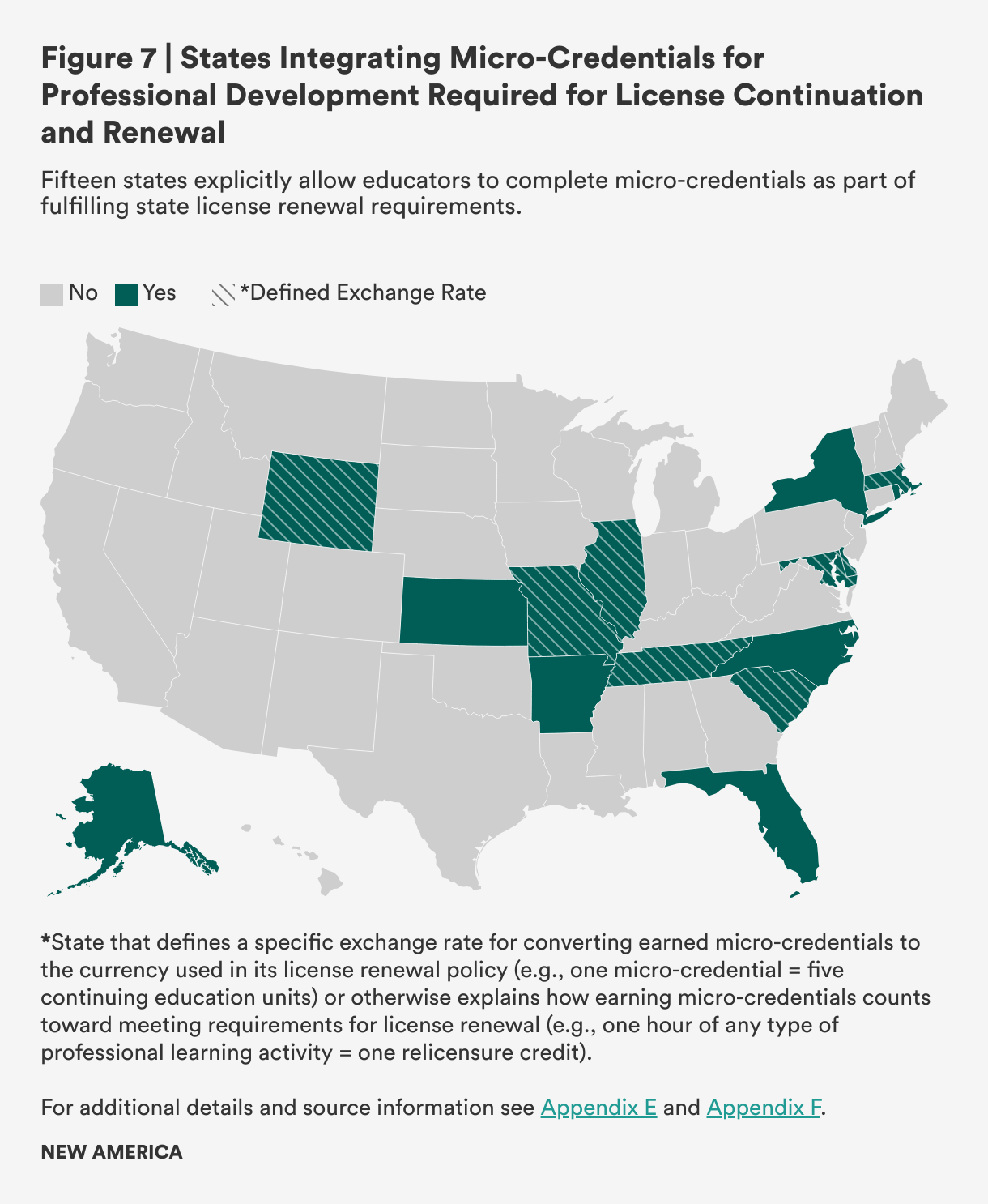
The most common way that states currently include micro-credentials in policy is by explicitly allowing educators to count them toward professional development requirements for license renewal. Among the 15 states with this type of policy (see Figure 7), there is wide variation, both in terms of which educator micro-credentials count toward relicensure credit and in how much credit educators receive for earning a micro-credential.
In many states, any micro-credential offered by a state-approved provider of professional development is eligible for relicensure credits, but Alaska provides a list of three specific entities whose micro-credentials are approved for this purpose, while Illinois vets each individual micro-credential offered by state-approved providers to determine which can count toward license renewal.
State license renewal requirement policies typically require educators to accrue a certain number of professional development credits (which hold various names and are measured in various ways) over a specified period of time. Some state policies say that micro-credentials are allowed but are silent about what value they hold in the state’s license renewal currency. Some states, such as Illinois, indicate that the same policy holds for all types of professional learning activities, typically where one clock hour of attendance is the equivalent of one professional development hour.
But a growing number of states assign a specific value in the state’s relicensure credit currency for each micro-credential as part of this process. Seven states—Delaware, Illinois, Maryland, Massachusetts, Missouri, Tennessee, and Wyoming—take this step to ensure that educators understand a micro-credential’s worth within state license renewal policy. In South Carolina, local education agencies (LEAs) have authority to determine how much value to give micro-credentials earned by their educators in the state’s relicensure currency, but the state department of education offers LEAs a recommendation. Massachusetts staff members acknowledge that individual micro-credentials are not all created equal, but they provide educators with a rough sense of what value to expect for earning them while differentiating their value in the state’s license renewal currency.
It is worth noting that in addition to the states with an explicit micro-credential policy for the purpose of license renewal, there are several additional states that implicitly allow their use by including entities that offer micro-credentials on their list of approved professional development providers. As a result, in many states educators can obtain license renewal credit by completing micro-credentials through the National Education Association’s Certification Bank, which the NEA offers to members and affiliate members at no cost.33
Additional Endorsements
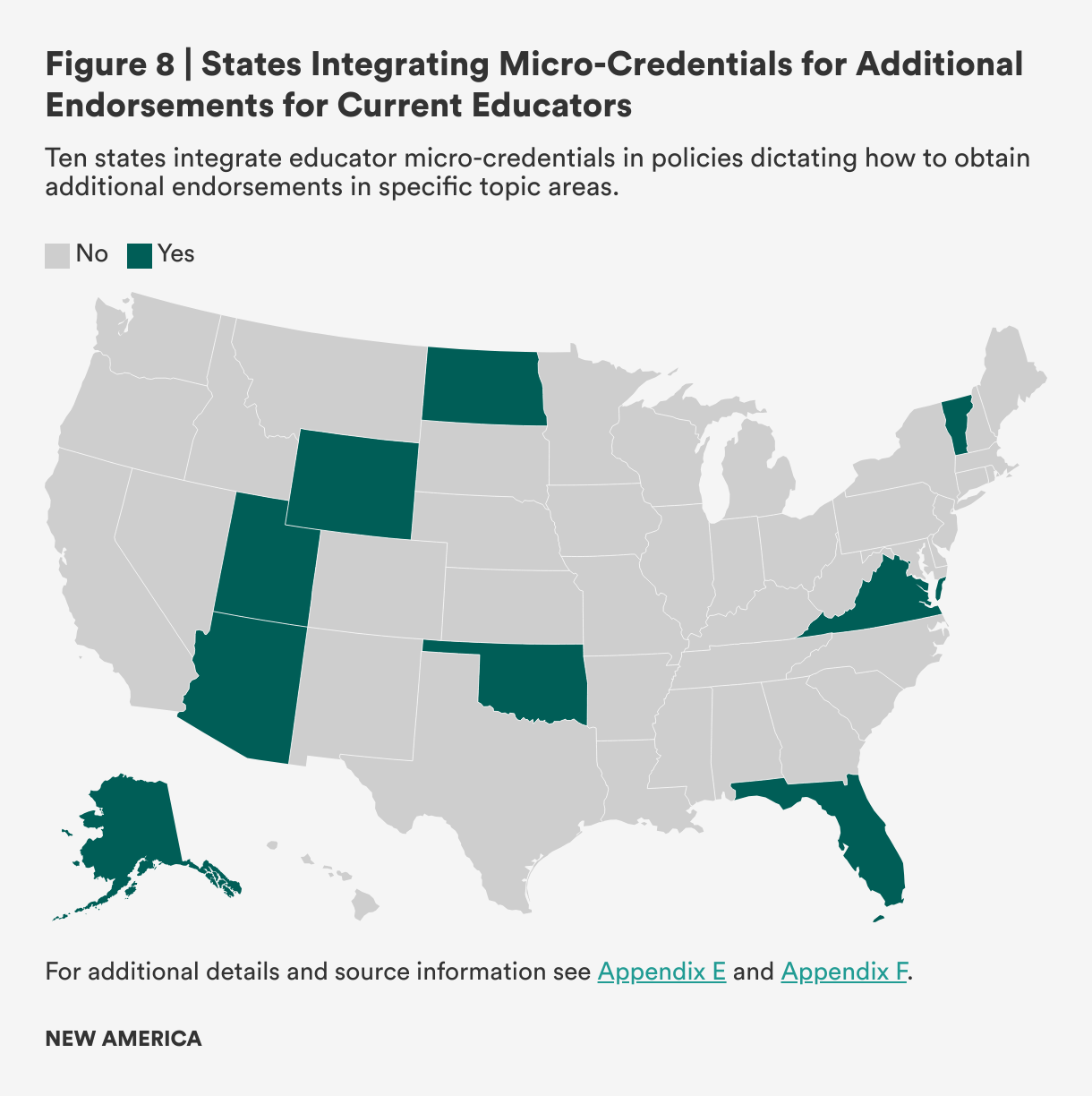
Another way that states integrate micro-credentials into policy is by allowing educators to obtain endorsements in additional instructional areas via micro-credentials. Sometimes this solely entails a requirement to earn one or more stacks of complementary micro-credentials in a given subject area, as is the case with North Dakota’s computer science endorsement.34 Other times, in addition to earning one or more micro-credentials, educators must engage in additional activities, such as passing college-level courses and/or passing a state licensing exam, as is the case in the District of Columbia.35
As shown in Figure 8, 10 states now allow at least some endorsements to be earned through micro-credentials. In three states—Alaska, Utah, and Wyoming—any additional endorsement can be earned through micro-credentials. In Arizona, micro-credentials are an option for earning a handful of different endorsements. In the remaining six—District of Columbia, Florida, North Dakota, Oklahoma, Vermont, and Virginia—micro-credentials are designated for use toward one or two specific endorsements, typically in shortage areas such as reading specialists, computer science, special education, and English for non-native speakers.
License Advancement
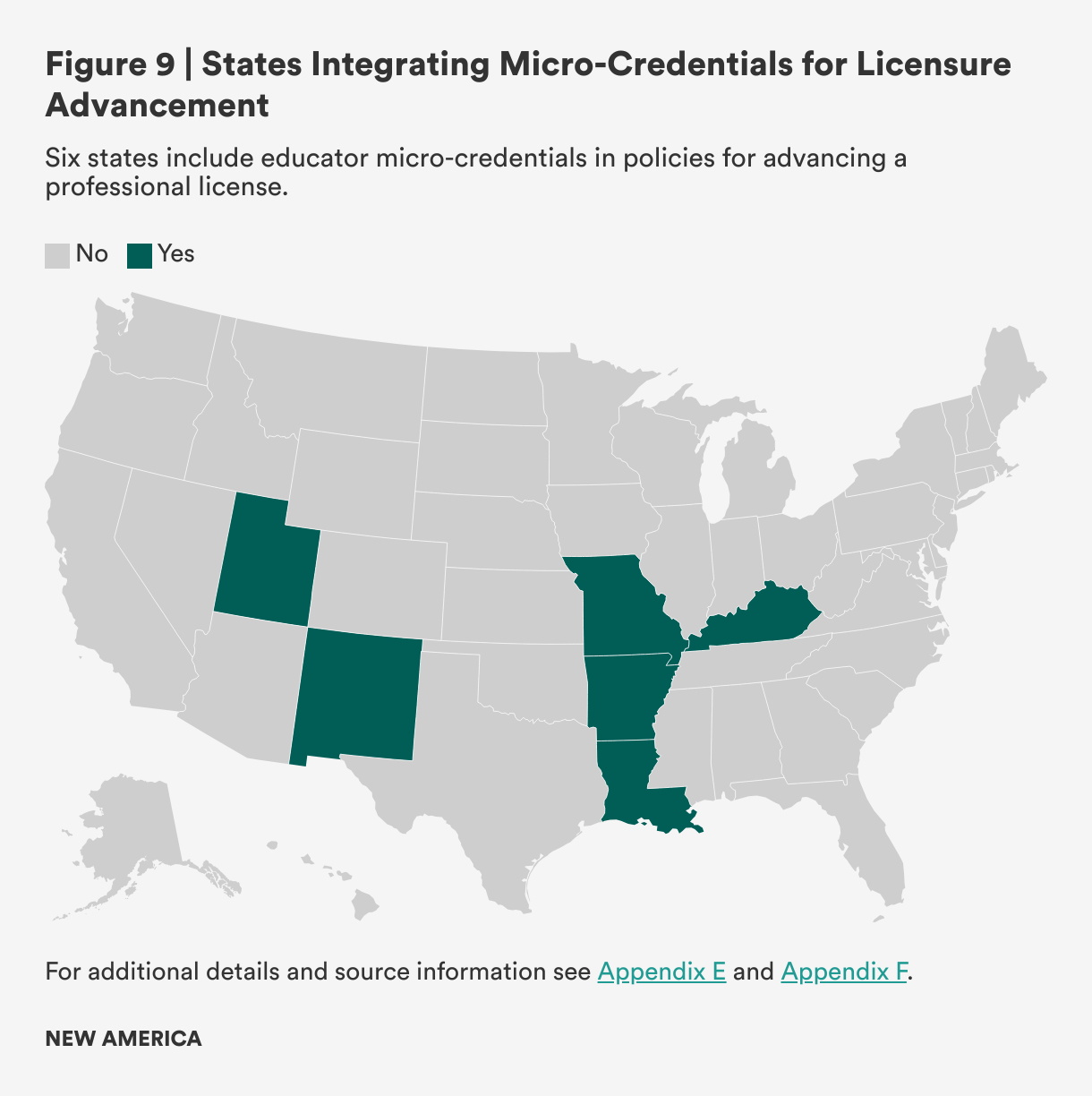
As Figure 9 shows, six states incorporate micro-credentials as part of policies governing the earning of an advanced license: Arkansas, Kentucky, Louisiana, Missouri, New Mexico, and Utah. The small number of states with this type of policy is likely because many states do not have clearly delineated licensure advancement pathways for educators, such as a separate license or endorsement to move from being a classroom teacher to a teacher leader.36

When Micro Goes Macro: A Nationwide Review of States’ Educator Micro-Credential Policies
- Executive Summary
- Introduction
- State Policy Scan Methodology
- Overall Findings
- Detailed Policy Category Findings
- Comparison to 2020 Findings
- Discussion
- Conclusions and Recommendations
- Appendix A: Understanding the High-Quality Micro-Credentialing Process and Ecosystem
- Appendix B: Interviews Conducted by Authors, Chronologically
- Appendix C: Definitions and Examples for Six Educator Policy Areas
- Appendix D: Policy Categorization Methodology Differences from 2020 to 2025
- Appendix E: Summary of State Educator Micro-Credential Policies, by Category
- Appendix F: Additional Insights on Individual State Educator Micro-Credential Policies
Citations
- Because this research is focused on state policies—and because determining how many of the thousands of EPPs across the country are leveraging micro-credentials would be very difficult—a tally of individual EPPs using micro-credentials is not offered in this report. However, in a September 11, 2024, Zoom interview with the authors, Jason Lange, founder of BloomBoard, indicated that there are EPPs in nearly every state opting to use micro-credentials as part of their coursework. For example, Relay Graduate School of Education is approved in several states and relies heavily on micro-credentials in its curriculum. For more information, see Digital Promise, “Micro-Credentials: A Promising Way to Put Educators’ Skills Front and Center,” https://digitalpromise.org/2016/02/22/micro-credentials-a-promising-way-to-put-educators-skills-front-and-center/.
- See Utah State Board of Education, “R277-304. Teacher Preparation Programs,” https://schools.utah.gov/adminrules/R277-304. The Utah educator preparation program approval forms for both elementary and secondary programs can be found here: “Elementary 2025 El Ed and ECE EPP Competency Approval Template,” https://docs.google.com/spreadsheets/d/19ZRA0JrRsgtDhe91SnTFcwo6OFpgICwiKtTmv6D_u_Y/edit?gid=1571238584#gid=1571238584; and “Secondary 2025 Secondary EPP Competency Approval Template,” https://docs.google.com/spreadsheets/d/1pKTsvh2f0fRLcKTCu7SQjxECS0P-VVqqioDtD3DPKg8/edit?gid=1368830943#gid=1368830943.
- Utah State Board of Education, Program Endorsement Review Approval Template for Universities, Utah State Board of Education Endorsement Review, https://docs.google.com/document/d/10fTYiVE7lUenQr5fxT3lt59hMZa4JXWy/edit?tab=t.0.
- A micro-credential stack is a collection of related micro-credentials organized around a theme. Completing a stack can provide the earner with a way to demonstrate a full skill set in a certain area or field and may lead to a broader credential. Examples of educator micro-credential stacks can be found at CarolinaCrED, Micro-credential Stacks, https://tinyurl.com/yc8xcwrh.
- Curated professional development is typically offered for a subject the state perceives to add significant value to instruction (e.g., the science of reading, financial literacy, etc.). This training can be required or optional and it sometimes, but not always, leads to an endorsement (in which case it is also counted in the endorsement category) or credit for relicensure. It is different from state policy for license renewal credits because of its specificity: Whereas a state-created micro-credential about the science of reading may also be counted toward licensure credit, its development by a state does not necessarily indicate that the state has approved micro-credentials as a form of professional development that counts toward license renewal.
- In some states, a customized version of the NEA’s micro-credentials bank is provided by the relevant state affiliate, likely in order to meet the requirement that relicensure opportunities be offered by an approved provider. National Education Association, NEA Certification Bank (website), https://nea.certificationbank.com/.
- North Dakota Department of Public Instruction, “Computer Science and Cybersecurity Credentials,” https://www.nd.gov/dpi/educators/credentials-and-certificates/computer-science-and-cybersecurity-credentials.
- District of Columbia, Office of the State Superintendent of Education, “Special Education Endorsement Recovery Initiative,” https://osse.dc.gov/page/spedfoundations.
- For examples, see Colleen McCann, Sasha Zuflacht, and Tierra Gilbert, The Decade-Plus Teaching Career: How to Retain Effective Teachers Through Teacher Leadership (Teach Plus, 2021), https://teachplus.org/wp-content/uploads/2021/10/decade-plus_final.pdf; and Questions 12 and 13 in Adrienne Fischer, Ben Erwin, Damion Pechota, and Eric Syverson, 50-State Comparison: Teacher Recruitment and Retention (Education Commission of the States, December 1, 2022), https://www.ecs.org/50-state-comparison-teacher-recruitment-and-retention-2022-2/.