A Chapter of: The Future of Deception in War: Lessons from Ukraine
Chapter IV: Building Enhanced Military Deception Systems
As was highlighted in the introduction to this report, the difference in emphasis for military deception between nations such as Russia and China and Western military institutions has led to a modern “deception gap” that needs to be addressed. Recent technological developments, including ubiquitous uncrewed systems, commercial sensing technologies, and artificial intelligence (AI) have exacerbated this gap. This section of the report therefore provides a summary of implications and potential remedies to close this gap in military deception with adversaries during the conduct of twenty-first-century operations. The implications and solutions cover the following thematic areas: (1) command and leadership, (2) strategy, (3) battlespace operations, (4) personnel, (5) military organizational structures, (6) equipment and technology, and (7) doctrine.
Sean Gallup via Getty Images
Command and Leadership
During a recent research visit to Ukraine, a brigade commander who had commanded a tank brigade since the beginning of the war explained that “deception is a central part of Ukrainian planning and can’t be added on after planning for operations is complete.”125 Evolving an institution’s approach to military deception demands advocacy and leadership from the highest levels. If a fundamental level of reform in thinking about military deception is desired, an explicit strategy with clear purpose, vision, priorities, and resources may be required. Changes must be explained (frequently) and experiments conducted to validate both the reasons for change and the directions to be taken in enhancing the institutional capacity for military deception.
Such a strategy might also be the opportunity to provide a clear statement of an institutional vision that inspires an organization’s members to stretch their expectations, aspirations, and performance to achieve its mission. It provides the people in a military organization with purpose and gives their work a unified guide to action.126 Such a strategy for improving military deception might also address the recommendations and initiatives that are proposed in the pages that follow.
Deception and surprise are thus an important element of command. As such, there must be a high level of advocacy for, and emphasis on, achieving surprise through deception by senior military leaders. Importantly, there must be a spokesperson for change. This was a key finding of General Don Starry in his examination of institutional change in the U.S. Army in the wake of the Vietnam War. This principle holds true for most military institutions that contemplate change. Whoever the spokesperson is, they must build a consensus that will give the new ideas about deception, and the need to adopt them, a wider audience of converts and advocates.127 This also appears to be a crucial function of Ukraine’s new Chief of the Unmanned Systems Force, Colonel Vadym Sukharevskyi. One of his key functions is the advocacy for the use of drones, but more importantly, for the cultural and organizational changes required in all elements of the Ukrainian Armed Forces that are driving enhanced strategic and tactical effectiveness through use of a wide variety of uncrewed systems.128
At the same time however, deception operations hold the potential to challenge civil–military relations in democracies that value transparency and accountability in all arms of government. To that end, the most senior military leaders may need to hold discussions with political leaders on the rationale for deception operations and to ascertain the legal and ethical limitations that might be placed on the conduct of military deception operations.
Senior military leaders need to be educated in the various aspects of signature management, measurement, and projection as a part of military strategy as well as operations. They should further be incentivized to include deception operations and outcomes in all command-intent statements when dealing with an adversary (doctrinal evolution is related to this). Senior leaders will need to be educated in the art of perception management for use in deception operations.
As military deception is focused primarily on changing the perceptions of adversary leaders, adapting the conduct of deception must focus on the education and development of friendly senior military personnel, as well as other national security leaders. Talented future leaders must be given the opportunity to not only lead but to practice the art of influence—it is an important way to shape the perceptions of others. Making senior leaders use social media frequently is one very easy way that NATO might be able to hone this art of influence in its personnel. But literacy in the psychological underpinnings of perception management might also be incorporated into respective professional military education systems, or in external educational opportunities.
All likely adversaries are likely to practice deception. Indeed, Russia has a long history of such activities. This leads to a finding that friendly forces must not only embrace a culture of deception but also pierce enemy deception regimes through the practice of counter-deception. In his book The Art of Deception in Warfare, Michael Dewar notes, “To counter the deceiver, one must also study him in depth…counter deception involves microscopic analysis in order to discover the minutest inconsistency, but it also involves a macroscopic appreciation of the enemy’s fears, aims, prejudices, and habits.”129
Counter deception is also included in the 2012 U.S. joint doctrine on military deception, which defines it as follows: “Counter deception contributes to situational understanding and IO [information operations] by protecting friendly command and control systems and decision makers from adversary deception. Friendly decision makers must be aware of adversary deception activities so they can formulate informed and coordinated responses.”130
In their 2003 study, Russell Glenn and Scott Gerwehr proposed a modern concept for counter-deception. They note that “counter-deception is a skillset of its own that requires conscious allocation of resources and training.” They identify five categories of counter-deception worthy of additional study and potentially for incorporation into NATO training and education curricula. These categories are: data type, data collection, data analysis, unmasking deception with deception, and rendering deception moot.131
A final point to note is that self-deception is a critical weakness that must be minimized in military leadership. Michael Dewar notes, “A study of deception in history reveals that success was usually achieved because the ruse conformed with a preconceived idea in the mind of the target and, since they were more or less what the target was expecting.”132
Russian actions at the start of the full-scale invasion in 2022 are an example of self-deception. If the Russians had searched for it, they would have found Ukrainian forces beginning to disperse their units and logistic supplies in the lead-up to the February 2022 invasion. But they did not look for it because Putin and commanders were convinced that the Ukrainians would not fight and that Russia’s forces could seize control of the country in 10 days.
Self-deception is unlikely to ever be totally removed from any human organization, however. To that end, investment might be required in additional research by academic institutions into psychology and other human cognitive sciences to inform training, education, and developmental opportunities for developing commanders and leaders who are less prone to self-deception before and during military operations.
Strategy
While military deception has an important role to play in tactical actions and the conduct of military campaigns, it also has utility at the strategic level of military affairs and in a broader range of national security affairs. Education, doctrine, and training should not focus exclusively on the tactical aspects of deception. This will require the cultivation of knowledge and expertise at the highest level in strategic deception activities, and potentially the establishment of a small permanent staff to coordinate such activities.
Strategic deception activities will make an invaluable contribution to solving some of the significant strategic and operational challenges facing military organizations due to the trends outlined in the previous section of this report. In particular, deception may contribute to solutions to the following contemporary military challenges in search of a solution. These are strategic problems because they involve all elements of contemporary military institutions and require new thinking about strategic force design, warfighting concepts, equipment and munitions, training, and education.
Strategic Problem 1: Mass versus Dispersion
The meshed civil–military sensor frameworks, and attendant signature battle, described in this report have produced an environment where all the signatures of military equipment, personnel, and collective forces can be detected more accurately and rapidly. When linked to an array of precision munitions, this closes the detection-to-destruction gap in military operations to just minutes. Massing military forces for ground combat operations, large-scale aerial attacks, or naval operations, therefore, becomes a high tactical and operational risk. As the Russians have found during the war in Ukraine, when they have massed forces in training or accommodation locations, or concentrated their logistics depots close to the frontline, the Ukrainians have been able to find and attack them.133 This has also driven both sides to conduct attacks with small teams to improve their ability to move to their lines of departure undetected.
Even if an array of hard and soft kill measures can protect massed forces, they are almost assured of detection, which makes achieving surprise difficult. Modern military forces must be equally capable of operating in dispersed and massed forms, but they must be able to minimize their detection when they do mass in a way that offers an improved chance of surprise and landing a decisive blow against an adversary. Strategic and operational deception activities may provide at least part of the solution to this quandary.
Strategic Problem 2: Closing Operational and Strategic Distances
Modern combat forces require new-era techniques that are quicker, lower signature, and more survivable at crossing operational and tactical spaces between them and their objectives. The failings of current Western military doctrine were exemplified by Ukraine’s struggle in 2023 to penetrate Russian minefields and defensive belts in southern Ukraine. Meshed sensor networks, electronic warfare, and multi-layered and multi-domain drone frameworks make this a difficult problem.
In eastern Ukraine, where almost all movement on and above the ground is visible within many kilometers of the front line, assembling forces for any significant activity and moving those forces has become very high risk. We should expect that the ability of aircraft to assemble strike packages in friendly airspace, and the ability of naval task groups to move to their operating areas, will also become increasingly threatened.
Therefore, new warfighting concepts are needed to ensure that friendly forces can surviveably mass and move to a start point for operations and tactical activities in friendly parts of a theater. Deception may play a crucial role in solving this challenge, but this will require investment in strategic force design and force options testing activities.
Strategic Problem 3: Lowering the Cost of Defending Against Missiles and Drones
One of the implications of the new trend in more accessible long-range strike is that it requires a strategic approach to protecting key military and national assets much further beyond the front line. Enormous investment has been made in development of remotely controlled, autonomous, and semiautonomous uncrewed systems. Ukraine has essentially developed a long-range strike complex, capable of striking deep into Russia, from a standing start three years ago. A large proportion of the Ukrainian strike capability consists of indigenously designed and built long- and medium-range drones.
Until recently, there has been a large gap between the capabilities of uncrewed systems and those that counter them, as well as a major disparity in the costs of drones versus the systems to counter them. New systems developed by the Ukrainians, including their Drone Fall program using interceptor drones, the expanded use of tactical radars to improve detection, and improved electronic warfare have all started turning this situation around, but Russian adaptation to these countermeasures poses a constant challenge.134 As such, deception operations at multiple levels might provide part of the solution to this strategic problem in the following areas:
- deceiving an adversary about the capability and range of counter-drone systems
- deceiving an adversary about the locations and depth of these systems
- deceiving an adversary about the locations of strategic capabilities, such as low-density munitions
- dispersion and deception activities for key military production facilities
Finally, strategic deception activities hold the potential to endanger the contract of trust that an elected government has with the people. In his book Active Measures: The Secret History of Disinformation and Political Warfare, Thomas Rid argues that “it is impossible to excel at disinformation and democracy at the same time.”135 While it may not be such an absolute, strategic deception activities by democracies will face cultural challenges, and must be endorsed by political leadership as well as having a basis in law and be subject to legal oversight.
Battlespace Operations
Deception operations should be planned and conducted not as separate but as integral aspects of military activities. Two forms of maneuver that embrace deception as a core enabler are distributed operations and flooding the zone. These will be examined separately but should not be seen as distinct approaches; they are most likely to be mutually reinforcing methods of operations.
Distributed operations deceive an enemy about capacity to concentrate and force structure because distributed elements can be grouped, disaggregated, and then regrouped according to the mission and threat profile of the enemy.
Distributed operations have been studied by several military organizations, perhaps most resolutely by the U.S. Marine Corps.136 One reason these operations offer a useful approach in operational and tactical activities is that they support enhanced force-preservation and survivability against technologies that have increased the lethality of the contemporary battlefield; they deceive the enemy about a friendly main effort and its critical vulnerabilities.
Increased lethality has been a trend for at least the last 200 years of human conflict. Charting force dispersion and theoretical killing power over two millennia, Trevor Dupuy notes that the lethality of warfare remained constant for nearly two thousand years. But the dawn of the first industrial revolution at the end of the 1700s saw a significant change in this pattern. Starting in the 1800s, the trend in lethality commenced a sharp upward curve.137
However, this was countered over the past century through dispersion of military forces. This lowered average daily casualty rates in war. Technological progress in killing was countered by an intellectual response.
In addition to lowering lethality, dispersion of forces through distributed operations allows for more opportunities to deceive an adversary. This is because a more dispersed force provides fewer insights into friendly main and supporting efforts due to a lack of concentrated forces. Distributed operations also distribute logistics and fire support assets, again denying an enemy detailed insights into main efforts, and deceiving them about friendly intentions for a longer period of time than might otherwise be the case with more traditional operational approaches.
Service and joint operational approaches will require extensive review to ascertain whether different modes of distributed operations, as well as signature minimization and projection, have utility—and a good return on investment—in preserving a deployed force in a lethal environment, and its potential for deceiving an adversary.
As well as considering distributed operations, normal military operations must consider the minimization of all forms of signatures. Where possible, exercise designs for military training activities—single-service and joint—should encourage the recording of signatures of all platforms and units, so that the projection of false signatures in the real world and in cyberspace can be used to overwhelm or at least confuse adversary analysts and AI analytics about friendly locations, capabilities, and intentions.
“Flood the zone” is a term that originates in team sports and, in American football, refers to an offensive team deploying a larger number of players than normal to one side of the field to force a defending team to over-commit their number of players on that side of the field. It is a term that has also been used in political commentary to describe political parties launching multiple policies and making numerous announcements in a short space of time to draw attention away from the most controversial policies.138
It is also a method increasingly used in Ukraine and Russia, by both sides, to penetrate the air, missile, and drone defenses of each nation. Both sides use large numbers of decoy drones in their strike operations, in successive waves, to draw defenders into firing scarce air defense missiles, while other drones are able to proceed to their targets. The Russians often use large numbers of Shahed drones in initial waves to draw out Ukrainian air defenses, and then use successive waves of cruise and ballistic missiles to hit targets. The number of drones used in these complex attack operations has increased over the past year. And while Ukraine has improved its ability to shoot down drones, it is not 100 percent successful. Missiles and drones get through.
Russian infiltration attacks on the ground use similar principles. Large numbers of small groups are used to conduct constant attacks to wear down defenders and force them to use up ammunition. It is a brutal yet effective way that Russian commanders on the eastern front have used their advantage in manpower to slowly advance—but at great human cost.
The key to flooding the zone in military operations will be flooding the battlespace with a wide array of targets—in the physical, cyber, information, and electromagnetic domains—to occupy sensors and engagement systems of the enemy, while attacking forces penetrate the tactical or operational zones they are seeking to move through. This may demand a range of autonomous systems to be employed as decoys as well.
Neither distributed operations nor flooding the zone are simple operational methods, and their combination will be more difficult still. Extensive experimentation and concept development will be required to employ such methods not only to deceive an adversary force but also to provide a higher chance of mission success for joint forces.
Military operations need to prioritize the conduct of planning and activities that serve to detect enemy deception, as well as to degrade the enemy’s capacity to counter friendly deception operations. This may include, for example, evolution of the extant operating procedures for countering enemy sensors across all spectra. The conduct of this style of operation might consider prioritizing focus on enemy sensors, analytics and analysis processes, and shifting the perceptions of human decision makers.
Finally, some investment might be required in the capability to measure the success or failure of friendly deception endeavors. Measuring success and failure of deception activities can inform friendly commanders about tactical and operational risk (if deception fails, risk may rise).
Personnel
The quality of military personnel will have an important influence on the ability of military organizations to undertake effective military deception activities. To that end, three areas of personnel development may require reform: individual training, professional military education, and collective training.
Individual Training Design
Camouflage and concealment remain core competencies of military personnel and units. This is regardless of service, function, or proximity to combat operations. As our survey of new technologies and the signature battle found, almost everything is detectable and targetable in modern competition and warfare. And if it is not, we should assume it is anyway—we don’t always understand the full scope of an enemy detection capability.
Training institutions must incorporate the development of expertise in camouflage and concealment as a foundational skillset, just as they do with weapons training and team building. This should include knowledge on all kinds of signatures that are generated by individuals, platforms, and units, and how these might be reduced or blended “into the noise” of military activities.
All personnel should understand the basic ideas associated with reducing signatures, conducting deception, and generating surprise. For example, these competencies should be included in formal training courses for officers and non-commissioned officers as well as in basic recruit and officer training. How potential adversaries conduct deception operations, and the markers for recognizing deception activities, should be included in military training curricula.
Professional Military Education (PME)
The various stages of military officer education offer the chance to inform and incentivize the use of deception in all forms of the military art. In particular, the education at command and staff colleges and war colleges should further reinforce the need for deception in an era where the most likely adversary will be a larger and even more powerful military force.
Professional military education (PME) systems potentially need to focus more on training in signatures, deception, and surprise; hone the capacity of officers to prioritize thinking about these aspects of war; and to fully incorporate them into formal and informal planning processes. Assessment in PME institutions might also shift more toward incentivizing lateral thinking about deceiving an adversary, and toward developing military leaders to invest in their capacity to influence the perceptions and behavior of enemy commanders.
Deception must be integrated into training and education systems. Presently, it is just one of many training outcomes in Western training institutions. It must be given more precedence because of the increasing need to surprise potential adversaries, deceive adversaries about locations and intentions to enhance force preservation, and recognize and counter enemy deception operations.
Collective Training Design
Collective training must be a mandatory part of exercise design for service and joint exercise design at every level. Achievement of surprise, through deception and other means, must be a required element of exercise assessment and a central aspect of all after-action reviews. Collective training activities must also be exploited as an opportunity to collect signatures of units, joint task forces, and other aggregated military capabilities. Not only does this signature measurement activity assist in efforts to minimize signatures and deceive adversaries, but these collected signatures might then be projected in cyber and information operations to deceive and confuse adversaries about friendly locations and intentions.
The concepts of signature management, deception, and surprise need to be part of design, conduct, and assessment criteria in military exercises. It should pertain to both single-service and joint environments, as well as in coalition or alliance exercises if possible. Pre-exercise activities and briefings should include the potential for enemy deception activities to ensure staff and commanders are trained in the art of recognizing deception conducted by an adversary in sufficient time to adapt to those enemy actions. Additionally, these exercises can provide useful testbeds for new techniques to mask signatures and deceive an adversary.
Military Organizational Structures
During the Second World War, the Soviets concentrated deception planning in their Stavka and General staff. They did this for two reasons. First, it provided for more thorough planning, including deception planning, between the various fronts. And second, the Soviets saw tactical, operational, and strategic deception as integrated and indistinguishable.139
At the same time as the Allied deception staff was conducting its operations, tactical deception organizations were also established by the British and Americans. These were able to bring a range of creative ideas to military commanders to enhance their chances of generating surprise on the battlefield. While a contemporary version of such organizations would need to focus on both the physical and cyber environments, small teams might be viable in contemporary joint task force organizations.
In 1990, a small team was established in the U.S. Central Command to develop a deception plan to focus Iraqi defenses on the Corps that would advance from the south. The aim of the plan was to deceive the Iraqis about a second Corps that would swing around into Kuwait from the west. This resulted in an integrated plan that included dummy formations and measures of success, and it even co-opted the media in their reporting of the lead-up to the U.S. offensive operations.140
In more contemporary practice, deception is a function of both Russian and Ukrainian planning at the general staff and senior tactical commands. Given the sensitivity of the topic, further details are not publicly available.
In U.S. combatant commands, the coordination of deception, while tightly controlled to maintain operational security like in the Ukrainian and Russian models, is generally overseen by the J39 deception staff in the operations branch. Responsible for military deception, electronic warfare (EW), psychological operations (PSYOP), operations security (OPSEC), and cyber operations, its key functions include developing and overseeing theater-wide deception strategies to mislead adversaries about U.S. and allied intentions and capabilities, coordinating with the intelligence organization to shape deception efforts based on adversary intelligence collection priorities, and coordinating with those undertaking longer-term planning to integrate deception into all operational and contingency planning.
The standardization of this approach might be considered for a wider number of military institutions. While this is unlikely to require the large-scale reallocation of military personnel to become deception specialists, a small number of experts in the art and science of deception might be useful at headquarters for joint task forces. Such small, expert teams—either integral to organizations or that can be “fly away” teams—might provide advice and planning for the conduct of tactical, operational, and strategic deception activities.
But organizational constructs beyond headquarters and staff will also be influenced by the new environment of enhanced battlespace visibility, democratized access to digital command and control systems, and ubiquitous all-domain drones. The combination of these developments now means that those conducting defensive operations have powerful advantages in modern warfare.141 For survivability purposes, the structures of ground, air, and naval units will need to evolve based on the lessons of the last three years in Ukraine. And these new structures must incorporate designs for better deception and operational security constructs.
For integration of military deception into broader strategic deception efforts, a dedicated function executed by a strategic deception staff (which oversees deception and counter-deception activities) may be required. An example of this is the Allied deception staff, known as the London Controlling Section, established during the Second World War to deceive the Germans about the D-Day landings, which proved incredibly successful, all the way to convincing Hitler to hold off the release of Panzer division reserves even after the Normandy landing.142
Equipment and Technology Development
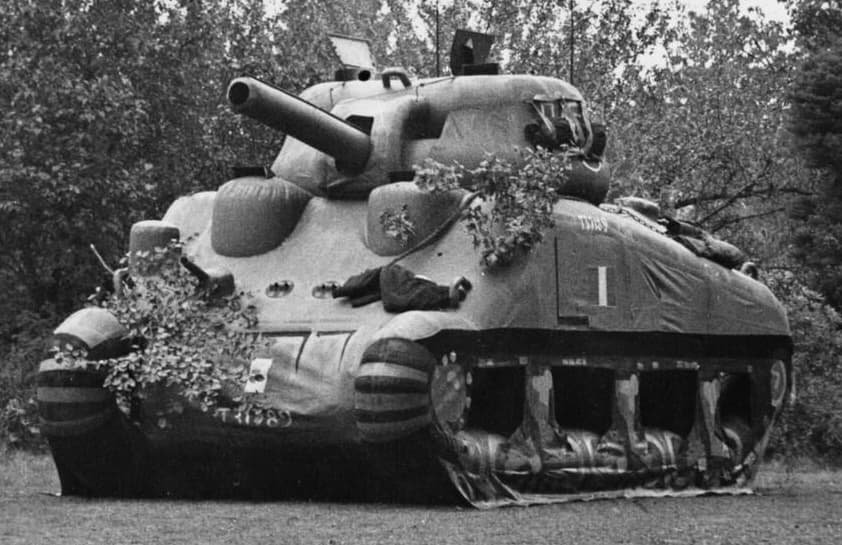
Decoys have made a big comeback in the war in Ukraine.143 While the Second World War saw the use of decoys extensively, particularly in the lead-up to the invasion of Normandy in 1944, the period since then has not seen decoy equipment and networks used extensively—until now.144
Ukraine began deploying decoys early in the war. The provision of high mobility artillery rocket systems (HIMARS) systems by America led to Ukraine also deploying multiple decoy systems to protect real launchers and deceive Russian intelligence, surveillance, and reconnaissance (ISR) and strike capabilities into hitting fake launchers.145 Since then, a wide array of decoys has been employed, including artillery systems, air defense radars and missile launchers, and armored vehicles.146 Additionally, strikes by both Russia and Ukraine often use decoy drones in an attempt to overwhelm air defense systems and draw air defense weapons to shoot down decoys instead of warhead-bearing drones and missiles.
Nicolea Bonsegna has written about how decoys have a psychological impact: “Decoys have the potential to sow confusion, create uncertainty, and distort enemy decision-making processes. In Ukraine, Ukrainian forces have been using decoys to complicate Russian efforts to assess the real strength and positioning of Ukrainian forces…[and create] an atmosphere of uncertainty that forces Russian forces to misallocate resources, leading to operational inefficiencies.”147
Cheap and easily emplaced decoys should not only be employed on military operations but become a new priority in defense research and acquisitions, being made part of standard provisioning when new equipment is procured. Decoys must be issued alongside the real equipment, particularly for high-value equipment such as radars, air defense systems, artillery, and armored vehicles. This is not presently viewed as a valued area of the modern defense economy outside Ukraine, and that should change.
Additionally, decoys extend beyond physical replicas of equipment or locations. Communications networks, drones, and other signatures of military operations also need to be employed to provide an overwhelming number of potential targets for enemy sensors and kill chains, and to protect actual military capabilities.
Systems for the procurement of military equipment and services to military organizations will probably need to focus more on lowering the signatures of weapon systems, military platforms across all domains, and support equipment. This is not to suggest that every platform will be a stealth platform. However, the range of signatures—from visual to aural to exhaust—must all be concurrently lowered to significantly increase the challenge of signature detection by enemy sensors and platforms.
At the same time, the elements of contemporary meshed sensor and communications networks described in this report should constantly be reviewed for their security, as well as for their capacity to be used in the conduct of friendly deception activities and counter of enemy deception.
The power of AI offers functions that replicate many human cognitive functions. And it can be used to extend cognition in those who are tired, or who are unable to cope with massive amounts of data generated by meshed sensor networks. The theory of AI extenders, developed by Jose Hernandez-Orallo and Karina Vold, proposes that cognitive functions in humans, including enhanced memory, attention, and search, can be ‘extended’ with AI.148 For contemporary military institutions, AI offers the ability to develop bespoke algorithms that can support human analytic activities to counter enemy deception activities. Military institutions will need to consider investing in AI systems that can assist human activities associated with deception and counter-deception, as well as support friendly simulation and wargaming related to military deception.
The development of bespoke algorithms that support the countering of enemy deception activities may be required. The massive quantity of data that is currently generated by digital age sensors is generally beyond the comprehension and analytical capacity of human intelligence organizations. Some system to sort and recognize, in near real-time, is needed. Only AI can provide this capacity for breaking through the deliberately generated “fog of war” that Russian doctrine emphasizes. Such algorithms, and their accompanying datasets, might also be useful to support simulation and wargaming to hone friendly command and planning capabilities in deception activities.
Finally, new materials offer properties that might reduce friendly signatures and enhance the performance of friendly sensors in detecting adversary signatures. Complementing these new materials, 3D printing has field applications for the rapid production of tailored camouflage nets as well as dummy emitters and other forms of physical deception.
A wide array of commercial additive printing capabilities has been examined by military institutions in the past decade. In particular, they have applications in the production of spare parts. However, as 3D printers increase in capability and reduce in price, military institutions will be able to use massed, deployable 3D printers that can produce objects for the conduct of deception activities. For example, they may rapidly print tactical camouflage nets and covers that are tailored to the environment. Another example of deployed 3D printing for deception might be the rapid production of emitters for different electromagnetic emissions, or even the production of masses of small unmanned aerial vehicles (UAVs) to overwhelm enemy sensors.
The enhancement of military deception activities requires investment in technology. New or smart materials are one example of these technologies, but new types of sensors, masking technologies such as camouflage systems, and drone swarms are also important technologies that underpin deception and counter-deception operations. As with all military institutions, this investment must be balanced against other technology investments, as well as investments in people and operations.
Doctrine
Doctrine provides the essential foundation for all military training and the conduct of operations. It should not be a fixed template, but an essential starting point for thinking about solutions to unit and individual challenges. Therefore, the production of dedicated doctrine for deception operations is often necessary. This can encompass tactical operations as well as strategic activities.
Importantly, deception needs to be a highlighted and an important aspect of doctrine on other elements of military activities, including operations, planning, logistics, and communications. As Michael Anderson notes, with regards to deception and doctrine, an improved focus on military deception begins with “the elevation of deception from a niche doctrinal approach to inclusion in the foundational principles and elements of doctrine.”149
Doctrine on military deception, and counter-deception, will need to describe how deception operations go beyond just the orchestration of military deception into other military activities. It may also include the integration of civilian personnel into the conduct of deception activities. As an example, during the Second World War, the U.S. Army employed a range of artists, engineers, and architects in its secret 23rd Headquarters Special Troops organization to conduct tactical deception operations.150
U.S. Army via Wikimedia Commons
Deception must be employed at every level of national security activities, not just in military operations. This will pose some issues in democracies where transparency and auditability are essential parts of effective governance. New policies and potentially new laws might be required to enable this.
Finally, to inform doctrine for military deception activities, a review of existing principles and maxims was undertaken as part of the production of this report. The Maxims of Deception appear to have survived their transition into the twenty-first century. While some aspects of execution will evolve, similar to the principles for military deception, the maxims described earlier in this report remain suitable and are a useful guide to thinking about the conduct, execution, and measurement of military deception.
The principles for planning and conducting military deception must be consolidated and better incorporate new trends and technologies. To that end, the following new principles for military deception are proposed:
The New Principles for Military Deception
- Influence the decision maker. Military deception should target the thought process of the adversary decision maker to achieve a desired action, decision, or outcome. The adversary sensing and analysis system is not the target of military deception. It is, however, a means by which deception can deliver information to the targeted decision maker. By the same token, friendly counter-deception activities should influence the actions of friendly commanders.
- Create a response that achieves desired outcomes. Deception plans employ actions and resources to change the behavior of enemy decision-making in order for there to be an outcome desired by the friendly commander. Military deception must lead to the target making a specific decision or set of decisions.
- Integrate planning and control. An integrated approach to planning military deception and counter-deception within the wider military planning process is necessary to avoid confusion and to ensure various elements portray the same story and do not conflict with other operational objectives. This integration should orchestrate an array of different means of deception, because the greater the number of channels used, the greater the likelihood that deception will work. This integration of military deception starts with planning, continues through execution, and also includes learning and adaptation activities.
- Ensure approaches are credible, verifiable, executable, and measurable. Military deception must be credible in the minds of the targeted decision maker as well as those who provide advice. There must be consistency in the narrative being used to create the desired response. The enemy should also be able to conduct verification activities to confirm what our deception plan seeks to make them believe. The deception plan must be feasible to achieve with given resources. And finally, friendly forces should be able to measure the impact of deception measures to see if they are successful or not.
- Make security a priority. Military deception operations require appropriate security measures. Planning staff must employ the strictest need-to-know criteria for every element of military deception planning and execution. Counter-deception activities will require similar measures.
- Consider timeliness. A critical aspect of deception planning and execution is appropriate synchronization with the commander’s intent and maintaining synchronization during execution. A key challenge is getting the deception target to act in accordance with the deception objective within the timelines required. Friendly deception activities must be completed in a way that accounts for the time consumed by the enemy’s intelligence collection and analysis process, the enemy’s decision-making process, and the enemy’s activity that is to be exploited by friendly forces.
Citations
- Author interview with Ukrainian brigade commander, March 2025.
- The role of vision in organization change is the subject of an excellent study by Carl Builder and others that focused on the U.S. Army at the end of the Cold War but supplies enduring and widely applicable principles for the development and use of organizational vision. John K. Setear et al., The Army in a Changing World: The Role of Organisational Vision (RAND Arroyo Center, June 1990), vi, https://www.rand.org/content/dam/rand/pubs/reports/2006/R3882.pdf.
- Donn A. Starry, “To Change an Army,” Military Review, March 1983, 23.
- Author interview with Colonel Vadym Sukharevskyi, in Kyiv, March 15, 2025.
- Dewar, The Art of Deception in Warfare, 194, 200.
- U.S. Joint Staff, Joint Publication 3-13.4: Military Deception (2012), ix.
- Scott Gerwehr and Russell W. Glenn, Unweaving the Web: Deception and Adaptation in Future Urban Operations (RAND Corporation, 2003), xiv.
- Dewar, The Art of Deception in Warfare, 194.
- One example of this was the December 2022 attack on a Russian barracks in Donetsk that killed dozens of Russian soldiers. “Alleged HIMARS Strike Killed ‘Hundreds’ of Russian Troops During Putin’s New Year Address in Donetsk’s Makiivka – Media,” Euromaidan Press, January 2, 2023, https://euromaidanpress.com/2023/01/02/alleged-himars-strike-killed-hundreds-of-russian-troops-during-putuns-new-year-address-in-donetsks-makiivka-media/.
- Olena Hrazhdan, “Come Back Alive Says ‘DroneFall’ Project Downed Russian Drones Worth $65 Million,” Kyiv Post, March 22, 2025, https://www.kyivpost.com/post/49369.
- Thomas Rid, Active Measures: The Secret History of Disinformation and Political Warfare (Farrar, Straus and Giroux, 2020), 11.
- U.S. Marine Corps, “Distributed Maritime Operations,” August 2, 2021, https://www.marines.mil/News/News-Display/Article/2708130/distributed-maritime-operations-dmo/.
- Dupuy, The Evolution of Weapons and Warfare, 288–311.
- Laura Tingle, “The Opposition is ‘Flooding the Zone’ With Foggy Ideas Instead of Focused and Disciplined Attacks,” Australian Broadcasting Corporation News, March 22, 2025, https://www.abc.net.au/news/2025-03-22/flooding-the-zone-coalition-peter-dutton-referendum-donald-trump/105078038.
- David Glantz, Soviet Military Deception in the Second World War (Routledge, 1989), 559–562.
- Donald Wright, “Deception in the Desert: Deceiving Iraq in Operation Desert Storm,” in Weaving the Tangled Web, ed. Christopher Rein (Army University Press, 2018), 215–228.
- T.X. Hammes, Game-Changers: Implications of the Russo-Ukraine War for the Future of Ground Warfare (Atlantic Council, April 2023), 11–13, https://www.atlanticcouncil.org/in-depth-research-reports/issue-brief/game-changers-implications-of-the-russo-ukraine-war-for-the-future-of-ground-warfare/.
- John Hughes-Wilson, Military Intelligence Blunders (Robinson Publishing, 1999), 18.
- Nearly every Ukrainian officer interviewed by the author in March 2025 raised deception as a critical issue in contemporary operations in Ukraine, whether in land, sea, or air activities. See also Christopher Miller, “The Decoy Weapons Leading Russian Forces Astray in Ukraine,” Financial Times, September 22, 2023, https://www.ft.com/content/b0581f55-a449-439c-a92f-1dfb1ca5a181.
- Bonsegna, “The Strategic Role of Decoys in Warfare,” https://tdhj.org/blog/post/decoys-conflict-ukraine/.
- John Hudson, “Ukraine Lures Russian Missiles with Decoys of U.S. Rocket System,” Washington Post, August 30, 2022, https://www.washingtonpost.com/world/2022/08/30/ukraine-russia-himars-decoy-artillery/.
- Stephen W. Miller, “Battlefield Decoys and Deception: Reaffirmed in Ukraine,” Armada International, September 20, 2023, https://www.armadainternational.com/2023/09/battlefield-decoys-and-deception-reaffirmed-in-ukraine/; “Decoys and Deception – Ukraine’s Use of Fake Weapon Systems,” Kyiv Post, September 12, 2023, https://www.kyivpost.com/post/21544.
- Bonsegna, “The Strategic Role of Decoys in Warfare,” https://tdhj.org/blog/post/decoys-conflict-ukraine/.
- José Hernández-Orallo and Karina Vold, “AI Extenders: The Ethical and Societal Implication of Humans Cognitively Extended by AI,” AIES ‘19: Proceedings of the 2019 AAAI/ACM Conference on AI, Ethics, and Society, 2019, 507–513, https://dl.acm.org/doi/10.1145/3306618.3314238.
- Michael G. Anderson, “The Case for Deception in Operational Success,” Military Strategy Magazine 8, no. 2 (Fall 2022): 38–42, https://www.militarystrategymagazine.com/article/the-case-for-deception-in-operational-success/.
- Megan Garber, “Ghost Army: The Inflatable Tanks That Fooled Hitler,” The Atlantic, May 23, 2013, https://www.theatlantic.com/technology/archive/2013/05/ghost-army-the-inflatable-tanks-that-fooled-hitler/276137/; Lynn Neary, “Artists of Battlefield Deception,” NPR, September 25, 2007, https://www.npr.org/2007/09/25/14672840/artists-of-battlefield-deception-soldiers-of-the-23rd.