A Chapter of: A Case of Predatory Inclusion at Baylor University
A “New Era for Baylor”
When Baylor’s regents searched for a new president, they wanted a leader who would thrust the university onto the national stage—someone who was ambitious and tenacious enough to take the steps needed to propel Baylor to the top, consequences be damned.
They found that leader in Ken Starr, the former solicitor general and independent counsel who infamously led the investigation into the sex scandal that nearly brought down President Bill Clinton. In 1998, Starr, who also had been a federal judge and law school dean, and Clinton shared the honor of being Time Magazine’s “Person of the Year.”61 To highlight Starr’s legal career and national stature, Baylor held his inauguration in 2010 on Constitution Day and handed out pocket copies of the Constitution to the more than 4,000 people who attended the ceremony or related events that weekend.62
By all accounts, Starr helped calm the tensions with faculty that had roiled the campus over the past decade and endeared himself to students.63 The mandate that the regents gave Starr was for “increasing Baylor’s influence in the nation and the world.”64 Starr quickly found a vehicle for achieving this mission: gridiron success.
Baylor was part of the Big 12 Conference, but its football team had never really distinguished itself. The team had not had a 10-win season since 1980.65 The “Baylor 2012” plan had stressed the need for Baylor to “build with integrity a winning athletic tradition in all sports.”66 In 2007, the university hired a star college football coach, Art Briles, to lead the Baylor Bears. And by the time Starr arrived, the fruits of the coach’s labor were starting to show. In 2011, Baylor quarterback Robert Griffin won the university’s first Heisman Trophy as the best college football player. The team won its first Big 12 championship in 2013 and then did so again in 2014.
To capitalize on the Bears’ success, Starr devoted himself to raising the money needed to build a $266-million football stadium on the north bank of the Brazos River, adjacent to the campus. The unveiling of McLane Stadium—“a breathtaking football cathedral,” as The New York Times reported—occurred on the night of August 31, 2014, the first game of the new season.67 The Bears destroyed Southern Methodist University 45–0. Former President George W. Bush was on hand to conduct the pre-game coin toss.68
Earlier that year, Starr had declared that “success in athletics means that all boats rise,” and his gamble on football dominance was paying off.69 Baylor’s reputation was rising and demand for the university was surging, with application and enrollment numbers breaking records yearly.
But as much as athletics success paid off, Baylor had more than one tool in its enrollment management toolbox. To reel in the students it most desired, Baylor, with the help of private enrollment management consultants, increased the amount of non-need-based aid it awarded by more than 60 percent, from $47 million to $83 million, between the fall of 2010, when Starr arrived, to the fall 2014.70 That year, Baylor ranked fifth among all selective private universities in terms of how much money it was annually spending on merit aid for non-needy students (see Figure 1).71
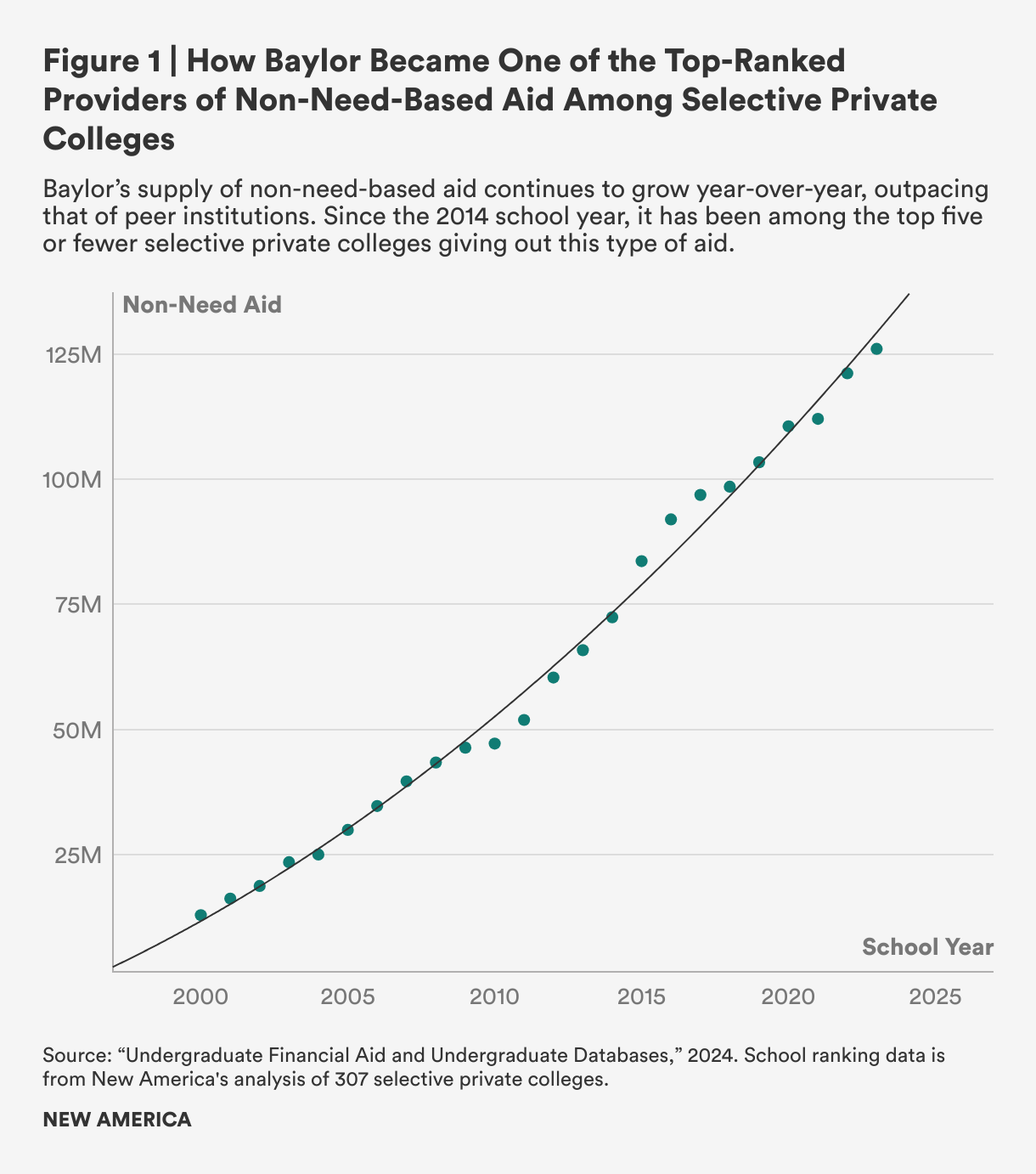
With the rapid rise in applications and the aggressive use of financial aid leveraging, the university became much more selective. Its acceptance rate dropped from 61 percent in 2012 to 55 percent in 2014.72 And because the U.S. News rankings reward selectivity above all else, the university achieved its best ranking to date in 2014, reaching 71, up from 75 in 2007.73
The crushing victory against Southern Methodist in the brand spanking new stadium, with the former U.S. president in the stands, was the high watermark for Starr’s leadership. Soon after, he recorded his feelings in Baylor’s alumni magazine:
We often lift up thanks for our campus situated on the edge of the Brazos River, but the campus never shone so gloriously as it did on August 31 when we grandly opened our stunning McLane Stadium. In vibrant images broadcast on national television to tens of millions of households across the globe, we flung “our green and gold afar.” Viewers beheld firsthand the spectacular beauty not only of McLane Stadium, but of our campus and community as well. This is truly a new era for Baylor…
Just prior to our McLane Stadium opening celebrations, we welcomed the largest incoming class in the University’s history….Combined with similarly strong incoming classes in recent years, this year’s class of new students—one of the most academically prepared and diverse in our long history—has lifted Baylor to its seventh consecutive total enrollment record. We give thanks that demand for a transformational Baylor University education stands at an all-time high.74
However, behind the victories on the football field and in the university’s enrollment management office lurked some terrible secrets that Starr and his colleagues either were unaware of or kept under wraps, hoping that they would never see the light of day. These secrets turned into scandals that not only led to Starr’s downfall and harmed the university’s reputation, but damaged, and may have even destroyed, people’s lives.75
Citations
- Sue Ambrose and David Tarrant, “The Silence of Ken Starr,” The Dallas Morning News, May 5, 2016, https://interactives.dallasnews.com/2016/the-silence-of-ken-starr.
- Baylor University, “Media and Public Relations: Baylor University Inaugurates Ken Starr as University’s 14th President,” September 17, 2010, https://news.web.baylor.edu/news/story/2010/baylor-university-inaugurates-ken-starr-universitys-14th-president.
- Matthew Watkins, “Under Starr’s Presidency, Baylor Watched Golden Age Turn Sour,” The Texas Tribune, May 31, 2016, https://www.texastribune.org/2016/05/31/under-starrs-presidency-baylor-watched-golden-age-/.
- Ambrose and Tarrant, “The Silence of Ken Starr,” https://interactives.dallasnews.com/2016/the-silence-of-ken-starr.
- Watkins, “Under Starr’s Presidency, Baylor Watched Golden Age Turn Sour,” https://www.texastribune.org/2016/05/31/under-starrs-presidency-baylor-watched-golden-age-/.
- Baylor University, “Baylor 2012, Imperative X: Build with Integrity a Winning Athletic Tradition in All Sports,” https://baylor2012.web.baylor.edu/imperativeX.
- Marc Tracy and Dan Barry, “The Rise, Then Shame, of Baylor Nation,” The New York Times, March 9, 2017, https://www.nytimes.com/2017/03/09/sports/baylor-football-sexual-assault.html.
- Watkins, “Under Starr’s Presidency, Baylor Watched Golden Age Turn Sour,” https://www.texastribune.org/2016/05/31/under-starrs-presidency-baylor-watched-golden-age-/.
- Tracy and Barry, “The Rise, Then Shame, of Baylor Nation,” https://www.nytimes.com/2017/03/09/sports/baylor-football-sexual-assault.html.
- Peterson’s, “Undergraduate Financial Aid and Undergraduate Databases.”
- Peterson’s, “Undergraduate Financial Aid and Undergraduate Databases.”
- Colleges and universities report annual data on their acceptance rates to the U.S. Department of Education’s Integrated Postsecondary Education Data System (IPEDS).
- Baylor University, “Baylor Reaches Highest-Ever U.S. News Ranking,” Baylor Magazine, November 1, 2014, https://magazine.web.baylor.edu/news/story/2014/baylor-reaches-highest-ever-us-news-ranking.
- Ken Starr, “From the President,” Baylor University, Baylor Magazine, November 1, 2014, https://magazine.web.baylor.edu/news/story/2014/president.
- Paula Lavigne and Mark Schlabach, Violated: Exposing Rape at Baylor University Amid College Football’s Sexual Assault Crisis (Center Street, 2017).