A Chapter of: Disconnected Systems for Disconnected Youth: Performance Partnership Pilots Could Help
The Basics of P3
Federal policymakers hoped that P3 would remove the barriers state, local, and tribal governments face in serving opportunity youth through federal programs.
P3 is not a federal program in the conventional sense. Rather, it creates permission—or “authority”—for participating federal agencies to “waive statutory, regulatory, or administrative requirements” associated with their discretionary funding programs for youth.7 Under P3, certain federal agencies can grant states or local areas permission to follow different rules for spending federal funds that participating agencies administer. However, agencies do not waive requirements universally. Instead, state, local, or tribal governments have to apply, through a competitive process, to receive P3 authority.
P3’s goal is twofold: (1) to enhance service delivery and improve outcomes for disconnected youth by reducing programmatic and administrative barriers, and (2) to promote broader systems change and alignment across agencies and service providers.8 Systems change refers to changes in how partners collaborate across education, workforce, and human services systems to support disconnected youth.9 It can include implementing shared or collaborative governance structures, streamlined communication practices, and integrated data-sharing.10 These changes impact how youth-serving organizations operate collectively.
Programmatic changes, conversely, are often more youth-facing: They are changes to how services are provided to youth or which youth are eligible to participate. For example, expanding a college preparation program to include first-year college students is a programmatic change. Amending a federal funding stream’s definition of opportunity youth to include foster youth or homeless youth, regardless of whether they are disconnected from school and work, is another example.
There are two main components to the P3 authority: granting waivers to certain program requirements and allowing the blending and braiding of federal funds.11 Waivers and blending arrangements require approval from the relevant federal agencies to ensure they remain consistent with the original statutory intent of each funding stream. Most of the waivers that sites requested through P3 focused on programmatic changes that made serving youth in their communities easier through federal programs. For example, approved waivers ranged from expanding the age range of young people served to allowing service during the school day to negotiating alternative performance measures.
Within a single organization, combining various federal funding streams to support one unified program can be challenging.12 For example, an organization may want to provide access to social workers to help opportunity youth in middle school learn about various careers and the corresponding education and experience required. It could use a variety of federal funds to pay for this, like Gaining Early Awareness and Readiness for Undergraduate Programs (GEAR UP), Perkins, or WIOA, to name a few. Coordinating multiple funding sources while maintaining separate accountability, reporting, and eligibility rules for each is called braiding funding, and it requires meticulous financial tracking to stay compliant.13
Blending, by contrast, allows funds to be merged under a single set of requirements, offering more flexibility. However, blending typically needs legal authorization or approval from the overseeing agency, making it less common.14 While some providers successfully braid or blend funding within their own organizations, doing so across multiple organizations is rare.15 Cross-organizational pooling of funds demands complex invoicing, fund transfers, or the involvement of fiscal sponsors, which are administratively burdensome and costly. As a result, many providers become discouraged from pursuing deeper, cross-system collaboration.
Implementation of P3
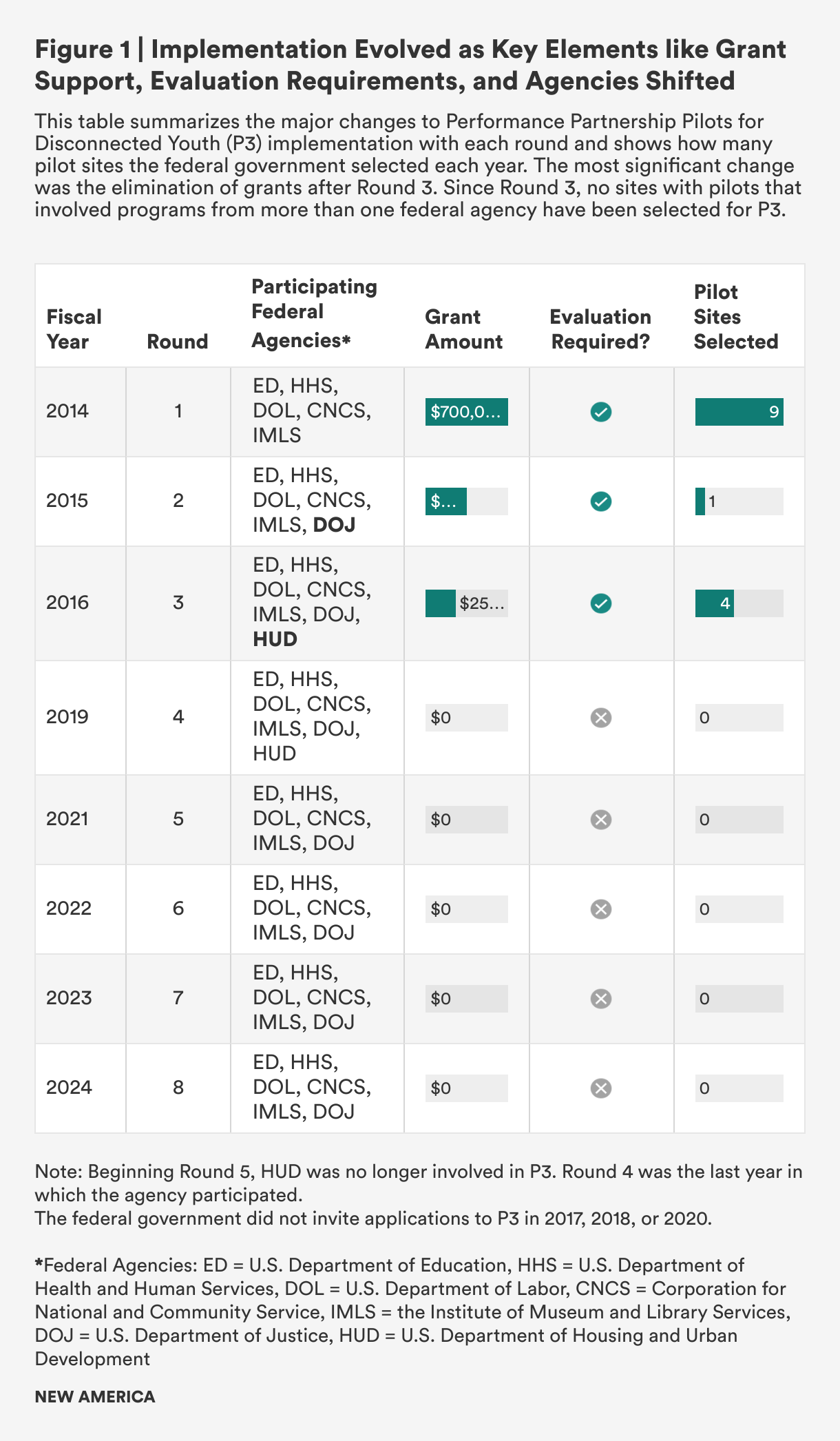
Though the Office of Management and Budget (OMB) led the initial effort to secure P3’s inclusion in the Consolidated Appropriations Act of 2014, implementation was handed off to agencies themselves, with the ED as the lead, with the DOL and HHS playing key roles. At the start, federal staff spent significant energy on figuring out how to collaborate across their own siloes. Below, we outline core elements of P3 implementation. Figure 1 below shows how these elements evolved over time.
Participating Agencies
At first, P3 included programs at five agencies: ED, DOL, HHS, the Corporation for National and Community Service (CNCS), and the Institute of Museum and Library Services (IMLS). It expanded in 2015 when Congress added the Department of Justice (DOJ) and then again in 2016 with the inclusion of the Department of Housing and Urban Development (HUD). HUD left the program after FY2020. There have been no changes since then. (To see the programs within each agency that were most frequently involved in P3, see Figure 3.)
Application Process and Selected Pilots
Between 2014, when the P3 authority was created, and 2024, the federal government issued eight rounds of application notices.16 Sites are selected through a competitive process, with state, local, or tribal governments eligible to serve as lead applicants and organizations and agencies from across the education, workforce, and human services systems listed as partners.
In their applications, sites must submit a proposal for how they would like to use the P3 authority, including any waiver or blended funding requests. For the first three rounds (2014–16), applicants needed to propose—and, if selected, implement—an evaluation design of their P3 project.
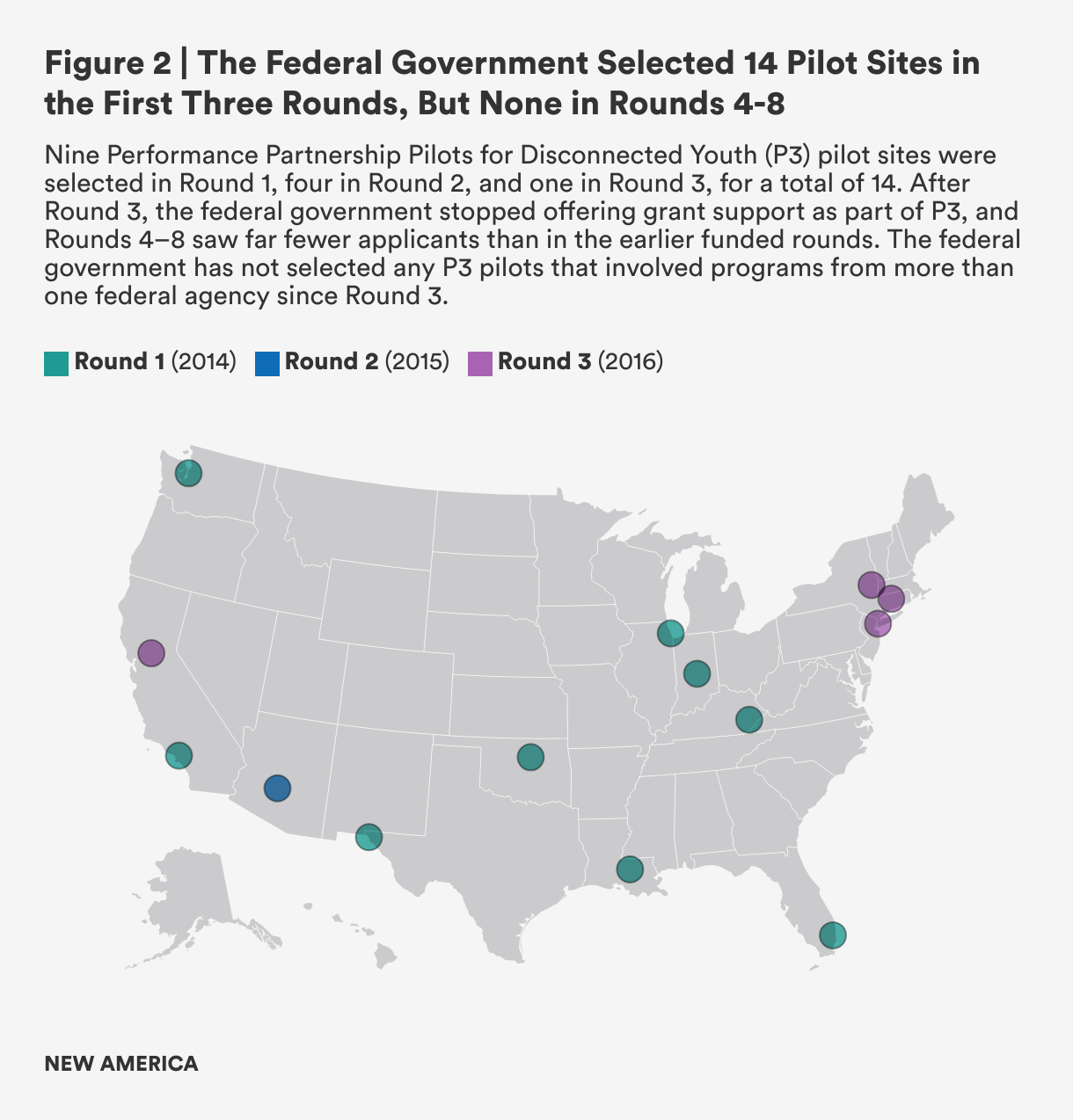
P3 authority was granted to 14 pilot sites in the first three rounds of P3: nine in the first round, one in the second, and four in the third (see Figure 2).17
Implementation Grants
The first three rounds provided grants to fund sites’ P3 intervention and evaluation. Notably, these grants were not funded through congressional appropriations.18 Instead, ED used P3’s blending authority to pool funding from other programs, like DOL’s Reentry Employment Opportunities, Adult Education and Perkins national activities, and the CNCS’ Social Innovation Fund, to create the grants.
Originally, the grants were capped at $700,000, but the agencies reduced the cap to $350,000 in the second round and $250,000 in the third.19 After this, the federal government phased out the grant support entirely and eliminated the requirement for sites to conduct evaluations of their projects. Later rounds have not provided funding for implementation. Not surprisingly, the rounds with implementation funding support had more applicants and selected sites (14) than later rounds that did not include funding.
Waivers
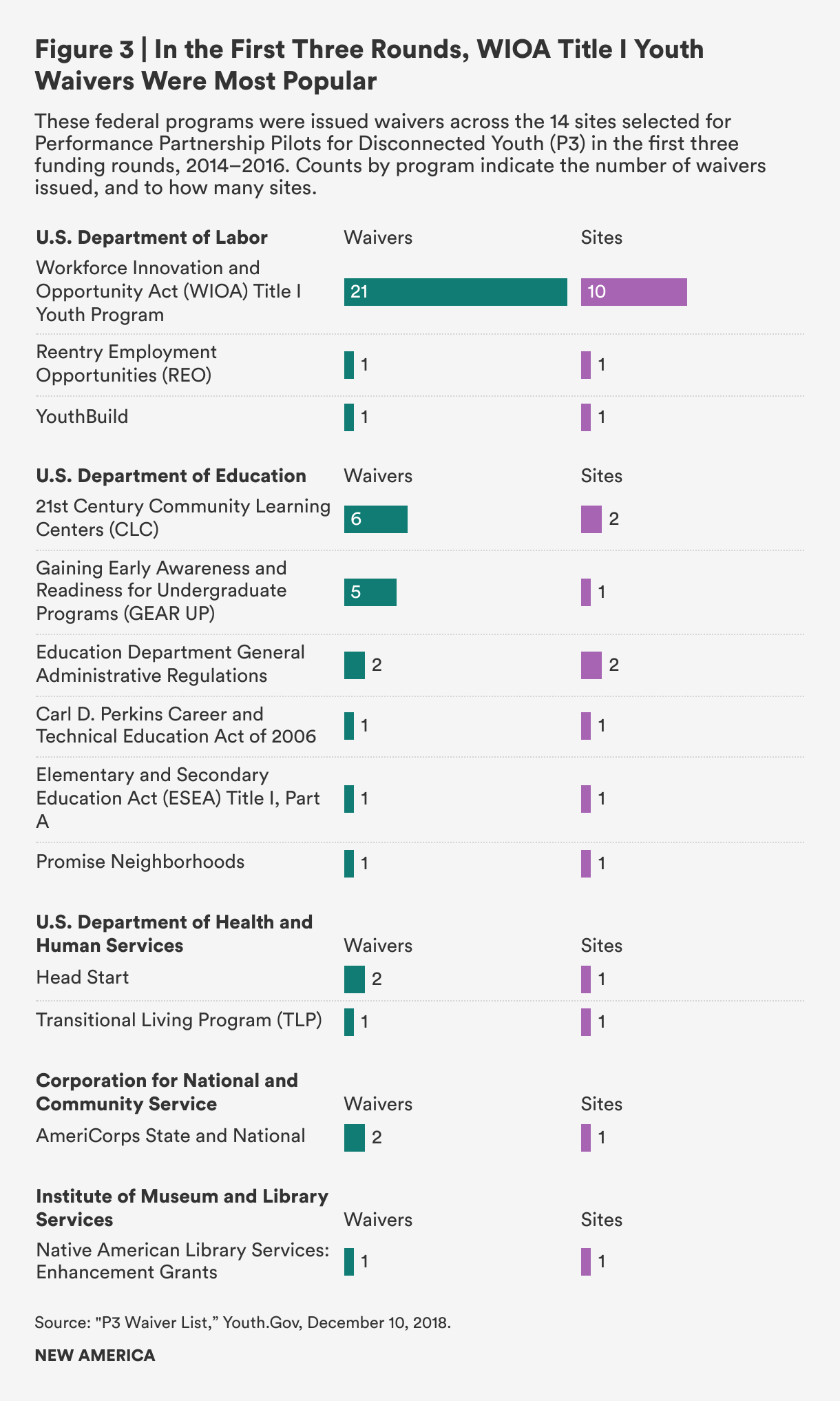
In the first three rounds, WIOA Title I Youth waivers were the most popular by a wide margin.20 Of the 45 waivers issued across the 14 sites in the first three rounds, 21 were for WIOA Title I Youth, with 10 different sites receiving WIOA Youth waivers.21 In several cases, pilot sites received waivers for more than one WIOA Youth requirement. Pilots used WIOA waivers to expand participant eligibility; create more flexibility in where, when, and how they served WIOA-eligible youth; and reduce administrative burden.22 ED’s 21st Century Community Learning Centers was the next most popular, with six waivers issued at two pilot sites.23 See Figure 3 for more information about the other waivers issued in the first three rounds of P3.
Citations
- GAO, Performance Partnerships, 12, https://www.gao.gov/assets/gao-17-208.pdf.
- Elizabeth Brown, Performance Partnership Pilots for Disconnected Youth (P3): Sustaining Systems Change Efforts and Coordinated Services for Youth (Mathematica, October 2020), https://drive.google.com/file/d/1Op65kMv4wwC6G4SOdaf2M84OLhWagCfZ/view?usp=sharing.
- Brown, Performance Partnership Pilots for Disconnected Youth, https://drive.google.com/file/d/1Op65kMv4wwC6G4SOdaf2M84OLhWagCfZ/view?usp=sharing.
- Brown, Performance Partnership Pilots for Disconnected Youth, https://drive.google.com/file/d/1Op65kMv4wwC6G4SOdaf2M84OLhWagCfZ/view?usp=sharing.
- Downs, “Lessons from the Performance Partnership Pilots for Disconnected Youth,” https://www.newamerica.org/education-policy/edcentral/lessons-from-the-performance-partnership-pilots-for-disconnected-youth/.
- For more on these challenges, see Downs, “Lessons from the Performance Partnership Pilots for Disconnected Youth,” https://www.newamerica.org/education-policy/edcentral/lessons-from-the-performance-partnership-pilots-for-disconnected-youth/.
- Taylor White and Lancy Downs, “Combining Multiple Funding Sources” in Unraveling the Finance Models of Work-Based Learning Intermediaries (New America, November 16, 2023), https://www.newamerica.org/education-policy/reports/braiding-funding-for-survival-sustainability/.
- White and Downs, “Combining Multiple Funding Sources” in Unraveling the Finance Models, https://www.newamerica.org/education-policy/reports/braiding-funding-for-survival-sustainability/.
- White and Downs, “Combining Multiple Funding Sources” in Unraveling the Finance Models, https://www.newamerica.org/education-policy/reports/braiding-funding-for-survival-sustainability/.
- See the following links for the full notices: https://www.federalregister.gov/documents/2014/11/24/2014-27775/applications-for-new-awards-performance-partnership-pilots for FY 2014; https://www.federalregister.gov/documents/2016/04/26/2016-09748/applications-for-new-awards-performance-partnership-pilots for FY 2015; https://www.federalregister.gov/documents/2016/08/15/2016-19294/applications-for-new-awards-performance-partnership-pilots for FY 2016; https://www.federalregister.gov/documents/2019/01/28/2019-00200/applications-for-selection-as-a-performance-partnership-pilot-performance-partnership-pilots-for for FY 2019; https://www.federalregister.gov/documents/2021/06/24/2021-13382/applications-for-selection-as-a-performance-partnership-pilot-performance-partnership-pilots-for for FY 2021; https://www.federalregister.gov/documents/2022/08/08/2022-16966/applications-for-selection-as-a-performance-partnership-pilot-performance-partnership-pilots-for for FY 2022; https://www.federalregister.gov/documents/2023/07/07/2023-14288/applications-for-selection-as-a-performance-partnership-pilot-performance-partnership-pilots-for#citation-8-p43325 for FY 2023; and https://www.federalregister.gov/documents/2024/08/12/2024-17895/applications-for-selection-as-a-performance-partnership-pilot-performance-partnership-pilots-for#footnote-8-p65610 for FY 2024.
- In round three, an additional pilot site was selected but voluntarily ended its project before the P3 term expired, so we have not included the site in our analysis. Since round three, the federal government has approved some single-agency P3 pilots, either through ED or DOL. We do not focus on them in this analysis because they did not break down federal funding silos. They also functioned differently from the original 14, as they didn’t receive grant support or conduct an evaluation.
- Alexandra Stanczyk, Armando Yañez, and Linda Rosenberg, Performance Partnership Pilots for Disconnected Youth (P3): Implementation Study Findings of the Pilots’ Experiences (Mathematica, December 8, 2020), 3, https://drive.google.com/file/d/1alWM2gqk9vA2pZh4mkK1J16IM6qT6RKc/view?usp=sharing.
- Stanczyk, Yañez, and Rosenberg, Performance Partnership Pilots for Disconnected Youth (P3): Implementation Study, 3, https://drive.google.com/file/d/1alWM2gqk9vA2pZh4mkK1J16IM6qT6RKc/view?usp=sharing.
- “P3 Waiver List,” Youth.Gov, December 10, 2018, https://web.archive.org/web/20220815045008/https://youth.gov/sites/default/files/P3-Waiver-List-FINAL_2018-12-10.pdf.
- If an agency granted the same flexibility to more than one site, we counted that as multiple waivers, not one. For example, for six different sites, DOL waived WIOA performance measures and allowed the sites to use proposed alternative measures instead. For the purposes of this paragraph and our accompanying graphic, we counted these as six individual waivers, not one waiver.
- “P3 Waiver List,” https://web.archive.org/web/20220815045008/https://youth.gov/sites/default/files/P3-Waiver-List-FINAL_2018-12-10.pdf.
- “P3 Waiver List,” https://web.archive.org/web/20220815045008/https://youth.gov/sites/default/files/P3-Waiver-List-FINAL_2018-12-10.pdf.