What Are Citizen-Initiated Ballot Measures?
For more than a century, citizen-initiated ballot measures—sometimes called ballot initiatives, initiative and referendum (I&R), or direct democracy7—have given voters in many states a direct path to policymaking. Initiatives allow citizens to propose laws, amend constitutions, or repeal legislation, placing these actions on the ballot for a public vote.
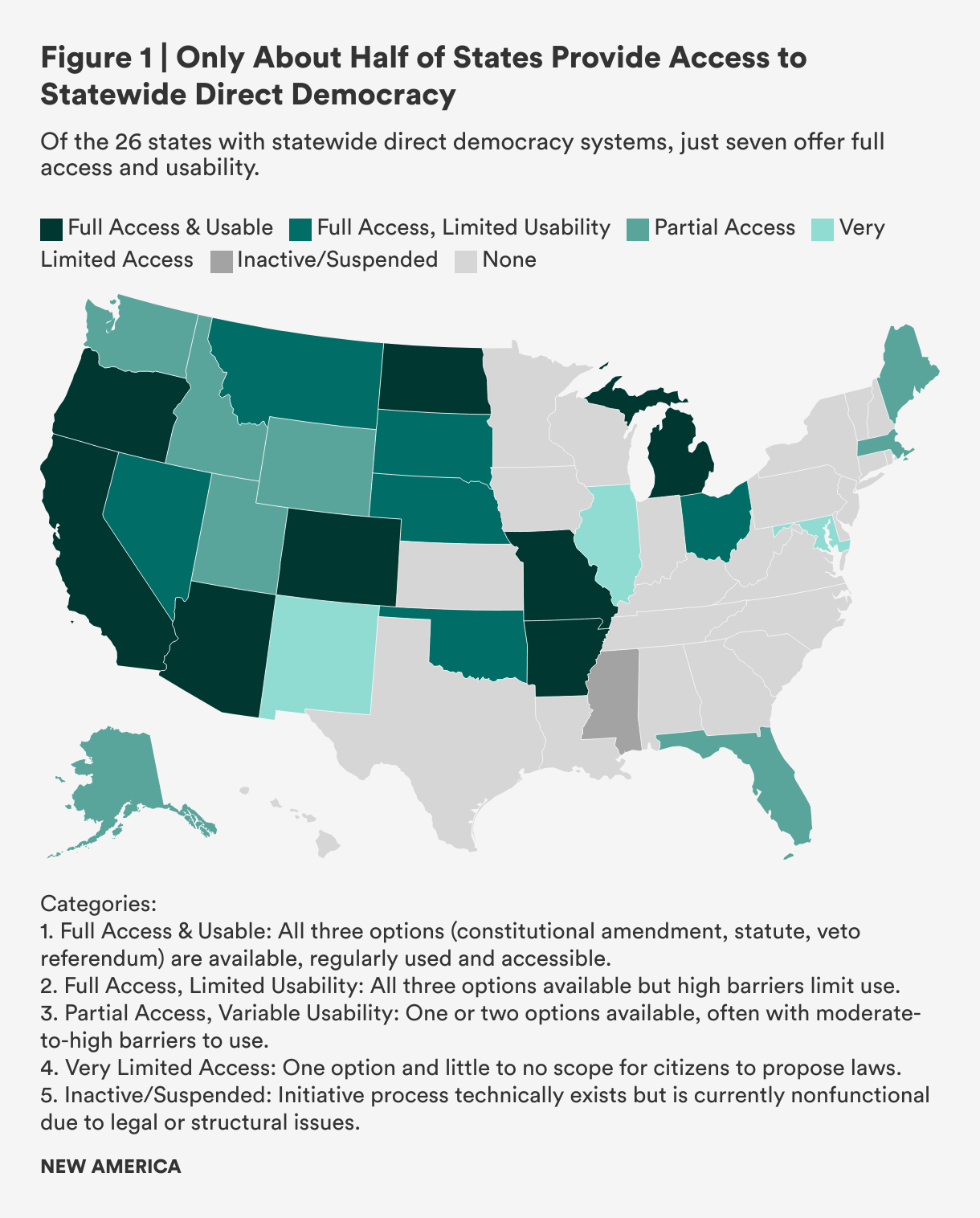
Unlike legislatively referred measures (measures placed on the ballot by the state legislature), which exist in all 50 states, only 26 states provide for some form of statewide citizen-led ballot measure.8 The details vary: Twenty-one allow statutory initiatives, 18 permit constitutional amendments, and only 15 allow both. Twenty-three states allow veto referendums, which allow citizens to overturn recently passed laws, but not proactive lawmaking. Maryland and New Mexico allow veto referendums only. Illinois, Mississippi, and Florida provide for initiated constitutional amendments but not referendums. Though technically still in the state constitution, Mississippi’s initiative process has been inactive since a 2021 state supreme court decision.9
There are two primary models of statewide ballot initiatives in use today: (1) direct, which go directly to the ballot, and (2) indirect, which are first submitted to the legislature. Though the mechanics of indirect initiated statutes and amendments vary across states, typically, lawmakers can adopt the citizens’ proposal outright, ignore it (sending it to voters to approve or reject in the next election), or propose a competing measure to appear on the ballot alongside the initiated measure.10
In each of the 25 active initiative states, getting a measure on the ballot requires clearing several procedural hurdles (see Figure 1). These hurdles include requiring the collection of a certain number of signatures within a fixed period, often with rules about geographic distribution to ensure statewide support. Signature thresholds range from as low as 2 percent of voters in North Dakota to as high as 15 percent in Wyoming.11
After an initiative’s passage, implementation can still be contested. Some measures are executed smoothly; others face resistance from elected officials, especially when the measure challenges special interests or social values held by a powerful legislative faction, or it necessitates significant new funding. Even initiatives that receive overwhelming voter support can still face bureaucratic, legislative, or judicial obstruction, as was the case during voter-led efforts to expand Medicaid and marijuana legalization.12
Despite these variations, all initiative processes share a democratic promise: They give people a way to act when representative institutions will not. In doing so, they reaffirm that democracy is not just about people choosing representatives. It’s also about reserving the right to make and shape policy when those representatives fail to legislate in the interests of the majority of their constituents. As Teddy Roosevelt said about initiatives in a speech to the 1912 Ohio constitutional convention, they “should be used not to destroy representative government, but to correct it whenever it becomes misrepresentative.”13
Expanding Citizen-Led Policymaking in the Twenty-First Century
- Executive Summary
- Why This Moment Is Ripe for Direct Democracy
- What Are Citizen-Initiated Ballot Measures?
- A Short History of Citizen-Initiated Ballot Measures
- Lessons from Reform Leaders and Coalitions
- Analysis of Adoption Trends: Strategic Takeaways from History
- Assessing State Readiness: Preliminary Criteria and Methodology
- Conclusion: The Future of Citizen-Initiated Ballot Measures
- Appendix
Citations
- Recall of public officials is sometimes treated as the third leg of the direct democracy stool, alongside initiative and referendum. The scope of this investigation, however, is limited to citizen-initiated legislating and referendums.
- In addition to Washington, DC, states that allow some form of statewide citizen-initiated ballot measure include: Alaska, Arizona, Arkansas, California, Colorado, Florida, Idaho, Illinois, Maine, Maryland, Massachusetts, Michigan, Missouri, Montana, Nebraska, Nevada, New Mexico, North Dakota, Ohio, Oklahoma, Oregon, South Dakota, Utah, Washington, and Wyoming. Mississippi’s constitution provides for citizen-initiated amendments, but the process is currently inactive.
- In a 2021 decision, the Mississippi Supreme Court struck down Initiative 65, a medical marijuana measure that had passed with 73 percent of the popular vote, ruling that the state’s ballot initiative process had been unworkable since redistricting reduced Mississippi’s congressional districts from five to four in 2001. The court found that the signature distribution requirement in the state constitution made it impossible for any petition to qualify for the ballot, sending the issue back to the state legislature to resolve.
- Some states, including Ohio, require two rounds of signatures to qualify an initiated statute for the ballot. Meanwhile, in Massachusetts, a petition to amend the constitution must be approved by one-fourth of the legislature in two joint sessions before it is sent to the ballot.
- “Signature Requirements for Ballot Measures,” Ballotpedia, accessed May 12, 2025, https://ballotpedia.org/Signature_requirements_for_ballot_measures.
- See, for example, efforts to override ballot initiatives or significantly revise the text of the initiatives: Anne Whitesell, “The Increasing Trend of Lawmakers Overriding Ballot Initiatives,” Governing, January 30, 2024, https://www.governing.com/politics/the-increasing-trend-of-lawmakers-overriding-ballot-initiatives; Jeremy Kohler, “Red State Voters Approved Progressive Measures. GOP Lawmakers Are Trying to Undermine Them,” ProPublica, May 30, 2025; Election Reformers Network, Partisan Control of Ballot MeasuresHow to Stop Manipulation of Citizen Initiatives (Washington, DC: Election Reformers Network, 2025), https://cdn.prod.website-files.com/642dcbc53f522476efc85893/67b7435eb1eaf84deca013cf_ERN%20Natl%20Ballot%20Initiative%20Report-FINAL.pdf.
- Theodore Roosevelt, “A Charter of Democracy” (address before the Ohio Constitutional Convention, Columbus, Ohio, February 21, 1912), Ohio State University Library, accessed May 12, 2025, https://ehistory.osu.edu/exhibitions/1912/1912documents/CharterofDemocracy.