A Chapter of: Maximizing Impact Under Any Structure: Governance Lessons from Local Early Childhood Programs
Introduction: Many Sources Fund Public Early Childhood Programs
Many programs exist to help young children get the best start in life—so many, in fact, that it can be difficult for even seasoned policymakers to understand the different programs and funding streams that support them. A recent federal early childhood systems-building effort cataloged 35 such at the federal level that are designed to help families with child care, preschool, home visitation, early intervention, and more. Established by different statutes over time, these programs are administered across multiple federal agencies, but are largely implemented and delivered by state and local governments.
The result is a well-intentioned quagmire of funding streams and programs that require careful braiding and blending to deliver more seamless programs to children and families. Observers of a typical pre-K class might note two teachers, 18 students, and hopefully items like books, toys, interesting materials, and learning centers to support an enriching environment. Fueling that classroom could be a mix of funds coming from an alphabet soup of programs: Child Care and Development Fund (CCDF), Temporary Assistance for Needy Families (TANF), Title I, Individuals with Disabilities Education Act (IDEA) Part B, Preschool Development Grant Birth Through Five (PDG-B5), state universal pre-K, and Head Start. It takes an acronym to fund a classroom—sometimes four or five.
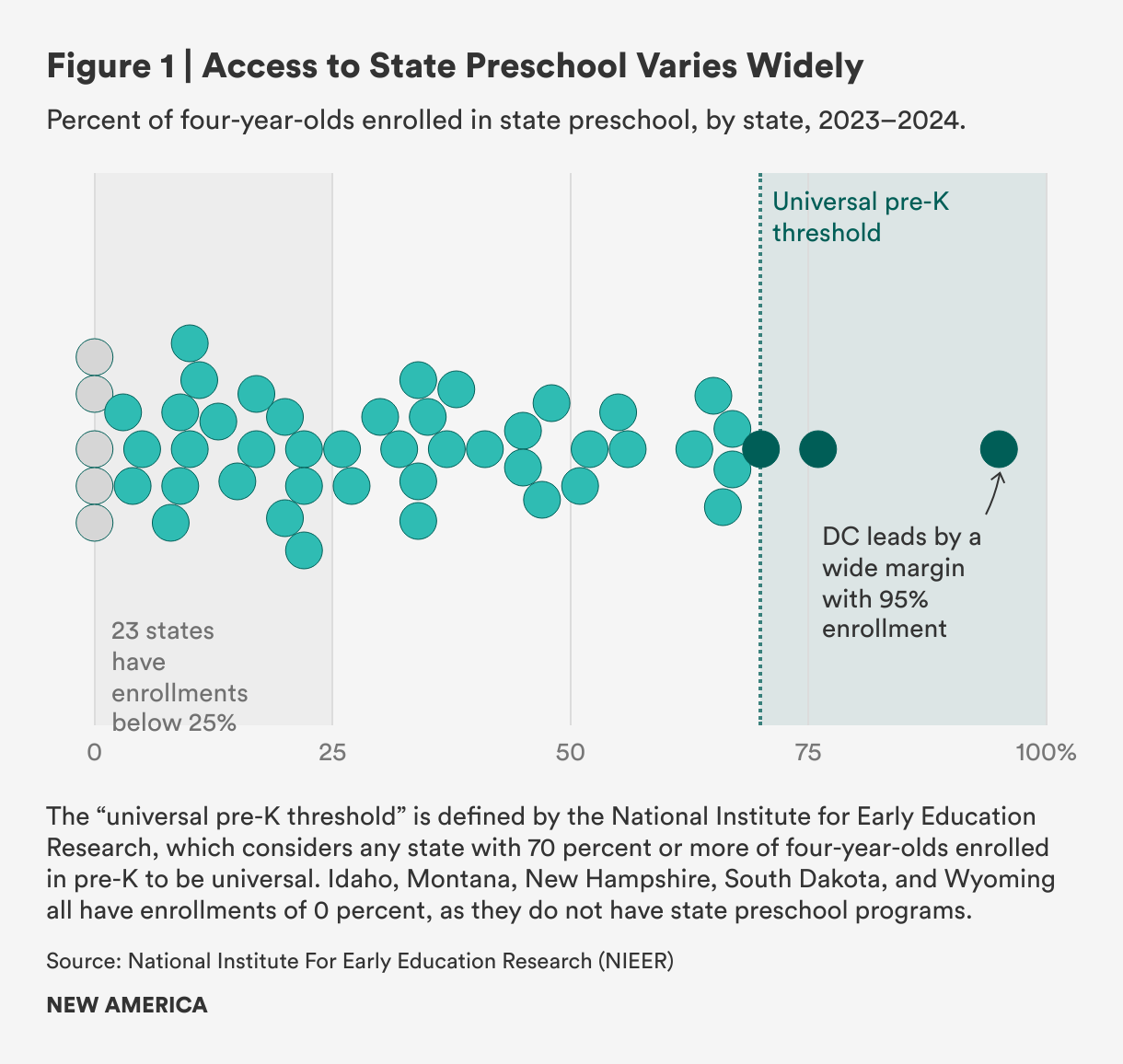
Most of these federal programs are targeted towards children from families with low incomes, and delivering more “universal” early childhood programs—sometimes defined as serving 75 percent or more of a target age group—requires additional funding.1 Free pre-K is popular, but current federal investments won’t fund enough seats for all children. Just under half of all four-year-olds and less than 20 percent of three-year-olds have access to some sort of publicly funded preschool; this means the rest pay out of pocket or do not participate at all. State and local governments have responded by launching their own early education programs with some of the most “universal” and full-time programs operating at the municipal level. Most states (44, plus Washington, DC) operate some publicly funded pre-K, but enrollment varies widely from place to place, with state pre-K enrollment of four-year-olds ranging from zero all the way up to 95 percent (see Figure 1).
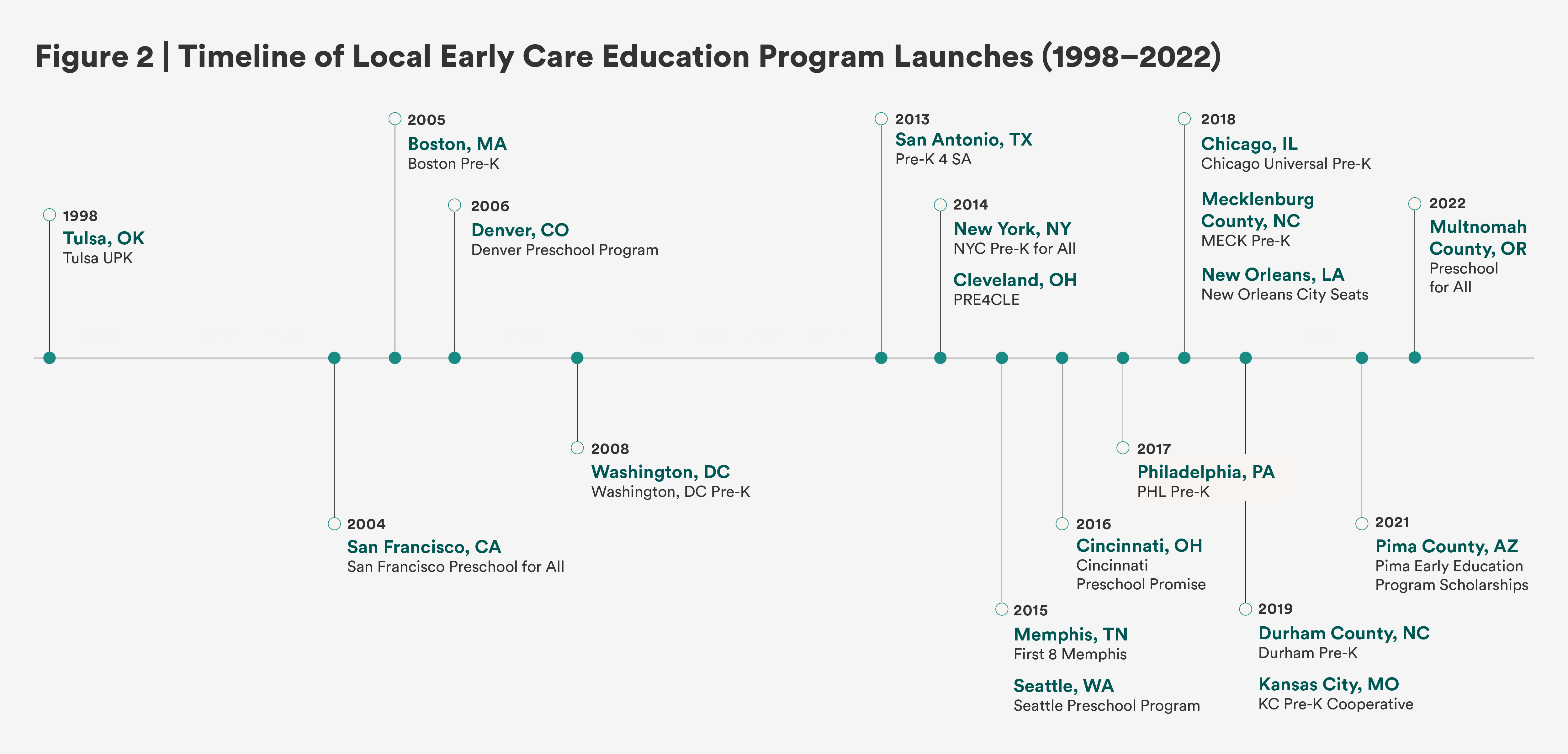
To meet demand for high-quality and affordable early learning opportunities, dozens of cities and counties have launched their own publicly funded and administered early childhood programs over the past two decades (see Figure 2 for a noncomprehensive list of local program launches).
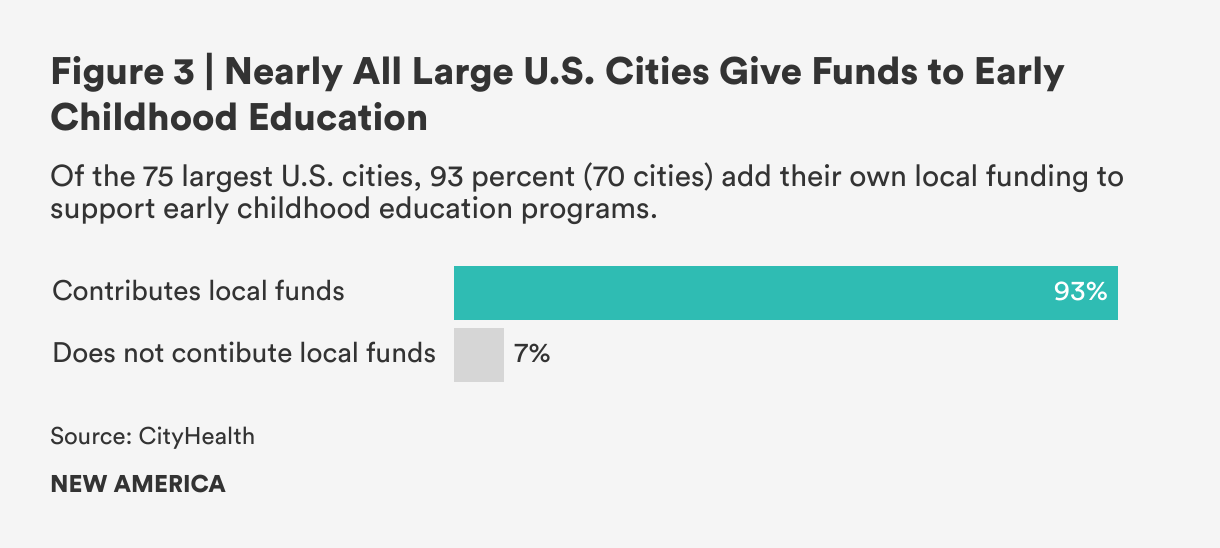
According to CityHealth, 70 of the 75 largest cities contribute local funding to preschool services as of 2024 (see Figure 3). In some cases, local funding is a prerequisite to run any programs at all; according to the National Institute for Early Education Research (NIEER), 12 state preschool programs require a local match. In many states that have robust statewide pre-K programs, localities often opt to augment state investments even if a local match is not required. For example, in Texas, every school district must offer state-funded pre-K services. Many school districts invest their own funds on top of the state dollars to increase the number of children they can serve or expand services like offering longer hours.
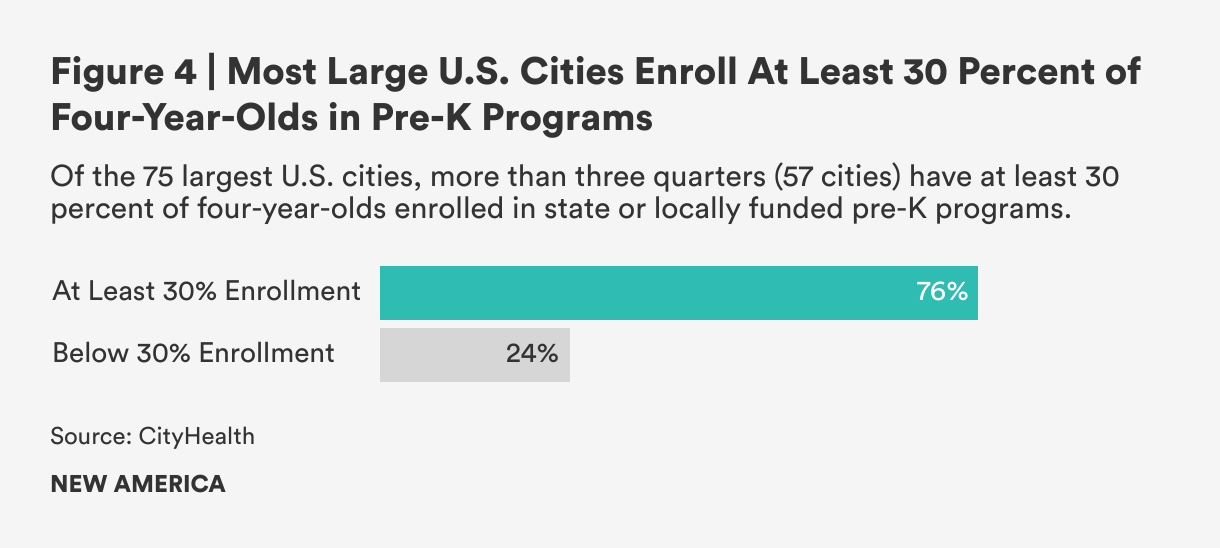
Just as early childhood enrollment rates vary widely from state to state, there is also wide variation from city to city and county to county. But unlike NIEER’s enrollment data for states, there is no single nationwide source for local early childhood enrollment data. However, CityHealth estimates that 30 percent or more of four-year-olds are enrolled in pre-K in 57 of the 75 largest cities (see Figure 4). For a list of which of the 75 largest U.S. cities invest in early childhood education, please see the additional resources section of this report.
The strong investments in and growth of local early childhood initiatives might imply a highly developed playbook to help facilitate the design and structure of emerging programs, but in fact, local early childhood governance is not well documented or understood.

Citations
- Even “universal” programs may not be full day, and even “full day” programs may not align with a full day work schedule for many parents. This requires additional hours of care to be arranged, typically at the expense of families.