Executive Summary
Higher education is facing unprecedented scrutiny. Since the Trump administration took office early this year, the White House has aggressively targeted some of the nation’s most prestigious colleges and universities, freezing research funding and contracts, investigating curricula and campus activities, and threatening to revoke international students’ visas. Congress, through a partisan budget reconciliation process, recently passed a sweeping legislative package that proposes major changes to federal student aid programs, including loans and Pell Grants. Once enacted, these changes would have serious implications on how low- and moderate-income students pay for higher education for years to come. Colleges and their stakeholders, even those that have not yet been directly affected, all feel the pressure of these challenges.
Yet Americans, regardless of political party, are more aligned than divided when it comes to their support for higher education.
Varying Degrees, New America’s annual survey about Americans’ perceptions of higher education, was conducted in March of this year. We surveyed more than 1,600 adults to find that even when it seems politicians can’t agree on higher education policy, Americans across the board are much less divided. Democrats and Republicans nationwide largely agree about the core value and purpose of higher education. The most partisan divergence relates to who should fund higher education. However, despite believing that students should be the ones responsible for bearing the cost of college, a majority of Republicans still support more federal and state investment into making college more affordable—aligning themselves with Democrats.
Now in its ninth year, our survey continues to track public opinion on issues like value, funding, and accountability. It also introduces new questions to explore Americans’ views on confidence in higher education and college quality, and whether they think colleges and universities are fulfilling their roles. These timely insights get at the core of the public and political frustration with higher education and offer a clearer picture of what Americans believe higher education is—and what it should do.
Given New America’s deep policy expertise, we believe that Varying Degrees will help inform policymakers, researchers, and advocates about how Americans feel about critical higher education issues. In this year’s report, we focus on understanding where Democrats’ and Republicans’ views converge or differ and find more similarities than differences between the two groups. We found six key themes:
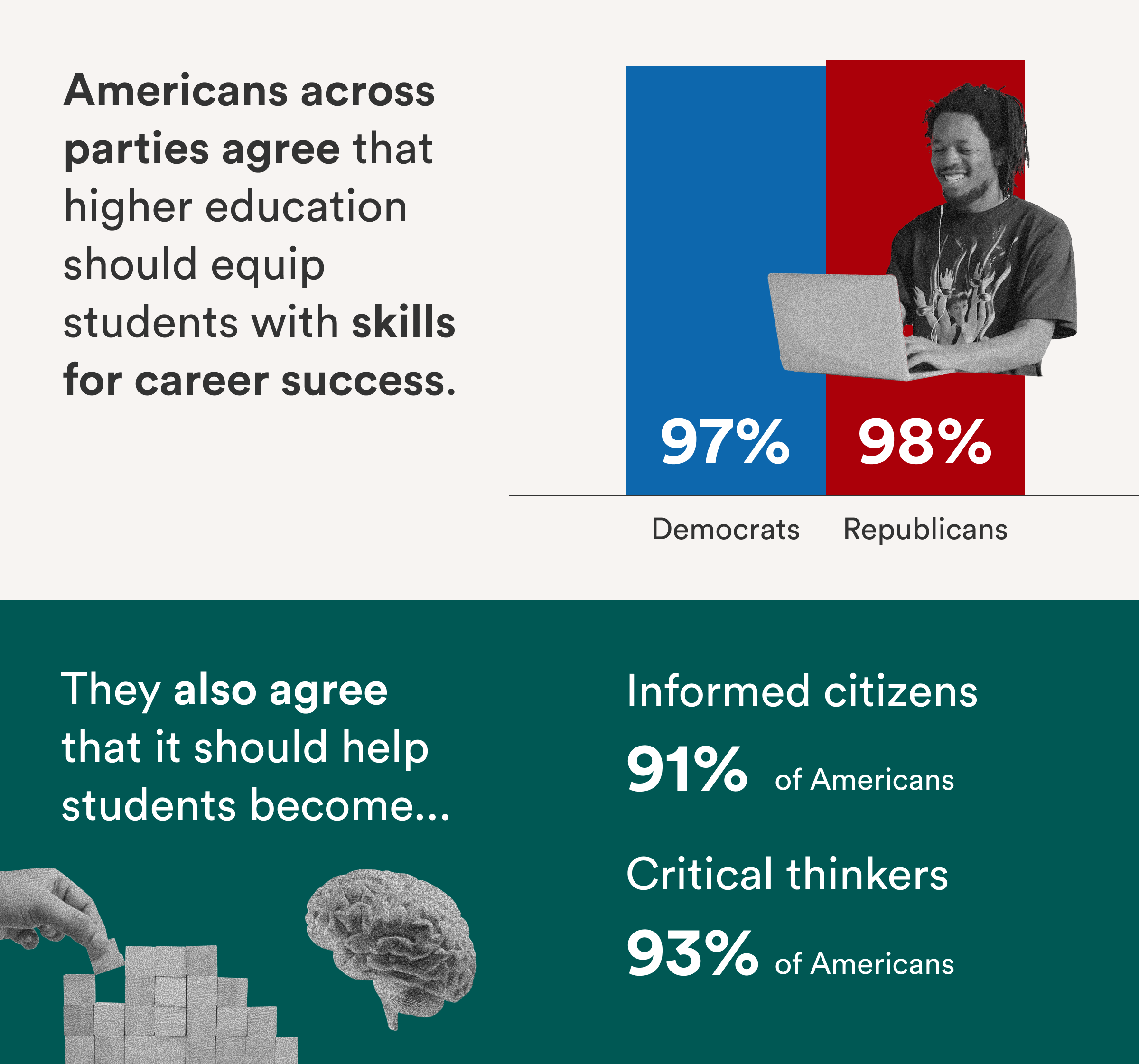
1. Americans broadly agree on the core roles of colleges and universities. Nine in 10 Americans think that it’s important for colleges to equip students with the skills and knowledge to succeed in their chosen fields (97 percent of Democrats and 98 percent of Republicans). Americans also believe colleges should help students become informed citizens (93 percent) and critical thinkers (91 percent). See image below.
2. Americans agree that job training should not be the only outcome of a college education. They believe other areas such as writing and communication (97 percent of Democrats and 92 percent of Republicans) and thinking and reasoning (97 percent and 92 percent, respectively) are also important indicators of quality.
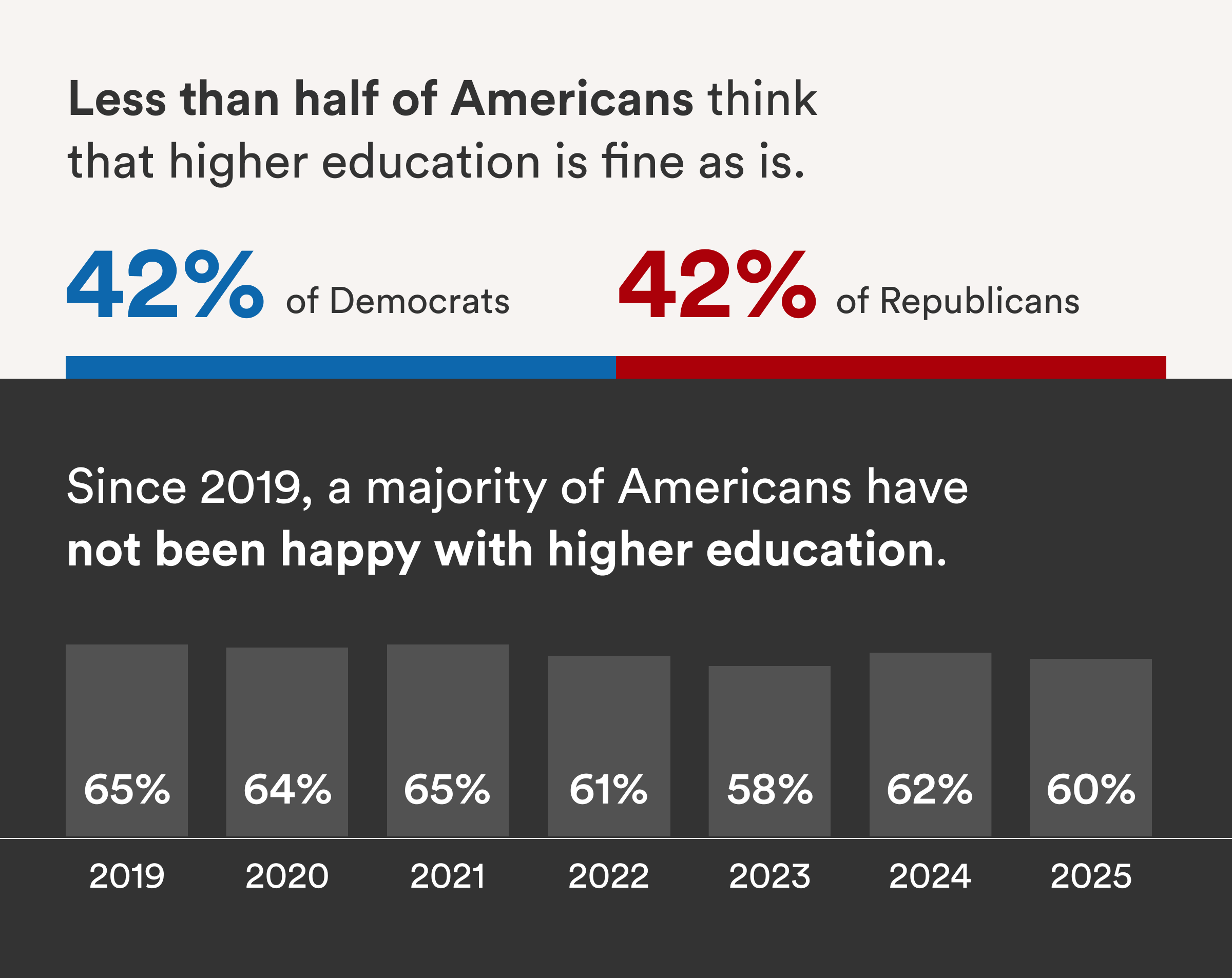
3. Americans continue to show frustration with the current state of higher education. Only 40 percent agree that higher education is fine how it is (42 percent for both parties); see image below. And like last year, slightly more than half of Americans (54 percent) think colleges and universities are having a positive effect on the way things are in the country. There is a vast partisan divide on this question: 74 percent of Democrats said they see positive effects of higher education, compared to only 39 percent of Republicans.
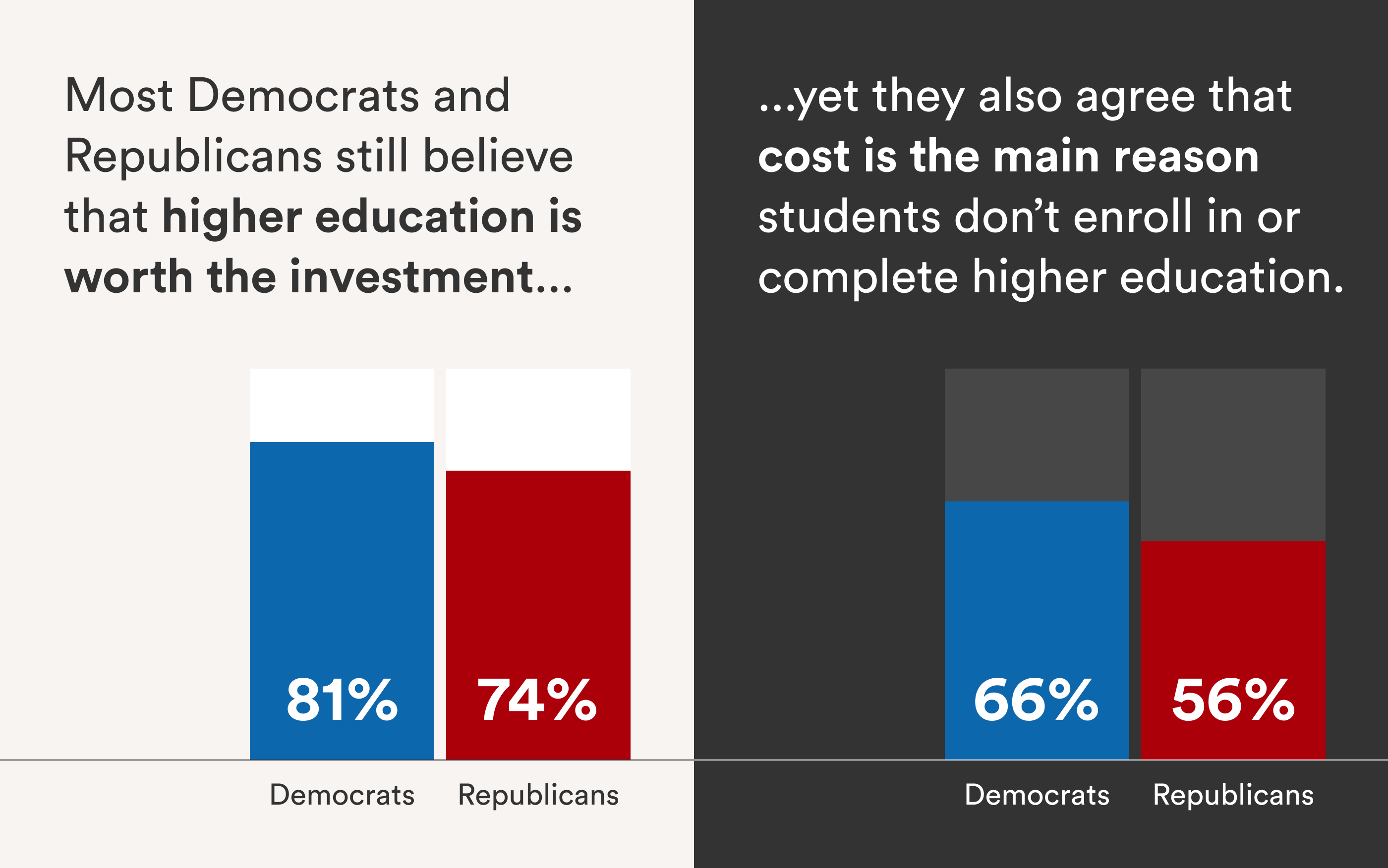
4. A large share of Americans still believe that higher education is worth the investment and is needed if one wants to get ahead in life. Seventy-three percent of Americans agree that education beyond high school offers good return on investment for the student (81 percent of Democrats and 74 percent of Republicans); see image on the left below.
5. The cost of college remains a major concern. Only half of survey respondents think that Americans can get a high-quality education after high school that is also affordable. Democrats and Republicans agree that affordability is a significant barrier to college access: When asked to pick one among the top reasons that stop students from enrolling or completing their programs, 66 percent of Democrats and 56 percent of Republicans choose the cost of attending as the main reason. See image on the right below.
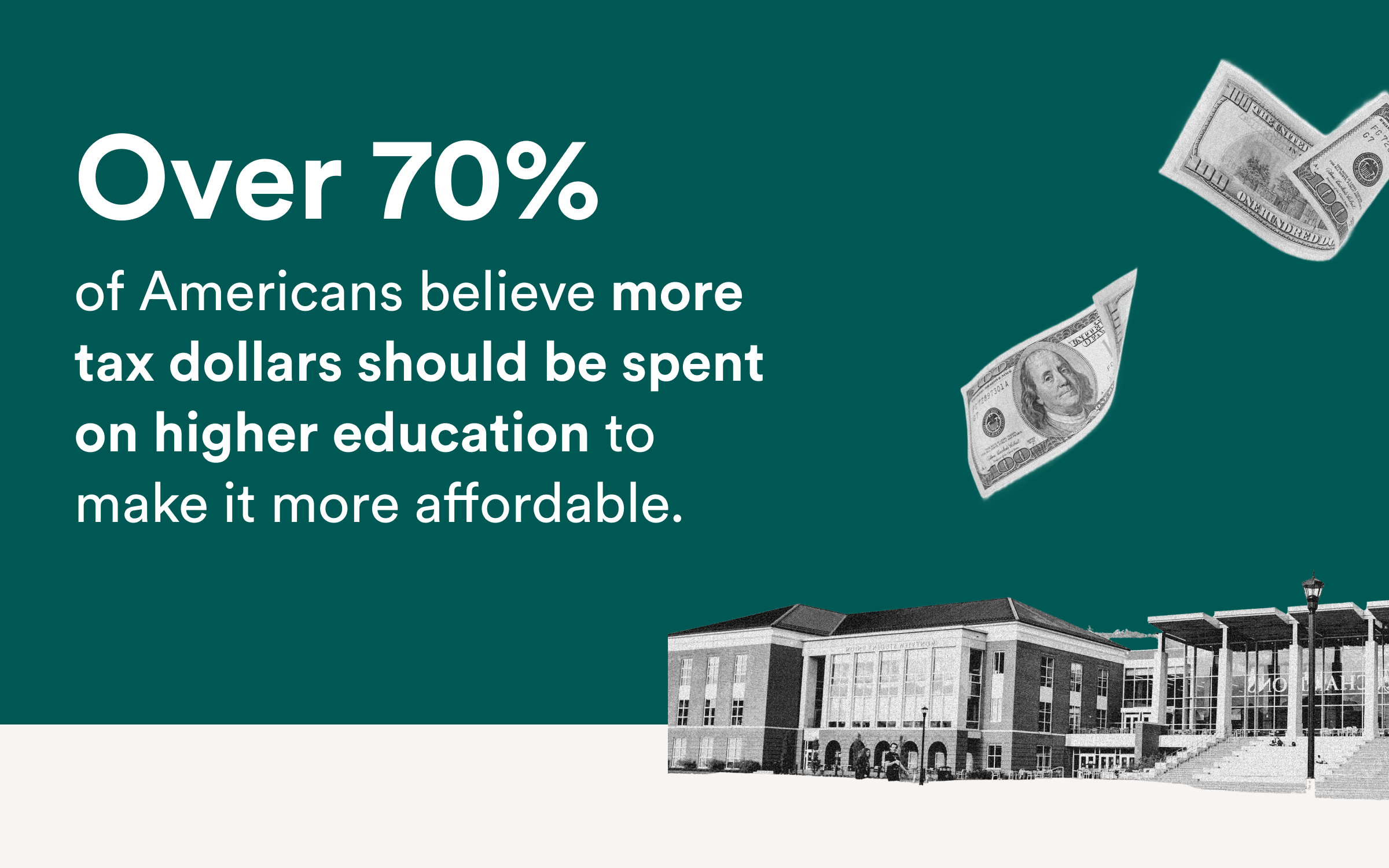
6. Americans may not agree on who should pay for college, but a majority believe more federal and state investment is needed. While only 54 percent of Americans think the government should be more responsible for funding higher education because it’s good for society, 74 percent of Americans think that the federal government should spend more tax dollars on education opportunities after high school to make them more affordable; see image below. Despite a sizable gap on this question: a majority of Democrats (91 percent) and Republicans (58 percent) agree.
Varying Degrees 2025: Americans Find Common Ground in Higher Education
- Executive Summary
- Preface
- Americans Broadly Agree on the Core Values of Higher Education, Despite Some Disagreements
- Americans Are Frustrated with the High Cost of College but Disagree on Who Should Pay
- Historical Trends: Even in Challenging Times, Americans’ Perceptions of Value and Investment Have Stayed Relatively Steady
- Explore the Data
- Appendix: Methodology