A Chapter of: Thinking and Working Politically on Land Tenure
II. The Politics of Land
Land and land-based resources like soil, water, minerals, forests, and fossil fuels are finite and constitute a substantial part of both household and national wealth. The land that individuals use in a myriad of ways, such as building homes or businesses, is foundational to their survival. The minerals beneath that land and the vegetation that grow from it provide critical resources that fuel modern society and increasingly have the power to curb climate change and fuel the green energy transition. And yet, because land and resources are finite, anything that impacts the distribution of these resources will necessarily generate winners and losers, both in reality and in perception.
For all these reasons, control over land has long been the foundation of political power and contributes to differences between wealthy and less wealthy individuals. Recent studies have found that 16 percent of the world’s farms manage 88 percent of the total farmland in production, and that land concentration has increased across major developing countries over the past 40 years.10 Women, minorities, Indigenous peoples, youth, and other vulnerable groups especially suffer from unequal ownership, access, and control over land, and land continues to be used by the powerful as a tool for political control, patronage, and speculation.
Because the allocation of land is critical to social, economic, and political health, scholars Frank F.K. Byamugisha and Nancy Dubosse observe that corruption, elite capture, and inefficient allocation are endemic in government-led land administration. Byamugisha and Dubosse go on to note:
“Government is the custodian of the most critical (and limited) factor of production, namely, land. Assuring the security of tenure, arbitrating disputes, and facilitating the transfer or sales of titles renders the land market more efficient and less volatile, attracting investors and promoting sustainable urban development. Yet, one of the most underperforming parts of public administration in developing countries is land administration. This is borne out by the observed land conflicts, squatting in undesignated urban areas, non-compliance to land use planning and construction regulations, and lack of investment in housing and farms across the world.”11
Different world views on the purpose and importance of land contribute to these tensions. From the viewpoint of Indigenous peoples, for example, land, water, and other resources are each linked to deep cultural values and social relationships. Land is often viewed as sacred, and people are regarded as the custodians of the land for present and future generations, rather than owners. Conversely, in Western cultures, land is often seen as a productive asset and commodity, though individuals may harbor deep emotive attachments to it.
Land Politics in Fragile States
One of the principal challenges for land policies, law, and administrative structures is that many countries are marked by state fragility. Fragility refers to the difficulties that states face because of some combination of low legitimacy, ineffective governance, weak institutions, poor social cohesion, and vulnerability to instability, insecurity, and conflict. These problems often intersect with other well-known challenges such as corruption, factionalized elites, and longstanding group grievances. Many fragile states are also in vulnerable ecological zones or parts of the world at acute risk for climate impacts and loss of biodiversity.
In these fragile states, well-elaborated land policies and legislation may collide with the reality that there are few functioning governance structures and limited financial resources to implement and enforce these policies. In areas of high instability in the Sahel, for example, land offices providing opportunities for formalizing customary rights through land titles and certificates are no longer available because government functionaries have had to flee to safety elsewhere. The costs of land administration in financially strapped countries are often passed on to citizens seeking to formalize their rights. Depending on the level of a state’s fragility, the land intervention toolbox may be limited to recognizing locally led efforts to negotiate land use and access and stemming active displacement or other forms of harm.
Land Tenure Stakeholders, Interests, and Motivations
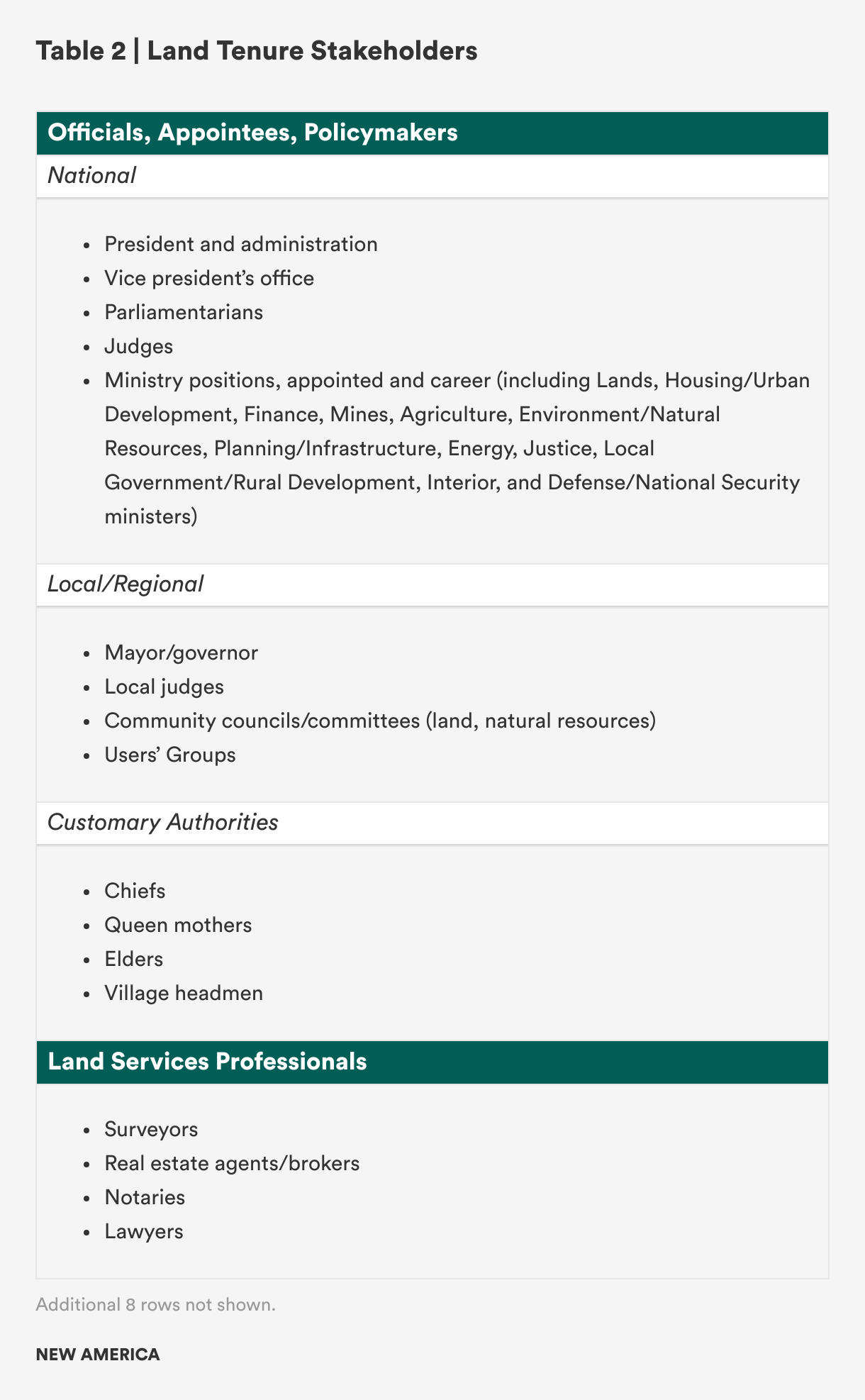
Land is governed, controlled, and interacted within an ecosystem of stakeholders who each have their own motivations, interests, concerns, and constraints (see Figure 1). Learning how stakeholder groups interact with land by engaging in stakeholder analysis—including other stakeholders who may not be captured in Table 2—is key to TWP on Land.
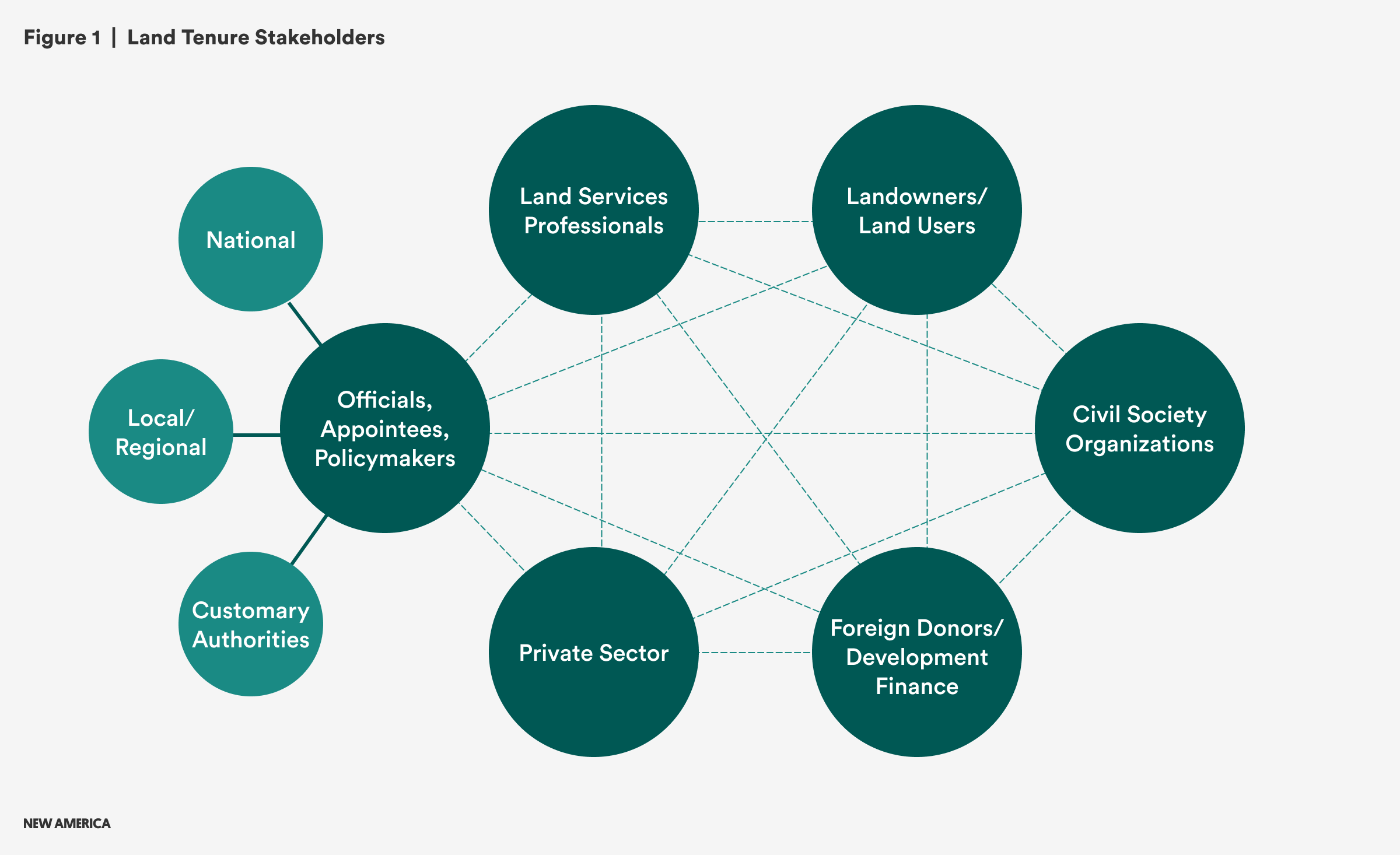
The motivations of stakeholders with vested interests in land governance can be very diverse. They vary over time depending on national and cultural context, shifting national and local dynamics, and the personalities and interpersonal relationships among the people who embody the stakeholder types above.
That said, there are several dynamics commonly seen within these stakeholder groups to be aware of at the outset of a land-related engagement. These dynamics are described in illustrative examples below.
National-Level Policymakers, Officials, and Appointees
Table 2 above identifies the principal elected or appointed officials at the national and local levels who engage directly or indirectly on land issues. At the national level, especially through the executive functions of government, land tenure, use, and administration are linked to higher-level development goals.
For most countries, economic growth is the first among equals of development priorities. Many countries set their visions for economic growth and national development through sweeping strategies that can carry significant political weight. This can be seen, for example, in countries like Nigeria (Vision 20:2020), Tanzania (Vision 2025), Kenya (Vision 2030), Uganda (Vision 2040), and Rwanda (2050), as well as in many other countries’ high-level strategies with similar purposes. Policies, programs, and plans for exploiting land-based natural resources and clarifying and formalizing land rights are often key components of these strategies. Identifying who owns the land is key to negotiating benefit distribution, as well as compensation for land takings. For this reason, governments are often interested in issuing deeds, titles, and certificates to clarify and confirm ownership.
National development strategies, however, may also reflect or mask deeper political crosscurrents relevant to thinking and working politically (TWP). For example, the prioritization by power holders of certain types of economic investments—like the extraction of minerals, timber, and promotion of industrial agriculture—often rests on a country’s relationship to the global economy and the incentives for political leaders to distribute resource revenues as a means to retain domestic political support. The imperative for growth and pressure to achieve national development strategies are often used by elected officials and government administrators as a guide and rationale for their actions on land, even when those actions may appear to be contrary to the interests and legal rights of large rural populations working in traditional agriculture or other locally based economic activities. The use of TWP can help to better understand the drivers of these contradictions.
The Influence and Interests of Ministries
Ministries responsible for land management and resource use are frequently caught in political crosscurrents. Oftentimes, these middle-level ministries need to be both upwardly accountable to central authorities concerned with national development strategies and the needs of their political supporters, and downwardly accountable to local government counterparts and local communities. These obligations are rarely symmetrical. Central authorities and local stakeholders equally have interests, but central authorities have the lion’s share of the power (and control over revenue). Repeated efforts at decentralization in resource management in many countries have shown some progress in ameliorating this imbalance, but the evidence to date indicates that decentralization is often incomplete, poorly implemented, and subject to reversals.12 The recurrent interplay between top-down decision-making and unresolved grievances about land inequality is one of the main dynamics for TWP on land.
Although many different ministries have mandates that bring them into contact with land issues, there are obvious differences in the intensity and nature of each institution’s interests and the level of political influence (and autonomy) held within the national government. For example, while land ministries and housing/urban development agencies are directly engaged in matters involving land demarcation, registration, and clarification and the formalization of land rights, they typically have comparatively low levels of political influence. Conversely, while the broad mandates of finance and planning ministries may result in comparatively weak institutional interest in most land-related issues (infrastructure development and taxation issues might be exceptions), their political clout within the national government is often substantial. From a strictly institutional point of view, a ministry of justice, whatever its larger political influence, may be principally interested in reducing longstanding backlogs of land-related court cases. The levels of institutional interest and political influence in ministries like environment, agriculture, local government, mining, and energy—who clearly have concerns related to land but are attuned to different core agendas—will also vary in accordance with specific national contexts.
Understanding these inter-ministerial power relationships, however, is an essential step in the everyday practice of TWP. Weaker bureaucracies like land ministries may look for shared interests with other ministries (and for champions among elected officials) to increase their political capital and budgets and achieve their institutional goals. They may also jump at opportunities to join sweeping national agendas and vision strategies. Finance ministries may lend support to land tenure advocates when convinced that land-related legal, tax, and regulatory reforms are likely to help to achieve their growth and budgetary objectives. A narrow focus on the technical aspects of land programming, without appreciation of these kinds of shifting political dynamics, can lead to unanticipated bottlenecks that negatively affect program outcomes.
Local/Regional Government and Customary Land Authorities
The legal, cultural, and power dynamics between customary and statutory government leaders (both at the local and national levels) are complex and dynamic. Understanding and tracking these shifting sands is crucially important to TWP on land. For this reason, development agencies need to rely on local experts to interpret these dynamics, instead of relying solely on foreign land tenure experts.
Local government officials working in everyday land administration in rural areas often operate in the context of community grievances, limited budgets, and low salaries. At the district level, local officials may feel motivated, obliged, or even justified to engage in petty corruption. This can take the form of bribes for land administrative services such as registration, titling, and land use plans, or preferential treatment for certain vendors or consultants who may be politically connected or otherwise advantageous to have as allies. Opaque and baroque administrative procedures can make seemingly straightforward land transactions complex and expensive. This tendency simultaneously creates a need and an opportunity for rent seeking (e.g., the payment of “expediting fees”) for those who can afford to pay, while excluding those who cannot. Yet, this further undermines the credibility and adherence to land laws and the vulnerability of land transactions to political and financial manipulation.
At the local level, land is often subject to the politics and power dynamics of legal pluralism. The coexistence of customary, religious, and statutory land laws is common in Africa and in parts of Asia and Latin America. Beyond the technical aspects of attempting to bridge or harmonize these different legal regimes and practices, there are often fundamental divergences in the understandings of stakeholders around land ownership, access, and use, as well as in the punitive or restorative aims of dispute resolution. Customary land laws may reflect notions of equity and justice that are more encompassing than statutory provisions on land management, and equally or more compelling for local groups. Here, too, there are often power asymmetries. While customary leaders in some countries yield immense power, the political (and enforcement) power of statutory government officials is sometimes (and increasingly) greater than that of customary authorities, at least at the national level. Statutory officials often have more resources to conduct systematic land registration. In fact, some scholars have found that national governments use land registration “as a strategy to reclaim territorial dominance in contested locations that lack state presence.”13
Customary leaders like chiefs, queen mothers, and other elders are, nevertheless, often viewed in their communities as more authoritative and responsive in their judgments than representatives of the formal government. Traditional leaders, therefore, may find themselves caught in the conundrum of holding deep community respect amid an erosion of their political power vis-à-vis formally constituted authorities. They remain deeply influential, but in ways that may easily be missed or insufficiently appreciated by cultural outsiders. Given the traditionally preeminent roles of customary authorities in matters involving intra- and inter-community conflict, awareness of the nuances of these kinds of power dynamics can be an important part of TWP.
Additionally, efforts in recent decades to implement decentralized and devolved resource governance structures have set up a variety of consultative bodies responsible for land use planning and land rights demarcation. While these kinds of local bodies have helped to empower new cohorts of locally selected leaders in rural areas, these bodies sometimes reflect and formalize cultural norms that discriminate against women, youth, and marginalized groups. Furthermore, as local bodies create new power dynamics, new opportunities for petty corruption may present, and thereby create complications for program activities with commitments to addressing gender inequality and social exclusion. The creation of new, more democratic bodies for land management is an important step in reducing land inequality and spurring new possibilities for economic growth, but it does not diminish the need for TWP. It merely recasts it in a new light.
Land Administration Professionals
The land services professionals listed in Table 2 are legally empowered to carry out land registration and other property rights-related functions. For instance, surveyors are engaged in mapping and documenting land boundaries and clarifying property rights that reduce conflicts and promote investment. Notaries perform an essential role in verifying identities, administering oaths and affirmations and certifying necessary documentation. Lawyers facilitate and navigate the legal processes and administrative steps that are required for land use plans to move forward. These technical services, however, are also an instrument of power that can be provided or withheld by these stakeholders, who often act as gatekeepers or veto players in land management. Local contexts may be complex, as well, with officials or power holders ambivalent about formalizing property rights or concerned about lingering community-level disagreements. Professionals like surveyors and lawyers are embedded in and knowledgeable about the political setting in which they work, including patterns of patronage and power. The value, cost, and performance of their services implicitly include their “political capital” in addition to their technical skills.
Over the last two decades, the proliferation of mapping, surveying, and e-filing technologies has disrupted the land administration sector, and these innovations have sometimes threatened the livelihoods and relevance of land administration service professionals. These professionals are responding either by wielding political capital to obstruct these shifts or by adapting to these changes, using their professional connections and know-how to be first movers and early adopters. For example, the increasing use of new technologies in surveying, such as mobile mapping systems that use global navigation satellite systems (GNSS) and global positioning systems (GPS), can allow non-surveyors to accomplish basic positioning tasks for land demarcation. These trends benefit the land sector by decreasing the cost and time it takes to register land, but also threaten the value and need for surveyors, reducing not just their incomes but also their relative power in the overall land management system. In some instances, surveyors may seek to advocate more complex and demanding requirements in land tenure legislation as a countervailing action against the effects of technological change. From the standpoint of TWP, the lesson is that the roles of stakeholders often appear to be “merely technical,” when in practice they are often political as well.
Landowners and Land Users
The inherently political nature of land is well reflected if one considers the categories of land stakeholders on a spectrum of power that descends from large landowners to small landholders (with or without documentation), to collective landowners/users (with or without legal recognition), to indebted land users (like renters and sharecroppers), to those who are landless. In some countries, ownership of all land is vested in the state, while in others, it is in the hands of customary land authorities. No matter the case, the government is often a large landowner (i.e., national parks, forest reserves, agricultural concessions). Other landed elites are typically well connected to (or part of) the dominant political groups, while those with little or no land often search for political patrons or have limited political engagement and expectations. While this pattern of highly divergent ownership, wealth, and power (from the strong to the weak) is evident, there are important regional differences resulting from distinctive historical experiences, such as the legacy of large estates in Latin America, collectivization and caste systems in parts of Asia, and the prevalence of communal land systems in Africa. Thus, the land–power relationship is strong but subject to modification through policies for regulation, taxation, and redistribution, as well as nonmarket-based social and cultural norms.
For example, in recent decades prime agricultural land has become increasingly concentrated in a “bimodal” pattern with corporate control or ownership and industrial production (often for export) controlling a large majority of farms and farmland, in contrast to a large majority of farmers composed of small-scale producers linked to local markets. Large landholders, companies, and enterprises have access to political elites and are highly influential in regulatory matters and land use decisions, while many citizens engaged in agriculture and other land-based economic activities lack an effective voice on land policies and how they are implemented. A more complex but not dissimilar pattern of control exists between industrial mining and artisanal mining, as well as between industrial and community-based logging and timber activities. In many countries, the distribution of land and productive assets is highly skewed in ways that are very likely to be reflected in political decision-making.14 Accounting for and addressing this uneven playing field, therefore, is a central concern for TWP.
Private Sector Investors
Similarly, given the ascendant position of economic growth in the priorities of national political leaders and policymakers, private sector investors in sectors like agribusiness, mining, infrastructure, tourism, and carbon reduction are politically powerful stakeholders in land use decision-making. While some investors may wish to adhere to good practices like those described in the UN’s Guiding Principles on Business and Human Rights and the OECD Guidelines for Multinational, all investors are principally focused on maximizing business opportunities and ensuring returns on investment. Toward that end, investors seek a reliable and predictable enabling environment.
Achieving those preferences and conditions, however, can be very challenging in what are frequently flawed governance systems with weak institutions and low transparency. Efforts to mitigate risks and increase rewards are further complicated by investors who may not initially have deep familiarity with or knowledge about the local politics and power brokers of the investment opportunity areas. Establishing trust and strong relationships with the local communities that are likely to be affected by projects takes sustained efforts. Since private sector investments are normally regulated (or solicited) and approved by the national government, it is often expedient for investors at the outset to develop favored relationships with high-level political leaders and decision-making bureaus relevant to their interests. Yet, as Transparency International has observed, “Weak governance and corruption can facilitate quick and cheap [land] deals, maximize profit and minimize red tape: all reasons why investors might be attracted to those contexts.”15 In addition to vetting companies for financial due diligence and reputational track records, TWP encourages awareness of the relationships between investors and host country power brokers.
The emerging field of climate finance introduces related TWP considerations for governments, climate finance enterprises, philanthropists, and others involved in compensating communities for preserving forests and engaging in climate-smart agriculture on their lands. These transactions rely on land demarcation, often for the first time. This also introduces the potential for significant financial benefits, which dually carries risks of corruption, misappropriation, and maldistribution.
Civil Society
Civil society organizations (CSOs) are key actors in efforts to reduce land inequality, overcome barriers to secure land tenure, and ensure legal rights to the regulation and control of land. Land rights advocates approach land-related issues through a variety of different lenses and hold a variety of political values and constituencies, including womens’ rights, Indigenous peoples’ rights, environmental protection, biodiversity conservation, food insecurity, conflict resolution, rural grievances, and community-based development. While these CSOs may vary widely in skills and organizational capacity, they represent a shifting and generally strengthening constellation of stakeholders whose main political efforts are directed toward enhancing land rights advocacy, facilitating alliances, and advancing reforms to increase the power of marginalized citizens, whether rural or urban.
The orientation, agendas, and comparative advantages of domestic CSOs often differ from international CSOs in important ways. In most instances, local CSOs can be expected to have deeper understandings of the needs and interests of local communities and local government, and have a greater direct commitment to meeting those needs. Experienced and effective local CSOs can play pivotal roles in convening dialogues, bridging relationships, and serving as “translators” between formal and customary authorities responsible for land management. International CSOs generally have more technical expertise, resources, organizational capacity, and experience and familiarity working with foreign donors and multilateral organizations. Nevertheless, as indicated in Table 1, one of the main lessons learned from TWP (and echoed in principles of locally led development) is the importance of continuous engagement with domestic stakeholders and organizations.
Foreign Donors and Development Organizations
The many international stakeholders working on land issues—including bilateral and philanthropic donors, UN agencies, multilateral financial institutions, and regional development banks—have specific institutional and programmatic differences but broadly similar and overlapping goals for increasing secure land tenure, improving land governance, generating greater economic benefits from land assets, reducing land conflicts, introducing new technologies for land administration, and promoting sustainable land use. As assistance partners, these stakeholders address or encounter all the political challenges discussed in the sections above. Both explicitly and implicitly, TWP plays a large role in the strategies and day-to-day operations of international stakeholders.
For foreign organizations, the complexity of TWP is particularly pronounced, given their involvement in the host country’s policy, legal, and administrative reforms. Working on land reforms risks entanglement in issues of national sovereignty, vested interests, historical controversies, and the deep vulnerabilities of those who occupy or seek to occupy land. International guidelines on land tenure often protect international donors from becoming embroiled in national politics. The Voluntary Guidelines on the Responsible Governance of Tenure of Land, Fisheries, and Forests in the Context of National Food Security (VGGT) are particularly helpful because it sets principles and internationally accepted standards for practices for the responsible governance of tenure.16 Other international agreements like the United Nations Declaration on the Rights of Indigenous Peoples (UNDRIP), the Convention on Biological Diversity (CBD), and the Sustainable Development Goals (SDGs) provide further normative frameworks that validate the strategies of foreign assistance stakeholders. There are many key land agreements that give further support and deepen these understandings.
Nevertheless, working in fragile states or illiberal regimes with low legitimacy means that international stakeholders will frequently encounter gaps between the preferences and actions of national political authorities and the preferences and needs of their programs’ intended participants. Here, the consensus derived from TWP is to balance meaningful reform efforts while working within national political realities. At the local level, these efforts may be further complicated by other normative commitments that international stakeholders have for gender equality, human rights, and social safeguards. The overarching challenge of TWP for these stakeholders lies in determining how to align program activities in the context of institutional, national, and international strategies, goals, and norms.
Media
Journalists in print, radio, television, and social media also raise awareness of the challenges of equity and justice in land access, use, and tenure. They identify and build narratives around trends like rising land values, shrinking land availability, land use changes, and land grabbing. Investigative journalism can dramatize cases of corruption, political malfeasance, impunity, and abuses by law enforcement and the military. However, in many countries, media may be directly aligned with or even paid for by specific political interests, parties, and power brokers, and the reliability and accuracy of media may be low. Mis- and disinformation can spread quickly and inflame local conflicts over land. Donors have recognized the need for training journalists to increase subject matter expertise and enhance professionalism in investigative reporting, including responsible coverage of politically sensitive topics.17
Land-Related Trends and Shifts: Implications for TWP on Land
While the politics of land vary from country to country, it is possible to identify a set of common scenarios, events, and trends that tend to change the status quo of land-related politics. These forces may cause new stakeholders to enter the picture or change the motivations and constraints of existing stakeholders. It is helpful to be mindful of the following changes that can trigger land-related competition, conflict, or corruption, or that open moments of political opportunity for land reform.
Land Suddenly Becomes More Valuable
A variety of factors can render land more valuable, and thus more desirable, raising demand. For example, the arrival of a large-scale, land-based investment related to sectors like agriculture, forestry, mining, infrastructure, or tourism can stimulate the land market and the local economy, thus increasing the price of surrounding land. This surge in demand can be felt even during the planning stages of a large project, as land-related stakeholders maneuver to position themselves as favorably as possible in the event a project materializes. The discovery of a valuable natural resource can have a similar effect.
When the value of land assets experiences a sudden increase, a renegotiation of rights and procedures related to access, transfer, and inheritance often ensues. This dynamic frequently leads to tensions and conflicts, as individuals with varying levels of wealth, power, and societal influence engage in a struggle for control. Large land-based investments can present opportunities for corruption at the highest levels of government; this dynamic is important to be aware of and can explain seemingly arbitrary decisions related to the siting and approval of large land-based investments. For local communities, the prospect of the sudden appreciation of land can lead to conflict and land grabbing by outsiders, and can cause particular harm to local landholders and land users who do not have formal rights to the land on or near the investment.
Political changes can also lead to greater demand for land. Regulatory changes in extractive industries that increase commodities’ commercial viability sometimes increase competition and land prices. Policy changes like tax reforms at the local, regional, or national levels can create the opportunity for a windfall for investors, resulting in a scramble for land.
The availability of information about the timing and nature of new investments and/or legal and regulatory changes is not equal among different stakeholders. Political and economic elites, including both government decision makers and foreign investors, often know much more and gain information more quickly about new developments affecting land values than local governments and communities. This sort of asymmetrical information and lack of transparency encourages rumors and misinformation and can be a further source of tension and grievances among stakeholders in land politics.
Climate Change, Biodiversity, and the Increasing Complexity of Land Politics
Global concerns about climate change and biodiversity have potentially large implications for land politics at the international, national, and local levels. Many countries have made commitments to land-based carbon dioxide removal (CDR) that would require land-use change through actions like forest protection and afforestation or reforestation. One study estimated that the global land-based CDR commitments made to 2060 are already larger than the landmass of the United States.18 While these commitments are still imprecise and uncertain, they raise questions about the effects of land-based carbon removals and the impact of carbon credit markets on the access, control, and stewardship of land by local communities with weak or absent tenure rights. Similarly, advocacy groups have expressed concerns about the impact of ambitious conservation targets on land use and land rights, particularly those of Indigenous peoples and local communities. These emerging global trends are creating a more diverse mix of stakeholders at multiple levels, with competing interests, differing perspectives on land values, asymmetric power relations, and limited reliable information. As a consequence, land politics may be fraught and are likely to require the adept use of TWP to resolve contentious issues. International environmental organizations, bilateral and multilateral donors, private sector investors, national governments, and local communities all have a stake in how land is to be valued and used in a post-carbon era that includes stronger norms for ecosystem protection.
Legal or Policy Changes Shift Who Owns or Accesses Land
Legal and policy changes can rapidly reshuffle land-related power dynamics and usher in new winners and losers when it comes to ownership and control over land.
A legal or policy change can involve a specific demographic or community, such as women, Indigenous peoples, or other traditionally marginalized groups. These changes sometimes grant, restore, or call into question land rights for these specific groups. Differently, a broad legal or policy change, including zoning reform, designation of conservancies or game management areas, or the taking of private property for public use, can alter the rules of access for all stakeholders.
A change in land rights usually means a change in power structures between men and women, farmers and pastoralists, rural and urban communities, and within various other relationships. As a result, there is risk of “blowback” and other negative consequences. The process of documenting women’s land rights, for example, can create resentment and increase disputes between spouses and conflict within families and communities, sometimes leading to gender-based violence. Indigenous peoples also experience disproportionate discrimination and violence when defending their traditional land and resource rights from encroachment and exploitation. In fact, in 2021, over 40 percent of fatal attacks against environmental defenders were directed at Indigenous people, even though they make up only 5 percent of the world’s population.19
Population Movements Result in Increased Demand for Land
Urbanization, conflict- and environmental-driven displacement, and other population movements can result in an influx of people in need of land and upset longstanding configurations of land supply and demand within a geography. Government policies sometimes favor certain groups over others in the allocation of land, spurring competition over land. Uneven access to land can exacerbate socioeconomic inequalities and can also lead to land-based grievances that increase the risk of violence and conflict.
Many individuals and households move to urban areas for greater economic opportunity; however, urban expansion can also generate serious conflict. Rapid and unplanned urbanization can also lead to increased competition for land and a range of other social issues, including the growth of informal settlements, health and sanitation crises, food insecurity, poor public service delivery, and economic exploitation.20 In low-lying coastal areas, rapidly growing populations in precarious housing are highly vulnerable to storm surges and flooding.
Developing additional infrastructure, housing, and commercial spaces often requires governments to acquire land through expropriation or compulsory acquisition. These practices can be highly controversial, inequitable, and susceptible to corruption.
A common source of tension in recent decades, especially across Africa, involves the movement of herders and their livestock into farming areas. A variety of factors, including climate change, population pressures, government policies, conservation efforts, and expansion of agricultural areas have reduced the availability of grazing land and water points for pastoralists’ herds. As a result, pastoralists increasingly resort to encroaching on farmland as they move their livestock, which can damage crops and eventually lead to disputes and violence.
These population movements can create or amplify grievances between the state and its citizens or between established communities and newcomers. Poor, high-density, and underresourced urban communities without legal land rights often lack both access to basic services and the political standing to advocate effectively for their household needs and security. Governments sometimes resort to forcible evictions. By the nature of their mobile livelihood, pastoralists do not form a recognized constituency, and their claims to traditional grazing routes often conflict with expanding farmlands and government plans for commercial development and agricultural intensification. As a general rule, population movements that result in increased and competing demands for land have high potential to reflect and dramatize the existing disparities of political power that are a foremost consideration for TWP.
Changes in Land-Related Administrative Decision-Making
Control over decisions involving land has long been a basis for political, social, and economic power, and is sometimes viewed as the prerogative of national-level decision makers. The decentralization of land administration from the national to the regional or local level, therefore, can significantly alter power dynamics within a country. National governments can be resistant to land decentralization projects, both because they can make it harder to control land-related initiatives and revenue streams, and because the reform can disrupt entrenched land-related corruption by national elites, where such corruption exists. In Kenya, for example, a constitutional change in 2010 devolved control over land from the national government to the county level. The reform met fierce resistance, in large part because of its intent to halt endemic corruption within the Ministry of Lands.21
In some areas, traditional or customary leaders, such as chiefs, village councils, elders, or headmen, may hold significant power over decisions related to land ownership and access, making them important actors. They may perceive hyperlocal devolution and democratization of land governance, especially through participatory, community-based approaches, as a threat to their power and may obstruct or delay these processes.
Finally, structural reforms within government may involve the creation or expansion of agencies or governing bodies with mandates over land governance, or a shifting of land governance mandates from one part of government to another. Because these shifts are often accompanied by budget and staffing allocations and power shifts vis-à-vis other agencies, they can cause friction and interpersonal grievances. The shifting of registries and cadasters between a government’s land ministry, justice ministry, and geospatial authority is a common example of this sort of shuffle.
Mass Land Formalization and Registration
Mass land formalization efforts often change the politics of land, both locally and at the national level.
Land demarcation projects often usher in significant investment, both to finance the mapping and land registration and via accompanying investments, since geographies slated for mass demarcation are often prioritized simultaneously for infrastructure and other development. Sudden large investments in relatively remote or undeveloped areas can create opportunities for corruption and rent seeking, but also create heightened visibility and accountability in geographies where local elites may have previously acted with impunity and can place (unwanted) visibility on powerful large landholders and other elites.
Large-scale formalization also moves land into the formal economic sector, which can increase its value, create opportunities for lending, and further develop rental and real estate markets. The dynamics surrounding land formalization can therefore mirror some of the political dynamics that occur when land suddenly becomes more valuable. In particular, land registration can build and consolidate the power of local government authorities who can use the prospect of land registration as a bargaining chip to achieve other objectives, whether legitimate or otherwise.
Land demarcation reflects the politics of hope for a more prosperous future, but stakeholders may be in broad agreement while lacking full understanding or consensus about what specific changes may entail. For established leaders, the erosion of cultural traditions and modifications of social roles—as well as the political prerogatives associated with them—may create incentives to resist changing norms around land and its legal status. Part of TWP is to be sensitive to and aware of these crosscurrents that may be explicit or implicit in day-to-day interactions.
The systematic registration of land rights, land demarcation, surveying, and mapping can help to empower individuals and communities politically, economically, and socially. For example, it may provide the first opportunity for women to formally own land. In this way, the politics resulting from land formalization and sudden changes in who owns and accesses land can have larger long-term effects. In the near term, demarcation and registration efforts can allow space for latent land-related conflicts to emerge and often be resolved. Yet, disputes between those with vested land interests and those who may benefit from the reallocation of land can be highly contentious and require the state to intervene to prevent physical violence. For these reasons, while systematic land mapping programs are often critical components of broad-based economic development, they can be highly disruptive, increase competition and tensions, and contribute to instability and conflict.

Citations
- Lowder, Sánchez, and Bertini, “Which Farms Feed the World?,” https://www.sciencedirect.com/science/article/pii/S0305750X2100067X.
- Frank F.K. Byamugisha and Nancy Dubosse, “The Investment Case for Land Tenure Security in Sub-Saharan Africa: A Cost–Benefit Analysis,” Journal of Benefit-Cost Analysis 14, no. S1 (2023): 1–29, https://www.cambridge.org/core/journals/journal-of-benefit-cost-analysis/article/investment-case-for-land-tenure-security-in-subsaharan-africa-a-costbenefit-analysis/5BD8E51B1697D57453E29F41202006C1. While Byamugisha and Dubosse’s work focuses on statutory government structures, customary land administration bodies and processes as similarly susceptible to political pressures and headwinds.
- Jeffrey Stark et al., “Linkages Between Participatory Natural Resource Management and Democratic Outcomes: A Review of the Evidence,” USAID, 2022.
- Giorleny Altamirano Rayo, “State Building, Ethnic Land Titling, and Transnational Organized Crime: The Case of Honduras,” Latin American Research Review 56, no. 1 (2021): 50–66, https://doi.org/10.25222/larr.450.
- Yuliya Neyman and Karol Boudreaux, Operational Guidelines for Responsible Land-Based Investment (USAID, 2015).
- Anti-Corruption Helpdesk, Land Corruption Topic Guide (Transparency International, 2018), https://knowledgehub.transparency.org/assets/uploads/kproducts/Land-Corruption-Topic-Guide-2018-with-picture.pdf.
- Food and Agriculture Organization and Committee on World Food Security, Voluntary Guidelines on the Responsible Governance of Tenure of Land, Fisheries and Forests in the Context of National Food Security (2022), https://www.fao.org/3/i2801e/i2801e.pdf.
- USAID previously supported programs in more than 30 countries to strengthen journalistic professionalism, establish media management skills, and promote free and independent media.
- Kate Dooley, Kirstine Lund Christiansen, Jens Friis Lund, Wim Carton, and Alister Self, “Over-Reliance on Land for Carbon Dioxide Removal in Net-Zero Climate Pledges,” Nature Communications 15 (2024), https://doi.org/10.1038/s41467-024-53466-0.
- “Last Line of Defense,” Global Witness, September 13, 2021, https://www.globalwitness.org/en/campaigns/environmental-activists/last-line-defence/.
- Karol Boudreaux and Daniel Abrahams, Land and Conflict: A Toolkit for Intervention 2.0 (USAID, 2022).
- Ellen Bassett, “Reform and Resistance: The Political Economy of Land Planning Reform in Kenya,” Urban Studies 57, no. 6 (2019), https://journals.sagepub.com/doi/abs/10.1177/0042098019829366.