A Chapter of: Redrawing the Lines: How Purposeful School System Redistricting Can Increase Funding Fairness and Decrease Segregation
VI. State Spotlights
Blank-State Redistricting: Spotlight on Mississippi
The policies governing school district boundaries in Mississippi are a study in contrasts.
On the one hand, its only statutory processes for redrawing borders must be instigated by local school boards or local voters,60 and while the State Board of Education must review and approve changes, the law specifies no criteria at all that the board should consider.61 This suggests that redistricting in the state is guided almost entirely by local priorities.
On the other hand, the Mississippi legislature has repeatedly passed laws to alter the borders of specific districts. Between 2012 and 2019, it forced the creation of countywide districts in Sunflower, Clay, Oktibbeha, Montgomery, Leflore, and Holmes Counties, merging multiple school systems each time.62 In 2012 and 2017, respectively, it consolidated some of the districts in each of Bolivar and Chickasaw Counties,63 and in 2019, it ordered that the Lumberton Public School District be dissolved and its territory split between two other districts.64 It is clear that, while there is no statutory process for the state to change school district boundaries, Mississippi lawmakers are not shy about passing new laws to redraw lines where they see the need.
Perhaps, then, the state legislature might consider a more comprehensive set of changes to Mississippi’s boundaries—one with the potential to bring about huge gains for its students. Mississippi has pockets of deep segregation. Our Crossing the Line report found that in 2021, the state had four of the country’s 100 worst poverty-rate divides between adjacent school districts, and five of the 100 worst racial divides.65 If the state were to adopt the map, see Figure 2, we proposed in the blank-slate model, inter-district segregation by poverty rate would be cut by 73.2 percent, and districts would become 64.7 percent more racially representative of the state as a whole. Impressively, this model would reduce per-pupil tax-base inequality by 81.6 percent. This whole-state revision of district maps would create far more integrated school districts and give their students a much more level playing field when it comes to local school funding.
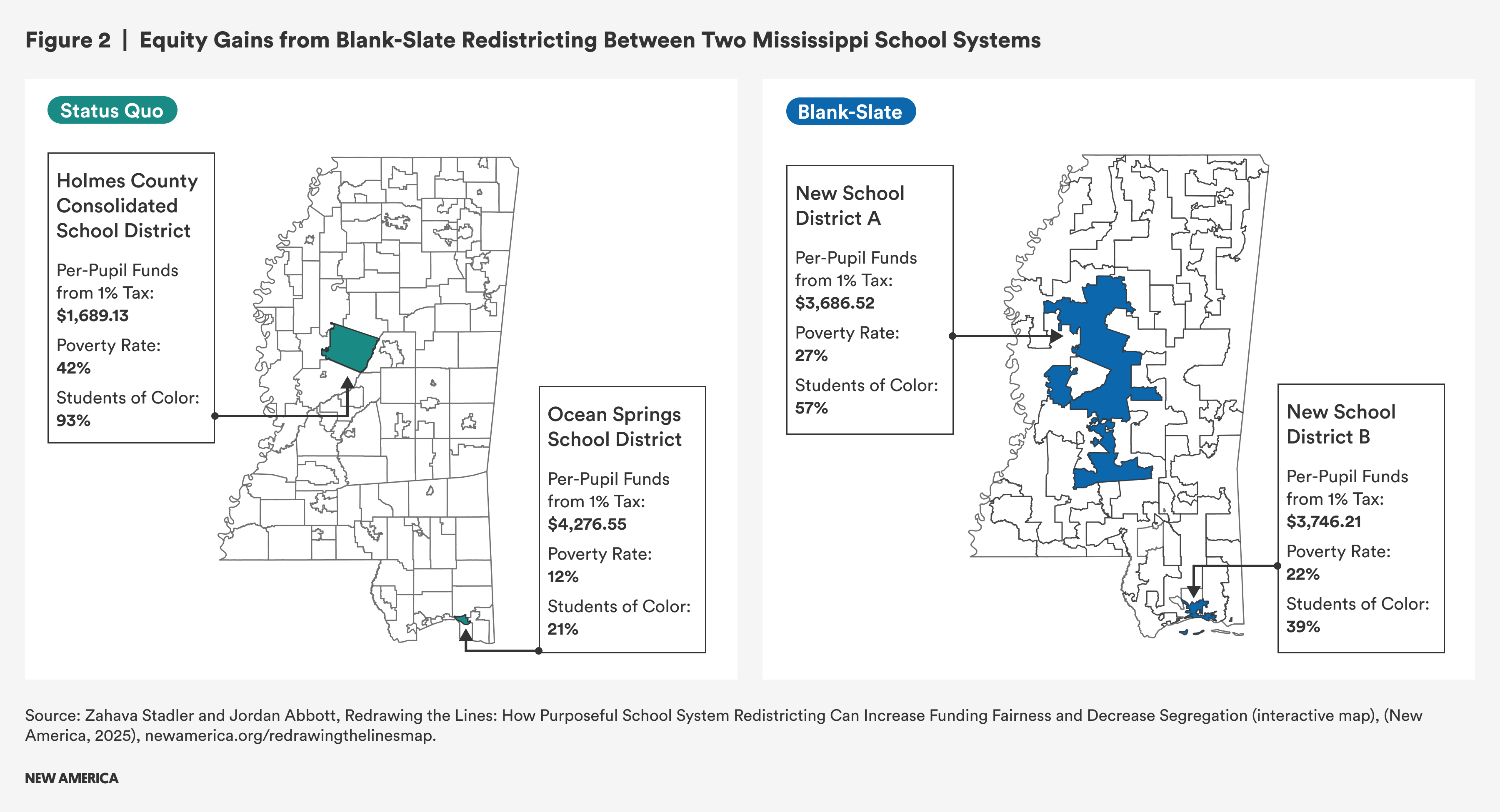
To see the new map of school systems proposed for Mississippi by our optimization algorithm and compare it to the state’s existing school district map, select Mississippi on the interactive mapping tool that accompanies this report and choose “blank slate” from the model drop-down menu.
County-Based Redistricting: Spotlight on Ohio
Ohio is currently engaged in a conversation about a different kind of redistricting—congressional redistricting—and the fear that gerrymandering could make the state’s congressional delegation less representative of Ohio voters than it is now.66 The state has an advantage, though, amid national concerns over partisan gerrymandering. In 2015, Ohioans amended the state constitution to require that new congressional districts be approved by a bipartisan supermajority of the state legislature.67 Failing that, the districts must be drawn by a bipartisan, independent redistricting commission. With this process, Ohio voters threw their support behind the idea that redistricting should be fair and not be used to advantage one party over the other.
To a limited extent, Ohio’s policy regarding school district boundary change also prioritizes fairness. The State Board of Education must approve locally initiated mergers and territory transfers,68 so boundary change is not entirely driven by hyperlocal concerns. The state board also has the power to initiate redistricting on its own rather than waiting for school districts to propose changes, though local voter approval is usually required in the end.69 When a local school board applies to the state for a change of boundaries, the state department of education must send all potentially affected school districts a list of 25 questions.70 These include a few related to property tax capacity and segregation. For instance, would a proposed territory transfer increase the concentration of students of color in the district that would be giving up land? And is the property in the area targeted for acquisition valuable enough that the request could be motivated by the prospect of increased property tax revenue? Though these questions are not asked in every instance of school district boundary change, financial and racial equity priorities are part of how Ohio approaches this policy area and could be extended to a whole-state redistricting effort.
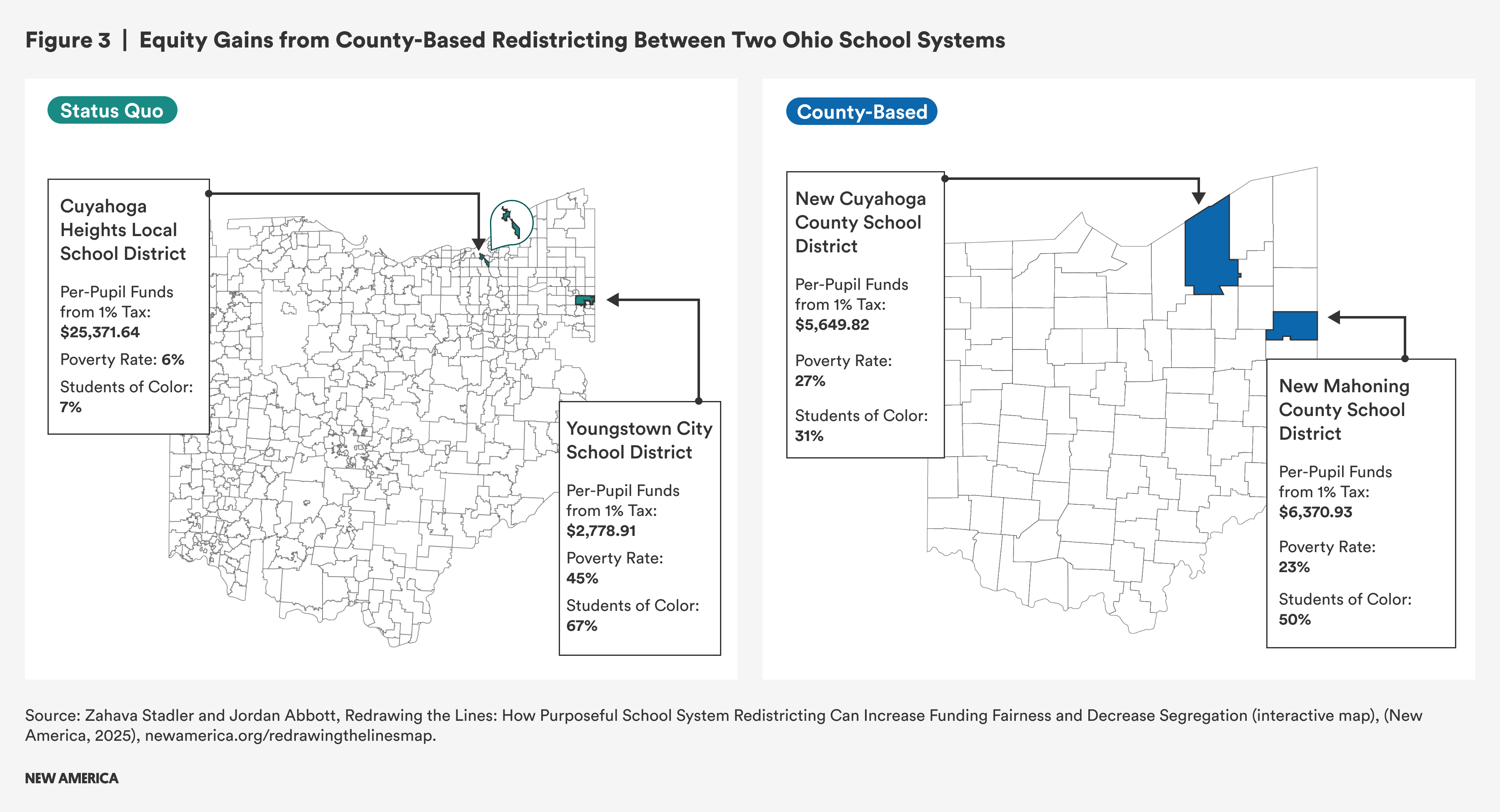
Ohio state law already addresses the one-off merger of districts within the same county,71 as well as mergers proposed by educational service centers,72 many of which cover whole counties.73 This precedent is useful because Ohio would benefit significantly from county-based redistricting, see Figure 3 below. Ohio is currently fragmented into over 600 school districts—about double the national average. County-based redistricting would reduce that number to 88. Although the county-based model is not algorithmically optimized, the wider district borders would still increase inter-district tax-base equality in the state by 56.2 percent, while cutting racial segregation by 52.8 percent and reducing poverty-rate disparities by 74.1 percent. (These improvements are all greater than the national average for county-based redistricting, though they mostly fall short of the gains that Ohio could realize by adopting one of the optimized-model maps.) When districts in Ohio are assigned to quartiles based on the percentage of students of color they include, current bottom-quartile Ohio school systems have just 1.1 percent students of color, on average, while top-quartile school systems have 34.6 percent. County-based redistricting would cut this racial gap by a third.
While there is no specific process prescribed in Ohio law for whole-state redistricting or universal county-based districts, the state board has a history of involvement in district boundary change and of considering the financial and diversity implications of new district lines. These would be advantages for a state taking on wholesale, equity-driven redistricting. Still, the fact that current law generally requires voters in affected districts to approve each boundary change would pose a real difficulty for statewide redistricting. Unless that policy were changed, the voters in a single school system would hold effective veto power over any new district map. Ohio would likely need to address that barrier before attempting to institute county-level school districts.
To see the impact of Ohio’s simulated, county-based school system and compare it to the state’s existing school district map, select Ohio on the interactive mapping tool that accompanies this report and choose “county” from the model drop-down menu.
Redistricting by Merger: Spotlight on Pennsylvania
As recounted in the Introduction, state leaders in Pennsylvania have been discussing statewide school district consolidation for years, but hardly any mergers have actually occurred. In fact, no school districts have consolidated in the state since the lone merger of two districts in Beaver County in 2009.74 This is a loss, because our analysis shows significant gains for Pennsylvania from redistricting by strategic merger.
Our Crossing the Line report found that in 2021, Pennsylvania had 13 of the country’s 100 widest poverty-rate divides between neighboring school districts, and four of the 100 worst racial divides between neighbor-districts.75 Of the 42 states analyzed in this report, Pennsylvania had the seventh-worst level of interdistrict racial segregation.
Our simulated redistricting by merger would reduce Pennsylvania’s number of school districts to 128—almost as few as proposed by Governor Rendell in 2009, see Figure 4 below. These strategic consolidations would give Pennsylvania school systems 64.6 percent more equal access to per-pupil property wealth. It would also make school districts 44.8 percent more racially representative of the state’s population of school-aged children, and 70.2 percent more similar to the state overall when it comes to the school-aged child poverty rate.

Why, despite the potential gains and the persistent interest, has Pennsylvania not pursued school system consolidation in earnest? One possibility is that while state law does prescribe a process for school district consolidation, it only contemplates one merger at a time, and only on local initiative. The board of each involved district must separately vote for the consolidation, and then an application must be filed with the state secretary of education.76 This is not a framework for a statewide consolidation effort.
However, when districts apply to merge, state law requires the State Board of Education to review the application and approve it only if the board considers the merger “wise, in the best interest of the Commonwealth.”77 The statute is silent on what these interests might be. But it does recognize that school district mergers can carry statewide implications. By this logic, there should be a way for the state itself—the secretary of education, the state board, or the Department of Education—to instigate a consolidation, or multiple consolidations in a coordinated effort.
A 2019 article in The Pennsylvania Capital-Star noted that when two districts merge, they must clear many practical hurdles, including reconciling teacher salary scales and labor agreements, resolving curricular differences, and making best use of existing school buildings.78 The article also described the public relations challenge of winning over “district taxpayers, parents, and alumni” who may not be enthused about the merger. (These lists echo the difficulties described by Scott Menzel above, in Section V.) Pennsylvania districts currently lack support for this process. Given that there is only provision for one-off, locally instigated mergers, each pair or group of consolidating districts must handle it alone, developing bespoke solutions to problems as they come up. As State Senator Judy Schwank told The Capital-Star at the time, “This gets back to educational equity, which is why I think the commonwealth should play some role.”79 If mergers can serve the best interest of the commonwealth and all its students, then state government should be involved in smoothing the way. In a statewide consolidation effort, the state could not only choose the mergers that would do most to further school system diversity and funding fairness, but could also guide districts by offering tools and standard processes for addressing the predictable questions that arise in nearly every consolidation.
To see the consolidated school systems proposed for Pennsylvania by our optimization algorithm and compare it to the state’s existing school district map, select Pennsylvania on the interactive mapping tool that accompanies this report and choose “merger” from the model drop-down menu.

Redrawing the Lines: How Purposeful School System Redistricting Can Increase Funding Fairness and Decrease Segregation
- Executive Summary
- I. Introduction
- II. The Past, Present, and Future of School System Redistricting
- III. Overview of Data and Methods
- IV. Gains from Three Approaches to School System Redistricting
- V. Achieving District Boundary Change: Lessons from a School System Leader
- VI. State Spotlights
- VII. A Time for Better Borders
- VIII. Interactive Map and Data Explorer
Citations
- Miss. Code Ann. § 37-7-105, § 37-7-107, § 37-7-109 (FindLaw 2025).
- Miss. Code Ann. § 37-7-113 (FindLaw 2025).
- State Board of Education Meeting Agenda, October 18–19, 2012, Mississippi Department of Education, https://www.mdek12.org/sites/default/files/documents/MBE/MBE%20-%202012%20(10)/tab-07-october-2012.pdf; and Miss. Code Ann. § 37-7-104, § 37-7-104.2, § 37-7-104.3, Miss. Code Ann. § 37-7-104.4, Miss. Code Ann. § 37-7-104.6, and § 37-7-104.7 (FindLaw 2025).
- Miss. Code Ann. § 37-7-104.1, § 37-7-104.8 (FindLaw 2025).
- 55 Miss. Code Ann. § 37-7-104.5 (FindLaw 2025).
- Stadler and Abbott, Crossing the Line, 48–53, https://d1y8sb8igg2f8e.cloudfront.net/documents/Crossing_the_Line_Segregation_Inequality_Americas_School_Districts_Report_FINA_xc6iO1e.pdf.
- Morgan Trau, “Ohio Congressional Redistricting Process Begins on Heels of Texas Battle,” Ohio Capital Journal, August 12, 2025, https://ohiocapitaljournal.com/2025/08/12/ohio-congressional-redistricting-process-begins-on-heels-of-texas-battle/.
- Emily E. Wendel, “Members Brief: Redistricting in Ohio,” Ohio Legislative Service Commission, Ohio General Assembly, April 19, 2024, https://www.lsc.ohio.gov/assets/organizations/legislative-service-commission/files/redistricting-in-ohio-10019544.pdf.
- Ohio Rev. Code Ann. § 3311.06 (FindLaw 2025).
- Ohio Rev. Code Ann. § 3311.26 (FindLaw 2025); and Ohio Rev. Code Ann. § 3311.38 (FindLaw 2025).
- Ohio Admin. Code § 3301-89-02 (2025).
- Ohio Rev. Code Ann. § 3311.25 (FindLaw 2025).
- Ohio Rev. Code Ann. § 3311.22 (FindLaw 2025).
- OESC Association, “Ohio Educational Service Centers (ESCs),” accessed August 3, 2025, https://www.oesca.org/esc-network/ohio-escs.
- Editorial Board, “School District Consolidation Will Be Necessary for Pa.,” Pittsburgh Post-Gazette, August 13, 2025, https://www.post-gazette.com/opinion/editorials/2025/08/13/rural-school-district-education-pennsylvania-consolidation-merger/stories/202508120027.
- Stadler and Abbott, Crossing the Line, 48–53, https://d1y8sb8igg2f8e.cloudfront.net/documents/Crossing_the_Line_Segregation_Inequality_Americas_School_Districts_Report_FINA_xc6iO1e.pdf.
- 24 Pa. Stat. Ann. §2-224 (FindLaw 2025).
- 24 Pa. Stat. Ann. §2-224 (FindLaw 2025).
- Elisabeth Hardison, “Pennsylvania Has 500 School Districts. What’s Stopping Consolidations?” Pennsylvania Capital-Star, June 18, 2019, https://penncapital-star.com/education/pennsylvania-has-500-school-districts-whats-stopping-consolidations/.
- Hardison, “Pennsylvania Has 500 School Districts,” https://penncapital-star.com/education/pennsylvania-has-500-school-districts-whats-stopping-consolidations/.