

Rebecca Gale
Staff Writer, Better Life Lab
In the United States, child care remains a broken system for most families, while paying poverty wages to providers. While the COVID-19 pandemic put an unprecedented media spotlight on the care crisis, there still remains a vital need to show the ways our system can be improved, including highlighting local solutions that work.
Through its reporting grants to independent writers, storytellers, and content producers, New America’s Better Life Lab invests in keeping these stories alive. The articles and multimedia content emerging from this initiative help elevate the crucial role child care plays in our economy, communities, businesses, and families.
This report collects these grant-supported stories from the last year in one place to highlight the key themes, trends, and bright spots uncovered from across the child care space. Crafted by a cohort of both experienced reporters and up-and-coming storytellers and featured in 14 outlets across 16 U.S. states and Washington, DC, these narratives keep the need for care solutions at the forefront of the national conversation and apply pressure on leaders and policymakers to act.
The Better Life Lab is grateful for the financial support and partnership of the Bainum Family Foundation and its pioneering WeVision Early Education Framework, acknowledging the “core shifts” that must take place to change mindsets and fundamentally improve our child care systems.
Editorial disclosure: The views expressed in this report are solely those of the authors and do not reflect the views of New America, its staff, fellows, funders, or board of directors.
In 2021, following the failure of Build Back Better legislation to invest significant federal dollars in building public care infrastructure in the United States, the Better Life Lab embarked on an exploration of small-scale solutions and successes working to address the care crisis already underway at the state and local level. By capturing these innovations through interviews and reporting, we hoped this could inspire others in the sector and help lead to a universal child care system that is equitable, affordable, and accessible.
This sparked the idea for a solutions journalism–based reporting grant initiative, launched in 2021. Since then, the Better Life Lab has worked closely to support cohorts of diverse storytellers, helping them report with depth and nuance on child care innovations.
Building on the efforts of previous years, this report captures another round of child care reporting grants and the stories that emerged from them. It collects reporting from independent journalists, writers, and content creators from a variety of backgrounds and regions in the country focused on the child care crisis, supported by the Better Life Lab. Together with our in-house experts, 11 independent reporters and content creators produced 24 stories on early care and education that appeared in 14 different outlets covering 16 U.S. states and Washington, DC.
Through our reporting grant initiative, we showcase that child care problems exist across the country at every socioeconomic level—disproportionately impacting the most marginalized and least-resourced populations. By focusing on the ways in which child care policy can uplift and transform communities, we were able to bring attention to a topic that is often under-reported and misunderstood. This is part of the Better Life Lab’s larger narrative change work that seeks to shift mindsets about the role of care and expand the sense of what’s possible in policy, practice, and culture, so that all individuals and families can thrive.
Through years of research, reporting, and countless interviews, the Better Life Lab has found that creating a truly equitable universal child care system will require robust, sustained public investment. Child care is not solely a family responsibility. It is infrastructure that should be seen as a public good, worthy of public investment that benefits our families, economy, and children.
True to its own reputation for quality independent journalism, the Better Life Lab supports storytellers by posing a question or topic, offering help when needed, and enabling reporters to independently report and shape their own stories. This year, these multimedia stories—print, video, and graphic explainers—explore this central question: What innovations or solutions are underway that could scale or help build an equitable, high-quality, affordable universal child care system in the United States? Specifically, what solutions are pushing to expand access to all families who need it, and provide care providers and teachers with living wages, stable schedules, and dignified work conditions?
The child care reporting by 11 independent journalists and the Better Life Lab team across 14 outlets in 16 different U.S. states (and Washington, DC) serves as a shocking wake-up call for how our current system fails to support families and children—specifically mothers—and exacerbates racial, income, and gender inequality. But perhaps more importantly, these stories offer hope for a way forward and show the transformative power that communities can play in deciding to make child care a priority, and the tremendous gains available when we invest in the people and places that support our families and care for our youngest generation.
The craft of journalism and storytelling often benefits from a collaborative process, and we employed this approach across this series of reporting grants. We provided close editorial support and encouragement for reporters who brought various levels of expertise in policy reporting. The Better Life Lab’s narrative change strategy calls for creating and maintaining a firehose of credible insights on work, family, and care backed by rigorous research and data. By “flooding the zone” with compelling stories rooted in economic and political realities and historical context, we aim to provide rich analysis and smart solutions to push against status quo thinking about the role of care in our society. Offering care reporting grants to a cohort of independent journalists and writers allows us to broaden the spectrum, diversity, and reach of that flood.
The following are a few key insights from our child care innovation reporting grants process:
Throughout the reporting grant process, the Better Life Lab team supported grantees in editorial collaboration, providing expertise, resources, and contacts where needed, sharpening reporting questions, and helping to shape pitches. We also brought the cohort of reporting grantees together for virtual convenings to create peer networks and support. By investing in new voices from across the country, the reporting grants are equipping a new generation of storytellers who understand care issues deeply and will be able to write with nuance and complexity about care and care infrastructure.
Key takeaways from our stories for this 2024 to 2025 cohort include:
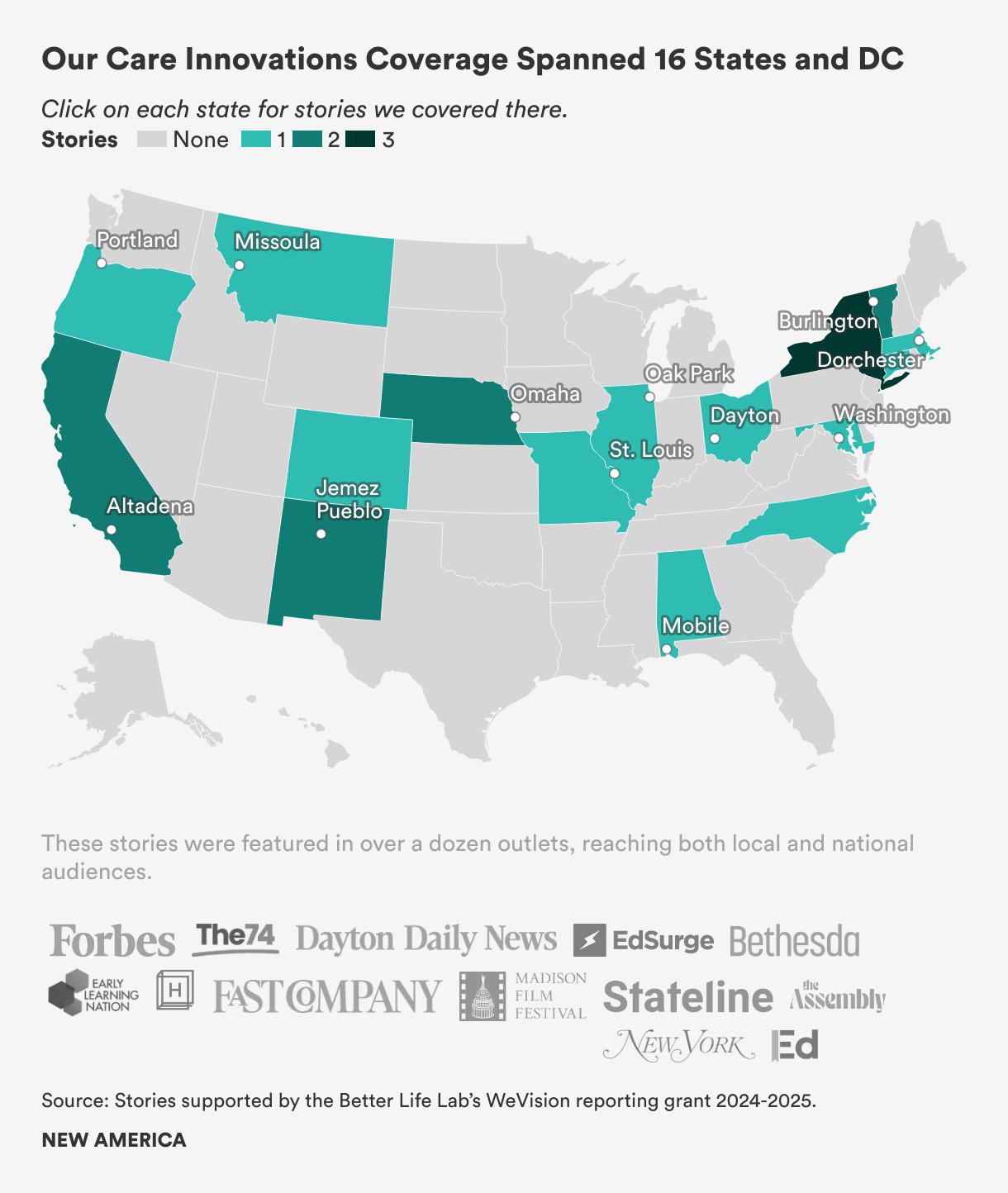
Below is a list of 24 stories supported by Better Life Lab’s reporting grants. To read the full article, click on the link before each story summary.
Home-based daycare owners say they face outdated and discriminatory regulations that shut down their businesses and leave working parents in the lurch.
By Kendra Hurley, Fast Company
October 24, 2024
Kendra Hurley shows how regulations that have nothing to do with child health and safety, along with property owner discrimination, prevent home-based child care programs from opening and growing or make them vulnerable to being shut down.
But change is afoot, and Hurley documents the states, cities, and advocates innovating a better way by working to pass antidiscrimination laws and revamp the regulations governing home programs. Advocates see it as part of a long-overdue reckoning with the outsized role home-based child care has played in the United States, including filling the gap when the U.S. first retreated from public child care investment following Nixon’s 1971 veto of a national child care plan. Then, welfare reform in the 1990s pushed mothers into low-wage jobs while decimating informal child care networks throughout the country.
Hurley’s story ran in Fast Company and was featured in Bloomberg CityLab’s daily “What We’re Reading” round-up.
Ten years in, Bill de Blasio and his allies explain how they made universal pre-K possible—and what future mayors could learn from them.
By Bryce Covert, New York Magazine
December 26, 2024
Ten years ago, New York City did something remarkable: it added a whole new grade to its education system, offering universal, free, quality education and care to all of the city’s four-year-olds. How did it pull something like that off in less than two years at a time when the issue had little national profile?
Bryce Covert spoke to over a dozen people who worked on the program inside the Bill de Blasio administration and described the ingredients to the policy’s success: speed, focus, resources, accepting the good instead of insisting on the perfect, and a refusal to consider anything but a universal program. What she found is that the lessons learned from the city’s experience can apply broadly—that the government can offer constituents new goods for all if it sets its mind to it.
A climate-linked disaster like the LA wildfires can shock a child care system in many ways.
By Christine Ro, Forbes
March 22, 2025
This story follows parents and child care providers as they recover from the devastating Eaton Fire that tore through Altadena, California, in January 2025. One key theme emerges: Climate resilience is intertwined with financial resilience. As one care provider’s experiences show, those without emergency savings will likely struggle not only to adequately prepare for a disaster but also to quickly rebuild after it.
Disasters only exacerbate the existing problems of child care being insufficient and unaffordable. Charities and community groups have offered some support to families in need following disasters, but the scale of their efforts is limited compared to what is needed at different levels of government.
Reporter Christine Ro, despite being from Southern California herself, had never seen the effects of wildfire as dramatic as what she witnessed in Altadena, and she described this as an emotional article to report. She was also conscious of the trauma of the Altadena residents who shared their stories and broke down in tears during interviews, all while maintaining a spirit of generosity and concern for their larger community.
The scarcity of affordable child care keeps parents—primarily women—out of the workforce.
By Maggie Clark, Stateline
January 3, 2025
This story spotlights a crucial but often overlooked barrier to America’s child care crisis: the logistical and structural challenges of physical space. Even when demand is high, care providers struggle to expand their child care facilities because of construction costs, zoning rules, and permitting hurdles.
To address this, both Republican and Democratic leaders are turning to economic development strategies to help centers grow—a rare example of bipartisan collaboration. And early results indicate that these approaches are working. Child care centers are expanding, access to care is increasing, and local economies are seeing real gains. By breaking down infrastructure barriers and boosting capacity, these policies are also helping to lower costs for families and enabling more parents, especially women, to participate in the workforce.
Too many child care providers cannot afford health care.
By Tonia McMillian, EdSource
February 11, 2025
Child care is widely recognized as a critical need for parents and children. But the well-being of the workforce behind it has been overlooked for too long. Early educators and caregivers— predominantly of Black and brown women—are the backbone of the system, and yet, in most cases, sacrifice their own health to meet families’ needs. Care providers must have affordable health care and the time needed to care for themselves and their families. The child care industry cannot maintain a healthy, robust status if those who do the work aren’t mentally fit and in good health.
In this story, Tonia McMillian, a child care provider herself, sounds the alarm. Drawing from her own experience and conversations with other providers, McMillan takes a deeper look at the pressure that providers face and the toll it takes on their individual health and livelihoods. Her commentary is a call to action: If we want quality child care, we must protect the people who provide it.
A graphic primer on the child tax credit—and why Congress is talking about it.
By Rebecca Gale and Dianne Kirsch, Early Learning Nation
April 10, 2025
As part of Better Life Lab’s mission to create more ways to reach wider audiences, writer Rebecca Gale and artist Dianne Kirsch teamed up to create a graphic story that provides a clear and accessible guide explaining the Child Tax Credit.
With parts of the expanded credit set to expire, millions of families could see reduced benefits unless Congress acts. As Congress debates next steps, this story underscores how the policy, often seen as technical or abstract, directly affects families’ daily lives—especially those with lower incomes who stand to lose the most should these changes go into effect. It also answers the question of the checks that were mailed out to families in 2021, and the low likelihood that those checks would be coming back. This piece was especially popular on social media, where readers could scroll through the entire story.
Providers operating on “razor-thin margins” worry about the possibility of deep cuts from the Trump administration.
By Anya Kamenetz, Hechinger Report
April 2, 2025
As Project 2025 threatens to dismantle Head Start, many federal employees of the program have been pink-slipped in the past few months. Meanwhile, supporters of the program say that they have been successful in the past in protecting bipartisan support in Washington. And states such as New Mexico, Kentucky, and Vermont are stepping up their support of broad access to child care.
Journalist Anya Kamenetz visited an Early Head Start in-home child care in New Haven, Connecticut, the city where the program originated. There she found a program that’s delivering on its promise to offer two generations of wraparound support—helping connect parents to housing, education, and job opportunities as children receive the early nurturing care that is crucial to their development. Her story highlights what’s at stake if federal support ends, underscoring the importance of keeping attention on this issue.
North Carolina parents can’t find affordable child care. Without state help, business groups are concerned about “catastrophic impact.”
By Lisa Rab, The Assembly
October 18, 2024
North Carolina businesses were facing a child care crisis. In 2024, the U.S. Chamber of Commerce Foundation published a study estimating that the state loses $5.65 billion a year due to its child care shortage, and an NC Chamber Foundation survey found that more than a quarter of parents with young children had left the workforce because they couldn’t find affordable care.
Journalist Lisa Rab interviewed business leaders, child care providers, advocates, and parents to illustrate the economic impact of this problem. Advocates proposed several solutions—including supplementing teachers’ wages and raising the tuition subsidy rate for parents—but they need more funding from the state. This article highlights the importance of federal and state investments in child care, because locals can’t alleviate the shortage on their own.
Vermont passed a 0.44 percent payroll tax. A year later, the state has 90 new child care programs and 1,000 new child care spots.
By Rebecca Gale, Fast Company
April 3, 2025
This article follows a group of Vermont employers who—facing a tight labor market and limited child care options—take matters into their own hands, launching an innovative public-private partnership to build new child care centers across the state.
Spearheaded by a coalition of business owners, local government, and nonprofits, the initiative helps fund construction of new child care facilities while also subsidizing tuition and improving worker pay. The approach has already led to more than 500 new child care slots and has become a model for how local collaboration can address a nationwide crisis.
Rebecca Gale traveled to Vermont and profiled several of the business leaders involved, as well as the families and providers benefiting from the expansion. The Vermont model shows how coordinated local action can create meaningful change, even as federal solutions to the child care shortage remain uncertain.
The Walatowa Head Start program protects and preserves tribal language and culture on the Pueblo of Jemez in New Mexico.
By Rebecca Gale, The74
June 23, 2025
For many tribal communities, federally funded Head Start programs serve as much more than early education—they’re vital for preserving language, culture, and community cohesion. On the Pueblo of Jemez in New Mexico, Walatowa Head Start immerses children ages three to five in Hemish (Towa), the tribe’s sacred oral language, through daily rituals like clan-name prayers and cornmeal traditions, alongside cultural songs, dances, and meals. From their earliest years, young children gain a meaningful connection to their heritage through these practices.
Walatowa is one of three tribal Head Start centers in the state with formal language immersion programs. Half of the state’s 34 Head Start and Early Head Start programs operate on tribal lands. While federal funding covers approximately 80 percent of their budgets, tribal communities still must contribute the remaining 20 percent, amid rising costs tied to rural roads, transportation, and post-COVID enrollment drops, which reduced Walatowa’s student numbers from 70 to 57.
Journalist Rebecca Gale’s reporting highlights that tribal Head Start programs do more than teach: They build resilience against historical trauma and loss. In communities where Indigenous languages and customs were once suppressed or endangered, these programs represent enduring practices of cultural preservation and revival.
A documentary short inspired by Jessica Calarco’s 2024 book Holding It Together: How Women Became America’s Safety Net.
Directed by Si Si Boudoin and created by Cameron Kit
Premiered at the Madison Film Festival, August 2025
This documentary film follows Andrea, a mother who started her own business after being denied paid maternity leave and facing the high cost of child care. Her story exemplifies the central thesis behind Jessica Calarco’s book Holding It Together: America effectively runs on women's unpaid and undervalued labor.
Through intimate footage—from car seats to kitchens to weighing the prices of diapers and eggs—we see the personal toll of policy choices that have eroded social infrastructure. While Andrea appears to be “holding it all together”—managing her business while caring for her daughter Eva Luna—that work also wears on Andrea, affecting her financial security and her emotional wellbeing. Her experience reflects the broader crisis Calarco uncovered through research with 4,000 families. When social safety nets fail, women become the fallback solution—creating the illusion that institutional support isn't necessary. Widowed mothers juggle multiple jobs; teenage girls are thrust into caregiving roles for nieces and nephews; and professional women become the “default” caregivers, even when they’re the primary breadwinners for their families.
This film is not just a portrait of individual resilience—it’s a call to recognize how women’s labor maintains the illusion that America can function without robust social support systems.
Early childhood educators are excluded from a federal tax deduction for classroom expenses—a brief argues this should change.
By Rebecca Gale, The74
May 5, 2025
The IRS currently excludes early childhood educators from a federal tax deduction available to K–12 teachers who purchase school supplies with their own money. A new proposal from the Buffett Family Foundation would extend this deduction to early educators, potentially saving them as much as $300 per year. This financial relief would benefit a workforce facing significant economic challenges. Early educators earn a median of just $13.07 per hour, with 13 percent living below the poverty line and 43 percent relying on public assistance programs. A new policy brief from the Buffett Early Childhood Institute recommends extending the deduction to these educators to ease financial burdens and signal respect for their work. Critics caution, however, that the savings might be modest than the maximum suggests—potentially around only $66 per year—raising questions about the impact of this relief on employee retention.
In this article, journalist Rebecca Gale examines how this tax relief extends beyond financial impact to issues of fairness, respect, and recognition for early educators and their role in delivering high-quality education.
Advancements include increased wages for early educators and higher reimbursement rates for providers accepting child care subsidies.
By Rebecca Gale, The74
June 17, 2025
Affordable, accessible child care doesn’t just support working families—it also lays the foundation for stronger civic participation. In New Mexico, recent public investments in early care and education are beginning to show results, especially for low-income parents who have long struggled to balance caregiving with economic survival. By increasing wages for early educators and raising reimbursement rates for providers who accept subsidies, the state is beginning to repair a fragmented system that often pushed families—especially mothers—out of the workforce and away from civic life.
New Mexico’s approach offers a blueprint for how care infrastructure can strengthen both family well-being and democratic engagement. These reforms come in response to years of advocacy and were made possible by stable public funding, including voter-approved constitutional amendments.
Journalist Rebecca Gale reports on the early impact of these changes, showing how better pay, more stable providers, and expanded access to care benefit young children and unlock time and mental space for parents to reengage in their communities. As the nation debates the future of child care, New Mexico demonstrates how sustained investment in care is also an investment in democracy.
In St. Louis, trained parent educators help parents and caregivers navigate developmental milestones and support kids from birth until kindergarten.
By Rebecca Gale, Early Learning Nation
March 31, 2025
A decade into its work, the Show Me Strong Families program in St. Louis, Missouri—an affiliate of the national Parents as Teachers model—is helping families thrive through biweekly home visits that begin during pregnancy and continue through a child’s early years.
The program pairs families with trained parent educators who deliver developmental activities, screen for health issues, and connect families to critical services. For parents like Jettaqua Johnson, the support proved transformative—offering guidance through early childhood milestones, access to an autism diagnosis, and even a doula for later pregnancies. The model has been linked to strong outcomes: developmental concerns are often resolved early, and families report better school readiness, parenting practices, and emotional resilience.
Rebecca Gale’s reporting underscores the power of trusted, long-term relationships in early childhood care—and the high return on investment that home visiting programs provide, even as federal funding faces uncertainty.
What if, instead of isolating work and care away from one another, the real solution is to let them thrive side by side—in the same setting?
By Georgia Norton, New America’s The Thread
September 16, 2025
A recent survey found that nearly half of Gen Z workers would welcome being “severed,” a nod to Apple TV’s sci-fi drama Severance, where employees split their work and personal lives through brain implants.
Georgia Norton examines a more hopeful alternative: community-centered spaces that combine both work and child care. Drawing on interviews with “co-location” founders and policy experts, she shows how these models can support families, empower caregivers, and lift up communities.
Kindness Creators, a child care program housed in a senior facility in Illinois, builds empathy, fosters community, and combats social isolation.
By Mark Swartz, Early Learning Nation
February 13, 2025
The care economy affects older adults as well as young children, but these services are normally provided in different spaces. Intergenerational day centers bridge that divide—bringing young and old together, with joint programming for at least for part of each day.
At Kindness Creators, a child care center housed inside a senior center in Oak Park, Illinois, Mark Swartz witnessed this model in action. For this story, Swartz spoke with the center’s co-leaders, spent time with the children and residents, and interviewed Donna Butts, leader of Generations United, an advocacy organization that tracks and promotes these programs. He found the benefits were clear. For the seniors, intergenerational programs relieve isolation and bring joy. For children, they offer empathy and help them understand the differences and limitations experienced by others. The result is a win-win: a care solution that strengthens both generations.
Poverty, trauma, and instability stand in the way of civic participation.
By Rebecca Gale, Dayton Daily News
November 1, 2024
A lack of affordable, trusted child care is a hidden barrier keeping many Americans—especially low-income parents—from voting and participating in civic life. In Dayton, Ohio’s East End, Brandon Wallace and Edie Philbeck are part of a broader group of “swing-state” residents who rarely vote—not because they don’t care, but because daily survival leaves little room for civic engagement. Child care is just one piece of a larger web of structural hardship, including addiction, eviction, poverty, and trauma, that drains their time, money, and mental energy.
Journalist Rebecca Gale traveled to Dayton to understand how care work—or the lack of public support for it—directly limits civic participation. Her reporting shows that disengagement from voting is often the result of systemic barriers, not apathy. Until policymakers confront these structural realities, especially the child care crisis, many potential voters in swing states will remain unheard and unseen.
Vermont’s bold expansion of child care subsidies shows surprising effects.
By Rebecca Gale, EdSurge
October 21, 2024
Vermont’s landmark Act 76, passed in June 2023, dramatically expanded child care assistance and revamped reimbursement rates to providers to match the true cost of care.
Full-time working parents like Teigue Linch, a Burlington office manager, discovered that their monthly child care bills dropped from $3,068 to $1,000 after applying online. Providers, in turn, receive higher payments: For example, Pine Forest Children’s Center now gets $700 more per family, helping stabilize operations.
Reimbursements for home‑based providers were also leveled up, provoking a surge in availability—more than 1,000 new child care slots in just one year. This kind of rapid impact was enabled by Vermont’s small size and nimble state systems, which pivoted to implement the law within weeks.
Rebecca Gale’s reporting highlights how targeted state policy—funded by a new payroll tax—can swiftly transform child care affordability and supply, offering a compelling model for other jurisdictions.
Jessica Calarco’s new book exposes America’s reliance on unpaid caregiving.
By Rebecca Gale, Early Learning Nation
June 4, 2024
Rebecca Gale interviewed sociologist Jessica Calarco, author of Holding It Together: How Women Became America’s Social Safety Net. In the book, Calarco argues that, unlike peer nations with strong institutional support, the U.S. places the burden of care squarely on women—who effectively become the nation’s informal safety net.
Drawing on interviews, surveys, and historical analysis, Calarco shows how mothers shoulder most unpaid labor—from child care to elder care and household mental management—often sacrificing career advancement, well-being, and financial stability. Over two-thirds of U.S. unpaid caregivers are women, performing nearly $1 trillion in caregiving work each year.
In this Q&A, Calarco spoke with Rebecca Gale about the outdated “Supermom” myth, the illusion of a DIY society, the role of humor in perpetuating misogynistic stereotypes, and more.
Training allows early educators to spot and support new parents’ mental health.
By Rebecca Gale, Bethesda Magazine
May 30, 2024
As the pandemic blurred the lines between home and work, Nicole Kumi, a new mom in Silver Spring, Maryland, found solace not just at home but through trusted caregivers at her daughter’s child care center—an unexpected lifeline during a postpartum crisis.
Recognizing this potential, Wonders Early Learning in Bethesda partnered with Postpartum Support International (PSI) to train child care staff in identifying postpartum mood disorders. These educators are now equipped to notice subtle behavioral signs during drop-offs and pickups, distribute resources, and guide parents toward help.
For this article, Rebecca Gale spent time meeting with the educators and sitting in on Kumi’s training, where she discussed what postpartum support could look like in a child care setting.
Typically, just one in five mothers are screened for postpartum mood disorders—but by empowering child care providers, the initiative fills a crucial gap in postnatal care. Educators like Liza Pringle emphasize that while they don’t conduct formal screenings, their frontline relationships allow them to “play a role” and “know the next steps to give [parents] help.”
Hidden costs keep families from thriving.
By Rebecca Gale, Early Learning Nation
April 16, 2024
For families already struggling to make ends meet, expenses like gas, groceries, and extracurricular activities often become unaffordable luxuries—yet all are essential for children’s growth.
In this piece, Rebecca Gale explores how financial precarity forces parents to make difficult trade-offs that can limit their children’s opportunities and affect family well-being. Through stories from parents and insights from community leaders, Gale highlights how even modest financial relief—like scholarships for dance classes or expanded public transit—can make a big difference.
The article underscores the importance of thinking beyond basic necessities when supporting families. As policymakers focus on large-scale child care and housing solutions, Gale makes the case that everyday affordability is just as critical to helping families thrive.
Neighborhood Villages graduates its first cohort of paid apprentices—empowering them through career advancement.
By Rebecca Gale, Early Learning Nation
April 12, 2024
Cassandra Antoine, a YMCA staffer in Dorchester balancing full-time work and raising twins, joined the Neighborhood Villages apprenticeship program—a paid, hybrid training pathway—earning her Child Development Associate (CDA) certificate in just one year. The program provided Zoom classes, a $250 biweekly stipend, hourly wage increases tied to training hours, and support for classroom experience. In February 2024, Antoine was among 68 apprentices graduating—the largest Registered Apprenticeship in Massachusetts for early childhood roles. This article tells Antoine’s story and sheds light on the power of apprenticeship programs to help address a national early childhood staffing crisis by combining on-the-job training with quality classroom instruction, paid compensation, certification paths, and career ladders.
The initiative, funded by American Rescue Plan dollars, the City of Boston, the Massachusetts labor office, and philanthropic donations, has been so successful that other states and localities are looking to create similar programs. Rebecca Gale’s reporting highlights how career-connected, paid apprenticeship models can both elevate educator credentials and pay and increase retention—especially for aspiring teachers entering the field from diverse socioeconomic backgrounds.
Work and caregiving seem to exist as a yin and yang in our lives: The pull of one exerts influence on the other.
By Rebecca Gale, Early Learning Nation
March 27, 2024
Rebecca Gale interviews productivity expert Cal Newport, who advocates for a “slow productivity” approach—focusing on fewer, high-impact projects with intentional rest—to improve work quality and reduce burnout. But how does this impact our care conundrum?
Newport acknowledges that his model centers on individuals and ignores systemic obstacles such as child care scarcity, lack of paid leave, and insufficient sick days—barriers that disproportionately affect workers who are also caregivers. While “slow productivity” offers autonomy and focus, it becomes largely inaccessible without structural support systems for working families.
Through the Q&A conversation, Newport shares how caregiving inspired his productivity philosophy: As a father of three, he sought a sustainable career rhythm that accommodated meaningful family time. He explains that prioritizing results over busyness can enable caregivers to manage interruptions—like a child’s sickness—while preserving intentionality and avoiding reactive stress.
On-site child care, or business-supported child care, has a role to play in solving our national child care crisis.
By Rebecca Gale, Early Learning Nation
March 1, 2024
In a report co-published with New America’s Better Life Lab, author and policy expert Elliot Haspel questions the promise of employer-sponsored child care.
In it, he cautions that relying too heavily on businesses may undermine broader systemic solutions. Haspel argues that employer-sponsored care risks becoming a “minimum viable child care”—enough to get parents back to work, but lacking in quality, inclusivity, and continuity.
Rebecca Gale’s Q&A with Haspel for Early Learning Nation underscores his central warning: While employer-based child care can play a valuable role, it should remain part of a larger, publicly supported infrastructure—not the foundation of America’s child care policy.
Staff Writer, Better Life Lab