
Supporting Parenting Students: Recommendations for Colleges Addressing Child Care Barriers
Abstract
More than 1.5 million parenting students are enrolled at community and technical colleges in the United States, about half of whom have at least one child under age six. Limited child care options put these students at risk of stopping out before completing a credential, jeopardizing their personal investment in education and federal and state investments in postsecondary success.
New America launched a research project in partnership with 10 community colleges to better understand how schools address parenting students’ child care needs. We found that colleges that support parenting students do so through a mix of full-time on-campus child care, drop-in services, and partnerships with organizations that help families find and afford off-campus care. While colleges can’t fix the broader issues of workforce shortages, supply, quality, and affordability in the child care system, there are promising strategies they can adopt to better support the child care needs of parenting students.
Editorial note: Read a companion report that outlines federal and state strategies to support student parents and advance a more accessible child care system.
Acknowledgments
We would like to thank Iris Palmer for her leadership throughout this project and extensive editing; Sarah Sattelmeyer, Tiffany Thai, Da’Shon Carr, Tia Caldwell, and Rory O’Sullivan for their contributions to this project; and all reviewers from the community colleges mentioned in the report. We would also like to thank Sabrina Detlef for her copyediting support, and Katherine Portnoy, Amanda Dean, and Natalya Brill for their communication and production support.
Downloads
Introduction
Rebecca, a mother of four attending a rural community college told us, “I kept dropping classes because I was drowning with all of the responsibilities I had.”1 Rebecca is not alone. A 2023 New America survey found that almost 60 percent of community college enrollees with young children cited providing care for a child as a reason for stopping out.2
For the more than 1.5 million parenting students enrolled at community and technical colleges in the United States, around half of whom have at least one child under age six, limited child care options can put them at risk of dropping out without completing a credential.3 This jeopardizes students’ investment in their education and federal and state investments in postsecondary success.
Mya, another parenting student enrolled in an associate’s degree program, told us how she ran into a problem as she worked to wrap up her final classes. One required course was only offered at the main campus, rather than the campus where she typically took classes, and at a time when she didn’t have child care. She said, “Unfortunately, I didn’t have anyone available to care for my children during that time. At first, I felt overwhelmed and feared I wouldn’t be able to finish my degree.” But an on-campus student-parent coordinator helped her access drop-in child care for that class: “Thanks to the [drop-in care] program, I was able to attend class while my children were cared for nearby. This support made all the difference,” she said.
For students like Mya and Rebecca, access to child care services can mean the difference between completing a degree and stopping out after investing time and money in higher education.
New America wanted to better understand how community colleges are meeting the child care needs of their parenting students and what barriers prevent campuses from doing so. While some research has focused on the declining number of child care centers on campuses,4 we found that offering care on campus does not guarantee that child care spots are available or affordable for parenting students. For parenting students who can access it, child care on campus can meet their needs and lead to better retention and graduation outcomes.5 However, serving parenting students with child care access requires more than one strategy, and child care on campus alone doesn’t solve the problem.
We launched a research project in partnership with 10 community colleges to look into this issue. We found that on-campus child care centers serve an average of 60 children on these campuses, some of whom are children of faculty, staff, or community members.6 With 22 percent of community college undergraduates parenting, half of whom have younger children who are more likely to require full-time care, 60 spots per campus are simply insufficient to meet the needs of parenting students.
Further, a one-size-fits-all approach doesn’t meet the needs of all families. A 2022 Bipartisan Policy Center survey found that more than half of parents using informal child care, like family or neighbors watching their children, would choose informal child care even with access to convenient and free formal care options.7 Some prefer this option for reasons ranging from having their child with caretakers of a shared cultural background to feeling assured their child is with someone they trust. Informal care options are critical for parenting students who need evening or weekend care, when traditional centers are typically not open.
We found colleges meeting parenting students’ child care needs through a combination of full-time, on-campus child care, drop-in child care services, and partnerships with organizations that help families find and afford off-campus care. Some colleges also work hard to ensure their policies allow for flexibility for parenting students and empower faculty to excuse absences related to child care or other parenting emergencies, or to bring a child to class when needed.
Colleges use various strategies to help meet the child care needs of parenting students. While some options, like funding full-time, on-campus care or building out a new child care facility, can be daunting, other strategies, like increased flexibility for parenting students or developing strong relationships with community organizations, can be more feasible.
Inadequate funding streams to support child care are one of the main challenges faced by colleges that provide, or want to provide, child care services to parenting students. Three out of the five colleges we visited were using Child Care Access Means Parents in School (CCAMPIS) grants to fund child care access for parenting students.8 CCAMPIS is a competitive federal grant administered by the U.S. Department of Education, designed to help colleges fund child care subsidies for low-income students. However, the Trump administration has proposed eliminating the program in the President’s Fiscal Year 2026 Discretionary Budget Request,9 even though eliminating CCAMPIS would worsen the already dismal funding climate for campus-based child care, threatening essential access to care that keeps parenting students on the path to graduation and gainful employment.
The president’s proposed budget and call to eliminate CCAMPIS claimed that the program duplicated the Child Care and Development Block Grant (CCDBG), a federal law that authorizes funds to states for the Child Care and Development Fund (CCDF).10 CCDBG funds reach only 14 percent of eligible children ages five and under, however, so it’s difficult to imagine how CCAMPIS could duplicate a program that only has enough resources to reach 14 percent of eligible children.11
In the absence of enough CCDBG funds to meet child care needs, some states have taken significant steps to improve child care access through other means. For example, after a grassroots campaign mobilized the business community to advocate for child care investments, Vermont passed Act 76 in 2023, directing state general funds and money from a new payroll tax toward the state’s child care subsidy program.12 This enabled Vermont to both increase wages for providers and raise the income threshold at which families can qualify for subsidies.
In 2022, New Mexico began drawing on a fund that collects and invests profits from oil and gas revenue in order to provide child care to families earning up to 400 percent of the federal poverty level and to invest in early education programs in a myriad of ways.13 The state recently announced it will move to offering universal child care in November of 2025.
Solving the child care crisis for parenting students will require solving it for all families in the United States, and most states have not made the kind of commitment to funding a robust child care system that New Mexico and Vermont have. We need a universal right to early education, a system in which all families can access high-quality care.14 Within a broken child care system, colleges alone can’t solve the workforce, supply, quality, and affordability issues that plague families, providers, and communities. Still, there is reason for hope, and colleges can adopt strategies to better meet the needs of their parenting students. In this report, we outline our research findings and recommend how colleges can support parenting students with their child care needs.
Citations
- A pseudonym, at the student’s request.
- Sophie Nguyen and Olivia Cheche, “Enrollment at Community Colleges Might Improve, but Challenges Remain for Students,” EdCentral (blog), New America, February 7, 2024, https://www.newamerica.org/education-policy/edcentral/enrollment-improve-but-challenges-remain/.
- Theresa Anderson, Sheron Gittens, and Kate Westaby, “Undergraduate parenting students at Community and Technical Colleges,” infographic, SPARK Collaborative, September 30, 2024, https://studentparentaction.org/resources/infographic-undergraduate-student-parents-community-tech-colleges.
- Kevin Miller, “On‑Campus Child Care: A Valuable but Dwindling Support for parenting students,” EdCentral (blog), New America, October 17, 2023, https://tinyurl.com/nhyw3b2y.
- Barbara Gault and Lindsey Reichlin Cruse, “Access to Child Care Can Improve Student Parent Graduation Rates,” Institute for Women’s Policy Research, May 12, 2017, https://iwpr.org/access-to-child-care-can-improve-student-parent-graduation-rates/.
- Iris Palmer, “Child Care Centers on Campus Alone Don’t Solve the Problem,” EdCentral (blog), New America, January 29, 2025, https://www.newamerica.org/education-policy/edcentral/child-care-centers-on-campus-alone-dont-solve-the-problem/.
- Linda Smith and Victoria Owens, “Survey Results: What Keeps Employed Parents Out of the Child Care System?” Bipartisan Policy Center, August 8, 2022, https://bipartisanpolicy.org/blog/survey-results-what-keeps-employed-parents-out-the-child-care-system/.
- Adam K. Edgerton, Child Care Access Means Parents in Schools (CCAMPIS): In Brief (Congressional Research Service, 2024), https://www.congress.gov/crs-product/R47422.
- Office of Management and Budget, The President’s Fiscal Year 2026 Discretionary Budget Request, letter to the Hon. Susan Collins, Chair, Committee on Appropriations, U.S. Senate, May 2, 2025 (Office of Management and Budget, Executive Office of the President), PDF, https://www.whitehouse.gov/wp-content/uploads/2025/05/Fiscal-Year-2026-Discretionary-Budget-Request.pdf.
- Karen Lynch, The Child Care and Development Block Grant: In Brief (Congressional Research Service, December 3, 2024), https://www.congress.gov/crs-product/R47312.
- First Five Years Fund, “2025 State Fact Sheet: Child Care & Early Learning in the United States,” https://www.ffyf.org/wp-content/uploads/2025/09/2025-National-Fact-Sheet.pdf.
- Aaron Loewenberg, “One Year Later, Vermont’s Act 76 is Showing Promise,” EdCentral (blog), New America, November 14, 2024, https://www.newamerica.org/education-policy/edcentral/one-year-later-vermonts-act-76-is-showing-promise/.
- Rebecca Gale, “New Mexico Will Become the First State to Offer Universal Child Care,” The 74, September 15, 2025, https://www.the74million.org/zero2eight/new-mexico-will-become-the-first-state-to-offer-universal-child-care/.
- Aaron Loewenberg, “Establishing a Right to Early Education: Part One of a Four‑Part Series,” EdCentral (blog), New America, March 15, 2024, https://tinyurl.com/4684x2he.
Project Overview
In 2023, New America launched the Child Care for Student Parents at Community Colleges Project to research child care access for students with children. Issues such as high child care costs, limited supply, and inconsistent quality affect most parents in the United States, including parenting students. About 22 percent of students in college are parents, and most of them attend community colleges.15 Through interviews with parenting students at community colleges, we confirmed that access to affordable, convenient, and high-quality child care could make their academic careers more manageable and fulfilling.
We engaged with community college leadership, staff, and current students to explore the most effective ways to support parenting students in accessing child care. As part of this effort, we issued a request for proposals inviting public community colleges to join one of two cohorts.
Cohort 1: Child Care for Student Parents at Community Colleges
New America selected five community colleges to join the Child Care for Student Parents at Community Colleges cohort. We conducted site visits to gain a deeper understanding of their approaches to funding, data collection, policies, and the logistics of providing child care for parenting students. We selected five colleges:
- Forsyth Technical Community College (North Carolina)
- Linn-Benton Community College (Oregon)
- Madison Area Technical College (Wisconsin)
- Mott Community College (Michigan)
- Quinsigamond Community College (Massachusetts)
Each college we visited offered at least one child care service:
- On-campus child care center operated by the college
- Partnership or contract with community child care providers
- Partnership with Head Start
- Drop-in child care services
- Child care resources and referral offices
- Scholarships, grants, or vouchers to subsidize child care costs
Each participating college received a one-time $30,000 grant from New America to support initiatives to improve data collection on parenting students and expand access to child care. Colleges collaborated closely with New America to advance research and practice supporting parenting students. As part of their participation in the project, the colleges developed plans to enhance data infrastructure for identifying parenting students. While participating in this project, they planned to implement at least one practice or policy change to address their child care needs better.
Cohort 2: Community of Research and Practice on Barriers to Supporting Student Parents
New America invited community colleges interested in expanding and strengthening their support for parenting students, specifically in child care, to join the Community of Research and Practice on Barriers to Supporting Student Parents cohort. We selected five colleges to participate, each receiving a one-time, flexible $5,000 grant from New America.
We conducted virtual interviews with key stakeholders at each institution to better understand the barriers and challenges limiting support for parenting students and ways to improve these services. We selected five colleges:
- Glen Oaks Community College (Michigan)
- Harry S Truman College (Illinois)
- McLennan Community College (Texas)
- Montgomery College (Maryland)
- Savannah Technical College (Georgia)
Members of this cohort represented community colleges at three different stages of developing child care-related support:
- Colleges that did not currently offer child care support services but were considering introducing at least one service
- Colleges that had previously offered child care-related support but had scaled back or discontinued these services
- Colleges that had plans to implement child care support services but had yet to implement these services
Citations
- Anderson, Gittens, and Westaby, Undergraduate parenting students at Community and Technical Colleges, https://studentparentaction.org/resources/infographic-undergraduate-student-parents-community-tech-colleges.
Findings
Site visits to the five community colleges in cohort 1 occurred between April and November 2024. For each visit, two New America staff members worked closely with a designated college representative to schedule interviews with:
- College leadership, including presidents, vice presidents, and provosts
- Staff supporting parenting students (student-parent advisors, on-campus child care center directors, basic needs navigators, etc.)
- Faculty representatives
- Currently enrolled parenting students
We conducted thorough, semi-structured, one-on-one and group interviews with these stakeholders. On average, these discussions lasted 60 minutes and were facilitated by two New America staff members. We also toured on-campus child care facilities and resource offices that support parenting students, interviewing relevant personnel. All interviews were recorded.
In this section, we present insights drawn from the data collected during these site visits to cohort 1 colleges. The findings highlight successes, ongoing challenges, and key lessons from colleges striving to meet the child care needs of parenting students. Findings from cohort 2 strengthened our understanding of the barriers colleges face in supporting parenting students’ child care access. These findings informed both our recommendations and policy agenda to make child care more accessible.
Supporting Parenting Students in General
While our research specifically focused on parenting students’ access to child care services offered by community colleges, we found that broader support for parenting students was a prerequisite to providing these services. Colleges that recognize and have systems in place to support parenting students are more likely to offer services that help them access child care while pursuing their education.
1. Policies Can Help Meet Parenting Students’ Needs
Institutional culture and policies have historically not supported parenting students, though some colleges are starting to make changes. According to a 2019 Generation Hope survey of parenting students, only 3 percent of respondents said their campus had a policy allowing them to bring their children to class.16 Sixty percent did not know whether such a policy existed. Often, the lack of clear guidelines around children on campus means that individual professors decide whether a student can bring their child to class when child care falls through. Students who don’t know who or how to ask may assume they can’t bring a child.
We spoke to a student parent who requested accommodations when her child was hospitalized. Because the college lacked a specific policy for supporting pregnant and parenting students, she received inconsistent responses from faculty and administrators. Ultimately, she left her sick child at the hospital to take a certification test. She said,
“I was at the hospital with my youngest, and I was like, trying to tell the administrative [staff], ‘What are my options for taking this certification? Because I know it’s supposed to be tomorrow, but I’m in the hospital with my two-year-old who’s hooked up to IVs, and they’re doing CAT scans. It’s kind of serious and kind of scary…’ The teachers were like, ‘I’m so sorry, we’ll figure it out.’ And the administrators were like, ‘Do what you can, try to get in, because this is your [only] chance.’”
At Linn-Benton Community College, some staff expressed concern that the college’s administrative rules did not address pregnant or parenting students. The absence of clear guidelines left individual professors with discretion over whether to accept absences, late assignments, missed tests, or tardiness, sometimes causing confusion about how to accommodate parenting students. During our site visit, Linn-Benton was revising the administrative rules to clarify accommodations for pregnant and parenting students. The policy has since been updated and published on the college’s website. The excerpt below details some of the accommodations that have been added to support these parents:
“In general, classrooms are not a suitable space for children during active instruction; however, the College recognizes that student-parents occasionally experience unexpected child care situations that necessitate the choice of either missing class or bringing their child with them to class. Student-parents are not allowed to bring their child on a regular basis, but on an emergency basis only. The College encourages faculty to work with student-parents in these situations and consider alternatives such as an excused absence or Zoom option.”
“Student-parents or pregnant parents sometimes need flexibility on the part of instructors when there is an emergency regarding their child. This may include providing an excused absence due to illness of the child or pregnant parent, allowing a test date to be rescheduled, or making allowances for emergency doctor visits due to illness or pregnancy. Instructors can coordinate with the Testing Services to arrange for a test to be taken. In general, finals are to be taken at the scheduled time, but faculty may make exceptions on a case-by-case basis.”17
Linn-Benton’s new policy clarifies the expectations for staff, faculty, and any parenting students who need to bring a child to school due to unforeseen circumstances. Establishing college-wide policies like these is preferable to leaving accommodations up to individual instructors or administrators, which can result in inconsistent outcomes that may not always favor parenting students.

Kendra Votava/Linn-Benton Community College, used with permission.
Similarly, Madison Area Technical College is currently developing a Children on Campus policy. Administrative leaders have collected multiple rounds of feedback from students and faculty regarding their needs and preferences. Although the Children on Campus policy is still being drafted, the overall culture at Madison College is welcoming and supportive of parenting students. Everyone interviewed by New America, from senior leadership to mid-level administrators to students, was aware that roughly 40 percent of Madison College students are parents. This widespread awareness across Madison College has become a major organizational driver of change. A clear majority of campus leaders recognize that effectively serving parenting students is essential to fulfilling the college’s mission.
2. Parenting Students Thrive with Centralized College Support
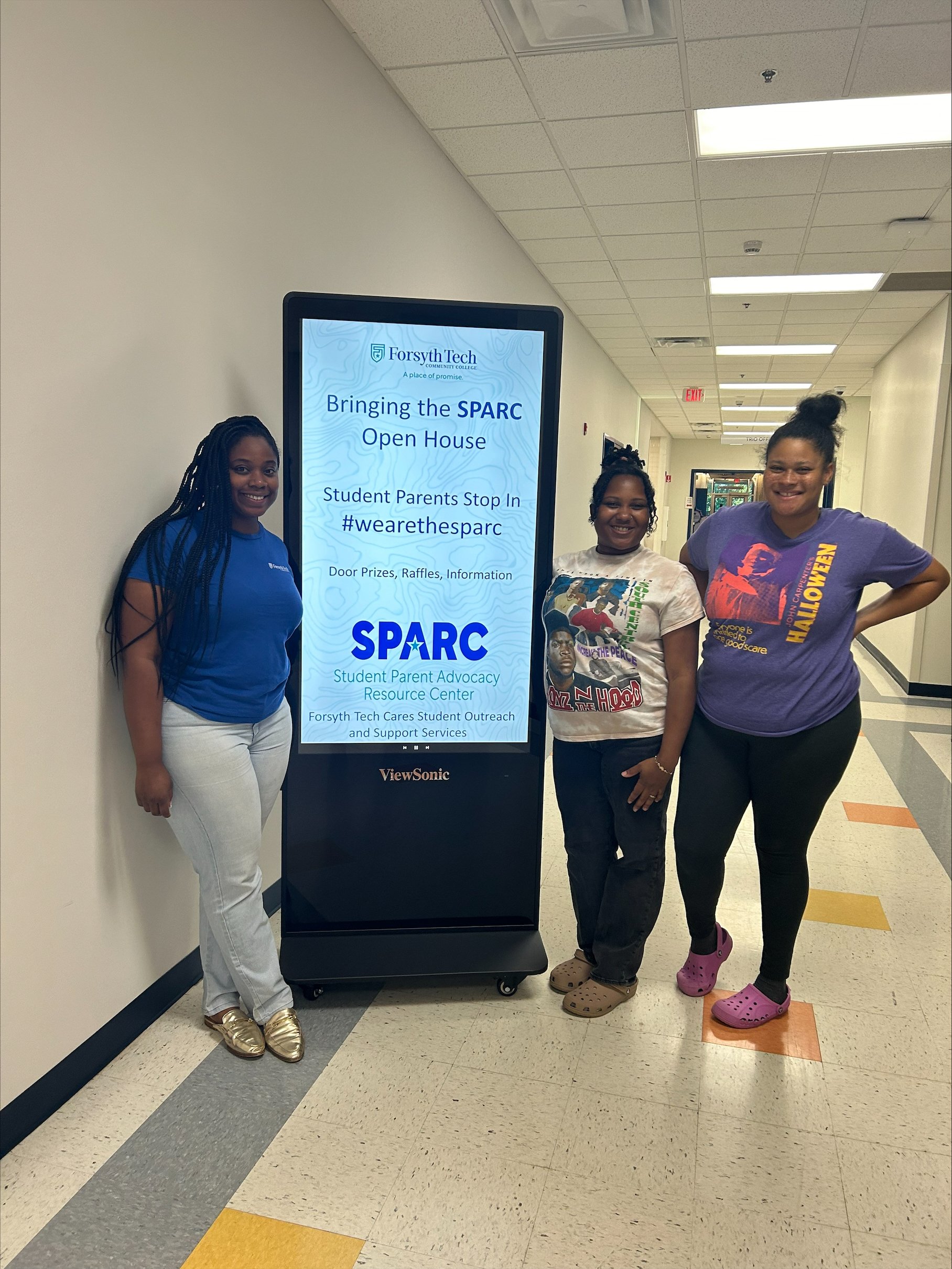
Colleges with a centralized approach to supporting parenting students fare better than those with fragmented efforts. Forsyth Technical Community College stands out as a strong example of a centralized and coordinated approach to supporting parenting students. All student-parent initiatives are housed within a single office, the Forsyth Tech Cares program. Led by Shanta Reddick, a former student parent herself, this office has significantly advanced the college’s capacity to meet students’ basic needs by partnering with various nonprofit organizations, including the Child Care Resource Center, Catholic Charities, Experiment in Self-Reliance, the Family Support Network of North Carolina, and the Salvation Army. Future plans include establishing an on-campus presence for Department of Social Services staff and connecting students to public benefits such as SNAP, Medicaid, and TANF.
Shanta Reddick/Forsyth Tech, used with permission.
Within Forsyth Tech Cares, the Student Parent Resource Advocacy Center (SPARC) is key to empowering parenting students to navigate and complete their academic programs. Though relatively new, SPARC has already established strong partnerships with both campus departments and community organizations to enhance its support offerings. Current and planned services include training faculty and staff on best practices for supporting parenting students, addressing mental health needs, engaging parenting students in program development, and piloting drop-in child care solutions. SPARC also uses a data dashboard, developed in collaboration with the college’s institutional research office, to monitor service usage.
Linn-Benton offers meaningful support to parenting students, but the absence of centralized coordination presents a significant challenge. The closure of the Pregnant and Parenting Students Program in June 2020, due to a lack of funding, left a major gap in dedicated services. Currently, there is no staff role focused on parenting students. Instead, Linn-Benton follows a “no wrong door” approach, an inclusive philosophy echoed by multiple staff members, where any student-facing employee is expected to offer support or direct students to appropriate resources. While this approach fosters a supportive culture and often results in warm hand-offs between departments, the lack of clear responsibility and accountability limits its effectiveness. For instance, although staff are motivated to collect better data on parenting students in order to advocate for additional resources, there is uncertainty about where this data is stored, who has access, and whether it is being used strategically.
Supporting Parenting Students’ Child Care Needs
Recognizing and supporting parenting students through inclusive policies and a centralized organizational structure is crucial, but providing child care support services can be transformative. Nearly 60 percent of community college stop-outs who cared for young children cited child care responsibilities as a reason for not reenrolling in community college. Additionally, 55 percent of these respondents reported that balancing coursework with child care needs prevented them from returning to college. Conversely, parents who remained enrolled were more likely to attend schools that offered financial and child care support services in various forms. Stop-outs also indicated that access to these services would encourage them to reenroll. In fact, just over half of stop-out student parents said they would likely return to college if they had access to affordable child care and drop-in care on campus.18
3. Colleges Use Varied Approaches to Support Parenting Students’ Child Care Needs
Colleges can support parenting students in accessing child care through various approaches, depending on available funding and local context. Policymakers and advocates often view on-campus child care centers as the solution for parenting students seeking adequate child care, which is why there has been significant concern over declining access to these centers.19 However, on-campus child care that is both affordable and accessible to parenting students is rare. Even at colleges with child care centers that prioritize parenting students and offer subsidies, additional support services are needed, especially when resources are limited. Since there is no one-size-fits-all solution, every support service offered to parenting students plays a critical role.
This section presents the various types of child care services the colleges offer to support parenting students.
I. Forsyth Technical Community College
Child care center: Forsyth Tech operates the Carol L. Danforth Early Childhood Lab School, a licensed child care facility. The Lab School serves up to 20 children, aged three to five years, and primarily supports parenting students who qualify for the CCAMPIS grant.20 The Lab School operates full days Monday through Thursday, with reduced hours on Fridays. The school offers flexible enrollment options, with a monthly tuition rate of $700 per month for students not covered by grants. Although its capacity is limited, the Lab School plays a crucial role in the college’s child care offerings. It also serves as a training site for early childhood education students.
Drop-in care: Forsyth Tech piloted drop-in care services in partnership with Kid Spot, a local child care provider, to accommodate parenting students who need flexible child care options. The college pays for up to four hours of drop-in care for parenting students in need. Kid Spot offers extended hours, Monday through Saturday, from 9 a.m. to 10 p.m., far beyond the availability of on-campus services. Although parenting students are limited to a maximum of four hours per day, Kid Spot’s flexibility has made it a valuable resource. Demand for this service is growing. In addition, Forsyth Tech offers limited on-campus drop-in care during specific events when the Lab School has capacity.
Resource and referral office: For parenting students needing off-campus, long-term, or complex child care solutions, Forsyth Tech partners with the Child Care Resource Center (CCRC).21 Through this partnership, students are referred to a regional coordinator, whose team helps them navigate state programs, including child care subsidies. The college’s strong relationship with the CCRC ensures that parenting students have access to a broader range of care options beyond what is available on campus. College staff provide contact information for parenting students and CCRC staff follow up directly to ensure that parenting students don’t fall through the cracks.
Reimbursement for family and friends: Forsyth Tech Cares, through the Forsyth Tech Foundation, has limited funds to help students pay for child care from a babysitter, family member, friend, or neighbor. Unlike the CCAMPIS and the state’s child care grants, which restrict support to state-licensed facilities, this funding source allows more flexibility in providing child care support, especially for students who need care when licensed facilities are closed.
II. Linn-Benton Community College
Child care center: The Periwinkle Child Development Center, Linn-Benton’s on-campus child care facility, was established in 1977 as a parent cooperative requiring volunteer hours for enrolled families. Due to funding constraints, the program was discontinued in 1990. The space was subsequently rented to a Head Start program, which operated for about 12 years. In 2022, the college reclaimed the space. The college allocated $1.2 million for its renovation, financed through a bond, and opened in early 2024. The center, designed for parenting students and staff, who often didn’t qualify for Head Start, will be funded by the college for its first five years. The college has hired a director for its center with a background in securing grants. Ultimately, the college hopes to diversify funding sources to sustain the center.
The center functions as an early childhood education lab school and gives priority enrollment to Linn-Benton’s parenting students. Currently, 30 out of the 40 enrolled children, aged two to five years, are children of students. There is a waiting list, and the center intends to continue prioritizing parenting students for enrollment.
The center offers full-time, half-time, or part-time care for parenting students from September through June and is closed in July and August. Tuition options include full-time or half-time care, but some half-time students use fewer than their allotted 22.5 hours and functionally use the center for drop-in care. Tuition is discounted for students who pay per term instead of monthly. Tuition rates for parenting students are presented in Table 1.
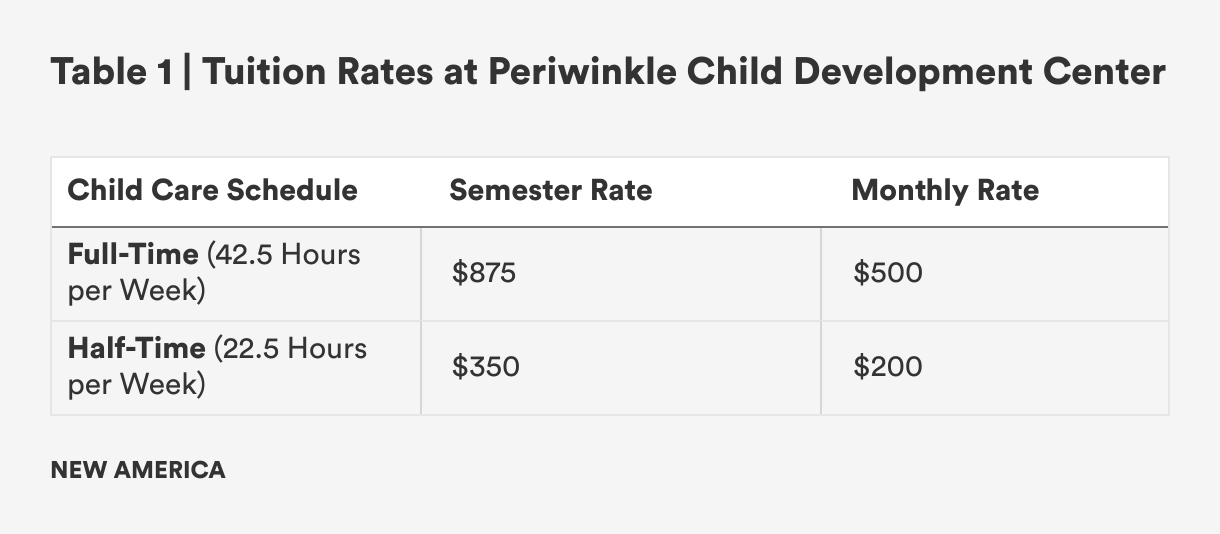
According to the director of the center, the rate for full-time care at other centers in the area ranges from $900 to $1,200 per child per month, making the tuition rate for parenting students at Periwinkle Center significantly discounted. The director explained that rates were set based on what the center believed parenting students could afford, rather than being determined by the center’s operating costs. To further subsidize tuition, eligible parenting students can access the following funding options:
- A $100/month child care scholarship for the 2024–25 academic year, funded by a grant from New America
- Employment Related Day Care subsidies—Oregon’s child care subsidy program, funded by the Child Care and Development Fund22
- Preschool Promise, a state program offering free preschool for children who meet income qualifications
Resource and referral office: Family Connections, the college’s child care resource and referral program for over 20 years, serves college students and staff. Although the state centralized the “referral” portion of child care resources and referral services several years ago, the college successfully advocated to continue serving its community with personalized referral services. While families in most of the state access child care referrals through a central phone line or web-based portal with information on licensed and exempt centers and home care options, the college’s referral office meets with families to guide them through the process of securing child care. This means that Family Connections can help not only with finding available child care spots but also support families in navigating barriers like transportation and problem-solving when no local spots are available.
III. Quinsigamond Community College
Child care center: Quinsigamond’s on-campus Early Education Center Lab School provides accredited, play-based care for 40 children, aged two years and nine months to five-and-a-half years old. While the center offers rates slightly below the market average ($275 per week), its primary purpose is to serve as a training lab for early childhood education students. Providing affordable care for Quinsigamond’s parenting students is not the center’s main focus, and as of our site visits in April 2024, only six parenting students were using the facility.
Drop-in care: Since the college began focusing on supporting parenting students with access to child care, the parenting student navigator is planning to launch Child Watch, a drop-in child care. Child Watch will be a supervised location on campus where registered and eligible Quinsigamond students will be able to safely leave their child(ren) for up to three hours while they attend class, study, meet with an advisor, receive tutoring, or otherwise advance their academic career. To be eligible for Child Watch, students will need to be enrolled full time. Part-time parenting students will need to register in advance for this service through the parenting student navigator. Once registered, they will sign up for a session in order to ensure that the appropriate number of staff will be present. The parenting student will be required to remain on campus and be accessible via cell phone at all times while their child is in the Child Watch area, so they can return to their child if necessary.
At any given time, approximately 10 children will be cared for at the center. Two spots will be available each day for last-minute, emergency care in case a student’s child care falls through. The center will not be licensed or accredited. Under the Massachusetts Department of Early Education and Care’s Criteria for Exemption from Licensing, this program does not require a license under the Occasional Care clause. Occasional care is defined as care where “no child attends for more than four hours per day and no child attends on more than six days per month.” This clause also requires that programs providing occasional care have a system in place for tracking attendance. Programs must submit an exemption application to the Department of Early Education and Care for review and approval.
IV. Madison Area Technical College
Child care centers: Madison College has offered child care to students at two of its campuses since the 1980s. By 2018, the Truax campus served around 30 children, while the downtown campus location served approximately 20 children. In 2019, the college closed its downtown campus. The college opened the new Goodman South Campus in South Madison, and the building did not have sufficient space to include a child care center.
With a 2022 Wisconsin Workforce Innovation Grant as the catalyst, the college began to create a new child care facility to serve Goodman South Campus parenting students. In the fall of 2023, the college purchased an old fire station from the City of Madison for $1 to build a new child care center next to the Goodman South Campus. By the time of our site visit in September 2024, the college had raised several million dollars for the renovation and was just $400,000 away from breaking ground. In December 2024, the college announced that this $10 million facility would open in January 2026.23 It will be licensed to serve 75 to 86 children and will increase access to high-quality, affordable child care for parenting students and other families in a high-poverty area. The new center will offer extended hours and drop-in care, including evenings and Saturdays, providing significant support to parenting students.
In response to the closure of the downtown campus’s child care center, the college planned, in 2019, to expand child care access at the main Truax campus. The college was able to convert an old trucking warehouse on the Truax campus into a child care center. This renovation allowed the center to increase its capacity from 30 to 50 children in 2021. In 2024, the center was expanded again, bringing the total capacity to 84 children, ranging from six weeks to five years old.
Despite these expansions, the Truax campus child care center currently has a waiting list, with approximately 85 families on it. When filling spots from the wait-list, the center prioritizes children of CCAMPIS-eligible students, followed by non-CCAMPIS parenting students, faculty, and finally community members. Families pay tuition based on a sliding fee scale and can receive financial support through various programs, including CCAMPIS scholarships, city and state child care subsidies, or privately funded scholarships.
Drop-in care: Madison College has partnered with the Dane County YMCA to offer parenting students access to drop-in child care and family wellness activities. Students can use YMCA services while studying, working out, or participating in other activities within the facility. This benefit includes access to open swims, fitness facilities, and various family programs. To register for the program, students must get a certificate at one of three nearby YMCA branches. By the time of our site visit, students had used 18 of the 25 available passes for the year. The college is considering long-term program funding after evaluating its uptake and the benefits it provides to students.
The college plans to introduce a drop-in care program at its upcoming Goodman South Campus child care center. A pilot program during finals showed promise, but it quickly became clear that relying on staff volunteers to manage the service would be unsustainable. Campus leaders are also in discussions with other colleges that have implemented drop-in child care to learn how to effectively address licensure and scheduling challenges.
Family study spaces: In response to input during student-parent focus groups, Madison College has created four student-parent study spaces, with more planned. These rooms include an adult desk, chair, and computer, as well as child-sized furniture, toys, and materials. Parenting students have reported finding these spaces very helpful for engaging their children while studying, taking an exam, and meeting with faculty/staff.
Resource and referral services: Madison College has partnered with Satellite Family Child Care System,24 a referral service that connects parenting students with accredited in-home child care providers. Home-based care helps fill a gap in center-based child care, particularly for parenting students who have specific scheduling and transportation needs. As part of the contract with Satellite, the college aims to increase the availability of accredited home-care providers near its rural locations, where center-based care cannot be offered on campus. However, there are still relatively few accredited in-home providers in those areas.
V. Mott Community College
Child care center: Mott Community College’s Early Childhood Learning Center serves approximately 125 children. The center’s five classrooms are divided by funding source. Classrooms for children aged four to five are funded by Michigan’s state-funded preschool program, the Great Start Readiness Program. Children aged zero to three are funded by Early Head Start, though few of the parents in these classrooms are students at Mott. The center also has tuition-based classrooms for children aged zero to five that cost $254 per week. Most of the parents of children in these classrooms are students at Mott who receive subsidized tuition through CCAMPIS. In the 2024–25 academic year, 23 students had spots funded by CCAMPIS, and six also received child care vouchers. To be eligible for CCAMPIS funding, students must meet GPA and enrollment requirements and be eligible for a Pell Grant.
The Early Learning Center uses a sliding scale fee structure to determine family co-pays after applying CCAMPIS funding. This approach ensures that families with the most significant needs receive the highest level of support. Depending on available CCAMPIS grant funds, more families may qualify for coverage at levels such as 85 percent. When the center’s funding is limited, a parent’s copay increases. The center is NAEYC-accredited and holds a 5-star rating, maintaining a low staff-to-child ratio.25 It also serves as the laboratory school for Mott’s early childhood education program.
4. Colleges Cite Funding as a Key Challenge
Inadequate funding for child care is the main challenge faced by the majority of colleges we visited. Providing child care services for parenting students involves significant costs. Colleges need funding both to operate these services and to subsidize or cover the cost for students who use them. Some options, like on-campus child care centers, are more expensive than others. To keep these services running, colleges must piece together funding from multiple sources. Unfortunately, none of these funding streams are sustainable or reliable in the long term, so most programs depend on annual fundraising efforts.
Of the five colleges we visited, three were using CCAMPIS grants to fund child care access for parenting students. CCAMPIS serves as a critical lifeline, enabling higher education institutions to provide affordable, high-quality child care to parenting students. However, this funding is not nearly sufficient to meet demand. In 2016–17, over 4,000 children nationwide were on CCAMPIS waiting lists, highlighting the significant gap between need and availability.26 Limited publicly available data from the Department of Education on the program makes it difficult to know how many parenting students are currently served by CCAMPIS grants. In 2018, when the program was funded at $50 million annually (up from $15 million in prior years), the Institute for Women’s Policy Research estimated the program served around 11,000 parenting students, or less than 1 percent of parenting students who could benefit from it.27 In fiscal year 2024, CCAMPIS was funded at $75 million.
Furthermore, the application process is complex, the annual reporting requirement is burdensome, and there are restrictions on how colleges can use the funds. This limits the child care access options available to parenting students and makes it difficult for less-resourced colleges to apply for and administer the program. CCAMPIS is one of the programs that the current administration has proposed to eliminate according to President Trump’s fiscal year 2026 discretionary budget request.28
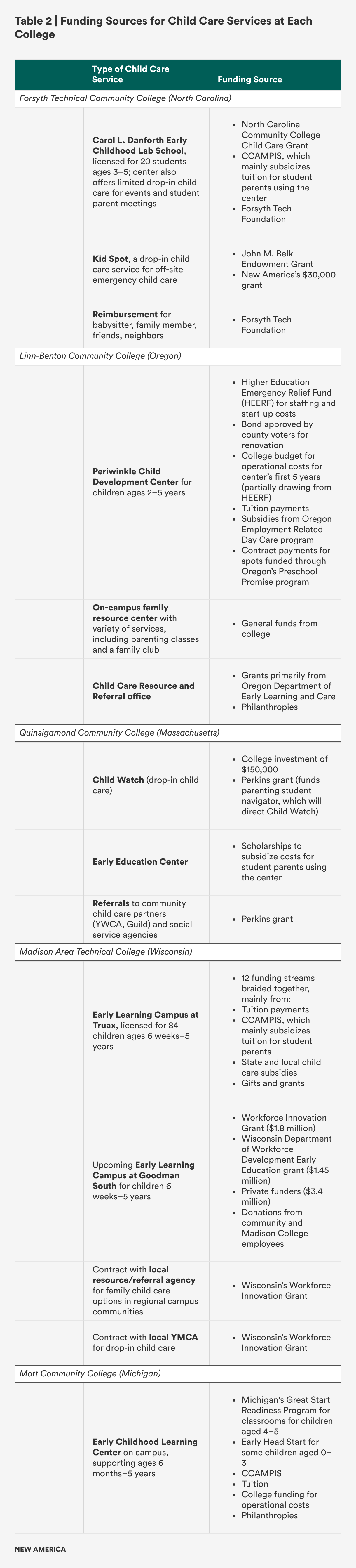
Table 2 illustrates the funding sources for each community college’s various child care services. At some colleges, these services are exclusively available to parenting students. At others, faculty, staff, and other members of the community can also access them.
Some colleges have scaled back on child care services available for parenting students because of inadequate funding. For example, Montgomery College (one of the colleges in cohort 2) has reduced its child care services, closing two of its three campus centers because of budget cuts following declining enrollment tied to demographic shifts. The centers, which mainly served community members rather than parenting students, were losing money. The Germantown Center remains open because it functions as a lab school that supports the college’s educational mission. Currently, it serves about 30 to 40 children. The college previously received a CCAMPIS grant to support child care, which ended in 2014. It is unclear whether the loss of that funding directly influenced the closures. There are no plans to reopen the closed centers.
Funding for campus child care is tricky. While programs like CCAMPIS provide essential support, they fall far short of addressing the full need. Colleges are often left to navigate a patchwork of temporary and restrictive funding streams, making it difficult to maintain, let alone expand, child care services for parenting students. Without more reliable, flexible, and long-term funding solutions, institutions may continue to scale back services, leaving parenting students with fewer resources and greater barriers to completing their education. Alternatively, they may raise tuition rates, which can price out parenting students and lead colleges to serve more faculty, staff, or community members.
5. Leadership Buy-In Boosts Child Care Services
Child care services for parenting students are robust when college leadership buys in. Improving access to child care for parenting students is most effective when college leadership recognizes these students as an essential part of the campus community and acknowledges that they require additional support to succeed. At several of the community colleges we visited, staff and administrators emphasized how “lucky” they felt to have leadership that prioritized child care services for parenting students.
Not surprisingly, colleges with strong leadership support for parenting students tended to offer more robust child care services. These institutions already provided one or more of the child care supports, and many had concrete plans to expand access to these services. Most also indicated they would use the grant funding from New America to implement these improvements.
For example, the president of Madison College, Jack E. Daniels III, was committed to expanding child care access for parenting students by planning the construction of additional on-campus centers. During the pandemic, Daniels engaged with local business leaders and gained insight into how increased access to child care could improve job opportunities for working parents. Recognizing the community’s broader need, he prioritized closing this gap. The college hired an experienced child care center director to lead the expansion, and with pandemic-era federal funding and state-level support, plans for a new child care center quickly progressed. Madison College also joined Generation Hope’s FamilyU cohort,29 which helped create a task force to support parenting students.
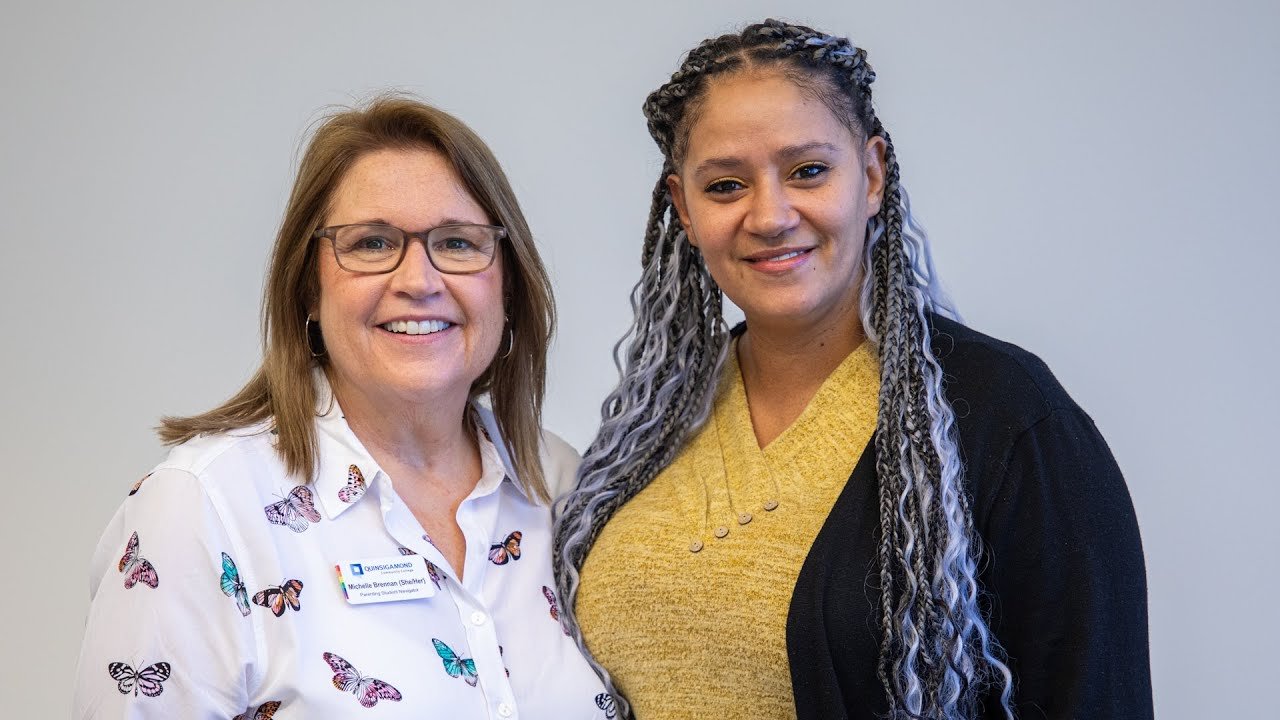
At Quinsigamond Community College, the former director of the Perkins Program was tasked with managing the federal grant aimed at helping underserved populations enter career-focused occupations.30 As part of the grant, he conducted a needs assessment, which revealed that approximately 40 percent of students in career-focused programs at Quinsigamond were parents, many of whom were dropping out despite strong academic motivation. Recognizing the need for better support, he recommended hiring a dedicated advisor for parenting students and successfully advocated for using Perkins funds to create the role. As a result, Quinsigamond hired a full-time parenting student navigator who has since developed parenting student support services on campus, including plans to launch a drop-in child care service.
Quinsigamond Community College, used with permission.
Linn-Benton’s leadership committed to five years of funding to staff its new child care center, allowing time to hire a director to pursue grants and other funding sources to support ongoing operations. This commitment enabled the college to launch the center while developing a plan for long-term sustainability. While the initial seed funding, partially provided through the Higher Education Emergency Relief Fund, may not be replicable at other institutions, the college is dedicated to supporting the center, even as it navigates a $3 million budget shortfall over the next two years.
6. Designing Child Care Services Starts with the Right Data
Colleges need data to design and deliver child care services to parenting students effectively. More community colleges are shifting their focus from serving primarily as transfer institutions to equipping individuals of all ages for today’s and tomorrow’s workforce. As a result, the typical community college student is no longer an 18-year-old high school graduate. The average age of community college students is 27.31 Many colleges are also prioritizing the reenrollment of stop-outs, who are often older, working adults with family obligations. States such as Massachusetts have made community college free for students aged 25 and older, helping to remove financial barriers for this population.32 These students often balance school with full-time work and caregiving responsibilities at home.
Parenting students are often called an “invisible population,” despite the fact that they are one in five undergraduate students. Many colleges lack the capacity or infrastructure to consistently track parenting students’ enrollment or needs. Without comprehensive data, institutions struggle to design and deliver key wraparound services, such as child care, that help parenting students stay in school.
Federal and state policymakers have taken steps to improve this kind of data collection through legislation, including introducing the Understanding Student Parent Outcomes Act.33 Several states—including Oregon, Texas, Illinois, and Minnesota—require colleges to identify and count parenting students. California has a de facto data collection requirement because of legislation that requires colleges to offer parenting students priority registration and cost-of-attendance adjustments to account for higher expenses than non-parents, like child care and housing.
While these efforts lay the necessary groundwork, institutions do not have to wait for legislative mandates to take action. Proactively identifying parenting students and understanding their needs enables colleges to design more effective supports, which can boost retention and completion rates.
At Quinsigamond Community College, the push to better support parenting students was sparked by data. During a routine needs assessment required by the Perkins grant, administrators discovered that approximately 40 percent of students in Perkins-funded programs at Quinsigamond were parents, and many were dropping out despite being academically motivated. Using this data point, the director of the Perkins program successfully advocated for creating a full-time parenting student navigator role to coordinate resources for students with children. The parenting student navigator is leading efforts to launch a drop-in child care program where registered and eligible Quinsigamond students can safely leave their children for up to three hours, six days per month, while they attend class, study, meet with advisors, receive tutoring, or engage in other academic activities. Additionally, the parenting student navigator is using the Family Friendly Campus Toolkit34 to guide and formalize data collection on parenting students, helping the college better understand and respond to their needs.
Recognizing the importance of data in designing services for parenting students, Madison College conducted a survey of approximately 10,000 students in fall 2022. The survey had a 16 percent response rate and included questions about caregiving responsibilities for children under 18. Everyone interviewed by New America, from senior leadership to mid-level administrators to students, was aware that roughly 40 percent of Madison College students are parenting. This widespread awareness has become a major organizational driver of change at Madison College. A clear majority of campus leaders recognize that effectively serving parenting students is essential to fulfilling the college’s mission and retaining students. The college has also gathered insights through focus groups and other surveys to develop a more comprehensive understanding of parenting students’ needs.
While there are important considerations around how to effectively collect data on parenting students’ child care responsibilities, institutions like Madison College have demonstrated that it can be done thoughtfully and respectfully. One key consideration is student privacy and how information about caregiving responsibilities will be used. Madison College allows students to self-identify as caregivers during the admissions process, or at any time through their student portal. Students may also select “I prefer not to answer.” Those who do self-identify are informed that they may receive targeted communications from the college, including newsletters, information about on-campus and community resources, invitations to special events or opportunities, and requests to collaborate on student-parent inclusion efforts. This approach ensures transparency while creating opportunities to connect students with meaningful support.
As of November 2023, when this change was implemented, nearly 850 students at Madison College indicated they were parents of minor children. However, many students had not yet updated their profiles in the student information system. To improve data accuracy, the college has been working to increase the rate of profile updates. Student success advisors and other staff members actively support parenting students in completing this question and helping them understand how their responses can connect them to valuable campus resources.
Collecting data on parenting students and their needs for wraparound services, such as child care, is just the first step. These data must also be analyzed and applied in order to (1) design targeted services that support parenting student success and (2) examine outcomes like academic performance and retention. Such analysis helps show which supports are most effective in helping parenting students succeed.
When colleges can point to research showing that investing in parenting students leads to improved retention, it becomes easier to justify, secure, and allocate resources for expanding those supports. For instance, Monroe Community College in Rochester, New York, found that students who used the campus child care center had higher retention and completion rates than peers who did not.35 This research was possible because Monroe collects data on whether students are pregnant or parenting every semester during enrollment. These data, combined with information on which parenting students use the on-campus child care center, provided an opportunity to compare the outcomes of similar students, differentiating between those who used the center and those who did not.
Citations
- Nicole Lynn Lewis and Devon Haynes, National Student-Parent Survey Results & Recommendations (Generation Hope, May 12, 2020), https://static1.squarespace.com/static/5ed7f7e97e1c361545410fe4/t/5fb8799dad29aa2b428e74f3/1605925281914/GH_%23StudentParentSuccess+Report_Final.pdf.
- Linn-Benton Community College, “Administrative Rule 1035-01: Children on LBCC Properties,” revised April 23, 2025, https://www.linnbenton.edu/about/bp-ar/1035-01.php.
- Sarah Nzau, “Child Care Support Services Are an Overlooked Strategy for Re-Enrolling Adult Learners,” EdCentral (blog), New America, March 11, 2025, https://www.newamerica.org/education-policy/edcentral/child-care-support-enrolling-adult-learners/.
- Palmer, “Child Care Centers on Campus Alone,” https://www.newamerica.org/education-policy/edcentral/child-care-centers-on-campus-alone-dont-solve-the-problem/.
- Adam K. Edgerton, Child Care Access Means Parents in Schools (CCAMPIS): In Brief (Congressional Research Service, January 23, 2024), https://www.congress.gov/crs-product/R47422.
- Child Care Resource Center, “About Work Family Resource Center Child Care Education,” https://childcareresourcecenter.org/about-work-family-resource-center-child-care-education/.
- Administration for Children & Families, Office of Child Care, “What We Do,” current as of June 4, 2025, https://www.acf.gov/occ/about/what-we-do.
- Madison Area Technical College, “Madison College and Partners Celebrate Future Child Care Facility at Goodman South Campus,” news release, December 10, 2024, https://madisoncollege.edu/about/news/madison-college-and-partners-celebrate-future-child-care-facility-goodman-south-campus.
- Reach Dane, “Satellite Family Child Care System,” https://www.reachdane.org/programs/satellite.cfm.
- NAEYC (website), “Early Learning Program Quality Assessment & Accreditation,” https://www.naeyc.org/accreditation/quality-assessment-and-accreditation.
- Richard Davis Jr., “Unlocking the Full Potential of CCAMPIS for parenting students,” EdCentral (blog), New America, February 12, 2025, https://www.newamerica.org/education-policy/edcentral/unlocking-the-full-potential-of-ccampis-for-student-parents/.
- Elissa Nadworny, “Vital Federal Program to Help Parents in College Is ‘A Drop in the Bucket,’” Institute for Women’s Policy Research, October 24, 2019, https://iwpr.org/vital-federal-program-to-help-parents-in-college-is-a-drop-in-the-bucket/.
- Russell T. Vought, letter to the Hon. Susan Collins, Chair, U.S. Senate Committee on Appropriations, with table of discretionary funding levels for fiscal year (FY) 2026, May 2, 2025, https://www.whitehouse.gov/wp-content/uploads/2025/05/Fiscal-Year-2026-Discretionary-Budget-Request.pdf.
- Generation Hope, “The FamilyU Cohort: Transform Your Institution to Better Serve parenting students,” https://www.generationhope.org/familyucohort.
- U.S. Department of Education, Office of Career, Technical, and Adult Education, “Perkins V,” last reviewed May 12, 2025, https://cte.ed.gov/legislation/perkins-v.
- Rosario Durán, “Navigating Recovery: Community College Enrollment Trends and Challenges,” ACCT Now Perspectives, July 10, 2024, https://perspectives.acct.org/stories/navigating-recovery-community-college-enrollment-trends-and-challenges.
- Mass.gov, Executive Office of Education, "Free Community College," https://www.mass.gov/info-details/free-community-college.
- Deborah K. Ross and Lucy McBath, Understanding Student Parent Outcomes Act of 2023, H.R. 6309, 118th Congress (2023–2024), introduced November 8, 2023, https://www.congress.gov/bill/118th-congress/house-bill/6309.
- Family Friendly Campus, “Data Collection,” https://www.familyfriendlycampus.org/the-toolkit/data-collection/.
- Lindsey Reichlin Cruse, Lashawn Richburg‑Hayes, Amanda Hare, and Susana Contreras‑Mendez, Evaluating the Role of Campus Child Care in Student Parent Success: Challenges and Opportunities for Rigorous Study (Institute for Women’s Policy Research and Insight Policy Research, October 2021), https://iwpr.org/wp-content/uploads/2021/10/Evaluating-the-Role-of-Campus-Child-Care_FINAL.pdf.
Recommendations for Colleges
On the basis of our work with 10 community colleges, we grouped suggestions for improving child care access and support for parenting students into five themes and 11 recommendations.
Theme 1: Prioritize Child Care as a Core Student Success Strategy
Child care is treated as a stand-alone service at many community colleges rather than integrated as a core student success support. Parenting students represent nearly one in five undergraduates nationwide, with even higher concentrations at community colleges. Data show they are less likely to complete degrees than their peers without children, despite earning similar GPAs.36 The difference? Higher non-tuition costs37 than non-parenting students, difficulty finding reliable child care, and time poverty.38
Colleges that integrate child care into their equity goals, strategic plans, and basic needs services are better equipped to support parenting students and improve retention. In addition, child care access can be a powerful tool for reengaging adults with some college but no credentials, which is an urgent priority for many institutions and states.39
Recommendation 1.1: Make Child Care Part of Strategic Planning and Equity Goals
Colleges should explicitly include child care access and parenting student support in their strategic plans, equity goals, and basic needs initiatives. Institutions like Madison College and Forsyth Tech have demonstrated that embedding child care into institutional priorities helps sustain services, secure funding, and drive student success. Madison College, for example, created a student-parent task force that reports to senior leadership and integrates child care into its strategic plan. Forsyth Tech connects parenting support to its basic needs office and views child care as essential to retention and completion.
Theme 2: Diversify Child Care Offerings to Reflect the Realities of Parenting Students
Parenting students rely on a patchwork of care arrangements. No single model meets all their needs. Data from New America and national surveys show that over 60 percent of parenting students depend on family, friends, and neighbors for child care,40 while formal on-campus centers only serve a fraction of parenting students,41 even at the most well-resourced colleges. This reflects the fact that parenting students face complex schedules, work demands, and financial constraints that require flexible, layered child care solutions.
Colleges that offer a mix of campus-based care, partnerships with community providers, drop-in options, and connections to subsidies or referral networks are better equipped to help parenting students stay enrolled and succeed.
Recommendation 2.1: Provide a Mix of On-Campus, Off-Campus, and Flexible Supports
On-campus child care centers alone cannot meet the demand for parenting student support. Madison College, for example, pairs its on-campus center (which prioritizes parenting students) with partnerships with community centers like the YMCA and is building a new center to expand capacity. Quinsigamond Community College used Perkins funding to hire a parenting student navigator and is developing drop-in child care for when other care is not available, like during evening classes or in emergencies. Forsyth Tech partners closely with the regional CCRC agency to connect parenting students to local providers and subsidies, and its SPARC program offers holistic basic needs support that includes child care as a key component. Colleges that combine on-campus care with community partnerships and financial support are better able to meet the actual needs of parenting students.
Recommendation 2.2: Strengthen Support for Family, Friend, and Neighbor (FFN) Care
The majority of parenting students rely on FFN care because it offers affordability, cultural alignment, trust, and flexibility that formal centers may not. Yet FFN care can be fragile, especially when providers face their own resource challenges. Colleges can help strengthen FFN arrangements42 through policies and services that make them easier to sustain, such as priority class registration for parenting students, family-friendly study spaces, and clear guidance on bringing children to class when care falls through. Some colleges also encourage student-parent networks or clubs that help parents build community and informal support systems, even if liability concerns prevent formal co-op child care arrangements. These strategies help create an ecosystem of support that aligns with how most parenting students actually piece together care.
Theme 3: Collect and Use Better Data to Inform Services
Parenting students are often called an “invisible population” because colleges lack systems to consistently identify and support them. Without reliable data, institutions struggle to connect parenting students to services, measure outcomes, or make the case for funding. This invisibility contributes to gaps in support that can derail parenting students’ educational journeys.
Colleges that proactively collect and integrate parenting status into student records, especially during admissions, advising, or registration, are better positioned to design effective supports and advocate for resources.43 Data collection also helps ensure that child care and other student support for parenting are part of larger equity and completion conversations on campus.
Recommendation 3.1: Integrate Parenting Status Data Into Student Records
Madison College and Forsyth Tech demonstrate two models for gathering actionable data on parenting students. Madison asks about parenting and caregiving responsibilities during admissions and allows students to update this information through the student portal at any time. Forsyth gathers parenting status during intake sessions through its SPARC office, which provides wraparound support to parenting students. Both approaches ensure that student-parent data are linked to other key information, such as academic progress, GPA, and use of support services. This allows the institutions to monitor trends, identify equity gaps, and tailor interventions. Madison includes the option for students to identify the ages of their children or other dependents, or to opt out of responding, helping balance data needs with privacy considerations.
Recommendation 3.2: Leverage Data to Secure Funding and Improve Services
Colleges that track parenting student data can advocate for funding and design more targeted programs. Parenting data can strengthen grant proposals or reporting for federal programs like CCAMPIS and Perkins, state basic needs funding, and private philanthropic support. It can also help colleges make decisions about how to use their resources to support increased degree attainment. For example, Madison College uses its parenting student data to conduct targeted outreach about child-friendly campus events and to evaluate the impact of services on retention. Forsyth Tech’s dashboard allows SPARC staff to monitor academic performance and intervene early when parenting students show signs of struggle.
Theme 4: Integrate Child Care Coordination with Campus Support Services
Parenting students often navigate fragmented campus systems to access child care, basic needs assistance, academic advising, and financial support. This disjointed structure can create additional stress, confusion, and barriers. Colleges that coordinate these services or create integrated points of contact make it significantly easier for parenting students to connect with the resources they need to persist and complete their studies.
Recommendation 4.1: Centralize or Coordinate Student-Parent Services
Forsyth Tech’s SPARC office integrates child care support with emergency grants, food assistance, housing referrals, and transportation help. By consolidating these services, Forsyth creates a one-stop shop that reduces administrative burdens for parenting students and allows for more proactive, coordinated support. Such models ensure parenting students aren’t left to piece together services on their own. They address the reality of time poverty and can improve retention and completion. At Madison College, a student-parent task force reports to college leadership and helps align child care, advising, and basic needs initiatives. This ensures that child care is seen not as a stand-alone service, but as part of a broader strategy for student success and equity.
Recommendation 4.2: Build Partnerships with Child Care Resource and Referral Agencies
Many colleges cannot meet the full demand for child care through on-campus centers alone. Partnerships with local child care resource and referral (CCR&R) agencies help connect parenting students to community-based care, subsidies, and additional support.44 Forsyth Tech maintains an active partnership with its regional CCR&R, facilitating warm hand-offs and personalized referrals. Linn-Benton Community College goes a step further by hosting its local CCR&R (Family Connections) on campus, allowing for greater integration with institutional support. These partnerships expand child care options and connect colleges to external expertise. CCR&Rs bring deep knowledge of the local child care landscape, helping institutions design supports that reflect parenting students’ real-world needs.
Recommendation 4.3: Train Faculty and Staff on Parenting Student Needs and Campus Supports
Faculty and staff play a critical role in supporting parenting students, but they don’t always know what resources exist or how to connect parenting students with the help they need. Colleges should provide regular training or resources that raise awareness of child care services, parenting student supports, and basic needs programs available on campus. Montgomery College offers a strong example. In partnership with Believe in Students and Ascend at the Aspen Institute, the college recently launched the first professional development curriculum focused on parenting students.45 The training, which is strongly encouraged for faculty and staff, includes real stories from parenting students and practical strategies for supporting them in and out of the classroom. Training like this helps foster a more supportive, inclusive environment for parenting students and ensures they aren’t left to navigate complex systems alone.
Recommendation 4.4: Develop Flexible, Family-Friendly Campus Policies
Even with strong child care support, parenting students will inevitably face gaps in coverage, whether a caregiver cancels at the last minute or a child care program closes unexpectedly. Colleges can help fill these gaps by creating policies that offer flexibility. This might include clarifying when children can accompany parents to class or use family-friendly spaces on campus or offering hybrid or virtual participation options in certain situations. Making these policies clear and accessible sends a strong signal that the institution values and accommodates parenting students.
Theme 5: Plan for Sustainability by Tapping into Diverse Funding Streams
Sustaining child care support takes intentional, diversified funding. On-campus centers, partnerships, subsidies, and drop-in care all demand resources beyond what most colleges can provide from institutional funds alone. Colleges that successfully build and maintain child care services for parenting students tap into federal, state, local, and private funding in combination with tuition for child care services.
Diversified funding not only helps sustain services but also allows colleges to expand offerings to meet demand over time. Our site visits and research revealed that colleges with the most robust child care support have tapped into a mix of sources, including CCAMPIS and Perkins grants, state and local child care funds, philanthropic contributions, and institutional investments.
Recommendation 5.1: Combine Federal, State, Local, and Philanthropic Funding
Madison College demonstrates the power of diversified funding. The college blends CCAMPIS dollars, city and state child care subsidies, and private philanthropy to reduce costs for student families and expand capacity. Its successful effort to secure $10 million in funding to build a new child care center shows what is possible when colleges align vision, strategy, and fundraising. Quinsigamond Community College used Perkins funds to hire a parenting student navigator, embedding support for parenting students into its broader career and technical education strategy. Forsyth Tech has layered CCAMPIS grants, state child care grants, local partnerships, and basic needs funding to provide child care grants, connect students to community subsidies, and integrate child care as part of its SPARC office.
Recommendation 5.2: Advocate for More Flexible and Robust Public Investments
Colleges that systematically collect student-parent data are in a stronger position to advocate for sustained and increased public funding. Parenting status data can help institutions make the case for federal grants like CCDF46 or CCAMPIS, state child care grants,47 and local investments48 that support child care.
For example, Madison College has used data on parenting students to guide fundraising and advocacy efforts, while Forsyth Tech’s data dashboard supports its work in sustaining and growing its basic needs infrastructure, including child care services. By demonstrating clear need and impact, colleges can strengthen policy arguments for flexible, sustainable funding that treats child care as a core student success investment.
Citations
- Afet Dundar, “New Data Insights on parenting students from a Multi‑Organization Collaborative Effort,” Institute for Women’s Policy Research, October 10, 2024, https://iwpr.org/new-data-insights-on-student-parents-from-a-multi-organization-collaborative-effort/.
- Brittani Williams, Jinann Bitar, Portia Polk, Gabriel Montague, Carrie Gillispie, Antoinette Waller, Azeb Tadesse, Kayla C. Elliott, and Andre Nguyen, “For parenting students, the Biggest Hurdles to a Higher Education Are Costs and Finding Child Care,” EdTrust, August 17, 2022, https://edtrust.org/rti/for-student-parents-the-biggest-hurdles-to-a-higher-education-are-costs-and-finding-child-care/.
- Katherine M. Conway, Claire Wladis, and Alyse C. Hachey, “Time Poverty and Parenthood: Who Has Time for College?” AERA Open 7, no. 1 (2021): 1–17, https://files.eric.ed.gov/fulltext/EJ1323956.pdf.
- Nzau, “Child Care Support Services Are an Overlooked Strategy,” EdCentral (blog), New America, https://www.newamerica.org/education-policy/edcentral/child-care-support-enrolling-adult-learners/.
- Stephanie Baker, “Parenting Students Rely on Family and Friends for Care. Here’s How Colleges Can Make That Easier,” EdCentral (blog), New America, March 11, 2025, https://www.newamerica.org/education-policy/edcentral/parenting-students-rely-on-family-and-friends-for-care-heres-how-colleges-can-make-that-easier/.
- Palmer, “Child Care Centers on Campus Alone Don’t Solve the Problem.” https://www.newamerica.org/education-policy/edcentral/child-care-centers-on-campus-alone-dont-solve-the-problem/.
- Baker, “Parenting Students Rely on Family and Friends for Care,” https://www.newamerica.org/education-policy/edcentral/parenting-students-rely-on-family-and-friends-for-care-heres-how-colleges-can-make-that-easier/.
- Richard Davis Jr., “Improving Child Care for parenting students Starts with Better Institutional Data,” EdCentral (blog), New America, April 15, 2025, https://www.newamerica.org/education-policy/edcentral/improving-child-care-for-student-parents-starts-with-better-institutional-data/.
- Stephanie Baker, “Promising Partners: Community Colleges and Child Care Resource & Referral Networks,” EdCentral (blog), New America, May 27, 2025, https://www.newamerica.org/education-policy/edcentral/promising-partners-community-colleges-and-child-care-resource-referral-networks/.
- Montgomery College, “Student Parent Program,” https://www.montgomerycollege.edu/offices/student-affairs/student-parent-program/index.html.
- Stephanie Baker, “What States Can Do to Help College Students Get Child Care Support,” EdCentral (blog), New America, June 5, 2025, https://www.newamerica.org/education-policy/edcentral/what-states-can-do-to-help-college-students-get-child-care-support/.
- Stephanie Baker, “States Should Invest in Postsecondary Child Care Grants,” EdCentral (blog), New America, February 5, 2025, https://www.newamerica.org/education-policy/edcentral/states-should-invest-in-postsecondary-child-care-grants/.
- Stephanie Baker, “Why Colleges Should Get Involved in Child Care Advocacy,” EdCentral (blog), New America, July 10, 2025, https://www.newamerica.org/education-policy/edcentral/why-colleges-should-get-involved-in-child-care-advocacy/.
Conclusion
Ultimately, we need a universal right to early education and adequate public investment to make the child care system work for all, including parenting students. Some states have made progress on expanding child care access, like New Mexico and Vermont. These efforts are promising for parenting students because they address the underlying challenges in the child care infrastructure. Early education advocacy and robust public investment are the keys to solving child care challenges for all families, including student-parent families.
In most states though, child care subsidies are limited and serve few income-eligible families. The themes and recommendations we make in this report reflect the child care system in place now. Colleges cannot solve the child care crisis on their own; it will take robust federal and state investment and policy changes to accomplish that. But colleges have a role to play within the existing child care system and can take steps to improve child care services for parenting students.
More About the Authors

Sarah N Kipkorir
Senior Policy Analyst, Center on Education & Labor

Richard Davis Jr.
Policy Analyst, Higher Education

Stephanie Baker
Senior Policy Manager, Higher Education
Issues
Programs/Projects/Initiatives
Topics
Related


Why Colleges Should Get Involved in Child Care Advocacy

Beyond Tuition: Funding for Campus Based Child Care for Student Parents
