The Value of Early Intervention for Infants and Toddlers
Early intervention services are an important federally funded program for families with children under three years of age who may be diagnosed with or are at risk of developmental delay or disability. Authorized in 1986 by Part C of the Individuals with Disabilities Education Act (IDEA), early intervention programs are run at the state level. They rely on a mix of federal and state funds to deliver therapeutic services to children and families who have been referred, evaluated, and approved for services based on state-determined criteria.
The purpose of early intervention is exactly what it sounds like: to intervene early to connect infants, toddlers, and their families with appropriate developmental supports before school entry. Early intervention helps infants and toddlers eat, sleep, move, speak, and play better, creating a strong foundation for the “free and appropriate public education” that IDEA guarantees. Early intervention uses a family-centered approach that takes into consideration a family’s environment, routines, and preferences, and integrates the family into services for children. When families can access the program, the impacts can be profound: Early intervention helps strengthen cognitive, motor, and language skills, reduces the likelihood of childhood maltreatment, and can lower education costs through reduced need for special education.
Early intervention provides critical support for the health and well-being of infants and toddlers, but delivery is challenging: Children with disabilities or delays, or at risk of developing delays, must be identified, referred, evaluated, and enrolled with an individualized family service plan before they can begin receiving services. Pain points at every step in the process interfere with access to early intervention.
The Government Accountability Office reported that 53 percent of the 650,211 children referred for early intervention services ultimately enrolled, expressed as real numbers in Figure 1.
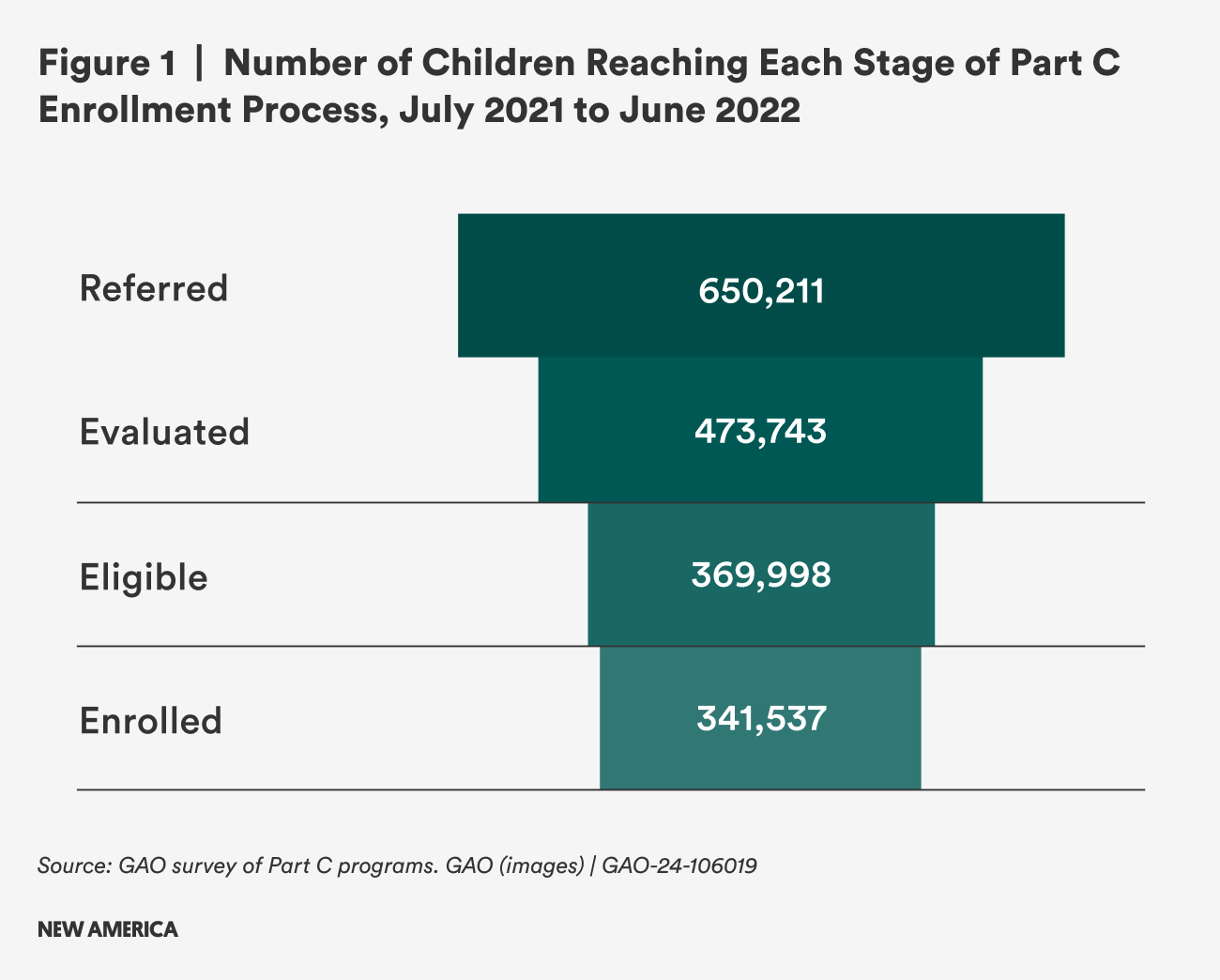
This dropoff may represent a typical program eligibility funnel: After all, not all families who apply for other early childhood or family support programs like Head Start or Medicaid will be approved for services. However, this funnel does not account for another key demographic: children who are likely eligible but never referred. While no national data is available, one study estimated that only 18.7 percent of children in Denver who were likely eligible for early intervention services were ever referred.1
Eligibility criteria for early intervention vary too widely from state to state to estimate the number of children who are likely eligible for services but never identified or referred. According to one study, the percentage of infants and toddlers likely to be eligible ranged by state from 2 to 78 percent, while the proportion of children actually served ranged from 1.48 to 6.96 percent.2 This paints a dispiriting picture and complicates estimation of a nationwide gap.
However, it’s reported that 8.42 percent of U.S. children ages three to seven have been diagnosed with a developmental disability or delay.3 The prevalence among older children is fairly constant, but decreases slightly with age (8 percent among children eight to 12, and 7.8 percent among children 13 to 17). In 2021, there were 11.1 million children under the age of three in the United States.4 Assuming that the prevalence of developmental disability is consistent in the birth-to-three population as it is in three-to-seven year olds, the number of children potentially eligible could be upwards of 934,000 nationwide.
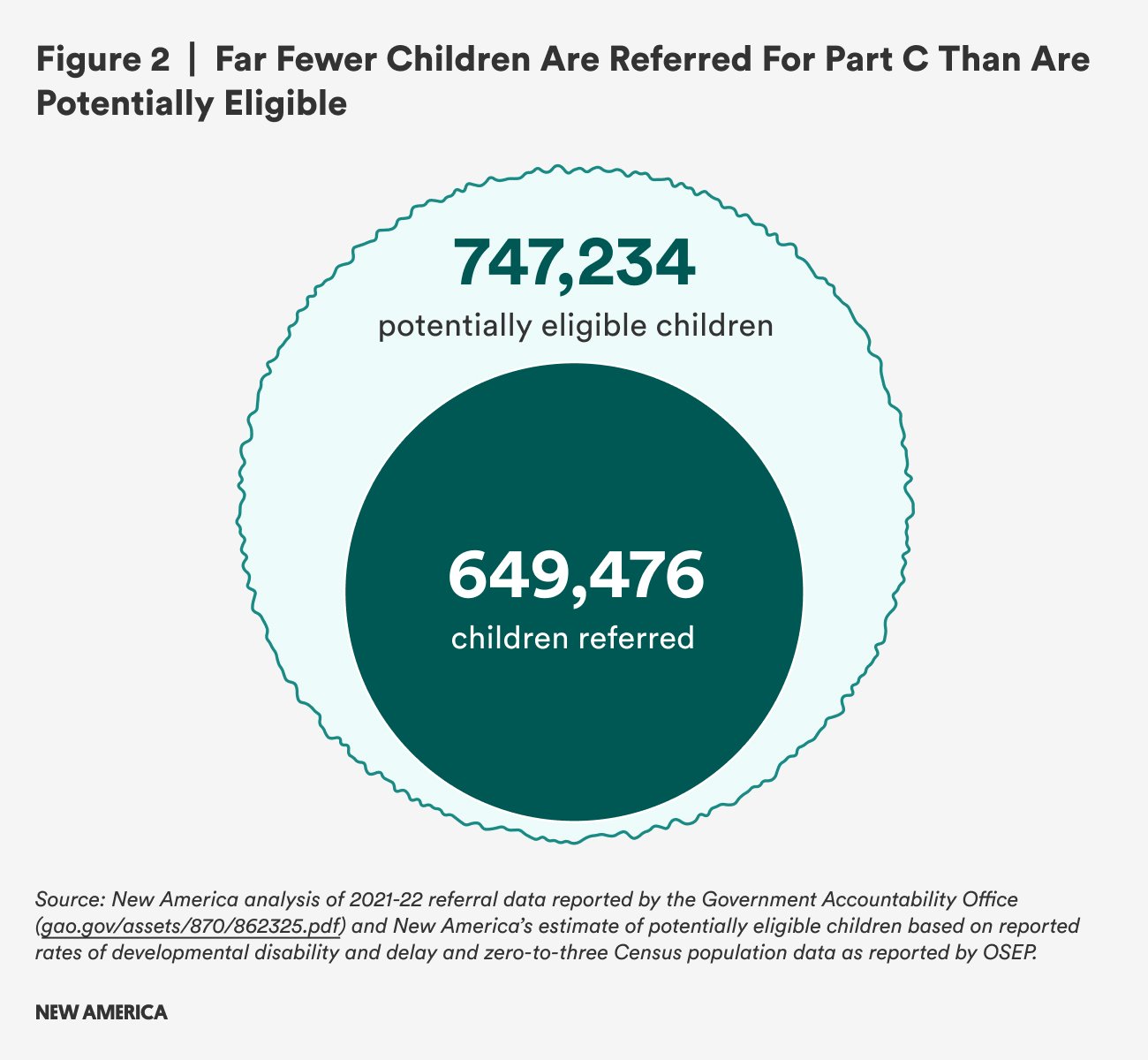
To understand what a gap might look like, we used this general prevalence rate to estimate numbers of children who could potentially benefit from early intervention in states with available referral data. The Government Accountability Office surveyed 56 state and territory Part C programs and found that among the 41 responding locations, just over 650,000 children were referred to early intervention.5 By applying the 8.42 percent prevalence rate to the birth-to-three population in those states, we estimate a gap of nearly 100,000 children who could have been eligible by diagnosed developmental disability (see Figure 2).6 Note that many of these children will not have been diagnosed with a delay or disability yet, which is one of the key challenges of serving children with early intervention services that are by law limited to the birth-to-three age range.
This estimate also undercounts the children who are never diagnosed with developmental disability or delay at all. The Centers for Disease Control and Prevention estimate that one in six children (17 percent) have a disability or delay, diagnosed or not.7 This would make the pool of potential beneficiaries of early intervention services over 1.8 million—if they could be successfully identified and referred in time.
The costs of serving a greater proportion of infants and toddlers would be high, but given the benefits of early intervention to both children and their families, the future and compounding costs of inaction are considerable, if not easily quantifiable.8
One framework to understand the missed opportunity costs is cost avoidance: estimating the extent to which receiving early intervention services may help avoid higher costs in the long run. For example, the Prenatal-to-3 Policy Impact Center summarized an analysis of six states where between 760 and 3,000 children served by early intervention were able to avoid special education services at age 3, with one-year cost avoidance falling between $7.6 and $68.2 million per state.9
However, while cost avoidance and return on investment frameworks help make the case for public programs, the actual experience of families who access (or don’t access) developmental support for their infants and toddlers should be of great interest to policymakers who care about the well-being and even financial security of young children and their parents. If families are denied early intervention, the full out-of-pocket costs for equivalent services could be substantial. Given the developmental benefits to children, the positive impacts on maternal role satisfaction and self confidence, and the poorly understood but very real stressors of caregiving, successful connection to early intervention should be a policy priority for anyone interested in creating conditions where children with disabilities and delays and their families can thrive.
Infants Are Underserved
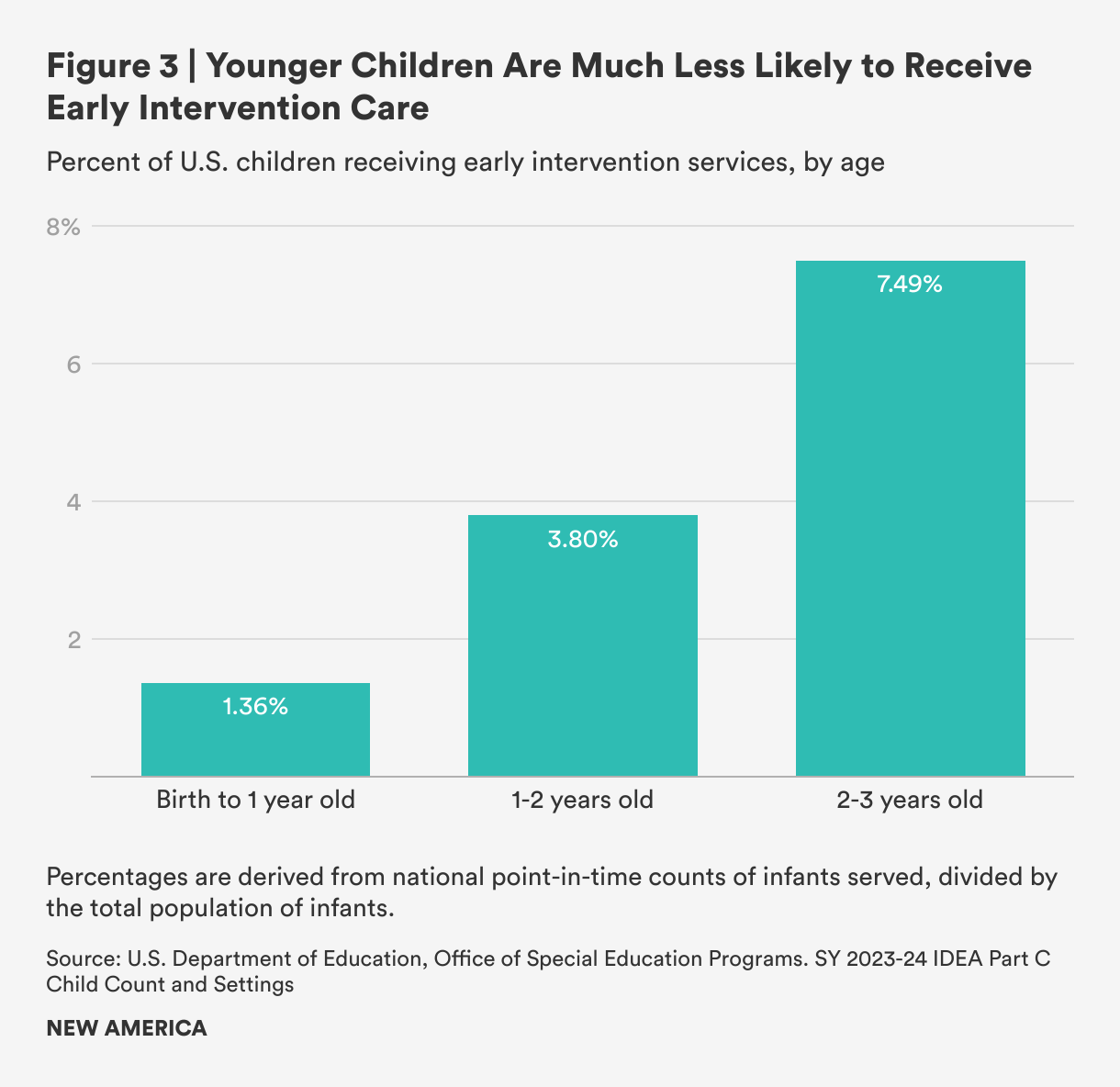
The gap is especially severe amongst infants: Nationally, only about 1 percent of babies under age one received early intervention services compared to approximately 8 percent of children under age three (see Figure 3).10 The service gap to infants can be attributed in part to the limitations of infant assessment: It is difficult to evaluate whether an infant is meeting milestones until they’ve missed them. Some conditions that are identifiable at birth would help qualify more infants for services in the earliest days of their lives, which can help families support their development from the start rather than waiting for delays to appear.
Focusing on early intervention is crucial for babies’ long-term development, so much so that one of the key indicators in state Part C performance plans is the percentage of infants under the age of one receiving an Individualized Family Service Plan. Early identification, referral, and enrollment of younger babies serves a dual purpose: supporting their development at a time of high neuroplasticity, and increasing the dosage of supportive therapies over a relatively short window of opportunity. Toddlers referred and enrolled later may only have a year or even months of benefits before transitioning out of early intervention at age three. Identifying children who might qualify for services while they are still infants is challenging, but states have flexibility in creating policies to make it easier.
Citations
- Beth McManus et al., “Child Characteristics and Early Intervention Referral and Receipt of Services: A Retrospective Cohort Study,” BMC Pediatrics (2020): 20–84, https://pmc.ncbi.nlm.nih.gov/articles/PMC7036184/.
- Steven Rosenberg et al., “Part C Early Intervention for Infants and Toddlers: Percentage Eligible Versus Served,” Pediatrics 113 (2013): 38–46, https://pubmed.ncbi.nlm.nih.gov/23266922/.
- Benjamin Zablotsky et al., “Diagnosed Developmental Disabilities in Children Aged 3–17 Years: United States, 2019–2021,” NCHS Data Brief 473 (2023): 1–8, https://www.cdc.gov/nchs/data/databriefs/db473.pdf.
- We used 2021 data to align with the data visualization published by the Government Accountability Office. “IDEA Section 618 Data Products: Static Tables Part C Child Count and Settings Table 4 (2021–2022),” Office of Special Education Programs, https://data.ed.gov/dataset/idea-section-618-data-products-static-tables-part-c-child-count-and-settings-table-4/resources?resource=9e23bff9-c49a-4531-8ca9-7d1aef19c8d0.
- Government Accountability Office, “Special Education: Additional Data Could Help Early Intervention Programs Reach More Eligible Infants and Toddlers,” GAO-24-106019 (2023): 24–25, https://www.gao.gov/assets/gao-24-106019.pdf.
- The Government Accountability Office conducted a survey of the 56 state and territory Part C programs, and 41 of them provided responses to requests for referral data included in Figure 1. Four of those were U.S. territories: Guam, Northern Mariana Islands, U.S. Virgin Islands, and American Samoa. These territories were excluded from our estimate of potentially eligible children in Figure 2 due to insufficient data, which changed the number of referred children from 650,211 to 649,747. We used the rate of diagnosed disability—8.42 percent among slightly older children—to estimate how many children might have been eligible, but not referred, amongst the zero-to-three population in those remaining states surveyed by GAO. Due to the varying eligibility rates across states, this estimate is illustrative rather than conclusive.
- Mary E. Cogswell et al., “Health Needs and Use of Services Among Children with Developmental Disabilities—United States, 2014–2018,“ Morbidity and Mortality Weekly Report 71 (2022): 453–458, https://www.cdc.gov/mmwr/volumes/71/wr/mm7112a3.htm.
- The legal requirements of Part C present challenges to conducting randomized control trials with non-treatment groups, as all children found eligible for early intervention should be served. As a result, the full costs of not serving children and families has not been quantified or estimated to our knowledge.
- “State Policy Roadmap 2024: Early Intervention Services,” Prenatal-to-Three Policy Impact Center, 2024, https://pn3policy.org/pn-3-state-policy-roadmap-2024/us/early-intervention/.
- In 2023, 7.7 percent of children under age three received early intervention services when counted cumulatively throughout the year. See: Office of Special Education Programs, “IDEA Section 618 Data Products: Part C Child Count and Settings, Table 10 (SY 2023 to 2024),” U.S. Department of Education, https://data.ed.gov/dataset/idea-section-618-data-products-static-tables-part-c-child-count-and-settings-tables-10/resources. Cumulative counts are not available for infants under age one, and this data relies on a “point-in-time” count. Of babies under age one, 1.35 percent received early intervention services and 4.2 percent of children under age three received early intervention services in 2023 according to point-in-time data collected in fall 2023. See: Office of Special Education Programs, “IDEA Section 618 Data Products: Part C Child Count and Settings, Table 4 (SY 2023 to 2024),” U.S. Department of Education, https://data.ed.gov/dataset/idea-section-618-data-products-static-tables-part-c-child-count-and-settings-table-4/resources.