A Chapter of: Low Earth Orbit Satellites: Policies to Promote Spectrum Sharing, Foster Competition, and Close Digital Divides
Chapter I. Fueling Connectivity from Space: Spectrum Sharing and Coexistence
Introduction
Filings with the International Telecommunication Union (ITU) indicate plans for hundreds of thousands of new Low Earth Orbit (LEO) satellites globally. While most of these constellations may never secure funding or be deployed, if even a fraction come to fruition, it would represent an unprecedented expansion of satellite activity.27 According to ITU Radiocommunication Bureau Director Mario Maniewicz, “Over the past decade, such requests have grown 5.5 times, showcasing not only the immense promise of the rapidly growing space economy, but also highlighting the complexity and challenges we face.”28 This growth will require more spectrum capacity and greater coordination among systems, and not only to accommodate the explosion in data capacity. Network performance metrics like latency and signal quality are also improving dramatically, making satellite services increasingly viable for near-real-time, high-capacity applications.
As of mid-2025, there were more than 11,700 active satellites in orbit—a number that has grown dramatically in recent years.29 This surge has been dominated by LEO communication satellites. Even larger LEO constellations are being proposed, enabled by advances in spacecraft manufacturing and cheaper access to launch. SpaceX alone has nearly 8,000 satellites in LEO and a pending Federal Communications Commission (FCC) authorization to begin launching a Gen 3 constellation with up to 30,000 satellites in 2026—each with 10 times the downlink capacity and more than 20 times the uplink capacity of current satellites.30
The surge in on-orbit systems has been matched by equally dramatic growth in network capacity. Global satellite capacity increased eightfold from 2020 to 2023, reaching 27 Tbps, and is forecast to increase another tenfold by 2028, to 240 Tbps.31 Virtually all of this growth reflects an explosion in demand for LEO satellite connectivity, marking a clear transition from an ecosystem dominated by a small number of large geostationary orbit (GSO) satellites to rapidly growing constellations of LEO satellites. According to consulting firm Novaspace, total capacity for non-geostationary orbit (NGSO) satellite networks was seven times greater than total GSO capacity in 2023, a disparity projected to grow to 26 times by 2028, with NGSOs representing 97 percent of the projected net increase in satellite capacity over that period.32
This rapid proliferation of LEO systems, and the scale at which they are being deployed, has begun to strain both spectrum availability and existing regulatory structures. The FCC’s current framework for spectrum allocation and licensing was not designed for this emerging dense and dynamic LEO environment. Relevant FCC regulations were largely promulgated more than 20 years ago, when the largest constellations envisioned were in the hundreds, and most were not deployed. While the circumstances have changed, many of these regulations have remained the same.
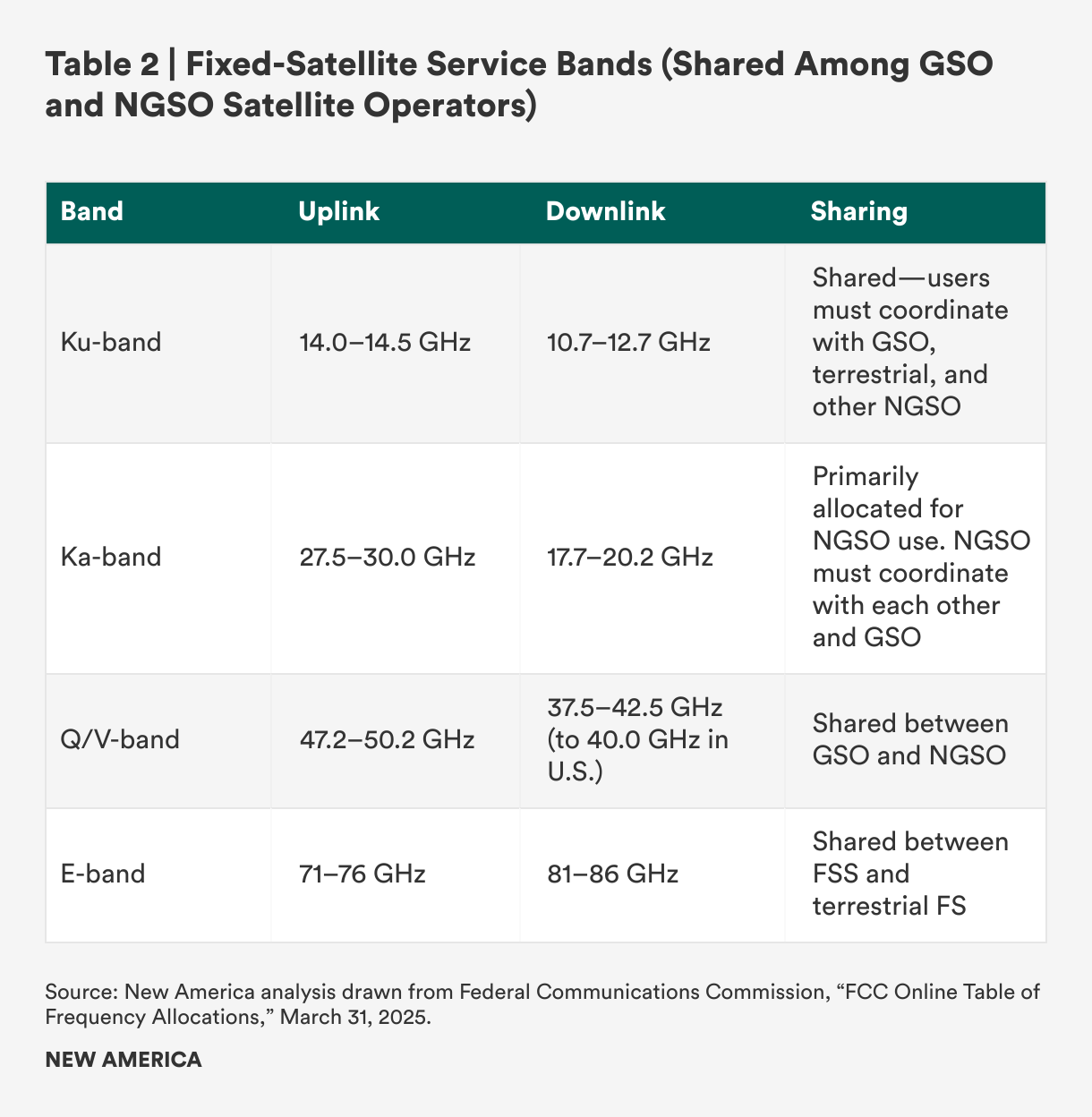
A key challenge in today’s satellite regulatory landscape is accommodating the rapid proliferation of LEO systems, particularly in the shared fixed satellite service (FSS) bands that serve as the primary spectrum resource for both incumbent GSO systems and most NGSO constellations. FSS downlink operations primarily use the 10.7–12.7 GHz and 17.8–20.2 GHz bands, while uplinks typically use the 27.5–30.0 GHz and 14.0–14.5 GHz bands. These bands are shared internationally and were not originally planned with large-scale NGSO constellations in mind, further compounding the technical and policy challenges of coexistence and coordination.
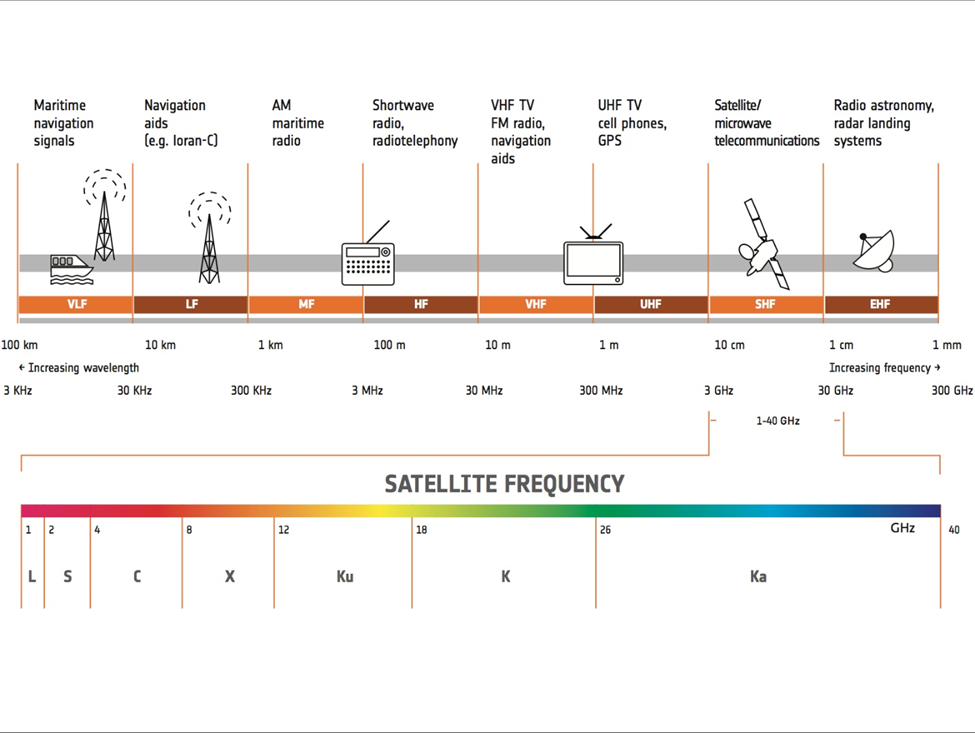
Screenshot from “Regulation of NGSO Satellite Constellations,” International Telecommunication Union and Digital Regulation Platform, from European Space Agency data, March 3, 2024, digitalregulation.org/regulation-of-ngso-satellite-constellations.
This chapter will cover the current allocation, licensing, and coordination mechanisms for FSS and mobile satellite service (MSS) satellite systems. It discusses potential reforms that could better streamline authorizations, boost LEO satellite capacity and performance, and facilitate more efficient spectrum sharing and coexistence among incumbents and market entrants alike.
Licensing and Market Access
The current FCC satellite-licensing system is rightly criticized for being slow, bespoke, and overly burdensome for satellite operators, forcing delays that hinder the development of the rapidly growing satellite sector. Highly customized application requirements, duplicate processes between the FCC and ITU filings, and the combination of technical, spectrum, and orbital debris reviews lead to a long process and restrictive, sometimes inconsistent licensing conditions. Reforms that seek to better standardize and streamline authorizations through clear, uniform ex ante rules and conditions, while shifting to target ex post enforcement as needed, could help address these challenges.
A. Authorizations and Modifications: Bespoke, Burdensome, and Delayed
1. Application Requirements and Procedural Burdens
Currently, the FCC has three types of licenses for nongovernmental satellites: amateur, experimental, and “Part 25.” All three license applications require operators to submit information regarding their radio frequency and orbital parameters, orbital debris mitigation plan, and a draft of their ITU filing materials. Apart from prototype satellites or bands not allocated for satellites, all FCC-licensed LEO constellations for MSS or FSS—as well as foreign-licensed LEO constellations seeking U.S. market access—are licensed under Part 25 of the commission’s rules.
NGSO systems—particularly those operating in the FSS—do not receive exclusive spectrum assignments. Instead, they are expected to coordinate and share frequency bands on a nonexclusive basis. Indeed, virtually all satellite spectrum is shared, although first-in-time authorizations generally get priority for protection from interference. FSS system licenses are considered for application in a processing-round procedure in groups based on their filing date. The filing of an acceptable lead application for a specific frequency band triggers the opening of a processing round and deadline for filing competing applications.
The Part 25 satellite licensing process used for constellations is complex, costly, and lengthy, with the process taking anywhere from one to nearly four years.33 Operators that file with the FCC under Part 25 rules must submit an extensive application that often runs more than 100 pages and includes requirements to provide a detailed narrative, technical annex, Schedule S, orbital debris mitigation plan, and ITU filing-related materials.34 Each application is reviewed individually and often subject to system-specific conditions. This differs from the licensing process for terrestrial services, where the FCC has adopted more consistent rules that provide a clear framework for applicants.
The unique “processing round” approach applied to NGSO systems has compounded these challenges. Unlike other FCC licensing frameworks, the satellite licensing system limits the period when applicants can apply, and recent FSS/MSS processing rounds have overlapped in ways that lack clear rules or precedent. Applicants may face significant delays if they are forced to wait for a new round to open after a lead applicant files, or risk missing a narrow filing window if they are not prepared. These dynamics, while intended to ensure fairness and spectrum sharing among competitors, are frequently cited as a primary source of delay for NGSO licensing.
ITU filings are submitted to the ITU’s Radiocommunication Bureau early in a satellite system’s development process and contain technical and operational information. Due to the public nature of FCC filings, applicants tend to submit filings to the FCC later in the satellite development process and include a more comprehensive set of materials for domestic authorization and, where applicable, for coordination with U.S. government users. Like the ITU, the FCC process assumes good-faith coordination among operators, with oversight by the licensing or registration administration.
One of the primary procedural challenges is the duplicative nature of the FCC and ITU procedures, which have significant overlap. For example, both applications include coordination requirements, such as identifying potential interference and documenting efforts to mitigate potential interference to other services (including GSO systems, terrestrial systems, and other NGSO systems), including calculations of equivalent power flux density (EPFD), a metric that the United States is moving away from (discussed further below).
2. Timeline for Approval
When the FCC accepts a lead application for a specific frequency band, it opens a processing round and sets a deadline for competing applications. Each application is placed on public notice and the commission notifies applicants if there are questions, errors, or omissions in the application that need to be resolved. This must be done within 60 days of submission to the FCC’s International Communications Filing System (ICFS), except when extensions are granted. The exception is, however, more common than the rule.
After applications are placed on public notice, the filings are open to public review and comment. FCC staff undertake a technical, legal, and managerial review, which generally extends far longer than the comment period. While applications are eventually either granted or denied, the timeline is unpredictable and may take many months or even years.
3. Buildout and Enforcement
The FCC and ITU both impose deployment milestones for satellite systems, but their frameworks differ in scope and intent. FCC rules require NGSO operators to deploy 50 percent of their authorized constellation within six years of being granted an FCC license, and to complete 100 percent within nine years of receiving a license. If these milestones are not met, the FCC adjusts the authorization to match what has been deployed, and the remaining satellite authorizations are forfeited.
Milestone requirements are one of the few consistent obligations in the satellite context, but they operate as blunt tools to weed out purely speculative filings. To date, FCC-licensed LEO systems have largely met these requirements. Given the growing number and scale of proposed constellations, however, milestone compliance is an emerging area of concern. This is particularly true given the relative shortage of launch capacity, which can be a major obstacle to timely deployment. For example, Amazon’s Project Kuiper must deploy at least 1,618 satellites by July 30, 2026, to meet its six-year milestone, but it had launched only 129 satellites as of September 2025.35 Table 1 shows the pending milestone obligations and deployments associated with several FCC-licensed NGSO systems as of mid-2025.
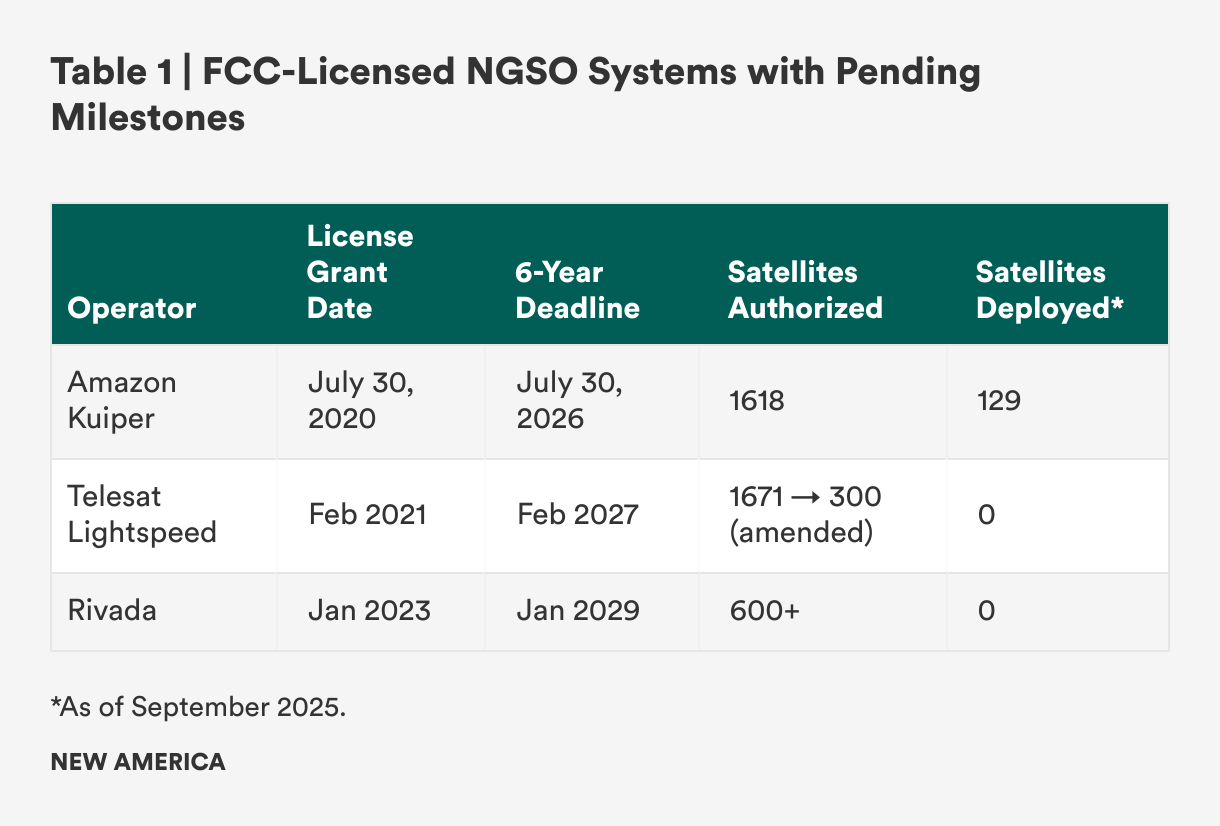
A key concern is whether these milestone requirements strike the right balance between facilitating market entry and deterring frivolous or infeasible applications. Some argue that these deployment deadlines are too lengthy and should be shortened, given the rapidly evolving ecosystem in LEO. Another consideration is whether enforcement of the buildout milestones is sufficient to offset the incentive for prospective satellite operators to apply and then later drop out if sufficient financing is not secured. The primary issue is how the FCC should distinguish systems that are legitimately trying to meet buildout requirements versus purely speculative or frivolous applications. The Commission has not yet tested how milestone waivers are to be handled, with Amazon’s Project Kuiper serving as one of the first cases to raise this issue. The ITU already has some precedent for handling waiver requests, which could serve as a reference point for the FCC.36
Introducing a higher up-front financial bond (for example, an escalating bond of $5 million or more post authorization) could serve as a stronger incentive to meet deployment milestones. Such a bond could be structured to release funds as verified buildout milestones are met. Conversely, failure to meet deadlines could result in partial forfeiture. This system would add accountability while giving applicants the opportunity to recover costs through performance. One of the potential downsides is that higher application fees or bond requirements may crowd out less well-funded startups and early innovators.
B. Proposals for Reform
1. Standardize Licensing Presumption
One overarching reform would be adoption of the presumption that NGSO applications that comply with existing FCC rules, especially those related to technical and sustainability standards, are in the public interest. This would reduce the need for case-by-case bespoke reviews and conditions. This would promote a more streamlined and consistent process, similar to how terrestrial wireless services are licensed. Instead of tailoring conditions to each operator, standardized operational rules—including for space sustainability—could provide clarity and predictability. Applicants seeking deviations from the rules would be required to seek waivers, creating a more rule-bound and transparent system.
2. Implement a Shot Clock for Application Review
A “shot clock” for application review would provide operators with more certainty about licensing timelines. It should be noted, however, that implementation of such a clock could be challenging, given the complexity of NGSO applications and the FCC’s current resource constraints. A rigid shot clock risks more tolling or dismissals without prejudice for incomplete showings.
Flexibility mechanisms could be included, such as pausing the clock in unusual review cases or if applicants fail to provide necessary information. U.S. government regulators like the Federal Trade Commission and Department of Justice employ similar flexibility in merger reviews if they need more time or if merging companies fail to provide required or needed information. Alternatively, some systems could seek a waiver of shot-clock rules to allow more time-sensitive applications to be addressed first. Systems that may be far away from their buildout requirements would allow higher-priority systems to be reviewed first.
3. Create Incremental Deployment Milestones
Deployment requirements could also be restructured into more graduated, measurable steps. For example, after final approval, satellite operators could be required to launch 5 percent of their constellation by Year 1, 10 percent by Year 2, and 20 percent by Year 3. These staged checkpoints could be tied to both financial incentives (for example, bond releases or refunds) and enforcement penalties for missed deadlines. Extensions would only be granted for deployment requirements in extenuating circumstances.
4. Raise Application Fees
Higher cost-based application fees could enable the FCC to hire additional staff and improve processing efficiency. In parallel, performance bonds structured to release funds as verified buildout milestones are met could reinforce deployment incentives. For example, an applicant might post a $5 million bond, with $3 million released upon launch of the first satellite and the remainder tied to subsequent milestones; missed deadlines would result in partial forfeiture. This dual-track approach would maintain compliance with the FCC’s statutory fee authority while still embedding strong, enforceable incentives for timely buildout.
C. Earth Stations: Light Licensing and Automated Database Coordination
LEO systems rely on ground-based earth stations (ES), also called ES gateways, to relay uplink traffic to their spacecraft, connect with the terrestrial internet, backhaul data, and perform essential tracking, telemetry, and control (TT&C) functions. ES gateways for these systems are typically dispersed globally, and larger constellations may require dozens of individual sites with hundreds of antennas worldwide. While inter-satellite links can reduce the number needed, ES gateways remain an essential component of NGSO network architecture.
One reform currently under consideration by the FCC is to streamline ES licensing by authorizing an automated database operated by one or more Commission-certified third parties to coordinate across all authorized Ka- and mmW-bands. As LEO constellations scale, gateway siting and authorization have become a key bottleneck. This is especially true in urban and suburban areas where access to fiber and low-latency ground infrastructure is essential, but where traditional Part 25 approvals are slow and often constrained by rigid geographic restrictions that govern certain mmW bands. It can also take a year and substantial cost to obtain a site-based license through the FCC’s traditional process. These delays can hinder timely constellation deployment and complicate coordination with terrestrial users in shared bands.
A simplified database-coordination system for third parties could rapidly aid in spectrum coordination and register new Earth stations in mmW bands above 28 GHz. It could also leverage the FCC’s existing 70/80/90 GHz lightweight coordination database, which for many years has successfully coordinated terrestrial fixed links (and, now, high-altitude platform links) operating in the 71–76, 81–86, and 92–95 GHz bands. This existing model allows for rapid, relatively easy registration and interference checking through third-party coordination without a full Part 25 review. This model is well-suited for sharing between satellite and terrestrial users, such as in the lower 37 GHz band, where the FCC has already requested comment on moving to a “lightly licensed” and automated coordination of terrestrial fixed and mobile network siting.
Integrating satellite ES into this database-coordination system could streamline the process, enabling faster, scalable NGSO-gateway deployments; reduce the burden of application development and processing on satellite operators and FCC staff; and help facilitate coexistence between terrestrial and satellite systems in the mmW bands. Finally, this method would allow for dynamic sharing and spatial reuse based on actual beam locations and terrain constraints. In mmW frequencies, a terrestrial fixed or mobile deployment at street level will rarely experience harmful interference from an ES gateway on a rooftop, or on the ground even a block away, and vice versa.
One remaining issue is whether the rules should also be modernized in bands designated for upper microwave flexible use service (UMFUS), such as 28 and 37–39 GHz, which also are allocated for mobile terrestrial use on a primary basis. These bands have very restrictive rules on ES location and operation, which typically limit siting to remote locations far from population areas or even highways. The FCC should revisit these legacy restrictions in mmW bands, especially the geographic exclusion zones and limited siting options, which prevent deployment in high-demand areas. Automated database coordination would enable an increased number of operators in channels without creating harmful interference and would open up more flexible interference-safe siting options.
Market Mechanisms and Spectrum Efficiency
A. Secondary Market Transactions
NGSO satellite licensing also lacks a functioning secondary market for licenses. This raises the question of whether such markets should be enabled and, if so, under what rules. There is often little to no demand for unrealized licenses for LEO systems because the licenses are specific to the operator’s system in terms of orbital configurations, spectrum, and orbital debris. Moreover, licenses cannot be altered or modified without losing their priority status, which would arguably be the primary motivation for a potential purchaser to seek to acquire a license rather than apply themselves.
Barring a new entrant who wants to provide a substantially identical system as the one proposed in the original application (or some subset of the same), there is likely no potential buyer for the license held by a willing seller. Further, the value of shared satellite licenses (FSS) generally depreciates as demand increases, since more systems deploying more satellites leads to more intensive spectrum sharing and more parties that must be accommodated through coordination agreements. MSS licenses are an exception, as they currently authorize only a single operator within each fairly narrow band; the September 2025 sale of 2 GHz MSS spectrum by EchoStar to SpaceX demonstrates the potential value of that exception.37
A key question is whether spectrum rights and coordination priorities should be transferable through secondary transactions. Allowing transfers could improve efficiency and flexibility, but it also raises concerns about encouraging speculative filings—where operators apply not to deploy but to resell. This issue overlaps with warehousing behaviors, in which licenses are held without any intent to build. If a secondary market were created, appropriate safeguards would be needed to prevent abuse and to ensure the market supports deployment and the sustainable use of spectrum rather than delaying it.
One potential reform is to explicitly allow secondary-market transactions related to relaxing or changing the default metrics that protect systems with prioritization from harmful interference. For example, even if the FCC adopts default coordination metrics that include a good-faith coordination requirement and defaults based on actual harmful interference—as it did for NGSO/NGSO coordination in 2024 and is currently considering for GSO/NGSO coordination (discussed below)—a secondary market for interference protection could further promote spectrum efficiency.
In practice, ITU administrations have approved the transfer of satellite licenses for both GEO orbital slots and NGSO systems, which contain associated coordination rights and priorities.38 While these do not constitute “sales” of coordination priority, the ability to transfer licenses allows operators to transfer interference-protection status to other parties. Processing rounds are intended to give operators greater certainty that their capital investments will be protected from harmful interference while still allowing future entrants (subject to coordination).
To the extent that an operator with prioritization agrees that the default interference thresholds (for example, the 3 percent degraded throughput metric that the FCC applies to sharing among NGSOs) can be further relaxed or even discarded, a negotiated transaction should generally promote more intensive and efficient use of shared satellite bands. Inasmuch as operators may be making payments as part of private coordination agreements, or granting other considerations, explicitly allowing transactions that relax priority coordination rights could encourage these transactions, as would an FCC requirement to disclose them.
B. Auctions
Spectrum allocated globally for satellite use is inherently shared under ITU rules and, with very few exceptions, continues to be coordinated for shared use in every nation. There are, however, important differences between the wide higher-frequency bands that characterize allocations for the FSS and the relatively few and narrow low-frequency bands allocated for the MSS. While NGSOs use both, these differences are crucial in considering the nature of the spectrum rights that are assigned and coordinated.
Neither the ITU nor the FCC currently uses an auction system for either FSS or MSS spectrum. The ITU lacks the authority to hold a global auction and requires operators to obtain a license from their national regulator, as well as an authorization for market access in any other nation where they operate. This does give participating member nations some flexibility in terms of how allocations and assignments are conducted. For example, Brazil previously conducted domestic FSS spectrum auctions but amended its regulations in 2020 to replace these auctions with administrative licensing.
In the United States, the FCC uses auctions for terrestrial exclusive-use licenses but does not currently use auctions to assign satellite spectrum. The ORBIT Act, enacted by Congress in 2000, generally prohibits globally allocated satellite spectrum from being auctioned.39 The law is premised on the idea that exclusive-use auctions would undermine the ITU’s global harmonization of frequency allocation and shared use. Whether that is necessary or the best policy in all bands, however, remains an open question among some economists and policy experts.
Supporters of auctions argue that the ORBIT Act’s prohibition is interpreted too broadly and that it could allow the FCC to conduct domestic auctions that do not impact global satellite allocations or those of other nations. For example, two decades ago, the FCC auctioned spectrum for purely domestic direct broadcast satellite (DBS) services in auctions 8, 9, and 52. However, the agency has not auctioned spectrum for satellite use since 2004, although it did auction FSS spectrum in the upper 3 GHz C-band for terrestrial use in 2021.
The working group discussed a few scenarios in which auctions could potentially be constructive. One option would be to use auctions to allocate priority in coordination for protection from interference for NGSO FSS systems operating in shared satellite spectrum. As congestion and traffic in LEO continues, satellite spectrum will become more congested as well. Auctions could be a mechanism to determine who receives coordination priority rather than rely solely on the current first-come, first-served processing round framework.
Similarly, the FCC could auction or assign aggregate “interference allowances,” which would effectively assign shares of a maximum allowable interference footprint for each NGSO system. This could give operators more certainty about their interference rights and obligations, at least in aggregate. It could additionally promote more efficient coordination if operators are allowed to trade interference allowances as part of their obligation to avoid harmful interference. It would also create an incentive for more spectrum-efficient satellite and system design by effectively putting a price on the externality of generating interference.
This approach is not without significant challenges. Interference is inherently dynamic—varying by geography, time, and constellation design—and defining static or aggregate interference quotas may oversimplify these complexities. Moreover, global satellite operations require coordination through the ITU, and any attempt to implement a U.S.-only interference allowance system may complicate international harmonization efforts or potentially hobble U.S.-licensed systems seeking to compete globally.
There could also be concerns about the impact on competition if one or even a few operators could effectively acquire all or most of the available spectrum capacity. In the context of terrestrial mobile licensing, the FCC has long had a “spectrum screen,” and the agency’s review of spectrum license transfers considers the impact on the concentration of spectrum ownership. Still, as NGSO operations scale up, exploring whether interference can be quantified, allocated, and traded may be worth studying as a means to increase the efficient use of limited spectrum capacity.
A third scenario where auctions might play a productive role would be in the narrower and scarcer MSS spectrum bands at lower frequencies. In the United States, these are currently occupied by single operators, but they are increasingly in demand for direct-to-device (D2D) services. In a January 2025 paper on MSS, Armand Musey and Tim Farrar stated: “Although co-frequency spectrum sharing (i.e., two operators sharing the same frequency) has been successfully implemented in FSS bands and certain terrestrial frequencies, the MSS spectrum bands and existing services within these bands have very different characteristics than FSS.”40 Unlike NGSO FSS systems, which often point highly directional antennas at ground-station locations, MSS systems typically serve mobile users with omnidirectional or low-gain antennas, and with limited interference-mitigation capabilities. This makes coordination more difficult and increases the risk of interference among MSS operators.
For example, in early 2024, SpaceX filed two currently pending petitions for rulemaking that requested the FCC consider whether the 2 GHz and 1.6/2.4 GHz MSS bands can be coordinated for shared use beyond their current assignment to single operators (for example, Globalstar, EchoStar, Iridium).41 This proposal has sparked debate that is unlikely to end with SpaceX’s September 2025 purchase of EchoStar’s 2 GHz licenses. Whether existing or newly allocated MSS bands can be assigned by coordinated sharing, or for a single or limited number of operators by auction, will be influenced in large part by disputed technical claims about whether multiple MSS operators can coexist on a co-frequency basis, or whether exclusive assignments are needed to avoid harmful interference. This is discussed further below.
Satellite Spectrum Sharing and Coexistence
A. Fixed Satellite Service (FSS): A New Framework for More Intensive Spectrum Sharing
NGSO FSS operators are required to share spectrum and coordinate operations with both incumbent GSO systems, which have assigned orbital slots, and other NGSO operators. This presents unique challenges in bands where demand is high and there is risk of interference, which can be short-term (the risk of in-line events between two satellites) or long-term (the risk of aggregate interference from multiple satellites). In 2023, the FCC adopted a new framework to govern sharing and coexistence among NGSO systems. It currently applies only to NGSO operations over U.S. skies, as it departs from the ITU’s decades-old approach to interference protection by instead relying on default interference thresholds that better reflect the risk of actual harmful interference.42 A similar framework is under consideration for NGSO/GSO sharing.
Under its current regulations, the ITU has two regulatory procedures to record spectrum assignments that allow satellite operators to obtain protection from interference: advance publication information (API) and coordination request (CR). The FCC does not distinguish between these, marking a divergence in domestic regulations from the ITU’s procedures.43
1. NGSO/NGSO Coordination and Coexistence
Through a pair of orders in 2023 and 2024, the FCC adopted a revised framework to govern coordination and coexistence among NGSO systems.44 The new rules require good-faith coordination to avoid interference, including by systems authorized in an earlier processing round, which receive prioritization for interference protection over systems licensed in later rounds. NGSO systems approved in the same processing round that fail to reach a coordination agreement are subject to a default spectrum-splitting procedure as the remedy for an in-line event that makes harmful interference likely. This typically serves as an incentive for voluntary coordination among systems approved in the same processing round, since neither party would welcome an arbitrary division of the band.
For operators approved in different processing rounds, a failure to coordinate gives the system approved in an earlier round priority protection for up to 10 years, after which the protection sunsets. Earlier-round systems are protected from later-round systems by interference-protection thresholds based on actual harmful interference: The short-term limit protects against a loss of link availability that exceeds 0.4 percent and the long-term interference threshold protects against aggregate interference, defined as exceeding the 3 percent time-weighted average throughput degradation.
The FCC’s coordination framework for NGSO FSS operators, which relies on a default interference-protection threshold based on actual harmful interference, represents a major change from what both leading LEO operators and the FCC itself characterized as the outdated and overly conservative EPFD threshold, which remains the ITU standard globally.45 For example, using a default threshold of 3 percent degraded throughput makes spectrum more available, particularly for later entrants, and could greatly increase the potential capacity of NGSO FSS bands.
2. NGSO/GSO Coordination and Coexistence
While spectrum sharing among U.S. NGSO FSS systems is now conducted under a modernized coordination framework, LEO satellites remain bound internationally by the ITU’s low-power EPFD limits designed decades ago to prioritize GSO operations. These legacy ITU rules limit aggregate NGSO equivalent isotropically radiated power (EIRP) toward the GSO arc, regardless of whether a GSO link is at risk of harmful interference at a given time or location. The result is reduced power levels, constrained beam patterns, and narrower orbital flexibility—all of which significantly suppress NGSO system capacity.
While updating the rules for NGSO/GSO sharing is under study at the ITU (with any change at least two to six years away), the FCC launched a notice of proposed rulemaking (NPRM) in April 2025 to modernize its framework for spectrum sharing among NGSO and GSO operators. At the time, the Commission stated that the ITU’s “EPFD limits based on 90s-era system designs significantly limits the services offered by NGSO broadband satellite constellations today.”46 More specifically, the FCC notes that EPFD rules constrain NGSO operations in multiple critical respects: limiting radiated power levels; establishing wide avoidance angles around the GSO satellite arc; restricting the number of satellites allowed to serve a particular location; and limiting ES antenna-elevation angles.
The FCC proposes to replace static EPFD masks in certain Ku- and Ka-band ranges with a sharing model based on metrics that approximate actual harmful interference. In place of fixed power-density limits and large avoidance angles, the FCC’s default protections would measure the actual impact on GSO service. For example, the short-term limit could be based on an absolute increase in link unavailability between 0.1 percent (proposed by SpaceX) and 0.4 percent (the metric for NGSO/NGSO sharing). The long-term limit, at least for GSO satellites using adaptive coding and modulation (ACM)-enabled GSO links, could be a 3 percent average degraded-throughput threshold (if the FCC adopts the same threshold it did for the NGSO/NGSO sharing framework); for non-ACM GSO links, an I/N threshold would be set over a defined percentage of time. A small minimum avoidance angle (for example, 4 degrees) would serve only as a backstop where validated GSO reference links are unavailable. Operators could meet these protections using in situ mitigation—such as dynamic beam shaping, time–frequency scheduling, and geographic avoidance—rather than designing entire systems around a one-size-fits-all EPFD mask. This approach contrasts sharply with the ITU’s legacy framework, which relies on low power, large avoidance angles, and static exclusion zones.
If the FCC adopts default interference limits premised on actual harmful interference, it will enable substantially higher power limits for LEO satellites and more beams per satellite over a given geographic area, enabling enormous increases in data capacity and performance. Kuiper included a study in its initial comments demonstrating that adopting these “new limits for NGSO-to-GSO interference…could increase the number of satellites available to serve a location by roughly 27 percent and increase the capacity available to an area by 700 percent, while, at most, a GSO operator might experience a 0.000001756 percent increase in unavailability and a less than 3 percent reduction in throughput.”47 This would allow NGSO operators to take full advantage of the capabilities of modern NGSO systems, which are increasingly software-defined and adaptive.
The FCC’s NPRM also requests comments on whether to apply a sunset period to GSO interference protections, analogous to the 10-year priority protection limit the agency applies to NGSO systems approved in earlier processing rounds. Applying such a limit to GSOs poses challenges, as these satellites are larger, more expensive, and designed for operational lifetimes of 15 years or more. They are also part of systems that are less able to adapt rapidly to new coordination regimes. Even if a sunset provision were to be phased in, it would be challenging to determine a reasonable duration due to the long and variable lifespan of GSO satellites.
A more practical alternative may be to enact sunsets for GSO ground infrastructure, such as ES gateways and user terminals. These facilities are far easier to upgrade on a predictable cycle, and targeted sunsetting of protections for outdated equipment could help clear persistent bottlenecks without undermining the economics of long-lived spacecraft. While there are limits to how feasible this would be if the satellites were not updated, the FCC and ITU should study how such an approach could be implemented to accelerate adoption of modern, more resilient GSO ground systems.
Overall, the Working Group recommends adoption of a good-faith coordination framework anchored in degraded-throughput and other service-quality metrics—rather than static EPFD masks—as default protections when coordination fails. By tying interference limits to actual harmful-interference proxies, the FCC can unlock substantial spectrum capacity for LEO systems, raise permissible NGSO transmit power, and improve both coverage and service quality while still ensuring that GSO networks receive robust and predictable protection.
3. Advances in Spectrum Sharing Technologies
One potential approach to improve coordination among NGSO systems—and possibly with GSO systems as well—is the development of database-enabled spectrum coordination mechanisms. A database-enabled coordination tool could be used to better manage spectrum for FSS systems by preventing interference, automating coordination, and allowing for more dynamic spectrum sharing. This database could contain key operating parameters for NGSO systems (such as orbital parameters, power, and frequencies used) and be used to track spectrum usage in LEO. Operators would benefit from a database that facilitates orbital planning and spectrum coordination, including the anticipation and avoidance of interference and other in-line events, including with space debris. Database coordination could potentially incorporate data on GSO operations as well, allowing NGSOs to adjust in congested areas.
The operational data sharing (ODS) system recently announced and tested by the U.S. National Radio Astronomy Observatory in partnership with SpaceX offers a potential preview of this concept.48 The ODS system enables near-real-time sharing of telescope operational data through a secure database between observatories and participating satellite operators. Satellites can then dynamically adjust their transmissions to minimize interference. One key technique tested by SpaceX allows “satellites equipped with phased array antennas to redirect their beams away from telescopes when they are within a certain proximity, and also temporarily disable transmissions if they pass directly through a telescope’s line of sight.”49
The European Space Agency has recommended further study of dynamic-satellite database coordination, and several major operators have expressed cautious interest.50 At the same time, questions remain about the feasibility, efficiency, and fairness of such systems—particularly concerns that it could place disproportionate burdens on NGSO operators. The emergence of far more capable spectrum analysis tools that leverage advanced computing and artificial intelligence could help address some of these challenges by enabling faster and more accurate interference assessments. Any future coordination mechanism must carefully balance these tradeoffs and be subject to rigorous cost-benefit evaluation.
A broader and related question is what role advances in spectrum sharing technology should play in the FCC’s coordination framework, and whether the commission should encourage or require their use with sunset provisions. For example, to what degree should the FCC prioritize systems using steerable antennas or other technologies that make coordination and coexistence more efficient? In this context, regulators could consider whether and how to sunset certain GSO interference protections over time, particularly for GSO earth stations and user terminals, which are generally more practical to upgrade than the satellites themselves. While such an approach would face challenges—notably, the long operational lifespans of incumbent GSO satellites—it could help encourage greater adoption of technologies that facilitate coexistence. Ultimately, the FCC should consider whether a more technology-forward sharing regime is feasible or necessary for long-term spectrum sustainability in heavily used FSS bands.
B. The Mobile Satellite Service Access and Sharing Challenge
Spectrum allocated for MSS comes with an entirely different set of capabilities, challenges, and constraints. The lower-frequency spectrum currently used to bring MSS connectivity to mobile devices and platforms in motion—including vehicles, ships, and aircraft—is in increasing demand to fill connectivity gaps where traditional mobile or landline service is not possible or cost-effective. D2D service, which enables communication between satellites and handheld consumer devices (for example, smartphones) or with enterprise IoT networks (for example, sensors, asset tracking), is a particularly useful form of communication that has grown in both popularity and relevance as satellite communication improves and as private enterprise networks proliferate.51
But while the demand and use cases for D2D are growing, efforts to expand services are complicated by the fact that there are only a few relatively narrow bands of licensed MSS spectrum available, all of it currently assigned to single operators. The three primary MSS bands are much lower in frequency than FSS spectrum and thus better able to connect to consumer handsets. These include the L-band GEO spectrum (1525–1559 MHz downlink and 1626.5–1660.5 MHz uplink), the 2 GHz S-band (2.0–2.02 GHz and 2.18–2.2 GHz), and the “Big LEO” band (1610–1626.5 MHz paired with 2483.5–2500 MHz).52
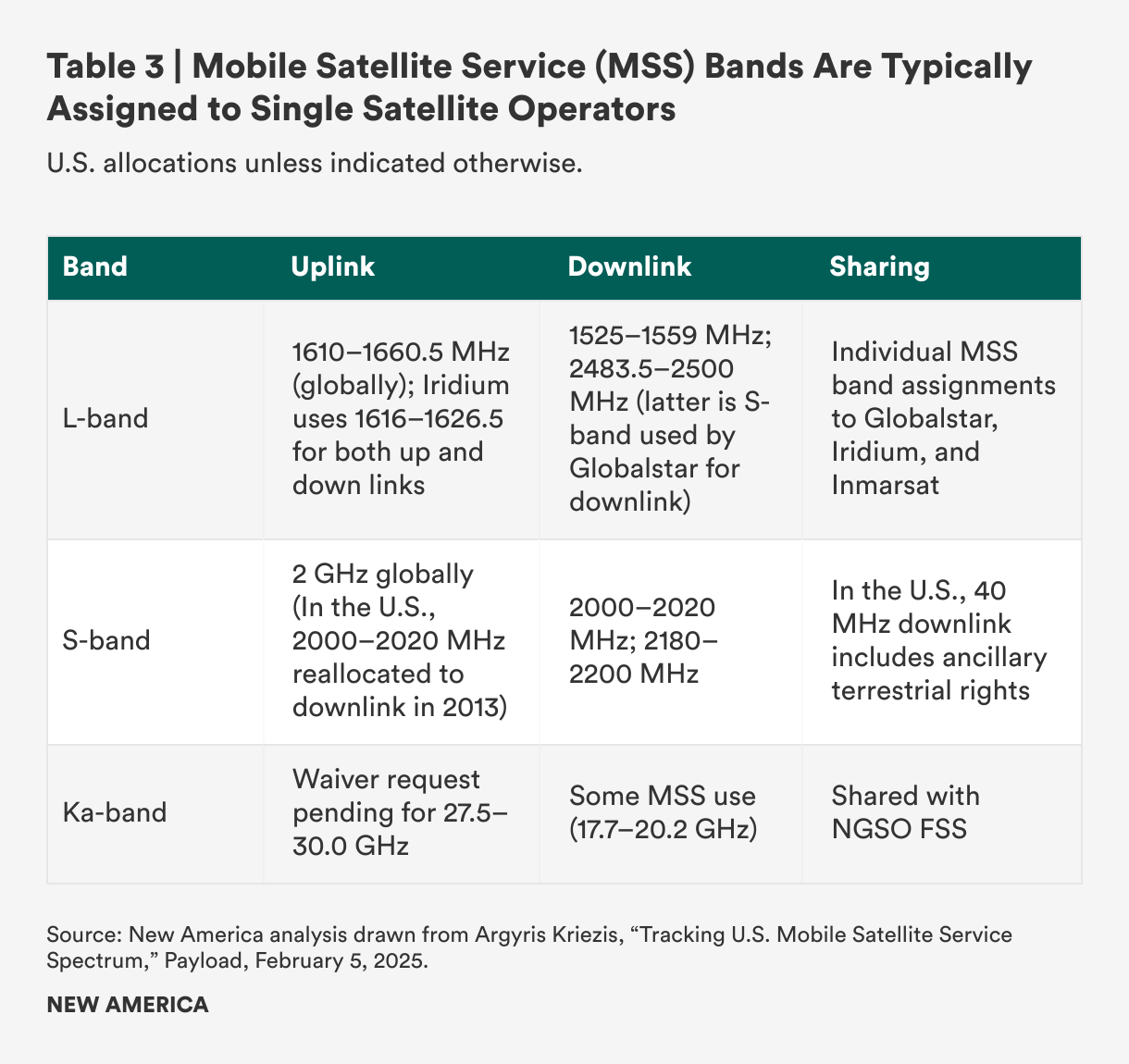
In addition, LEO satellite operators recently have forged partnerships with leading terrestrial mobile carriers in the United States and in Europe to use terrestrial mobile (IMT) spectrum to provide very basic LEO satellite connectivity—initially texting, and possibly phone calls and web browsing in the future—to mobile phone customers in rural, remote, and other areas without cellular coverage or where the signal is too weak. In 2023, the FCC authorized this additional option for D2D service as supplemental coverage from space (SCS).53 In 2025, T-Mobile’s partnership with Starlink became the first to offer D2D to cellular customers in the United States. A major constraint, however, is that SCS service is contingent on an agreement with the mobile carrier that licenses that frequency band on an exclusive basis. SCS is a secondary use case and heavily dependent on partnerships between satellite and mobile providers.
In contrast, Globalstar uses its own allocation of MSS spectrum in the “Big LEO” band, in partnership with Apple, to allow owners of new-model iPhones to text from any location, regardless of which operator they use for their mobile service. Whereas SCS is a complement to the mobile carrier’s service, enough MSS spectrum could allow LEO operators to innovate new services and even compete directly with mobile carriers.
As noted in the discussion of auctions above, a key challenge is how to make more MSS spectrum available. The low mid-band spectrum useful for D2D connectivity is in extremely short supply and, in the United States, Congress recently required that another very large increment of mid-band spectrum be identified and auctioned for exclusive terrestrial use.54 Alternatively, SpaceX and others have argued that existing MSS bands could be shared, making room for new users. However, the technical feasibility of sharing MSS bands remains unproven. Unlike FSS spectrum, which offers very wide bands more easily shared by coordinating antenna direction among users, D2D devices require omnidirectional antennas that are less able to direct the power they radiate toward one specific satellite and away from others. Because of these challenges, co-frequency sharing has historically been looked at as unlikely or impossible.
A Brief History of Mobile Satellite Service (MSS) Spectrum
Both the Big LEO and 2 GHz bands were initially allocated for shared use. Big LEO’s original band plan allowed for up to four NGSO MSS operators using code-division multiple access (CDMA) in 1610–1621.35 MHz, and for one NGSO MSS operator using time-division multiple access (TDMA) in 1621.35–1626.5 MHz, for uplink and bidirectional transmission respectively.55 It also assigned 2483.5–2500 MHz for the equivalent downlink use. Though multiple applicants were intended to use the band, only two ended up deploying: Globalstar, using CDMA, and Iridium Constellation LLC (Iridium), using TDMA. Further revisions to the band plan have further minimized the amount of spectrum shared between the operators, which now have most of their operations in bands they exclusively occupy.
Until the recent emergence of demand for LEO direct-to-smartphone connectivity, there was little interest in expanding or sharing low-band MSS spectrum. Eight operators were initially licensed to provide MSS in the 2 GHz band, but most either failed to complete buildout requirements or eventually surrendered their licenses.56 The two that remained in the band went bankrupt and were acquired by DISH, now EchoStar, which has only very recently announced the sale of its AWS-4 and H-block licenses to SpaceX.57 In 2012, the FCC authorized an ancillary terrestrial component (ATC) for this 2 GHz spectrum (AWS-4) that allowed EchoStar to offer both terrestrial and satellite service using the same 2 GHz MSS spectrum.58 This has had the practical effect of closing the band to additional MSS users based on the assumption that only a single operator could coordinate use of the band for both downlink satellite and terrestrial mobile use without causing harmful interference to one service or the other. As noted above, in September 2025 EchoStar agreed to sell its 2 GHz MSS spectrum to SpaceX.
Although the MSS bands have evolved in ways that currently appear incompatible with spectrum sharing, their relatively light usage has made them the target of hopeful direct-to-device (D2D) providers seeking more MSS spectrum. After SpaceX filed petitions for rulemaking in 2024 asking the FCC to authorize shared use,59 the Commission invited public comment on the issue and may still decide to open a rulemaking to determine if sharing these relatively narrow MSS bands is technically feasible.60 Since SpaceX filed its petitions, the debate over the potential for coexistence in the bands has only intensified. Proponents argue that shared use better aligns with the original intent of the band plans, while incumbents argue there is insufficient technical evidence in the record on how band entrants could adequately protect existing services from harmful interference.
At the same time, D2D providers have recently begun striking business partnerships with existing MSS licensees—most notably, Apple’s partnership with Globalstar61 and AST SpaceMobile’s leasing agreement with Ligado Networks.62 The demand for MSS spectrum does, however, exceed the amount available and seems likely to grow as the number and importance of potential D2D use cases increase.
The FCC should work to allocate or open more MSS spectrum for use through two primary avenues. First, the commission should allocate additional MSS spectrum that supports new D2D use cases. One immediate opportunity is the upper C-band (3980–4200 MHz), where the FCC is currently exploring the consolidation of incumbent FSS earth stations, as well as what additional services could be accommodated in the upper portion of the band that remains in use for FSS. One option is to authorize MSS operations to share the band with GSO FSS downlinks to earth stations, which are primarily used for relaying video and data content in near real time (for example, live TV programming).63 The FCC’s consolidation of the upper C-band has been mandated by Congress and represents a timely opportunity to add MSS services to prime spectrum that is only lightly used. An added advantage is that, since this spectrum is allocated globally for FSS, it could become a global MSS band as well. While the FCC would need to determine if coexistence is technically feasible, the agency should use its upcoming C-band rulemaking as an opportunity to invite proposals and studies.
Longer term, the Commission should seek to identify other bands that may be suitable for MSS use. One pathway is through the bands that the National Telecommunications and Information Administration (NTIA) is charged with studying under the One Big Beautiful Bill Act.64 As part of its 2025 budget reconciliation package, Congress instructed NTIA to conduct spectrum analysis of several large federal bands, with the goal of identifying bands for reallocation to commercial use. Some of the lower-frequency bands under review—including 2.7–2.9 GHz and 4.4–4.9 GHz—likely possess the physical characteristics needed to support an MSS allocation. Portions of those bands that are too narrow or non-harmonized to support a valuable auction for full-power terrestrial mobile service should, instead, be considered for MSS.
One downside of a new U.S. allocation for MSS is its effect on global harmonization. For example, EchoStar’s (and now SpaceX’s) 2 GHz MSS spectrum is available for D2D services across Europe and most of the world. But a U.S.-only allocation in a band currently allocated primarily for terrestrial or federal agency use might not be economically viable, depending on the value of the service provided and which other nations followed suit.
Second, the FCC should open a broad proceeding to better understand whether, and under what circumstances, it might be feasible for two or more LEO satellite providers to coordinate and share MSS spectrum. While debates to that effect are currently raging over some MSS bands, there is insufficient technical evidence in the records related to these proceedings to say whether, or with what strategies, coexistence is possible. Collecting a technical record on the subject would both help the Commission reach a conclusion on the current debates and inform future band plans.
The timing for this proceeding is ripe as NTIA explores new bands for additional uses. Indeed, even if sharing is too difficult for already-allocated bands occupied by operators who have proceeded under the assumption that they would not need to coordinate shared use, sharing could be possible in newly allocated bands if those bands could be licensed under specific conditions intended to coordinate multiple users. For example, some federal satellite users may be able to share with commercial MSS under the right conditions. A proceeding that gathers evidence on which rule structures and limitations are necessary to enable sharing will both help open up MSS spectrum to additional users and facilitate maximum use of the bands.
C. Recommendations to Expand the LEO Satellite Spectrum Access Pipeline
1. Expanding Contiguous FSS Downlink Allocations
The Working Group expressed general support for the FCC’s pending “Satellite Spectrum Abundance” proposals to allocate substantially more spectrum in the upper 12 GHz and lower 42 GHz bands for NGSO FSS operations. The agency’s NPRM outlined a number of substantial new allocations for both NGSO satellite downlinks, as well as for very high-capacity uplinks for FSS earth-station gateways in the 51.4–52.4 GHz and W-band frequencies above 94 GHz.65
As part of this rulemaking, the FCC has requested comment on a proposal to add an additional 500 megahertz to the downlink Ku-band—the 10.7–12.7 GHz band currently shared by GSO and NGSO FSS operators, including Starlink and OneWeb—that would extend this contiguous allocation to 13.25 GHz. This would facilitate a substantial increase in overall LEO satellite downlink throughput, latency, and quality of service, particularly if combined with the modernization of NGSO/GSO spectrum sharing and power limitations discussed above.
2. Allocating Additional MSS Bands or Shared Access in Low Mid-Band Spectrum
Another promising area is the potential expansion of MSS access to low mid-band spectrum. In February 2025, the FCC created a notice of inquiry on how to free additional mid-band spectrum for new services in the upper C-band, which is currently used for FSS earth stations between 3980 and 4200 MHz.66 Congress subsequently required the Commission to reallocate and auction at least 100 megahertz in this band for terrestrial mobile use.
It is likely, however, that a substantial portion of the band will remain in use for FSS, and as a buffer to protect airline altimeter systems operating in the band above from interference. The FCC should use this opportunity to consider whether MSS systems could share and coexist with incumbent FSS earth stations in any portion of the band that remains allocated to FSS, as SpaceX67 and New America’s Open Technology Institute68 suggested in comments responding to the FCC’s notice of inquiry.
The FCC should also evaluate band segments that are less attractive or feasible for terrestrial mobile use to determine their feasibility for MSS use. Some bands that should be investigated in particular are those that are too narrow or non-harmonized to be of great value for auction to terrestrial carriers. For example, Congress has required the FCC and Department of Commerce to consider the 2.7–2.9 GHz band for potential reallocation. Full repurposing of this band to MSS is likely unfeasible, as it overlaps with critical radar systems, but sharing in the band should be studied.
Finally, the FCC should consider initiating a rulemaking process to gather input on whether existing MSS bands could be more efficiently shared among multiple operators, given the growing demand for MSS capacity and advancement of satellite technology.

Low Earth Orbit Satellites: Policies to Promote Spectrum Sharing, Foster Competition, and Close Digital Divides
- About the LEO Policy Working Group
- Foreword
- Executive Summary
- A Brief Introduction to Low Earth Orbit (LEO) Satellites
- Chapter I. Fueling Connectivity from Space: Spectrum Sharing and Coexistence
- Chapter II. The Final Economic Frontier: Satellite Competition in Low Earth Orbit
- Chapter III. Connectivity from New Horizons: How LEO Satellites Help Bridge the Digital Divide
Citations
- Andrew Falle et al., “One Million (Paper) Satellites,” Science 382 (October 2023): 150–2, https://www.science.org/doi/10.1126/science.adi4639.
- “Space Connect,” International Telecommunications Union, https://www.itu.int/hub/2025/02/space-connect-the-rise-of-leo-satellite-constellations.
- Harry Baker, “How Many Satellites Could Fit in Earth Orbit? And How Many Do We Really Need?” Live Science, May 30, 2025, https://www.livescience.com/space/space-exploration/how-many-satellites-could-fit-in-earth-orbit-and-how-many-do-we-really-need.
- “Network Update,” Starlink, https://www.starlink.com/us/updates/network-update.
- “Novaspace Reports Major Shifts in Satellite Communications Industry,” BroadcastPro Middle East, September 16, 2024, https://www.broadcastprome.com/news/satellite/novaspace-reports-major-shifts-in-satellite-communications-industry.
- “Non-Geostationary Orbit Constellations Redefining the High Throughput Satellites Market Landscape,” Novaspace, April 25, 2024, https://nova.space/press-release/non-geostationary-orbit-constellations-redefining-the-high-throughput-satellites-market-landscape.
- See Argyris Kriezis and Whitney Lohmeyer, U.S. Market Access Authorization Timeline Analysis for Megaconstellation Networks (Olin Satellite + Spectrum Technology & Policy Group, April 2022).
- “Part 25 Space Station License and Market Access Checklist,” Federal Communications Commission, updated October 27, 2023, https://www.fcc.gov/part-25-space-station-license-and-market-access-checklist.
- Amazon, “Kuiper Mission Updates,” accessed on September 25, 2025, https://www.aboutamazon.com/news/innovation-at-amazon/project-kuiper-satellite-rocket-launch-progress-updates.
- “ITU Radio Regulations Board Approves Waiver for Rivada LEO Constellation and the Company Signs an MoU with IEC Telecom,” SatNews, July 11, 2023, https://news.satnews.com/2023/07/11/itu-radio-regulations-board-approves-waiver-for-rivada-leo-constellation-and-the-company-signs-an-mou-with-iec-telecom.
- “EchoStar Announces Spectrum Sale and Commercial Agreement with SpaceX,” EchoStar, September 8, 2025, https://ir.echostar.com/news-releases/news-release-details/echostar-announces-spectrum-sale-and-commercial-agreement-spacex. The pending 2 GHz license transfer also includes ancillary terrestrial rights. At the time of this report, SpaceX stated it would do a direct-to-cell service but had not announced any plans for a terrestrial component.
- “Spectrum Management: Key Applications and Regulatory Considerations Driving the Future Use of Spectrum,” Digital Regulation Platform, April 25, 2025, https://digitalregulation.org/spectrum-management-key-applications-and-regulatory-considerations-driving-the-future-use-of-spectrum-2.
- See ORBIT ACT, Pub. L. No. 106-180, 106th Congress (Mar. 17, 2000), (“Notwithstanding any other provision of law, the Commission shall not have the authority to assign by competitive bidding orbital locations or spectrum used for the provision of international or global satellite communications services. The President shall oppose in the International Telecommunication Union and in other bilateral and multilateral for any assignment by competitive bidding of orbital locations or spectrum used for the provision of such services.”). The Federal Communications Commission (FCC) has determined that the act does not cover allocations for purely domestic services. For example, the FCC required auctions for co-primary rights to deliver one-way direct broadcast satellite service both before and after passage of the ORBIT Act. See Federal Communications Commission, Auction of Direct Broadcast Satellite Licenses, Order, AUC-03-52 (rel. Jan. 15, 2004).
- J. Armand Musey and Tim Farrar, Spectrum for Emerging Direct-to-Device Satellite Operators, at 15 (Summit Ridge Group, January 2025), https://summitridgegroup.com/wp-content/uploads/D2D-White-Paper-SRG-TMF-Final.pdf.
- Space Exploration Holdings LLC, Revision of the Big LEO Spectrum Sharing Plan to Encourage Productive MSS Use of 1.6/2.4 GHz Frequencies, Petition for Rulemaking, RM-11975 (filed Feb. 21, 2024); Space Exploration Holdings LLC, Revision of the Commission’s Sharing Plan to Encourage Productive Satellite Use of the 2 GHz Frequencies, Petition for Rulemaking, RM-11976 (Feb. 22, 2024).
- Federal Communications Commission, Revising Spectrum Sharing Rules for NonGeostationary Orbit, Fixed-Satellite Service Systems, Second Report and Order and Order on Reconsideration, IB Docket No. 21-456 (rel. Nov. 15, 2024), https://www.fcc.gov/document/fcc-revises-satellite-system-spectrum-sharing-rules.
- At the International Telecommunication Union, an API filing is early notification and includes basic orbital parameters and frequency information. It does not, however, require formal coordination. Many GSO FSS assignments are API-only and not coordinated with NGSO systems. CR filings are required when radio regulations mandate coordination or agreement with other administrations. See “Regulation of NGSO Satellite Constellations,” Digital Regulation Platform, https://digitalregulation.org/regulation-of-ngso-satellite-constellations.
- Federal Communications Commission, Revising Spectrum Sharing Rules for Non-Geostationary Orbit, Fixed-Satellite Service Systems, Report and Order and Further Notice of Proposed Rulemaking, IB Docket No. 21-456, (rel. April 21, 2023); https://www.fcc.gov/document/fcc-adopts-new-rules-satellite-system-spectrum-sharing-0; Federal Communications Commission, Revising Spectrum Sharing for NGSO, FSS Systems, Docket No. 21-456, (2024).
- See Jack Kuhr, “LEO and GEO Satellite Operators Battle It Out on EPFD Rules: Payload Research,” Payload, June 12, 2024, https://payloadspace.com/leo-and-geo-satellite-operators-battle-it-out-on-epfd-rules-payload-research.
- Federal Communications Commission, Modernizing Spectrum Sharing for Satellite Broadband, Notice of Proposed Rulemaking, SB Docket No. 25-157, at para. 11 (rel. April 29, 2025), https://www.fcc.gov/document/modernizing-spectrum-sharing-satellite-broadband.
- Federal Communications Commission, Comments of Kuiper Systems LLC, Modernizing Spectrum Sharing for Satellite Broadband, SB Docket No. 25-157, at i and Appendix (July 28, 2025). Id. at 11-12 and Appendix, Table 14.
- Bang D. Nhan et al., “ODS: A Self-Reporting System for Radio Telescopes to Coexist with Adaptive Satellite Constellations,” arXiv (2025), https://arxiv.org/abs/2502.15068.
- “Satellite Internet Meets Space Science: A Groundbreaking Solution for Spectrum Sharing,” National Radio Astronomy Observatory/National Science Foundation, August 12, 2025, https://public.nrao.edu/news/satellite-internet-meets-space-science-a-groundbreaking-solution-for-spectrum-sharing.
- See Michael Calabrese, Solving the Spectrum Crunch: Dynamic Spectrum Management Systems (Dynamic Spectrum Alliance, October 2023), 45–46, https://www.dynamicspectrumalliance.org/solving-the-spectrum-crunch.pdf.
- See Musey and Farrar, Spectrum for Emerging Direct-to-Device Satellite Operators, https://summitridgegroup.com/wp-content/uploads/D2D-White-Paper-SRG-TMF-Final.pdf.
- Musey and Farrar, Spectrum for Emerging Direct-to-Device Satellite Operators, https://summitridgegroup.com/wp-content/uploads/D2D-White-Paper-SRG-TMF-Final.pdf.
- FCC, Supplemental Coverage from Space, GN Docket No. 23-65 (2024).
- See One Big Beautiful Bill Act, H.R.1, 119th Cong. (2025), https://www.congress.gov/bill/119th-congress/house-bill/1/text.
- Federal Communications Commission, Amendment of the Commission’s Rules to Establish Rules and Policies Pertaining to a Mobile Satellite Service in the 1619–1626.5/2483.5–2500 MHz Frequency Band, Memorandum Opinion and Order, CC Docket No. 92-166 (rel. Feb. 15, 1996), https://www.fcc.gov/document/amendment-commissions-rules-establish-rules-and-policies-1.
- Federal Communications Commission, Space Exploration Holdings, LLC, Application for Modification of Authorization for the SpaceX Gen2 NGSO Satellite System to Add a Mobile-Satellite Service System, Order, ICFS File No.: SAT-MOD-20230207-00022 (rel. March 26, 2024).
- Monica Alleven, “SpaceX Scoops Up EchoStar Spectrum for $17B,” Fierce Network, September 8, 2025, https://www.fierce-network.com/wireless/spacex-scoops-echostar-spectrum-17b.
- Federal Communications Commission, Space Exploration Holdings, LLC, Application for Modification of Authorization for the SpaceX Gen2 NGSO Satellite System to Add a Mobile-Satellite Service System, Order, ICFS File No.: SAT-MOD-20230207-00022 (rel. March 26, 2024).
- SpaceX, Revision of the Big LEO Spectrum Sharing Plan, Petition for Rulemaking (2024); SpaceX, Revision of the Commission’s Sharing Plan to Encourage Productive Use of 2 GHz, Petition for Rulemaking (2024).
- See Federal Communications Commission, Request for Comment on Petition for Rulemaking by Space Exploration Holdings, LLC, Regarding Revision of the Commission’s 2 GHz MSS Sharing Plan, Public Notice, RM-11976, (rel. March 26, 2024), https://www.fcc.gov/document/comment-sought-spacex-2-ghz-mss-petition-rulemaking; see also Federal Communications Commission, Request for Comment on Petition for Rulemaking by Space Exploration Holdings, LLC, Regarding Revision of the Commission’s 1.6/2.4 GHz “Big LEO” NGSO MSS Sharing Plan, Public Notice, RM-11975, (rel. March 26, 2024), https://www.fcc.gov/document/comment-sought-spacex-1624-ghz-mss-petition-rulemaking.
- Argyris Kriezis, “Tracking U.S. Mobile Satellite Service Spectrum,” Payload, February 5, 2025, https://payloadspace.com/tracking-us-mobile-satellite-service-spectrum.
- “AST SpaceMobile Announces Agreement for Long-Term Access to up to 45 MHz of Premium Lower Mid-Band Spectrum in the United States for Direct-to-Device Satellite Applications,” AST SpaceMobile, January 6, 2025, https://feeds.issuerdirect.com/news-release.html?newsid=6159593683706351.
- Federal Communications Commission, Comments of New America’s Open Technology Institute and Public Knowledge, Upper C-band (3.98 to 4.2 GHz), GN Docket No. 25-29 (April 29, 2025), https://www.newamerica.org/oti/wireless-future-project/legislativeregulatory-filings/joint-comments-urging-the-fcc-to-repurpose-and-authorize-sharing-in-c-band-spectrum-for-more-intensive-use/.
- One Big Beautiful Bill Act, H.R.1, 119th Cong.
- Federal Communications Commission, Satellite Spectrum Abundance, Further Notice of Proposed Rulemaking and Notice of Proposed Rulemaking, SB Docket No. 25-180 (rel. May 27, 2025), https://www.fcc.gov/document/fcc-looks-unleash-more-spectrum-satellite-spectrum-abundance.
- Federal Communications Commission, Upper C-band (3.98 to 4.2 GHz), Notice of Inquiry, GN Docket No. 25-29 (rel. Feb. 28, 2025), https://www.fcc.gov/document/fcc-launches-inquiry-upper-c-band.
- Letter from Jameson Dempsey, Director, Satellite Policy, Space Exploration Technologies Corp., to Marlene H. Dortch, Secretary, Upper C-band (3.98 to 4.2 GHz), Federal Communications Commission, GN Docket No. 25-59 (Feb. 20, 2025).
- Federal Communications Commission, Comments of Open Technology Institute and Public Knowledge, Upper C-Band, https://www.newamerica.org/oti/wireless-future-project/legislativeregulatory-filings/joint-comments-urging-the-fcc-to-repurpose-and-authorize-sharing-in-c-band-spectrum-for-more-intensive-use/.