A Chapter of: Low Earth Orbit Satellites: Policies to Promote Spectrum Sharing, Foster Competition, and Close Digital Divides
A Brief Introduction to Low Earth Orbit (LEO) Satellites
What Are LEO Satellites?
Satellite technologies are divided into three categories based on the orbital range they occupy: Geostationary Earth Orbit (GEO), Medium Earth Orbit (MEO), and Low Earth Orbit (LEO).1 LEO satellites operate in the closest range to Earth, orbiting between 300 and 2,000 kilometers above the planet’s surface (see Figure 1). At this altitude, latency (or lag time) is reduced, thus enabling LEO satellites to provide near-real-time communications with less signal power for transmission.2 This allows LEO satellites to be smaller in size than those in MEO or GEO, reducing the cost to develop and deploy them.
While LEOs can provide enhanced satellite-communication services due to their proximity to Earth’s surface, they do come with tradeoffs. LEOs have smaller coverage areas than MEOs and GEOs (see Figure 2), and they must be constantly in motion to offset the pull of gravity and remain on their orbital path. Due to their proximity, movement, and small size, a “constellation” of hundreds or thousands of LEOs is typically needed to provide consistent service to an area. Additionally, LEO satellites, which complete an orbit approximately every 90 minutes, are fuel-intensive to operate and prone to atmospheric drag, which degrades satellites over time. As a result, the lifespan of a typical LEO ranges from seven to 10 years.
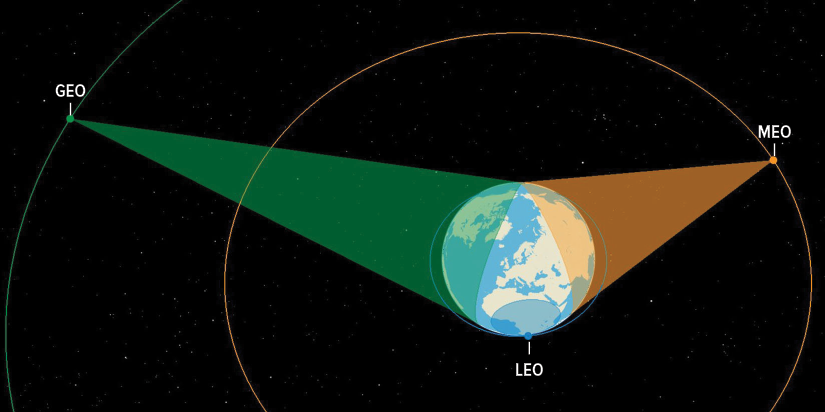
Screenshot from “Large Constellations of Low-Altitude Satellites: A Primer,” May 2023, Congressional Budget Office, cbo.gov/publication/59175.
How Do LEO Satellites Work?
LEO satellite systems consist of three main components: the satellite constellation, user terminals, and ground stations.3 To establish a connection, terminals and ground stations must have clear lines of sight to satellites. Since LEO satellites are in constant movement, a constellation of hundreds or thousands of LEO satellites is typically needed to provide consistent service to an area, with user terminals and ground stations continually switching among different satellites within the constellation to maintain a user’s connection. While LEO satellites generally need to be within range of a ground station to send or receive data, some satellites also use inter-satellite links to share data among themselves until the data reaches a satellite within range of a ground station. Advancements in inter-satellite links, such as laser-based technologies, help LEO satellites provide reliable connectivity, even in areas far from a ground station.4
Satellites use spectrum—radio frequencies that transmit wireless signals—to send (downlink) and receive (uplink) information from user terminals and ground stations.5 Since available spectrum is limited and in most cases shared among operators, it is regulated nationally and internationally to promote global harmonization and to avoid interference or signal disruptions.6
The International Telecommunication Union (ITU), an organization within the United Nations, allocates specific frequency bands for satellite communications with a variety of propagation characteristics and coordinates the registration of satellite-frequency assignments and (for the geosynchronous GEOs) their associated orbital positions.7 Currently, the most commonly used bands for connectivity-oriented LEO satellites are the Ku- (12–18 GHz) and Ka- (26.5–40 GHz) bands.8
Satellite operators obtain licenses for spectrum use from their national regulators, who are responsible for ensuring registered satellite operators follow international guidelines, as well as any specific national regulations. Filing a registered satellite operator with the ITU is a multistep process designed to identify and mitigate any potential conflicts between a planned system’s orbital characteristics, frequency bands, and intended service areas within an existing system.9 As such, once certain spectrum bands are in use, new entrants must design their systems around existing operators.
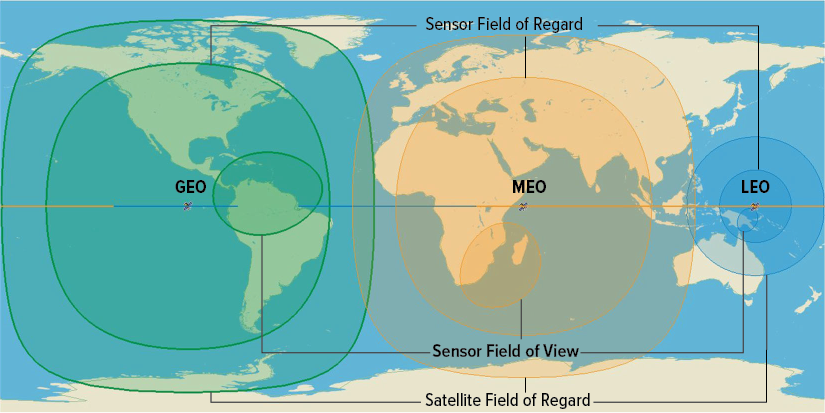
Screenshot from “Large Constellations of Low-Altitude Satellites: A Primer,” May 2023, Congressional Budget Office, cbo.gov/publication/59175.
The Promise of LEO Satellites: Ubiquitous Connection and Versatility
Due to their global coverage and proximity to Earth, LEO satellites can offer a wide range of services as both an alternative and complement to existing connectivity services. LEO systems can provide broadband connectivity to residential, community, and enterprise customers, along with other services such as:
- Vehicles and platforms in motion: In June 2022, the Federal Communications Commission (FCC) approved SpaceX’s Starlink and Kepler Communications for earth stations in motion (moving or transportable ground terminals), allowing the use of LEO satellites to provide connectivity for vehicles in motion—including cars, trucks, ships, and planes.10
- Areas experiencing natural disasters and conflict: LEO satellite connections are being used in combination with GEO satellites to respond to natural disasters and connect areas experiencing conflict, such as Ukraine and Gaza, where existing infrastructure is damaged.
- Enterprise Internet of Things (IoT): LEO satellites can offer enterprise connectivity services, such as providing backhaul to increase network coverage, enhance cloud storage, and provide support for edge computing. LEOs can also provide connectivity for widespread IoT devices and machine-to-machine communications, from asset tracking and remote monitoring to delivery drones and robotics.
- Direct-to-device mobile service: The FCC’s 2024 decision to authorize “supplemental coverage from space” allows LEO (and GEO) satellites to transmit directly to devices (D2D) on select mobile-carrier spectrum bands without the need for a ground station.11 Starlink and T-Mobile have been authorized to provide this service, initially limited to texting. Similarly, LEO operators can use Mobile Satellite Service spectrum bands to transmit directly to mobile devices without an arrangement with a terrestrial mobile carrier, such as Apple’s partnership with Globalstar, to transmit directly to iPhones and enable texting in even remote locations.12
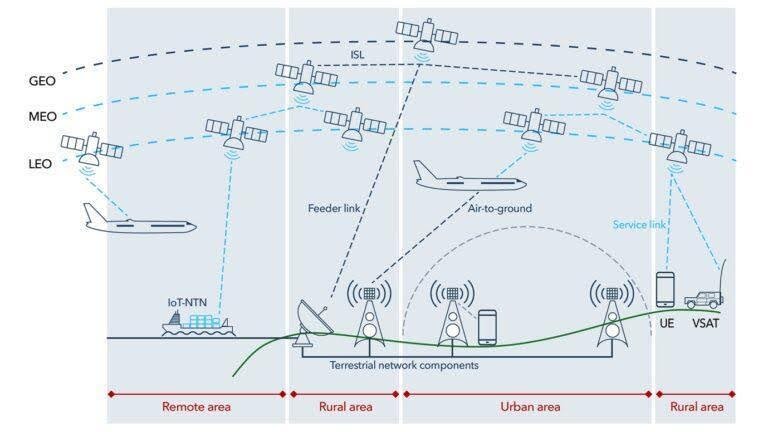
Screenshot from “Regulation of NGSO Satellite Constellations,” International Telecommunication Union and Digital Regulation Platform from European Space Agency data, March 3, 2024, digitalregulation.org/regulation-of-ngso-satellite-constellations.
From GEO to LEO Satellites: A New Space Race
Global satellite communications first began in the 1960s with GEO and MEO satellites. In 1962, AT&T, with help from NASA, launched Telstar 1—a medium orbit satellite that enabled transatlantic television transmission from the United States to the United Kingdom and France.13 In 1964, Syncom 3, developed by Hughes Aircraft Co., became the first satellite in geostationary orbit, and transmitted live coverage of the 1964 Tokyo Olympics to one-third of the globe.14 From these initial launches until the 1990s, GEO and MEO satellites dominated the satellite-communications industry, delivering telephone and broadcast radio and television services across the globe.
In 1998, both Iridium and Globalstar launched LEO satellite mobile-communications services.15 High costs, limited market share, and long timelines to bring networks online, however, often meant the LEO networks of the 1990s failed to gain competitive viability relative to other terrestrial-service providers.16 In 2003, Eutelsat would launch e-BIRD, the first geostationary satellite designed to deliver broadband.17
Despite previous false starts, advances in satellite and launch technologies over the past decade have lowered the cost to bring LEO constellations online and to improve performance, thereby renewing the promise for future LEO-based communications and ushering in a new space race. By 2024 there were an estimated 10,000 active satellites in orbit, up tenfold from 1,000 satellites in 2014.18
With operators around the world filing with the ITU to bring hundreds of thousands of new satellites online in the coming years, Goldman Sachs Research forecasts as many as 70,000 LEO satellites to be launched within the next five years.19 To deter early filers from “warehousing” spectrum or reserving it for future use, satellite operators must deploy systems within seven years of the ITU receiving its request or their claim expires. For LEO satellites, operators are required to deploy 10 percent of a planned constellation within two years, 50 percent within five years, and total deployment within seven years to maintain their spectrum authorization.
The LEO satellite field is occupied by only a small number of companies, with SpaceX’s Starlink dominating satellites in orbit. One estimate found that Starlink operated roughly 60 percent of 10,000 functioning satellites as of 2024. As of July 2025, Starlink reports having more than 7,800 satellites in orbit.20 Starlink originally planned to launch 12,000 satellites for its constellation, but later expanded the project to 42,000 satellites.21 Other companies—including Eutelsat’s OneWeb (operating 630 satellites), Telesat (operating 198 satellites), Amazon’s Project Kuiper (launched 129 of its planned 3,000 satellite constellation as of September 2025), and Iridium Communications (operating 80 satellites)—are working to carve out market share for LEO-based connectivity for residential, enterprise, and government consumers.22
At the same time, many countries are exploring opportunities to advance and invest in the commercial LEO sector. Canada, China, and the EU are developing and heavily investing in national LEO satellite systems. The Canadian government provided Telesat Lightspeed a C$2.14 billion loan to develop and operate a LEO network to advance national connectivity and defense.23 In December 2024, the European Commission announced a contract to build a multi-orbital constellation of 290 satellites for its Infrastructure for Resilience, Interconnectivity and Security by Satellite (IRIS²) project.24 In China, two megaconstellation projects—Guowang and Qianfan—have plans to launch 13,000 and 14,000 LEO satellites respectively.25 As the field of LEO satellite connectivity matures, the orbital range is expected to become increasingly crowded, limiting orbital and spectrum availability while increasing space traffic and debris.
While LEO-based solutions are on the rise, some are already pushing for a new era of the final frontier: multi-orbit satellite connectivity. By integrating satellite service from multiple orbits, advocates hope to dynamically route service and capacity needs between GEOs, MEOs, and LEOs to provide reliable, flexible, and quality service for consumers.26 Developing multi-orbit service configurations depends, however, on first establishing a robust LEO satellite ecosystem.
Incorporating LEO Systems into the Existing Infrastructure
As LEO systems continue to come online, the existing connectivity infrastructure is struggling to accommodate and integrate this new technology. With LEO satellite growth expected to rise exponentially in the coming years, it is critical to assess and address barriers to LEO system inclusion to fully capture the potential to better connect everyone, everywhere.
This report outlines three major challenges currently facing LEO satellite inclusion and offers recommendations specific to the U.S. context:
- Chapter I explains how the proliferation of LEO systems is straining spectrum availability and existing regulatory structures that were not designed to accommodate the nascent field’s emergence or the speed of its growth. The chapter offers proposals to reform the current system to more efficiently accommodate a growing number of LEO systems and their expected rapid development.
- Chapter II examines the current LEO competition environment across four principal dimensions: market structure, barriers to entry, competitive differentiation, and potential anticompetitive conduct. While competition within the sector is intensifying, it is often skewed, and the chapter suggests ways for policymakers to monitor the development of the field to ensure robust and sustainable competition.
- Chapter III looks at the role of LEO satellites in bridging the digital divide and helping to provide broadband access across the United States, with an emphasis on their strengths and limitations. The chapter provides policymakers with key considerations and recommendations for how to utilize and integrate LEO systems into current universal service programs.

Low Earth Orbit Satellites: Policies to Promote Spectrum Sharing, Foster Competition, and Close Digital Divides
- About the LEO Policy Working Group
- Foreword
- Executive Summary
- A Brief Introduction to Low Earth Orbit (LEO) Satellites
- Chapter I. Fueling Connectivity from Space: Spectrum Sharing and Coexistence
- Chapter II. The Final Economic Frontier: Satellite Competition in Low Earth Orbit
- Chapter III. Connectivity from New Horizons: How LEO Satellites Help Bridge the Digital Divide
Citations
- Satellites in MEO or LEO are also referred to as non-geostationary satellite orbit (NGSO), meaning they move in relation to the Earth rather than remaining stationary. “Large Constellations of Low-Altitude Satellites: A Primer,” Congressional Budget Office, May 2023, https://www.cbo.gov/publication/59175; Lisa Sodders, “LEO, MEO or GEO? Diversifying Orbits Is Not a One-Size-Fits-All Mission (Part 1 of 3),” Space Systems Command, July 18, 2023, https://www.spoc.spaceforce.mil/News/Article-Display/Article/3462529/leo-meo-or-geo-diversifying-orbits-is-not-a-one-size-fits-all-mission-part-1-of; Lisa Sodders, “LEO, MEO or GEO? Diversifying Orbits Is Not a One-Size-Fits-All Mission (Part 2 of 3),” Space Systems Command, July 20, 2023, https://www.ssc.spaceforce.mil/Newsroom/Article-Display/Article/3465697/leo-meo-or-geo-diversifying-orbits-is-not-a-one-size-fits-all-mission-part-2-of; Lisa Sodders, “LEO, MEO or GEO? Diversifying Orbits Is Not a One-Size-Fits-All Mission (Part 3 of 3),” Space Systems Command, July 21, 2023, https://www.ssc.spaceforce.mil/Newsroom/Article-Display/Article/3465828/leo-meo-or-geo-diversifying-orbits-is-not-a-one-size-fits-all-mission-part-3-of.
- “What is Network Latency,” Amazon, https://aws.amazon.com/what-is/latency.
- Perspectives on LEO Satellites: Using Low Earth Orbit Satellites for Internet Access (Internet Society, 2022), https://www.internetsociety.org/resources/doc/2022/perspectives-on-leo-satellites.
- “Using Laser Transceivers for LEO Satellite Links,” Tech Briefs, January 1, 2023, https://www.techbriefs.com/component/content/article/47300-using-laser-transceivers-for-leo-satellite-links.
- “What is Spectrum? A Brief Explainer,” CTIA, June 5, 2018, https://www.ctia.org/news/what-is-spectrum-a-brief-explainer.
- Spectrum Management Training Program, “Interference,” International Telecommunications Union Academy, 2020, https://www.itu.int/en/ITU-D/Regional-Presence/ArabStates/Documents/events/2020/SM/Pres/D3S1Interference.pdf.
- “Regulation of NGSO Satellite Constellations,” Digital Regulation Platform, March 28, 2024, https://digitalregulation.org/regulation-of-ngso-satellite-constellations/#post-3004751-footnote-10.
- “Ku, K, Ka Bands in LEO Satellites,” Reliasat, January 25, 2024, https://reliasat.com/ku-k-and-ka-bands-in-leo-satellites.
- “Regulation of Satellite Systems,” International Telecommunications Union, February 2022, https://www.itu.int/en/mediacentre/backgrounders/Pages/Regulation-of-Satellite-Systems.aspx; “International Satellite Coordination,” Federal Communications Commission, April 17, 2024, https://www.fcc.gov/space/international-satellite-coordination.
- Federal Communications Commission, SpaceX Services, Inc. Application for Blanket Authorization of Next-Generation Ku-Band Earth Stations in Motion, IBFS File No. SES-LIC-20210803-01360 Call Sign E210309, SpaceX Services, Inc. Application for Blanket Authorization of HighPerformance Ku-Band Earth Stations in Motion, IBFS File No. SES-LIC-20210803-01361 Call Sign E210310, and Kepler Communications Inc. Application for Blanket Authorization of Ku-Band Earth Stations on Vessels, IBFS File No. SES-LIC-20210809-01568 Call Sign E210416, Order and Authorization, (rel. June 30, 2022), https://docs.fcc.gov/public/attachments/DA-22-695A1.pdf.
- Federal Communications Commission, Single Network Future: Supplemental Coverage from Space, Report and Order and Further Notice of Proposed Rulemaking, GN Docket No. 23-65 (rel. March 15, 2024), https://www.fcc.gov/document/fcc-advances-supplemental-coverage-space-framework-0.
- Michael Sheetz, “Apple Commits $1.5 Billion to Globalstar for Expanded iPhone Satellite Services,” CNBC, November 1, 2024, https://www.cnbc.com/2024/11/01/apple-commits-1point5-billion-to-globalstar-for-iphone-satellite-services.html.
- David J. Whalen, “Communications Making the Global Village Possible,” National Air and Space Administration, November 30, 2010, https://www.nasa.gov/history/communications-satellites; “Bell-Labs Telstar,” Bell System Memorial, https://memorial.bellsystem.com/telstar.html; “Telstar,” Smithsonian National Air and Space Museum, https://airandspace.si.edu/collection-objects/communications-satellite-telstar/nasm_A20070113000.
- “A Brief History of Satellite Communications,” Ground Control, https://www.groundcontrol.com/knowledge/guides/a-brief-history-of-satellite-communications.
- “T-Minus Ten Years to First Launch,” Iridium Museum, https://www.iridiummuseum.com/exhibits/t-minus-10-years-to-first-launch; “Globalstar Telcom Network Launched,” Wired, February 16, 1998, https://www.wired.com/1998/02/globalstar-telecom-network-launched.
- J. Armand Musey, “Satellite Bankruptcies Circa 2020: We’ve Come a Long Way!” SpaceNews, April 15, 2021, https://spacenews.com/op-ed-satellite-bankruptcies-circa-2000-vs-2020-weve-come-a-long-way.
- “e-Bird, The First Satellite Designed for Internet Broadband Lofted into Orbit for Eutelsat,” SpaceNews, September 28, 2003, https://spacenews.com/e-bird-the-first-satellite-designed-for-internet-broadband-lofted-into-orbit-for-eutelsat.
- “Space Connect: The Rise of LEO Satellite Constellations,” International Telecommunications Union, February 11, 2025, https://www.itu.int/hub/2025/02/space-connect-the-rise-of-leo-satellite-constellations.
- Ryan Duffy, “Astra, Hughes Net, Inmarsat, Telesat, and Others File Constellation Applications,” Payload, November 5, 2021, https://payloadspace.com/https-spaceexplored-com-2021-11-04-astra-hughes-net-inmarsat-and-telesat-all-file-for-satellite-constellations-boeing-constellation-approved; “The Global Satellite Market Forecast to Become Seven Times Bigger,” Goldman Sachs, March 5, 2025, https://www.goldmansachs.com/insights/articles/the-global-satellite-market-is-forecast-to-become-seven-times-bigger.
- “Starlink Network Update,” Starlink, July 2025, https://www.starlink.com/updates/network-update; some estimates, however, put this figure closer to over 8,000 active satellites. Tereza Pultarova, “Starlink Satellites: Facts, Tracking, and Impact on Astronomy,” Space.com, August 1, 2025, https://www.space.com/spacex-starlink-satellites.html.
- Sissi Cao, “SpaceX Expands Starlink Project to 42,000 Satellites, ‘Drowns’ ITU in Filing Paper,” Observer, October 21, 2019, https://observer.com/2019/10/spacex-elon-musk-starlink-satellite-internet-itu-fcc-filing.
- “Our Network,” Eutelsat OneWeb, https://oneweb.net/our-network; “LEO Network,” Telesat, https://www.telesat.com/leo-satellites; “Project Kuiper,” Amazon, https://www.aboutamazon.com/what-we-do/devices-services/project-kuiper; “Kuiper Mission Updates,” Amazon, accessed on September 16, 2025, https://www.aboutamazon.com/news/innovation-at-amazon/project-kuiper-satellite-rocket-launch-progress-updates; “Iridium Adds to Constellation Resilience with Launch of Spare Satellites,” Iridium, May 20, 2023, https://investor.iridium.com/2023-05-20-Iridium-Adds-to-Constellation-Resilience-with-Launch-of-Spare-Satellites.
- “High-Speed Internet Across the Country with Canada’s Largest Space Program,” Prime Minister of Canada, September 13, 2024, https://www.pm.gc.ca/en/news/news-releases/2024/09/13/high-speed-internet-across-country-canadas-largest-space-program.
- “Commission Takes Next Step to Deploy to Deploy the IRIS² Secure Satellite System,” European Commission, December 16, 2024, https://ec.europa.eu/commission/presscorner/api/files/document/print/en/ip_24_6439/IP_24_6439_EN.pdf.
- Stephen Clark, “China Orbits First Guowang Internet Satellites, with Thousands More to Come,” Ars Technica, December 16, 2024, https://arstechnica.com/space/2024/12/china-orbits-first-guowang-internet-satellites-with-thousands-more-to-come.
- “Multi-Orbit Connectivity Advancing Innovation in Satellite Communications,” Payload, April 15, 2024, https://payloadspace.com/multi-orbit-connectivity-advancing-innovation-in-satellite-communications; Jason Rainbow, “Dawn of the Multi-Orbit Era,” SpaceNews, March 11, 2024, https://spacenews.com/dawn-of-the-multi-orbit-era.