Public Opinion and Threat Hierarchies
Changing Threat Hierarchies
Since the Cold War, Americans have consistently regarded nuclear weapons as dangerous but have not consistently viewed them with urgency.18 Concern has spiked during crises—such as the Cuban Missile Crisis, the early 1980s arms race, and post-9/11 fears of nuclear terrorism—but each surge faded as immediacy declined.19 Today, polling shows that while most Americans acknowledge nuclear risk, they rarely rank it among the nation’s most pressing concerns.
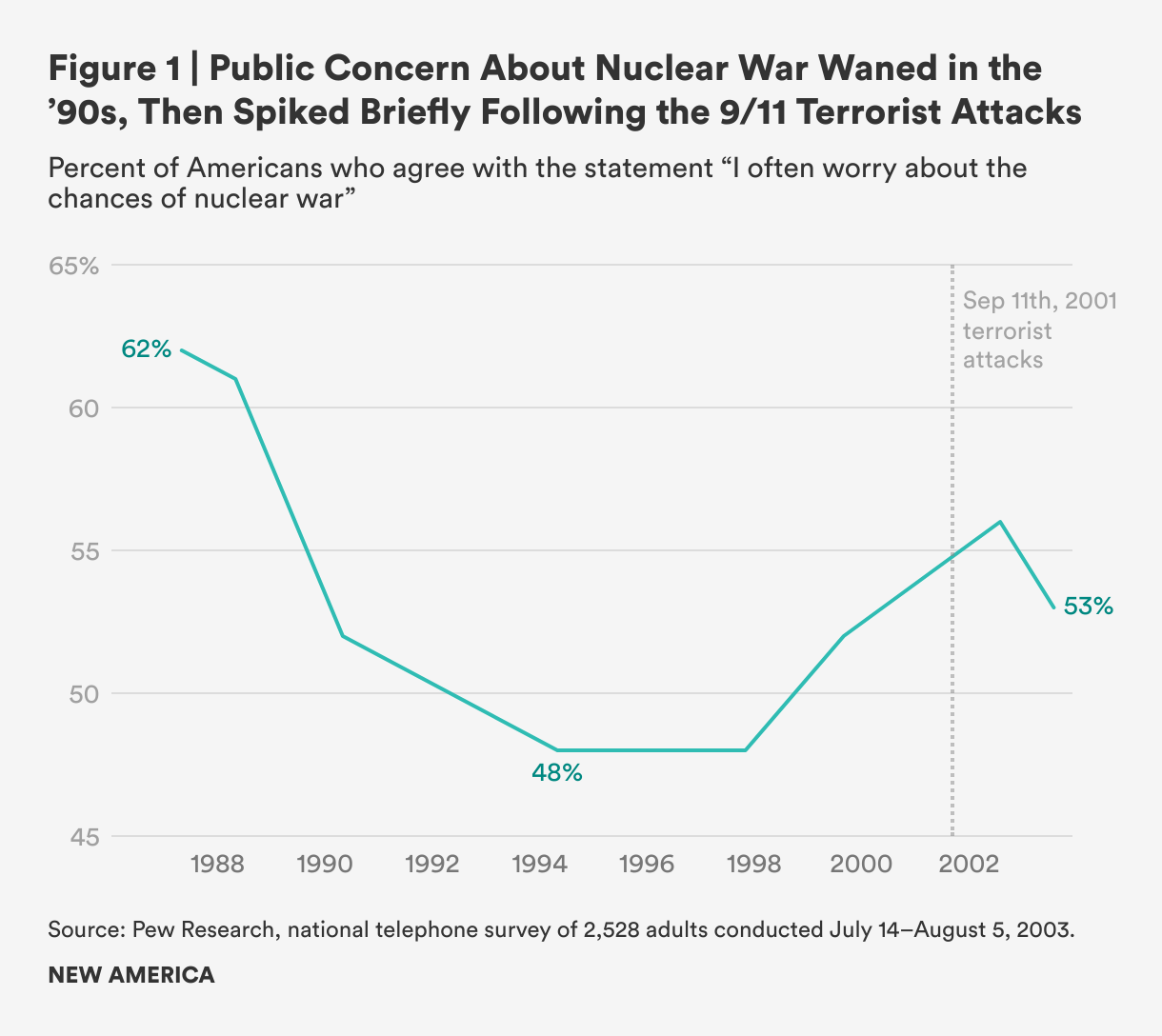
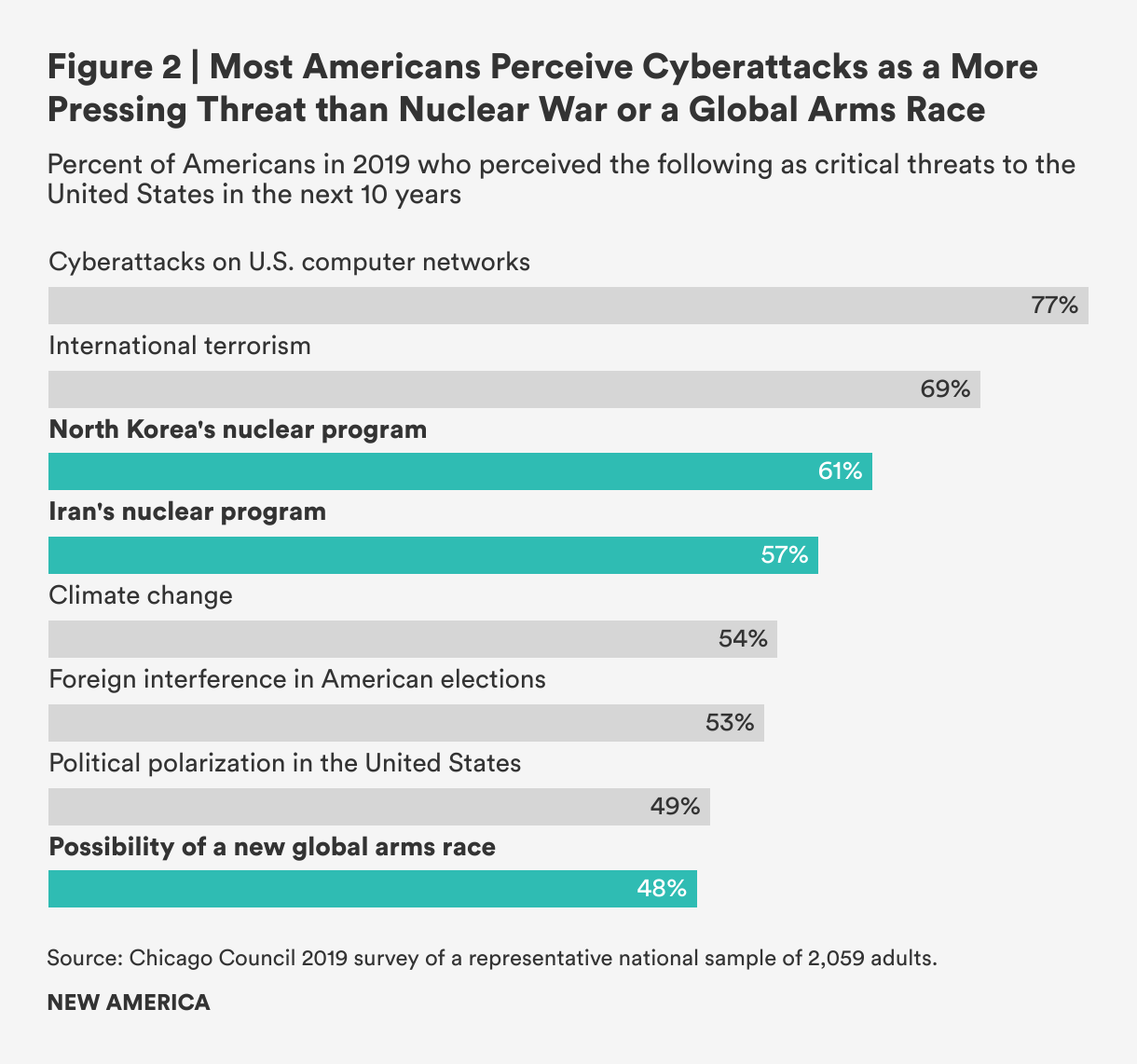
During the Cold War, anxiety drove broad mobilization—the 1980s nuclear freeze campaign drew support from roughly 70 percent of Americans. But by the 1990s, immediacy faded: Only about half of Americans still reported worrying about nuclear war.20 The pattern repeated after 9/11, when fears of nuclear terrorism briefly renewed attention, before subsiding again.21 By the late 2010s, the public’s threat hierarchy had reordered around more tangible risks: A 2019 Chicago Council survey showed that most Americans viewed cyberattacks, climate change, and terrorism as greater threats than a new arms race, which only 48 percent identified as a critical threat.
In a notable exception, their third-ranked concern was North Korea’s nuclear program—a reflection, not of broad anxiety about nuclear weapons, but of heightened media attention and the personalization of risk around a single adversary, which then faded.22
The onset of the COVID-19 pandemic followed a comparable dynamic. In a 2020 Pew Research Center polling, 79 percent of Americans identified the spread of infectious disease as a “major threat” to the United States, ranking above both terrorism and the spread of nuclear weapons (each 73 percent).23 Yet by February 2025, only about one in five Americans continued to view COVID-19 as a major threat—a decline of more than 45 percentage points since 2020.24 The arc of pandemic concern underscores how quickly salience decays once an emergency recedes from daily experience (although nuclear weapons have sustained a higher baseline concern than has COVID).
A 2020 Chicago Council survey found that when Americans were asked to identify the top critical threats to U.S. vital interests over the next decade, nuclear weapons did not appear among the seven leading concerns.25 Instead, respondents prioritized the COVID-19 pandemic, domestic violent extremism, and China’s rise as a global power. However, partisan divisions shaped nuclear attitudes: Republicans included Iran’s (54 percent) and North Korea’s (53 percent) nuclear programs among their top concerns, while Democrats omitted nuclear issues entirely, focusing instead on climate change, racial inequality, and election interference.
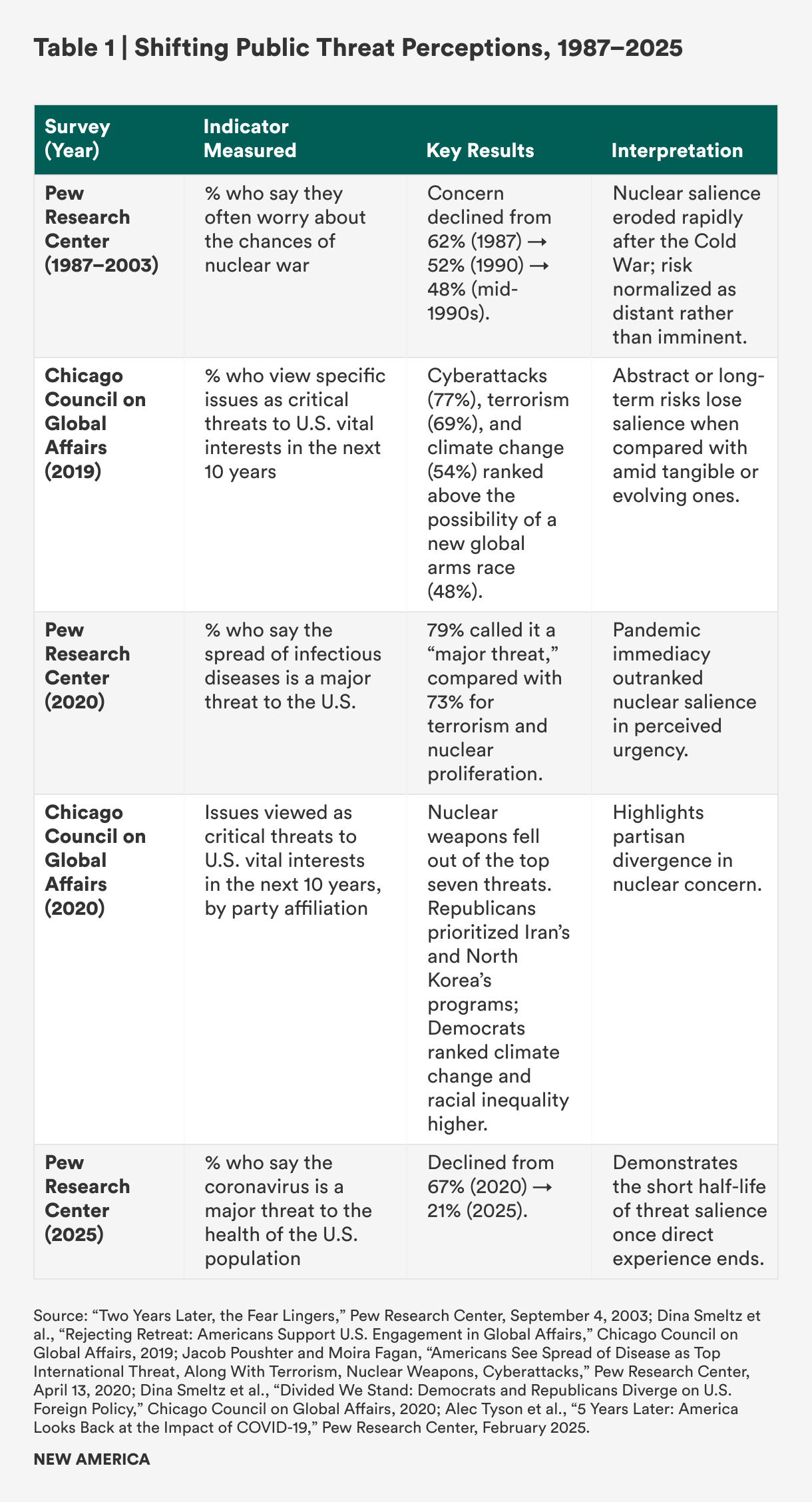
Interpreting public opinion on nuclear risk requires caution. Survey questions differ in what they measure—whether people fear nuclear war, view nuclear weapons as a major threat, or see them as important to U.S. national security. Still, taken together, these indicators trace a clear pattern: While Americans continue to recognize nuclear weapons as dangerous, their concern has become increasingly conditional, spiking around crises or specific adversaries, then fading as immediacy fades.
Across decades, several dynamics stand out:
- Immediacy and visibility govern attention. Threats that feel lived—pandemics, terrorism, natural disasters—dominate the public hierarchy of concern.
- Nuclear danger has become abstract. Without visible cues, Americans are less likely to perceive nuclear risk as urgent.
- Partisanship fragments perception. Republicans emphasize adversaries’ programs; Democrats emphasize systemic risks like climate change or inequality.26
Americans thus tend to locate danger in others’ arsenals while viewing their own as stabilizing—a reflection of deterrence framing and limited engagement with nuclear risks as a domestic concern. In addition, compared with other global threats, nuclear weapons are acknowledged but not activating. Issues such as climate change or pandemics offer visible cues, moral clarity, and tangible pathways for action; nuclear risks, by contrast, lack immediacy and accessible points of engagement. As a result, awareness seldom translates into agency. The central challenge for policymakers and advocates is therefore not recognition but relevance—making nuclear danger felt, not merely understood.
Strategic and Moral Ambivalence
While most Americans still endorse deterrence in principle, confidence in its necessity and moral legitimacy has eroded over time. Public opinion polling over several decades reveals a shift from conviction to conditional acceptance: Nuclear weapons are tolerated as legacy instruments of security rather than actively endorsed as policy tools.
In Rasmussen Reports surveys from 2012–2013, an overwhelming majority (80 percent) said that maintaining nuclear weapons was at least “somewhat important” to U.S. national security. However, the share describing them as “very important” declined from 57 percent in 2012 to 45 percent in 2013, suggesting an erosion of certainty about their strategic value.27
Similarly, YouGov (2024) and Pew Research Center (2025) polling data show that Americans now express widespread skepticism about whether having nuclear weapons make either the United States—or the world—safer.28 The table below summarizes key findings from major public opinion surveys on the perceived value, morality, and desirability of nuclear weapons.
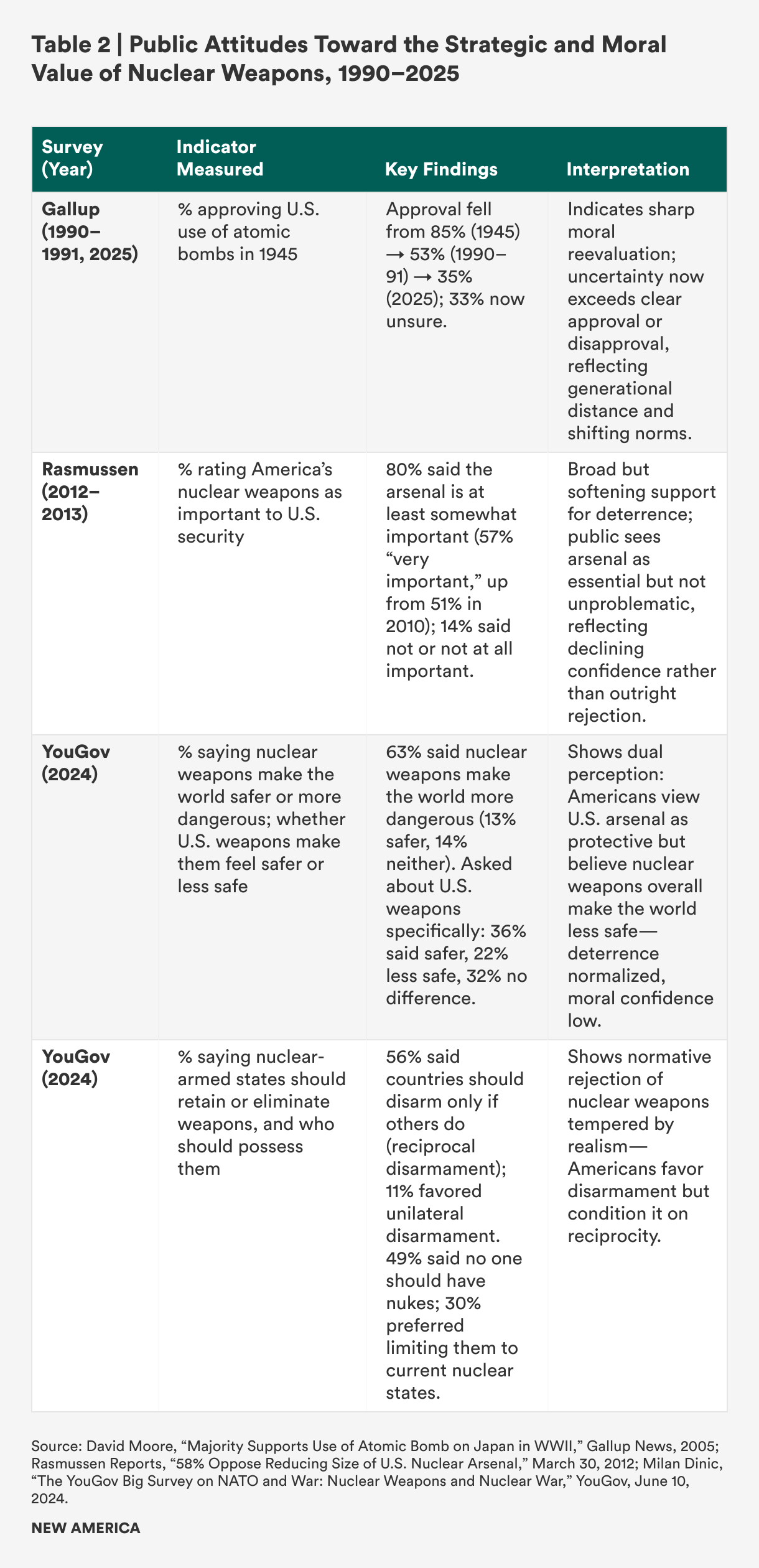
These data reveal three interrelated trends:
- Strategic uncertainty: Most Americans still see nuclear weapons as part of U.S. security, but confidence in their necessity and effectiveness has weakened.
- Moral ambivalence: Approval of nuclear use has declined sharply over time, with uncertainty replacing conviction.
- Reciprocal idealism: The public favors disarmament in principle but hesitates in practice unless all states participate—reflecting a preference for shared restraint rather than unilateral leadership.
Taken together, these findings reveal a public that recognizes the dangers of nuclear weapons but feels neither empowered nor morally compelled to act. Americans still acknowledge these weapons’ deterrent role but are less persuaded of their legitimacy or value as tools of security. Those who do perceive nuclear danger tend to externalize it—focusing on adversaries’ programs, such as those in North Korea or Iran, rather than on the risks of maintaining or modernizing the U.S. arsenal. The result is a form of psychological distance: Nuclear risk is understood, even feared, but rarely felt as proximate or actionable. Awareness has become acknowledgment without agency—a defining feature of contemporary nuclear politics and the central paradox this report seeks to explain.
Demographic Patterns in Nuclear Threat Perceptions
Public attitudes toward nuclear weapons are not uniform. Beneath aggregate polling averages lie deep variations by generation, gender, and political identity that reveal how experience, worldview, and socialization shape what kinds of danger people recognize—and whether they feel able to respond. These differences matter because they determine not only who worries about nuclear risk, but how that worry is interpreted: as moral outrage, strategic realism, or background noise. In this sense, demographic divides function as cognitive filters through which nuclear risk becomes meaningful—or fails to.
Generational Divides Remain Pronounced
Younger adults, distant from Cold War memory, are more likely to view nuclear weapons as stabilizing: In a 2024 YouGov survey, 17–18 percent of those aged 18 to 29 said nuclear weapons make the world safer, compared with about 10 percent of those over 40.29 Concern rises steeply with age: Nearly three-quarters (72 percent) of adults over 60 said nuclear weapons make the world more dangerous, compared with just over half of younger respondents. Older Americans, socialized through duck-and-cover drills and missile crises, perceive nuclear danger as real but managed; younger generations regard it as an abstraction outside lived experience.
Gender Differences Follow a Similar Pattern
Men are nearly twice as likely as women to view nuclear weapons as contributing to global safety, while women are slightly more likely to describe them as making the world more dangerous (64 percent vs. 61 percent).30 This aligns with longstanding research showing that women and caregivers express greater moral and humanitarian concern but lower perceived agency—interpreting nuclear risk through human impact rather than strategic stability.31
Partisan Divides Compound These Differences
In a 2025 Pew survey, majorities in both parties said nuclear weapons make the world less safe, but their reasoning diverges.32 Among Democrats, 56 percent said nuclear weapons make the United States less safe; among Republicans, only 37 percent agreed, and 38 percent said they make the country safer. Republicans thus frame deterrence as strength; Democrats see restraint as security. These partisan lenses reinforce interpretive gaps in what “safety” itself means.
Preparedness and Agency Vary
In the same YouGov survey, nearly half of Americans (47 percent) reported never having considered what they would do in a nuclear attack, with women (52 percent) and younger adults more likely to say so.33 Men and older adults—groups more exposed to historical crises—were significantly more likely to have thought through a response. This suggests that experience and identity shape not only perceptions of risk but also imagined capacity to act.
Together, these patterns underscore a central point: Awareness of nuclear danger is widespread but fragmented by social position. Younger Americans tend to view the threat as distant; older ones as familiar but normalized. Women register higher concern but less agency, while men and conservatives rationalize risk through deterrence. The barrier, then, is not ignorance but interpretation—people understand nuclear risk in fundamentally different ways. For advocates and policymakers, the task is no longer to amplify awareness, but to convert recognition into agency: designing messages and interventions that address the cognitive, moral, and social filters through which different publics perceive, prioritize, and act on nuclear danger.
How Americans View Issues of Nuclear Use and Taboo
Public attitudes toward nuclear use reveal the same pattern of conditional acceptance that characterizes broader views of deterrence and danger. Most Americans support the nuclear taboo—the powerful moral and norm against the use of nuclear weapons—but their support weakens when use is framed as defensive or necessary.
A 2024 YouGov survey found that 65 percent of Americans said it would be unacceptable for the United States to use nuclear weapons first.34 This rejection was particularly strong among older adults (over 75 percent among those aged 60+) and among Democrats (70 percent compared with 65 percent of Republicans). Yet when asked about retaliation, the picture changed: 61 percent said they would support U.S. use of nuclear weapons in response to a nuclear attack, rising to 74 percent among Republicans and 63 percent among Democrats. The moral duality—aversion to initiating nuclear use coupled with acceptance of retaliatory use—illustrates how Americans reconcile fear with faith in deterrence.
A 2024 University of Massachusetts Amherst poll comparing civilian and military attitudes highlights this divide further.35 When asked whether the United States should ever use nuclear weapons under “limited and extreme circumstances,” a slim majority of both groups agreed. Yet absolute rejection of nuclear use was far more common among civilians: One-third (33 percent) said the U.S. president should never authorize nuclear use, compared with 21 percent of military respondents. Professional proximity to nuclear planning appears to normalize conditional use, while distance from the operational domain reinforces moral absolutism among civilians.
Across both groups, humanitarian concerns, such as civilian harm and environmental devastation, were the strongest arguments against nuclear use, far outweighing legal and normative rationales. Both military and public respondents ranked “violating the norm of non-use” near the bottom of their reasoning hierarchies, underscoring how restraint is moral and emotional, not procedural.36
Demographic patterns mirror these divisions. The military sample was older, male, and Republican-leaning; the public was younger, more gender balanced, and leaning Democratic by 32 points. These differences echo broader trends: Men are more likely than women to view the Hiroshima and Nagasaki bombings as justified; older Americans more likely than younger; and Republicans more likely than Democrats. In short, attitudes towards nuclear use are shaped by social identity and political worldview—how people balance moral restraint against perceptions of national strength, as well as historical memory.
These attitudes show that awareness of nuclear danger coexists with rationalizations for its potential use. Americans broadly recognize the catastrophic consequences of nuclear weapons, but interpret them through identity, ideology, and emotion. Fear coexists with justification, and moral restraint with strategic rationalization. This fragmentation dilutes collective concern and weakens the shared sense of taboo that, during the Cold War, once drove engagement.
How Americans Think About Nonproliferation and Disarmament
Public opinion on disarmament reveals the same ambivalence that shapes broader attitudes towards nuclear weapons: moral support for abolition in principle, tempered by strategic caution in practice. Americans endorse a world without nuclear weapons but hesitate when elimination requires unilateral sacrifice or trust in rivals.
A 2024 YouGov survey found that nearly half of Americans (49 percent) believe no country should possess nuclear weapons, with women substantially more likely than men to hold this view.37 Partisan differences were also pronounced: 55 percent Democrats supported universal disarmament, compared with 40 percent of Republicans. Men and Republicans were more likely to favor maintaining the status quo—limiting nuclear possession to existing nuclear powers—while a small minority (12 percent said non-nuclear states should be allowed to develop nuclear weapons.
These results reflect a tension between moral aspiration and strategic objectives or reciprocity. While most Americans express ethical opposition to nuclear weapons, their willingness to eliminate them depends on mutual compliance (vs. unilateral action). This logic mirrors the structure of deterrence itself: Trust only works if symmetrical.
Support for complete abolition remains high in theory but collapses under conditions of asymmetry. Just 11 percent of respondents favored U.S. unilateral disarmament, and fewer than one in five (19 percent) said nuclear-armed countries should be required to give up their arsenals before others. In short, Americans imagine disarmament as an end state, not a process—desirable but distant, and contingent on others moving first.38
This “reciprocal idealism” helps explain why awareness seldom translates into advocacy. Disarmament is framed as a moral goal rather than a policy pathway—something to support, not to pursue. Public faith in deterrence as a guarantor of order, combined with uncertainty about alternatives, keeps nuclear policy insulated from mass mobilization. The result is moral agreement without political energy: a shared ideal stripped of agency.
Education, Geography, and Public Perceptions of Nuclear Authority
Americans’ understanding of nuclear risk is shaped not only by ideology and generation but also by education, geography, and trust in institutions—factors that together determine how people interpret information and whom they believe.
Education and Cognitive Confidence
Education exerts a paradoxical influence on nuclear perception. Less educated Americans tend to be more skeptical of existential risks, reflecting lower scientific literacy and weaker trust in expert authority.39 This is due to the so-called “science confidence gap”: the tendency for less educated individuals to possess lower scientific literacy and greater distrust of scientific authority.40 Conversely, higher education can foster overconfidence: Even trained national security professionals often display exaggerated certainty about probabilities and outcomes. A 2024 NATO study by Jeffrey Friedman found that senior military officers and policy officials routinely overestimated their accuracy when assessing nuclear and geopolitical threats.41 Such overconfidence can lead to threat inflation (exaggerating the likelihood of adverse events), but in the nuclear context, it may instead produce threat deflation (confidence in deterrence that downplays catastrophic risk and encourages maximalist policies without fully accounting for unintended consequences).42 In short, lower education produces complacency; higher education, overconfidence—each in its own way blunting adaptive awareness.
Regional Context and Proximity
Geography also shapes perceptions of risk. During the Cold War, city dwellers reported higher anxiety about nuclear attack than rural residents; today, nuclear awareness clusters sporadically around perceived “target” regions or moments of proximity.43 The 2018 Hawaii false missile alert briefly reignited local fear and revealed how little preparedness or understanding most citizens had of actual response protocols. Such moments show that distance from perceived targets dulls vigilance—where proximity, whether geographic or experiential—can still provoke acute but fleeting engagement.
Nuclear Literacy and Institutional Trust
Despite low baseline knowledge, curiosity remains high. Polling evidence suggests that most Americans have low levels of nuclear literacy. A 2019 University of Maryland study found that nearly half of respondents thought the U.S. nuclear arsenal was larger than it actually is, while only about one in eight thought it was smaller. Similarly, most Americans assumed that other countries’ nuclear stockpiles were greater than their actual size.44
A 2023 Chicago Council survey found that while most Americans said they understand the effects of nuclear weapons, far fewer reported familiarity with their potential targets (31 percent), U.S. nuclear policy (30 percent), or the costs of maintaining the arsenal (20 percent)—even though cost is the most tangible way for taxpayers to participate in nuclear decision-making.45 A 2023 Chicago Council poll likewise revealed that fewer than half of Americans expressed confidence in the government’s ability to manage nuclear weapons responsibly. In a University of Amherst study, when asked whom they trust, majorities (55 percent) cited the military and academics as reliable messengers, while fewer expressed confidence in journalists (43 percent), the president (43 percent), Congress (37 percent), or activist groups (22 percent). When asked where they would seek information about U.S. nuclear weapons policy, respondents most often cited television (24 percent), the government (21 percent), academics (16 percent), and social media (13 percent).46 Notably, the poll did not ask about NGOs. Television remains the most common source of information, but the other institutions Americans are likely to rely on—the military, academics, and government—are those whose legitimacy depends on deterrence, reinforcing the perception that nuclear stability is a technical matter best left to experts.
Despite this limited knowledge, public curiosity remains high: Six in 10 Americans said they would like to learn more about U.S. nuclear policy, and nearly a quarter (24 percent) admitted they wanted answers to “basic questions.” Interestingly, those who reported greater familiarity with U.S. nuclear policy were also more likely to believe that nuclear weapons make the country safer, suggesting a familiarity may reinforce rather than challenge existing deterrence assumptions.
Although polling data is often interpreted as evidence that the public does not care about nuclear risk, what emerges from cross-poll analysis is something more nuanced: Americans are broadly aware of nuclear danger but rarely translate that recognition into sustained concern or action. Most people acknowledge the catastrophic potential of nuclear weapons and support arms control in principle, yet they rank nuclear risk far below more visible or immediate threats. This reflects a familiar cognitive gap between awareness and engagement. Nuclear danger is recognized but not prioritized; it is concerning but not actionable.
Americans are not apathetic but deferential—curious about nuclear risk yet inclined to trust the authorities who sustain the deterrence status quo. The result is a public that acknowledges danger but rarely claims ownership over it.
This gap between curiosity and responsibility is intensified by another structural feature of the U.S. nuclear landscape: No institution is formally tasked with alerting the public to nuclear risk. Unlike public health, disaster preparedness, or climate science—domains with clearly designated communicators—nuclear warning has emerged piecemeal and organically, driven largely by NGOs, activist networks, and a handful of research organizations. In the United States, this role is diffuse across groups such as the Bulletin of the Atomic Scientists, Ploughshares, and the Nuclear Threat Initiative, among others. Internationally, the pattern is similar: In the U.K., organizations like the British American Security Information Council (BASIC) and the Campaign for Nuclear Disarmament (CND) often fill the gap. In Japan, hibakusha (survivors of the Hiroshima and Nagasaki bombings) networks, local peace museums, and civil society do much of the educational work. And in NATO states, warning typically comes from NGOs rather than government ministries. The absence of a dedicated, authoritative communicator means that nuclear risk enters public consciousness only when NGOs mobilize attention or when geopolitical crises erupt.
Bridging Awareness and Action: Fading Salience and Global Contrasts
Despite widespread unease about nuclear weapons, Americans remain largely unprepared to act—a reminder that awareness seldom translates into mobilization. Nuclear anxiety, once central to Cold War civic life, has receded amid more visible and proximate dangers. In an era of information saturation and renewed great-power competition, why does the world feel more dangerous even as nuclear concern fades? The answer lies partly in perception: Nuclear risk has become cognitively distant, politically normalized, and emotionally abstract.
Fading Salience
Americans respond most strongly to risks they can see or experience—such as pandemics, cyberattacks, climate disasters, and terrorism—while rare, catastrophic risks like nuclear war feel remote. This tendency reflects not simply a distraction by the news but a cognitive bias: People privilege immediacy over probability, salience over scale. As the next section explores, cognitive and behavioral biases, such as temporal discounting, ambiguity aversion, and scope neglect, make existential threats seem unmanageable or unreal.
Yet the picture is not one of indifference. Pew surveys from 2019 to 2020 found that 72 percent of both Republicans and Democrats viewed the spread of nuclear weapons as a “critical threat,” and concern about North Korea’s nuclear program was nearly identical across parties.47 This shows latent bipartisan concern even as salience declines. In contrast, climate change—often framed as an existential risk of similar magnitude—remains one of the most polarizing issues in U.S. politics. This shared baseline of unease represents a rare foundation for rebuilding civic attention, even if it has not yet translated into sustained engagement.
Global Contrasts
Globally, public opinion tells a strikingly different story: stronger awareness and greater moral opposition than in the United States, yet persistent strategic ambivalence. A 2023 Vienna Center for Disarmament and Non-Proliferation survey found that 68–85 percent of respondents across 24 countries supported their nation joining the Treaty on the Prohibition of Nuclear Weapons, with minimal differences between the Global North and South.48 Yet the same study showed that only 31 percent supported unilateral U.S. reductions, and in roughly one-third of countries, majorities favored acquiring or expanding national arsenals.
Similarly, the 2024 Elders Survey showed that 58 percent of respondents across five countries—the United States, South Africa, Brazil, India, and Indonesia—viewed nuclear weapons as a major threat—second only to climate change—a position particularly pronounced in countries without nuclear capabilities. Interestingly, nearly 70 percent of respondents supported total disarmament.49 In Europe, majorities in NATO host states such as Germany, Italy, and Belgium favored removing U.S. nuclear weapons from their soil.50
This contrast underscores the exceptionalism of U.S. nuclear psychology. Where other publics view nuclear weapons as a humanitarian emergency, Americans have learned to domesticate existential risk—treating it as a technical issue managed by experts. Understanding this normalization is essential before turning to the next question: why even credible warnings fail to motivate action. The following section explores how cognitive biases sustain inattention—and how attention itself can become a form of security.
Citations
- Pew Research Center, Two Years Later, the Fear Lingers (September 4, 2003), https://www.pewresearch.org/politics/2003/09/04/two-years-later-the-fear-lingers/.
- Steven Kull et al., The Foreign Policy Gap: How Policymakers Mis-Read the Public (Program on International Policy Attitudes, University of Maryland, 1997).
- Lawrence S. Wittner, “The Nuclear Freeze and its Impact,” Arms Control Today, October 2010, https://www.armscontrol.org/act/2010-12/nuclear-freeze-and-its-impact.
- Pew Research Center, Two Years Later, the Fear Lingers, https://www.pewresearch.org/politics/2003/09/04/two-years-later-the-fear-lingers/.
- According to the 2019 Chicago Council survey, the top threats to the vital interests of the United States in the next 10 years were: (1) cyberattacks on U.S. computer networks, (2) international terrorism, (3) North Korea’s nuclear program, (4) Iran’s nuclear program, (5) climate change, (6) foreign interference in the United States, (7) political polarization in the United States, and (8) the possibility of a new global arms race. See more here: Dina Smeltz et al., Rejecting Retreat: Americans Support U.S. Engagement in Global Affairs (Chicago Council on Global Affairs, 2019), https://globalaffairs.org/sites/default/files/2020-11/report_ccs19_rejecting-retreat_20190909.pdf.
- Jacob Poushter and Moira Fagan, Americans See Spread of Disease as Top International Threat, Along With Terrorism, Nuclear Weapons, Cyberattacks (Pew Research Center, April 13, 2020), https://www.pewresearch.org/global/2020/04/13/americans-see-spread-of-disease-as-top-international-threat-along-with-terrorism-nuclear-weapons-cyberattacks/.
- Alec Tyson et al., 5 Years Later: America Looks Back at the Impact of COVID-19 (Pew Research Center, February 2025), https://www.pewresearch.org/politics/2025/02/12/5-years-later-america-looks-back-at-the-impact-of-covid-19/.
- Dina Smeltz et al., Divided We Stand: Democrats and Republicans Diverge on U.S. Foreign Policy (Chicago Council on Global Affairs, 2020), https://globalaffairs.org/sites/default/files/2020-12/report_2020ccs_americadivided_0.pdf.
- Smeltz et al., Rejecting Retreat: Americans Support U.S. Engagement in Global Affairs, https://globalaffairs.org/sites/default/files/2020-11/report_ccs19_rejecting-retreat_20190909.pdf.
- Rasmussen Reports, “58% Oppose Reducing Size of U.S. Nuclear Arsenal,” March 30, 2012, https://www.rasmussenreports.com/public_content/politics/general_politics/march_2012/58_oppose_reducing_size_of_u_s_nuclear_arsenal.
- Milan Dinic, The YouGov Big Survey on NATO and War: Nuclear Weapons and Nuclear War (YouGov, June 10, 2024), https://today.yougov.com/politics/articles/49675-yougov-big-survey-nato-war-nuclear-weapons-nuclear-war; Emma Kikuchi, 80 Years Later, Americans Have Mixed Views on Whether Use of Atomic Bombs on Hiroshima, Nagasaki Was Justified (Pew Research Center, July 28, 2025), https://www.pewresearch.org/short-reads/2025/07/28/80-years-later-americans-have-mixed-views-on-whether-use-of-atomic-bombs-on-hiroshima-nagasaki-was-justified/.
- Dinic, The YouGov Big Survey on NATO and War, https://today.yougov.com/politics/articles/49675-yougov-big-survey-nato-war-nuclear-weapons-nuclear-war.
- Dinic, The YouGov Big Survey on NATO and War, https://today.yougov.com/politics/articles/49675-yougov-big-survey-nato-war-nuclear-weapons-nuclear-war.
- Pew Research Center, Two Years Later, the Fear Lingers, https://www.pewresearch.org/politics/2003/09/04/two-years-later-the-fear-lingers/; Misse Wester, Evelyn Salas Alfaro, and Phu Doma Lama, “Gender Differences in Risk Perception: A Review,” Oxford Research Encyclopedia of Natural Hazard Science, August 21, 2024, https://oxfordre.com/naturalhazardscience/display/10.1093/acrefore/9780199389407.001.0001/acrefore-9780199389407-e-525.
- Kikuchi, 80 Years Later, Americans Have Mixed Views on Whether Use of Atomic Bombs on Hiroshima, Nagasaki Was Justified, https://www.pewresearch.org/short-reads/2025/07/28/80-years-later-americans-have-mixed-views-on-whether-use-of-atomic-bombs-on-hiroshima-nagasaki-was-justified/.
- Dinic, The YouGov Big Survey on NATO and War, https://today.yougov.com/politics/articles/49675-yougov-big-survey-nato-war-nuclear-weapons-nuclear-war.
- Dinic, The YouGov Big Survey on NATO and War, https://today.yougov.com/politics/articles/49675-yougov-big-survey-nato-war-nuclear-weapons-nuclear-war.
- Human Security Lab, Military v. Civilian Attitudes Toward Nuclear Use and Legality (University of Massachussetts Amherst, conducted July 19–August 5, 2024), https://static1.squarespace.com/static/6036ca5c01be1f3ada2fcc09/t/671c07946bf199389f2ea207/1729890199125/Military-Civilian+Nuclear+Attitudes_Toplines_JulAug2024.pdf.
- Human Security Lab, Military v. Civilian Attitudes Toward Nuclear Use and Legality, https://static1.squarespace.com/static/6036ca5c01be1f3ada2fcc09/t/671c07946bf199389f2ea207/1729890199125/Military-Civilian+Nuclear+Attitudes_Toplines_JulAug2024.pdf.
- Dinic, The YouGov Big Survey on NATO and War, https://today.yougov.com/politics/articles/49675-yougov-big-survey-nato-war-nuclear-weapons-nuclear-war.
- Dinic, The YouGov Big Survey on NATO and War, https://today.yougov.com/politics/articles/49675-yougov-big-survey-nato-war-nuclear-weapons-nuclear-war.
- Anne G. Hoekstra et al., “The Educational Divide in Climate Change Attitudes: Understanding the Role of Scientific Knowledge and Subjective Social Status,” Global Environmental Change 86 (May 2024), https://www.sciencedirect.com/science/article/pii/S0959378024000554#b0005.
- Peter Achterberg, Willem de Koster, and Jeroen van der Waal, “A Science Confidence Gap: Education, Trust in Scientific Methods, and Trust in Scientific Institutions in the United States, 2014,” Public Understanding of Science 26, no. 6 (2017): 704–720, https://journals.sagepub.com/doi/10.1177/0963662515617367.
- Jeffrey Friedman, “The World is More Uncertain Than You Think: Assessing and Combating Overconfidence Among 2,000 National Security Officials,” Texas National Security Review 8 (Fall 2025): 34–48, https://tnsr.org/2025/09/the-world-is-more-uncertain-than-you-think-assessing-and-combating-overconfidence-among-2000-national-security-officials/.
- Friedman, “The World is More Uncertain Than You Think,” https://tnsr.org/2025/09/the-world-is-more-uncertain-than-you-think-assessing-and-combating-overconfidence-among-2000-national-security-officials/.
- Alyssa Davis, “Gallup Vault: Atomic Anxiety in 1951,” Gallup, January 19, 2018, https://news.gallup.com/vault/226046/gallup-vault-atomic-anxiety-1951.aspx.
- Steven Kull et al., Americans on Nuclear Weapons (Center for International and Security Studies: University of Maryland, May 2019), https://publicconsultation.org/wp-content/uploads/2019/05/Nuclear_Weapons_Report_0519.pdf.
- Dina Smeltz, Craig Kafura, and Sharon K. Weiner, Majority in U.S. Want to Learn More About Nuclear Policy (Chicago Council on Global Affairs, July 19, 2023), https://globalaffairs.org/research/public-opinion-survey/majority-us-want-learn-more-about-nuclear-policy.
- Human Security Lab, Military v. Civilian Attitudes Toward Nuclear Use and Legality, https://static1.squarespace.com/static/6036ca5c01be1f3ada2fcc09/t/671c07946bf199389f2ea207/1729890199125/Military-Civilian+Nuclear+Attitudes_Toplines_JulAug2024.pdf.
- Pew Research Center, Climate Change and Russia Are Partisan Flashpoints in Public’s Views of Global Threats (July 30, 2019), https://www.pewresearch.org/politics/2019/07/30/climate-change-and-russia-are-partisan-flashpoints-in-publics-views-of-global-threats/.
- “Global Public Views on Nuclear Deterrence and Nuclear Disarmament,” Vienna Center for Disarmament and Non-Proliferation, April 18, 2025, https://vcdnp.org/public-views-deterrence-disarmament/.
- The Elders, Existential Threats: Global Public Attitudes (September 20, 2024), https://theelders.org/news/existential-threats-global-public-attitudes.
- International Campaign to Abolish Nuclear Weapons, One Year On: European Attitudes Toward the Treaty on the Prohibition of Nuclear Weapons—A YouGov Poll of Four NATO States (2018), https://d3n8a8pro7vhmx.cloudfront.net/ican/pages/714/attachments/original/1575571450/YouGov_ICAN_EUNATOTPNW2018.pdf.