A Chapter of: Mixed Delivery, Stronger Results: How to Intentionally Design Local Early Childhood Systems
Enabling Stronger Collaboration in Mixed Delivery Models
There is inherent tension within most mixed delivery models because providers are competing for scarce resources—namely, educators and students. Providers cannot operate when there are insufficient workers and children. In most systems, there are just not enough educators to go around due to the overall workforce shortage in early childhood education, making it difficult to meet the adult-to-child ratios required to keep children safe. If there are too few children, a program cannot afford or justify the costs to keep a classroom open; the fixed costs are too high to operate without full classrooms. Mixed delivery models force fully publicly funded entities (public schools) into competition with private businesses, despite their different funding mechanisms. If the United States were to move to a national universal child care framework, or even a universal preschool framework, some of these tensions would disappear. However, because we have a patchwork public system coexisting with a profit-based incentive system, resource scarcity is a huge factor and one that program administrators have to be thoughtful about.
All providers may feel some sense of competition with each other; dynamics between private providers broadly and the school district can be particularly fraught. Common tensions can arise from the imbalance in scale, expertise, and resources that school districts hold relative to community providers, even when the relationships are collaborative and well-intentioned. (Common tensions between districts and private providers are characterized in Table 1.) No one side is more “right” than the other, but districts and community providers often have different needs and priorities; the challenge for system leaders is how to reconcile these to create the most effective, equitable system possible that meets families’ needs.
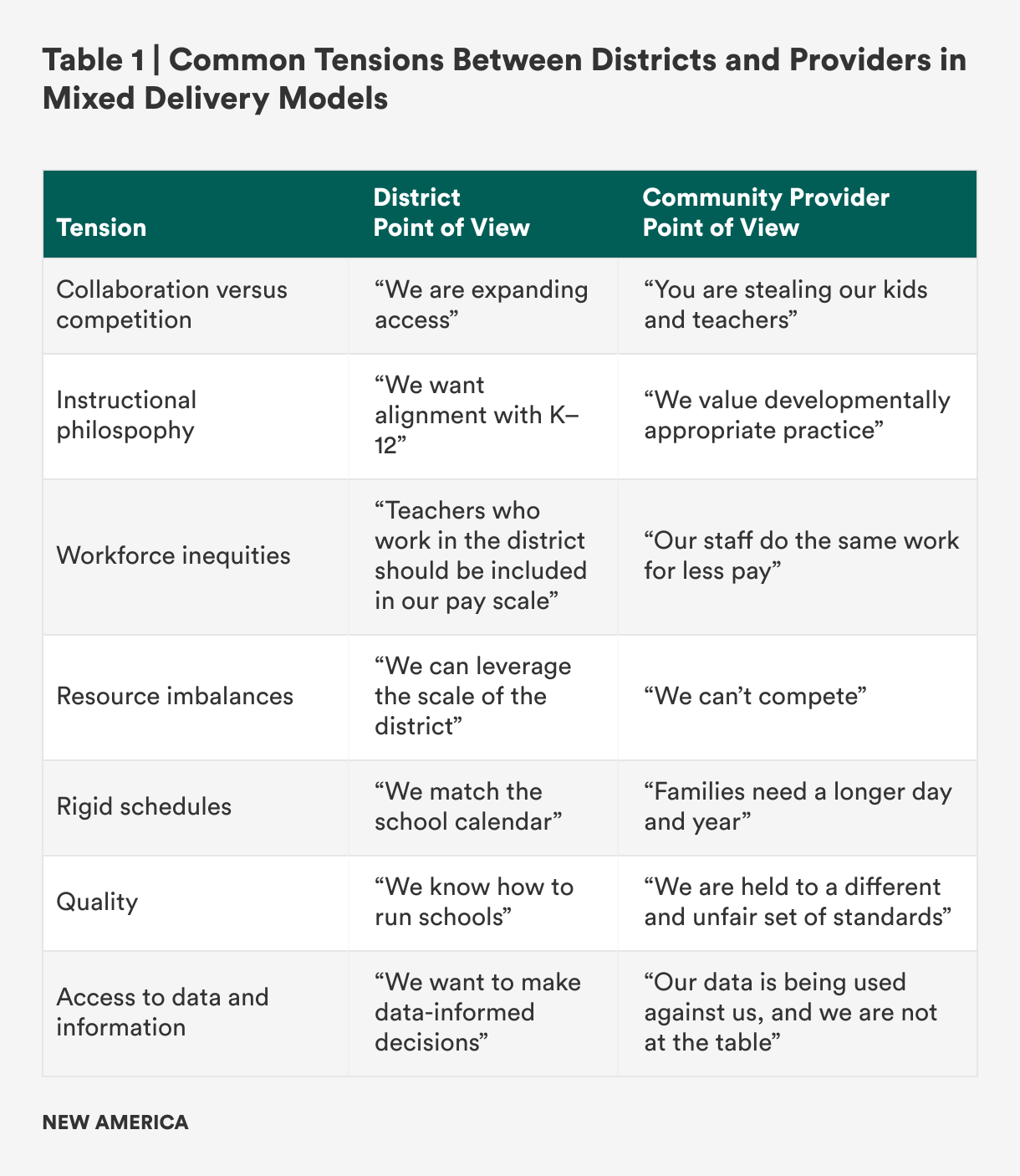
So, how can communities push through these very real tensions and build mixed delivery models that deliver impact while reducing conflict? Lessons from the ECE Implementation Working Group offer some insight into how system leaders can foster a more collaborative dynamic within a mixed delivery model.
Design systems that acknowledge the underlying tension and work to address it. The diverse experiences of communities across the country show that it is possible to navigate these tensions and build stronger partnerships with intentional effort. Rarely do school districts and community providers accidentally happen into collaboration; it takes real work and investment to set up well-functioning mixed delivery models. In Maine, MaineAEYC, serves as a broker between school districts and community providers to set up more effective mixed delivery partnerships. They have been doing this for over five years because they observed a major need; the state was allowing, or even encouraging, school districts to build mixed delivery partnerships, but few knew how to even get started.
Create opportunities for shared governance. System leaders can build structures that give providers a formal role in leadership. When done authentically (i.e., ceding some power to providers and giving them a voice in decision-making) this is more than just checking a box. In California, Alameda County’s Community Advisory Council, which includes parents and providers, informs how the county will spend over $150 million annually in support of early care and education.
Honor the unique expertise that community providers have. Some of the tensions that arise in mixed delivery models come from a pressure that providers feel to conform to the operating model for public schools. For many, that makes them feel like they are set up to fail from the outset; it may also feel disrespectful to their expertise as educators and their experience running a different type of program. System leaders can address this by differentiating policies by setting, where appropriate, and by allowing providers more discretion in certain activities. Educators in private programs can also be lifted up as experts and given opportunities to deliver training to their peers in schools. Some places have highlighted model programs within the community and given them opportunities to serve as demonstration sites for other educators.
Deploy data as a powerful unifier. It benefits trust and collaboration when all parties have the same information. In Cincinnati, the same external evaluator collects data from Cincinnati Preschool Promise and Cincinnati Public Schools, which makes some data-sharing easier. The two entities have very different priorities in what they analyze, evaluate, and publish. However, the shared data infrastructure enables more cohesive storytelling across the city’s entire early childhood ecosystem and creates greater information parity.
Ensure all providers have access to the resources they need to operate their programs. Private providers may struggle to access the same supplies and materials as public schools without the scaled purchasing power of a school district. System leaders can set up master purchase agreements and other mechanisms to allow providers to access the same materials at a cost they can afford. Distribution channels may look different for a small provider who operates out of her home, for example; system leaders can work with providers to make sure the necessary materials reach them.
Leverage the scale that school districts offer to benefit private providers, too. The district can house shared services that can be appropriately tailored to meet the needs of community providers. Some school districts are able to screen teaching candidates and share resumes with private providers or take on administrative tasks that might otherwise fall to each individual provider. A district-run centralized enrollment system and family outreach operation can benefit individual providers immensely, though success typically requires buy-in and enough trust from providers that they will have equal access to the students who the district successfully recruits. (See our prior briefs for more tactical strategies on centralized enrollment and family outreach.)
Utilize a neutral convener to bring all actors to a shared table. In systems where an independent entity or a municipal agency is the administrator and the school district is one of many providers, there may be specific steps the administrator can take to ease tensions between the district and private providers. Having a convener in a fragmented system can be powerful. In San Antonio, there are 17 school districts, seven of which engage with Pre-K 4 SA in some capacity. Pre-K 4 SA offers real resources and capacity to the districts and serves as a convener across districts and community providers. Bringing different players within the system together in a regular and formal way enables better information and resource sharing. Without Pre-K 4 SA, there would be no central “table” around which these entities could convene. In Atlanta, there is no local early childhood administrator; Atlanta Public Schools and private providers all work directly with the state to offer the Georgia Pre-K program. The Georgia Early Education Alliance for Ready Students (GEEARS) serves as a convener and a coordinator across the early childhood ecosystem in the city, driving policy and advocacy work, and helping to bridge communication gaps and create opportunities for collaboration through GEEARS’ local initiative, Promise All Atlanta Children Thrive.
Create opportunities for shared learning. Expertise can be a two-way street if there is enough trust. In many systems, there is a deeply held belief among public school personnel that school districts hold the greatest wisdom and expertise on instructional quality—even if that does not match what early childhood leaders see and experience. In San Antonio, where Pre-K 4 SA works to build trusting relationships with district leaders, many of the districts now send their elementary school leaders to training institutes that Pre-K 4 SA runs. This has helped to promulgate more developmentally appropriate practice across the broader ecosystem. (Read more about the work Pre-K 4 SA does with school districts here: “Texas District Learns the Building Blocks of Pre-K.”)
Address inequities in educator pay across settings. However much attention is given to collaboration and partnership, pay inequities for teachers across settings remain among the biggest barriers in mixed delivery models. Salary disparities drive so much of the underlying tension between school districts and community providers. Pre-K teachers in public schools nationally earn nearly twice as much as teachers in community-based settings. For mixed delivery models to ultimately succeed, leaders need to tend to these pay gaps through whatever strategies they have at their disposal.
Some places have been able to drive toward pay equity through their contracting vehicles. In Multnomah County, per-child rates for Preschool for All are the same across setting types so that all providers can pay the same wages. Multnomah County also offers a wage supplement for infant and toddler teachers to support providers in paying an equitable wage across their program, as well as to minimize the risk that Preschool for All negatively impacts the supply of infant and toddler capacity in the county.
Unions have played a major role in driving toward wage parity in some places. Private providers in Chicago that contract with the city to provide early childhood services to preschool-aged children must pay teachers a minimum salary, defined in an agreement with the city. Providers can choose to pay more if they wish. In New York City, labor leaders pushed for a landmark agreement with the city in 2019 that matched starting teacher pay in community settings to starting public school teacher salaries. In Portland, Maine, teachers in community programs can belong to the public school union and earn union-level wages and benefits. This has created some tricky wage disparity issues within community organizations, though preschool teachers are now treated equitably across all settings.