A Chapter of: The Impact of Increased ICE Activity on the Child Care Workforce and Mothers’ Employment
Results
Characteristics of ICE Arrests
Table 1 presents information on the intensity of ICE arrest activity across states during the February to July periods of 2024 and 2025. The data show a clear and widespread escalation in enforcement over this period. Nationally, the average number of arrests per 10,000 foreign-born residents more than doubled, increasing from 3.6 in 2024 to 7.7 in 2025. The rise was broad-based but uneven across the country, with the largest increases occurring in the South and in several Midwestern states that historically have smaller immigrant populations. For example, states such as Tennessee, West Virginia, Arkansas, Oklahoma, and Kentucky experienced some of the sharpest increases in enforcement activity, with arrest rates roughly doubling or tripling between 2024 and 2025. These states have relatively small immigrant populations and possibly more favorable political environments, conditions that likely magnified the impact of changing enforcement priorities.
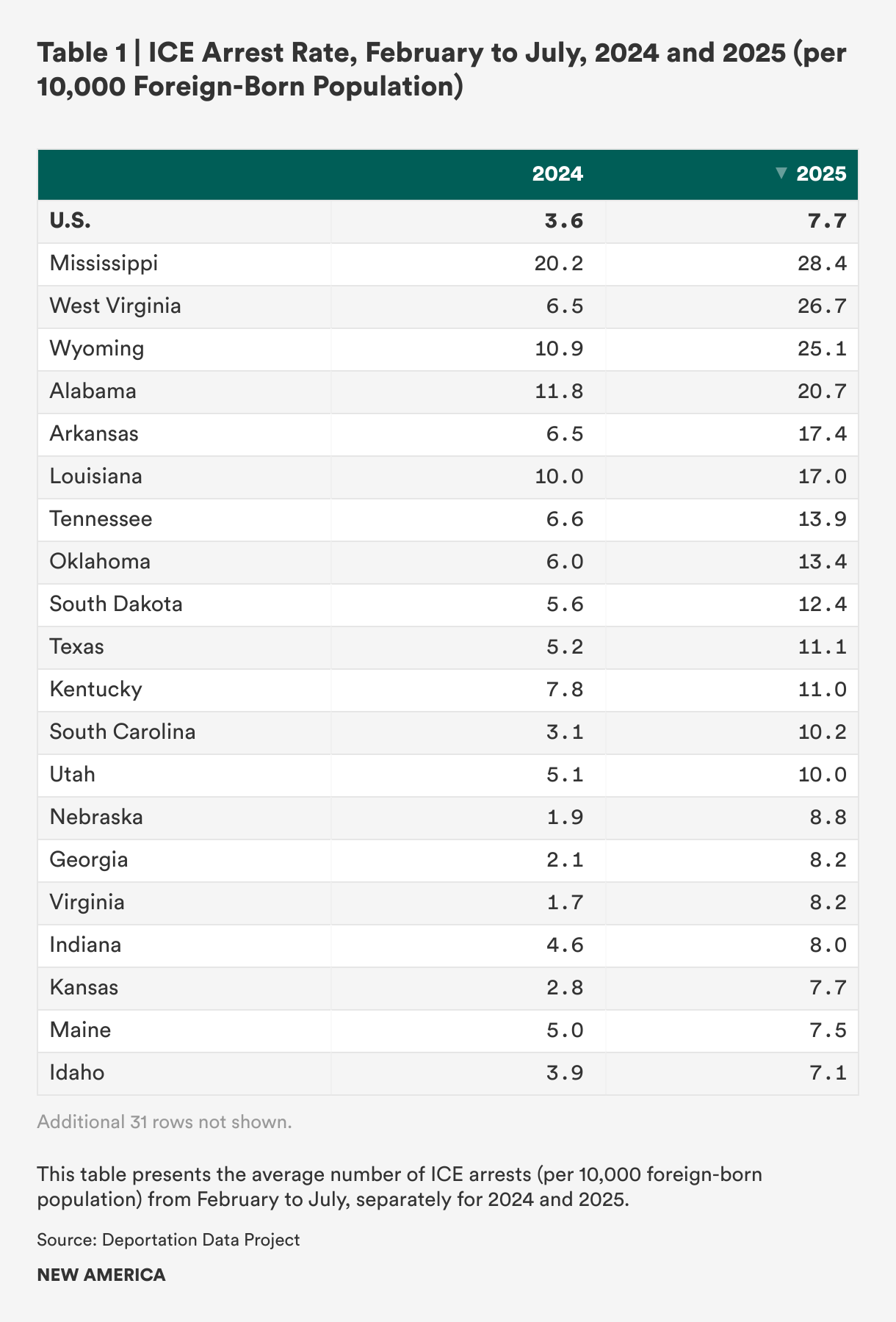
In contrast, the increase in ICE arrests was smaller in states with large and long-established immigrant communities. California, New York, and New Jersey all maintained relatively low levels of enforcement activity, with arrest rates remaining below 3.5 per 10,000 foreign-born residents in both years. This regional contrast suggests that the 2025 surge in enforcement may have reflected an expansion of ICE activity into areas with stronger local cooperation and greater enforcement visibility rather than being proportional to the size of states’ immigrant populations.
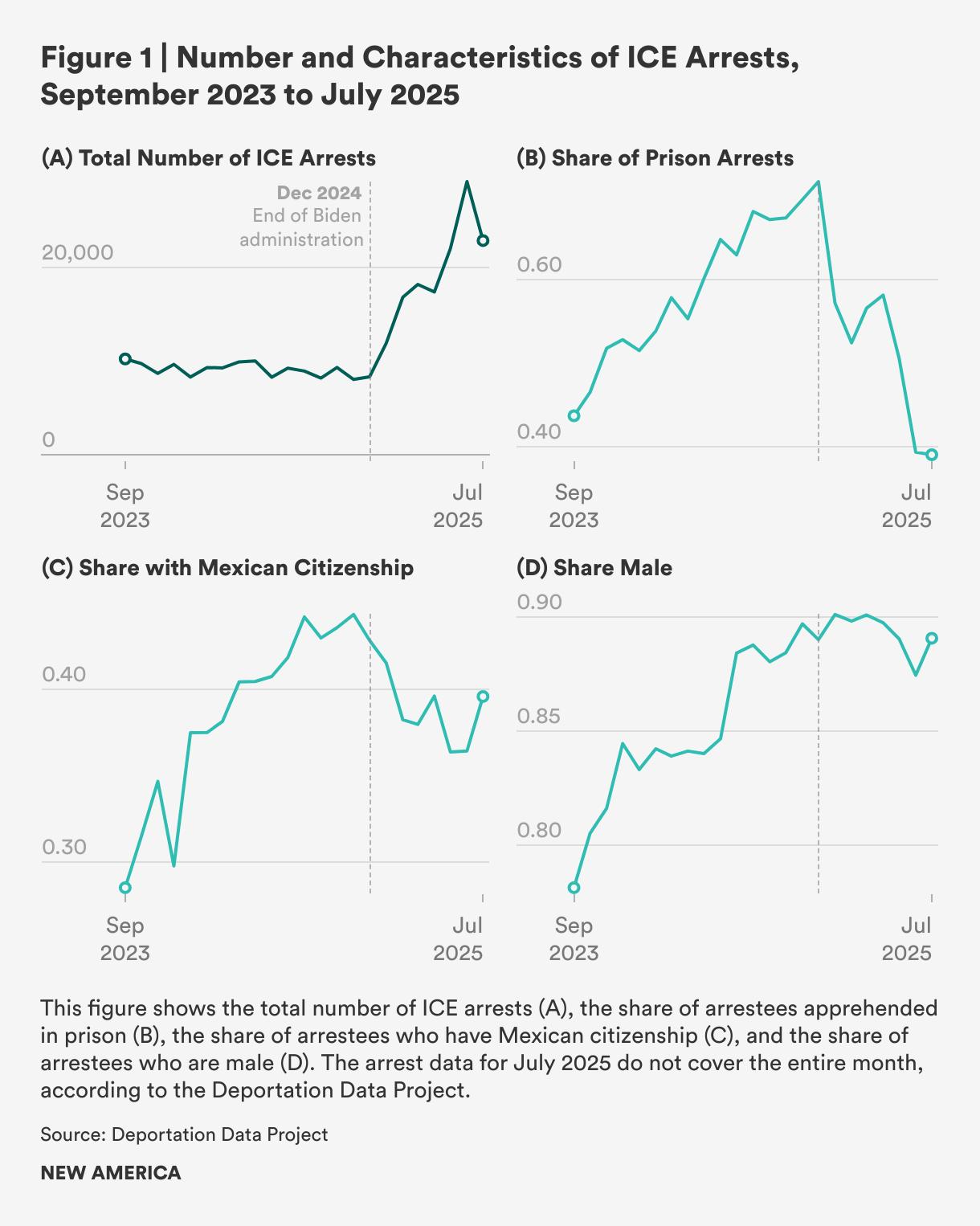
Figure 1 complements this cross-sectional evidence by showing the national evolution in and composition of ICE arrests between September 2023 and July 2025. Panel A displays a steady rise in the total number of arrests beginning in early-2025—coinciding with the inauguration of President Trump—and accelerating throughout the first half of 2025, indicating that the enforcement escalation was both substantial and sustained. Indeed, the number of ICE arrests in December 2024 was 8,320, rising to 11,904 in January 2025 and peaking at 29,147 in June 2025.28
The remaining panels in Figure 1 provide information on the characteristics of those arrested by ICE. Panel B shows the evolution in the share of arrests occurring in local, state, and federal jails and prisons. In particular, we find that the share of arrests in prisons or jails rose steadily from 44 percent in September 2023 to 72 percent in December 2024, followed by an immediate and sharp reversal in January 2025. Indeed, between January and July 2025, the share of ICE arrests occurring in jails or prisons declined from 57 percent to 39 percent. At the same time, as arrests in custodial settings declined, arrests taking place in various community settings increased dramatically in both share and level terms after December 2024.
Panels C and D show changes in the demographic characteristics of those arrested. The share of arrestees with Mexican citizenship increased steadily between September 2023 and December 2024, from 29 percent to 43 percent. The proportion then declined during the early months of 2025, falling from 42 percent in January to a low of 36 percent in May and June. Such changes suggest that the recent enforcement surge is drawing from a broader range of nationalities than in the preceding period. For example, we find that the ICE arrestees in December 2024 held citizenship in 112 distinct nations, a number that rose to 143 nations in June 2025. Finally, panel D shows that the vast majority of arrestees are male, with the share rising gradually from 78 percent in September 2023 to 89 percent in December 2024, before leveling off at about 90 percent throughout 2025. This stabilization likely reflects an increase in the number of female arrestees after December 2024, which offset the continued growth in male arrests and kept the overall gender composition relatively stable during the recent enforcement surge.
Impact of ICE Arrests on Child Care Employment
Table 2 presents estimates of the relationship between state-level ICE arrest rates and the probability of employment in the child care sector. Panel A reports results for foreign-born women, and Panel B reports them for U.S.-born women. We present separate estimates for all women as well as for subgroups of low- and high-education women, all Hispanic women, women of Mexican origin, and all non-Hispanic women.
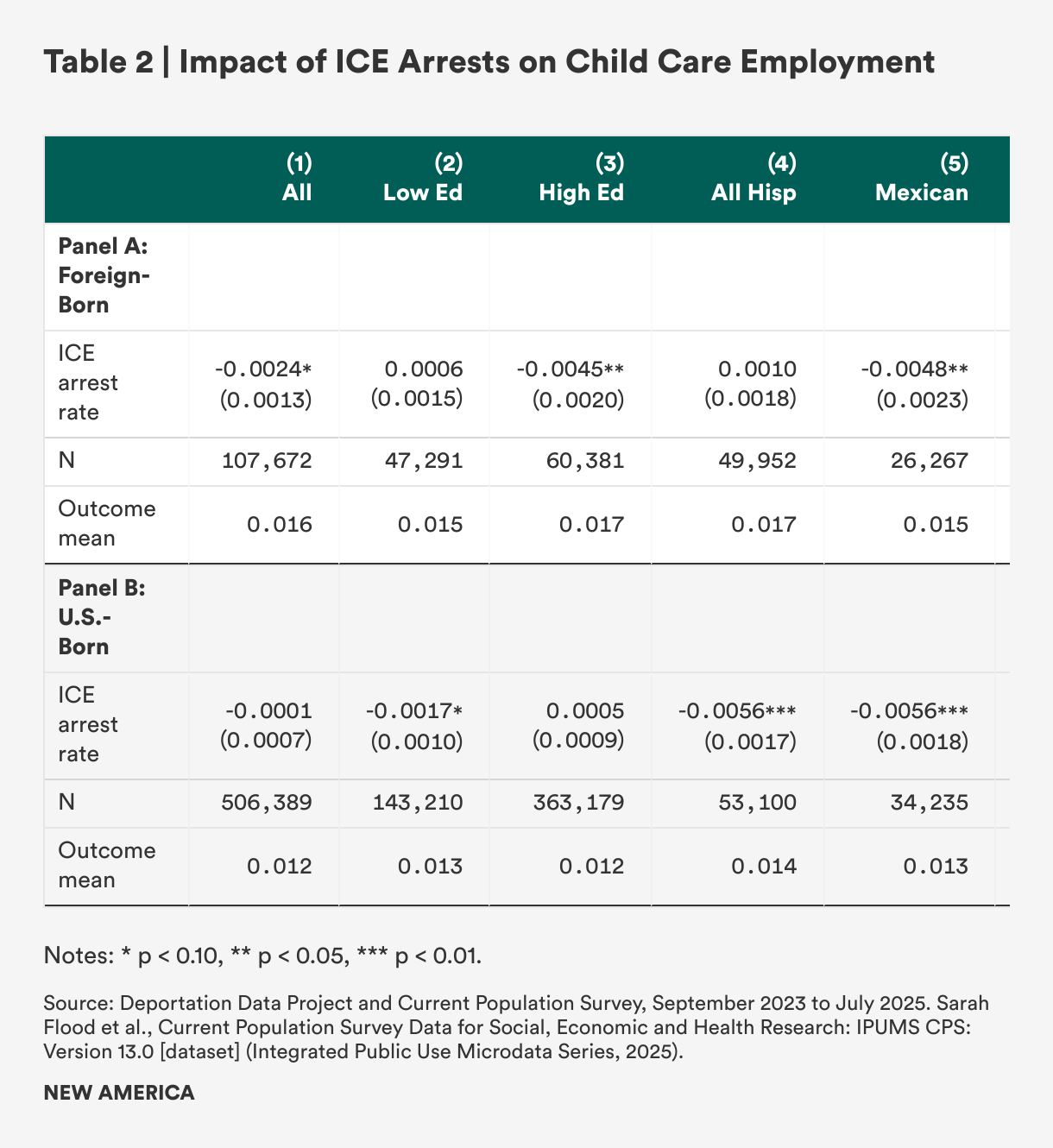
In general, higher ICE activity corresponds to lower employment in child care, with stronger effects among foreign-born women and among certain subgroups of U.S.-born women. For all foreign-born women, the estimated coefficient of -0.0024 implies that a 1 percent increase in the ICE arrest rate is associated with a 0.24 percentage-point decrease in child care employment, equivalent to about a 15 percent decline relative to the mean employment probability of 0.016. To put this magnitude in a more policy-relevant context, doubling the ICE arrest rate is associated with a decline in child care employment of about 0.17 percentage points, or a 10 percent reduction in employment relative to the mean.29 The negative relationship is strongest for immigrant women with more education and for non-Hispanic and Mexican immigrants. Among higher-education women, the coefficient of -0.0045 implies that doubling the ICE arrest rate is associated with a decline in child care employment of about 0.31 percentage points, or roughly an 18 percent decrease relative to the mean employment probability of 0.017. For non-Hispanic and Mexican women, the point estimates translate into declines of approximately 0.32 percentage points, or about a 21 percent decrease relative to their mean employment probabilities.
For U.S.-born women, the overall relationship is weak, but some subgroups display meaningful effects. The estimate for the full sample is close to zero, while the estimate for low-education women (-0.0017) implies that doubling the ICE arrest rate reduces the likelihood of child care employment by about 0.12 percentage points, or about 9 percent. The largest reduction in employment appears among all Hispanic and Mexican U.S. natives, where the coefficient of -0.0056 implies a 0.39 percentage-point, or 30 percent, decrease in the likelihood of working in child care.30 The estimate for non-Hispanic U.S. natives is small and not statistically significant. These results suggest that immigration enforcement may indirectly influence U.S.-born women. We speculate that these spillovers are particularly relevant for U.S. natives living or working in areas with large immigrant populations, where public ICE raids are a more visible part of daily life. It is also possible that the concentration of negative effects among Hispanic, Mexican, and low-education U.S. native women—groups less likely to be targets of enforcement on legal grounds because they are U.S. born—may reflect a perceived pattern of profiling or discriminatory enforcement practices. If ICE officers disproportionately target individuals based on appearance or language, some U.S.-born individuals in these groups may experience heightened fear of wrongful arrest. Such profiling could amplify the chilling effects of enforcement and contribute to reduced labor force participation even among those who are fully authorized to work.
Table 3 extends the analysis by disaggregating the relationship between ICE enforcement activity and women’s employment in child care across three segments of the market, including center-based, home-based, and private household care. Overall, the results suggest that higher levels of ICE arrests are associated with lower employment in both center- and home-based settings, with stronger effects on foreign-born, Hispanic, and Mexican women.
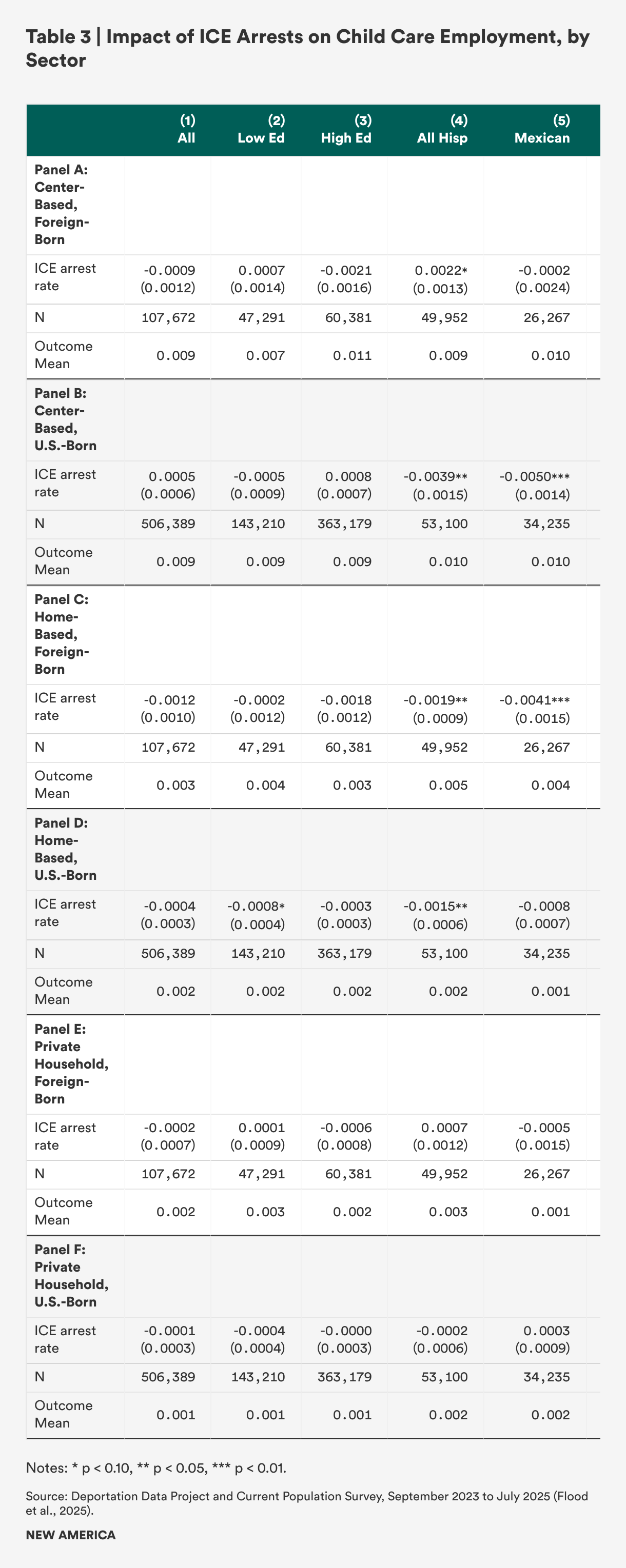
In Panel A, which focuses on center-based employment among foreign-born women, the estimated coefficients are negative for most subgroups, although the statistical significance varies. The largest negative effect appears for non-Hispanic foreign-born women, with an estimate of -0.0031. This implies that a doubling of ICE arrests reduces the likelihood of center-based employment among this group by about 0.21 percentage points, which corresponds to roughly a 21 percent decline relative to the mean employment of 0.010. An exception to the pattern of negative effects appears for all Hispanic foreign-born women, where the estimated coefficient is positive and statistically significant. One possible explanation is compositional or substitution effects within the immigrant labor force. If, for example, heightened enforcement disproportionately displaces undocumented or less-educated workers from informal sectors, some documented Hispanic immigrants may move into more formal, center-based employment to fill the resulting vacancies, at least in the short run.
Panel B reports estimates for U.S.-born women in center-based care. The relationship is weak for the full sample, but the estimates for Hispanic and Mexican U.S. natives (-0.0039 and -0.0050, respectively) are negative and statistically significant, indicating that increased ICE activity is associated with reductions in center-based employment for these groups. A doubling of ICE activity corresponds to declines in employment of 27 percent and 35 percent, respectively. These results reinforce the notion that immigration enforcement can indirectly affect U.S.-born women, particularly those working in communities or facilities that employ immigrant labor or serve immigrant families. The potential mechanisms may include reduced demand for child care services, targeted workplace disruptions, or broader uncertainty in affected localities.
Panels C and D report results for home-based care among foreign- and U.S.-born women, respectively, showing uniformly negative estimates. In Panel C, the largest effects are observed among Hispanic and Mexican women, with coefficients of -0.0019 and -0.0041, respectively, implying reductions of 26 percent and 71 percent for a doubling in ICE arrests. These patterns suggest that small-scale, self-employed providers are particularly vulnerable to immigration enforcement, possibly because they face greater exposure risks and because their clients may withdraw from these care arrangements in response to elevated enforcement activity. Looking at Panel D, although most coefficients are small, several are negative and statistically significant, particularly for the low-education and Hispanic subgroups. These findings again suggest that enforcement may also depress employment opportunities for U.S.-born women engaged in informal or self-employed care work.
Panels E and F of Table 3 present estimates for foreign- and U.S.-born employment in private household settings, respectively. Across all subgroups, the coefficients are small and statistically insignificant, indicating no meaningful association between ICE arrests and employment in this sector. The dearth of effects suggests that private household employment is largely insulated from immigration enforcement pressures. This may be because such work takes place in individualized and informal settings—where many workers are paid under the table—that are ultimately less visible to regulatory and tax authorities and therefore less exposed to enforcement actions or workplace disruptions.
Is the Trump Era Different?
Table 4 turns to the question of whether the relationship between ICE enforcement activity and women’s employment in child care changed following the start of the second Trump administration. As noted previously, all models include both the main effect (i.e., log of the ICE arrest rate) and its interaction with a post-Trump indicator.31
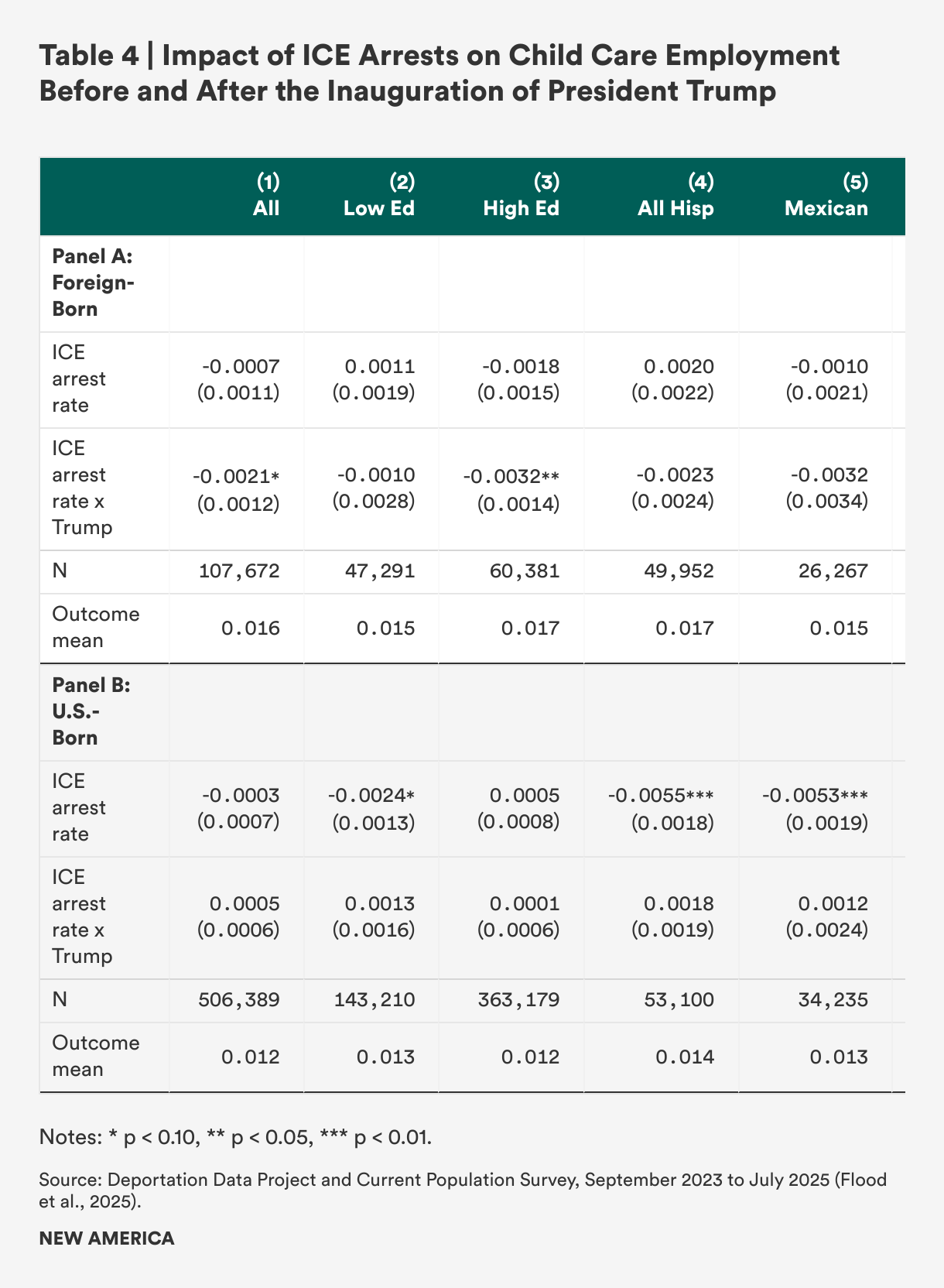
Panel A shows that, in the pre-Trump period, the relationship between ICE arrests and child care employment was generally weak and statistically insignificant for foreign-born women. The estimates on the ICE arrest rate alone are small and close to zero across all groups, suggesting limited responsiveness of immigrant employment to enforcement activity before President Trump took office. However, the estimates on the interaction term are consistently negative and statistically significant for all women and those with more education. This implies that the negative relationship between ICE enforcement intensity and child care employment strengthened significantly after the Trump administration began. In other words, foreign-born women became increasingly sensitive to immigration enforcement following the inauguration of President Trump. Specifically, the coefficients for all women suggest that a doubling of ICE arrests is associated with a 12 percent reduction in child care employment, while the corresponding reduction for higher-education women is 20 percent.
Another way to interpret the magnitude of our estimates is to calculate the reduction in the number of foreign-born child care workers due to the post-Trump escalation in immigration enforcement. As a benchmark, the average monthly number of immigrant women employed in child care was 327,000 between February and July of 2024. Therefore, a doubling of ICE arrests is associated with 39,000 fewer foreign-born child care workers overall between February and July of 2025 compared to the same period in 2024 (0.12 × 327,000).32
Panel B of Table 4 presents the analogous results for U.S.-born women. The estimates for the pre-Trump period are negative for all groups and statistically significant for lower-education, Hispanic, and Mexican U.S.-born women, while the interaction terms are small in magnitude and statistically insignificant across all groups. Such patterns suggest that higher levels of ICE enforcement were associated with lower employment in child care among some groups before President Trump took office, and the onset of the new administration did not materially change the intensity of this relationship. In other words, low-education, Hispanic, and Mexican U.S.-born women were equally sensitive to increased ICE arrests during the post-Trump period as they were during the pre-Trump period.
Finally, Table 5 examines heterogeneity across sectors of the child care market. Panel A presents estimates for foreign-born women in the center-based sector, showing a dramatic change in the relationship between ICE enforcement and child care employment after the start of the Trump administration. During the pre-Trump period, estimates on the ICE arrest rate are positive for all groups and statistically significant for some, but the effect sizes are generally small in magnitude. In contrast, the Trump-era interaction terms are uniformly negative, larger in magnitude, and more precisely estimated. Such patterns indicate that the relationship between enforcement intensity and center-based employment turned markedly negative under the Trump administration. Thus, it is possible that the escalation in ICE activity in the post-Trump period produced an equivalently strong (negative) employment response among foreign-born women. In contrast, Panel B shows that the negative relationship between ICE arrests and center-based employment among U.S.-born women is concentrated among Hispanic and Mexican U.S. natives, and this pattern remained largely unchanged during the post-Trump period.
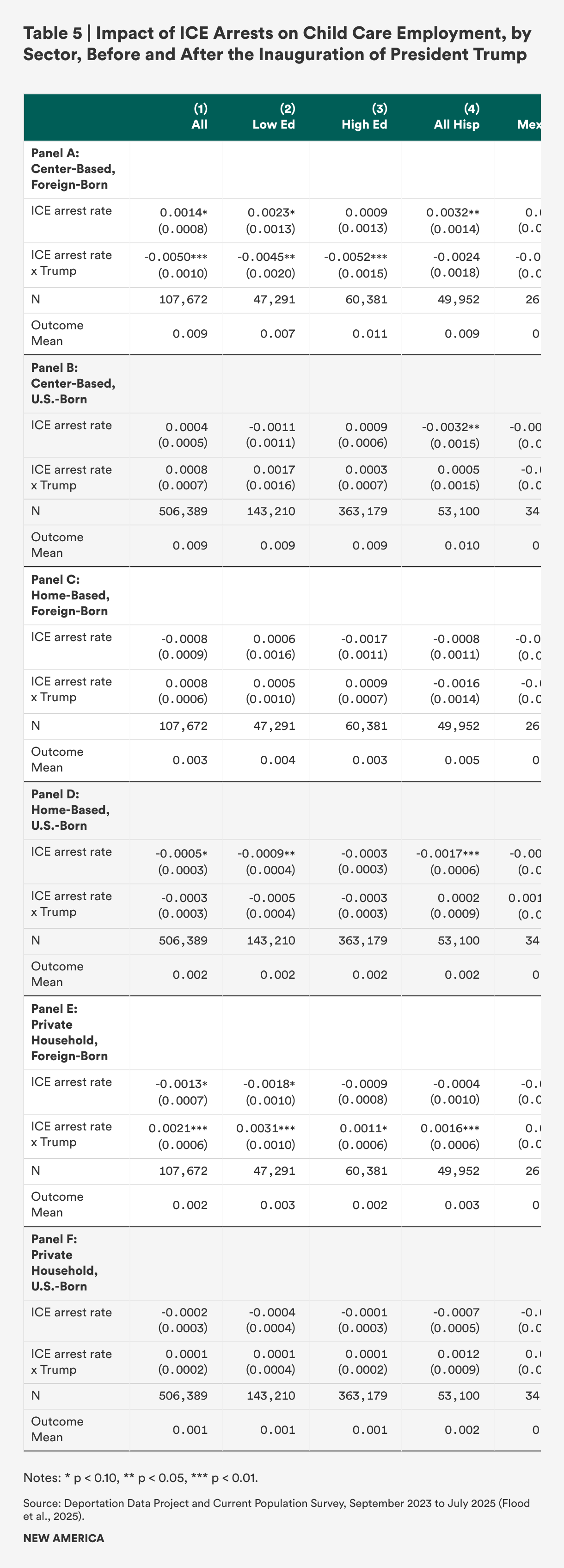
Panels C and D of Table 5 present estimates for home-based child care employment among foreign- and U.S.-born women, respectively. In Panel C, the estimates show that the pre-Trump period relationship between ICE arrests and employment was modest and statistically insignificant across most groups, and this pattern remained largely unchanged after the start of the Trump administration. The corresponding results for U.S.-born women shown in Panel D reveal negative effects of ICE arrests for several groups in the pre-Trump period, particularly among lower-education, Hispanic, and Mexican women. However, the interaction terms are small and imprecisely estimated, implying that enforcement activity was already associated with lower home-based employment prior to the Trump administration, and that this relationship did not materially change following the onset of the new administration.
Panels E and F of Table 5 report results for private household child care employment among foreign- and U.S.-born women, respectively. In Panel E, the coefficients on ICE arrests are negative and statistically significant for several subgroups, indicating that higher enforcement intensity in the pre-Trump period was associated with lower employment in the sector. Interestingly, however, the interaction terms are positive, larger in magnitude, and statistically significant across most groups, suggesting that this negative relationship weakened considerably after the Trump administration began. These results imply that foreign-born women may have shifted into private household work as enforcement pressures increased in more formal segments of the child care market. Such a shift may reflect a move toward less visible, more flexible forms of employment that offer greater protection from ICE encounters.33 Panel F presents the corresponding estimates for U.S.-born women. In contrast to Panel E, the estimates on both the ICE arrest rate and its post-Trump interaction are small and statistically insignificant across all groups, indicating no clear relationship between enforcement activity and private household employment in either period.
Employment of Mothers with Young Children
Having established the relationship between ICE arrests and child care labor supply, we now turn to the broader labor market for mothers with young children, to study the relationship between increased immigration enforcement and maternal employment.
Given that families outsource many dimensions of household production for work-enabling purposes, a decrease in the availability of nonparental child care services—in this case due to heightened immigration enforcement—may lead to a reduction in the amount of maternal time allocated to employment.34 Indeed, recent research from Ali, Brown, and Herbst, as well as from economic scholars Chloe East and Andrea Velasquez, finds that the Secure Communities program reduced the supply of formal child care and the employment of high-skilled mothers with preschool-aged children.35 Such patterns are consistent with the findings from economic researchers Catalina Amuedo-Dorantes and Almudena Sevilla, who show that increased low-skilled immigration reduces the amount of time that high-skilled mothers engage in housework and basic child care duties.36 While the insights above apply to U.S. native- and foreign-born mothers, there are some additional considerations for the latter group. In particular, the presence of chilling effects could reduce immigrant mothers’ labor force participation directly, or such chilling effects could reduce the willingness of immigrants to send their children to child care—in both cases decreasing the demand for child care. Thus there are reasons to believe that the recent increase in ICE activity may spill over to the labor market for mothers by fraying their attachment to the workforce.
The analysis relies once again on the monthly CPS from September 2023 to July 2025. The analytic sample includes U.S. native- and foreign-born women ages 22 to 64 whose youngest child is ages 0 to 5 (N=71,975). The outcome variable is a binary indicator equal to one if a given woman was employed (defined in the CPS as “doing any work at all for pay or profit”) during the previous week, and zero otherwise. As with the analysis of child care labor supply, we examine both the average effect of ICE arrests over the study period as well as any differential effects of arrests on maternal employment after President Trump was inaugurated. That is, we estimate separate models with the log ICE arrest rate entered individually and with its interaction with a binary indicator denoting the first six (full) months of the new Trump administration. The models include the same set of individual-level demographic and time-varying state controls, and account for unobserved heterogeneity in the same manner. All models are weighted by the CPS’s final person-level weight, and the standard errors are clustered at the state level.
Results from this analysis are presented in Table 6. Panel A displays the estimates for U.S.-born mothers of preschool-aged children, while Panel B shows the corresponding results for immigrant mothers. We present separate estimates for mothers overall as well as subsets of low- and high-education mothers and non-white and white mothers. In this analysis, consistent with prior studies on related topics, we define “low-education” as having less than a two-year college degree, while “high-education” is defined as having at least a two-year college degree.
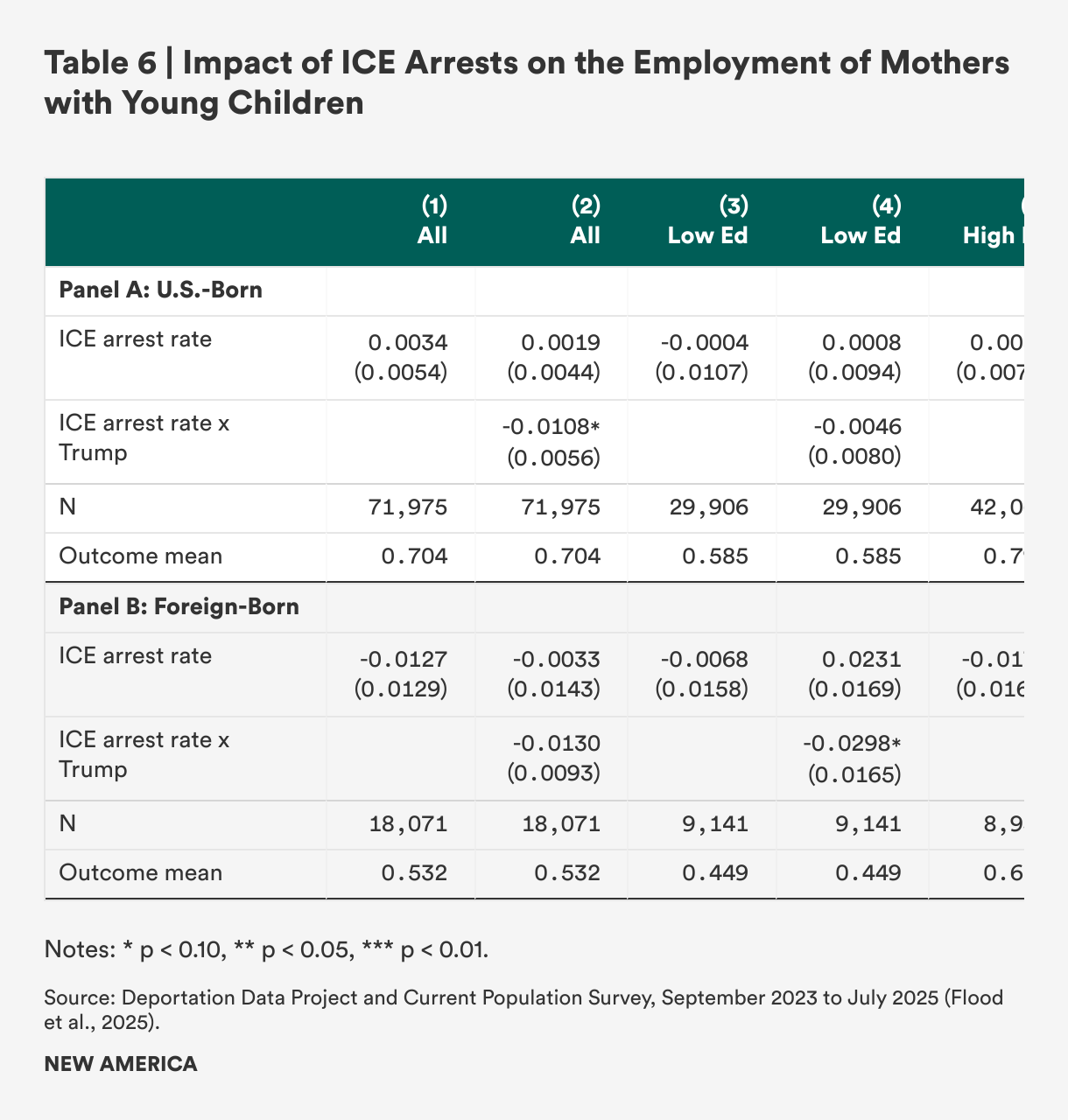
Looking first at U.S.-born mothers, we find that an increase in ICE enforcement activity did not influence mothers’ employment throughout the entire study period (September 2023 to July 2025), as shown in the odd-numbered columns. Indeed, the coefficients on ICE arrests are inconsistently signed, and all but one are statistically insignificant. However, the estimates show evidence of substantial heterogeneity in the impact of ICE arrests across the pre- and post-Trump periods. While immigration enforcement during the pre-Trump period did not influence mothers’ employment, such enforcement measures began reducing employment in the months following President Trump’s inauguration. This pattern holds for U.S.-born mothers overall and appears to be driven by high-education and white mothers, as shown in the even-numbered columns. Specifically, among mothers overall, the relevant coefficients imply that a doubling of ICE arrests is associated with about a 1 percent reduction in employment in the post-Trump period. The corresponding employment reductions are 1.2 percent for high-education mothers and 1.4 percent for white mothers.37
As we did above, we use the estimates to calculate the reduction in the number of working mothers in response to the post-Trump escalation in immigration enforcement. Approximately 7.7 million U.S.-born mothers with preschool-aged children were estimated to be employed each month between February and July of 2024. Therefore, a doubling of ICE arrests led to about 77,000 fewer employed U.S.-born mothers overall between February and July of 2025 compared to the same period in 2024.
Turning to foreign-born mothers, we find that increases in ICE activity did not influence employment rates overall, as shown in the odd-numbered columns. The relevant coefficients, while consistently negative, are never statistically significant. However, certain subgroups of mothers appear to have been affected in the period after President Trump’s inauguration. In particular, the results indicate that low-education and white mothers experienced declining employment rates in the post-Trump period. The relevant coefficients imply that a doubling of ICE arrests is associated with a 1 percent reduction in both low-education and white mothers’ employment.
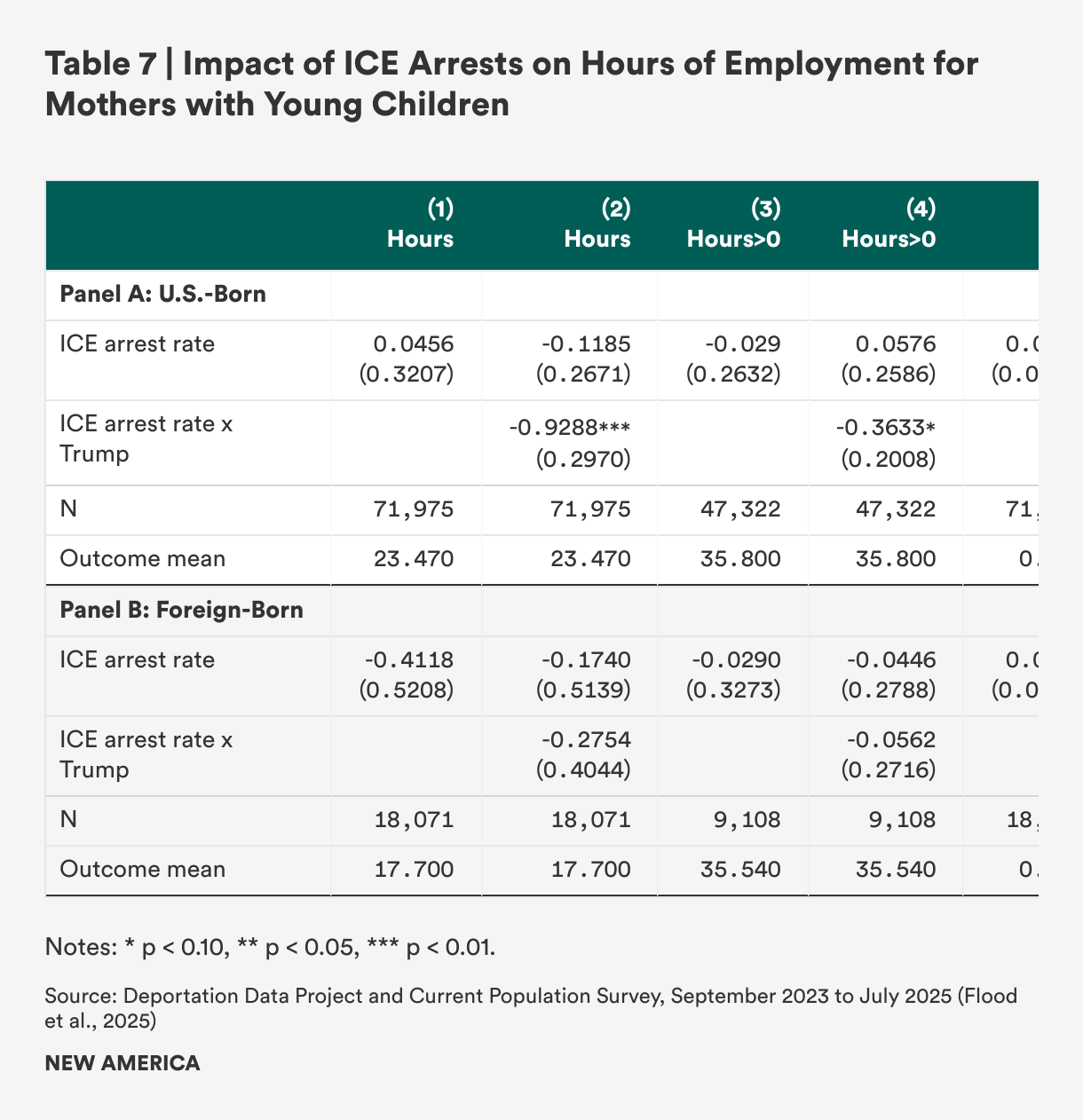
The results discussed above pertain to the likelihood of any employment, or employment at the extensive margin. We now examine various measures of infra-marginal labor supply (e.g., the number of hours of work), as shown in Table 7. Columns (1) and (2) report results for mothers’ total hours of work last week, including zeros, while columns (3) and (4) show results for weekly hours of work conditional on working at least one hour. Columns (5) and (6) examine effects on part-time employment (i.e., one to 34 hours of work), and columns (7) and (8) study full-time employment (i.e., 35 hours or more). Note that we report results for only the full samples of U.S. native- and foreign-born mothers. Looking first at U.S.-born mothers (Panel A), we continue to find evidence of intensifying effects of ICE enforcement after the inauguration of President Trump. While the coefficient on the interaction term is negative and statistically significant for both measures of hours worked [columns (2) and (4)], the reduction in hours including zeros is larger than its counterpart excluding zeros. This implies that mothers’ labor supply adjustment primarily entails an exit from the labor force rather than a reduction in hours of work. Furthermore, a comparison of columns (6) and (8) reveals that U.S.-born mothers are more likely to leave full-time employment than part-time employment. Turning to the full sample of foreign-born mothers (Panel B), the results continue to show null effects of immigration enforcement.
Robustness
Table A1 in the Appendix provides several checks of the robustness of our main results. Columns (1) through (4) show results for the child care employment models, and columns (5) through (8) show the corresponding results for maternal employment. For ease of presentation, we concentrate on the full samples of women and mothers, rather than the subsamples shown previously.
Panel A includes a set of month × year fixed effects (instead of separate year and month fixed effects), which is a more stringent control for any national time-varying shocks that may be correlated with the intensity of ICE arrests and the employment outcomes. Panel B incorporates region × year fixed effects to account for the possibility of region-specific adjustments to the new immigration enforcement environment. Recall that Table 1 shows that the largest increases in ICE arrests occurred in the South and Midwest, while smaller increases occurred in the West and several Eastern states. Such patterns indicate that different areas of the country may be better positioned for and politically open to immigration enforcement. Finally, Panel C includes a set of state × year fixed effects to account for any state-specific unobservables that vary over time.
Generally speaking, results from these robustness exercises are consistent with the main results. Adding the month × year fixed effects does little to change the results.38 Including the region × year fixed effects reduces the size of the coefficient (and increases the size of the standard error) on the interaction term in the foreign-born child care employment model such that it is no longer statistically significant. However, all other results are unchanged. Inclusion of the state × year fixed effects seems to have a larger influence on the results, in most cases reducing the size of the relevant coefficients (and increasing the size of the standard errors). However, the coefficient on the interaction term in the U.S.-born maternal employment model remains statistically significant.

Citations
- The sharp reduction in July 2025 may be due in part to the fact that the most recent data released by the Deportation Data Project does not cover the entire month of July. Appendix Figure A1 exploits information in the Deportation Data Project on the method of apprehension to generate separate time series plots for the number of ICE arrests that take place in prisons or jails and arrests that occur within the community. After declining throughout much of the pre-Trump period, non-prison arrests rose sharply starting in early 2025 and now exceed the number of prison arrests. Indeed, although prison arrests increased as well during the Trump presidency, the growth has been far less dramatic.
- Table 1 shows that the ICE arrest rate roughly doubled nationwide between the February to July periods of 2024 and 2025, increasing from about 3.6 to 7.7 arrests per 10,000 foreign-born residents. We therefore interpret the coefficients as reflecting the effect of a doubling in ICE enforcement intensity. The 10-percent decline is obtained by multiplying the coefficient (-0.0024) by ln(2)=0.693 to get -0.0017, and dividing this by the mean employment probability of 0.016 (i.e., 0.0017 ≈ 0.10).
- In this report, “Hispanic” and “Mexican” capture separate, though related, categories: “Hispanic” refers to all Census-defined categories of Hispanic persons, including Mexicans. We present separate results for all Hispanics and the subset of Mexicans.
- The coefficient on the ICE arrest rate reflects the association between enforcement activity and employment during the pre-Trump period (September 2023 to January 2025), while the interaction term captures the differential effect after the start of the new Trump administration (February to July 2025). The sum of the two coefficients therefore indicates the overall effect of enforcement intensity on employment in the post-Trump period.
- We note the possibility that this is a lower-bound estimate if some child care workers were detained or self-deported and therefore are not included in the data.
- The shift may also indicate that as opportunities in center- and home-based settings decreased under heightened enforcement, private household work emerged as an alternative form of employment for displaced and risk-averse workers in the child care market.
- We note the possibility that the supply of child care is influenced by demand-side factors, including the increased cost of household services (e.g., cleaners) that are complementary to employment, or to an overall reduction in local job creation and consumption from the decline in immigrant labor supply. If maternal employment decreases, the demand for child care should fall as well, along with the supply of care services.
- Ali, Brown, and Herbst, “Secure Communities as Immigration Enforcement,” https://www.sciencedirect.com/science/article/pii/S0047272724000379; East and Velásquez, “Unintended Consequences of Immigration Enforcement,” https://jhr.uwpress.org/content/59/5/1458.
- Catalina Amuedo-Dorantes and Almudena Sevilla, “Low-Skilled Immigration and Parenting Investments of College-Educated Mothers in the United States: Evidence from Time-Use Data,” Journal of Human Resources 49 (July 2014): 509–539, https://jhr.uwpress.org/content/49/3/509.
- Interestingly, we find a positive relationship between increased ICE activity and the employment of non-white mothers for the full study period. While the increase in employment appears to be concentrated in the pre-Trump period, coupled with a small reduction in the post-Trump period, neither of the relevant coefficients in the interacted model are statistically significant.
- As shown in Table A2 in the Appendix, we also estimate the child care employment models with month × year fixed effects on all of the subgroups of foreign- and U.S.-born women. Results from these estimations are robust.