
The Impact of Increased ICE Activity on the Child Care Workforce and Mothers’ Employment
Abstract
This report examines whether the recent escalation in U.S. immigration enforcement—measured by Immigration and Customs Enforcement (ICE) arrests—influences employment in the child care industry and among mothers with young children. Using monthly data from the Census Bureau’s Current Population Survey, merged with newly compiled ICE arrest data between September 2023 and July 2025, we find that intensified enforcement reduces the number of foreign-born child care workers, particularly highly educated immigrants and those from Mexico. Certain groups of U.S.-born women, especially less educated and Hispanic women, also experience declines in employment, suggesting indirect “chilling effects” of enforcement on groups not eligible for deportation. The negative effects are concentrated on workers in center- and home-based care, while employment in private households increases, indicating a shift toward less formal, less visible work arrangements. We also find that heightened immigration enforcement reduces the employment of mothers with preschool-aged children, especially highly educated and white mothers. These negative effects on child care and maternal employment intensify after President Trump’s inauguration in early 2025, when ICE activity rose sharply. Overall, our findings highlight how immigration enforcement policies can disrupt the child care market and limit mothers’ participation in the workforce, with potential implications for the broader economy.
Acknowledgments
The authors would like to thank Haley Swenson, Jessica Brown, and Erkmen Aslim for their helpful comments and suggestions on previous drafts of the paper.
Editorial disclosure: The views expressed in this report are solely those of the authors and do not reflect the views of New America, its staff, fellows, funders, or board of directors.
Downloads
Introduction
Immigrants play an essential role in the U.S. child care sector.1 Approximately one in five child care workers is foreign born, making this among the most immigrant-dependent segments of the labor market. Immigrant caregivers tend to bring substantial skills to the job, as they are more likely than U.S.-born caregivers to have a college degree, and they earn more on average. Furthermore, immigrant care workers offer a range of linguistic and cultural competencies that help them connect with families from diverse backgrounds. Because immigrant and U.S.-born caregivers differ systematically in their training, work experience, and language backgrounds, the two groups are not perfect substitutes for each other in the production of child care services.2 Therefore, when the number of immigrant caregivers declines, U.S.-born workers cannot quickly fill the gap in the short run, which can reduce overall capacity and affect the availability and quality of care.
The child care sector’s heavy reliance on immigrant labor means that restrictive immigration policy has the potential to directly impact, and disrupt, the stability of the child care market. For example, when the federal government rolled out the Secure Communities program between 2008 and 2013—a policy that shared the fingerprints of local arrestees with the Department of Homeland Security and Immigration and Customs Enforcement (ICE)—employment and wages dropped for both immigrant and U.S.-born child care workers, while families’ participation in center-based child care services decreased.3 The evidence also suggests that the largest reductions in child care employment occurred in the center-based sector, where formal licensing and documentation requirements likely make immigrant workers (as well as the families of the children in their care) more exposed to enforcement activity. These patterns point to the possibility that strict immigration reforms generate chilling effects in which both immigrant and U.S.-born individuals stop working in order to remain hidden from federal agents.
Evidence from news reports suggests similar dynamics are at play in the current policy environment. The second Trump administration rescinded a Biden-era policy that prohibited immigration enforcement actions at child care centers and preschools (via “sensitive location” status).4 As a result, there appears to be an increase in ICE activity at or near these facilities, with recent press reports documenting at least one arrest at a Chicago child care center.5 In Washington, DC, a late-summer surge in immigration enforcement was accompanied by widespread fear among Hispanic child care providers, along with reports of missed shifts and changes in daily routines to avoid public spaces.6 More generally, qualitative research on immigration raids provides further insight into how enforcement shapes workers’ experiences and behavior. Political science scholar Álvaro José Corral documents how worksite raids are staged as highly visible public events that signal state power, creating fear among both targeted and non-targeted workers.7 Such visibility discourages immigrant workers from asserting their rights, fosters their withdrawal from public and formal workplaces, and increases job insecurity. Through these mechanisms, enforcement can reduce the observed supply of labor even when few workers are directly detained or deported. It is also possible that any enforcement-induced reduction in child care demand could decrease the equilibrium supply of care services.
This discussion underscores that immigration policy and child care policy are closely connected. When enforcement intensifies, it affects not only the targeted population but also the broader labor market and the families who depend on child care services for their employment. Understanding these connections is essential for assessing how interior immigration enforcement influences the availability, affordability, and quality of care in a system already under strain.
In this report, we address this question by investigating how the recent increase in immigration enforcement, measured by the number of ICE arrests, influence the child care and maternal labor markets. We focus on the period from late 2023 to mid-2025, when ICE arrests rose sharply under new federal enforcement priorities. Using monthly data from the Census Bureau’s Current Population Survey (CPS) combined with newly compiled arrest records from the Deportation Data Project, we examine the relationship between the intensity of ICE arrests and women’s employment in child care as well as the employment of mothers with preschool-aged children. Our analyses focus on different sectors of the child care market (i.e., center-based, home-based, and private household services) as well as a range of demographic subgroups defined by educational attainment and ethnicity. This approach allows us to capture both short-run labor supply adjustments and potential spillovers across segments of the market. By focusing on a period of heightened enforcement activity and exploiting rich monthly data, our analysis provides new evidence on how immigration enforcement policy influences a critical pillar of the economy and, by extension, the employment of parents who rely on these services.
Our analysis proceeds in four primary steps. We begin by examining the short-run relationship between ICE arrests and the supply of immigrant labor to child care. Given that recent ICE enforcement activities are targeted at immigrants—particularly, but not exclusively, those who are undocumented—it is important to understand whether these activities bind on the most relevant populations. We then assess the relationship between ICE arrests and the employment of U.S.-born individuals in the child care sector. On the one hand, U.S. natives might be more likely to work in child care if ICE’s enforcement activities decrease the supply of immigrant labor. However, such activities might have a “chilling effect,” whereby a climate of fear and confusion leads some U.S.-born individuals to forego a variety of important activities, including avoiding places of employment, schools, and other crowded areas.8 We expect any chilling effects to be particularly relevant to U.S.-born Hispanics given that Hispanic immigrants have been heavily targeted by ICE.9 If so, these individuals might be discouraged from working in child care.
In the third step, we focus on the early months of the new Trump administration, asking whether the ICE arrests during this period influenced child care employment differently than before President Trump was inaugurated. This period was marked by a sharp escalation in ICE enforcement activity coupled with heightened popular press attention on—and social media–shared footage of—the federal government’s evolving immigration strategy. Together, these factors may have increased public awareness and anxiety around immigration enforcement, likely amplifying the perception of risk within immigrant and ethnic minority communities.10 The growing attention is evident across a variety of indicators, including measures of online search activity.11 The growing public interest in immigration enforcement suggests that the same level of arrest activity during the Trump era may have larger behavioral and labor market effects than in earlier periods when enforcement was less visible. We test this possibility by estimating the impact of ICE arrests before and after President Trump was inaugurated in January 2025.
In the final set of analyses, we turn to the broader labor market for mothers with children ages 0 to 5, asking whether the recent increase in ICE activity has affected mothers’ employment. Such an analysis is important, given that the labor force participation rate of mothers with preschool-aged children declined nearly three percentage points between January and June of 2025 and is now at its lowest level since 2021.12 While a variety of explanations for the decline have been discussed in the popular press, to our knowledge the potential significance of ICE’s recent enforcement activity has been neglected.13 Such enforcement seems important, in light of research showing that previous policies like the Secure Communities program reduced the employment of high-skilled, U.S.-born mothers with young children.14 Given that families rely heavily on child care services in order to work, we examine whether the recent escalation of ICE activity has consequences for maternal employment.
Our report makes several contributions to the literature on immigration enforcement and labor markets. First, by linking newly released ICE arrest data from the Deportation Data Project to individual-level CPS data, we provide one of the first analyses of the immediate labor market consequences of a sharp escalation in interior immigration enforcement over the first few months of the new Trump administration. The analysis captures an ongoing policy shift that remains central to debates over immigration, labor shortages, and the stability of the overall economy.15 Second, our report complements previous work done by economic researchers Umair Ali and Jessica Brown, in partnership with co-author of this paper Chris Herbst, to study the impact of the Secure Communities program on child care participation and supply.16 Together, this work is important because it focuses on a critical service with high levels of immigrant labor and low wages, but whose availability and quality have implications for mothers’ employment and child development.17 Finally, we contribute to the broader debate over whether immigrant and native labor are complements or substitutes by examining an occupation where these relationships are especially salient.18 Our sectoral analysis distinguishes between center-based, home-based, and private household care, allowing us to identify where enforcement pressure is most binding and to test for potential spillovers across segments of the market. Taken together, these contributions advance our understanding of how immigration enforcement policies shape the availability of essential services and the employment opportunities for both immigrant and U.S.-born women.
Citations
- In this report, an “immigrant” is defined as an individual who is born abroad, and is either a noncitizen or a naturalized citizen. We use “immigrant” and “foreign-born” interchangeably.
- Umair Ali, Jessica H. Brown, and Chris M. Herbst, “Secure Communities as Immigration Enforcement: How Secure Is the Child Care Market?,” Journal of Public Economics 233 (May 2024): 105101, https://www.sciencedirect.com/science/article/pii/S0047272724000379.
- Ali, Brown, and Herbst, “Secure Communities as Immigration Enforcement,” https://www.sciencedirect.com/science/article/pii/S0047272724000379.
- Lynn Damiano Pearson, Factsheet: Trump’s Rescission of Protected Areas Policies Undermines Safety for All (National Immigration Law Center, 2025), https://www.nilc.org/resources/factsheet-trumps-rescission-of-protected-areas-policies-undermines-safety-for-all/.
- Tahman Bradley, Marisa Rodriguez, and Brónagh Tumulty, “‘Absolute Terror’: Day Care Teacher Detained by ICE Agents on Chicago’s North Side,” WGN9, November 5, 2025, https://wgntv.com/news/operation-midway-blitz/video-daycare-teacher-detained-by-ice-agents-on-chicagos-north-side/.
- Chabeli Carrazana, “‘They Are Hunting Us’: Child Care Workers in D.C. Go Underground amid ICE Crackdown,” The 19th, September 11, 2025, https://19thnews.org/2025/09/child-care-workers-ice-dc-immigration/.
- Álvaro José Corral, “Raids at Work: Latinx Immigrant Labor Precarity and the Spectacle of ICE Worksite Enforcement Raids,” Political Research Quarterly 76, no. 3 (2023): 1529–1541, https://journals.sagepub.com/doi/10.1177/10659129231155136.
- Katie Jane Fernelius and Benito Garcia Garcia, “Climate of Fear,” The Assembly, June 2, 2022, https://www.theassemblync.com/politics/criminal-justice/henderson-county-climate-of-fear/; Reis Thebault et al., “Documented or Not, Latinos Are Changing Habits During ICE Crackdown,” Washington Post, November 1, 2025, https://www.washingtonpost.com/nation/2025/11/01/ice-latinos-race-profiling/. Evidence of chilling effects is abundant. For example, increased enforcement activities reduce the likelihood of reporting crimes; see Elisa Jácome, “The Effect of Immigration Enforcement on Crime Reporting: Evidence from Dallas,” Journal of Urban Economics 128 (March 2022): 103395, https://www.sciencedirect.com/science/article/pii/S0094119021000772.
- In this report, we use the term “Hispanic” to refer to all people of Hispanic, Latino, or Spanish origin, as defined by the U.S. Census Bureau. We present separate results for all Hispanic workers and for the subset who identify as Mexican, as Mexican citizens constitute a plurality of those arrested by ICE.
- Thebault et al., “Documented or Not, Latinos Are Changing Habits During ICE Crackdown,” https://www.washingtonpost.com/nation/2025/11/01/ice-latinos-race-profiling/.
- Google searches for the term “ICE arrest” increased dramatically during the first seven months of 2025: The average search interest index rose from 2.2 during January to July 2024 to 34.8 over the same months in 2025, with one week in June 2025 reaching the maximum score of 100, indicating peak national attention. See “Google Trends,” accessed November 2025, https://tinyurl.com/msa5nunj.
- Abha Bhattarai, “Mothers Are Leaving the Workforce, Erasing Pandemic Gains,” Washington Post, August 11, 2025, https://www.washingtonpost.com/business/2025/08/11/mothers-leaving-workforce-large-numbers; Lucie Prewitt, “Labor Force Participation Tracker: Parents with Children Under 5,” The Care Board at the University of Kansas, August 28, 2025, https://thecareboard.ku.edu/blogs/labor-force-participation-tracker-parents-children-under-5. The figures in the latter article are based on an analysis of CPS data from the Care Board by Prewitt.
- Jessica Grose, “American Women Are Leaving the Work Force. Why?,” New York Times, October 1, 2025, https://www.nytimes.com/2025/10/01/opinion/erasure-working-women-federal-agency.html.
- Chloe N. East and Andrea Velásquez, “Unintended Consequences of Immigration Enforcement: Household Services and High-Educated Mothers’ Work,” Journal of Human Resources 60 (November 2025), https://jhr.uwpress.org/content/early/2022/05/02/jhr.0920-11197R1.
- Paul Wiseman and Gisela Salomon, “Trump’s Immigration Crackdown Weighs Heavy on the U.S. Labor Market,” Associated Press, October 18, 2025, https://apnews.com/article/immigration-crackdown-american-economy-e00e12257737680ba55c35c3bc25768f; Wendy Edelberg, Stan Veuger, and Tara Watson, Immigration Policy and Its Macroeconomic Effects in the Second Trump Administration (American Enterprise Institute, July 2025), https://www.aei.org/research-products/report/immigration-policy-and-its-macroeconomic-effects-in-the-second-trump-administration.
- Ali, Brown, and Herbst, “Secure Communities as Immigration Enforcement,” https://www.sciencedirect.com/science/article/pii/S0047272724000379.
- In contrast, there is a large body of work focusing on the labor market as a whole; see Pia M. Orrenius and Madeline Zavodny, “The Impact of E-Verify Mandates on Labor Market Outcomes,” Southern Economic Journal 81 (April 2015): 947–959, https://onlinelibrary.wiley.com/doi/10.1002/soej.12023; Nhan Tran, “The Effects of Deferred Action for Childhood Arrivals on Labor Market Outcomes,” Journal of Demographic Economics (May 2025), https://doi.org/10.1017/dem.2025.5.
- George J. Borjas, “The Labor Demand Curve Is Downward Sloping: Reexamining the Impact of Immigration on the Labor Market,” Quarterly Journal of Economics 118 (November 2003): 1335–1374, https://academic.oup.com/qje/article/118/4/1335/1925108; David Card, “Is the New Immigration Really So Bad?,” The Economic Journal 115 (November 2005): F300–F323, https://academic.oup.com/ej/article/115/507/F300/5085670; Andri Chassamboulli and Giovanni Peri, “The Labor Market Effects of Reducing the Number of Illegal Immigrants,” Review of Economic Dynamics 18 (October 2025): 792–821, https://www.sciencedirect.com/science/article/pii/S1094202515000514; Patricia Cortes, “The Effect of Low-Skilled Immigration on U.S. Prices: Evidence from CPI Data,” Journal of Political Economy 116 (June 2008): 381–422, https://www.jstor.org/stable/10.1086/589756; Chloe N. East et al., “The Labor Market Effects of Immigration Enforcement,” Journal of Labor Economics 41 (October 2023): 957–996, https://www.journals.uchicago.edu/doi/10.1086/721152.
Data and Methodology
Data Sources
The data on child care employment come from the CPS.19 Specifically, we rely on monthly CPS samples from September 2023 to July 2025. The analytic sample includes women ages 22 to 64, regardless of whether they are employed and regardless of whether they are foreign- or U.S.-born. Males are not included in the analysis, given that they comprise only 5 percent of the child care workforce (authors’ calculation based on Current Population Survey data). We further limit the sample to those not in the armed services. We report separate results for foreign- and U.S.-born individuals, where the former is defined as someone who is born abroad and is either a noncitizen or a naturalized citizen.
Following the previous work from Ali, Brown, and Herbst, we use the CPS’s industry and occupation codes to examine the effect of ICE arrests on the decision to work in the child care industry.20 The primary outcome is measured as a binary indicator equal to one if a given woman is employed in the child care industry and zero otherwise. This dichotomous measure of child care employment is frequently used in the literature as a proxy for supply. We then examine employment choices within three sectors of the child care industry: center-based providers, home-based providers, and private household caregivers. Center-based workers include non-self-employed individuals working in what the CPS labels the “child daycare services” industry, and whose occupation is a child care worker, preschool or kindergarten teacher, education administrator, special education teacher, or assistant teacher. Those in the home-based sector are self-employed and working in the “child daycare services” industry with an occupation of child care worker or education administrator. Finally, private household caregivers are defined as those employed in what CPS terms the “private household services” industry and whose primary occupation is a child care worker.21 All other individuals in the sample are either employed outside the child care sector or are nonworking. The full sample includes 614,061 individuals, of which 107,672 are foreign-born and 506,389 are U.S.-born.
The data on ICE arrests were obtained from the Deportation Data Project, which collects and makes publicly available anonymized U.S. government immigration enforcement datasets, typically by using Freedom of Information Act (FOIA) requests. The current analysis relies on a dataset of arrests (or apprehensions) by ICE during the period September 2023 to (late) July 2025. Arranged at the (individual) arrest-level, the data contain 291,723 arrests. ICE agents record a variety of information about each arrest, including the date of arrest, the state in which it occurred, the apprehension method (e.g., at a local jail, a workplace raid, or a traffic stop), and a nearby landmark. The data also include unique person identifiers as well as information on the gender, year of birth, and country of citizenship of those arrested.
To prepare the data to be merged with the CPS, we first removed all duplicate arrests as well as those occurring outside the United States.22 Of the 283,580 remaining arrests, 229,415 contained information on the state in which the arrest occurred. We utilized the following procedures to assign a state of arrest to as many missing fields as possible. First, there are 25 ICE Enforcement and Removal Operations (ERO) offices in the United States, each one covering a different Area of Responsibility. Most of these EROs cover multiple states.23 However, 10 EROs cover a single state.24 Under the assumption that the ICE arrests listed under each of these 10 EROs occurred in the corresponding state, we assigned that state to the arrests with missing state information. This was overwhelmingly the case in practice. For example, 99.9 percent of arrests in the Buffalo Area of Responsibility occurred in New York; 98.2 percent of arrests in the Baltimore Area of Responsibility occurred in Maryland; 99.9 percent of arrests in the Phoenix Area of Responsibility occurred in Arizona; and 99.9 percent of arrests in the San Antonio Area of Responsibility occurred in Texas.
Second, we used the “apprehension landmark” variable to make additional state-of-arrest assignments. This variable frequently includes information on the actual location of the arrest (e.g., jail or sheriff’s office name), a physical landmark, or street name, or it includes the name of the county or state in which the arrest occurred. We relied on a combination of artificial intelligence (AI) and searches on Google Maps to assign state names based on this information.25 Ultimately, we were able to assign a state name to all but 7,669 ICE arrests (which were dropped).
We then produced a state-by-month dataset of the number of arrests over the period September 2023 to July 2025. In the regression analysis, this variable is expressed as the log number of ICE arrests per foreign-born individual. The foreign-born population was calculated in state-by-month cells using the CPS. It is important to note that the reference period for the CPS’s labor force participation questions is the calendar week that includes the 12th day of the month. Therefore, we attempted to achieve a more precise temporal match between the CPS’s reference period and the date of arrests recorded by ICE. All arrests made in the first 15 days of a given month are assigned to the same month.26 However, arrests made after the 15th day of the month are assigned to the following month. Once these revised assignments were completed, we merged the arrest data to the CPS in state-by-month cells.
Methodology
The data described above are used to estimate two models. To examine the impact of ICE arrests on child care employment decisions for foreign- and U.S.-born women, we estimate the following:

where Yisym denotes the binary indicator for employment in the child care industry for woman i located in state s in year y and month m. The primary variable of interest is ARRESTsym, which represents the log number of ICE arrests per foreign-born individual.27 The coefficient on this variable, β, is interpreted as the percentage point change in the likelihood that a woman is employed as a child care worker for a 1-percent increase in the rate of ICE arrests. The model includes a set of individual-level demographic controls (X′ ), including age fixed effects, separate binary indicators for whether the individual is married and is non-white, the number of children in the household, family size, and educational attainment fixed effects. Also included are a set of time-varying state characteristics (Z′ ), including the Hispanic share of the population, the share residing in metropolitan areas, and the share employed. Finally, the models include a set of state fixed effects, ξs, year fixed effects, ηy, and month fixed effects, τm, to account for any geographic and temporal unobservables that may be correlated with women’s occupational choices.
We then examine whether the ICE arrests during the first six (full) months of the new Trump administration affected child care labor supply differently than the arrests made prior to President Trump taking office. Formally, the analysis is conducted by way of the following model:

where ARRESTsym is defined in the same manner as above, and TRUMPym is a binary indicator equal to one for all observations between February and July of 2025 and zero otherwise. In this model, the coefficient β captures the impact of ICE arrests on child care employment in the time period before President Trump’s second inauguration, hereafter referred to as the pre-Trump period, while the coefficient on the interaction term, ζ, captures whether there was a slope shift in—or a differential effect of—ICE arrests after the inauguration. In this setup, the sum of β and ζ gives the impact of ICE arrests in the post-Trump period, defined in this report as after his second inauguration (i.e., between February and July of 2025).
Both models are weighted using the CPS final person-level weight, and the standard errors are clustered at the state level. We report separate results for foreign- and U.S.-born individuals as well as by child care sector (i.e., center-based services, home-based providers, and private household caregivers). Some models also report results by level of schooling attainment and by Hispanic ethnicity. In the child care employment analysis, individuals with no more than a high school degree are referred to as “low-education,” while those with more than a high school degree are referred to as “high-education.”
Citations
- Sarah Flood et al., Current Population Survey Data for Social, Economic and Health Research: IPUMS CPS: Version 13.0 [dataset] (Integrated Public Use Microdata Series, 2025), https://doi.org/10.18128/D030.V13.0.
- Ali, Brown, and Herbst, “Secure Communities as Immigration Enforcement,” https://www.sciencedirect.com/science/article/pii/S0047272724000379; Chris M. Herbst, “The Declining Relative Quality of the Child Care Workforce,” Economics of Education Review 109 (December 2025): 102726, https://www.sciencedirect.com/science/article/pii/S0272775725001062.
- Home-based child care providers typically operate independent, small businesses out of their own home and care for small groups of children of varying ages. Private household caregivers are employed in the home of the family using the child care and are either unpaid or paid at a negotiated rate. Such individuals are sometimes referred to as nannies or au pairs.
- For example, under the data field “apprehension state,” some arrests were reported to have occurred in Guam and the Virgin Islands or to have involved European-based members of the armed forces.
- For example, Atlanta’s ERO office is responsible for Georgia, North Carolina, and South Carolina as its AOR.
- The 10 offices (and their associated states) are: Baltimore Area of Responsibility (Maryland), Buffalo Area of Responsibility (New York), Harlingen Area of Responsibility (South Texas), Houston Area of Responsibility (Southeast Texas), Los Angeles Area of Responsibility (California), New York City Area of Responsibility (New York City and parts of upstate New York), Newark Area of Responsibility (New Jersey), Phoenix Area of Responsibility (Arizona), San Antonio Area of Responsibility (Central Texas), and San Diego Area of Responsibility (California).
- The AI procedure is a form of text-based geographic inference, which is conceptually related to but distinct from traditional geocoding. Instead of matching structured address data to a spatial database, the AI approach uses natural language processing and pattern recognition to infer geographic entities from unstructured text. The model interprets contextual cues—such as city, county, or institutional names and state abbreviations—to identify the most likely state associated with each “landmark” entry.
- For example, if an arrest occurred on March 10, 2025, we assigned the month of arrest as March. But if an arrest occurred on March 25, 2025, we assigned it to April. We experimented with other cut-off dates, such as the twelfth, and our regression results are very similar.
- There is a small number of state-months containing zero ICE arrests. We therefore add one arrest to all state-month combinations before taking the log.
Results
Characteristics of ICE Arrests
Table 1 presents information on the intensity of ICE arrest activity across states during the February to July periods of 2024 and 2025. The data show a clear and widespread escalation in enforcement over this period. Nationally, the average number of arrests per 10,000 foreign-born residents more than doubled, increasing from 3.6 in 2024 to 7.7 in 2025. The rise was broad-based but uneven across the country, with the largest increases occurring in the South and in several Midwestern states that historically have smaller immigrant populations. For example, states such as Tennessee, West Virginia, Arkansas, Oklahoma, and Kentucky experienced some of the sharpest increases in enforcement activity, with arrest rates roughly doubling or tripling between 2024 and 2025. These states have relatively small immigrant populations and possibly more favorable political environments, conditions that likely magnified the impact of changing enforcement priorities.
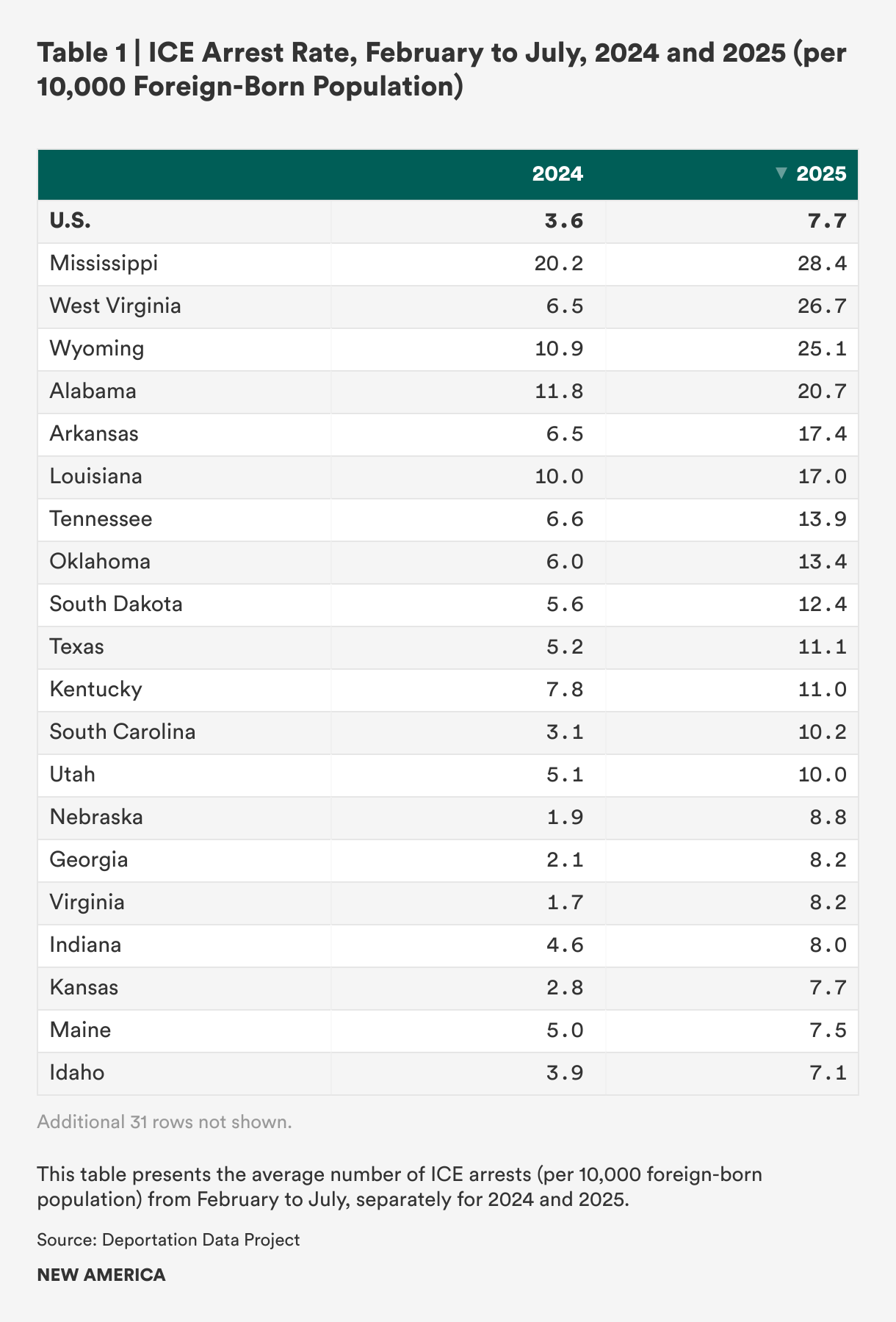
In contrast, the increase in ICE arrests was smaller in states with large and long-established immigrant communities. California, New York, and New Jersey all maintained relatively low levels of enforcement activity, with arrest rates remaining below 3.5 per 10,000 foreign-born residents in both years. This regional contrast suggests that the 2025 surge in enforcement may have reflected an expansion of ICE activity into areas with stronger local cooperation and greater enforcement visibility rather than being proportional to the size of states’ immigrant populations.
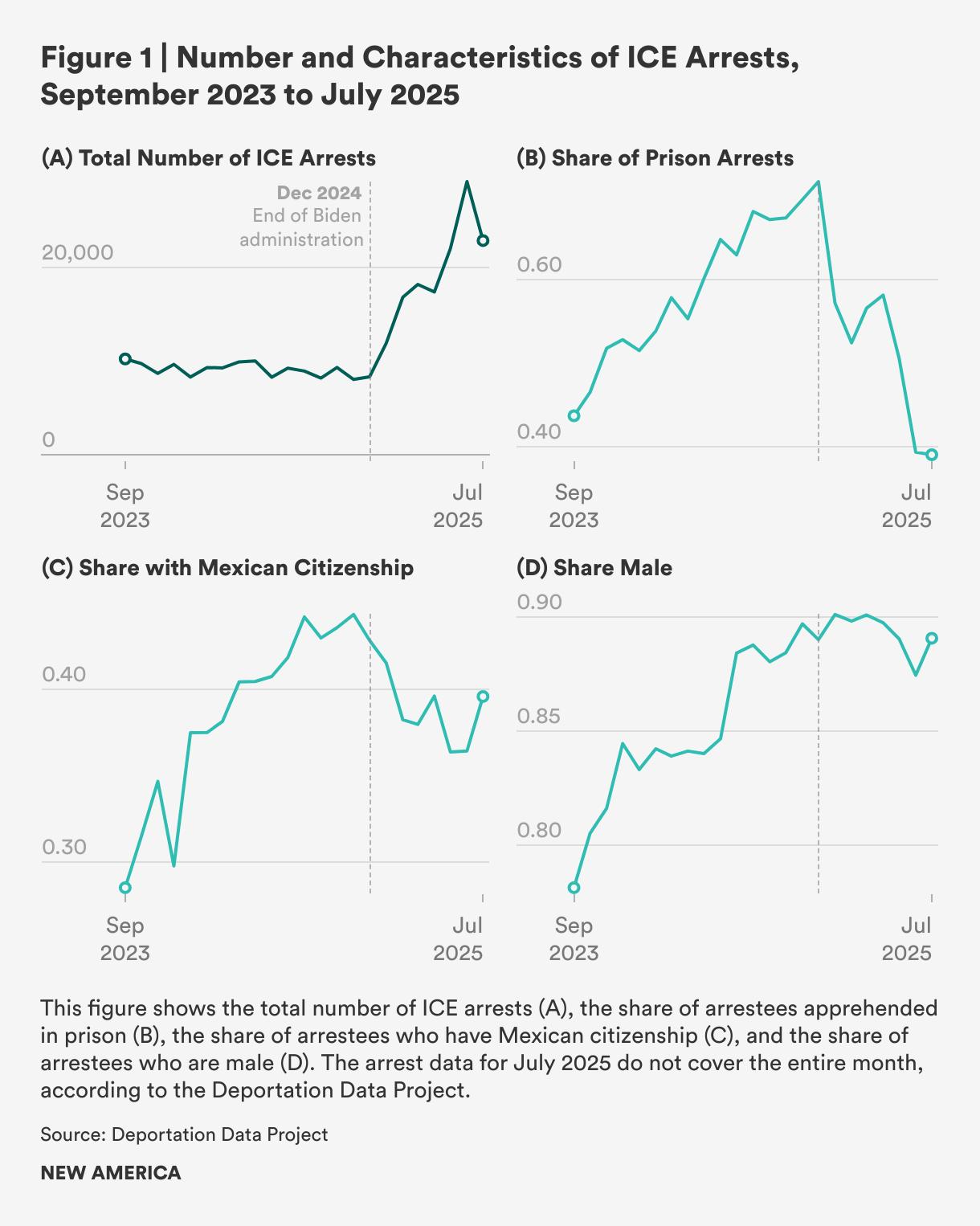
Figure 1 complements this cross-sectional evidence by showing the national evolution in and composition of ICE arrests between September 2023 and July 2025. Panel A displays a steady rise in the total number of arrests beginning in early-2025—coinciding with the inauguration of President Trump—and accelerating throughout the first half of 2025, indicating that the enforcement escalation was both substantial and sustained. Indeed, the number of ICE arrests in December 2024 was 8,320, rising to 11,904 in January 2025 and peaking at 29,147 in June 2025.28
The remaining panels in Figure 1 provide information on the characteristics of those arrested by ICE. Panel B shows the evolution in the share of arrests occurring in local, state, and federal jails and prisons. In particular, we find that the share of arrests in prisons or jails rose steadily from 44 percent in September 2023 to 72 percent in December 2024, followed by an immediate and sharp reversal in January 2025. Indeed, between January and July 2025, the share of ICE arrests occurring in jails or prisons declined from 57 percent to 39 percent. At the same time, as arrests in custodial settings declined, arrests taking place in various community settings increased dramatically in both share and level terms after December 2024.
Panels C and D show changes in the demographic characteristics of those arrested. The share of arrestees with Mexican citizenship increased steadily between September 2023 and December 2024, from 29 percent to 43 percent. The proportion then declined during the early months of 2025, falling from 42 percent in January to a low of 36 percent in May and June. Such changes suggest that the recent enforcement surge is drawing from a broader range of nationalities than in the preceding period. For example, we find that the ICE arrestees in December 2024 held citizenship in 112 distinct nations, a number that rose to 143 nations in June 2025. Finally, panel D shows that the vast majority of arrestees are male, with the share rising gradually from 78 percent in September 2023 to 89 percent in December 2024, before leveling off at about 90 percent throughout 2025. This stabilization likely reflects an increase in the number of female arrestees after December 2024, which offset the continued growth in male arrests and kept the overall gender composition relatively stable during the recent enforcement surge.
Impact of ICE Arrests on Child Care Employment
Table 2 presents estimates of the relationship between state-level ICE arrest rates and the probability of employment in the child care sector. Panel A reports results for foreign-born women, and Panel B reports them for U.S.-born women. We present separate estimates for all women as well as for subgroups of low- and high-education women, all Hispanic women, women of Mexican origin, and all non-Hispanic women.
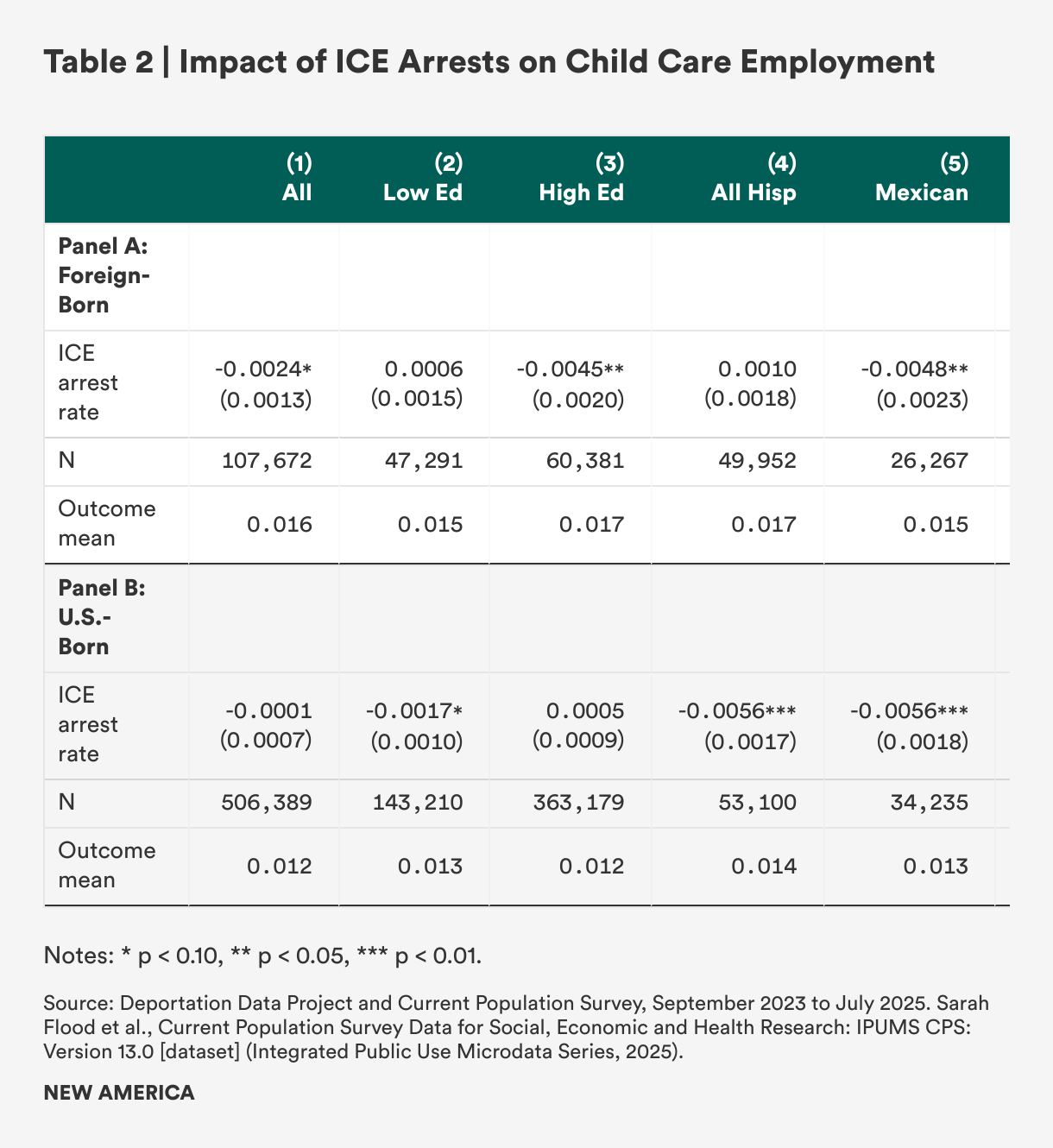
In general, higher ICE activity corresponds to lower employment in child care, with stronger effects among foreign-born women and among certain subgroups of U.S.-born women. For all foreign-born women, the estimated coefficient of -0.0024 implies that a 1 percent increase in the ICE arrest rate is associated with a 0.24 percentage-point decrease in child care employment, equivalent to about a 15 percent decline relative to the mean employment probability of 0.016. To put this magnitude in a more policy-relevant context, doubling the ICE arrest rate is associated with a decline in child care employment of about 0.17 percentage points, or a 10 percent reduction in employment relative to the mean.29 The negative relationship is strongest for immigrant women with more education and for non-Hispanic and Mexican immigrants. Among higher-education women, the coefficient of -0.0045 implies that doubling the ICE arrest rate is associated with a decline in child care employment of about 0.31 percentage points, or roughly an 18 percent decrease relative to the mean employment probability of 0.017. For non-Hispanic and Mexican women, the point estimates translate into declines of approximately 0.32 percentage points, or about a 21 percent decrease relative to their mean employment probabilities.
For U.S.-born women, the overall relationship is weak, but some subgroups display meaningful effects. The estimate for the full sample is close to zero, while the estimate for low-education women (-0.0017) implies that doubling the ICE arrest rate reduces the likelihood of child care employment by about 0.12 percentage points, or about 9 percent. The largest reduction in employment appears among all Hispanic and Mexican U.S. natives, where the coefficient of -0.0056 implies a 0.39 percentage-point, or 30 percent, decrease in the likelihood of working in child care.30 The estimate for non-Hispanic U.S. natives is small and not statistically significant. These results suggest that immigration enforcement may indirectly influence U.S.-born women. We speculate that these spillovers are particularly relevant for U.S. natives living or working in areas with large immigrant populations, where public ICE raids are a more visible part of daily life. It is also possible that the concentration of negative effects among Hispanic, Mexican, and low-education U.S. native women—groups less likely to be targets of enforcement on legal grounds because they are U.S. born—may reflect a perceived pattern of profiling or discriminatory enforcement practices. If ICE officers disproportionately target individuals based on appearance or language, some U.S.-born individuals in these groups may experience heightened fear of wrongful arrest. Such profiling could amplify the chilling effects of enforcement and contribute to reduced labor force participation even among those who are fully authorized to work.
Table 3 extends the analysis by disaggregating the relationship between ICE enforcement activity and women’s employment in child care across three segments of the market, including center-based, home-based, and private household care. Overall, the results suggest that higher levels of ICE arrests are associated with lower employment in both center- and home-based settings, with stronger effects on foreign-born, Hispanic, and Mexican women.
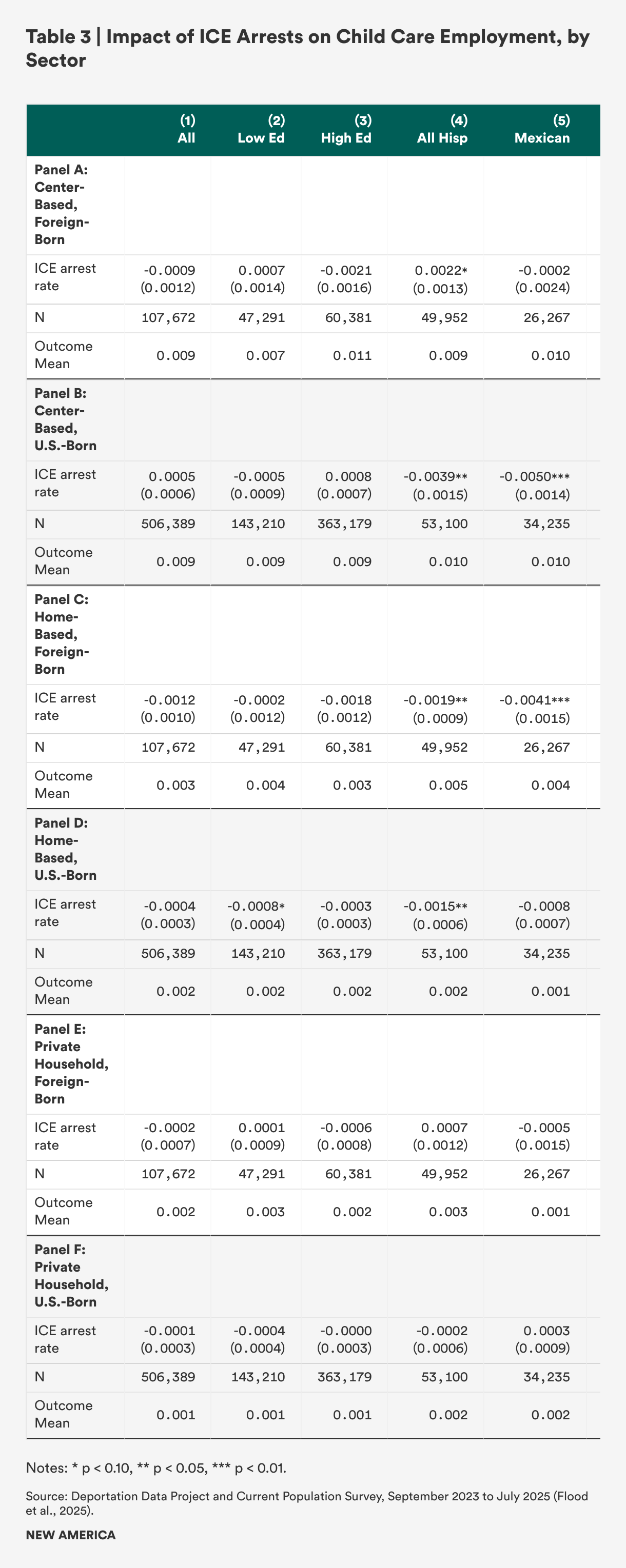
In Panel A, which focuses on center-based employment among foreign-born women, the estimated coefficients are negative for most subgroups, although the statistical significance varies. The largest negative effect appears for non-Hispanic foreign-born women, with an estimate of -0.0031. This implies that a doubling of ICE arrests reduces the likelihood of center-based employment among this group by about 0.21 percentage points, which corresponds to roughly a 21 percent decline relative to the mean employment of 0.010. An exception to the pattern of negative effects appears for all Hispanic foreign-born women, where the estimated coefficient is positive and statistically significant. One possible explanation is compositional or substitution effects within the immigrant labor force. If, for example, heightened enforcement disproportionately displaces undocumented or less-educated workers from informal sectors, some documented Hispanic immigrants may move into more formal, center-based employment to fill the resulting vacancies, at least in the short run.
Panel B reports estimates for U.S.-born women in center-based care. The relationship is weak for the full sample, but the estimates for Hispanic and Mexican U.S. natives (-0.0039 and -0.0050, respectively) are negative and statistically significant, indicating that increased ICE activity is associated with reductions in center-based employment for these groups. A doubling of ICE activity corresponds to declines in employment of 27 percent and 35 percent, respectively. These results reinforce the notion that immigration enforcement can indirectly affect U.S.-born women, particularly those working in communities or facilities that employ immigrant labor or serve immigrant families. The potential mechanisms may include reduced demand for child care services, targeted workplace disruptions, or broader uncertainty in affected localities.
Panels C and D report results for home-based care among foreign- and U.S.-born women, respectively, showing uniformly negative estimates. In Panel C, the largest effects are observed among Hispanic and Mexican women, with coefficients of -0.0019 and -0.0041, respectively, implying reductions of 26 percent and 71 percent for a doubling in ICE arrests. These patterns suggest that small-scale, self-employed providers are particularly vulnerable to immigration enforcement, possibly because they face greater exposure risks and because their clients may withdraw from these care arrangements in response to elevated enforcement activity. Looking at Panel D, although most coefficients are small, several are negative and statistically significant, particularly for the low-education and Hispanic subgroups. These findings again suggest that enforcement may also depress employment opportunities for U.S.-born women engaged in informal or self-employed care work.
Panels E and F of Table 3 present estimates for foreign- and U.S.-born employment in private household settings, respectively. Across all subgroups, the coefficients are small and statistically insignificant, indicating no meaningful association between ICE arrests and employment in this sector. The dearth of effects suggests that private household employment is largely insulated from immigration enforcement pressures. This may be because such work takes place in individualized and informal settings—where many workers are paid under the table—that are ultimately less visible to regulatory and tax authorities and therefore less exposed to enforcement actions or workplace disruptions.
Is the Trump Era Different?
Table 4 turns to the question of whether the relationship between ICE enforcement activity and women’s employment in child care changed following the start of the second Trump administration. As noted previously, all models include both the main effect (i.e., log of the ICE arrest rate) and its interaction with a post-Trump indicator.31
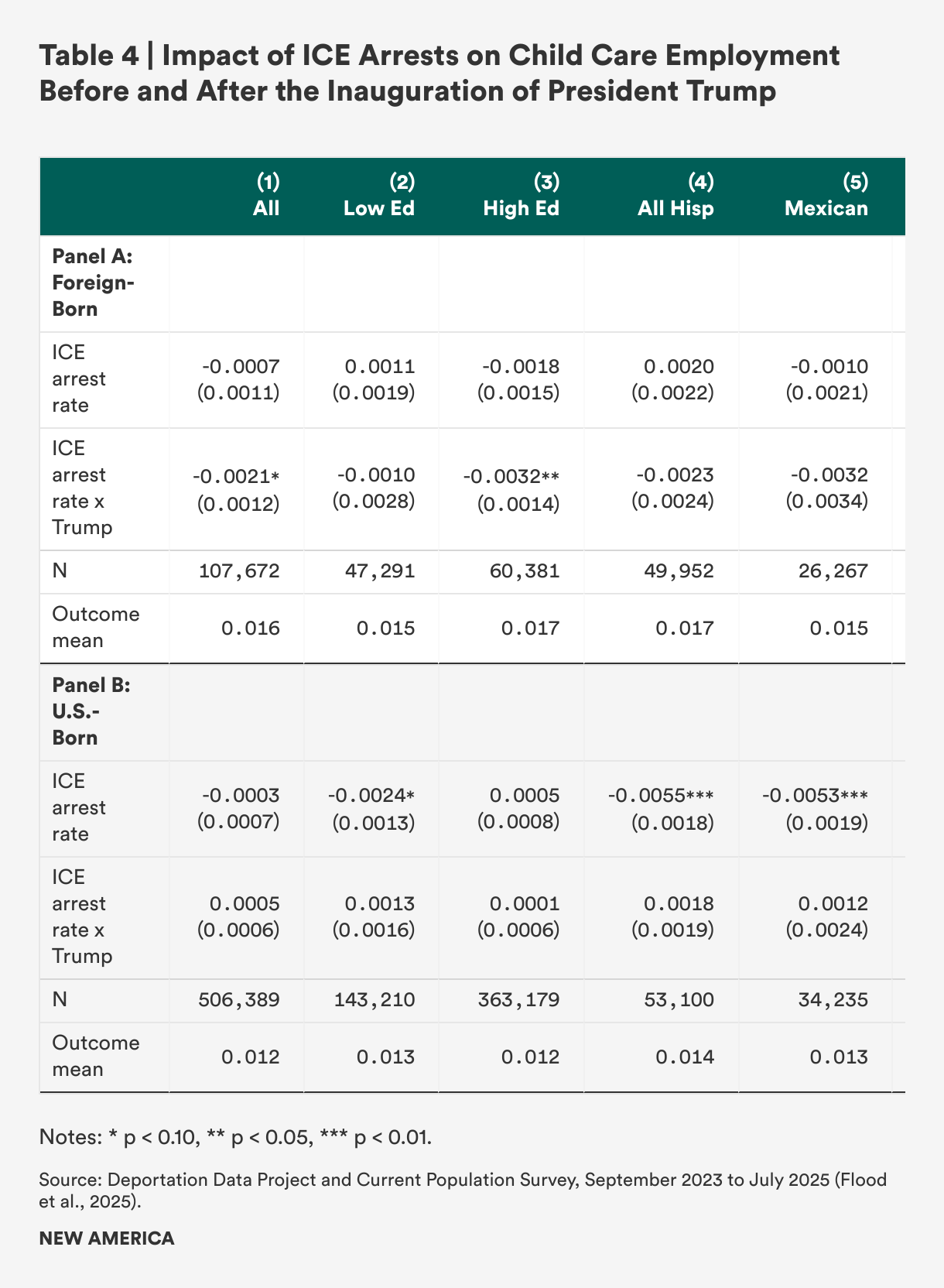
Panel A shows that, in the pre-Trump period, the relationship between ICE arrests and child care employment was generally weak and statistically insignificant for foreign-born women. The estimates on the ICE arrest rate alone are small and close to zero across all groups, suggesting limited responsiveness of immigrant employment to enforcement activity before President Trump took office. However, the estimates on the interaction term are consistently negative and statistically significant for all women and those with more education. This implies that the negative relationship between ICE enforcement intensity and child care employment strengthened significantly after the Trump administration began. In other words, foreign-born women became increasingly sensitive to immigration enforcement following the inauguration of President Trump. Specifically, the coefficients for all women suggest that a doubling of ICE arrests is associated with a 12 percent reduction in child care employment, while the corresponding reduction for higher-education women is 20 percent.
Another way to interpret the magnitude of our estimates is to calculate the reduction in the number of foreign-born child care workers due to the post-Trump escalation in immigration enforcement. As a benchmark, the average monthly number of immigrant women employed in child care was 327,000 between February and July of 2024. Therefore, a doubling of ICE arrests is associated with 39,000 fewer foreign-born child care workers overall between February and July of 2025 compared to the same period in 2024 (0.12 × 327,000).32
Panel B of Table 4 presents the analogous results for U.S.-born women. The estimates for the pre-Trump period are negative for all groups and statistically significant for lower-education, Hispanic, and Mexican U.S.-born women, while the interaction terms are small in magnitude and statistically insignificant across all groups. Such patterns suggest that higher levels of ICE enforcement were associated with lower employment in child care among some groups before President Trump took office, and the onset of the new administration did not materially change the intensity of this relationship. In other words, low-education, Hispanic, and Mexican U.S.-born women were equally sensitive to increased ICE arrests during the post-Trump period as they were during the pre-Trump period.
Finally, Table 5 examines heterogeneity across sectors of the child care market. Panel A presents estimates for foreign-born women in the center-based sector, showing a dramatic change in the relationship between ICE enforcement and child care employment after the start of the Trump administration. During the pre-Trump period, estimates on the ICE arrest rate are positive for all groups and statistically significant for some, but the effect sizes are generally small in magnitude. In contrast, the Trump-era interaction terms are uniformly negative, larger in magnitude, and more precisely estimated. Such patterns indicate that the relationship between enforcement intensity and center-based employment turned markedly negative under the Trump administration. Thus, it is possible that the escalation in ICE activity in the post-Trump period produced an equivalently strong (negative) employment response among foreign-born women. In contrast, Panel B shows that the negative relationship between ICE arrests and center-based employment among U.S.-born women is concentrated among Hispanic and Mexican U.S. natives, and this pattern remained largely unchanged during the post-Trump period.
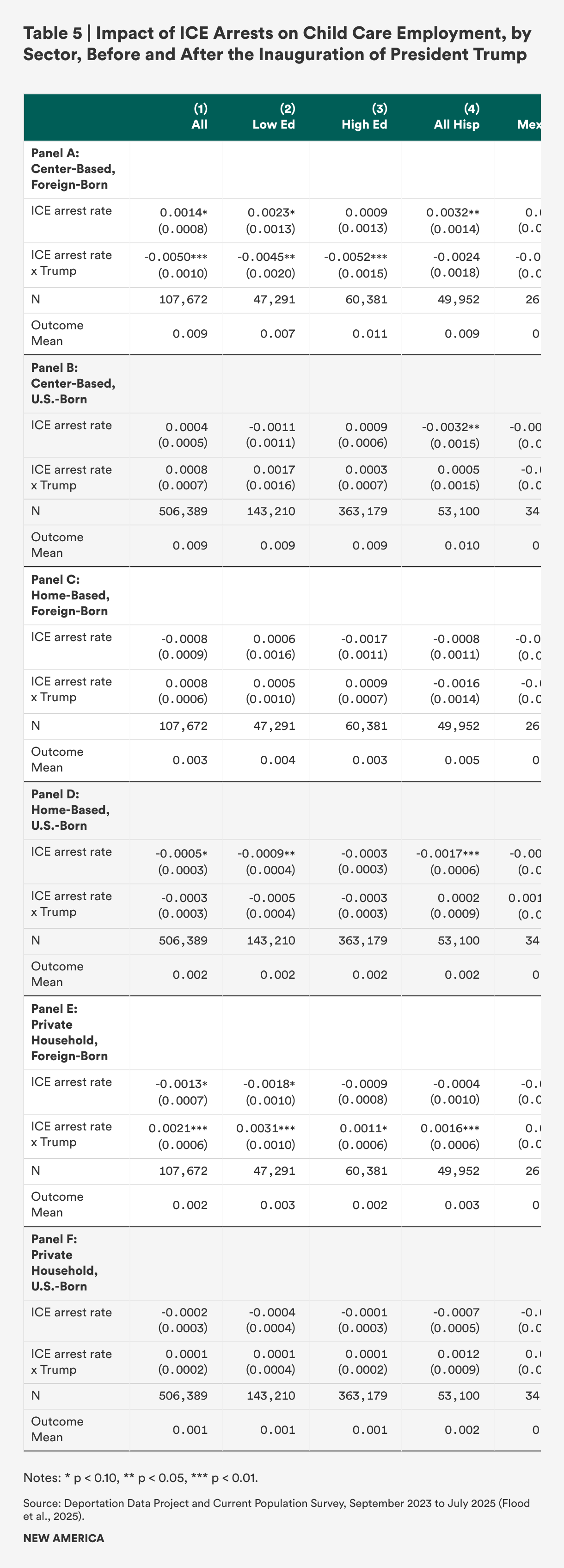
Panels C and D of Table 5 present estimates for home-based child care employment among foreign- and U.S.-born women, respectively. In Panel C, the estimates show that the pre-Trump period relationship between ICE arrests and employment was modest and statistically insignificant across most groups, and this pattern remained largely unchanged after the start of the Trump administration. The corresponding results for U.S.-born women shown in Panel D reveal negative effects of ICE arrests for several groups in the pre-Trump period, particularly among lower-education, Hispanic, and Mexican women. However, the interaction terms are small and imprecisely estimated, implying that enforcement activity was already associated with lower home-based employment prior to the Trump administration, and that this relationship did not materially change following the onset of the new administration.
Panels E and F of Table 5 report results for private household child care employment among foreign- and U.S.-born women, respectively. In Panel E, the coefficients on ICE arrests are negative and statistically significant for several subgroups, indicating that higher enforcement intensity in the pre-Trump period was associated with lower employment in the sector. Interestingly, however, the interaction terms are positive, larger in magnitude, and statistically significant across most groups, suggesting that this negative relationship weakened considerably after the Trump administration began. These results imply that foreign-born women may have shifted into private household work as enforcement pressures increased in more formal segments of the child care market. Such a shift may reflect a move toward less visible, more flexible forms of employment that offer greater protection from ICE encounters.33 Panel F presents the corresponding estimates for U.S.-born women. In contrast to Panel E, the estimates on both the ICE arrest rate and its post-Trump interaction are small and statistically insignificant across all groups, indicating no clear relationship between enforcement activity and private household employment in either period.
Employment of Mothers with Young Children
Having established the relationship between ICE arrests and child care labor supply, we now turn to the broader labor market for mothers with young children, to study the relationship between increased immigration enforcement and maternal employment.
Given that families outsource many dimensions of household production for work-enabling purposes, a decrease in the availability of nonparental child care services—in this case due to heightened immigration enforcement—may lead to a reduction in the amount of maternal time allocated to employment.34 Indeed, recent research from Ali, Brown, and Herbst, as well as from economic scholars Chloe East and Andrea Velasquez, finds that the Secure Communities program reduced the supply of formal child care and the employment of high-skilled mothers with preschool-aged children.35 Such patterns are consistent with the findings from economic researchers Catalina Amuedo-Dorantes and Almudena Sevilla, who show that increased low-skilled immigration reduces the amount of time that high-skilled mothers engage in housework and basic child care duties.36 While the insights above apply to U.S. native- and foreign-born mothers, there are some additional considerations for the latter group. In particular, the presence of chilling effects could reduce immigrant mothers’ labor force participation directly, or such chilling effects could reduce the willingness of immigrants to send their children to child care—in both cases decreasing the demand for child care. Thus there are reasons to believe that the recent increase in ICE activity may spill over to the labor market for mothers by fraying their attachment to the workforce.
The analysis relies once again on the monthly CPS from September 2023 to July 2025. The analytic sample includes U.S. native- and foreign-born women ages 22 to 64 whose youngest child is ages 0 to 5 (N=71,975). The outcome variable is a binary indicator equal to one if a given woman was employed (defined in the CPS as “doing any work at all for pay or profit”) during the previous week, and zero otherwise. As with the analysis of child care labor supply, we examine both the average effect of ICE arrests over the study period as well as any differential effects of arrests on maternal employment after President Trump was inaugurated. That is, we estimate separate models with the log ICE arrest rate entered individually and with its interaction with a binary indicator denoting the first six (full) months of the new Trump administration. The models include the same set of individual-level demographic and time-varying state controls, and account for unobserved heterogeneity in the same manner. All models are weighted by the CPS’s final person-level weight, and the standard errors are clustered at the state level.
Results from this analysis are presented in Table 6. Panel A displays the estimates for U.S.-born mothers of preschool-aged children, while Panel B shows the corresponding results for immigrant mothers. We present separate estimates for mothers overall as well as subsets of low- and high-education mothers and non-white and white mothers. In this analysis, consistent with prior studies on related topics, we define “low-education” as having less than a two-year college degree, while “high-education” is defined as having at least a two-year college degree.
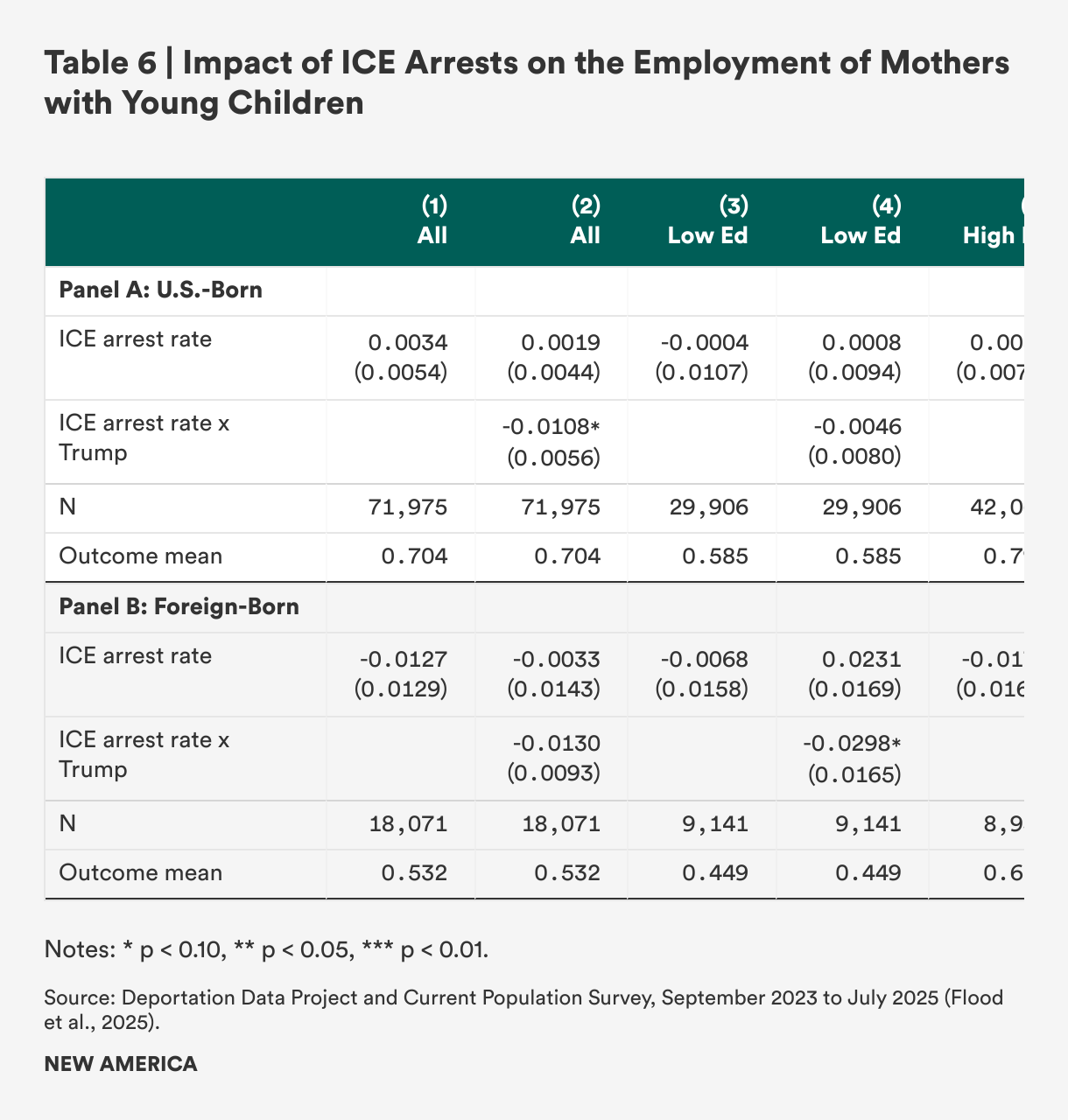
Looking first at U.S.-born mothers, we find that an increase in ICE enforcement activity did not influence mothers’ employment throughout the entire study period (September 2023 to July 2025), as shown in the odd-numbered columns. Indeed, the coefficients on ICE arrests are inconsistently signed, and all but one are statistically insignificant. However, the estimates show evidence of substantial heterogeneity in the impact of ICE arrests across the pre- and post-Trump periods. While immigration enforcement during the pre-Trump period did not influence mothers’ employment, such enforcement measures began reducing employment in the months following President Trump’s inauguration. This pattern holds for U.S.-born mothers overall and appears to be driven by high-education and white mothers, as shown in the even-numbered columns. Specifically, among mothers overall, the relevant coefficients imply that a doubling of ICE arrests is associated with about a 1 percent reduction in employment in the post-Trump period. The corresponding employment reductions are 1.2 percent for high-education mothers and 1.4 percent for white mothers.37
As we did above, we use the estimates to calculate the reduction in the number of working mothers in response to the post-Trump escalation in immigration enforcement. Approximately 7.7 million U.S.-born mothers with preschool-aged children were estimated to be employed each month between February and July of 2024. Therefore, a doubling of ICE arrests led to about 77,000 fewer employed U.S.-born mothers overall between February and July of 2025 compared to the same period in 2024.
Turning to foreign-born mothers, we find that increases in ICE activity did not influence employment rates overall, as shown in the odd-numbered columns. The relevant coefficients, while consistently negative, are never statistically significant. However, certain subgroups of mothers appear to have been affected in the period after President Trump’s inauguration. In particular, the results indicate that low-education and white mothers experienced declining employment rates in the post-Trump period. The relevant coefficients imply that a doubling of ICE arrests is associated with a 1 percent reduction in both low-education and white mothers’ employment.
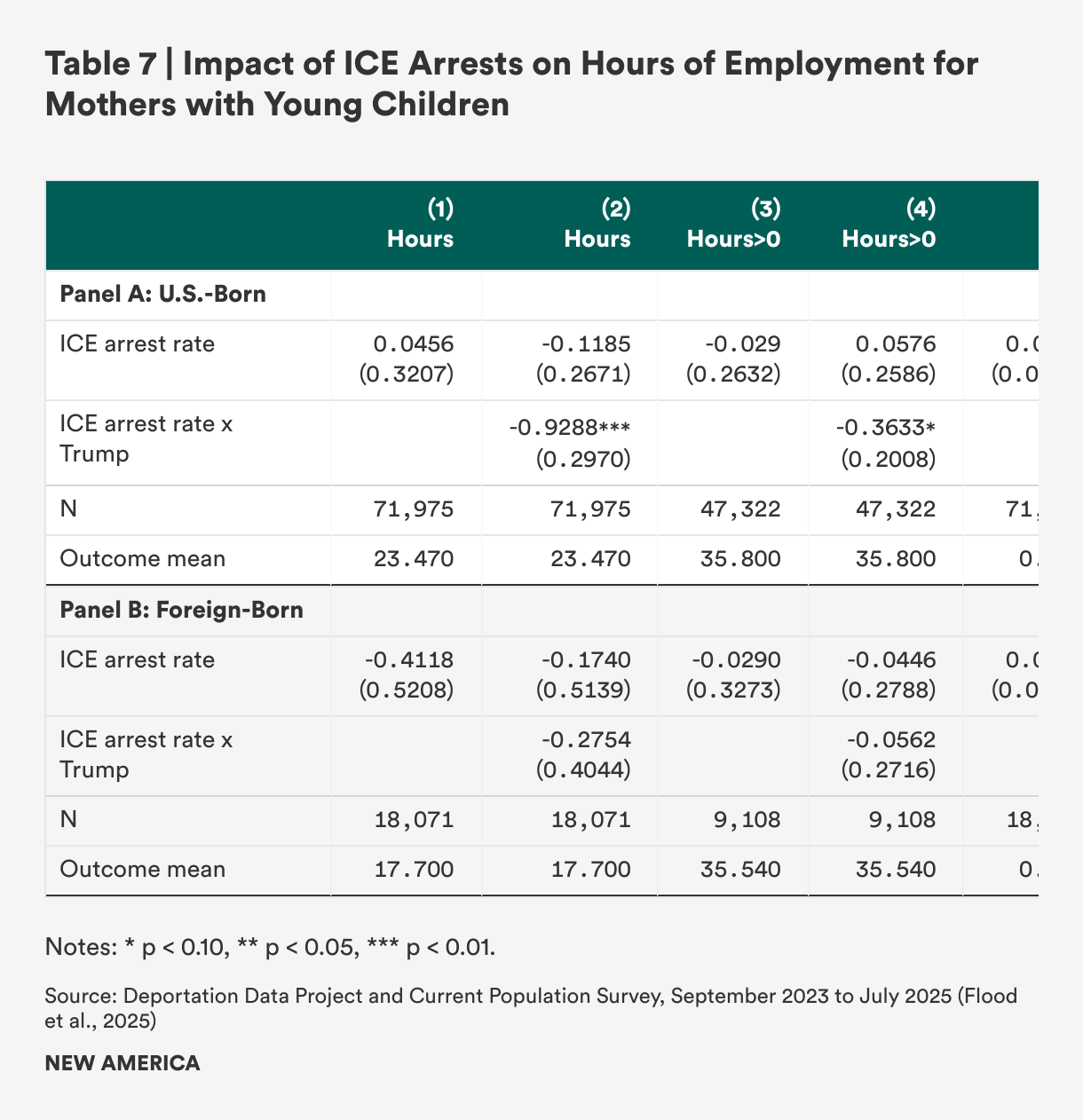
The results discussed above pertain to the likelihood of any employment, or employment at the extensive margin. We now examine various measures of infra-marginal labor supply (e.g., the number of hours of work), as shown in Table 7. Columns (1) and (2) report results for mothers’ total hours of work last week, including zeros, while columns (3) and (4) show results for weekly hours of work conditional on working at least one hour. Columns (5) and (6) examine effects on part-time employment (i.e., one to 34 hours of work), and columns (7) and (8) study full-time employment (i.e., 35 hours or more). Note that we report results for only the full samples of U.S. native- and foreign-born mothers. Looking first at U.S.-born mothers (Panel A), we continue to find evidence of intensifying effects of ICE enforcement after the inauguration of President Trump. While the coefficient on the interaction term is negative and statistically significant for both measures of hours worked [columns (2) and (4)], the reduction in hours including zeros is larger than its counterpart excluding zeros. This implies that mothers’ labor supply adjustment primarily entails an exit from the labor force rather than a reduction in hours of work. Furthermore, a comparison of columns (6) and (8) reveals that U.S.-born mothers are more likely to leave full-time employment than part-time employment. Turning to the full sample of foreign-born mothers (Panel B), the results continue to show null effects of immigration enforcement.
Robustness
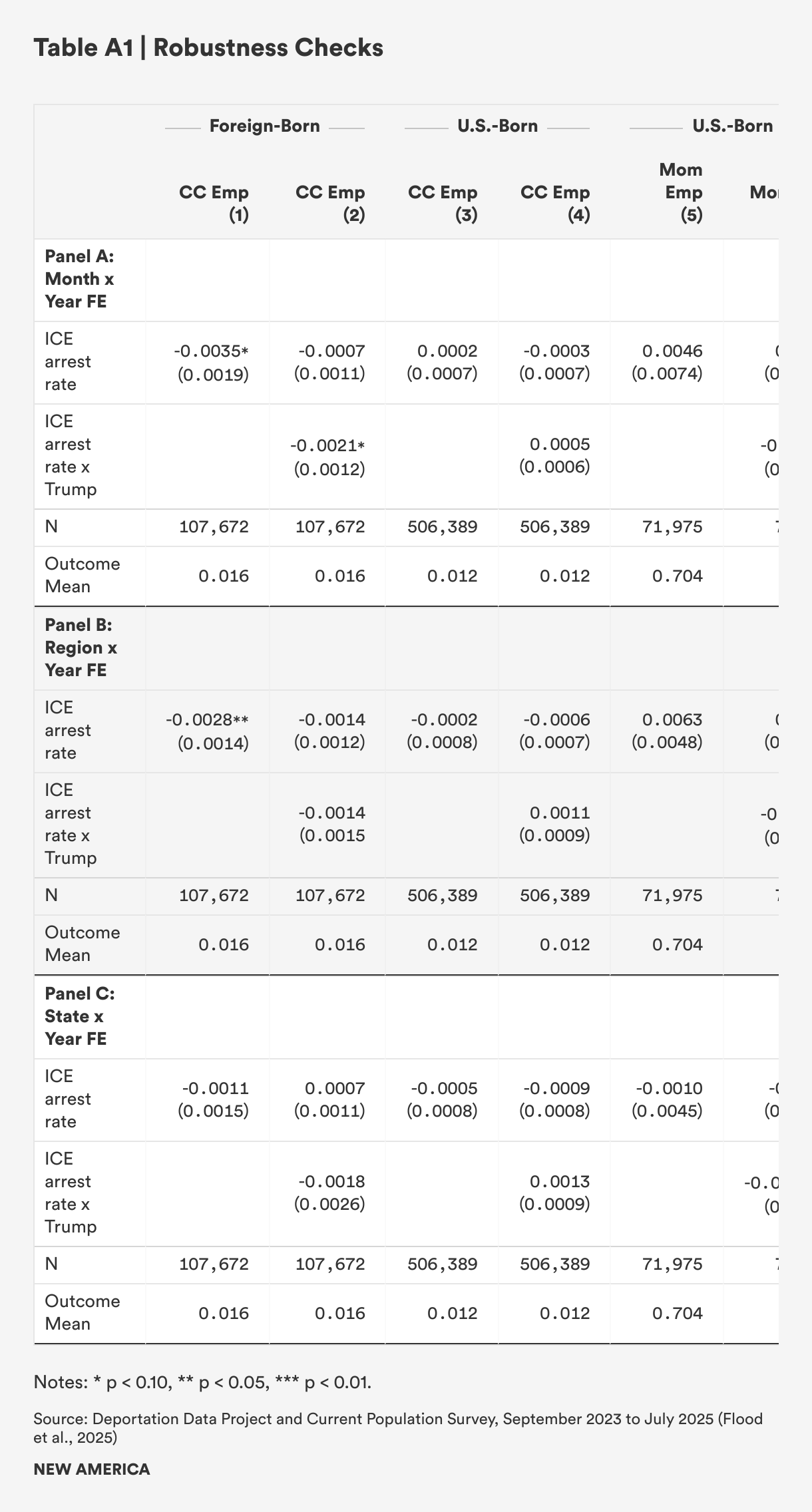
Table A1 in the Appendix provides several checks of the robustness of our main results. Columns (1) through (4) show results for the child care employment models, and columns (5) through (8) show the corresponding results for maternal employment. For ease of presentation, we concentrate on the full samples of women and mothers, rather than the subsamples shown previously.
Panel A includes a set of month × year fixed effects (instead of separate year and month fixed effects), which is a more stringent control for any national time-varying shocks that may be correlated with the intensity of ICE arrests and the employment outcomes. Panel B incorporates region × year fixed effects to account for the possibility of region-specific adjustments to the new immigration enforcement environment. Recall that Table 1 shows that the largest increases in ICE arrests occurred in the South and Midwest, while smaller increases occurred in the West and several Eastern states. Such patterns indicate that different areas of the country may be better positioned for and politically open to immigration enforcement. Finally, Panel C includes a set of state × year fixed effects to account for any state-specific unobservables that vary over time.
Generally speaking, results from these robustness exercises are consistent with the main results. Adding the month × year fixed effects does little to change the results.38 Including the region × year fixed effects reduces the size of the coefficient (and increases the size of the standard error) on the interaction term in the foreign-born child care employment model such that it is no longer statistically significant. However, all other results are unchanged. Inclusion of the state × year fixed effects seems to have a larger influence on the results, in most cases reducing the size of the relevant coefficients (and increasing the size of the standard errors). However, the coefficient on the interaction term in the U.S.-born maternal employment model remains statistically significant.
Citations
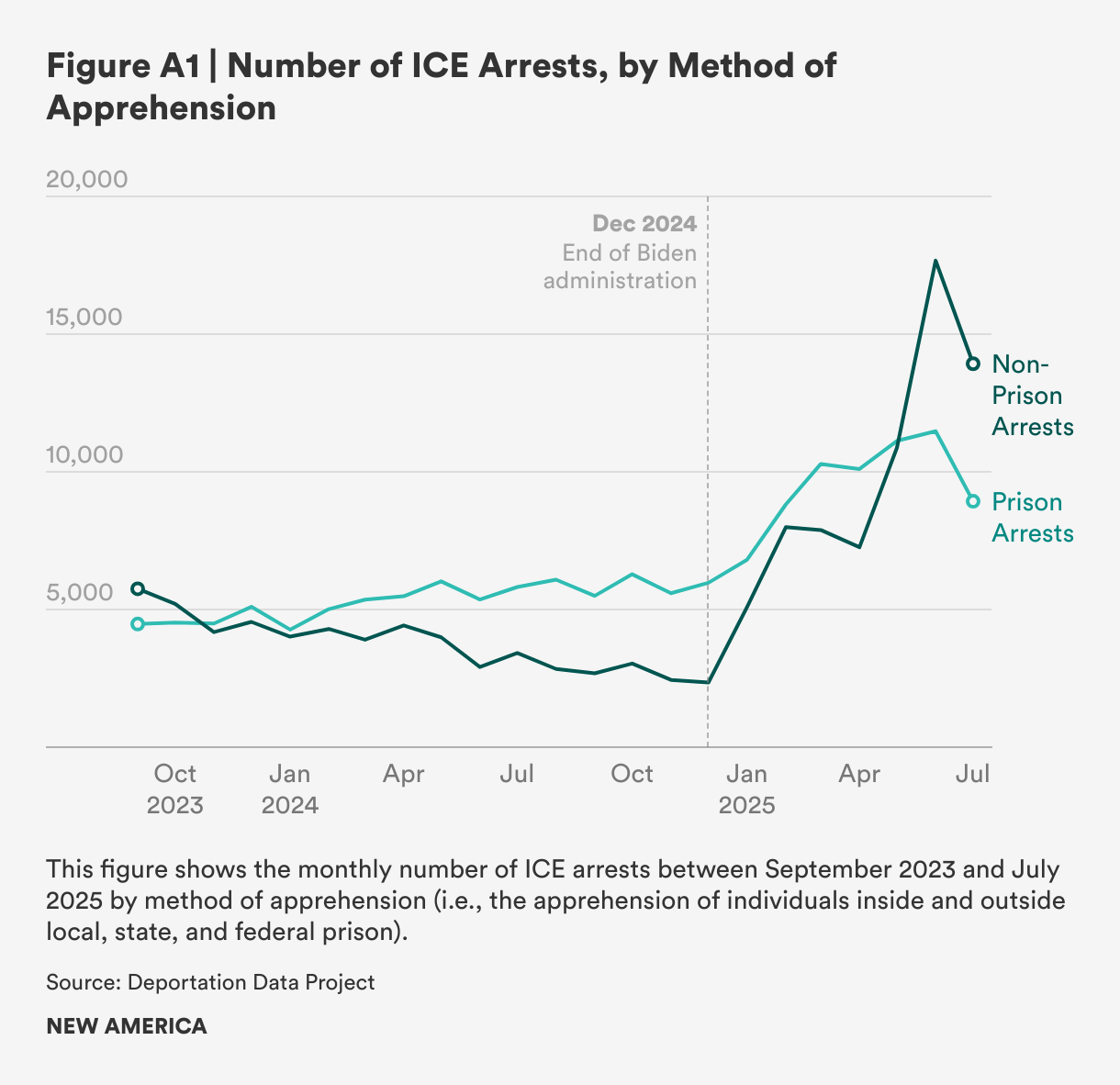
- The sharp reduction in July 2025 may be due in part to the fact that the most recent data released by the Deportation Data Project does not cover the entire month of July. Appendix Figure A1 exploits information in the Deportation Data Project on the method of apprehension to generate separate time series plots for the number of ICE arrests that take place in prisons or jails and arrests that occur within the community. After declining throughout much of the pre-Trump period, non-prison arrests rose sharply starting in early 2025 and now exceed the number of prison arrests. Indeed, although prison arrests increased as well during the Trump presidency, the growth has been far less dramatic.
- Table 1 shows that the ICE arrest rate roughly doubled nationwide between the February to July periods of 2024 and 2025, increasing from about 3.6 to 7.7 arrests per 10,000 foreign-born residents. We therefore interpret the coefficients as reflecting the effect of a doubling in ICE enforcement intensity. The 10-percent decline is obtained by multiplying the coefficient (-0.0024) by ln(2)=0.693 to get -0.0017, and dividing this by the mean employment probability of 0.016 (i.e., 0.0017 ≈ 0.10).
- In this report, “Hispanic” and “Mexican” capture separate, though related, categories: “Hispanic” refers to all Census-defined categories of Hispanic persons, including Mexicans. We present separate results for all Hispanics and the subset of Mexicans.
- The coefficient on the ICE arrest rate reflects the association between enforcement activity and employment during the pre-Trump period (September 2023 to January 2025), while the interaction term captures the differential effect after the start of the new Trump administration (February to July 2025). The sum of the two coefficients therefore indicates the overall effect of enforcement intensity on employment in the post-Trump period.
- We note the possibility that this is a lower-bound estimate if some child care workers were detained or self-deported and therefore are not included in the data.
- The shift may also indicate that as opportunities in center- and home-based settings decreased under heightened enforcement, private household work emerged as an alternative form of employment for displaced and risk-averse workers in the child care market.
- We note the possibility that the supply of child care is influenced by demand-side factors, including the increased cost of household services (e.g., cleaners) that are complementary to employment, or to an overall reduction in local job creation and consumption from the decline in immigrant labor supply. If maternal employment decreases, the demand for child care should fall as well, along with the supply of care services.
- Ali, Brown, and Herbst, “Secure Communities as Immigration Enforcement,” https://www.sciencedirect.com/science/article/pii/S0047272724000379; East and Velásquez, “Unintended Consequences of Immigration Enforcement,” https://jhr.uwpress.org/content/59/5/1458.
- Catalina Amuedo-Dorantes and Almudena Sevilla, “Low-Skilled Immigration and Parenting Investments of College-Educated Mothers in the United States: Evidence from Time-Use Data,” Journal of Human Resources 49 (July 2014): 509–539, https://jhr.uwpress.org/content/49/3/509.
- Interestingly, we find a positive relationship between increased ICE activity and the employment of non-white mothers for the full study period. While the increase in employment appears to be concentrated in the pre-Trump period, coupled with a small reduction in the post-Trump period, neither of the relevant coefficients in the interacted model are statistically significant.
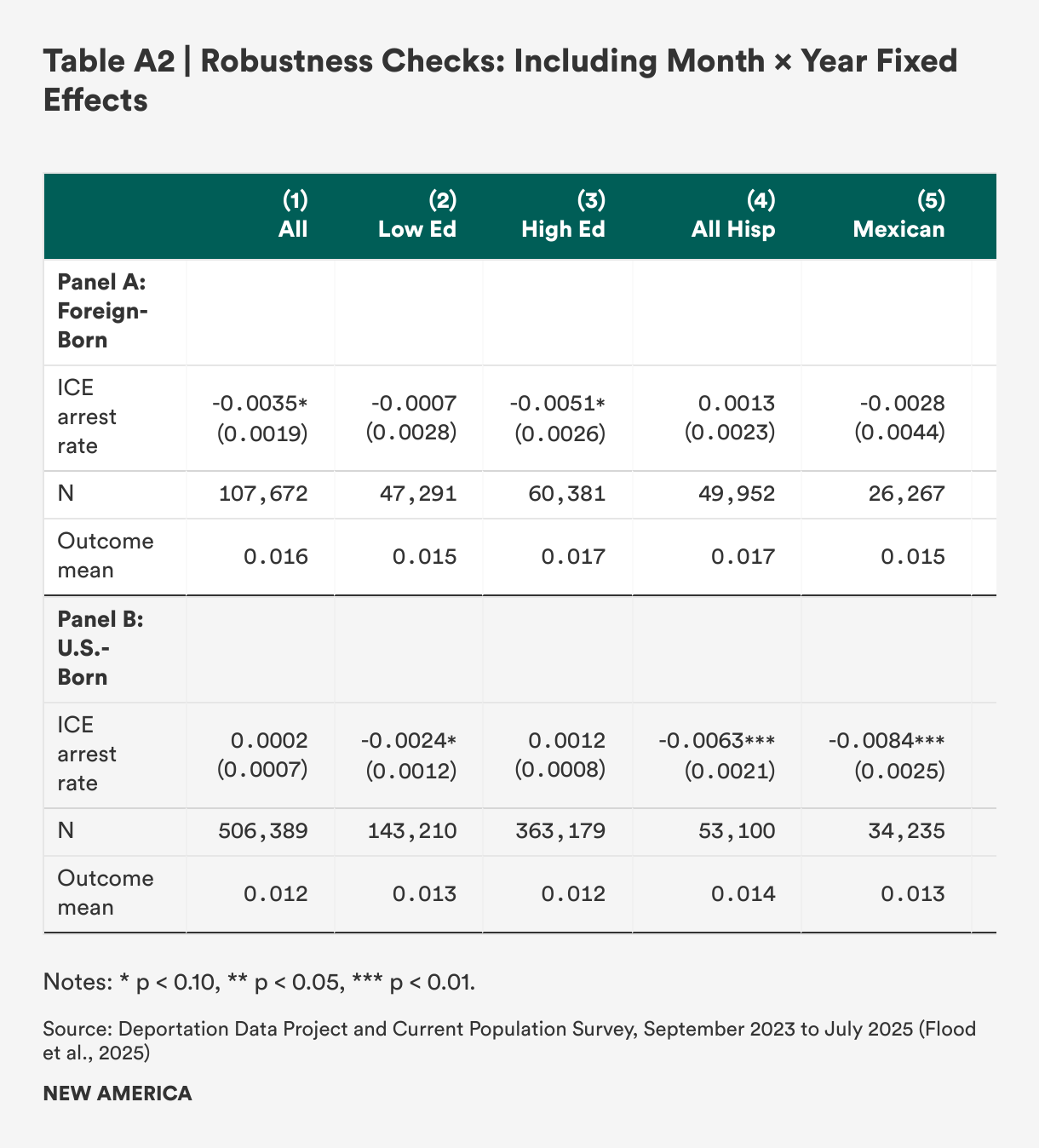
- As shown in Table A2 in the Appendix, we also estimate the child care employment models with month × year fixed effects on all of the subgroups of foreign- and U.S.-born women. Results from these estimations are robust.
Conclusion
This paper assessed the impact of increased immigration enforcement—measured by the number of ICE arrests—on the child care and maternal labor markets. Our results provide four main insights. First, foreign-born child care labor declined, particularly among high-education and Mexican immigrants. Second, certain groups of U.S.-born individuals also became less likely to work in child care, including those with low-education and those of Mexican descent. Third, we find that the reduction in child care employment was concentrated in the post-Trump time period, which in this paper spans from February to July of 2025. In other words, the estimates suggest that the impact of ICE arrests after President Trump’s inauguration was more negative for child care employment than it had been before he took office. Finally, increased ICE activity reduced the employment of mothers with preschool-aged children, particularly in the period after Trump became president.
Our results are consistent with those from Ali, Brown, and Herbst finding that the Secure Communities program reduced the supply of U.S.- and foreign-born labor to the child care market, particularly among Hispanics employed in the center-based sector.39 The maternal employment results in this report are also consistent with those from East, Velasquez, and colleagues, as well as an additional paper from East and Velasquez, who find that the Secure Communities program had larger labor supply effects on high-skilled U.S. natives.40 Finally, our maternal employment results are broadly consistent with previous work by Amuedo-Dorantes and Sevilla as well as economic researchers Patricia Cortés and José Tessada, who find that in response to increases in the supply of low-skilled immigrants, high-skilled women spend less time on basic child care tasks and more time on market work.41
An interesting feature of our results is that the reduction in child care labor is concentrated in the center- and home-based sectors. The private household sector, on the other hand, experienced an increase in employment, driven by foreign-born individuals in the period after President Trump took office. Therefore, it appears that some workers left the formal child care sector in order to provide informal caregiving services as a babysitter, nanny, or au pair. This pattern is consistent with the results from Ali, Brown, and Herbst, who find that Secure Communities reduced employment primarily in the center-based sector.42 The authors posit that center-based workers are more exposed to government agencies and officials through wage reporting as well as licensing and regulatory oversight. Such dynamics could be at play in the current environment. Given that a single center-based worker is able to care for more children than one in a private household setting, our results suggest that total caregiving capacity has declined.
Why would the employment of U.S.-born child care workers fall at the same time that immigrants became less likely to work in the sector? Two explanations seem plausible. First, the increase in ICE arrests had a chilling effect on some groups of U.S. native workers. Indeed, we find that U.S.-born Hispanics—and particularly those of Mexican descent—experienced the largest reductions in child care employment. Given that those with Mexican citizenship are heavily targeted by ICE agents, a “chilling effects” story seems reasonable. Second, a simple trade model allows for the possibility that immigrants and U.S. natives do not compete for the same jobs at child care businesses. Instead, they may possess complementary—or imperfectly substitutable—skills and work experience, so that changes in the demand for immigrant workers lead to similar changes in the demand for U.S. native workers. Therefore, it is possible that the recent increase in ICE arrests pushed foreign-born individuals out of the child care labor market, which in turn decreased the demand for their U.S.-born counterparts.
We end by acknowledging some limitations of this work. First, our work covers only the first six (full) months of the new Trump administration’s efforts to curtail the number of undocumented immigrants in the United States. Such efforts remain underway, and are growing increasingly aggressive. Indeed, the recently passed One Big Beautiful Bill Act allots over $170 billion over four years to immigration enforcement, including $75 billion to ICE, a majority of which will be used to detain immigrants. Considerable new funding is also available to enable ICE to hire as many as 10,000 new officers to track down and arrest immigrants.43 Therefore, as ICE activity continues to intensify, we might observe additional departures from the child care and maternal labor markets. Second, the monthly CPS does not provide a measure of earnings, precluding us from estimating impacts on hourly wages. Such information is only available in the annual (March) demographic supplement to the CPS and the annual American Community Survey. Thus, future research should consider integrating these surveys into the analysis. Third, our analysis does not test for pre-trends in the employment outcomes, nor does it utilize the new class of event-study methods for continuous treatments. In future work, we plan to expand the analysis by incorporating such methods into our reports.
Citations
- Ali, Brown, and Herbst, “Secure Communities as Immigration Enforcement,” https://www.sciencedirect.com/science/article/pii/S0047272724000379.
- East et al., “Labor Market Effects of Immigration Enforcement,” https://www.journals.uchicago.edu/doi/10.1086/721152; East and Velásquez, “Unintended Consequences of Immigration Enforcement,” https://jhr.uwpress.org/content/early/2022/05/02/jhr.0920-11197R1.
- Amuedo-Dorantes and Sevilla, “Low-Skilled Immigration and Parenting Investments,” https://jhr.uwpress.org/content/49/3/509; Patricia Cortés and José Tessada, “Low-Skilled Immigration and the Labor Supply of Highly Skilled Women,” American Economic Journal: Applied Economics 3 (July 2011): 88–123, https://www.aeaweb.org/articles?id=10.1257/app.3.3.88.
- Ali, Brown, and Herbst, “Secure Communities as Immigration Enforcement,” https://www.sciencedirect.com/science/article/pii/S0047272724000379.
- Margy O’Herron, “Big Budget Act Creates a ‘Deportation-Industrial Complex,’” Brennan Center for Justice, August 13, 2025, https://www.brennancenter.org/our-work/analysis-opinion/big-budget-act-creates-deportation-industrial-complex.
Appendix
More About the Authors

Chris M. Herbst
Professor, Arizona State University

Erdal Tekin
Professor, American University