A Chapter of: The Case for Child Care Plus Coworking: A Model that Empowers Families and Neighborhoods
Part III. Challenges and Opportunities for Scaling Shared Sites
Addressing the Equity and Accessibility Challenges Across Gender, Race, Ability, and Class
In February 2025, remote work accounted for a quarter of paid workdays among Americans aged 20 to 64.35 The rate is consistently higher for parents of children under age eight, and for women. It’s crucial to note that the desired remote-working rates exceed actual rates in every major demographic group—just more so for women, workers with young children, and workers without college degrees.36 Throughout my research, I found that hybrid coworking spaces specifically designed for parents offered a feasible structural solution to the pressure to “return to the office.” And yet, barriers to the approach seem to be increasing with every return-to-office mandate.
Gender
Despite the loud headlines, office occupancy rates have not returned to 2019 levels.37 Calls to return to on-site working are often driven by narrow political and corporate interests.38 Daniella Cornue, founder of LeVillage, a coworking space with child care in Illinois and Wisconsin, calls return-to-office mandates like those from the Trump administration and major corporations “an attack on working parents.”39 She argues that coworking spaces with embedded child care offer a practical alternative solution that could help many parents reconcile their caregiving responsibilities with their work ones.
Remote work is a powerful driver of inclusion—it offers a diverse workforce with diverse needs the flexibility to support their families.40 And it urgently needs defending. Cornue’s solution proactively fights the “motherhood penalty” that has been shown to limit women’s careers and economic potential, and it also challenges the associated “fatherhood bonus” that often casts parenting as a positive catalyst in men’s work. Children are not the true barrier to meaningful paid work: It’s a matter of unequal relationships and gender expectations. The United States is truly an outlier in lacking systemic support for parents41 and needs the political will to act to close these gaps. The stakes are high: Over 200,000 women over the age of 20 left the workforce in the first eight months of 2025, according to the U.S. Bureau of Labor Statistics, while 44,000 men entered it.42 There’s been a steady, and now increasing, exodus of mothers, specifically.43 The labor force participation rate between January and June alone declined 3 percentage points for those with children under five. In previous years, flexible working policies directly correlated to women’s increased workforce participation, and now return-to-work policies and lack of child care are harming that trend.44
Race and Ability
Parents are not alone in their preference for flexible and remote work. According to one study, in 2021, only around 22 percent of women (Black and white) and only about 16 percent of Black men desired a return to the office.45 Instead, many preferred working remotely, free from the “identity labor” demanded by the institutionalization of male- and white-coding of professionalism that calls back to the office reinforce.46 A 2024 study of resumes across SpaceX, Apple, and Microsoft revealed that return-to-work mandates led to an exodus of talent.47 Many workers with disabilities or neurodiverse conditions prefer flexible and remote work, saying they’re better able to focus on getting work done and being productive.48 (And remote workers who moved to rural areas for quality of life helped breathe new life into their adopted communities.49 Many of those communities want them to stay.)
Class
When exploring the close tie between child care access and women’s workforce participation, I became hopeful that addressing the gap via practical care solutions embedded within physical workspaces might advance equity for other marginalized groups, too. Just as communities historically excluded from opportunity, such as people of color, rural families, and low-income households, are disproportionately affected by insufficient child care options, it’s likely that they also have more limited access to coworking spaces. Hourly, retail, and service workers and those in jobs not tied to desks and computers are less likely to be able to conduct work that’s not in-person: Compared to 36 percent of workers in management, and professional occupations working hybrid or remotely, just 5.5 percent of service occupations, 3.5 percent of construction and maintenance occupations, and 2.8 percent of production and transportation occupations work remotely.50 And those lines are often drawn along race and class. For instance, the U.S. Bureau of Labor Statistics data shows fewer Latinos working in the remote sector.51 Children growing up in homes with low incomes and children of color are less likely to be enrolled in formal child care and are more likely to have parents who work,52 but that work is less likely to be done with autonomy or remotely. It’s both ambitious and urgent that we address both of these problems.
Offering this model for low-wage and hourly workers will require creatively rethinking and repurposing community spaces. The Local Initiatives Service Corporation (LISC) is now researching underutilized neighborhood spaces nationwide, building on existing community development work to explore situating child care adjacent to other resources, as they have already piloted with elder and health care.53
Coworking, Care, and Community Development
After interviewing the founder of Switchboard, I learned that Indianapolis is the site of extensive community coalition-building in partnership with LISC, which saw particular success with its quality-of-life planning process there to bridge gaps in investment and projects in underresourced neighborhoods.54 This approach leverages the strengths and untapped potential of neighborhoods, appointing local leaders during the initial analysis to determine collaborative strategies and set goals. A culture of “adaptive prosperity” was established, which led to tactical investments to boost community assets.55
To advance the potential of the coworking-plus-care model as a lever for equity, further research might consider developing an “impact calculator” that could build on recent work by LISC on co-locating child care with community development projects to evaluate key metrics of ongoing success for the approach.56 LISC has collated examples of projects where child care provision is part of broader community revitalization efforts with research into long-term outcomes for children. In the same vein, Brilliant Cities has initiated an exemplary neighborhood stakeholder-led approach to revitalizing locales with early years care and education at the heart of the model.
This model offers the opportunity to reinvent in-home child care.57 One avenue might be through hosting parents on-site, while also exploring the use of flexible shared spaces such as community centers, retirement homes, and libraries, as some recent research has explored. The Aspen Institute’s Ascend Network, which reaches over 15 million families via its 600 organizations, is also dedicated to finding specifically intergenerational solutions for family prosperity and well-being, could offer another venue for further research.58 A senior volunteer program at Heinsch House (a coworking space with child care in Atlanta, Georgia) is already embracing a third generation of on-site child care.59
Tackling Founding Challenges and Building Awareness
Establishing a co-located care and work solution isn’t easy. All of the female founders I interviewed spoke of the tenacity required to establish businesses that bridge zoning regulations or don’t fit neatly into a single known category. Many of the settings actually fly beneath the radar of licensing because the parents are on-site and child care supervision is provided in three-hour blocks. However well-intentioned the regulations, this circumstance is ironic because the proximity and access to their children (often with background checks on the coworking adults) proved to be more reassuring for many parents than the stringent safeguarding and state-level inspections that accompany scaled, center-based child care. A further irony is that these founders may have figured out an ideal set-up for many families, but because their hybrid spaces are unlicensed, they are often ineligible for many funding streams.
There are several areas of deeper study required to round out the case for co-located work and care. First, awareness of alternative and experimental models is generally low. The foundational importance of the first 1,000 days of life—and the importance of support for parents and quality care partnerships—is finally being championed more widely. Awareness-raising campaigns to valorize early years caregivers are needed because the essential pipeline of recruitment and training is under threat. Relatedly, empowerment of business owners and entrepreneurs in early childhood is possible via blended and braided public investment (block grants for owners and tax credits for parents) and responsible employer program approaches.60 The opportunity to reimagine physical spaces for integrated work and care is ripe, too—for example, through partnerships with urban planners, architects, or designers.
The success stories provided in this report could inspire models for scaling the potential in the nonprofit and private sectors, where capital could flow from investors, philanthropy, the public sector, and from parents who could afford memberships, to enable wider access on a sliding scale for more families in neighborhood wrapped-service hubs. In some cities where the model had been tested, I found new co-located sites seemed to pop up from there, indicating that local awareness-raising of the model could encourage more entrepreneurs to develop their own version and serve even more families.
Public Investment in Child Care Is Needed to Give Families Choices
Without public investment for child care in the United States, parents are often left to their own devices in trying to create their own, better care solutions. Grassroots solutions are precious because families invest so much faith in partnerships during their child’s earliest days. From my conversations, it seemed that this is why families are increasingly turning to the neighborhood model, relying on local help because there’s often more trust and it’s cheaper. An effective child care system gives parents a choice of centers; home-based, faith-based, or secular settings; and trusted caregivers. Employer-sponsored benefits unfortunately tend to focus funds on one type of care and often disproportionately flow to large for-profit child care chains (who regularly lobby against public investment to protect their own interests).61 As author and policy expert Elliot Haspel puts it, “Employers are not a sustainable core solution for the problem of child care…Public or social goods are simply not delivered through the employer-employee relationship.” Haspel proposes that employer-based taxes or direct investment in care infrastructure simply work better.62
The coworking plus child care model offers fresh evidence that functioning social safety nets translate to economic advantage because preventing absences for caring duties is usually cheaper than lost productivity. Situating work in closer proximity to children instead of the employer site can allow parents to be both productive and present.63 What’s more: Reducing economic inequality translates to greater national happiness.64 And yet, despite the business case that shows how child care efficiently raises labor supply, especially for women, workers have found themselves vulnerable when programs get withdrawn for cost-engineering or benefits “lock” them into one approach.65 Worse, employer subsidies do not address systemic issues like an unstable workforce and “child care deserts,”66 nor do they reach all workers. Data on the hemorrhaging of women’s talent from corporations when return-to-office is demanded also correlates with the lack of public investment in child care.67
If we believe that the well-being of all children is society’s shared responsibility, then policy must support that belief—and yet many observers contend that this vital dimension of how we structure our society has come up short. Policy reflecting what families want and need has been set back and sidelined for decades, thrusting the United States into an even lonelier hinterland compared to other developed nations’ standards for investment in child care.68 Leading experts agree that public investment cannot be postponed any longer.69
An overwhelming majority want the government to take action on child care, seeing it as a good use of federal funds, according to data from First Five Years Fund and UpOne insights from March 2025.70 There’s no real solution without permanent public funding, which is how every other country makes child care work—following the percentage-of-GDP norm for the ratio of investment.
Exploring Community Solutions to Bolster Sustainability
While the idea of co-locating workspaces with child care seems simple, it can be a complex business to organize and run. Owners must find a way to accommodate the ups and downs of family life (appointments, illnesses) and work (leave allowance, reducing hours) and still turn a profit, or at least break even. To address this challenge, many settings offer a dynamic menu of options, such as The Office in Minneapolis, Minnesota, for example, where options include flexible Friday access to workshops and a happy hour, as well as day passes or “full access” memberships.
Another challenge to sustainability is simply the fact that families grow and change over time. As I’ve shared in this report, many of these businesses started to meet the needs of the founders’ own families. Once the child or children they built their business around move out of child care and into school, their reason for being is often gone. That’s what happened at Playhood, where my son and I shared work and care. When founder Karen Partridge’s children aged out of child care and the family decided to move out of the city, she decided to close Playhood. It had served the purpose she needed. So for some founders, this is a temporary solution by design. But I began to see how a long-term sustainable model is possible if the founder wants to continue serving local families by building other kinds of services into their business plans.
I’d seen the treatment rooms model at OneSpace in Vancouver, Canada, akin to Bloom’s local business-boosting approach. Then I found CoPlay in San Antonio, Texas. Founder Deepika Mittal is seeking to accommodate local businesses looking for premises near potential customers—for example, speech pathology, yoga, college-readiness, and other tutoring services. Mittal told me she wants to simplify families’ suburban journeys and serve all stages of parenting: Following the need for on-site care of preschoolers often comes the need for afterschool and vacation time camps for older children. Co-located enterprises like Lola+Tots in Brooklyn, New York, offer wraparound programs and camps as a natural evolution of their business model. At ProducKIDvity’s community in British Columbia, Canada, 75 percent of their community now uses their extended hour and weekend enrichment options. A similar plan to generate incremental revenue via tiered memberships beyond daily coworking and child care also launched at Workplayce in Manhattan. (See Figure 3 mapping these co-located child care and coworking sites across North America.)
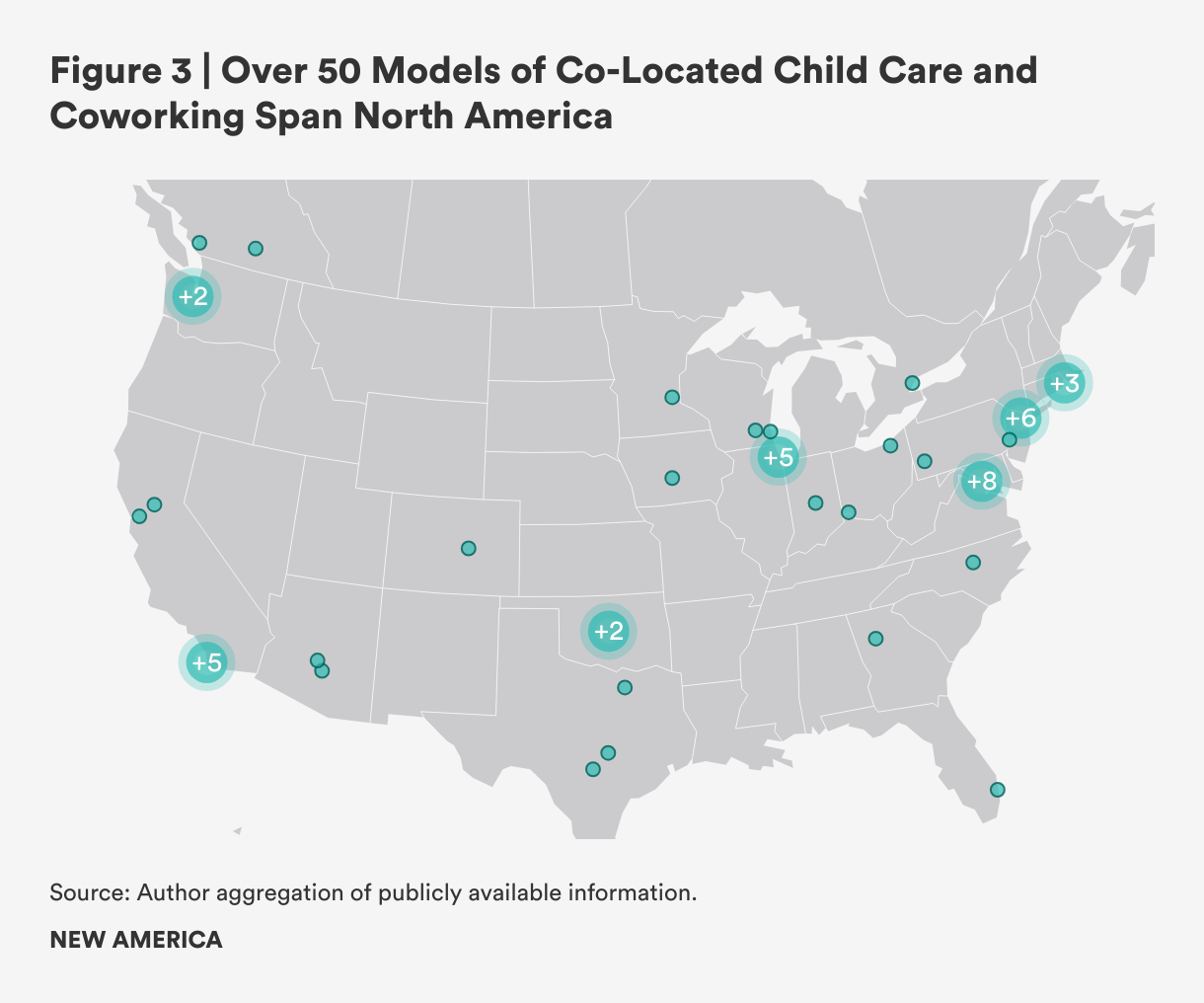
When I contacted the founder at Workplayce and then at Collective Kind (also in New York City), I learned of lively programs of workshops, support, and networking for parents, too. And that once their first location was proven to be viable, the same realtors and investors who’d initially hesitated came knocking, offering new sites. I observed that co-location rarely stayed in its “lane”—that is, it rarely remained just a room for parents and a room for children. Rather, several hybrid spaces played host to coalitions of small businesses and events for valuable community connection and support, too.
I also heard from a number of founders about the challenges of expanding—that a coworking with child care proposition offering “flexibility” made investors and realtors nervous, and that some automatically assumed that dual-proposition businesses and child care are risky, operationally and financially. Anna Raborn and Debbie Lee ran a coworking space with child care in their Boston neighborhood during the pandemic, and have now turned to offering support to others integrating child care on-site in a consultancy called Hopscotch Labs. They told me they’d seen clear cases of “bias against founders of hybrid businesses and child care operators.” Yet many founders I met revealed that the initial idea of co-location often leads to the unlocking of additional revenue streams beyond fees alone. The uniqueness and flexibility of spaces for adults and children alike have led some to rent out their premises for events outside of working hours, like Pillar in Lafayette, California, and The New Haven in San Diego, California (which also offers parenting coaching and courses), among others. Some found that sharing space with neighborhood, health, and other relevant services can be a stable, lucrative model. In Watertown, Wisconsin, The Collective offers space to nonprofit service providers so families can “access wraparound supports in one, convenient location,” as their website phrases it, along with office space and professional development initiatives—and an early care and education center for up to 126 children.
Creating Peer Networks to Refine and Expand the Model
The simplest thing we can do to explore the potential of the co-location model is to connect, celebrate, and support those already doing it. To scale up and further support these existing spaces, I propose convening a peer network that could potentially grow into a conference, directory, networking, and mentorship platform—one that shines a light on what’s being learned in the field. I’m hopeful the interest among several interviewees in making connections with other founders will gain momentum, and there are avenues of potential partnership with early childhood academics and innovators and neighborhood development organizations. While there is local nuance in every founder’s story shaping the unique settings I’ve evaluated, there are so many areas of common ground for owners of these co-located settings and their members. Across sites, founders experienced similar early missteps, indicators of success, and outcomes that boosted families’ resilience and reduced barriers between work and care. But there could be a strong and united voice tying these discrete efforts together—to push the advocacy work forward, campaign for investment, and enable more and more entrepreneurs to enter this space and connect.
Compiling evidence and sharing knowledge is critical. In this global space of child care and work, it seems there’s only an Instagram chat group for a handful of the commercial co-located settings so far. An assembly could join hands with those in the care movement to share resources (a la Eve Rodsky’s Fair Play) or take inspiration from the Impact Hub model for ongoing communication, research, and impact measurement.

The Case for Child Care Plus Coworking: A Model that Empowers Families and Neighborhoods
- Prologue: A Personal Need for Spaces for Work and Play
- Introduction: The Rise of Coworking Spaces and the Opportunity to Broaden Access
- Part I. Building Capacity for Families’ Resilience: Stories from Founders and Parents
- Part II. Boosting Opportunity for the Child Care Workforce: Stories from Practitioners and Parents
- Part III. Challenges and Opportunities for Scaling Shared Sites
- Conclusion
Citations
- Shelby Buckman, Jose Maria Barrero, Nicholas Bloom, and Steven J. Davis, “Measuring Working from Home,” National Bureau of Economic Research Working Paper 33508, February 2025, https://wfhresearch.com/wp-content/uploads/2025/02/NBERWP.pdf.
- Zoe B. Cullen, Bobak Pakzad-Hurson, and Ricardo Perez-Truglia, “Home Sweet Home: How Much Do Employees Value Remote Work?,” National Bureau of Economic Research Working Paper 33383, January 2025, https://www.nber.org/papers/w33383.
- Brian Elliott, “The Great Office Divide,” The Work Forward, March 26, 2025, https://theworkforward.substack.com/p/the-great-office-divide.
- Moira Forbes, “The Cost of Corporate Inflexibility: Reshma Saujani on the Risks to Working Mothers,” Forbes, March 11, 2023, https://www.forbes.com/sites/moiraforbes/2023/05/11/the-cost-of-corporate-inflexibility-reshma-saujani-on-the-risks-to-working-mothers/.
- Daniella Cornue, “Blending Coworking and Child Care,” interview by Jamie Russo, Everything Coworking, January 21, 2024, https://open.spotify.com/episode/0BGB5RiWvMykOFOb1ZzL0M.
- Data from the “Implications of Remote Work” conference, Stanford Institute for Economic Policy Research, September 17, 2023, https://siepr.stanford.edu/events/implications-remote-work.
- Vivek H. Murthy, Parents Under Pressure: The U.S. Surgeon General’s Advisory on theMental Health and Well-Being of Parents (U.S. Department of Health and Human Services, 2024), https://www.hhs.gov/sites/default/files/parents-under-pressure.pdf.
- Bureau of Labor Statistics, “The Employment Situation—September 2025,” U.S. Department of Labor, September 5, 2025, https://www.bls.gov/news.release/pdf/empsit.pdf.
- Alana Semuels, “Why So Many Women Are Quitting the Workforce,” TIME, August 4, 2025, https://time.com/7306896/women-leaving-workforce/.
- Brian Elliott, “The Flex Index,” Work Forward, October 2025, https://www.canva.com/design/DAGmmuZfWoY/Y0_P7WZwxkdvXhlPWvFRRw/view.
- Angelica Puzio, “Who Wants to Return to the Office?,” FiveThirtyEight, August 11, 2021, https://fivethirtyeight.com/features/why-post-pandemic-offices-could-be-whiter-and-more-male/.
- Angelica Leigh and Shimul Melwani, “Am I Next? The Spillover Effects of Mega-Threats on Identity Threat, Identity Labor, and Withdrawal,” Academy of Management, July 26, 2021, https://journals.aom.org/doi/abs/10.5465/AMBPP.2021.221.
- David Van Dijcke, Florian Gunsilius, and Austin Wright, “Return to Office and the Tenure Distribution,” University of Michigan, May 8, 2024, https://arxiv.org/pdf/2405.04352.
- Danielle Abril, “The Workers Who Feel Left Behind,” Washington Post, April 19, 2025, https://www.washingtonpost.com/business/2025/04/21/rto-mandates-neurodivergent-workers/.
- David Fulton, “How Return-to-Office Mandates Are Quietly Reversing Rural America’s Recovery,” LinkedIn, April 1, 2025, https://www.linkedin.com/pulse/how-return-to-office-mandates-quietly-reversing-rural-david-7tqoe/.
- “Current Population Survey: Telework or Work at Home for Pay,” Bureau of Labor Statistics, tables retrieved May 12, 2025, https://www.bls.gov/cps/telework.htm.
- Connor Borkowski and Rifat Kaynas, “Telework Trends,” Beyond the Numbers (blog), Bureau of Labor Statistics, March 24, 2025, https://www.bls.gov/opub/btn/volume-14/telework-trends.htm.
- National Academies of Sciences, Engineering, and Medicine, Monitoring Educational Equity (National Academies Press, 2019), https://nap.nationalacademies.org/catalog/25389/monitoring-educational-equity; Linda Smith, Brittany Walsh, Victoria Owens, et al., Building Bipartisan Support for Child Care Toolkit: 2023 Update (Bipartisan Policy Center, February 16, 2023), https://bipartisanpolicy.org/report/child-care-toolkit-2023/.
- “Building Innovation for Child Care,” Local Initiatives Service Corporation, https://www.lisc.org/our-initiatives/child-care-early-learning/our-work/building-innovation-child-care/.
- James Capraro and Joel Bookman, Building Sustainable Communities: Moving from Quality-of-Life Planning to Implementation (Local Initiatives Service Corporation, October 31, 2014), https://www.lisc.org/our-resources/resource/building-sustainable-communities-moving-quality-life-planning-implementation/.
- Capraro and Bookman, Building Sustainable Communities, https://www.lisc.org/media/filer_public/8d/36/8d3667f4-9c37-4767-99c8-9afd8d035803/08102018_resource_implementation_report.pdf.
- “Launch of the Child Care Co-Location Impact Calculator Tool,” Local Initiatives Service Corporation, July 15, 2024, https://www.lisc.org/our-resources/resource/launch-child-care-co-location-impact-calculator-tool-i-lisc-child-care-early-learning/.
- “Rural Homes Early Childhood Initiative,” Rural Homes Colorado, https://www.ruralhomes.co/early-childhood-initiative.
- “The 2GEN Approach,” Ascend Aspen Institute, https://ascend.aspeninstitute.org/2gen-approach/.
- “Senior Volunteering,” Heinsch House, https://heinschhouse.com/#volunteering.
- Emmy Liss, “Blending and Braiding to Build an Equitable Early Care and Education System—Lessons from New York City,” Children’s Funding Project, March 21, 2023, https://childrensfundingproject.org/update/guest-blog-blending-and-braiding-to-build-an-equitable-early-care-and-education-system-lessons-from-new-york-city/.
- J.D. McMurray and Julia Carpenter, “Can Child Care Be Big Business?,” New York Times, December 16, 2022, https://www.nytimes.com/2022/12/16/us/child-care-centers-private-equity.html.
- Elliot Haspel, Questioning the Promise of Employer-Sponsored Child Care Benefits (New America, February 22, 2024), https://www.newamerica.org/better-life-lab/reports/questioning-the-promise-of-employer-sponsored-child-care-benefits/.
- Emily Kos, Kelsey Clark, Nicole De Santis, and Tyler Joseph, Child Care Benefits More Than Pay for Themselves at U.S. Companies (BCG, March 26, 2024), https://www.bcg.com/publications/2024/childcare-benefits-pay-for-themselves-at-us-companies.
- Madeline Fitzgerald, “Americans Are Unhappy. Here Are the 5 Happiest Countries in the World,” Quartz, March 20, 2025, https://qz.com/happiest-countries-in-the-world-1851770886.
- Kos, Clark, De Santis, and Joseph, Child Care Benefits More Than Pay for Themselves, https://www.bcg.com/publications/2024/childcare-benefits-pay-for-themselves-at-us-companies.
- “Child Care Sector Jobs,” Center for the Study of Child Care Employment, September 10, 2025, https://cscce.berkeley.edu/publications/brief/child-care-sector-jobs-bls-analysis/.
- Jane Their, “‘The System Is Not Working for Women’: Companies with Return-to-Office Mandates Are Hemorrhaging Female Talent,” Fortune, July 23, 2024, https://fortune.com/2024/07/23/women-workplace-return-to-office-mandates-losing-talent-upwork/.
- Elliot Haspel, “The Aftershock Child Care Disaster of 1975,” Family Frontier, March 4, 2024, https://familyfrontier.substack.com/p/the-aftershock-child-care-disaster.
- Rachel Cohen Booth, “This Workplace Benefit Is Helping Parents—and Boosting Businesses. Could It Backfire?,” Vox, February 26, 2025, https://www.vox.com/child-care/401260/child-care-daycare-employer-ceo-kindercare-bright-horizons-pittsburgh; Robin Buller, “How Did Child Care in the U.S. Become So Absurdly Expensive?,” The Guardian, March 24, 2025, https://www.theguardian.com/us-news/2025/mar/24/childcare-daycare-cost-absurdly-expensive.
- “New Poll: GOP Voters Call on Congress, White House to Act on Child Care,” First Five Years’ Fund, February 12, 2025, https://www.ffyf.org/2025/02/12/2025poll/.