A Chapter of: The Case for Child Care Plus Coworking: A Model that Empowers Families and Neighborhoods
Part II. Boosting Opportunity for the Child Care Workforce: Stories from Practitioners and Parents
A RAND study conducted in the spring of 2024 found the stress level of pre-K teachers in public schools to be nearly twice the rate of comparable working adults in other kinds of jobs, with low wages being a top stressor.30 The median wage for the child care workforce sits at $13.07 an hour, which is lower than 97 percent of all other professions in the United States.31 Showing respect for—and properly compensating—trained early childhood educators and caregivers is foundational to the Haven Collection in Rhode Island. As Haven Collective founder Britt Riley underscored, “Anything we can do to nurture talent among those with the special vocation to work with children and families, we must—as this work is of the greatest importance. And we’re losing those with this calling to places like fast food outlets.” Solutions that address the decline in those entering training, working in the child care workforce, and staying in the sector are urgently needed.32 Such businesses are evidence of the broader potential for integrating caregiving and workforce development, bringing staff and parents in sync—one that might blaze a trail towards greater equity and opportunity.
That’s very much the approach at Blush in North Carolina. Founder Alison Rogers explained that, beyond offering the convenience of the enterprise’s co-located services to fee-paying members, her mission is to empower local women looking for work who’ve historically been disadvantaged by a lack of access to training and child care. She knew the uncertainty and anxiety of losing her job back in 2020. Winning a small business grant in 2023 and then crowdfunding additional resources enabled the launch of a program offering job-seeking women the opportunity to use Blush’s professional office space to do interviews and borrow laptops or even clothing.

Photo by Jonathan Fredin, used with permission.
Many co-located organizations raise equity by paying care workers above living wages, offering decent benefits, and empowering staff career development. Larissa Christie was hired as a caregiver at Blush, but she was able to use the workspace herself to work toward getting her teaching license, crossing the physical threshold from paid work in the child care area to sitting at a desk along with the paying parents. “They actually feel like my coworkers,” she said, nodding to the solidarity achieved by seeing parents at more than just drop-off and pick-up times.
In the United Kingdom, Jana Baluchova, a care worker at Playhood where I worked, served herself a plate of coconut chicken curry and rice at the kitchen counter and took a seat at a long table, around which parents of the children she cares for were enjoying their lunch, too. Baluchova moved to London from rural Slovakia, where she’d grown up on a farm, to become a nanny in England in the early 2000s. She learned English and went on to work in nursery schools, including one of the largest daycare chains in the United Kingdom and United States. “The staffroom at some of the nurseries is mainly a place to vent about the lack of respect from parents,” Baluchova shared. “The relationships felt really broken, hostile even, with little trust. There was so much paperwork and tokenistic ways to make parents feel informed.” But this year she’s completing her Montessori training online in the evenings and on-the-job at Playhood. It’s a world away from the low-wage, high-stress work environments she’d experienced in more formal child care settings.
“When the parents are working where I am also working, they’re visible to the kids when we head out to the woods or shops with them, and on the same clock as the nursery,” Baluchova said. “There’s just so much more meaningful connection and mutual respect. The staff appreciate more about who [the parents] are, and it definitely works the other way too. I’ve had support for my side hustle, gotten lots of advice and ideas, and even been able to fulfill my dream of getting the diploma [that] advances my career.”
Playhood founder Karen Partridge believed co-location has the potential for better working conditions for all, as care-as-work is more visible. In fact, all forms of work are more understood by children, practitioners, and parents alike, and collaboration happens more readily. Mollie Giannikaki has two children, now aged four and six, who both attended the preschool at Playhood while she utilized the coworking space. She’s one of approximately a quarter of members there who changed course, in her case from working in design for a large corporation to becoming self-employed as a caterer. She noted the close bonds that develop between parents and care workers: “The fact that the parents [and care workers] became friends who work alongside each other was fertile ground for encouraging honest conversations about career aspirations. A feeling of support, without judgement or pressure, is what allowed me to take the plunge into a cooking career that I’d previously only dreamt about.”
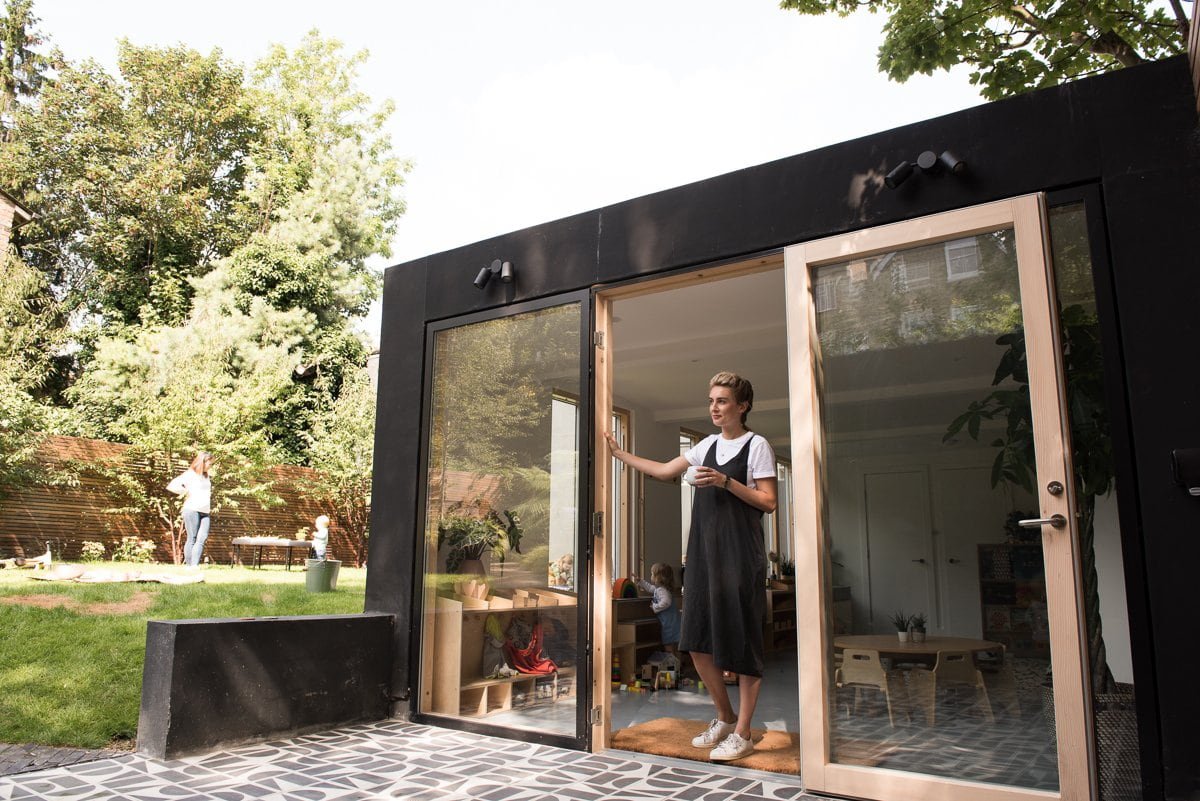
Photo by Catriona Campbell, used with permission.
For all the benefits, it’s clear that this model is difficult to sustain for a host of reasons, and ensuring living wages for child care workers and educators is chief among them. Amanda Munday founded The Workaround in Toronto, Canada, in 2018, after she observed the difficulties of finding and affording child care: “There were three-year-long waitlists and fees of $2,000 CAD per child!” (That translates to about $1,430 in U.S. dollars). Despite surviving through the pandemic, the business closed in 2023. Munday found the burden of carrying a commercial lease, insurance, and the principle of paying her staff fairly while offering flexibility to an audience of mostly single parents, freelancers, and part-time workers, heartbreakingly hard to reconcile. “This is a delicate type of organization to build,” she explained. “Care work is best done as a collective. You have to find the right staff prepared to work so collaboratively with parents—in a sector where these often marginalized and minority workers have not been treated so well elsewhere—and build the relationships over time. Community doesn’t happen the minute you open your doors; you have to earn it.”
“Care work is best done as a collective… Community doesn’t happen the minute you open your doors; you have to earn it.”
Munday found what others in any other child care model have found: Without a dedicated source of public funding to cover the real costs of providing child care, it is simply unworkable. As former U.S. Treasury Secretary Janet Yellen has said, “Child care is a textbook example of a broken market.”33 Relying on private-sector solutions or expecting already-strapped parents to shoulder the bulk of the cost for care has left the United States with a patchwork child care system where no one benefits: Most families pay nearly as much (or more) for child care as their mortgage or rent,34 many child care workers make poverty-level wages so low that they qualify for public assistance, and providers operate on razor-thin margins that keep their centers perpetually at risk of closing. The co-location model offers a structured solution for both employed and freelance people to organize their working day with commitment and accountability, all while simplifying their families’ routine with convenient child care. And if the relational benefits of proximity I heard about so consistently are nurtured, then both parties’ social and economic well-being can improve.

The Case for Child Care Plus Coworking: A Model that Empowers Families and Neighborhoods
- Prologue: A Personal Need for Spaces for Work and Play
- Introduction: The Rise of Coworking Spaces and the Opportunity to Broaden Access
- Part I. Building Capacity for Families’ Resilience: Stories from Founders and Parents
- Part II. Boosting Opportunity for the Child Care Workforce: Stories from Practitioners and Parents
- Part III. Challenges and Opportunities for Scaling Shared Sites
- Conclusion
Citations
- Bryce Covert, “Pre-K Teachers Are Stressed and Say They Want to Quit,” The 74, June 16, 2025, https://www.the74million.org/zero2eight/pre-k-teachers-are-stressed-and-say-they-want-to-quit/.
- Caitlin McLean et al., “Early Educator Pay & Economic Insecurity Across the States,” in Early ChildhoodWorkforce Index 2024 (Center for the Study of Child Care Employment, 2024), https://cscce.berkeley.edu/workforce-index-2024/the-early-childhood-educator-workforce/early-educator-pay-economic-insecurity-across-the-states/.
- Center for the Study of Child Care Employment, Child Care Sector Jobs: BLS Analysis (University of California, Berkeley, September 10, 2025), https://cscce.berkeley.edu/publications/brief/child-care-sector-jobs/.
- “Remarks by Secretary of the Treasury Janet L. Yellen on Shortages in the Child Care System,” U.S. Department of Treasury, September 15, 2021, https://home.treasury.gov/news/press-releases/jy0355.
- Chabeli Carrazana, “Paying More for Child Care than Your Mortgage? You’re Not Alone,” The 19th, June 23, 2025, https://19thnews.org/2025/06/child-care-costs-rising-home-costs/.