What 6G Should Be: Ubiquitous and Seamless Connectivity, Not Just Another “G”
Abstract
This report describes important and challenging connectivity gaps that should be a priority as governments and industry develop visions and plans for a “6G” wireless ecosystem. While forms of broadband convergence, based on substitutability and bundling, are increasingly evident in the marketplace, a broader and more ambitious convergence should move to the fore. Convergent connectivity can also refer, as it does here, to the integration of varied wireless communication technologies and networks (mobile, fixed, satellite) to create ubiquitous, seamless, and interoperable networks that allow users to access and transition among the best available connections everywhere they go. This form of convergence bridges the gaps between diverse networks and platforms, enabling real-time communication and data sharing across multiple devices, networks, and locations at all times.
Today’s networks fall far short of this goal, subjecting users to rural coverage gaps, urban “not-spots,” weak (or nonexistent) indoor mobile signals, and enormous friction and frustration when smartphones and other devices must manually authenticate to Wi-Fi and other location-based networks as they move around throughout the day. Instead of embracing this challenge, industry and most governmental bodies emphasize visions for mobile 6G that remain siloed and misaligned with some of the most important benefits that convergent connectivity could yield for consumers and the economy. This report explores the current reality, including consumer preferences for frictionless connectivity and the flattening growth rate of mobile network data consumption, both of which indicate that 6G-related policy priorities should nurture a wireless ecosystem anchored on ubiquitous and seamless connectivity. This includes, at a minimum, a scalable solution that provides seamless handoffs between Wi-Fi, cellular, and satellite networks. The report goes on to describe implications for competition, as well as technologies and policies that can potentially promote ubiquitous coverage and seamless connectivity, including a larger role for Low Earth Orbit (LEO) satellites, community wireless networks, and targeted public Wi-Fi hotspots.
An earlier version of this report was presented by one of the authors, Michael Calabrese, on September 19, 2025, at TPRC53, the 53rd Research Conference on Communications, Information, and Internet Policy.
Acknowledgments
Editorial disclosure: The views expressed in this report are solely those of the authors and do not reflect the views of New America, its staff, fellows, funders, or board of directors.
Downloads
Introduction: Convergence and What 6G Should Be
In discussions about broadband and connectivity services, convergence has frequently referred to two concepts that fall short of the sort of ubiquitous and seamless connectivity that would most benefit consumers. One concept of convergence refers primarily to substitutability. That is, the increasing ability of different communication platforms and providers (e.g., fixed wireline, fixed wireless, mobile cellular, and satellite) to deliver internet access capable of supporting the full range of services (calling, streaming video, high-speed fixed, and/or mobile internet access).1
A second and related concept of convergence refers to the market strategy of bundling: the familiar and growing inclination of large wireline and mobile ISPs to integrate multiple communication services—typically high-speed internet, mobile, and video—into a single offering. This strategy aims to reduce customer churn, lower customer acquisition costs, enhance cross-selling, and create competitive advantages against pure-play services.
While this limited form of marketplace convergence has been largely achieved, a broader and more ambitious convergence should move to the forefront. Convergence of connectivity can also refer, as it does here, to the integration of varied wireless communication technologies and networks (mobile, fixed, satellite) to create ubiquitous, seamless, and interoperable networks that allow users to access and transition among the best available connections anywhere and everywhere. Convergent connectivity aims to bridge the gaps between diverse networks and platforms, enabling real-time communication and data sharing across multiple devices, networks, and locations. Convergent connectivity should ensure information and services are accessible to everyone, everywhere, fostering inclusivity.
Today’s networks fall far short of this goal, subjecting users to rural coverage gaps, urban “not-spots,” weak (or nonexistent) indoor mobile signals, and enormous friction and frustration when smartphones and other devices must manually authenticate to Wi-Fi and other location-based networks as they move around throughout the day. Unfortunately, instead of embracing this challenge, most regulatory agencies, mobile industry groups, device and equipment manufacturers, and at least large mobile internet service providers are pushing ahead with visions for mobile “6G” that remain siloed and misaligned with some of the most important benefits that truly converged connectivity could yield for consumers and the economy.
Visions for 6G: Just Another “G”?
Many of the first visions for 6G that emerged from industry associations and equipment manufacturers emphasized mobile networks that would double down on 5G, delivering far faster throughput and lower latency to support very high-capacity new applications such as virtual reality, telepresence, robotics, holographic displays, immersive gaming, and digital twins. In The 6G Manifesto, William Webb—an independent analyst and former U.K. Office of Communications (Ofcom) official—gave a lengthy recap of these visions, concluding that most of them could be summarized as “5G, but better and faster.”2 Ironically, the emerging echo chamber of hype around these visions ignores the reality that these promised applications will operate almost entirely indoors, where mobile signals operating on higher-frequency spectrum will be unreliable or secondary to Wi-Fi, as Preston Marshall similarly observed in his 2024 book, Evolving to 6G.3 In addition, Webb emphasized, there is very little, if anything, in these visions that relates to ubiquitous coverage and lower costs, let alone seamless connectivity or closing digital divides.
An exception, to a degree, is the mobile industry’s recent interest in incorporating non-terrestrial (satellite) connectivity, particularly where it is operating as secondary, back-up connectivity on mobile carrier spectrum and under mobile carrier control—what the Federal Communications Commission (FCC) has categorized as Supplemental Coverage from Space.4 For example, in its 6G Position Statement, the Next Generation Mobile Network (NGMN) association, a voice of primarily European mobile network operators (MNOs), asserts in general terms that a major innovation and goal of 6G should be to “facilitate seamless integration and interoperability with fixed and satellite networks.”5
Regulators, particularly at the International Telecommunication Union (ITU) and the European Union, have mostly mirrored industry visions in their policy pronouncements, but have also increasingly expressed a preference for broadening the connectivity and sustainability goals for 6G. The most authoritative source for regulators is the ITU and the framework for international mobile telecommunications (IMT) adopted in 2023, IMT-2030 (see Figure 1).6 The ITU specifically adds “ubiquitous connectivity” as one of six “usage scenarios” and specifies that rural and “deep indoor coverage” are imperatives. The ITU framework also supports the seamless interworking between IMT systems (5G and future 6G networks) and non-IMT systems (including satellite, Wi-Fi, and fixed networks). The FCC’s recent Technological Advisory Council report on 6G states that the ITU’s IMT-2030 “vision promotes the integration of diverse network types to form heterogeneous networks,” enabling “devices and users to maintain continuous connectivity regardless of the access technology being used.”7
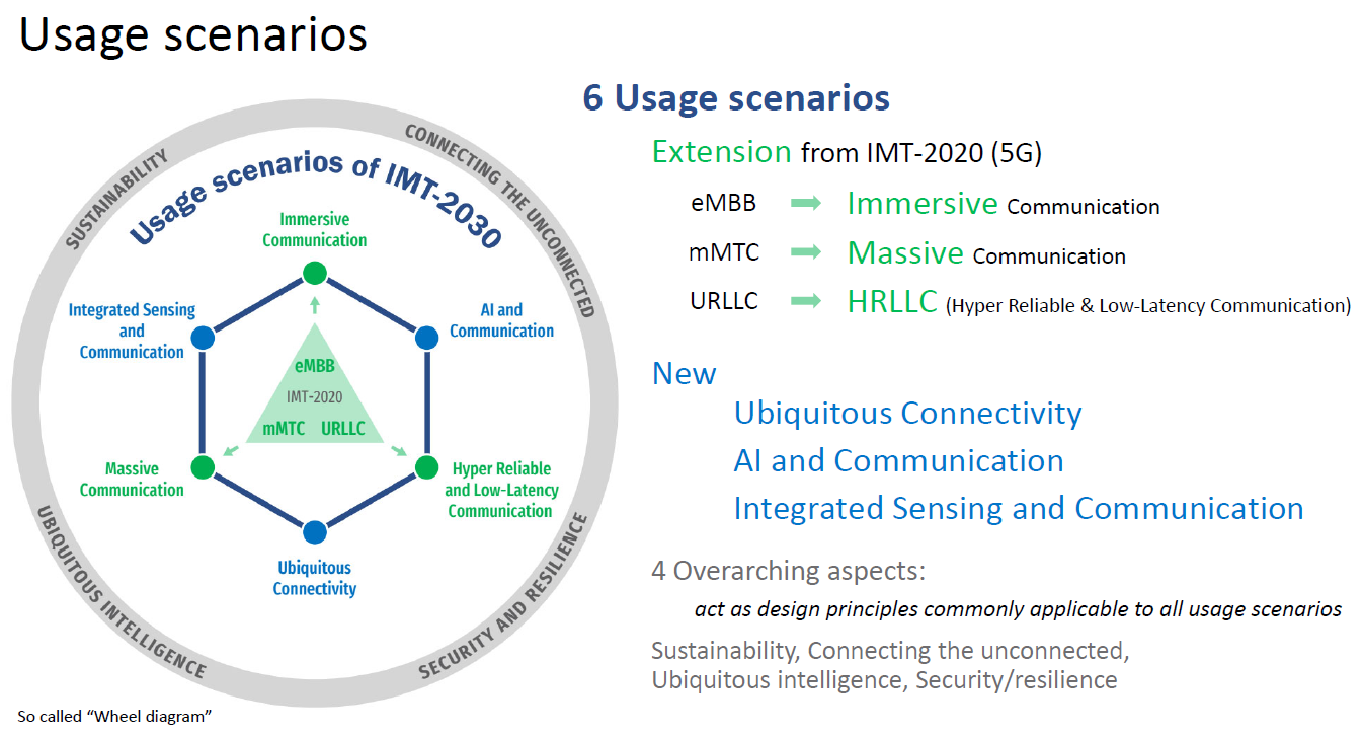
Screenshot from International Telecommunication Union, IMT-2030 framework (2023), www.itu.int/en/ITU-R/study-groups/rsg5/rwp5d/imt-2030/pages/default.aspx.
Last year, the EU’s Radio Spectrum Policy Group (RSPG) built on IMT-2030 with its own 6G Strategic Vision report. The RSPG similarly supports what it calls “network integration,” stating its belief that wireless local area networks (Wi-Fi) “and mobile networks, including 6G, will converge to deliver seamless, high-performance connectivity in diverse environments.” Although the RSPG is silent on when or how this will be achieved, it asserts there is great value in pursuing it, since “emerging use cases like AR/VR, automated transport and IoT, and emerging IT technologies like AI and cloud computing rely on both local connectivity [e.g., Wi-Fi] and wide-area [e.g., 6G] connectivity for scalability and flexibility.”8
What Do Consumers Want—and Need?
A McKinsey survey of MNO executives and consumers concluded that “telcos should ensure that 6G does not become a more-of-the-same technology that only provides higher peak speeds, lower latency, and higher device density,” attributes consumers do not view as “critical success factors.”9 Finding that consumers do not perceive a difference between 4G and 5G, McKinsey recommends that operators develop standards and upgrade toward 6G with goals in mind that enhance customer experience. The report’s authors wrote:
“What will excite consumers? The response is twofold. First, MNOs need to be able to build networks with robust coverage and capacity, which 5G has largely yet to achieve. Second, indoor-coverage issues must be resolved; about 70 to 80 percent of all data traffic is generated indoors, but indoor wireless usage is still relatively low because of weak signals. If consumers are ever going to see real value in the next-generation standard, 6G must tackle this challenge head-on.”10
McKinsey’s findings seem broadly consistent with other surveys concluding that what consumers want most is reliable connectivity everywhere at an affordable price. In its 2023 U.S. Household Survey, Opensignal found that among 55,000 respondents, consumers say coverage and reliability are (together) more than six times as important as speed.11 Speed is a distant sixth in priority for consumers among the attributes of mobile networks, according to Opensignal. Not surprisingly, cost is first, but not far behind are reliability, coverage, and network quality, all of which relate directly to consumer experience and implicate ubiquitous and seamless connectivity more than they do peak speed or latency.
More broadly, at least one mobile industry study revealed that signal quality and not-spots are rising as a concern, particularly as higher-capacity applications are used more frequently outside of Wi-Fi coverage. According to Virgin Media’s chief technology officer, a study it commissioned by mobile network benchmarking specialist GWS “found that speed is not a key driver for people to move networks, with poor signal and not-spots ranking much higher than speed as a reason to change.”12
Mobile Data Growth Is Flattening, Yet Wireless Gaps Remain
Another reason to shift 6G-related policy priorities from more and more mobile capacity to nurturing a 6G ecosystem anchored on ubiquitous and seamless connectivity is that the growth rate of mobile data consumption is falling steadily. Ericsson’s annual mobility report shows that year-over-year mobile data growth declined globally from 80 percent in 2019 to 20 percent in 2025, with “video traffic expected to account for 76 percent of all mobile data traffic.”13 For advanced markets, growth is—or soon could be—in the single digits. The United Kingdom’s Ofcom—among the few regulators that collects and reports this data—reported a drop from 15 percent in 2023 to just 7.2 percent in 2024.14
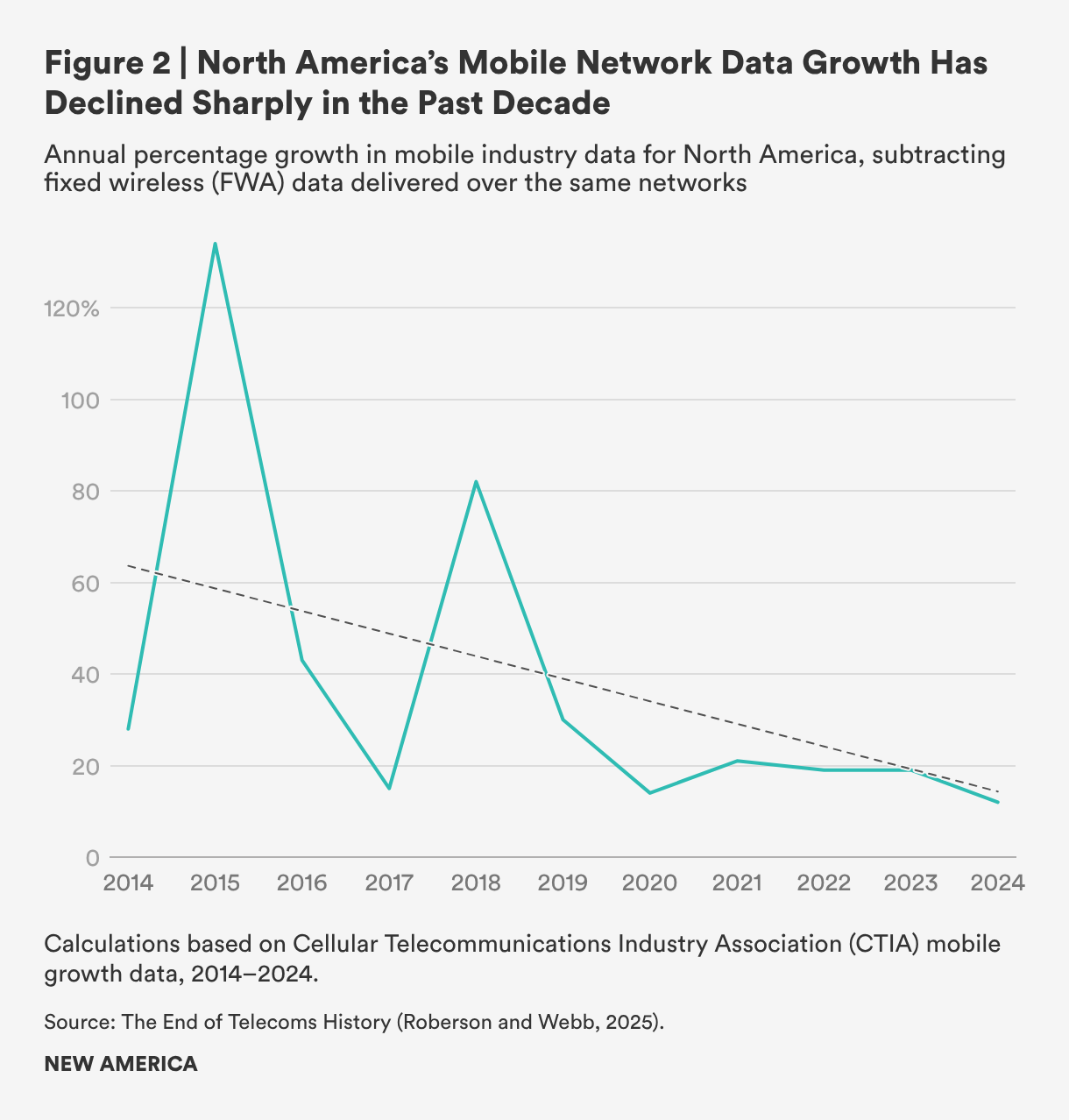
William Webb predicted this trend years ago—and now believes that mobile data growth may effectively flatline by 2028 or 2029. In The End of Telecoms History, written with Dennis Roberson (a former mobile industry executive and longtime chair of the FCC’s Technological Advisory Council), they observe that over the period since 2013 “there has been a very clear and inexorable downtrend in [mobile] data growth…around 5–6 percent per year,” with no discernable “5G effect.”15 This is consistent with “a very significant reduction in almost every country,” they report, with a particularly steep drop off in mobile data growth from 2023 through 2024 in the United Kingdom, Germany, France, China, and South Korea. Overall mobile data growth has declined more slowly in the United States, to a reported 15–20 percent range for 2024, which Webb and others attribute to the surge in fixed wireless access (FWA) provisioned using surplus low mid-band spectrum capacity on the existing cellular networks. An analysis by Cisco, which strips FWA data consumption from Ericsson’s overall tally, concludes that the growth rate for mobile data in North America is closer to 11 percent.16 Webb and Roberson calculate a similar estimate using CTIA mobile growth data through 2024 (see Figure 2) from which they extrapolate that the growth in mobile data consumption will touch down close to zero by 2029.17
Webb and Roberson explain this flattening growth primarily in reference to the immense flood of mobile video traffic unleashed after 4G was introduced and widely adopted after 2013. While 3G enabled low-bandwidth web browsing, video drove the 4G-era surge in mobile data traffic. But “there is only so much video we can realistically watch,” particularly when users are on the go and need to rely on the mobile network (rather than Wi-Fi).18 An industry executive recently voiced a similar view as part of a warning that 6G needed to be based on customer-focused goals and not just faster and better connections outdoors. Mobile broadband is a “mature market with complete penetration,” he wrote, and flattening mobile traffic growth is simply “a function of humanity being at peak video and video being the 80% traffic generator of any network. The new Gs do not generate more hours in the day where people can watch more video. No realistic use cases have been identified that would come close to video in terms of capacity requirements.”19
Citations
- See, e.g., International Telecommunication Union, Competition and Regulation in a Converged Broadband World (2012), https://www.itu.int/ITU-D/treg/Events/Seminars/GSR/GSR12/documents/GSR12_BBReport_Koboldt_SMP_8.pdf; Ellis Scherer and Joe Kane, Broadband Convergence Is Creating More Competition (Information Technology & Innovation Foundation, 2025), https://itif.org/publications/2025/07/07/broadband-convergence-is-creating-more-competition/.
- William Webb, The 6G Manifesto (2024), 47–84. The FCC’s Technological Advisory Committee recently released a report on 6G that similarly surveys the visions and status of standardization efforts globally. See FCC Technology Advisory Council, 6G Working Group Report (Federal Communications Commission, 2025), https://www.fcc.gov/sites/default/files/FCC-TAC-6G-Working-Group-Report-2025-Final.pdf.
- Preston Marshall, Evolving to 6G: The Case for a New Approach to 6G and Beyond (Amazon Publishing, 2024), 95 (“Cellular technology dominates outdoors, but wireless is dominated by indoor usage. The proposed needs for 5G and 6G technology are mostly indoor applications”).
- Federal Communications Commission, Single Network Future: Supplemental Coverage from Space, Report and Order and Further Notice of Proposed Rulemaking, GN Docket No. 23–65 (rel. March 15, 2024), https://www.fcc.gov/document/fcc-advances-supplemental-coverage-space-framework-0.
- 6G Position Statement (NGMN Alliance, 2023), https://www.ngmn.org/publications/6g-position-statement.html; see also 6G Drivers and Vision (NGMN Alliance, 2021) (“6G will involve enabling a seamless and ubiquitous experience, and service continuity, considering efficiency and affordability”), https://www.ngmn.org/work-programme/ngmn-6g-drivers-and-vision.html.
- Framework and Overall Objectives of the Future Development of IMT for 2030 and Beyond (International Telecommunication Union, 2023), https://www.itu.int/en/ITU-R/study-groups/rsg5/rwp5d/imt-2030/pages/default.aspx.
- FCC Technology Advisory Council, 6G Working Group Report, at 31–32.
- Radio Spectrum Policy Group, 6G Strategic Vision: RSPG Report (European Commission, 2025), 12, https://radio-spectrum-policy-group.ec.europa.eu/document/download/89457260-ab6b-495a-9a10-437711cbe831_en?filename=RSPG25-006final-RSPG_Report_on_6G_strategic_vision.pdf.
- Zina Cole et al., Shaping the Future of 6G (McKinsey & Company, 2024), at 2, 10, https://www.mckinsey.com/industries/technology-media-and-telecommunications/our-insights/shaping-the-future-of-6g.
- Cole et al., Shaping the future of 6G, at 14.
- Rupert Bapty, “Quantifying Reliability Experience in the U.S.,” Opensignal, March 20, 2024, https://www.opensignal.com/2024/03/20/quantifying-reliability-experience-in-the-us.
- Jeannie York, “Leaving the Vanity Metrics Behind and Focusing on what Matters: Customer Experience,” Virgin Media/O2, May 21, 2024, https://news.virginmediao2.co.uk/leaving-the-vanity-metrics-behind-and-focusing-on-what-matters-customer-experience.
- Ericsson Mobility Report (Ericsson, November 2025), 12, https://www.ericsson.com/en/reports-and-papers/mobility-report/reports/november-2025. See also William Webb, The End of Telecoms History (2024), at 39–49.
- Dennis Roberson and William Webb, The End of Telecoms History (2nd edition, 2025), 64, notes 49 and 50.
- Roberson and Webb, The End of Telecoms History (2025), at 60.
- Mark Grayson, “Wi-Fi and Open Roaming,” Cisco presentation to Wireless Broadband Alliance, Wireless Global Congress, January 2025, https://www.youtube.com/watch?v=Hbdf7gbcxyw.
- Roberson and Webb, The End of Telecoms History (2025); and data provided to the authors of this report.
- Roberson and Webb, The End of Telecoms History (2025), at 56.
- Geoff Hollingworth, “The Cost of Delusion, the Promise of Reality,” Rakuten Blog, September 8, 2024, https://www.linkedin.com/pulse/cost-delusion-promise-reality-geoff-hollingworth-vt4xe/.
The Road to Convergent Connectivity
Seamless Connectivity: The Indoor/Outdoor Conundrum
Along with ubiquitous coverage, seamless connectivity is central to convergent connectivity. This refers to the ability of a device to maintain a stable and uninterrupted internet connection as it transitions between different types of networks, such as Wi-Fi and cellular networks.20 But even among networks relying on a compatible air interface, attaching to a network in a new location, or in an area where your particular provider’s signal is absent, is at best a conscious chore. The most frequent example of this is Wi-Fi, where most users seeking to get connected—or stay connected—face the frustration of a “captive portal” rather than the sort of automatic and invisible connection made at home or work.
A recent CableLabs blog describing the benefits of “context-aware” devices and networks put it well:
“When we think about ‘our network,’ we envision the Wi-Fi router sitting in our home—a fixed point in space that defines where we can connect. Step outside that bubble, and our devices become digital strangers, forced to navigate a maze of guest networks, captive portals and security compromises. Even within our homes, every new smart device demands its own setup ritual: entering passwords, scanning codes, downloading apps and hoping everything connects properly.”21
In contrast, true convergence achieves frictionless (automated) device operation across:
- Multiple and interoperable radio/access/networking technologies
- Licensed and unlicensed spectrum
- Public, private, and personal (home) networks22
In addition to robust coverage and connectivity everywhere, a 6G wireless ecosystem should include automated handoffs between federations of interoperable network infrastructure that includes mobile, satellite, and Wi-Fi (fixed) networks to the greatest extent possible. While uninterrupted connectivity is valuable in all locations, maintaining a connection between indoor and outdoor use (and vice versa) will become increasingly more important—and more challenging—for at least two reasons. First, the very high-throughput and low-latency applications imagined for 6G will be used predominantly indoors, where Wi-Fi will increasingly dominate, even if users move from time to time outdoors (much like streaming video today, but more so).
Second, these 6G use cases will require such wide channels and strong signals that mobile transmissions from outdoor cell sites will find it more and more difficult to deliver indoors as cellular operators use higher frequency spectrum (particularly upper mid-band spectrum above 4 GHz) and as buildings are increasingly insulated to save energy, including with Low-e glass that blocks most signals. In short, automated and context-aware handoffs between mobile cellular networks and Wi-Fi, satellite, and private neutral host networks will move from nice-to-have to must-have from a user perspective.
Wi-Fi’s Growing Dominance and Reliability Indoors
Seamless connectivity between Wi-Fi, mobile, and satellite networks is increasingly important because the demand and need for high-capacity wireless broadband and data connectivity is, and will continue to be, increasingly indoors. Americans spend more than 90 percent of their time—and consume more than 80 percent of their data—inside.23 While the full scope and nature of a future 6G wireless ecosystem remains hypothetical, the very high-capacity applications and use cases most frequently offered as the rationale for investments in 6G by the Next G Alliance and others—such as virtual reality, telepresence, ultra-high definition video, immersive gaming, enterprise IoT, and more—will operate overwhelmingly indoors.24
Wi-Fi drives data consumption on mobile devices.25 The share of mobile device data traffic offloaded to Wi-Fi (and thus bypassing cellular networks) exceeds 80 percent in the United States and reportedly exceeds 90 percent in Europe.26 In fact, the economics of indoor use over shared spectrum allows Comcast, Charter, and Cox to support more than 18 million subscribers with a high-capacity mobile service that relies on Wi-Fi for roughly 90 percent of data use and, for use “on the go,” mobile connectivity via Verizon.27 Perhaps more surprisingly, Opensignal finds that U.S. smartphone users are increasingly on Wi-Fi away from home (77–88 percent of the time).28 Similarly, the vast majority (more than 80 percent) of IoT connections are to Wi-Fi or other unlicensed technologies, particularly Bluetooth and LoRa, not to cellular.29
Indeed, one important conceptual step for policymakers is to stop believing that mobile networks are “offloading” data onto Wi-Fi networks, as if the local area network is some sort of adjunct to a dominant mobile network that will (eventually) carry all the traffic. The more accurate construct is that mobile and Wi-Fi (fixed) are two complementary and essential networks with an imperfect degree of integration attributable entirely to Apple, Samsung, and other device manufacturers. A starting point is the recognition that for most users and purposes, Wi-Fi is the most cost-effective connection, particularly indoors, where (at a minimum) policymakers should ensure the technology has sufficient spectrum access and technical rules (e.g., power levels) to optimize its potential as a complement to fixed, mobile, and satellite networks. Indoor connectivity should be the realm of Wi-Fi and private networks (e.g., neutral host networks relying on Citizens Broadband Radio Service [CBRS] spectrum),30 and devices should, as they mostly do now, automatically move to the fixed network indoors when they can authenticate to a strong signal.31
As augmented and virtual reality (AR/VR), AI, health monitoring, and other innovations make seamless connectivity between indoor and outdoor locations and in remote areas more and more valuable, finding ways to allow devices to choose the best connection for the circumstances—based on preferences the user sets (e.g., trade-offs between cost and quality) should be a central goal in defining the 6G wireless ecosystem that best serves the public interest. By the time 6G standards are finalized, Wi-Fi will be at least two more generations advanced, with capabilities that are being designed to fit the sort of applications that will require not only far greater capacity and far greater latency, but also more deterministic connections that enable the prioritization of selected applications that need, for example, very low latency. In fact, it is early days for the still-new Wi-Fi 6E standard that can operate on channels as wide as 160 megahertz across the 6 GHz band. Most Wi-Fi 6 routers and phones do not support 6 GHz use; only Wi-Fi 6E and emerging Wi-Fi 7 models do.32
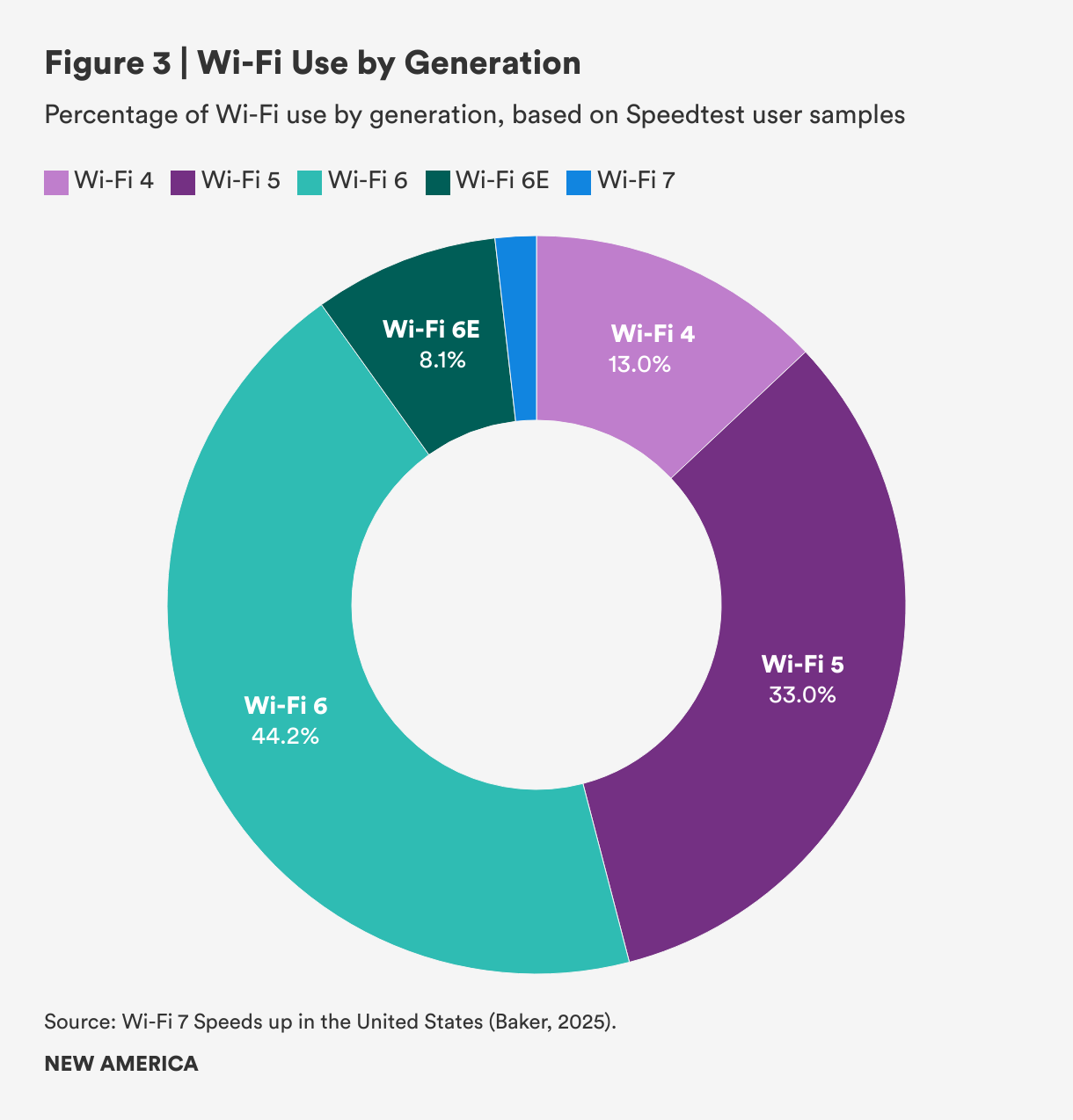
Wi-Fi 7 has just begun to be deployed by enterprise and home users, but the performance gains are already evident. Ookla, which collects massive samples of speed test data from user devices, reported in June 2025 that while adoption is only 2 percent, Wi-Fi 7 users are experiencing up to 1 Gbps download speeds on fiber, although substantially slower uplinks (64 Mbps for the three largest cable companies versus 595 Mbps for seven fiber companies).33 (See Figure 3, which shows Ookla data on current Wi-Fi use by generation.) According to Ookla, early adopters report significantly higher satisfaction compared to legacy Wi-Fi. The company believes gigabit-level performance and stronger uplink capabilities will “unlock new possibilities for gaming, AR/VR, remote work, and AI-powered homes.”
The next generation standard, Wi-Fi 8, will provide “ultra-reliable performance everywhere,” according to Qualcomm and other chipmakers.34 The focus will be on reliability rather than speed. Unlike today’s Wi-Fi, Qualcomm expects that Wi-Fi 8, operating across the 6 GHz band, will be a difference in kind, “designed to deliver consistent, low-latency and near-lossless connectivity even in highly congested, interference-prone and mobile environments.” According to the IEEE scope document, Wi-Fi 8 will introduce, first, at least 25 percent higher throughput in challenging signal conditions; second, 25 percent lower latency at the 95th percentile of the latency distribution; and third, 25 percent fewer dropped packets, especially when roaming between access points (APs).35
Qualcomm also highlights that the new capabilities being standardized for Wi-Fi 8 (IEEE 802.11bn) will enable seamless roaming, at least among Wi-Fi APs:
“802.11bn introduces a transformative approach to mobility through the concept of Single Mobility Domains, enabling seamless roaming across multiple access points. This allows devices to provide a ‘once connected, always connected’ experience by maintaining continuous, low-latency connections as they move—without the interruptions or packet drops caused by traditional handoffs.”36
While even this limited form of “seamless roaming” will be an improvement, particularly for enterprise or public Wi-Fi networks, the bigger challenge—discussed just below—is to enable truly seamless connectivity for devices across Wi-Fi (and cellular) networks that are not part of the same domain.
Wi-Fi/Cellular Interoperability: Seamless Handoffs
As noted above, today mobile carriers often cannot deliver a strong signal and wide-channel connectivity to users indoors, where at least 80 percent of mobile device data is consumed. This problem will only grow more challenging as mobile operators rely on spectrum bands above 2 GHz for 6G applications that require very high-capacity and near-real-time latency. The conundrum is that today operators are often able to meet basic connectivity needs indoors—for calls, texting, low-bandwidth web browsing—only by relying on their very limited high-penetration but narrow-band spectrum below 1 GHz. (This is similarly the case with coverage outdoors in many rural and low-density areas.) But the applications envisioned as drivers of demand for 6G will require the high throughput and wider channels that will rely on higher mid-band spectrum with far worse propagation from outdoors to indoors. And the challenge of reliable indoor coverage from outdoor cell sites only worsens as more and more buildings install Low-e glass and concrete or other insulated building materials that are harder to penetrate. The possibility of achieving reliable, high-capacity signals deeper inside a building, or below ground level, will further dwindle. All of this makes seamless handoffs between mobile/WANs and Wi-Fi/LANs crucial.
The Reality of Poor and Worsening Indoor Mobile Coverage
Several recent studies have shown that the penetration loss of 5G signals through building materials steadily increases at higher frequencies, including the upper mid-band frequencies where mobile operators are seeking more spectrum access for 6G. For example, two academic studies presented at an IEEE conference in December 2024 measured wideband penetration loss through building materials at 6.75 GHz and other upper mid-band frequencies. One focused on the penetration loss by four typical building materials (wood, glass, foam, and concrete) from 4 to 16 GHz, finding that “penetration loss generally follows a linear distribution with frequency, except for glass.”37 The other study found Low-e glass walls present 33.7 dB loss at 6.75 GHz and 42.3 dB loss at 16.95 GHz, with consistently higher penetration loss at higher frequencies.38 A 2021 white paper by Aptilo, a subsidiary of Enea, estimated that the building penetration of 5G signals worsens steadily above 2 GHz and drops off precipitously above 4 GHz. 39
In a pair of articles explaining the wide variation it found in cellular coverage and signal strength indoors and outdoors, Ookla found that as “mobile data usage continues to concentrate indoors, networks built to prioritize outdoor coverage often don’t deliver the performance users now expect inside buildings.”40 Ookla’s crowdsourced measurements (from user devices) found that as mobile carriers rely on higher frequency spectrum for 5G (e.g., 3 GHz mid-band and above) it “limits the ability of the existing mobile network site grid to provide high-speed mobile coverage deep indoors. Simply put, the signals that mid-band 5G networks rely on struggle to penetrate the materials in their path when the user is indoors.”41 It found that “traditional coverage maps often present an overly optimistic view of network performance—especially indoors—based on computer-modeled predictions rather than reflecting the actual signal conditions enjoyed by end users.”42
Ookla’s speed test data revealed large pockets of poor in-building coverage in major global cities. In central London, for example, it found a large share of buildings with poor indoor cellular reception (colored red and orange in Figure 4 below). In Dublin, Ookla likewise found that even important urban locations, such as University College Dublin, had widespread indoor connectivity gaps. Users able to receive basic coverage indoors were typically pushed onto low-band spectrum (800 MHz), which has better propagation but very limited capacity. The article noted that these low-band cellular connections have decreasing utility because “the significant increase in the density of devices and the intensity of their data traffic demands mean these frequencies alone are unable to support the higher performance attributes often expected with 5G, particularly in dense urban settings.”43
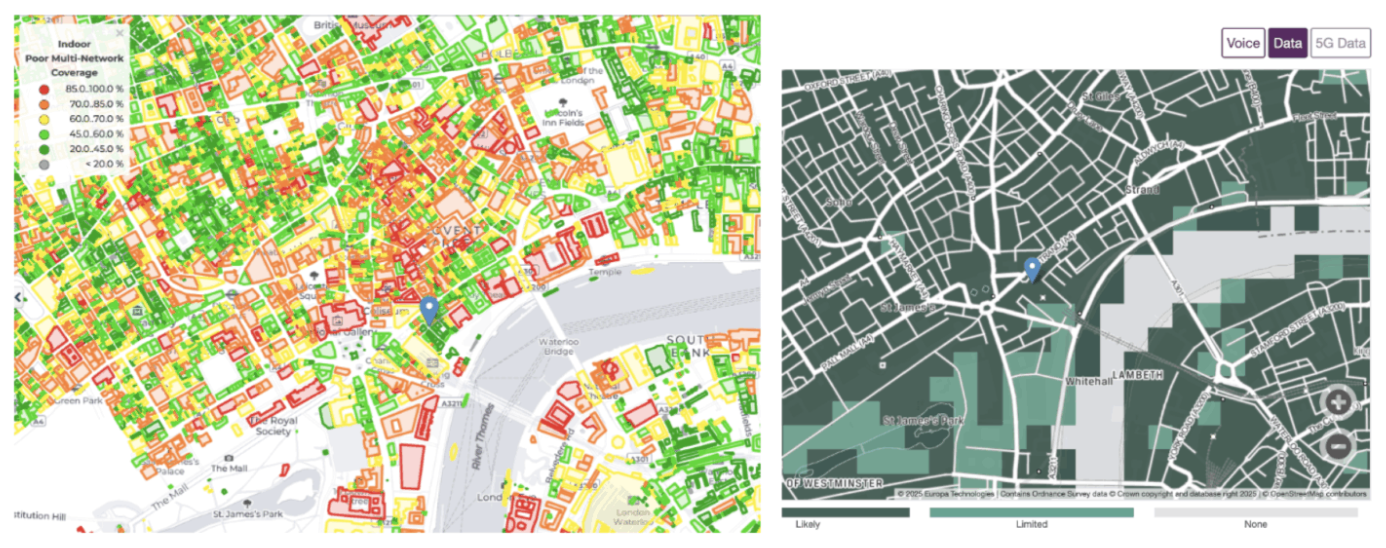
Screenshot from “Rethinking Indoor Connectivity: Why It Matters More Than Ever,” Ookla, www.ookla.com/articles/rethinking-indoor-connectivity-2025.
This indoor coverage problem is worsening even for large enterprises: Years ago mobile carriers were willing to install a distributed antenna system (DAS) inside certain high-density buildings, often in return for exclusive service contracts—but those days are over. Recent reports confirm that as existing in-building cellular systems age out, “enterprises must upgrade their own systems at their own expense” and without the benefit of in-house cellular expertise.44 According to a Fierce Wireless report, “MNOs are primarily focused on the huge, public-facing venues such as stadiums and airports. But in terms of the thousands of enterprise buildings that need wireless upgrades, the carriers have shifted their business models.”45 As a result, offices and smaller venues are on their own. Neutral host networks operating primarily on the shared CBRS band are beginning to fill that gap with indoor APs that can allow customers of any mobile carrier to remain seamlessly connected, but private LTE/5G networks operated by enterprises are new and will take time to proliferate.46
The indoor connectivity challenge for mobile operators will be further aggravated because many core applications anticipated for 6G (e.g., AR/VR) will require more high-capacity and low-latency uplinks from consumer handsets than video streaming does today. Broadcom, a leading semiconductor manufacturer, recently revealed that its field trials show that upper mid-band spectrum (specifically, the upper 6 and 7 GHz bands) “struggle to support reliable uplink, especially for indoor users who are located beyond ~300 m from the outdoor cellular tower.”47 It noted that Telefónica Germany’s recent testing in upper 6 GHz “proves the point: while downlink capacity is impressive, uplink collapses at cell edges—even with 100 MHz of bandwidth.”48
Mobile carriers could mitigate this problem by greatly densifying their network infrastructure, but this would be staggeringly expensive. As Webb notes in The 6G Manifesto, one engineering rule of thumb is that doubling the frequency cuts the range in half, which results in a need for four times as many cell sites to deliver the same signal quality.49 This suggests that each move up the frequency spectrum—e.g., from 800 MHz to 1.6 GHz, from 1.7 to 3.5 GHz, from 3.5 to 7 GHz—requires four times as many cell sites, implying the need for 64 times as many for a 6G channel operating in 7 GHz. Even limiting densification to metro areas suggests an unprecedented capital expense considering U.S. mobile carriers had a total of 432,000 active cell sites at the end of 2024 (both microcell and small cell), according to CTIA.50
The Daunting Challenge of Cellular/Wi-Fi Interoperability
As industry and governmental bodies outline visions for 6G use cases, it is clear that both sectors are downplaying the importance of integrating connectivity for Wi-Fi (indoors) with cellular (outdoors). In smartphones today, a user can manually select to use Wi-Fi or cellular, but the connections are not automatically maintained when one network or the other becomes unavailable or insufficient for the user’s activity. An exception is Voice over Wi-Fi, if it is provided by the mobile carrier and natively integrated into the smartphone’s dialer.51
Seamless connectivity, for smartphone users today and for augmented reality and other use cases going forward, must include ensuring that users experience service and session continuity without noticeable interruptions or degradation in performance as they move between locations where the most reliable or cost-effective connection changes between mobile, fixed (Wi-Fi), or satellite networks. It has been beneficial to both consumers and mobile operators that smartphone operating systems include a feature that continually searches for Wi-Fi networks open to join, effectively pushing users onto home, work, and other Wi-Fi networks where there is an established authentication.
Unfortunately, while each of the respective standard bodies for Wi-Fi and mobile (IMT) have made technical progress on their own, there appears to be no scalable solution in sight based on the sort of multistakeholder collaboration (between 3GPP, Wi-Fi Alliance, and leading device and chipmakers) that would be necessary. Industry experts we consulted believe that developing a solution that can scale to benefit most consumers and stakeholders is less a technical challenge than it is a multifaceted collective action and competition problem. This is particularly true for the mobile and Wi-Fi industries, neither of which want to cede control of wireless data traffic management to the other, nor invest heavily in a solution that will give the other an advantage.
There are two primary scenarios that would make seamless transitions between cellular and Wi-Fi connections very valuable for users, particularly in a future 6G ecosystem with very high-capacity and real-time connectivity between nearly everything of consequence, indoors and outside. One scenario is mobility-based (a device moving between indoors/outdoors) and the other is congestion-based (where the other network has better availability).52 Figures 5A and 5B illustrate the two cellular/Wi-Fi transition scenarios in which seamless transitions between cellular and Wi-Fi networks could most benefit consumers.
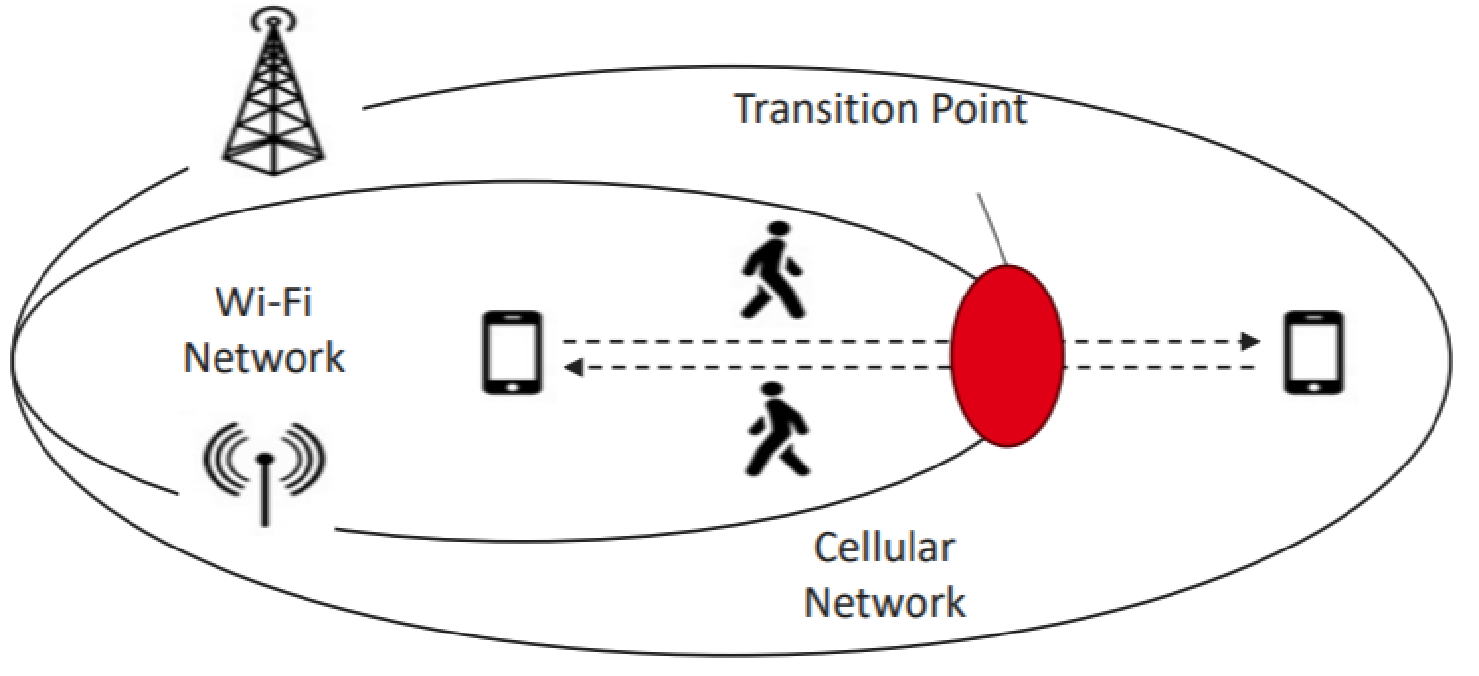
Screenshot from Bahr et al., Seamless Connectivity, CableLabs at 5–8, www.nctatechnicalpapers.com/?p=40147.
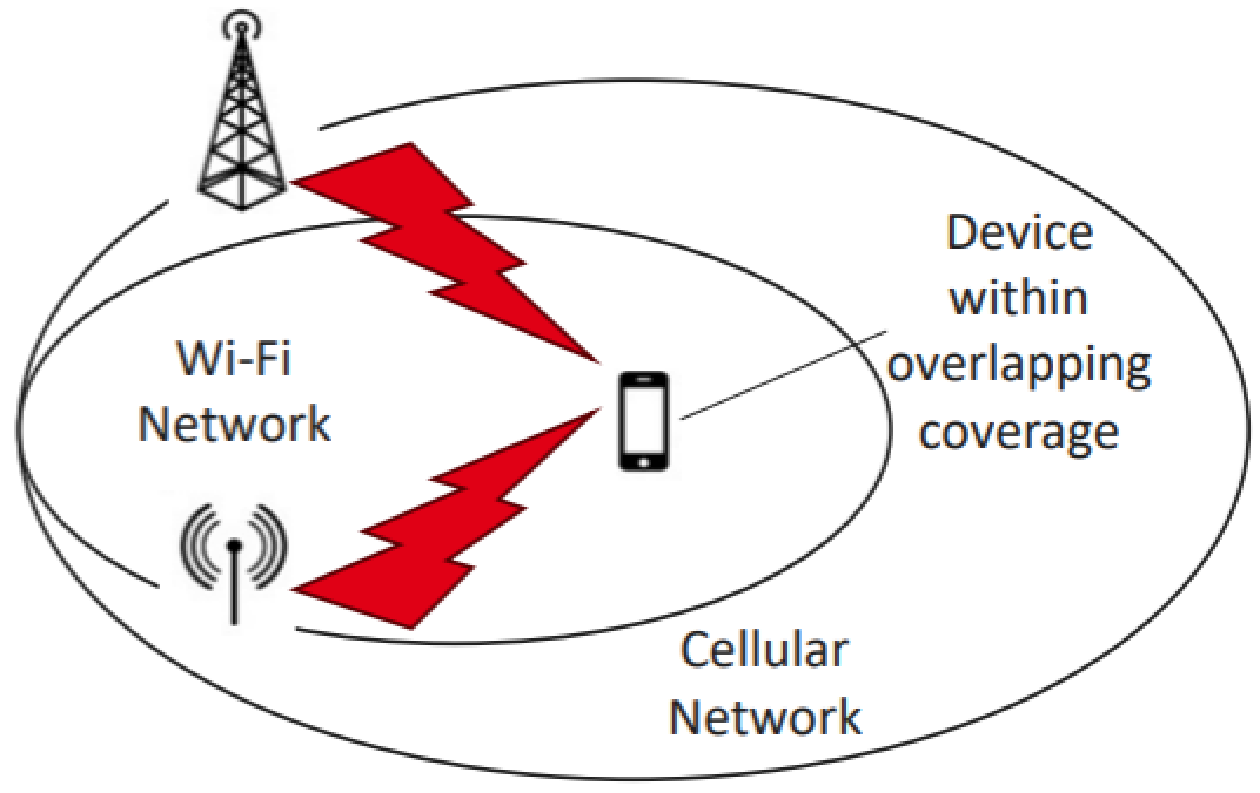
Screenshot from Bahr et al., Seamless Connectivity, CableLabs at 5–8, www.nctatechnicalpapers.com/?p=40147.
The mobile industry has made the most progress. Its global standards body, the 3rd Generation Partnership Project (3GPP), introduced Access Traffic Steering, Switching and Splitting (ATSSS) as an optional feature in 3GPP Release 16. ATSSS enables devices to intelligently manage traffic across multiple access networks, including Wi-Fi, by routing all traffic through a common mobile 5G core. ATSSS provides three distinct operating modes:
- Steering: Choosing the best available network based on speed, cost, and latency;
- Switching: Moving seamlessly between 5G and Wi-Fi networks; and
- Splitting: Using the highest priority network until congested, then splitting traffic across both networks.53
ATSS faces implementation challenges that make it unlikely to benefit users outside controlled enterprise environments. Most notably, ATSSS implementation requires operators to own a 5G core and have effective control over both mobile and Wi-Fi data traffic (see Figure 6). In practice, this means that it would be implemented as a mobile carrier service, in connection with an enterprise virtual private network or even operator-provisioned Wi-Fi, with both mobile and Wi-Fi traffic tunneled through the MNO’s 5G core. In addition, the three functionalities above translate into four ATSSS standard steering modes that need to be supported in the device as well as by the mobile core. Since this functionality is not standard in today’s smartphones, device makers would need to actively participate to reach a mass market. The ATSSS concept has been tested successfully by Korea Telecom using a proprietary solution, but it is not widely available.
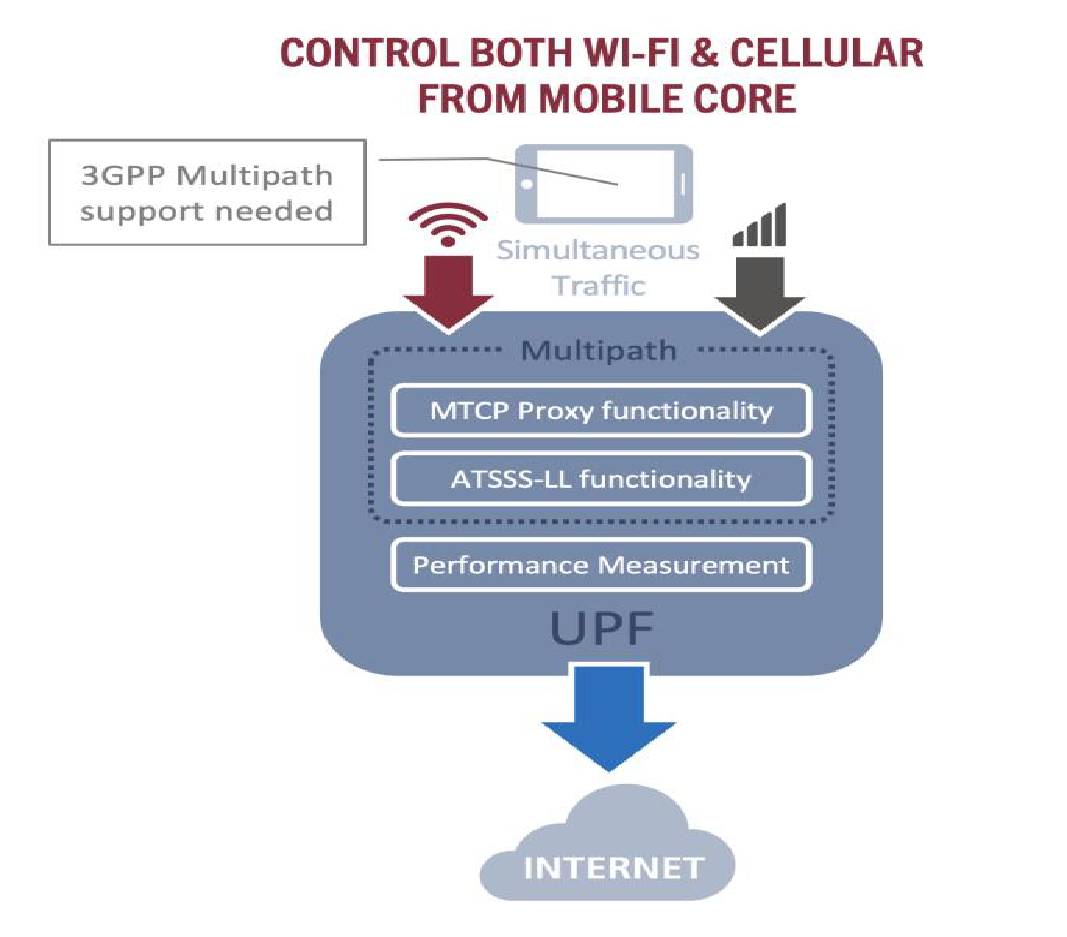
Screenshot from Aptilo/Enea, Wi-Fi in the 5G Era, at 61, www.pmc.ncbi.nlm.nih.gov/articles/PMC9103051.
On Wi-Fi’s side of the seamless handoff equation, the IEEE published a standard for Media Independent Handoff (MIH) in 2008. IEEE 802.21 supports algorithms enabling seamless handoffs between fixed (Wi-Fi) and cellular networks. However, it never gained commercial adoption, and the 802.21 working group has been in hibernation since 2019.54
The Wi-Fi Alliance, which certifies devices, and the Wireless Broadband Alliance (WBA) have focused more heavily on seamless access across Wi-Fi networks (discussed in the next section), but both currently have working groups studying solutions for seamless connectivity with cellular. Much of the emphasis among Wi-Fi stakeholders is to determine the key performance indicators (KPIs) that should trigger a device’s switch from Wi-Fi to cellular, or vice versa. WBA’s Access Network Metrics Working Group is developing a framework to enable Wi-Fi equipment vendors to define and expose Wi-Fi Quality of Experience (QoE) centric metrics to other stakeholders, including mobile operators and Wi-Fi end users. The Wi-Fi Alliance has multiple efforts largely aimed at defining a standardized set of KPIs that can be used in deciding when to transition a device to another Wi-Fi network or to a different radio access network (RAN), such as cellular.55 A related effort aims to enable Wi-Fi APs to know the cellular connection status of end user devices that are associated or seeking to associate with the Wi-Fi network.
CableLabs, the technical research arm of the cable industry globally, has its own seamless connectivity working group focused on “testing congestion-based and mobility-based scenarios to allow a more accurate characterization of the transition problem” between Wi-Fi and cellular networks.56 Their goal is to define and implement “a standardized way of transitioning devices across the Wi-Fi and cellular networks based on operator defined triggers” and quality of service thresholds that best meet the needs of end users.57 Currently, no standardized quality of service thresholds have been defined or made transparent to the components of the ecosystem (devices, mobile operators, Wi-Fi APs, chipsets).
As a starting point, CableLabs testing last year focused on the so-called sticky Wi-Fi problem. Although smartphone algorithms push devices onto trusted Wi-Fi networks (at home or work, for example), Wi-Fi APs and devices attempt to remain connected even at the very edge of the local area network’s coverage, including when the user is now outside and has a more robust cellular signal.58 The CableLabs group has used this problem as part of the larger effort to define the KPIs and standardize the thresholds at which a device should automatically transition to the better signal.
Overall, the current state of play is that seamless transitions between networks with different RANs (namely, cellular and Wi-Fi) are not close to consensus or implementation across the multiple and essential stakeholders in the ecosystem. While the technical foundations exist, widespread implementation faces significant ecosystem coordination challenges that will likely take several more years to fully resolve—and which may benefit from some form of regulatory intervention.
Open Roaming: Automating Wi-Fi Connections
An equal if not greater gap in seamless connectivity—and the challenge that should be easier to solve—is automating the authentication and connection to Wi-Fi networks as users move from location to location. Most users take it for granted that when they walk into their home or office their smartphone will immediately and automatically join the Wi-Fi network. This might even work at some retailers (e.g., Starbucks), across a college campus, or at the local library for those who have registered and used the network recently enough. The friction and literal disconnect occurs when the user moves inside a Wi-Fi environment where her device is a stranger to the network. Even when these venues and locations offer an open Wi-Fi connection, captive Wi-Fi portals that require manual registration or other steps to gain access—and which sometimes deny access—are a frequent and largely unnecessary barrier to seamless connectivity.
The technology to automate Wi-Fi network identification and authentication exists and is operating among a growing federation of enterprise Wi-Fi environments. But so far, coordination problems loom large. The leading standard is Passpoint (Hotspot 2.0), developed by the Wi-Fi Alliance, which eliminates the need to manually scan for open networks and authenticate with passwords or agree to terms of use. Most smartphones and mobile carriers in the United States today sell phones that incorporate Passpoint.59 Wi-Fi Alliance has emphasized the ability to automatically roam onto public Wi-Fi networks in airports, hotels, cafes, public spaces, shopping malls, health care facilities, and so on, which number in the millions globally.60
The challenge has been to create generally recognized and sufficiently secure means of identifying and authenticating users across Wi-Fi networks. The more recent OpenRoaming initiative builds on the Passpoint standard by creating a global federation of Wi-Fi aimed at accelerating adoption. The OpenRoaming federation effort was launched by Cisco, but is now operated by the WBA.61 The federation consists primarily of network providers (such as venues or enterprises offering Wi-Fi access) and identity providers (such as device makers and fixed and mobile internet providers). Once a user’s device is provisioned with a Passpoint profile, it is recognized and can automatically connect to any OpenRoaming-enabled network without the need to manually input credentials or accept terms. For example, both AT&T and T-Mobile support Passpoint, enabling users to automatically authenticate to a Wi-Fi network that accepts Passpoint using their existing SIM credentials.62
According to the WBA, the federation remains relatively small but has been growing at an accelerating rate. A WBA survey of enterprise Wi-Fi users reported earlier this year that 81 percent said they plan to deploy the technology, with 25 percent already in the process of rolling it out. Cisco reports that as of early 2025 it had integrated OpenRoaming capability into 3,870 enterprise networks that operate roughly 8 million Wi-Fi APs.63 Although Cisco did not report what share have activated OpenRoaming, their experience at least indicates the solution has the potential to scale. For example, RCR Wireless News reported that Cisco is working with the Canary Wharf Group and Virgin Media in London to deploy OpenRoaming-enabled Wi-Fi connectivity to more than 20,000 businesses, retailers, cafes, workspaces, and residents.64
Ubiquitous Coverage: The Rural and “Not-Spot” Gaps
LEO Satellites: Closing Rural Coverage Gaps
Despite painstaking progress, rural households are still more likely than urban households to have fewer provider choices, lesser quality options, or no available broadband infrastructure at all.65 The enormity of remaining rural coverage gaps was the primary driver behind Congress’s decision in 2021 to allocate over $42 billion to the Broadband Equity, Access, and Deployment (BEAD) Program, the federal broadband infrastructure initiative intended to close all remaining broadband deployment gaps. On top of this basic broadband gap, a significant share of the continental U.S. land area lacks reliable mobile cellular connectivity, although established coverage estimates are based on population rather than geography.
From this landscape, Low Earth Orbit (LEO) satellite service has recently emerged to provide broadband service to households consigned to lesser or no broadband access, as well as more basic connectivity to mobile devices in rural and remote areas virtually anywhere. Over the last several years, LEO satellite providers have begun to offer home broadband with lower latency and speeds comparable to fixed broadband options,66 in some places directly competing with traditional wireline broadband service providers to provide fixed home broadband service to unserved households. At the same time, the industry is aggressively expanding. Following a period of rapid growth, SpaceX’s Starlink has built out its ground infrastructure to reach more than 100 gateway sites in the United States alone, launched over 7,800 satellites,67 and has upward of 2 million U.S. subscribers.68
Some argue that LEO satellite connectivity is the missing puzzle piece necessary for ubiquitous broadband coverage across the country. There is no doubt that the technology has added new life to the world of intermodal competition. Because LEO satellite service is bound by capacity but not geography—so long as users have a clear view of the sky—over 99 percent of the country has potential access to Starlink already, and Amazon Leo has begun launching its own constellation as well.69 Although upload speeds may not always reach the FCC’s benchmarks, given the right conditions, speeds appear high enough to meet the typical user’s needs.70 However, current capacity limitations remain severe and ongoing. A recent analysis found that Starlink’s performance deteriorated when serving more than seven customers in a square mile,71 while another group found that LEO service was best suited to reliably serve barely a quarter (26 percent) of locations eligible for BEAD funds.72 Even with its current consumer base, capacity in some areas is so restricted that Starlink has been adding $750 upfront fees to discourage further uptake.73 LEO satellite is not a comprehensive solution fit for all of America yet.
Still, the technology is rapidly evolving. Overall industry capacity will increase as Amazon Leo’s services become available and as new satellites launch. Starlink has an application pending at the FCC for a new constellation of up to 30,000 satellites and advanced technology it claims can deliver gigabit throughput, further narrowing the performance gap between satellite service and fiber.74 At the same time, the Commission has in the offing a number of other policy changes that would substantially boost the capacity and performance of LEO constellations.
Currently, while LEO satellites operate their broadband services in the wide, higher-frequency Ku and Ka bands above 10 GHz, two distinct licensing frameworks govern the much lower-band spectrum available for the sort of direct-to-device (D2D) services that can keep individuals, enterprise, and transportation connected in any location. One relies on very limited swaths of low-band spectrum allocated for mobile satellite service (MSS) to offer D2D services that connect satellites to consumer handsets (e.g., smartphones) and IoT devices for remote asset tracking, as well as for emergency communications and with moving vehicles, ships, and planes.75 An example is Globalstar, an MSS operator that has partnered with Apple to enable new iPhones to send and receive texts from virtually any location irrespective of cellular connectivity. This has spawned a vibrant debate as interested parties like SpaceX eye the MSS bands for more D2D services.
In 2024, the Commission opened a second option for D2D services that connect individuals anywhere by adopting Supplemental Coverage from Space (SCS) rules, a licensing framework that permits satellite operators to partner with terrestrial mobile carriers and operate on a secondary basis in certain exclusively licensed cellular bands.76 SCS is intended to promote seamless integration of satellite connectivity with consumers’ existing smartphones without modification. Outside mobile network coverage areas, or in other dead zones, SCS coverage from satellite providers can enable basic texting capacities on mobile devices. What is currently a fairly rudimentary service limited to basic texting is expected to advance over time to the quality of a 3G connection—one that would allow users in every part of the country to make calls and enable basic web browsing.
MSS and SCS spectrum serve very different needs. SCS authorizes LEO operators to complement mobile carrier services by filling gaps in terrestrial network coverage, thereby creating seamless coverage for mobile network customers using unmodified consumer handsets. D2D services relying on MSS spectrum offer the potential for ubiquitous connectivity across all dedicated connected devices, with the quality of the connectivity limited only by the amount and kind of spectrum available for the satellite operators’ use.
A perhaps underappreciated upside of SCS is that carrier spectrum, like mobile FWA, is most available where needed most: in less densely populated areas, where entire channels could potentially be set aside for SCS to enable calling (2G) or even 3G-quality web browsing (e.g., lower-bandwidth mapping apps, etc.). This is generally easier in the United States, where there are just three nationwide carriers and few borders. But even then, this coexistence is challenging and unproven so far in mobile bands that are licensed in checkerboard fashion to different carriers, making it difficult to avoid interference. This was a key reason the FCC limited the mobile bands authorized for initial SCS deployments.
One challenge in supporting the potential for D2D connectivity is how to make more MSS spectrum available, which would give LEO operators more opportunities to innovate. This could be done through opening more bands for the purpose or by introducing sharing frameworks into the existing bands. Indeed, the MSS bands were each initially allocated with shared use in mind. But over time, failures to complete buildout requirements and license surrenders caused the number of operators to dwindle into the single-occupant frameworks that exist in practice in each band today. SpaceX has been leading the charge to introduce sharing frameworks more similar to the bands’ original design.77 The bands’ current occupants, EchoStar and Globalstar, have pushed back with the argument that harmful interference against the incumbents would be inevitable.78 The FCC dockets hosting this debate currently lack the technical support needed for the Commission to proceed with a sharing framework. The Commission should consider options for an MSS sharing framework more directly and build a record of more technical studies and evidence of technologies that could enable effective sharing.
The Commission will also soon have opportunities to explore coexistence between MSS and FSS (fixed satellite service) in the Upper C-Band (3980–4200 MHz) now that Congress has required the Commission to auction at least 100 megahertz of the band, which will require consolidating and/or relocating incumbent FSS earth stations.79 Since the spectrum is both lightly used and allocated globally for FSS, it offers a ripe opportunity to explore coexistence between MSS and FSS operators that could expand around the globe. Just as in the MSS bands, the Commission would need to gather evidence and technical justifications that coexistence is feasible, but this seems like an opportune time to build that record, since Congress has also mandated a study of certain lower-frequency federal bands (e.g., 2.7–2.9 GHz, 4.4–4.9 GHz) for potential reallocation to commercial use.
Another pending FCC proceeding—which the Commission has dubbed “Satellite Spectrum Abundance”—is considering adding 500 megahertz of spectrum to each of the primary bands that LEO satellites use to transmit broadband down to consumers and enterprise users: the Ku band (potentially adding 12.7–13.25 GHz) and the Ka band (potentially adding 42–42.5 GHz). In addition, the proceeding is exploring the allocation of 51.4–52.4 GHz and very high-frequency W-band spectrum (92–114.25 GHz), altogether investigating over 20,000 megahertz of spectrum for satellite usage.80 In mmWave bands above 24 GHz, the FCC is considering the authorization of an automated spectrum management system to streamline interference analysis and more quickly coordinate coexistence among users. The goal is to optimize efficient use of this high-band spectrum by a wide and diverse swath of users (including terrestrial mobile, fixed wireless, and fixed satellite earth stations).81 Such a system could be used to accommodate FSS earth station gateways and NGSO uplink operations in the 42 and 51.4 GHz bands respectively.82 Database coordination could also accommodate LEO satellite earth stations in the Lower 37 GHz band (37–37.6 GHz), which is pending in a separate rulemaking aimed at enabling coordination among federal and nonfederal users for a diverse range of both terrestrial and satellite users.83
In bands where GSO (geostationary orbit) and NGSO (non-geostationary orbit) satellite systems share spectrum, modern coexistence is curtailed in part by the imposition of equivalent power-flux density limits that the FCC asserts are antiquated and overprotect the higher-orbit GSO incumbents. The Commission has proposed to substantially increase power for LEO satellites, which the ITU declined to adopt at its last World Radiocommunication Conference in 2023.84 Less restrictive limits that allow LEO operators to use more FSS spectrum at higher power levels would reduce costs and greatly increase capacity for the next generation of LEO satellites.
In short, selective changes to satellite power limits, sharing frameworks, automated database coordination (where appropriate), and the opening of more bands for satellite spectrum use could make massive headway in increasing LEO satellite’s capacity and performance, both addressing lingering connectivity gaps and adding a strong contender to the mix for intermodal competition.
Community Networks: Urban Not-Spots to Hotspots
Households in urban areas are not immune from the connectivity gaps facing rural families. The barriers these offline households face can be as basic as the lack of a robust or affordable fixed broadband connection, and their impacts are just as concrete: For example, students lacking access to reliable broadband at home can fall behind in their studies and schools with widespread connectivity gaps may struggle to provide an adequate modern education that takes advantage of digital tools. A second, underappreciated gap is mobile coverage. While the affluent may experience not-spots in urban canyons, where buildings block signals even outdoors in particular locations, low-income areas (including those in big cities) often find that mobile signals are too weak for true broadband connectivity in far more locations, especially in low-density areas. For example, the school district in Fresno, a large but overwhelmingly low-income city in California’s Central Valley, tested mobile carrier RF coverage through “drive tests” in lower-income neighborhoods, concluding that a combination of dead spots and weak mobile carrier signals could not support broadband for education where a substantial share of their students lived.85
The solution that many communities have come up with to address both of these coverage gaps is to create their own community wireless networks and/or targeted Wi-Fi hotspot programs that provide basic internet access to those lacking it, or even as backup or on-the-go connectivity for those with access. The vast majority of community connectivity efforts leverage public infrastructure—such as city-owned streetlight poles and municipal building rooftops—to deploy Wi-Fi hotspots. Other efforts have been more ambitious. For example, the pandemic-induced school closings in 2020 motivated dozens of school districts to leverage access to free-to-use CBRS spectrum to connect students at home using “schools as towers” or to use large numbers of low-cost Wi-Fi APs mounted on streetlights and buildings.86 In other cases, municipalities, either on their own or in partnership with local nonprofits, have deployed wireless networks in targeted areas.
In Council Bluffs, Iowa, a free community Wi-Fi mesh network has been deployed at significantly lower cost than a mobile carrier hotspot solution.87 The city agreed to partner with the Council Bluffs Community School District to create a citywide network, called BLink, that serves both students and the rest of the population. Households outside of the reach of the network are provided hotspots. The city later extended its network to cover the neighboring Lewis Central school district and create seamless coverage for students moving between the two districts and for residents of the greater area.88 While students get priority, a separate service set identifier (SSID) allows any resident or visitor to register for basic wireless connectivity citywide. San Jose, California, has a similar dual-purpose school and community Wi-Fi network, initiated when the East Side Union High School District floated a technology bond and later partnered with the city to provide sites and expand the network to other areas.89
In California’s Central Valley, Lindsay Unified School District deployed a three-tiered network that combines Wi-Fi, CBRS, and Educational Broadband Service spectrum (all freely available to the district) to cover every part of the district, both within the town and in low-density rural areas outside it.90 The network evolved as part of an ambitious effort to fully implement digital learning in the school and at home, which required creating seamless coverage that allowed students to connect directly to their school’s network. At the time, only the most populous areas of the district were served by cable, and the rest were relegated to DSL. The network also provides some community access in select public places, where community members can connect through a separate portal that outlines the terms of service and provides some background on the network.
The Fresno Unified School District, noted above, went on to deploy its own network by relying on CBRS spectrum and “schools as towers”—base stations mounted on school buildings to connect students in targeted low-income neighborhoods.91 And in the city of Huntington Park, in Los Angeles County, a program to provide free citywide Wi-Fi using public places and municipal infrastructure (e.g., fiber owned by the Metropolitan Transportation Authority) is being rolled out in phases.92
In cases where entire community networks are not feasible, rooftop Wi-Fi and hotspot lending programs can bring seamless connectivity directly to offline community members. The New York Public Library system, using antennas it mounted on local libraries in very low-income neighborhoods, piloted a hotspot lending program using CBRS that helped connect patrons living close enough to connect.93 The program was a success, with officials reporting that they would expand it to more users if the hotspot devices were subsidized or lower-cost.
These kinds of “to and through” approaches, which extend wireless network connections by schools and libraries to bring home broadband directly to the surrounding households, have been reliably found to be a successful and achievable way of connecting communities to a ubiquitous network at lower cost than the purchase of a comparable monthly service from a commercial ISP.94 In particular, hotspot lending programs represent an avenue to another form of convergent connectivity, enabling reliable coverage that follows a user to any relevant location, including outdoor spots without cellular coverage.
Citations
- See, e.g., John Bahr et al., Seamless Connectivity: Transitioning Between Wi-Fi and Other Radio Access Networks, CableLabs, technical paper presented at SCTE TechExpo24, at 4, September 2024, https://nctatechnicalpapers.com/?p=40147 (in the “transition while moving between Wi-Fi and cellular, [seamless connectivity] ensures that the user experiences service continuity without noticeable interruptions or degradation in performance, regardless of changes in network environment”).
- Jason Page, Cody Lundy, and Leo Chely, “Context-Aware Networks: Ushering in the Experience Era of Connectivity,” Informed (blog), CableLabs, July 30, 2025, https://www.cablelabs.com/blog/context-aware-networks-ushering-in-the-experience-era-of-connectivity.
- See Eric A. McLaughlin, “Connectivity Convergence: Uniting Technologies for Flawless User Experiences,” Intel Corporation, presented at Wireless Global Congress, Wireless Broadband Alliance, at 75–84, May 21, 2025, https://www.wirelessglobalcongress.com/wp-content/uploads/2025/05/WGC-Americas-2025-DAY-1-Slides.pdf.
- See, e.g., Diana Adams, “5 Ways Indoor 5G Will Change Your Life (and Mine),” Ericsson Blog, July 26, 2023, https://www.ericsson.com/en/blog/2023/7/5-ways-indoor-5g-will-change-life.
- See, e.g., Preston Marshall, Evolving to 6G: The Case for a New Approach to 6G and Beyond (Amazon Publishing, 2024), at 95, 104–108.
- Rupert Bapty, Andrey Popov, and Francesco Rizzato, “Wi-Fi Drives Smartphone Data Consumption in the U.S., but Trends Vary Across Operators,” Opensignal, October 31, 2024, https://www.opensignal.com/2024/10/31/wi-fi-drives-smartphone-data-consumption-in-the-us-but-trends-vary-across-operators.
- See, e.g., Comments of Spectrum for the Future to NTIA, “Advancement of 6G Telecommunications Technology,” Docket 2024-001, at 2 (August 21, 2024); Dynamic Spectrum Alliance, “How Do Europeans Connect To The Internet?,” at 4 (2022), https://tinyurl.com/4hk6csbb (reporting that Wi-Fi represents about 90 percent of fixed broadband traffic in Europe); Claus Hetting, “Report: U.S. Cable MVNOs Extract Big Value from Wi-Fi Offload,” Wi-Fi NOW (October 17, 2019), https://wifinowglobal.com/news-and-blog/report-us-cable-mvnos-benefitting-greatly-from-wi-fi-offload/.
- See, e.g., Kelly Hill, “Hot Takes from Charter’s CEO on Mobile, Fiber, and More,” RCR Wireless News (May 19, 2025) (confirming that “87 percent of Charter’s Spectrum Mobile traffic goes over its own network, either via Wi-Fi or via CBRS”), https://www.rcrwireless.com/20250519/network-infrastructure/hot-charter; Kohposh Kuda, “Comcast Lights Up Wi-Fi Boost Delivering Gig Speeds to Xfinity Mobile Customers on Millions of Wi-Fi Hotspots,” Comcast Blog, April 23, 2024, https://tinyurl.com/2thfe979.
- Bapty, Popov, and Rizzato, “Wi-Fi Drives Smartphone Data Consumption in the U.S.,” Opensignal.
- Roberson and Webb, The End of Telecoms History (2025), at 97–98 (citing Transforma Insights).
- Joshua Roy Palathinkal et al., Indoor Sharing in the Mid-Band: A Performance Study of Neutral-Host, Cellular Macro, and Wi-Fi (University of Notre Dame and Celona, Inc., 2025) (finding that in a big box retailer, a private neutral host network operating on CBRS spectrum provides superior indoor coverage compared to microcellular MNO with excellent outdoor service), https://arxiv.org/html/2506.04974.
- See generally Michael Calabrese and Jessica Dine, The Next Frontier in Spectrum Policy: Indoor-Only Sharing of Federal Bands (Open Technology Institute at New America, 2024), https://www.newamerica.org/oti/reports/the-next-frontier-in-spectrum-policy/.
- See Jussi Kiviniemi, “Wi-Fi 7 vs. Previous Generations: Adoption Trends and Performance Impact,” Opensignal, May 30, 2025, https://www.opensignal.com/2025/05/wi-fi-7-vs-previous-generations/dt.
- Kerry Baker, “Cable Has the Fastest-Growing Wi-Fi 7, but Fiber Has the Fastest Wi-Fi 7 Speeds,” Ookla, June 11, 2025, https://www.ookla.com/articles/wifi7-speeds-united-states. Wi-Fi upgrade cycles are notoriously slow, but may accelerate as an increasing share of internet households in the United States get their routers from their ISP—currently 71 percent, according to research by Parks Associates. See Parks Associates, “71% of U.S. Home-Internet Households Report Receiving Their Router/Gateway from Their Internet Service Provider,” April 8, 2025, https://tinyurl.com/2bp2wv66.
- Rolf De Vegt, “Wi-Fi 8: Advancing Wireless Through Ultra-High Reliability,” Qualcomm, OnQ Blog, July 23, 2025, https://www.qualcomm.com/news/onq/2025/07/wi-fi-8-advancing-wireless-through-ultra-high-reliability. Approval of the first full draft (Draft 1.0) of the IEEE 802.11bn standard for Wi-Fi 8 was released in August 2025, with final IEEE approval anticipated by March 2028.
- De Vegt, “Wi-Fi 8,” 2025.
- De Vegt, “Wi-Fi 8,” 2025. See also Mark Hachman, “Meet Wi-Fi 8, Which Trades Speed for a More Reliable Experience,” PCWorld, December 6, 2024, https://www.pcworld.com/article/2518469/meet-wi-fi-8-which-trades-speed-for-a-more-reliable-experience.html.
- Enrui Liu et al., Experimental Analysis and Modeling of Penetration Loss for Building Materials in FR1 and FR3 Bands (China Mobile Research Institute, 2024), at 6, https://arxiv.org/pdf/2412.08752. See also Salvatore Salamone, “Solving the In-Building Cellular Signal Propagation Dilemma,” Network Computing, February 9, 2024 (“5G uses higher-frequency spectrums, and transmissions at such frequencies are easily attenuated or blocked”), https://www.networkcomputing.com/5g-6g/solving-the-in-building-cellular-signal-propagation-dilemma.
- Dipankar Shakya et al., Wideband Penetration Loss through Building Materials and Partitions at 6.75 GHz in FR1(C) and 16.95 GHz in the FR3 Upper Mid-Band Spectrum, presented 2024 IEEE Global Communications Conference, South Africa, 2024, https://arxiv.org/abs/2405.01362.
- Claus Hetting, Jonas Björklund, and Johan Terve, Wi-Fi in a 5G Era: Strategy Guide for Operators, White Paper (Enea, 2022), at 7, https://info.enea.com/wifi-in-the-5g-era.
- Dave Anderson, “Rethinking Indoor Connectivity: Why Matters More than Ever,” Ookla, July 31, 2025, https://www.ookla.com/articles/rethinking-indoor-connectivity-2025.
- Luke Kehoe, “Solving the Indoor Connectivity Problem,” Ookla, May 19, 2025, https://www.ookla.com/articles/solving-indoor-connectivity.
- Kehoe, “Rethinking Indoor Connectivity.”
- Kehoe, “Rethinking Indoor Connectivity.”
- Linda Hardesty, “Enterprises Must Become Indoor Cellular Experts as Operators Depart the Business,” Fierce Wireless, September 3, 2025, https://www.fierce-network.com/wireless/enterprises-must-become-indoor-cellular-experts-operators-depart-business.
- Hardesty, “Enterprises Must Become Indoor Cellular Experts.”
- See How Enterprises Are Transforming Indoor Cellular Networks (Fierce Network Research and Ericsson, 2025), report available on request at https://www.fierce-network.com/premium/research/1408674?pk=Ericsson-RR-082025-Editorial.
- Christopher Szymanski, Director of Technology Strategy, Broadcom, LinkedIn post, August 8, 2025, https://www.linkedin.com/feed/update/urn:li:activity:7359584234400804868/.
- Szymanski, LinkedIn.
- Webb, The 6G Manifesto at 17 (“Since the area of a cell is the range squared, [doubling the frequency] results in a need for four times as many cells….The main frequency band for 5G jumped up to 3.5 GHz—nearly twice that of 3G and nearly four times that of 2G (implying 16x more cells)”).
- CTIA, “Positions: Infrastructure,” https://www.ctia.org/infrastructure.
- “What Is the Difference Between VoIP and VoWiFi?,” Sony, May 17, 2023 (VoWiFi “is a Wi-Fi-based commercial telephony voice call service provided by different network operators”), https://www.sony.co.uk/electronics/support/articles/SX573001.
- See Bahr et al., Seamless Connectivity, CableLabs at 5–8.
- Xinran Ba, et al., “Wi-Fi in the 5G Era, Multiservice-Based Traffic Scheduling for 5G Access Traffic Steering, Switching, and Splitting,” Sensors (Basel) 22, no. 9 (2022): 1–2, https://pmc.ncbi.nlm.nih.gov/articles/PMC9103051/. See also Claus Hetting, et al., Wi-Fi in the 5G Era: An Operators Guide, Aptilo/Enea white paper (2021), at 61–62, https://info.enea.com/wifi-in-the-5g-era.
- IEEE, IEEE 802.21 Working Group on Media Access Independent Services (in hibernation since April 2019), https://www.ieee802.org/21/.
- See Bahr et al., Seamless Connectivity, CableLabs at 20–22.
- Bahr et al., Seamless Connectivity, CableLabs at 25.
- Bahr et al., Seamless Connectivity, CableLabs at 25.
- Bahr et al., Seamless Connectivity, CableLabs at 4, 8 (“because of the ‘Wi-Fi First’ approach (of mobile handsets), the transition from Wi-Fi to cellular causes challenges, where devices stay connected to the Wi-Fi network even when the Wi-Fi network quality is too poor”).
- Vivek Raj, “Which Devices Support Passpoint and OpenRoaming?,” SecureW2, November 8, 2024, https://www.securew2.com/blog/which-devices-support-passpoint-openroaming.
- See Wi-Fi Alliance, “Wi-Fi Certified Passpoint,” August 2023, https://www.wi-fi.org/system/files/Wi-Fi_CERTIFIED_Passpoint_Highlights_20230815.pdf.
- Hetting, Björklund, and Terve, Wi-Fi in a 5G Era, at 33.
- Mike Rice, “Demystifying Hotspot 2.0, Passpoint and OpenRoaming the Pros and Cons,” World Wide Technology, March 12, 2025, https://www.wwt.com/blog/demystifying-hotspot-20-passpoint-and-openroaming-the-pros-and-cons.
- Mark Grayson, “Unlocking the Enterprise Opportunity Through Open Roaming and Advanced Connectivity,” presentation at World Global Congress (May 2025), at 106, https://www.wirelessglobalcongress.com/wp-content/uploads/2025/05/WGC-Americas-2025-DAY-2-Slides.pdf.
- Catherine Sbeglia Nin, “Three Wi-Fi OpenRoaming Case Studies—Seamless Connectivity in Action,” RCR Wireless News, August 25, 2025, https://www.rcrwireless.com/20250825/fundamentals/wi-fi-openroaming-2.
- “More Than a Third of Americans Have Access to One or No Broadband Provider,” Benton Institute for Broadband & Society, January 7, 2025, https://www.benton.org/blog/more-third-americans-have-access-one-or-no-broadband-provider.
- Starlink Network Update, July 14, 2025, https://www.starlink.com/updates/network-update.
- Starlink Network Update, 2025.
- Joe Supan, “Starlink Just Passed 2 Million U.S. Subscribers. But Can It Keep Up With Users’ Needs?,” CNET, July 17, 2025, https://www.cnet.com/home/internet/starlink-just-passed-2-million-us-subscribers-but-can-it-keep-up-with-users-needs/.
- Andreas Rivera, “Starlink Internet: Plans, Pricing, and Speeds [2025],” SatelliteInternet.com, May 16, 2025, https://www.satelliteinternet.com/providers/starlink/; “Amazon Leo Mission Updates: Amazon Adds 27 Satellites to Constellation with Seventh Successful Mission,” Amazon News, December 16, 2025 (reporting 180 satellites launched), https://www.aboutamazon.com/news/innovation-at-amazon/project-kuiper-satellite-rocket-launch-progress-updates.
- Sue Marek, “Starlink’s U.S. Performance is on the Rise, Making it a Viable Broadband Option in Some States,” Ookla, June 10, 2025, https://www.ookla.com/articles/starlink-us-performance-2025.
- Shira Ovide, “Elon Musk’s Starlink Internet Works Great If Hardly Anyone Uses It,” Washington Post, July 18, 2025, https://www.washingtonpost.com/technology/2025/07/18/starlink-internet-satellite-speed-elon-musk/.
- “What Percentage of BEAD Eligible Locations Can LEO Satellite Providers Serve at Scale?,” Vernonburg Group, August 7, 2025, https://www.vernonburggroup.com/blog/what-percentage-of-bead-eligible-locations-can-leo-satellite-providers-serve-at-scale.
- Cameron Marx, “Starlink Imposes $750 Surcharge on New Customers in Major Northwestern U.S. Cities,” Broadband Breakfast, June 23, 2025, https://broadbandbreakfast.com/starlink-imposes-750-surcharge-on-new-customers-in-major-northwestern-us-cities/.
- Caleb Henry, “Dissecting Starlink’s V3 Constellation Application,” Quilty Space, October 15, 2024, https://www.quiltyspace.com/post/dissecting-starlink-s-v3-constellation-application.
- J. Armand Musey and Tim Farrar, Spectrum for Emerging Direct-to-Device Satellite Operators (Summit Ridge Group, January 2025), https://ssrn.com/abstract=5150379. The three primary MSS bands, each low enough in frequency to readily connect to consumer handsets, include the L-band GEO spectrum (1525–1559 MHz downlink and 1626.5–1660.5 MHz uplink), the 2 GHz band (2.0–2.02 GHz and 2.18–2.2 GHz), and the “Big LEO” band (1610–1626.5 MHz paired with 2483.5–2500 MHz).
- Federal Communications Commission, Single Network Future: Supplemental Coverage from Space, Report and Order and Further Notice of Proposed Rulemaking, GN Docket No. 23-65 (rel. March 15, 2024), https://www.fcc.gov/document/fcc-advances-supplemental-coverage-space-framework-0.
- Space Exploration Holdings LLC, Revision of the Big LEO Spectrum Sharing Plan to Encourage Productive MSS Use of 1.6/2.4 GHz Frequencies, Petition for Rulemaking, RM-11975 (filed February 21, 2024); Space Exploration Holdings LLC, Revision of the Commission’s Sharing Plan to Encourage Productive Satellite Use of the 2 GHz Frequencies, Petition for Rulemaking, RM-11976 (February 22, 2024); Federal Communications Commission, Request for Comment on Petition for Rulemaking by Space Exploration Holdings, LLC, Regarding Revision of the Commission’s 2 GHz MSS Sharing Plan, Public Notice, RM-1197 (rel. March 26, 2024).
- See, e.g., EchoStar Corporation’s Opposition to Petition for Rulemaking, Revision of the Commission’s Sharing Plan to Encourage Productive Satellite Use of the 2 GHz Frequencies, RM-119-76 (March 12, 2024).
- See generally Comments of Open Technology Institute at New America and Public Knowledge, Upper C-Band (3.98 to 4.2 GHz), GN Docket No. 25-59 (April 29, 2025).
- Federal Communications Commission, Satellite Spectrum Abundance, Further Notice Of Proposed Rulemaking And Notice Of Proposed Rulemaking, SB Docket No. 25-180 (rel. May 27, 2025), https://www.fcc.gov/document/fcc-looks-unleash-morespectrum-satellite-spectrum-abundance.
- See Comments of Public Knowledge and Open Technology Institute at New America, Lower 37 GHz Band, WT Docket No. 24-243 (July 14, 2025), https://www.newamerica.org/oti/wireless-future-project/legislativeregulatory-filings/715-joint-fcc-comments-supporting-sharing-lower-37-ghz-spectrum-using-an-automated-coordination-database/.
- Comments of Open Technology Institute at New America and Public Knowledge, Satellite Spectrum Abundance, SB Docket No. 25-180 (July 28, 2025), https://www.newamerica.org/oti/wireless-future-project/legislativeregulatory-filings/joint-comments-on-satellite-spectrum-abundance/.
- See Comments of Public Knowledge and Open Technology Institute, Lower 37 GHz Band.
- Rachel Jewett, “FCC Kicks Off Review of Satellite Spectrum Sharing and EPFD Limits,” Via Satellite, April 28, 2025, https://www.satellitetoday.com/government-military/2025/04/28/fcc-looks-to-kick-off-review-of-satellite-spectrum-sharing-and-epfd-limits/.
- See Letter from Kristen Corra, Schools, Health & Libraries Broadband (SHLB) Coalition, Addressing the Homework Gap Through the E-Rate Program, WC Docket No. 21-31 (November 3, 2023). The district discovered that fewer towers and older equipment are located in areas of poverty. Philip Neufeld, Fresno’s executive officer for IT, noted that this problem in many low-income neighborhoods was partly confirmed when AT&T self-reported, based on its own measurements, that in 15 of 22 public middle and high schools in Fresno the carrier would need to install microcells on top of school buildings because the signal strength did not meet FirstNet standards for reliable connectivity.
- See Matthew Marcus and Michael Calabrese, Case Studies of School and Community Networks Able to Close the Homework Gap for Good (Open Technology Institute at New America, August 2022) (case studies of school-sponsored wireless networks), https://newamericadotorg.s3.amazonaws.com/documents/Anchor-Nets-Case-Studies-revisedFINAL_091422.pdf.
- Marcus and Calabrese, Case Studies of School and Community Networks, at 14.
- Marcus and Calabrese, Case Studies of School and Community Networks, at 19.
- Marcus and Calabrese, Case Studies of School and Community Networks.
- Marcus and Calabrese, Case Studies of School and Community Networks, at 52.
- Marcus and Calabrese, Case Studies of School and Community Networks, at 25.
- Sid Garcia, “Huntington Park to Provide Free Wi-Fi Access for Residents,” Eyewitness News, April 18, 2024, https://abc7.com/post/free-wifi-for-huntington-park-residents/14689920/.
- Mike Dano, “New York Library to Offer Internet Through Fixed Wireless, Fiber,” Light Reading, November 27, 2023, https://www.lightreading.com/private-networks/new-york-library-to-offer-internet-through-fixed-wireless-fiber-.
- Raul Katz, The “To and Through” Opportunity: An Economic Analysis of Options to Extend Affordable Broadband to Students and Households via Anchor Institutions (New America/SHLB, August 2022), at 3, https://www.newamerica.org/oti/press-releases/new-research-finds-extending-school-library-networks-key-to-connecting-households/.
Convergence: More Connectivity, More Competition
Over the past decade, as technology and consumer needs have evolved, the communications industry has repeatedly expanded and reshaped itself, with new competitors and new ways to compete emerging all the time. Not long ago, connectivity providers operated in distinct siloes, as wireline, mobile, and some very niche satellite offerings, such as MSS for emergency communication or enterprise IoT. Today multi-network operators with overlapping and increasingly substitutable services are spurring reciprocal competition, particularly among the three largest mobile and cable ISPs, but increasingly with LEO satellite offerings as well. With each additional competitor comes the potential for more consumer choice and, if consolidation does not negate the benefits, more accessible prices that hold some promise for closing remaining availability and access gaps.
Mobile vs. Cable: Reciprocal Competition
One relatively new development is the gradual convergence of the traditionally distinct worlds of mobile and cable broadband service. In no small part thanks to the Commission’s balanced and abundant spectrum policies in recent years, both mobile and cable broadband providers have entered the other’s market, creating new choices for consumers.95 One industry analyst predicts a rapid evolution to fixed/mobile convergence: “The market has shifted irrevocably toward a converged model where the ability to offer a single, unified bill for a household’s complete connectivity needs has transitioned from a value-added perk to a baseline competitive necessity.”96
Initially stemming from the Commission’s votes in 2020 to allocate very wide channels of unlicensed spectrum in the 5.9 and 6 GHz bands, the cable industry’s major players today each offer “Wi-Fi First” mobile service that relies primarily on Wi-Fi (for 90 percent of data traffic carried) and on a mobile virtual network operator (MVNO) relationship with Verizon for use away from home (10 percent of usage).97 Indeed, in the last several years both Comcast and Charter have separately noted that the vast majority of data on their mobile networks travels over Wi-Fi, not cellular networks.98 This Wi-Fi First mobile service has proven popular with consumers: The three biggest cable companies have more than 18 million mobile subscribers, with a collective gain of over 800,000 mobile subscribers in the first quarter of 2025.99 In July 2025, Charter and Comcast both signed an additional multiyear agreement with T-Mobile to offer wholesale mobile connectivity to business customers through an MVNO on its network.100
For their part, the nationwide mobile carriers are making rapid inroads into the traditional wireline market for home broadband. AT&T, T-Mobile, and Verizon have signed up more than 13 million households for fixed wireless access (FWA) home broadband across the country.101 As mobile networks gained access to wide bands of spectrum in the 2.5 and 3 GHz bands over the past five years, using surplus capacity in less densely populated areas for home broadband has proven increasingly viable. FWA’s perceived legitimacy as a home broadband offering was underscored by the recent shift in the BEAD program, whose recent guidelines mark as “served” any location with FWA, whether licensed or unlicensed spectrum. Forthcoming state BEAD plans rely heavily on FWA providers in areas where fiber is not feasible, with some states (New Mexico, Kansas) proposing to grant FWA providers as much as 40 or 50 percent of locations.102
Each service appears to be taking market share from the provider’s competitors—FWA from cable, and cable’s Wi-Fi First from mobile. Leichtman Research Group reported that FWA accounted for more than 100 percent of the net growth in broadband subscriptions in 2023, as the top cable companies lost approximately 65,000 broadband subscribers in that same year.103 And in 2024, Opensignal found that some 6 percent of urban internet customers likely reside in areas with access to a cable subscription, subscribe to a FWA connection.104 At the same time, cable’s wireless offering has been determinedly chipping away at the wireless providers’ consumer base.105
LEO Satellite Service: Competitor and Complement
New competitors are now emerging in space as well. There was a time when satellite broadband service—provided by satellites in GSO—offered a second-tier service hamstrung by high latency and lagging speeds. But the world of intermodal competition today has undergone a fundamental shift as LEO satellite providers have begun offering residential service with generally sufficient speed and reliability for consumers’ everyday needs. Although LEO satellite services are most valuable in rural and remote areas where they may be the only option for high-capacity internet access, as the constellations grow and access more spectrum, they could potentially hit performance and pricing points that allow them to compete directly with traditional fixed broadband options in at least exurban and suburban areas as well.
This shift has been characterized by widespread, if somewhat tentative, acceptance of LEO satellite as a broadband solution in at least rural and remote areas. Most of the revised state broadband plans under the federal BEAD program include a significant share of satellite provider subgrantees (either Starlink or Amazon Leo) for the hardest-to-reach households. Indeed, although state plans are still pending approval by the National Telecommunications and Information Administration (NTIA), some show what may be overly optimistic reliance on satellite providers due to the last-minute shift in the program’s rules. Colorado, for example, is planning to entrust close to 60 percent of BEAD locations to LEO satellite providers.106 Montana is putting over a quarter of its BEAD funds into Starlink’s LEO satellite. Starlink’s and Amazon Leo’s ability to serve those locations at scale while meeting broadband benchmarks is unclear; but if nothing else, the industry is about to undergo a stress test like no other.
As a still emerging industry, LEO satellite service faces some significant growing pains such as the lack of competition, pricing and capacity constraints described above. But Starlink’s next generation of satellites, still pending FCC approval, promise speeds comparable to fiber,107 and the provider offers a low-cost (though lower-quality) service option for households unable to afford the full price. Moreover, despite minimal industry competition, the impact on intermodal competition with the introduction of a new, near-ubiquitous home broadband service has been considerable. And since LEO satellite service relies on only minimal ground infrastructure, it provides a level of resilience that renders it able to provide backup service in the face of natural disasters.108
D2D applications are creating additional competitive inroads. Satellite operators use both MSS and FSS spectrum to offer maritime, aviation, and other vehicle-in-motion connectivity, and to power industrial IoT functions including remote asset tracking, agribusiness, sensing networks, and emergency services using satellite phones. Starlink’s mini kit is intended to be taken on the go and can provide broadband connectivity to moving vehicles such as trucks, RVs, and boats.109
Using the FCC’s new SCS framework and mobile carrier spectrum, multiple satellite providers have partnered with mobile carriers—T-Mobile with SpaceX, Verizon with AST SpaceMobile—to offer limited D2D mobile connectivity (initially texting, supported by satellite connectivity in dead zones or areas where no other connection is available).110 Starlink’s universal direct-to-cell service officially launched in July 2025, available to customers of multiple major wireless carriers.111 These SCS-dependent services prioritize seamless satellite integration with existing mobile wireless networks and consumer devices.
The evolving D2D market may spur far more innovation and competition if the FCC provides additional MSS spectrum as an alternative to reliance on mobile carrier spectrum. While SCS adds LEO satellite connectivity in areas without a sufficient mobile signal, the service is contingent on an agreement with the mobile carrier that licenses the frequency band on an exclusive basis. In contrast, Globalstar uses its own allocation of MSS spectrum in the “Big LEO” band, in partnership with Apple, to allow owners of new-model iPhones to text from any location regardless of what operator they use for their mobile service. SpaceX, Kepler, and other LEO operators are currently seeking additional MSS spectrum access, a development that could lead to direct competition between the mobile and satellite industries for at least portions of the consumer and enterprise mobile handset connectivity market. A strong indication of this is the SpaceX agreement, announced in September 2025, to pay EchoStar $17 billion to purchase 40 megahertz of MSS spectrum (and 10 megahertz of additional low-band spectrum).
In the last decade, the communications industry has seen cable leveraging its fixed capacity to compete for mobile subscribers, mobile carriers using a surplus of mid-band spectrum to add millions of fixed home broadband customers, and LEO satellites offering both competing and complementary services for both. This industry convergence seems likely to become more and more widespread. Consumers now face more choices in basic and some more-than-basic forms of connectivity. Yet the true potential of all of this connectivity can only be unlocked with policies and technologies that promote interoperability, seamless communication, and data sharing across multiple networks and devices in any geographic location.
Citations
- Jennifer Andréoli-Fang et al., Cable and Mobile Convergence: A Vision from the Cable Communities Around the World, Technical Paper prepared for SCTE•ISBE (2020), https://nctatechnicalpapers.com/?p=39307.
- Nazym Azimbayev, “The Great Convergence: Competitive Realignment in U.S. Telecom and the Compelling Value Case for Charter Communications,” Altbridge AI Insights, July 31, 2025, https://nazymaltbridge.substack.com/p/the-great-convergence-competitive.
- Kuda, “Comcast Lights Up Wi-Fi Boost” (“90 percent of the mobile data traffic on Xfinity Mobile devices travels over Wi-Fi”). Charter reported 85 percent offload rates in 2023. Linda Hardesty, “Charter, Comcast Share Their Wi-Fi Networks for MVNO Services,” Fierce Wireless, May 10, 2023, https://www.fierce-network.com/wireless/charter-talks-spectrum-connectx.
- See Kuda, “Comcast Lights Up Wi-Fi Boost”; also see Hardesty, “Charter, Comcast Share Their Wi-Fi Networks.”
- See, e.g., Jeff Baumgartner, “With 18M Mobile Lines, Cable Still ‘Biggest Headwind’ for AT&T, T-Mobile, and Verizon,” Light Reading, March 14, 2025, https://www.lightreading.com/wireless/with-18m-mobile-lines-cable-still-biggest-headwind-for-at-t-t-mobile-and-verizon; Mike Robuck, “Analysis: Why Comcast, Charter Are Winning in Mobile,” Mobile World Live, April 28, 2025, https://www.mobileworldlive.com/5g/analysis-why-comcast-charter-are-winning-in-mobile/.
- “Comcast, Charter Sign MVNO Deal with T-Mobile,” Inside Towers, July 24, 2025, https://insidetowers.com/comcast-charter-sign-mvno-deal-with-t-mobile/.
- Jake Neenan, “Fixed Wireless Access Subscribers,” Broadband Breakfast, July 23, 2025, https://broadbandbreakfast.com/t-mobile-up-454-000-fixed-wireless-subs/. T-Mobile added 454,000 fixed wireless subscribers in Q2 of 2025, and Verizon and AT&T added 278,000 and 203,000, respectively, for a combined total of over 13 million overall subscribers of all three services.
- “Planned BEAD Awards,” Broadband Breakfast, accessed September 4, 2025, https://broadbandbreakfast.com/chart-of-states-accepting-bead-grant-applications/.
- Leichtman Research Group, “Research Notes, 1Q 2024,” March 2024, https://leichtmanresearch.com/wp-content/uploads/2024/03/LRG-Research-Notes-1Q-2024.pdf.
- Robert Wyrzykowski, “5G Fixed Wireless Access (FWA) Success in the U.S.: A Roadmap for Broadband Success Elsewhere?,” Opensignal, June 6, 2024, https://www.opensignal.com/2024/06/06/5g-fixed-wireless-access-fwa-success-in-the-us-a-roadmap-for-broadband-success-elsewhere.
- Linda Hardesty, “Cable’s Wireless Subs Come Largely from AT&T, Verizon Postpaid,” Fierce Network, December 12, 2023, https://www.fierce-network.com/wireless/cables-wireless-subs-come-largely-att-verizon-postpaid.
- Ian Doescher, “Updated, Comprehensive List: BEAD Benefit of the Bargain Provisional Awards,” Telecompetitor, December 3, 2025, https://www.telecompetitor.com/updated-comprehensive-list-bead-benefit-of-the-bargain-provisional-awards/.
- Jon Brodkin, “SpaceX Tells FCC It Has a Plan to Make Starlink About 10 Times Faster,” Ars Technica, October 15, 2024, https://arstechnica.com/tech-policy/2024/10/spacex-claims-starlink-can-offer-gigabit-speeds-if-fcc-approves-new-plan/.
- Samantha Mathewson, “SpaceX Makes Starlink Internet Service Free for People Hit by Hurricanes Helene and Milton,” Space.com, October 15, 2024, https://www.space.com/spacex-starlink-free-2024-hurricane-helene-milton; Patricia Blume, “Starlink Supports Texas Flood Relief With Emergency Connectivity,” Broadband Breakfast, July 7, 2025, https://broadbandbreakfast.com/starlink-supports-texas-flood-relief-with-emergency-connectivity/.
- Starlink, “Roam With Starlink,” accessed September 2, 2025, https://www.starlink.com/us/roam; “Starlink Mini: Pioneering a New Era in Transport and Logistics Connectivity,” Clarus Networks Group, February 4, 2025, https://www.clarus-networks.com/2025/02/04/starlink-mini-pioneering-a-new-era-in-transport-and-logistics-connectivity.
- Mike Dano, “Where Is the Value in Cellular Satellite Messaging?,” Light Reading, February 11, 2025, https://www.lightreading.com/satellite/where-is-the-value-in-cellular-satellite-messaging-.
- Joe Supan, “The End of Wireless Dead Zones? Starlink Texting Now Available on AT&T, T-Mobile, and Verizon Phones,” CNET, August 14, 2025, https://www.cnet.com/tech/mobile/the-end-of-wireless-dead-zones-starlink-texting-now-available-on-att-t-mobile-and-verizon-phones/.
Policies to Promote Convergent Connectivity
As we stated at the outset, while a limited form of competitive convergence is being achieved in the marketplace, a broader and more ambitious convergence should now move to the forefront. Both industry and government should promote policies that integrate wireless communication technologies and networks (mobile, fixed, satellite) to create ubiquitous, seamless, and interoperable networks that allow users to access and transition among the best available connections anywhere and everywhere. Convergent connectivity should aim to bridge the gaps between diverse networks and platforms, enabling real-time communication and data sharing across multiple devices, networks, and locations. Convergent connectivity should also ensure information and services are accessible to everyone, everywhere, fostering inclusivity. The following are a few general suggestions on policy directions in pursuit of these goals:
Balanced Spectrum Policy
Spectrum policy is central to convergent connectivity. A balanced spectrum policy that unleashes wide bands of quality spectrum for unlicensed, exclusively licensed, and lightly-licensed shared use has proven in recent years to be the most effective means to promote all of the converging modes of wireless communication, as well as to promote innovation, competition and consumer choice.112
As noted above, the emerging reciprocal competition between mobile and cable providers sprang directly from FCC decisions in 2020 to “go big” in allocating wide contiguous new bands of spectrum: 1,200 megahertz of unlicensed spectrum for Wi-Fi in the 6 GHz band and, for mobile carriers, 380 megahertz of prime 3 GHz spectrum for exclusive use (3700–3980 MHz, 345–3550 MHz). An earlier (2015) decision to allocate 150 megahertz of 3 GHz spectrum for lower-power access using a lightly-licensed, three-tier sharing framework has fueled innovation in private networks, among them neutral host networks that enable cellular coverage indoors. And currently, the FCC is considering enormous new allocations of spectrum, in a rulemaking literally captioned “In the Matter of Satellite Spectrum Abundance,” to enable market entry and capacity growth among current and aspiring LEO satellite operators. The direct linkages between these very consequential proceedings and the trend toward converging connectivity are clearly evident; yet, as Congress demonstrated in its July 2025 spectrum bill, it takes planning and strong leadership to maintain a balance between these competing demands for limited spectrum resources.
One specific initiative that could help would be an inventory of actual spectrum use in prime low to upper-mid bands. While tables of allocations and databases documenting assignments are available, regulators are mostly flying blind with respect to the degree to which each band of spectrum is actually in use (or not), including where, when, at what power levels and for what purposes. While the NTIA and FCC have made enormous progress in recent years identifying both federal bands (e.g., 3.5 GHz) and commercial bands (e.g., C-band) with enormous unused capacity, identifying these opportunities and knowing what sharing mechanisms are feasible or optimal is a challenge that will increasingly benefit from a more current and granular understanding of how intensively prime spectrum is actually being used (and how not) in general and in different geographies.113
Measure and Map Mobile Signals Indoors and Outdoors
Policymakers and industry stakeholders need far greater visibility into the reality of what mobile network “coverage” exists in relation to different physical environments and geographies, both indoors and outdoors. Currently, the FCC compiles and reports maps of mobile network coverage that tell us little to nothing about the level of service supported in a particular area. As mentioned earlier, drive testing (such as by the Fresno public schools during the pandemic) often reports signals that cannot support more than basic 3G-era connectivity, particularly indoors. The UK’s regulator, Ofcom, measures and maps mobile signal strength data—a first step that the FCC should pilot for the United States. Since 2021, Ofcom has been “compiling the 4G- and 5G-specific signal strength measurement data that our spectrum assurance vehicles capture along roads across the United Kingdom….Alongside the data, we have published a map showing the routes our vehicles have taken—in other words, the locations for which data is available.”114
Promote Seamless, Interoperable Connectivity
As described above in the section on indoor/outdoor seamless connectivity, despite the growing importance of integrating connectivity for Wi-Fi (indoors) with cellular (outdoors), none of the industry stakeholders are making it a priority, nor do they seem willing to give ground on their own standards or control over data traffic management. Although the respective standard bodies for Wi-Fi and mobile (IMT) have made technical progress on their own, there appears to be no scalable solution in sight based on the sort of multistakeholder collaboration (between, among others, 3GPP, Wi-Fi Alliance, and leading device and chipmakers) that would be necessary. Stakeholders tell us a solution is less of a technical challenge than it is a multifaceted collective action and competition problem.
While a technology-based FCC regulation would have little support and quite possibly be counterproductive, the agency should consider options to nudge the mobile and Wi-Fi industries, as well as leading smartphone OEMs, to make seamless handoffs between cellular, Wi-Fi, and satellite networks more of a priority. For example, as it did to develop dynamic spectrum sharing in the CBRS band, the Commission could designate a multi-stakeholder group to study and report back on options and obstacles. That process, with FCC guidance, could consider whether there are incentives—or requirements—that could align interests across the different types of networks. Cellular network coverage has long been encouraged with buildout requirements that are tied to licenses and factored into the bidding at auctions. Are there similar carrots, or sticks, that could promote progress on this front? At a minimum, the Commission should include seamless connectivity as a topic for notice, comment, and analysis as part of its biennial Communications Marketplace Report to Congress. Consumers have made their preferences clear. Making it open and discoverable which operators offer frictionless connectivity, and to what degree, and which do not, will help the public make informed purchases and stir competition among companies that otherwise might not be seriously invested in exploring its potential.
Community Networks and Open Public Hotspots
Wireless networks and open Wi-Fi hotspots sponsored by municipalities, schools, libraries, cooperatives, nonprofits, and a host of other institutions could, as described earlier, do far more to address two different aspects of the ubiquitous coverage challenge. First, they can provide basic connectivity to those lacking internet access at home or while on the go. Second, they can provide backup connectivity in urban not-spots, or in exurban or rural areas, where cellular signals are blocked or too weak to support the sort of robust connection needed for 5G (and someday 6G) applications. In addition, these community networking and targeted Wi-Fi hotspot initiatives often do so today in a very cost-effective fashion by leveraging public infrastructure, from free-to-use bands of spectrum (unlicensed, CBRS) to the assets owned by local public institutions (streetlight poles, public buildings, local public fiber rings).
Too often these networks are viewed with suspicion, or even hostility, sometimes under the misapprehension that they somehow compete with commercial ISPs. That is rarely the case. For example, as described above, the K-12 students in Lindsay, California—a very low-income farmworker community—use the Lindsay school district network (which leverages both Wi-Fi and private LTE operating on CBRS spectrum) only because they lack good connectivity at home. And in Council Bluffs, Iowa, where the municipality and school district partnered to cover almost the entire city with Wi-Fi, nonstudent residents use a separate SSID to access to relatively low-bandwidth service, one that at least allows them (and even visitors) to have basic connectivity on any device in almost any location. Public Wi-Fi networks targeted as amenities in parks, beaches, shopping districts, transit networks, and low-income neighborhoods should also be viewed and supported as an additional layer of connectivity which—along with mobile, satellite and fixed/Wi-Fi networks—facilitate ubiquitous and seamless connectivity as essential to a robust, future-proof wireless ecosystem.
Citations
- See generally Comments of the Public Interest Spectrum Coalition, Development of a National Spectrum Strategy (National Telecommunications and Information Administration, April 17, 2023), at 30–48.
- Comments of the Public Interest Spectrum Coalition, Development of a National Spectrum Strategy, at 33–36.
- Ofcom, “Mobile Signal Strength Measurement Data from Our Spectrum Assurance Vehicles,” March 7, 2025, https://www.ofcom.org.uk/phones-and-broadband/coverage-and-speeds/mobile-signal-strength-measurement-data.
More About the Authors
Michael Calabrese
Director, Wireless Future, New America; Senior Advisor, Technology & Democracy, New America

Jessica Dine
Policy Analyst, Open Technology Institute and Wireless Future, New America
Issues
Programs/Projects/Initiatives
Related