
Lee Drutman
Senior Fellow, Political Reform Program
This paper was jointly published with the Democracy Fund Voter Study Group.
As the Democratic presidential primary swings into full gear, voters and strategists are asking themselves what kind of campaign messaging can defeat President Donald Trump when it comes to economics and immigration. Can platforms that are progressive on economics and centrist on immigration win over working-class white voters? Or can the opposite approach (centrist on economics, progressive on immigration) win over higher-income professionals? Is it better to create a consistently progressive platform to energize base voters or run to the center? And, are there other winning issues a candidate should emphasize? Was healthcare a winning message in 2018? If so, should Democrats run on healthcare again?
Meanwhile, Republican strategists are wondering whether a replay of the immigration-heavy 2018 midterm election strategy can work in 2020. Or should they emphasize economics and run on the strength of the economy? Can they keep working-class white voters despite running traditional Republican economic policies?
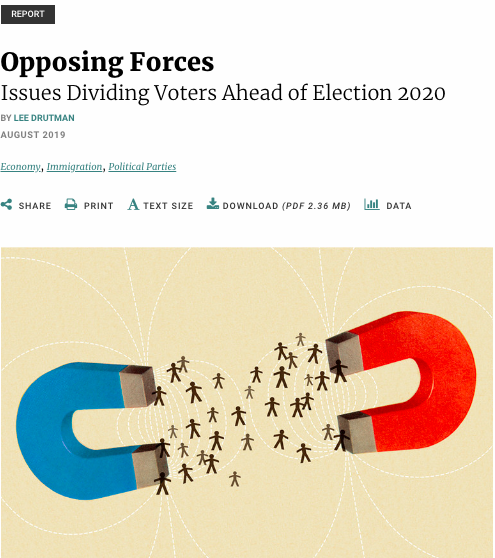
Using data from the Democracy Fund Voter Study Group 2018 and 2019 VOTER Surveys (Views of the Electorate Research Survey), this report maps the electorate along two dimensions — economics and immigration. This offers new insights into how the electorate has shifted since the 2016 presidential election and how different issues and party strategies could impact the 2020 presidential election.
Key Findings
View and download the paper here.
Senior Fellow, Political Reform Program