City of Brotherly Love, Sisterly Work

Philadelphia
makes just about every top 10 list these days, from the positive (food and
beer) to the negative (crime and poverty). But the category where it
might stand out the most has flown under the radar: Employment
opportunities for women.
Philadelphia
is the only city among America’s 10 largest where women comprise more of the
external workforce than men. They not only outnumber men in fields
traditionally strong for women, like education and health, but also in law and
business/finance.
But a
majority isn’t everything. While more women are working than men in many of
Philly’s most desirable job categories, they still lag behind in salaries, and
minority women are far less likely to attain high-paying or management jobs as
white women.
Why Philly
has a majority female labor force
Philadelphia
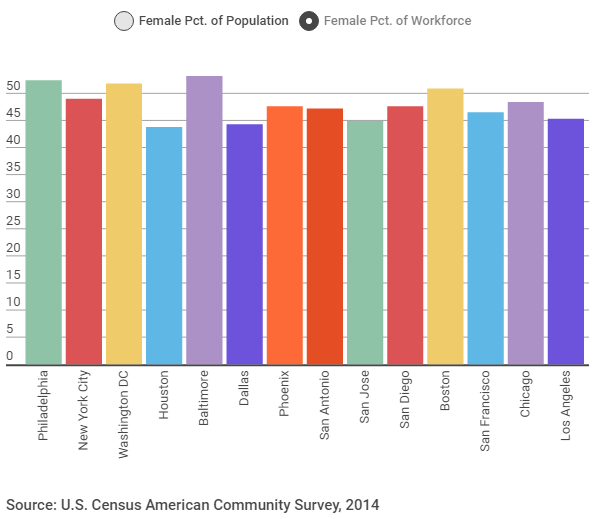
is unlike the rest of America’s 10 biggest cities in that women comprise a
majority of the workforce here, at 52.4 percent. This isn’t just because
Philadelphia has a majority population of women. Most of the other cities do,
too, as well as smaller East Coast cities like Baltimore, DC and Boston.
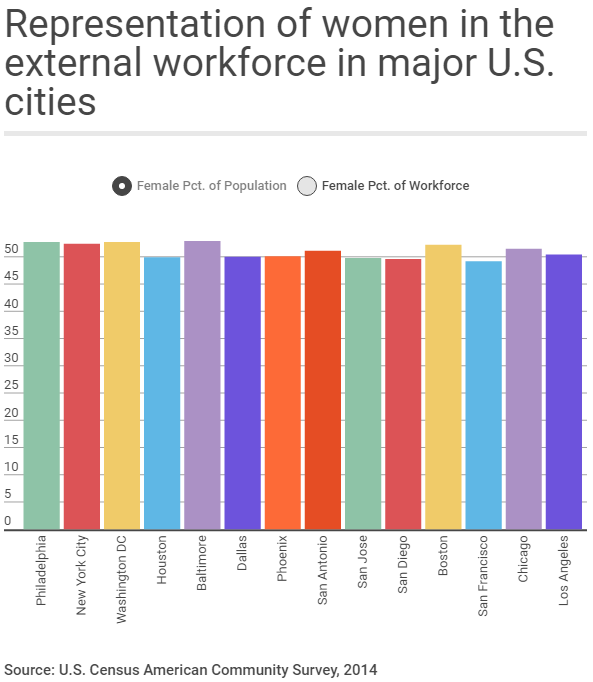
But of
these 14 cities, only Baltimore and Washington DC join Philly in
having majority women workforces. And only Baltimore has a percentage of
women that work exceeding the percentage of women in the overall population.
Philadelphia is next-closest, with women making up .3 percent less of the
external workforce than they do of the total population.
One
reason for the high number of working women is the local economy. Eds
and Meds run Philly. About 38 percent of the city’s jobs—from doctors to
nurses to janitors at hospitals or universities to college professors—fit
into this category. DC and Baltimore also have sizable Eds and Meds
sectors.
But
Eds and Meds aren’t the lone reason. The Census delineates most
high-paying jobs, ranging from some health professions to finance to engineer
under the category “management, business, science and arts
occupations.” Nationally, women hold about 52 percent of these jobs.
In Philadelphia, their share is 57.5 percent.
Even
in fields that tend to feature more men, Philadelphia has a greater share of
women than most other big cities. In the subcategory of finance, management and
business, for instance, women represent 46.9 percent of the total share. In
Philadelphia, they represent a majority, at 51.6 percent. Their share in legal
occupations is 55.6 percent, compared to 51.2 percent in New York City.
Debbi
Casey, assistant Professor of Human Resource Management from Temple
University’s Fox School of Business, suspects it might have to do with a
culture that has better embraced women as they started joining the external
workforce in higher numbers. Philadelphia has had a majority female workforce
for a long time now (the share of women has been between 51 and 53 percent the
last decade). Casey notes that Philaworks pegs the number
of woman-owned firms at just over 40,000—not far behind the men-owned firms,
at about 55,000.
Race
and gender
As
described above, Philadelphia has a greater share of women working in the
most lucrative and prestigious careers than many other big cities. The bad news
for Philadelphia is that black and Hispanic women attain those jobs—the “management,
business, science and arts occupations”—at a much lower rate than white and
Asian women.
Here’s
what the percentage of employed women working in that category of job looks
like for each major race or ethnicity in Philadelphia:
- White: 49 percent
- Asian: 41 percent
- Black: 31 percent
- Hispanic: 30 percent
The
share of Hispanic women working in these types of jobs in Philadelphia is
slightly above the national average but the same as it was here in 2005. The
share of black women in “management, business, science, and art occupations” is
below the national average of about 35 percent and 1 percent less than it was
in Philadelphia in 2005. So things haven’t improved in recent years.
The
wage gap
“Just
because it’s women dominating,” says Casey, “doesn’t mean it’s changed.”
Casey
is certainly right as it pertains to median salaries for women in Philadelphia.
Despite accounting for a majority of the external workforce and holding many
prestigious jobs, the median earnings for employed Philadelphia women in 2014
were $29,816, according to the Census. For men, median earnings were $35,599.
The gap is much smaller than the national average—about $40K for men and $28K
for women.
“People
who don’t believe employers are doing anything wrong typically cite women
go into lower paying jobs maybe because they’re family-friendly or don’t
require as much education,” Casey said. “That trend can’t be true for
Philadelphia because the women are participating at these highly trained jobs
of management and education and health care.”
Casey
said firms should be doing more wage audits, and women should be more willing
to negotiate salaries at the beginning of their careers.
“I
teach negotiation class and I asked women and men who has negotiated before,”
she said. “The women—almost every woman—was like, ‘meet a number I can live
with that’s great.’ Men are like, ‘that’s always just the start of the
conversation.’ We’re not teaching our own students to negotiate their first
salary.”
This story originally appeared in BillyPenn.
More About the Authors
Related

From Momentum to Maturity

Community College Presidents and Trustees Invited to Complete National Survey on Economic Development

Public Comments on DOL’s Independent Contractor Rule