Utilizing Women in Tomorrow’s Wars
Recruiting
and training the best soldiers possible to thrive in the face of challenging
and often unforeseen circumstances should always top any wartime military’s
priority list. But until recently, American women were officially barred from combat,
which restricted their training options and prevented the U.S. military from
accessing their broad range of skills—including but not limited to their gender.
The full integration of women into combat roles could potentially fulfill a pressing
need for new exceptional talent in the military.
“Our
talents aren’t being used to the best benefit of ourselves or the military,” acknowledged
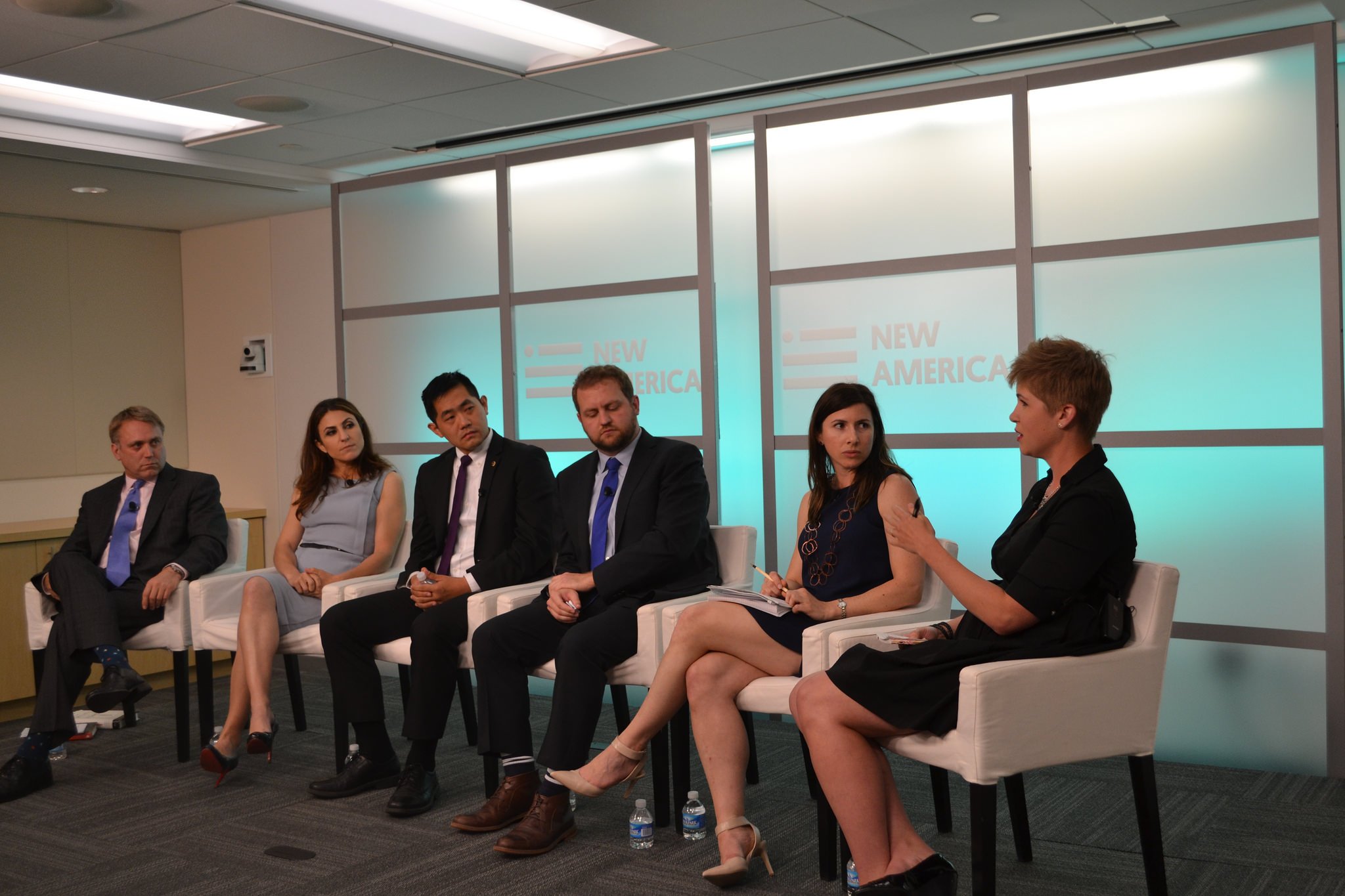
Jennifer Hunt, Civil Affairs NCO at the Truman National Security Project. Hunt,
along with other former service members—Alex Horton, Sebastian Bae, and
Elizabeth Verardo—spoke at a recent event at New America about their
experiences as (and with) women in combat.
In
2010, the U.S. Special Operations Command created Cultural Support Teams
(CSTs), a pilot program that aimed to fill the talent gap by putting women on
the battlefield alongside Special Forces. Gayle Tzemach Lemmon chronicles one
all-female team’s experience in this program in her new book Ashley’s War: The Untold Story of a Team of
Women Soldiers on the Special Ops Battlefield.
According
to Lemmon, who is a senior fellow at the Council on Foreign Relations and was
also part of the conversation, “This story starts with some of the most
seasoned Special Operations community leaders asking themselves, ‘how do we win this war without women?’” Lemmon
wrote Ashley’s War as a story that
would remind people about the stakes of the men and women who fight America’s wars and help expand the stereotypically
masculine image of heroes.
The
prevailing conclusion drawn by the leading service members was that in the
Afghan and Iraq wars, women were an untapped asset because they have the innate
capability to operate in spaces where men cannot. “In a conservative
traditional country like Afghanistan,” Gayle emphasized, “you needed women to
talk to other women.” In a war fought amongst the people, women often hold
critical intelligence about the movements and whereabouts of insurgents;
sometimes they even hide weaponry on their person because they know they won’t
be searched.
This
concept wasn’t a novel idea. As foreign men, soldiers often experienced
difficulty navigating gender relations to retrieve information from women on
the ground.
“When
I was trying to get information from women,” recalled Horton, a former U.S.
Army infantryman, “there was a whole segment of the population that we couldn’t
talk to. We just didn’t have women on our side.” During a fifteen-months tour,” Horton pointed
out, “I went on patrol with two women the entire time – two people who could
talk to women. I encountered probably hundreds of women who could have helped
us, but it [the opportunity to engage with them] was lost forever.”
Some
units mitigated this issue internally, ignoring policy and bringing women on
night walks with them. Through her description of how women are secretly taken
on missions, Hunt revealed that because women don’t have the proper training
for these missions, their safety was potentially at risk.
“I
know as a civil affairs person in Afghanistan, I was grabbed by our infantry
element that we supported,” she remembered. “He was just like, ‘hey, you’re
going with us, you’re going to search these women.’” “I thought I was building
schools and police stations,” joked Hunt about the difference between her
mission on the books and her duties on the ground.
Hunt’s
experience was common and shows that keeping women out of combat roles formally
did not prevent them from being used as resources on combat missions. On the
contrary, all it did was prevent them from receiving the proper training to be
able to conduct those missions safely and with equal expertise with their male
counterparts.
Though,
as Hunt pointed out, women were able to prove their significance inside and
outside of CST programs, their contributions to the unit were not always
welcome.
Reflecting
on an incident that occurred while deployed to Ramadi, Former Sgt. Squad Leader
of the U.S. Marine Corps Sebastian Bae described the challenges women face in programs
like CST that expose women to traditionally male-only missions, where they are
often treated as liabilities rather than assets.
When
women arrived to his unit in Iraq, the men were warned by an officer in the
presence of their staff sergeant to treat the incoming women as any other Marine.
Once the officer left the room, however, Bae’s staff sergeant delivered a
different message.
“Don’t
interact with these women,” he instructed, according to Bae. “Don’t talk to
them. Don’t be in the same room. Don’t ever have a closed door. Talk to them if
you need to, but only business. If they come up to you to talk about something
social, leave,” Bae recalled. To Bae, the implication was that the women would
be a distraction to the male soldiers and socially engaging them could
potentially expose the unit to allegations of sexual harassment.
Bae’s
anecdote, as well as the experiences shared by the other event speakers, is the
opposite of the inspiring experiences of
the women depicted in Lemmon’s book. While Ashley’s
War tells a story of combat, camaraderie, and unit cohesion, the
experiences of women in these programs—as the discussion among the panelists
indicated—varied widely.
“We
had a post-wide mentorship group for everyone in Jalalabad, and we invited
these women that were part of CST teams that were working with one of the
special operations teams,” Captain Elizabeth Verardo remembered. “We asked
them, so what’s it like, do you guys get
to go out a lot? Frankly, they had mixed reviews in terms of their
utilization.”
Despite
the variations in experience reported by women and the men who serve alongside
them, the question how women should enter combat isn’t going away. Recently, the
military conducted several experiments to test the level to which women should
be integrated into combat roles in compliance with a 2013 order by former
Defense Secretary Leon Panetta amending DOD’s Direct
Combat assignment Rule (DGCAR) that bars women from direct
combat missions. According to this amendment, gender restrictions to combat
units must be eradicated by January 1, 2016, unless the services are able to
justify an exemption.
One
theme that emerged from the discussion was the possibility that the issue of
women in combat—because dialogue surrounding the debate is highly
politicized—is being framed the wrong way. The discussants seemed to agree that
rather than being about gender, the conversation should be about equipping our
military with the tools to fight future wars.
Horton
said it best, acknowledging about women in combat that “this is a national
security issue – to draw women in.” If the military doesn’t find a way to
integrate women into combat, he continued, “we are going to get further and
further away from that talent pool. If we can’t figure out how to utilize
people to the best of their ability, we’re always going to be playing catch-up.”
More About the Authors
Related

Q&A with Andrew Frederick: Transforming the Construction Industry Using Natural Materials
Confronting Harmful Federal Disability Policy in Health and Human Services

Federal Early Education Update: March 2026