Beyond the “Peaceful” Protest
The largest march in United
States history brought joy, catharsis, and civic pride to the streets
after a sharply contested election shaped by widely recognized misogyny.
The mere act of acknowledging gender-based oppression—and celebrating
solidarity with the women who shoulder it—was intensely gratifying for the
swelling crowd. Millions of people seemed to be saying to and with women, “We
see you. We hear you. And you are important.” The march was lauded as a symbol
of the rights our nation was founded on.
But did you notice something?
For protesters and media alike,
the clearest marker of the march’s success was that it proceeded peacefully and
its supporters seemed to hope that it would set a standard for the next four
years. The new administration has already been rocked by nationwide and
international protests, not once but twice, in its first ten days. It seems all
too likely that the trend will continue. But should that be the way we
categorize protesters? Into easy groups—peaceful and not, worthy of our respect
and not?
A tweet from NBC Washington noting that not a single protester was
arrested at the Women’s March on Washington received close to ten thousand
retweets. Portland police tweeted, “Thank you to everyone who came for #womensmarchpdx today in
what was easily one of the largest marches ever in Portland. 100% peaceful.” A
post on the TwoXChromosomes subreddit, “Biggest protest in U.S. history was peaceful,
non-violent, positive”
has surpassed 44,000 upvotes, coming in at fourth for the top posts of 2017. Photos of law enforcement officials wearing the iconic pink beanies,
high-fiving protestors spread like wildfires, signaling a solidarity that marks
a sharp about face from other images of the police that we’ve seen in recent
years. Barely implicit in these and the thousands of other self-congratulatory
posts was a message, loud and clear: Unlike those other protests, we
were peaceful.
That’s all fine, and probably,
in the moment, a tactical attempt to get ahead of the likely pushback narrative
from conservative-friendly media outlets and social media, that they were
“riots.” But, pay attention to the strategic risk of that tactical move.
Given our justice system, an
institution built on institutionalized racism, a peaceful protest is not
typically about the actions of the protestors, but about what they’re
protesting, how much the system feels it has to lose.
Recent experience has taught us
this lesson again and again. We learned it in Ferguson, when, for the first
time, Amnesty International was deployed within the United States to observe
police response to protestors (finding evidence of human rights concerns in the process). We learned it in
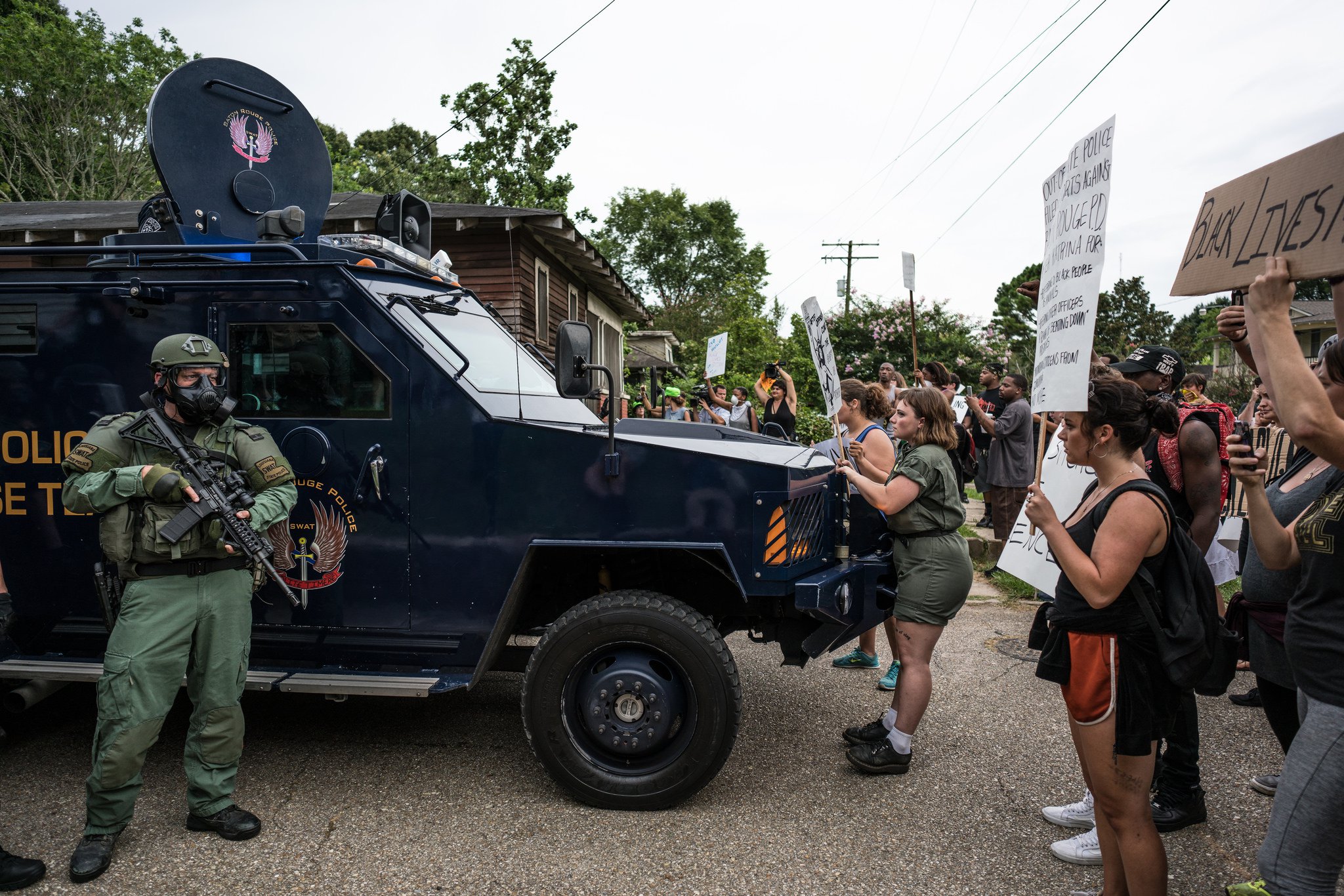
Baton Rouge, when in the aftermath of the shooting of Alton Sterling, a photo of an unarmed 28-year-old Ieshia Evans being swarmed by police in riot
gear took the country by storm. We learned it when protestors in Seattle and Los Angeles organized against President Trump’s visa restriction face-offed
against police. And we should have learned it decades ago in Selma, when
protestors were met with the force of Alabama state troopers and an officer
fractured Rep. John Lewis’ skull with a baton.
Lewis’ story is an important
one, not least of all because we still seem unable to conceptualize what
exactly Lewis meant when he coined the mischievous phrase, “good trouble,” even
50 years later. Good trouble entails civil disobedience—and civil disobedience
entails disobeying the laws. It means shutting down highways and Black Friday sales, because the general public and policymakers refuse to pay
attention until they are inconvenienced. It means disrupting presidential candidates because they have yet to include you in
their platform, but will overwhelmingly rely on your vote to win. Sometimes it
even means getting arrested because apartheid was legal and the Holocaust was
legal and segregation was legal.
Legal does not mean just. Unsurprisingly, then, struggling for
justice isn’t always peaceful. Take, for example the recent protests
mobilized against President Trump’s immigrant ban from seven Muslim-majority
countries. As they had the weekend before at the Women’s March demonstrations
most of the demonstrators carried only colorful handmade signs and flags—and
yet in Seattle, protestors were pepper-sprayed and in Los Angeles they were forced to face-off against police.
Civil disobedience is too often
met with police officers in riot gear, officers armed with weapons of war
because those in power have something to lose. And as history has shown us,
civil disobedience is also met with widespread disapproval from the majority of
Americans, from the segregationists to the good-hearted liberal who just wants
to get to work. A few months before the first March on Washington Martin Luther
King Jr., who is so often quoted around this time of the year, had almost reached the regrettable conclusion that the great stumbling block in the
road towards freedom was not the Ku Klux Klan or George Wallace but the white
moderate, “who is more devoted to ‘order’ than to justice; who prefers a
negative peace which is the absence of tension to a positive peace which is the
presence of justice; who constantly says: ‘I agree with you in the goal you
seek, but I cannot agree with your methods of direct action’; who
paternalistically believes he can set the timetable for another man’s freedom;
who lives by a mythical concept of time and who constantly advises the Negro to
wait for a ‘more convenient season.’”
In an almost universal amnesia,
America seems to have forgotten that at the height of the civil rights movement, majority of the country did not support
or even approve of the tactics employed by its activists. In fact, most of
America seemed to think that shutting down highways, inconveniencing civilians
and other demonstrations (including marches) would hurt black American’s
chances of integration into the South. It would be funny if it wasn’t so
disturbing how similar that sounds to the mass disapproval the United States
holds for the tactics employed by Black Lives Matter activists. And in a
terrifying indictment of our education system, many Americans also seem to believe “rowdy protests” are fundamentally un-American and that our country was founded on calm and reasoned discourse rather than a long and bloody revolution.
Over the next four years, we
should be attuned to this history. As Vann R. Newkirk II wrote in a prescient piece for The Atlantic, “civility is not
the highest moral imperative.” When celebrities like Kristen Bell tweet to their millions of followers “angry & violent protestors
accomplish nothing,” we should ask ourselves who really profits from narratives
of peaceful protests and who is vilified for their anger. Calm and reasoned
arguments alone aren’t going to sway those in power, especially if our
situation really is as perilous as it seems to be.
We know this much: Civil
disobedience works. Decades of history prove that truth. The eight states in the country attempting to criminalize protest prove
that. The Black Lives Matter protests that produced Department of Justice
investigations—which in turn provided evidence of systematic police misconduct
in Chicago, Ferguson, Cleveland and Baltimore—proved that. To use peacefulness
and respectability as measures of a demonstration’s validity creates a mismatch
when the demonstrator is met with a pointed gun and felony charges.
More About the Author
Related

Multilingual Students with Disabilities Deserve Stronger Support

Americans Love Families. How Can We Make Better Policy For Them?
As the 2026 Midterms Approach, the Congressional Gerontocracy Continues