Imagining a New Kind of Superhero
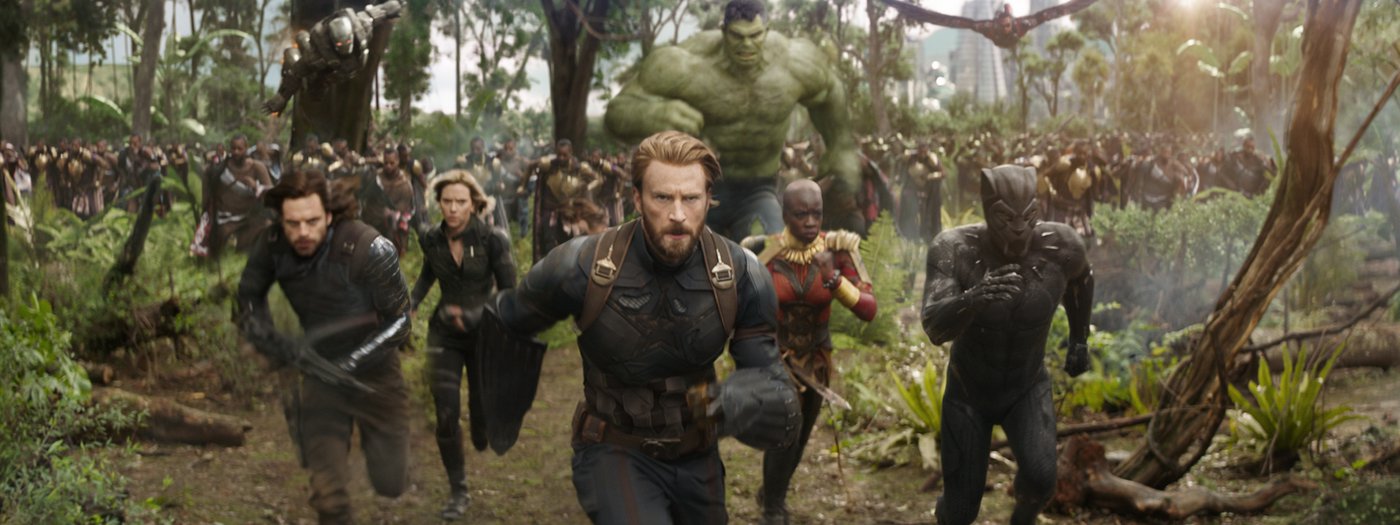
Since Black Panther took theaters by storm in February, it’s become almost impossible to imagine the Marvel Cinematic Universe moving forward without King T’Challa, the all-women military force the Dora Milaje, or the African kingdom of Wakanda. Why? For one thing, the numbers: Black Panther is only the 10th movie to gross over $1.3 billion at the box office, even surpassing the longtime crown jewel Titanic to take third place in domestic rankings (unadjusted for inflation).
But even beyond the numbers, Black Panther matters for the culture more broadly. “It is a sea-change moment,” the movie’s lead, Chadwick Boseman, told Rolling Stone in February. Black Panther isn’t only a black superhero movie, positively reinvigorating black communities across America; it’s also, more specifically, an African movie, with a strong, bold message about the continent as a beacon of hope and a model of innovation and prosperity. It’s too soon to tell how, exactly, the movie might influence audiences’ perceptions of black American and African communities, but it’s hardly a stretch to say that the movie has already resonated, profoundly, with audiences around the world whose onscreen superheroes have traditionally been lily-white.
These thoughts occupied me when I recently watched the latest addition to the Marvel canon, Avengers: Infinity War. The audience at the screening I attended cheered enthusiastically when Black Panther made his entrance into the fight to prevent the supervillain Thanos from securing the all-powerful Infinity Stones. This made me wonder: What’s preventing Hollywood’s onscreen embrace of other historically marginalized groups, including, in my case, those of Middle Eastern heritage? And how might we work toward imagining superheroes as diverse as the people they protect?
Movies and Mythology
“There’s an emerging, shared superhero mythology that isn’t exclusively American,” says Christopher Robichaud, a senior lecturer of ethics and public policy at the Harvard Kennedy School and a frequent writer on the moral and political philosophies stitched into superhero narratives. “If there’s anything the success of both Black Panther and Wonder Woman tells us, it’s that you don’t need to have white male or even strictly American superheroes.”
This, I think, is where hope lies for some minority groups in America: that with the success of these movies, they, too, may be offered a superhero with a background like theirs. First, however, there are stereotypes to shatter—stereotypes that often constrict people’s experiences both as individuals and as “othered” communities living in America.
What are these stereotypes? And what fuels them? Consider communities from the Middle East, a region whose narratives in the media and in Hollywood have largely been defined by conflict and terrorism. Both mediums are arguably complicit in reinforcing these rehashed stories. For instance, the Tyndall Report, which monitors the nightly newscasts of ABC, CBS, and NBC, shows that the vast majority of stories about the region in the 2000s focused on the Iraq war, the Israeli-Palestinian conflict, 9/11, fighting in Afghanistan, al-Qaeda, and Saddam Hussein. In 2017, the only reference to the Middle East by these networks was the war in Syria. I’m not arguing that these issues are unworthy of attention. But the Middle East is more than its problems.
Shirin Ghareeb, the deputy director of the D.C. International Film Festival, explains to me that the, “U.S. media’s focus on stories of conflict and war makes it even more challenging for Middle Eastern filmmakers to penetrate the U.S. market,” and to shift the focus toward human stories of love, life, and family. The result? You don’t have to squint to see how this lopsided portrayal of the Middle East in American news also is replicated in Hollywood. For instance, in Reel Bad Arabs: How Hollywood Vilifies a People, a 2001 book that examines how Arabs and other Middle Eastern characters are portrayed in American movies, the writer Jack Shaheen reveals that in the over 1,000 American movies he analyzed, Arabs—and Middle Easterners more generally—are hardly ever depicted as heroes. To the contrary, they’re nearly always cast as the villains—uncivilized, incompetent, and dangerous.
Indeed, film is a potent shaper of perceptions of different cultural backgrounds, particularly when it’s woven uncritically into wider social assumptions, or taps into cultural anxieties. As Shaheen notes in the documentary based on his book, “In spite of the reality, we still embrace the mythology. It is part of our psyche.”
A notable illustration of the power of mythology via film is a recent Arab News/YouGov poll, which highlights that “more than one-fifth” of Americans polled identified the fictional Sultanate of Agrabah, which appears in the classic Disney movie Aladdin, as part of the Middle East. On top of that, 38 percent, “said they would be happy with a U.S. travel ban on citizens of Agrabah” if they were deemed a “threat.” (A 2015 poll, by Public Policy Polling, found similarly horrifying results.)
In a similar vein, research by the Tufts University sociolinguists Calvin Gidney and Julie Dobrow shows that many of the villains in animated American movies have foreign accents, while most of the heroes have American ones—a trend that can send warped, harmful messages to kids about foreignness. Of course, even something as deceptively minor as a character’s accent can be used for good, too. In Black Panther, for instance, T’challa and his Wakandan compatriots all essentially have a South African Xhosa accent when they speak English. Boseman reportedly insisted on using this accent as a way to “train the audience’s ear,” so that viewers might become as attuned to an African accent as they have to Western ones.
Up Next: A Middle Eastern Superhero?
Despite all that, though, American filmmakers of Middle Eastern backgrounds tell me that they see a growing opportunity for their own superhero moment. According to Cherien Dabis, a Palestinian-American director, producer, and screenwriter, Black Panther, “opened the door for dialogue about perceptions of minorities and narrative, but also pushed the question: When is it our turn?”
The short answer: “Marvel [Studios] has so much muscle that it can do anything,” says Amin Matalqa, an L.A.-based Jordanian-American filmmaker. Both Matalqa and Robichaaud expect that the newly created Muslim superhero, Kamala Khan, known as Ms. Marvel, might show up in Marvel movies in the near future. While Kamala, of course, doesn’t represent the entire ethnic and religious diversity of the Middle East (she’s a New Jersey girl of Pakistani origin), her entrance into the market could help break corrosive perceptions of Muslim women by sending a message of acceptance not only to audiences in Muslim-majority countries, but also to members of the American Muslim community.
This isn’t to suggest that the road to more diversity is free of bumps. As Dabis notes to me, there’s more and more interest in Hollywood for stories from the Middle East, but “not necessarily in us telling these stories.” And yet, this is exactly why Dabis believes that it’s so important that filmmakers of these particular backgrounds have a hand in writing their own narratives. Take Kamala’s character, which was co-created by Sana Amanat, who, just like the heroine herself, is an American woman from New Jersey whose family hails from Pakistan.
The aim, ultimately, is that minority filmmakers will be able to harness the power of telling their own stories and, in turn, inspire the next generation of superheroes, whose accents, music, dance, attire, and other cultural traditions will be celebrated, not caricatured, by broader audiences. As Dabis puts it to me, the endgame is to secure a “seat at the cultural table,” to, “move from no voice to voice.”
More About the Author
Related
CCAMPIS Changes Put Politics Ahead of Student Parents
Five Things Principals Can Do to Protect Kindergarten’s Three Indispensables

Out of School…and Out of Luck?