Beyond Redshirting: The Case for PK-3 Alignment

Yet it’s precisely because kindergarten redshirting is such a fraught topic that we feel compelled to point out it doesn’t have to be. While necessary for some children, in many cases kindergarten redshirting is a blunt response to challenges that can be better address in other ways, namely through better pre-k access, pre-k through early elementary alignment, and more customized educational approaches.
Ultimately, kindergarten redshirting is based on two flawed assumptions: First, that there are and must be stark distinctions between preschool and kindergarten; Second, that “readiness” for school is a characteristic of the child. These two assumptions can produce the ridiculous conclusion that, when a child is lagging his peers, we should deny him access to opportunities to develop skills in the areas where he lags, rather than offering him more intensive support in those areas.
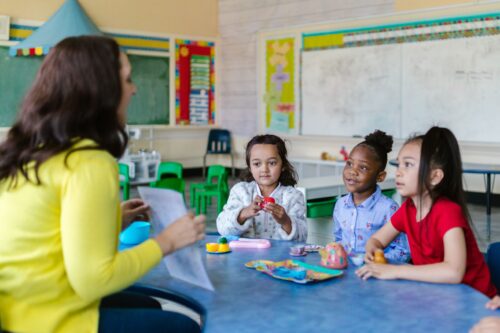
To be sure, kindergarten and pre-k aren’t identical. The skills and knowledge children are mastering at ages 3 and 4, and they way teachers convey those skills and knowledge to them, are different from, and build the foundations for, those they learn as 5-year-olds in kindergarten. But there shouldn’t be a stark divide between “pre-k” that is not school on the one hand and “kindergarten” that is school on the other. Rather, the skills and knowledge children learn in kindergarten should build seamlessly on top of those they learned in pre-k. Both pre-k and kindergarten should combine both “school-like” features—such as qualified teachers; a set curriculum focused on building children’s language, literacy, math, and social-emotional skills; and regular, developmentally-appropriate formative assessments—with “non-school” features, such as learning through play, teaching techniques that are responsive to children’s desire and interests, and a strong focus on social-emotional development rather than just academics. When pre-k and kindergarten programs are truly aligned, then the jump between pre-k and kindergarten is not as great, and “whether or not Johnny is ready” becomes less of an issue.
Of course, entering kindergarten is a bigger jolt for children who haven’t previously attended quality pre-k programs—that’s one reason we support policies that expand access to quality pre-k, which can help take the redshirting issue off the table by developing children’s skills and knowledge so that they are ready for kindergarten by age five. Schools can also help parents who want to keep their young children, by providing outreach and information that helps parents understand early childhood development and what children will be expected to learn in the kindergarten classroom.
Even with high-quality pre-k, not all children will have reached the same level of development and achievement by the time they’re scheduled to enter kindergarten. And that’s why it’s important to realize that “school readiness” isn’t just a matter of 5-year-olds being “ready” for kindergarten, but of schools being ready to support learning for the variety of levels at which children come to them. This means providing more supports for students, families, and teachers—such as ongoing professional development and mental health consultation. It also means greater customization, which goes hand-in-hand with alignment. Effective early educators and early education programs know how to tailor attention to individual children’s developmental levels and needs, even within the context of a classroom where children are achieving at very different levels. This customization can also support greater alignment, by breaking children’s academic progress down into a continuum of levels that are much more fine-grained than grades, and stretching that continuum across multiple grades, so that children progress through the levels at their own pace, but ultimately reach the end of it. Technologies that allow teachers to assess children’s learning in real time and tailor instructional approaches to where children are at also play a role here.
This raises an important point: The issues involved in kindergarten redshirting are very similar to those involved in equally contentious debates over grade retention in the early grades, and improving PK-3 alignment also provides new ways to deal with some of those challenges. In his book Building Blocks, Gene Maeroff profiles a few schools that have taken this approach to the next level, offering multi-grade classrooms and flexible groupings that allow children to take the time they need and progress and different paces in different subjects.
PK-3 alignment is far from easy. It requires changes in curriculum, instructional strategies, and how we operate schools. But ultimately it provides a better way to support children in the early grades, to address many of the challenges we face during those years, and to help keep children from falling through the cracks early on.
More About the Author
Issues
Programs/Projects/Initiatives
Related

Federal Early Education Update: September 2026

Five Things States Can Do to Support High-Quality Kindergarten and the Early Grades
Current Head Start Program Performance Standards Protect Children with Disabilities