Guest Post: The $7 Billion Question

 After the No Child Left Behind Act passed Congress in 2002, one education policy expert quipped that they should rename the Elementary and Secondary Education Act (of which NCLB is the most recent reauthorization) the Elementary Education Act, because NCLB largely ignored high schools.
NCLB’s funding and accountability requirements do focus primarily on the elementary and middle grades. Some high school reform advocates are seeking to broaden the law to more directly address the needs of high schools.
That’s not to suggest that federal policy ignores high school students entirely. In fact, the federal government spends some $7 billion every year on educational programs targeted to high-school-age youth and young adults. But the largest of these programs-accounting for 83 percent of federal investment in youth education-are outside of NCLB.
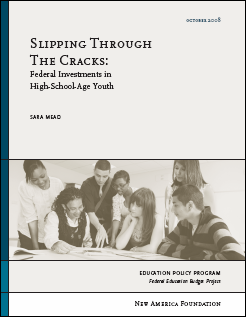
A new report from the Federal Education Budget Project, Slipping Through the Cracks: Federal Investments in High-School-Age Youth, takes a closer look at the more than 30 federal programs that support youth education and training. While many of these programs provide worthwhile services to at-risk youth and young adults, these investments are generally less effective and efficient than they could be. Specifically, the report identifies four areas of concern.
First, no dedicated federal funding stream exists to support high school reform efforts specifically. While the federal government invests in a variety of youth centered programs, few of these programs directly provide high schools with resources to support reform. Programs that could provide such support often have limitations that prevent them from being effective drivers of a national high school reform agenda.
Second, federal investments are not aligned with high school reform priorities. In the past decade, a national high school reform movement has emerged that focuses on reducing dropout rates and raising the level of rigor in high school coursework to prepare graduates for college. Current federal investments in high-school-aged youth focus primarily on preparing students for the workforce and providing second chance education. As such, they are ill-aligned with the current goals of high school reform.
Third, while federally funded programs such as Job Corps and the Workforce Investment Act provide a critical safety net for youth and young adults who slip through the cracks in our public education system, that safety net is frayed. At best, these programs serve only a third of the young people who need them.
Nor do we target resources effectively to prevent students from slipping through the cracks to begin with. The federal government currently spends more on services to help students whom the existing system has failed than it does to improve high schools and prevent that failure to begin with. In the long run, an emphasis on prevention will produce better results for both taxpayers and young people.
The report also offers four policy recommendations to address these challenges:
- Create a federal funding stream for high school reform and improvement that will reduce the need for costly and only modestly effective remedial services later, either by increasing federal Title I money and ensuring high schools get their fair share, or by rethinking the Perkins Career and Technical Education program.
- Improve the efficiency and effectiveness of educational safety net programs for out-of-school youth and young adults.
- Help high school reformers, local school districts, and community-based providers working on high school reform goals gain access to funding streams for youth education and training.
- Eliminate or overhaul ineffective programs and those that do not focus on national priorities.
Ultimately, an aggressive federal role in advancing high school reform will require both increased spending on this age group and redirection of existing resources from less to more productive uses. This new report provides a roadmap for policymakers embarking on this course.
Sara Mead is a Senior Research Fellow in the Education Policy Program and Workforce and Family Program at the New America Foundation.
More About the Authors
Issues
Related

Unraveling the Case for Credentials in High School

Launching a Torrent of Youth Apprenticeships in Florence, Alabama

The Rural Advantage—and Challenge—with Workforce Pell