Guest Post: Building Up the Federal Role in Supporting Education Innovation

In recent history, public education has been largely immune to innovation. The basic structure of public education today is much as it was several generations ago. Despite the increasing demands of global competition and student diversity, there has been little innovation in the core of teaching and learning.
In a recent paper published by the Brookings Institution’s Metropolitan Policy Program, Andrew J. Rotherham and I examine why education has remained largely insulated from innovation and what the federal government can do to create a new culture of innovation in education.
We conclude that this lack of innovation is due, in part, to a lack of funding for educational research and development (R&D) that can generate transformative innovations like those we’ve seen in other sectors. Most funding for educational R&D comes from the federal government. Yet the U.S. Department of Education spends barely one-half of one percent of its budget on R&D. And it invests much of that funding in educational statistics or conducting randomized controlled trials, not in developing new effective models for teaching and learning.
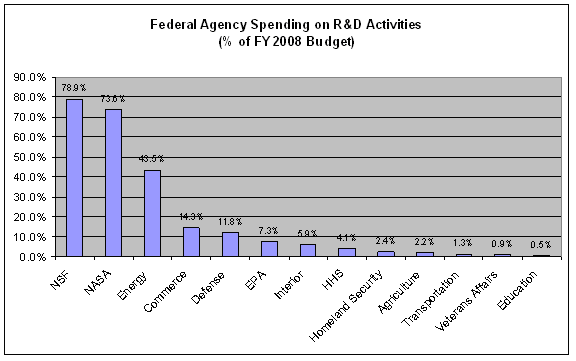
Similarly, the federal Office of Innovation and Improvement (OII), which was designed to support educational innovations, has had limited impact. Although OII controls a budget of nearly $1 billion, much of that money is dedicated to small, competitive programs that are neither innovative nor effective, and are not aligned with national education priorities. Further, nearly $160 million in OII funding is tied up in Congressional pet projects. Some OII programs-including the Teacher Incentive Fund and federal Charter School Grants program-have been successful in supporting educational innovation, but even these successes have been modest.
Lack of R&D funding isn’t the only obstacle.
Over the past two decades, a new generation of “educational entrepreneurs” has emerged, working outside the existing public education system to create new nonprofit or for-profit organizations that solve educational problems in innovative ways with potential for large-scale, system-wide impact. The most successful educational entrepreneurs, such as Teach for America’s Wendy Kopp and KIPP charter schools founders Mike Feinberg and Dave Levin, have produced impressive results at a national scale.
But the impact of educational entrepreneurs has been muted by three major challenges: 1) Laws, policies, and practices that prevent entrepreneurs from entering the field or competing on an even playing field with existing providers; 2) Lack of capital to launch or expand entrepreneurial organizations; and 3) A shortage of talented human capital.
The federal government can and must increase support for educational innovation and address the challenges facing educational entrepreneurs. To do this, it must: Help bring successful educational entrepreneurs to scale; Invest in developing the next generation of transformative educational innovations; Work to eliminate barriers to entry that prevent the expansion of educational entrepreneurship or the adoption of innovative educational practices.
To carry out these activities, we argue for a new, quasi-independent Office of Educational Entrepreneurship and Innovation (OEEI) that will advance a culture of entrepreneurship and innovation within the Department of Education. OEEI would operate a Grow What Works Fund to work with philanthropy to invest in scaling up entrepreneurial ventures with a demonstrated track record of success. OEEI would also fund an Education Innovation Challenge to invest in high-risk, potentially high payoff educational innovations.
Some critics have argued that our proposals are unrealistic-that the federal government can’t play a meaningful role in encouraging states and local governments to eliminate barriers to educational innovation. There are limits to federal power here. But the federal government also has numerous policy levers that it could use to incentivize changes in state and local policies. OEEI could collaborate directly with other parts of the Department to create those incentives. Moreover, OEEI could be a valuable partner to the growing number of states and districts that are seeking innovative solutions.
Both the Democratic and Republican presidential nominees have expressed support for increasing educational entrepreneurship and innovation. The current fiscal crisis should make these ideas even more appealing. While many proposals to improve federal support for education, such as fully funding NCLB or expanding access to universal pre-kindergarten, are quite expensive, supporting innovation could be done relatively cheaply. In fact, if policymakers redirected resources from existing earmarks and ineffective programs, our recommendations could be implemented with almost no new federal spending.
Public education may be behind the game when it comes to innovation, but it doesn’t have to stay that way. These proposals are a first step towards a more innovative public education system.
Sara Mead is a Senior Research Fellow in the Education Policy Program and Workforce and Family Program at the New America Foundation.
More About the Authors
Issues
Related

Public Comments on DOL’s Independent Contractor Rule

Unraveling the Case for Credentials in High School

Launching a Torrent of Youth Apprenticeships in Florence, Alabama